TagEnvironmental Impact Statement(400)
-
 1997-03-19
ACC Comments on Draft Supplemental EIS for Proposed Master Plan Update March 19, 1997
Comments submitted by the Airport Communities Coalition—comprising the cities of Burien, Des Moines, Federal Way, Normandy Park, Tukwila, and Highline Public Schools—on the Draft Supplemental Environmental Impact Statement for the proposed Master Plan Update Development Actions at Seattle-Tacoma International Airport. The document was prepared by Cutler & Stanfield, L.L.P. as counsel to the coalition, in -
 1997-03-01
Why the Port Of Seattle’s 3rd runway EIS fails adequately to examine impacts to wetlands and prescribes inadequate mitigation
This 1997 document argues that the Port of Seattle's Environmental Impact Statement (EIS) for a proposed third runway at Sea-Tac Airport inadequately examines impacts on wetlands and fails to prescribe sufficient mitigation measures. It contends that the FAA and Port must meet federal and state legal requirements — including Section 404 of the Clean Water Act and Washington's Growth Management Act — before any construction affecting wetlands can proceed. The document asserts that the EIS does not consider a broad enough range of alternatives, making it legally insufficient as a basis for approving the runway project. -
 1997-02-01
Sea-Tac International Airport Impact Mitigation Study: Initial Assessment and Recommendations — Section 9, Potential Socio-Economic Impacts and Mitigation
A 1997 study commissioned by cities and institutions near Seattle-Tacoma International Airport found that airport operations depress nearby property values compared to similar homes elsewhere in King County, and that properties directly under flight paths suffer additional losses from noise, visual pollution, and reduced quality of life. Researchers compared single-family homes around Sea-Tac with comparable homes in Northwest King County (Shoreline area), using strict criteria to ensure fair comparisons. The study notes that while overall regional growth means nearby home values may still rise over time, they appreciate more slowly than they would without the airport's presence. -
 1997-01-01
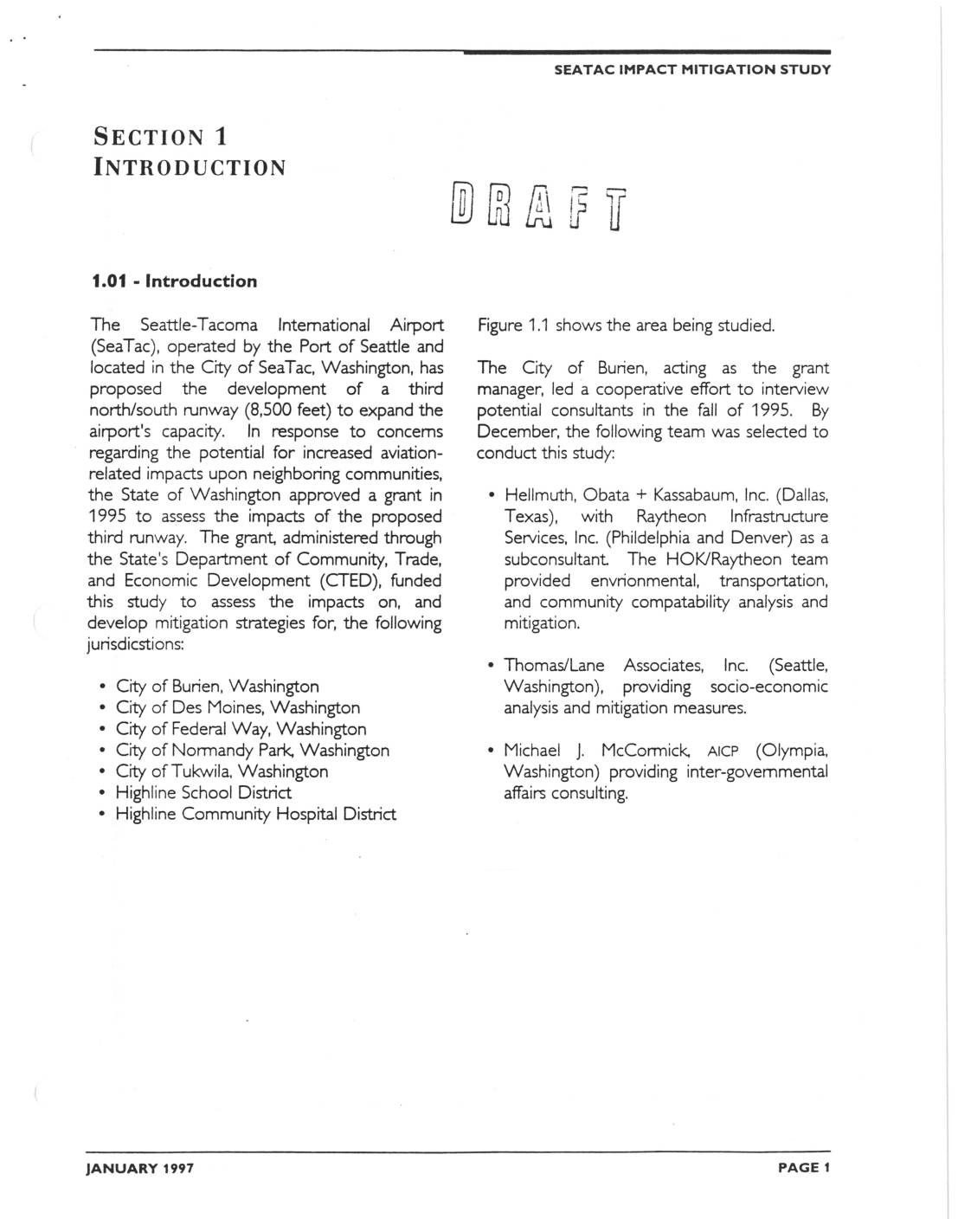
Sea-Tac Impact Mitigation Study: Section 1 Introduction and Section 1.02 Project Scope
This 1997 draft study assessed the potential environmental, transportation, and socioeconomic impacts of a proposed third runway at Seattle-Tacoma International Airport on five neighboring communities—Burien, Des Moines, Federal Way, Normandy Park, and Tukwila—as well as the Highline School District and Highline Community Hospital District. Funded by a Washington State grant administered through the City of Burien, the study was conducted by a team of consultants and aimed to develop mitigation strategies and funding mechanisms to address impacts on affected jurisdictions. The report reviewed the Port of Seattle's Environmental Impact Statement and proposed independent mitigation measures, while expressly prohibited from being used to oppose the runway's construction. -
1997-01-01
Sea-Tac Impact Mitigation Study: Section 1 Introduction and Section 1.02 Project Scope
Draft introduction and project scope section of the SeaTac Impact Mitigation Study, January 1997, funded by a State of Washington grant administered through the Department of Community, Trade, and Economic Development (CTED) and managed by the City of Burien. Assesses impacts of the proposed Seattle-Tacoma International Airport third runway (8,500 feet) on five communities — -
 1997-01-01
Considering Cumulative Effects Under NEPA (Executive Summary)
A handbook by the Council on Environmental Quality providing framework and methods for analyzing cumulative effects in environmental assessments and impact statements under NEPA. The document outlines principles, steps, and data sources for cumulative effects analysis but does not establish new legal requirements. -
 1996-12-18
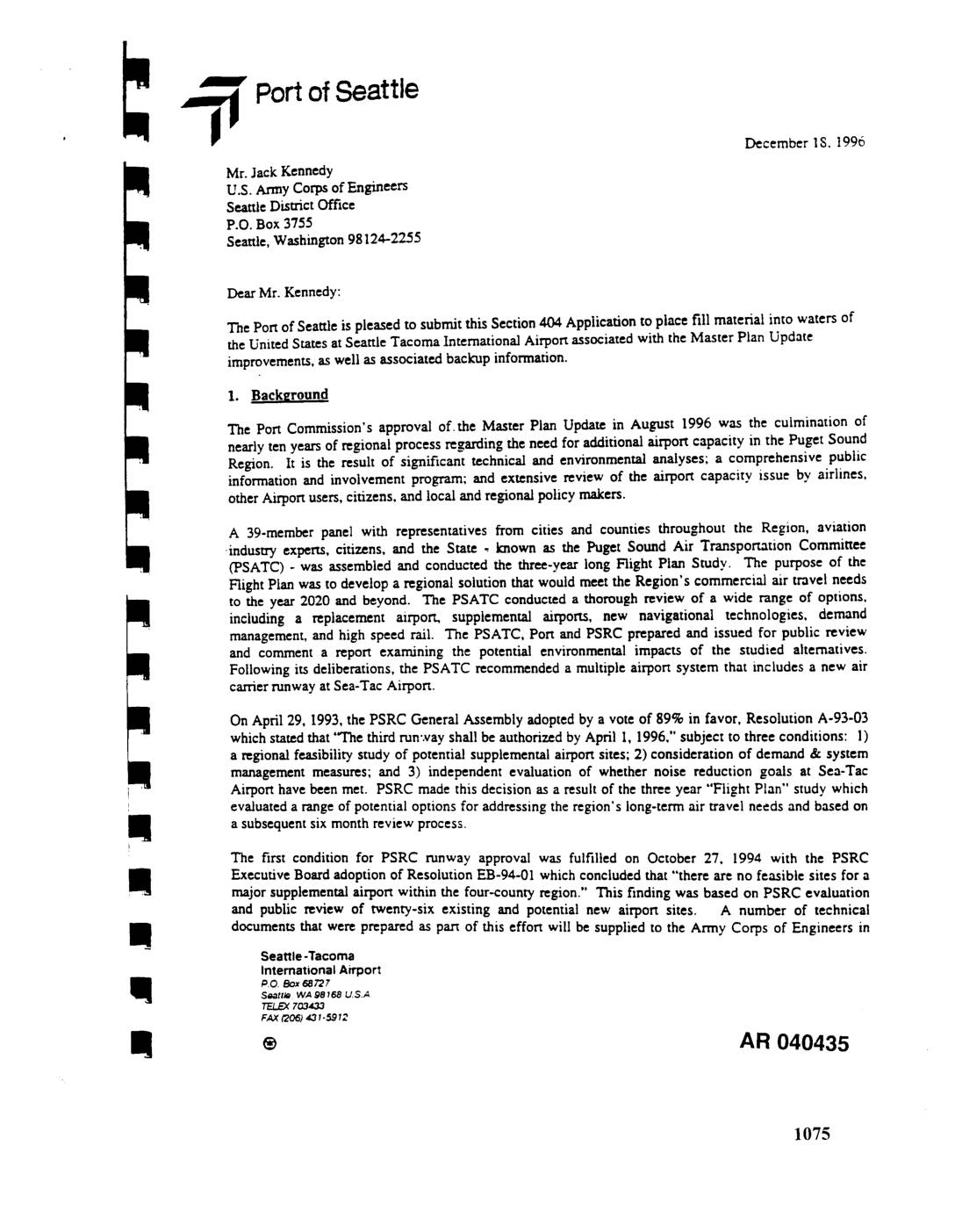
EXH AR040435: Port Of Seattle Section 404 Application Letter — Third Runway Master Plan Update
Letter dated December 18, 1996 from Barbara Hinkle, Senior Environmental Specialist, Port Of Seattle, to Jack Kennedy, U.S. Army Corps of Engineers, Seattle District Office, submitting a Section 404 Application to place fill material into waters of the United States at Seattle-Tacoma International Airport associated with the Master Plan Update. Covers background on the Puget -
 1996-12-18
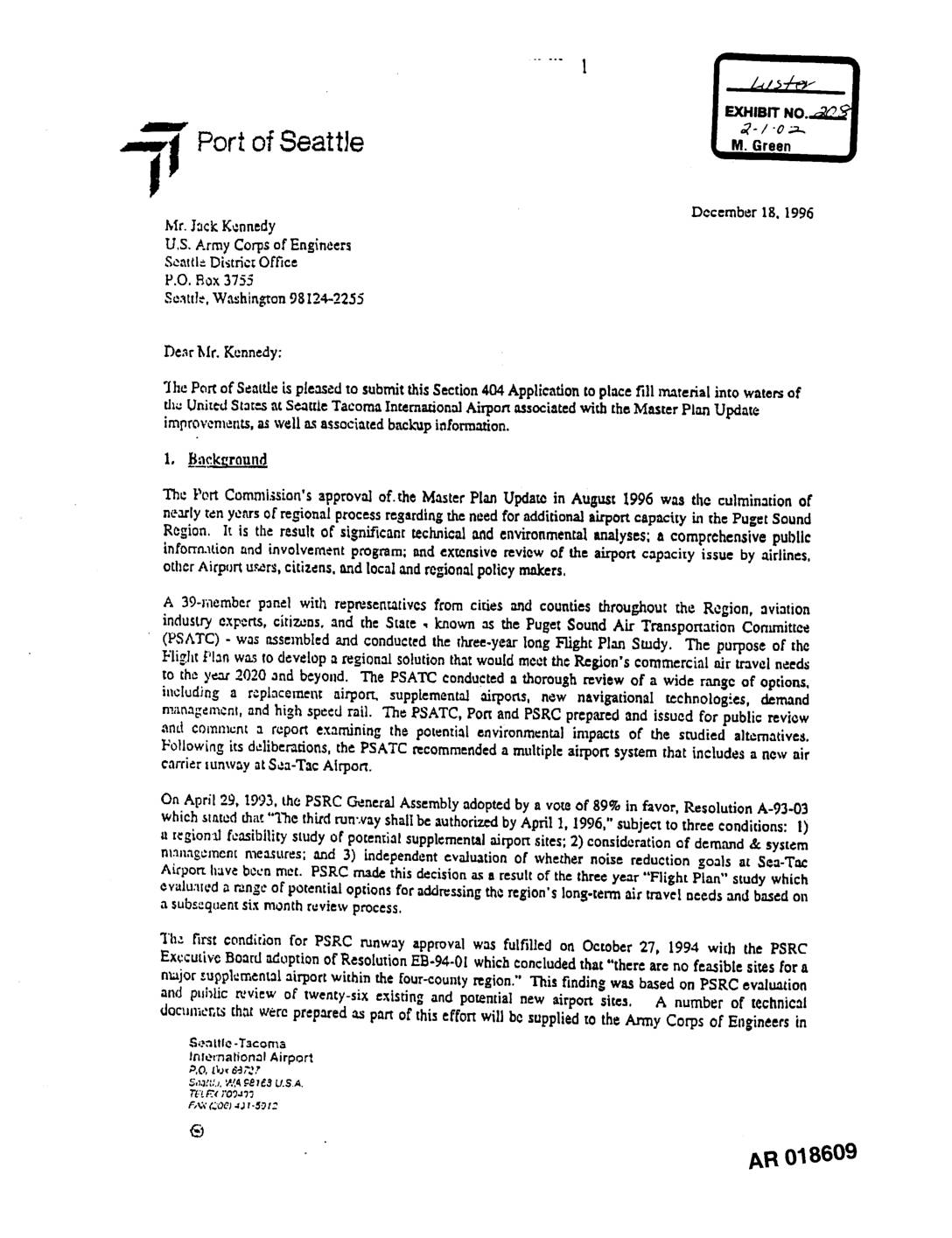
Exhibit 208: Port Of Seattle Section 404 Application Letter — Third Runway Master Plan Update Wetland Fill, Sea-Tac Airport
In December 1996, the Port of Seattle submitted a Section 404 permit application to the U.S. Army Corps of Engineers to place fill material into wetlands at Seattle-Tacoma International Airport as part of its Master Plan Update, which included construction of a third parallel runway. The proposed runway, located 2,500 feet west of the existing runways, was intended to address severe arrival delays during poor weather conditions, which reduced airport capacity from 60 to as few as 24 arrivals per hour roughly 44% of the year. The application was the result of nearly a decade of regional planning, environmental review, and public involvement, including studies confirming that no feasible supplemental airport sites existed in the four-county region. -
 1996-12-01
EXH AR040251: JARPA Application for Proposed Master Plan Update Improvements at Seattle-Tacoma International Airport
JARPA (Joint Aquatic Resources Permit Application) and Section 404 application submitted by Port Of Seattle to the U.S. Army Corps of Engineers (Jack Kennedy, Seattle District Office) in December 1996, prepared by Parametrix, Inc. Requests authorization to place fill material into waters of the United States at Sea-Tac Airport associated with the Master Plan Update -
 1996-12-01
Miller Creek Relocation Plan for Proposed Master Plan Update Improvements at Seattle-Tacoma International Airport
This 1996 plan by Parametrix, Inc. outlines the proposed relocation of Miller Creek to accommodate expansion improvements at Seattle-Tacoma International Airport. It assesses the creek's existing ecological conditions—including fish habitat, hydrology, and riparian vegetation—and identifies the construction impacts the relocation would cause. The document then presents mitigation goals, site selection rationale, and engineering details for redesigning the creek channel to offset environmental impacts.