TagEnvironmental Impact Statement(400)
-
 1979-04-12
Initial development of the Westside General/Corporate Aviation Facility, Sea-Tac International Airport: Final environmental impact statement
This April 1979 Final Environmental Impact Statement, prepared by the Port of Seattle's Planning and Research Department, evaluates the proposed initial development of a general and corporate aviation facility on the west side of Sea-Tac International Airport. The document was issued in compliance with Washington State's Environmental Policy Act of 1971 and incorporates findings from an earlier 1977 EIS related to a Weyerhaeuser corporate aviation facility on the same site. It was distributed to government agencies, citizen groups, and interested individuals to assess the environmental effects of the proposed development. -
 1978-03-09
Final Environmental Impact Statement for the Proposed Boeing Company Corporate Headquarters Facility
Final Environmental Impact Statement (EIS) prepared by King County Department of Planning and Community Development and Port Of Seattle Planning and Research Department for the proposed Boeing Company Corporate Headquarters Facility. The project site lies on the western boundary of Sea-Tac International Airport, east of 12th Avenue South, between approximately South 166th Place and South -
1978-03-09
Final Environmental Impact Statement for the Proposed Boeing Company Corporate Headquarters Facility
This March 1978 Final Environmental Impact Statement, prepared jointly by King County and the Port of Seattle, evaluates the proposed construction of a Boeing Company Corporate Headquarters Facility on the western boundary of Sea-Tac International Airport. The project required zoning reclassification, community plan amendments, and various permits for a site located east of 12th Avenue South between South 166th Place and South 173rd Street. The document was prepared under the Washington State Environmental Policy Act (SEPA) and related county regulations. -
 1978-02-06
Background report on Concorde flight operations
This 1978 background report, prepared for the Washington State House of Representatives, examines the potential impact of allowing Concorde supersonic jet flights at Seattle-Tacoma International Airport (SeaTac). It finds that even one Concorde flight per day would expose an additional 1,000 residents to severe aircraft noise and could increase the Port of Seattle's property acquisition costs by $10–15 million. The report also explores the legal boundaries of airport noise regulations following a landmark court case that affirmed airport proprietors may set their own noise rules, provided those rules are reasonable, non-arbitrary, and non-discriminatory. -
 1977-12-09
Highline Communities Plan: Final Environmental Impact Statement
Final Environmental Impact Statement (EIS) for the Highline Communities Plan (HCP), prepared by King County Department of Planning and Community Development, Division of Planning, Room W-217, King County Courthouse, Seattle, WA 98104. Responsible Official: Karen Rahm, Manager; Principal author: Dave Baugh. The proposed action is adoption of a Community Plan and Area Zoning for Highline, -
1977-12-09
Highline Communities Plan: Final Environmental Impact Statement
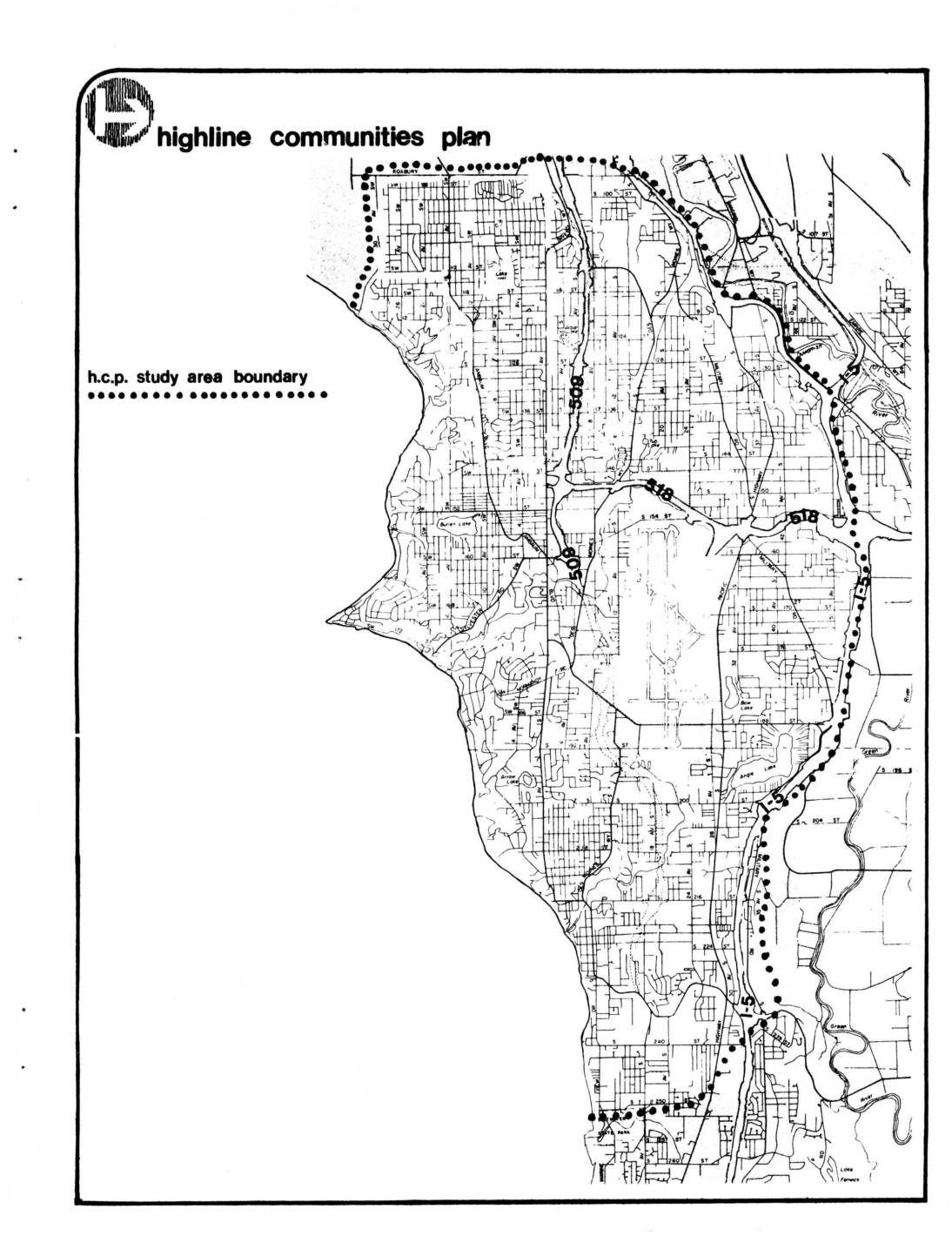
The Highline Communities Plan (HCP) is a King County land use and zoning proposal covering the area between Puget Sound and Interstate 5, from the City of Seattle south to South 252nd Street, including Des Moines and Normandy Park. Prepared by the King County Department of Planning and Community Development and issued in draft form in April 1977, the plan was intended to guide land use policy, area zoning, capital improvements, and housing programs for the Highline Communities Planning Area. Upon adoption, it became the official county policy framework for this coastal suburban region located adjacent to what is now Sea-Tac Airport. -
 1977-04-29
Highline Communities EIS Draft
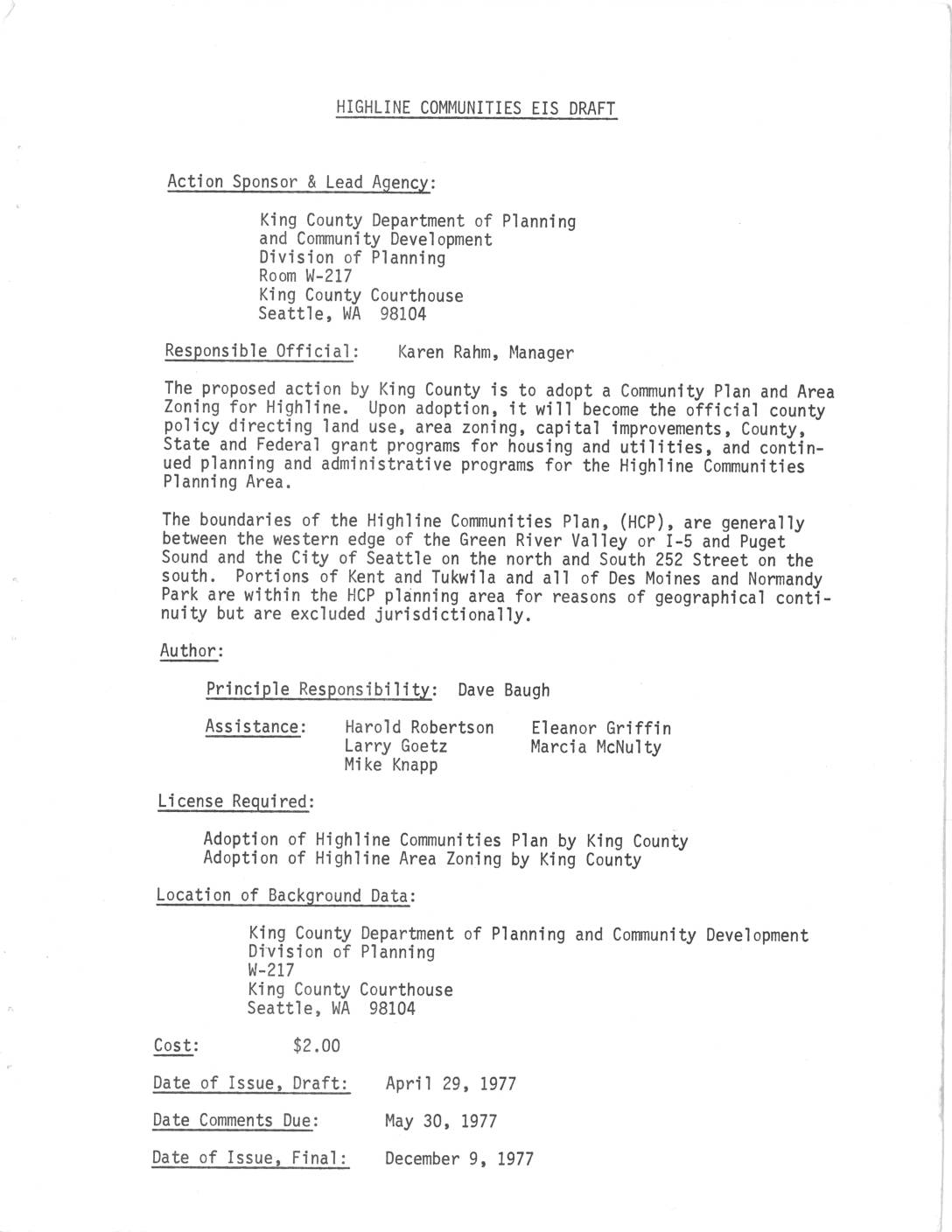
Draft Environmental Impact Statement (EIS) for the Highline Communities Plan (HCP) and Highline Area Zoning, prepared by King County Department of Planning and Community Development, Division of Planning, Room W-217, King County Courthouse, Seattle, WA 98104. Responsible official Karen Rahm, principal author Dave Baugh. The HCP covers the area between the western edge of the -
1977-04-29
Highline Communities EIS Draft
The Highline Communities EIS Draft, prepared by King County Department of Planning and Community Development in 1977, proposes the adoption of a Community Plan and Area Zoning for the Highline area southwest of Seattle. The plan is intended to guide land use, capital improvements, housing, and utilities policy for communities including Burien, White Center, Des Moines, and Normandy Park. Upon adoption, it would become an element of the King County Comprehensive Plan, with expected benefits including pollution control, improved transportation, and economic stability for the region. -
 1974-01-30
Letter to Port Of Seattle: Petition to Establish South 216th Street as Southern Terminus of Interim Land Acquisition
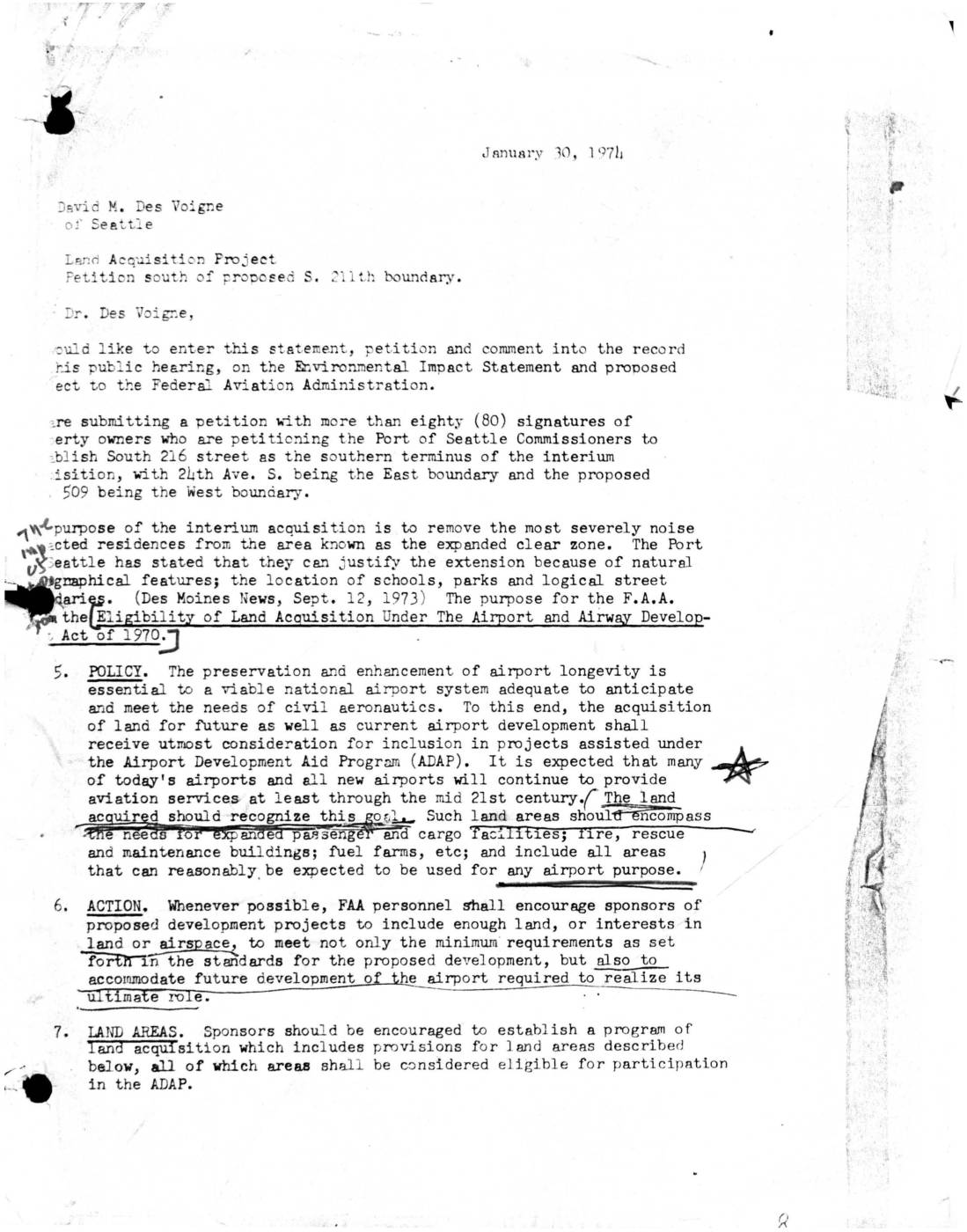
January 30, 1974 letter and petition submitted to David M. Des Voigne of Port Of Seattle for the public hearing on the Environmental Impact Statement and FAA proposed project. Over 80 property owner signatures petition Port Of Seattle Commissioners to establish South 216th Street as the southern terminus of the interim land acquisition, with 24th -
1974-01-30
Letter to Port Of Seattle: Petition to Establish South 216th Street as Southern Terminus of Interim Land Acquisition
A January 30, 1974 letter submitted to David M. Des Voigne of the Port of Seattle presents a petition signed by more than 80 property owners requesting that South 216th Street be established as the southern boundary of an interim land acquisition project near Sea-Tac Airport, bounded by 24th Ave. S. to the east and proposed Highway 509 to the west. The petitioners sought to remove the most severely noise-impacted residences from the expanded clear zone. The letter also cites FAA policy under the Airport and Airway Development Act of 1970, which encourages land acquisition to accommodate both current and long-term airport development needs.