Notes
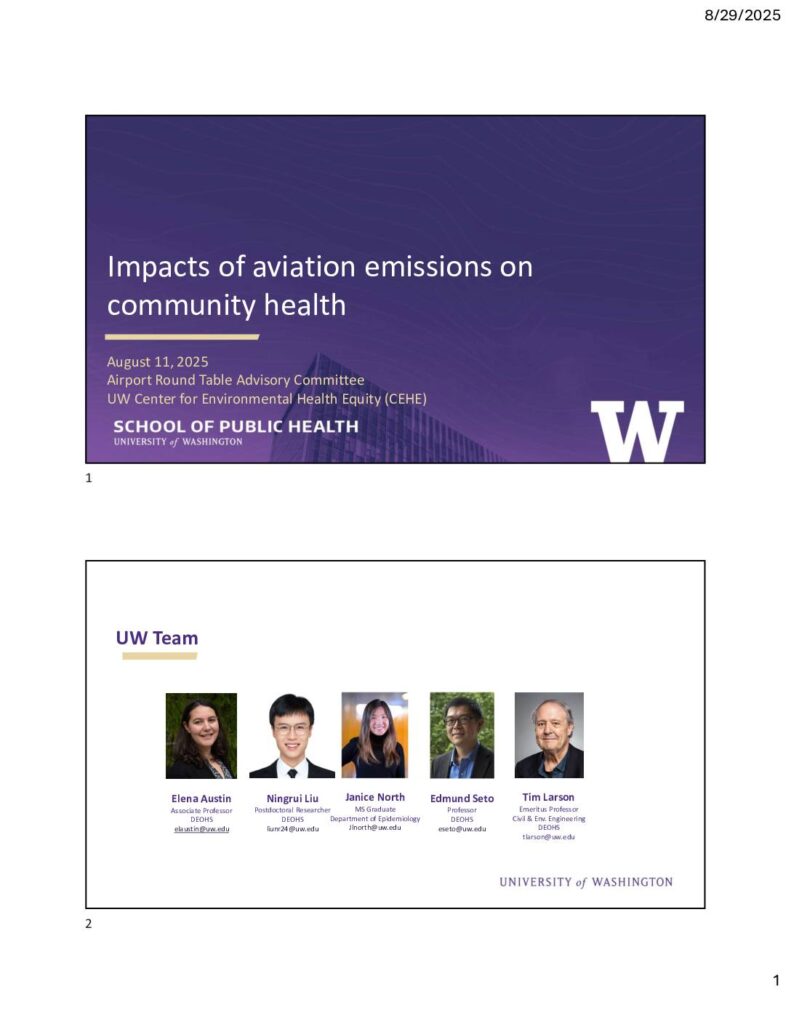
Presentation by UW Center for Environmental Health Equity (CEHE) team — Elena Austin, Edmund Seto, Timothy Larson, Ningrui Liu, and Janice North (DEOHS/Epidemiology) — to the Airport Round Table Advisory Committee on August 11, 2025. Covers aviation air pollution health impacts in King County including leaded aviation gasoline (avgas), ultrafine particles, nitrogen oxides, and Jet A fuel. Documents that King County airports account for 70% of airborne lead emissions in the county (1.23 tons, 2020 data). Cites EPA 2023 endangerment finding for aircraft lead emissions, blood lead level (BLL) studies from California (Zahran 2022), North Carolina (Soale 2024), Colorado (Berg 2024), and Bellingham WA lead deposition sampling (Shull 2025). Piston-engine aircraft account for ~70% of U.S. airborne lead emissions (Klemick 2022). Discusses neurological, cardiovascular, and respiratory health harms near airports with piston-engine and jet traffic.