TagAdvisory Committees(113)
-
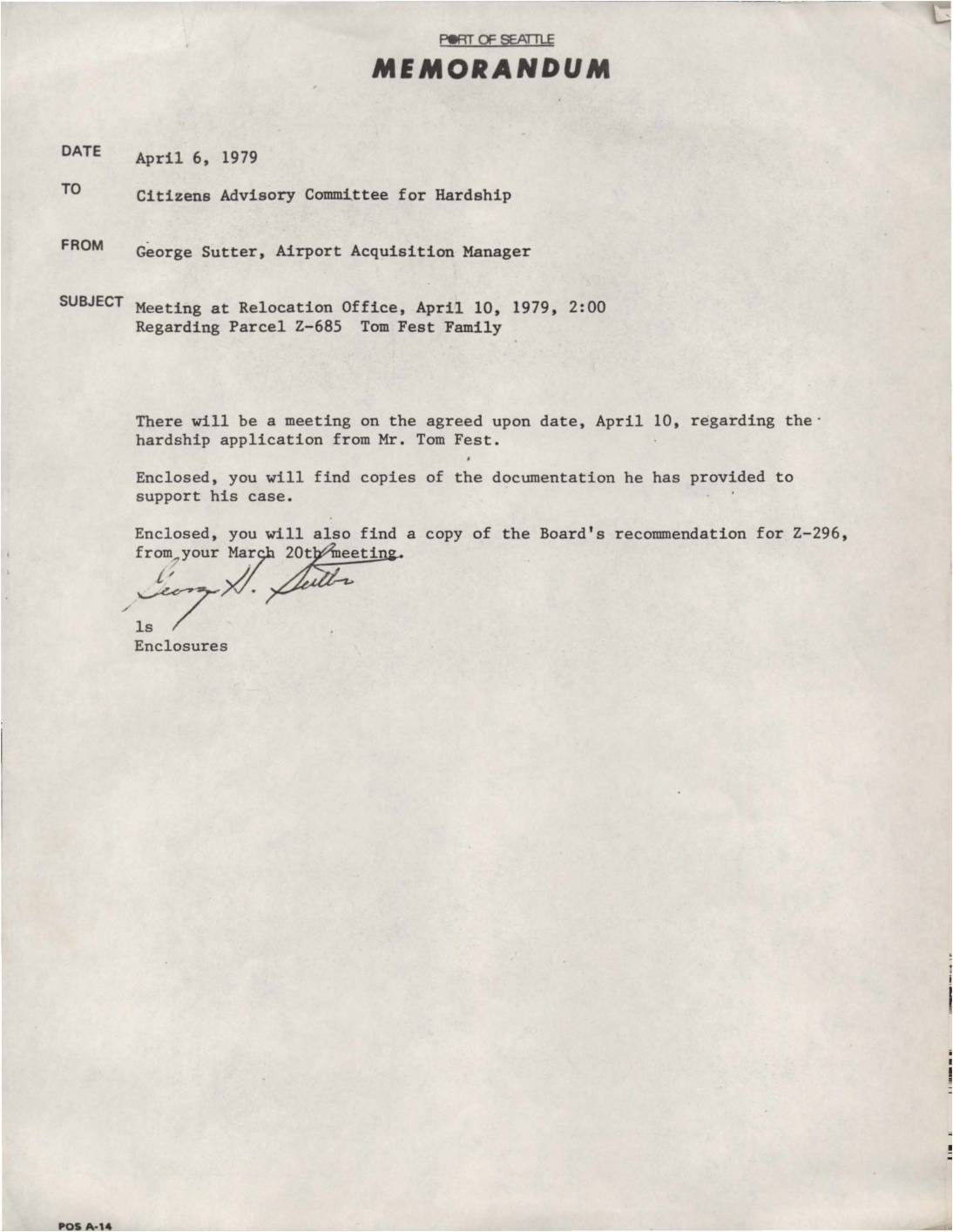 1979-04-06
Memorandum regarding meeting on hardship application for Parcel Z-685, Tom Fest Family
A April 6, 1979 memorandum from George Sutter, Airport Acquisition Manager at the Port of Seattle, notifies the Citizens Advisory Committee for Hardship of a meeting scheduled for April 10, 1979 at 2:00 PM at the Relocation Office. The meeting concerns a hardship application filed by Tom Fest and his family regarding Parcel Z-685. Supporting documentation from Mr. Fest and the Board's recommendation for Parcel Z-296 from the March 20th meeting are included as enclosures. -
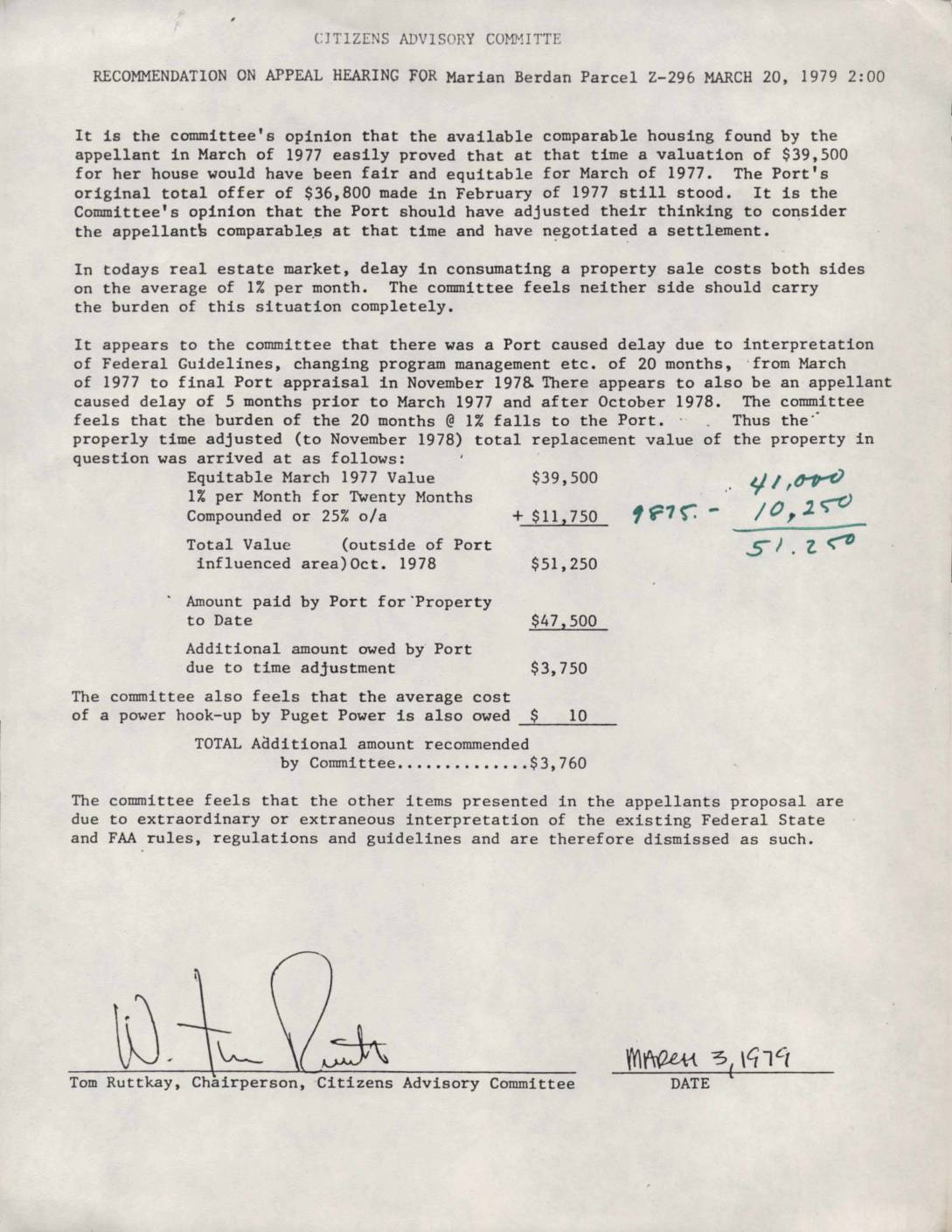 1979-03-03
Citizens Advisory Committee recommendation on appeal hearing for Marian Berdan Parcel Z-296
In March 1979, the Citizens Advisory Committee recommended that the Port pay an additional $3,760 to Marian Berdan (Parcel Z-296) in connection with the acquisition of her property near Sea-Tac Airport. The committee determined that the Port had caused a 20-month delay in settling the sale, and that a fair 1977 value of $39,500, adjusted upward by 25% to account for that delay, yielded a total property value of $51,250 — exceeding the $47,500 already paid. The remaining items in the appellant's proposal were dismissed as relying on extraordinary interpretations of federal, state, and FAA regulations. -
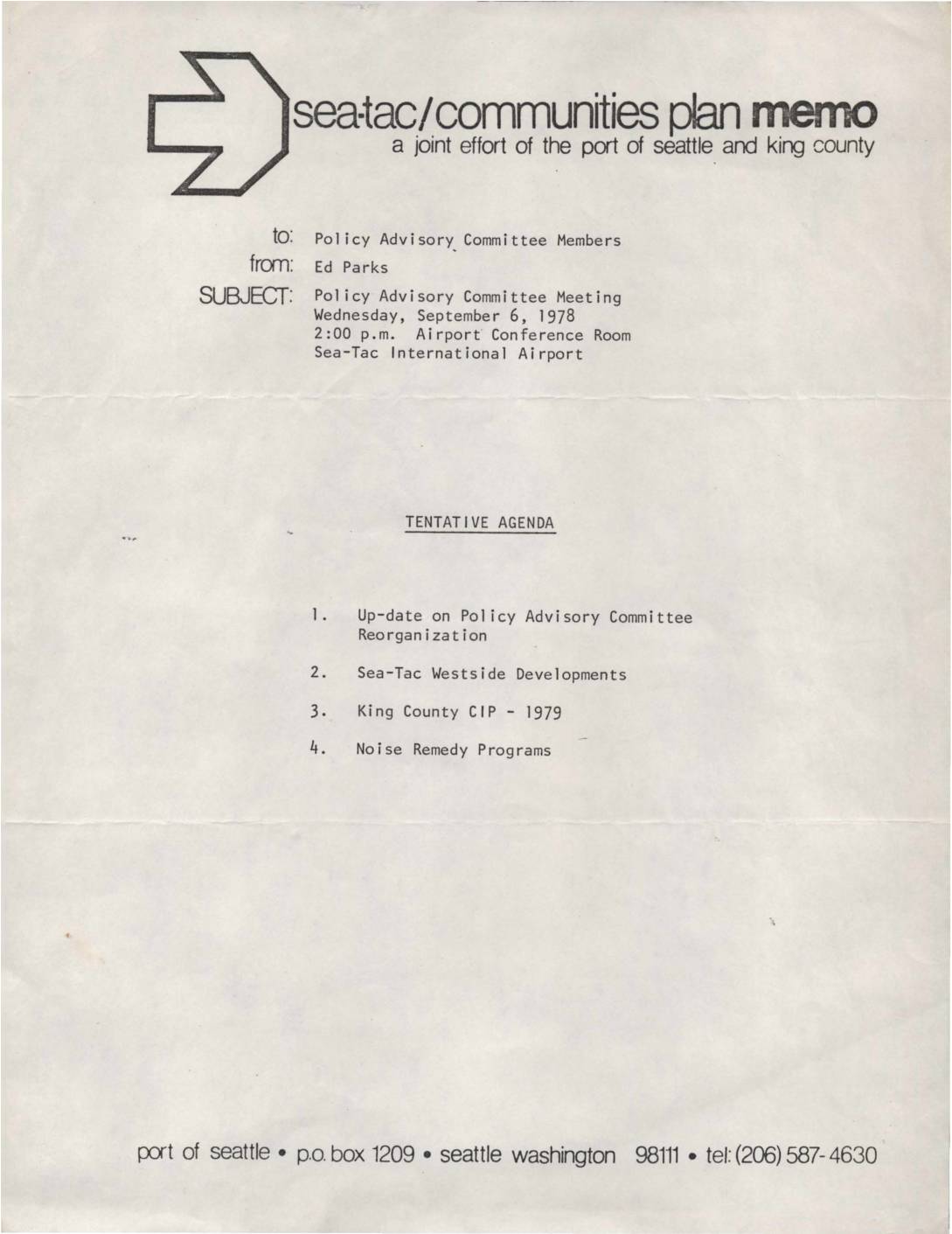 1978-09-06
Policy Advisory Committee Meeting Agenda – Sea-Tac/Communities Plan
A 1978 internal memo from Ed Parks to Policy Advisory Committee Members announces a meeting scheduled for Wednesday, September 6, 1978, at 2:00 p.m. in the Airport Conference Room at Sea-Tac International Airport. The meeting, organized as a joint effort of the Port of Seattle and King County, covers four agenda items: an update on Policy Advisory Committee Reorganization, Sea-Tac Westside Developments, the King County Capital Improvement Program for 1979, and Noise Remedy Programs. -
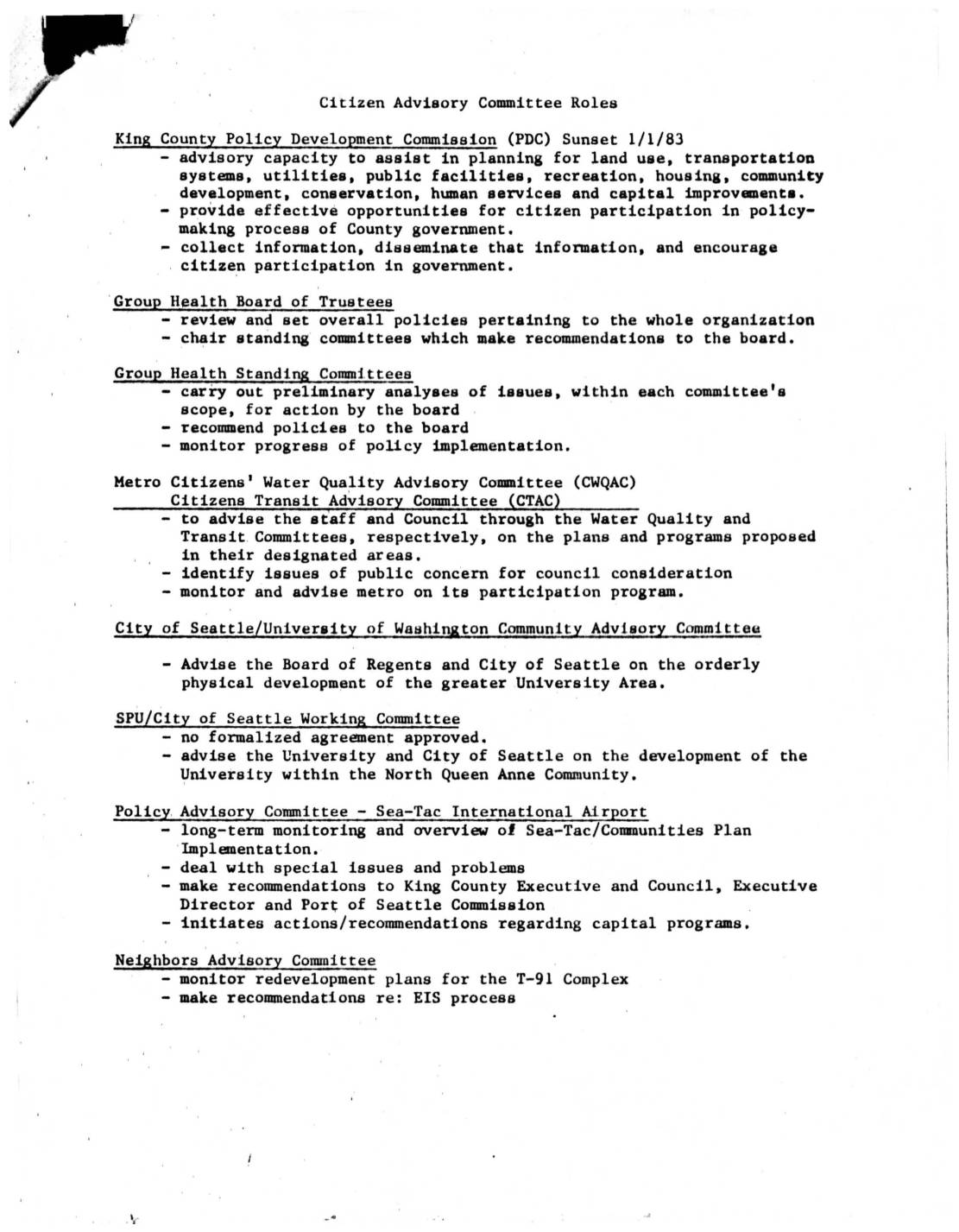 1978-09-01
Citizen Advisory Committee Roles: Comparative Overview of King County, Group Health, Metro, Seattle, and Sea-Tac Advisory Bodies
This document outlines the structure and responsibilities of the Policy Advisory Committee (PAC) established in 1978 to oversee implementation of the Sea-Tac Airport Communities Plan. The 12-member committee—drawn from King County, the Port of Seattle, local businesses, government, schools, airlines, and community representatives—was charged with long-term monitoring, addressing special issues, and making recommendations to the King County Executive, Council, and Port of Seattle Commission. The PAC met quarterly at the Sea-Tac Conference Room, with members serving three-year terms and staff support provided jointly by the Port and County. -
1978-09-01
Citizen Advisory Committee Roles: Comparative Overview of King County, Group Health, Metro, Seattle, and Sea-Tac Advisory Bodies
Comparative reference document summarizing the roles and functions of citizen advisory committees in the King County and Seattle region, prepared in the context of the Sea-Tac Communities Plan (STCP). Committees covered include the King County Policy Development Commission (PDC, sunset 1/1/83), Group Health Board of Trustees, Group Health Standing Committees, Metro Citizens’ Water Quality Advisory -
 1978-08-24
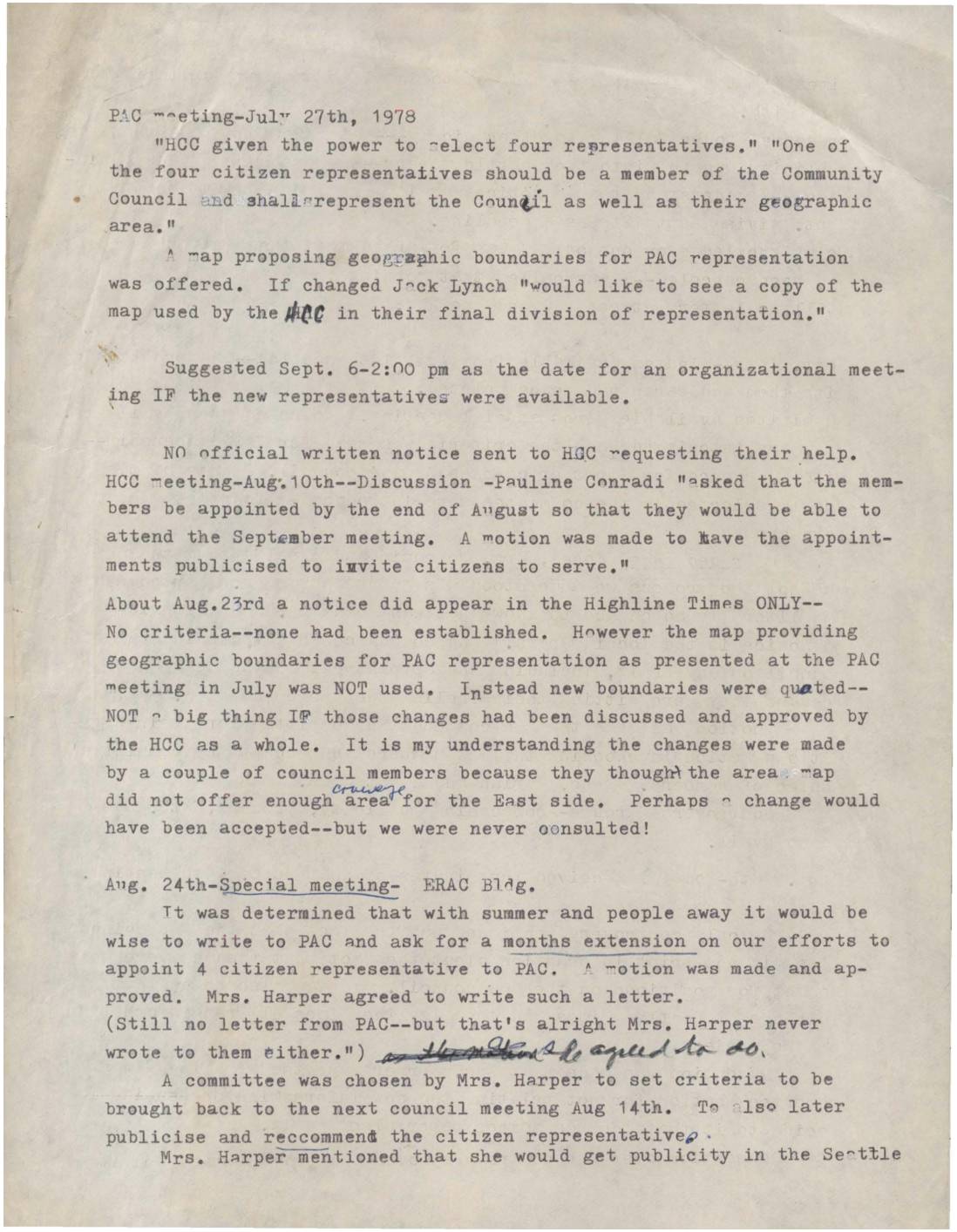
PAC Meeting Notes: HCC Citizen Representative Appointments, July–August 1978
This document records minutes from a 1978 series of meetings of the Highline Community Council (HCC) regarding the appointment of four citizen representatives to a Policy Advisory Committee (PAC). Key issues discussed included establishing geographic boundaries for representation, setting criteria for appointments, and publicizing openings to invite citizens to serve. Communication breakdowns and procedural disputes—such as unauthorized boundary changes and unfulfilled commitments to write official letters—hampered the process throughout the summer of 1978. -
1978-08-24
PAC Meeting Notes: HCC Citizen Representative Appointments, July–August 1978
Notes from PAC (Policy Advisory Committee) meetings in July and August 1978 documenting the Highline Community Council (HCC) being granted power to select four citizen representatives to PAC. Covers the July 27, 1978 PAC meeting, HCC meetings on August 10 and August 24 (special meeting at ERAC Building), and concerns about geographic boundary maps for -
 1977-05-26
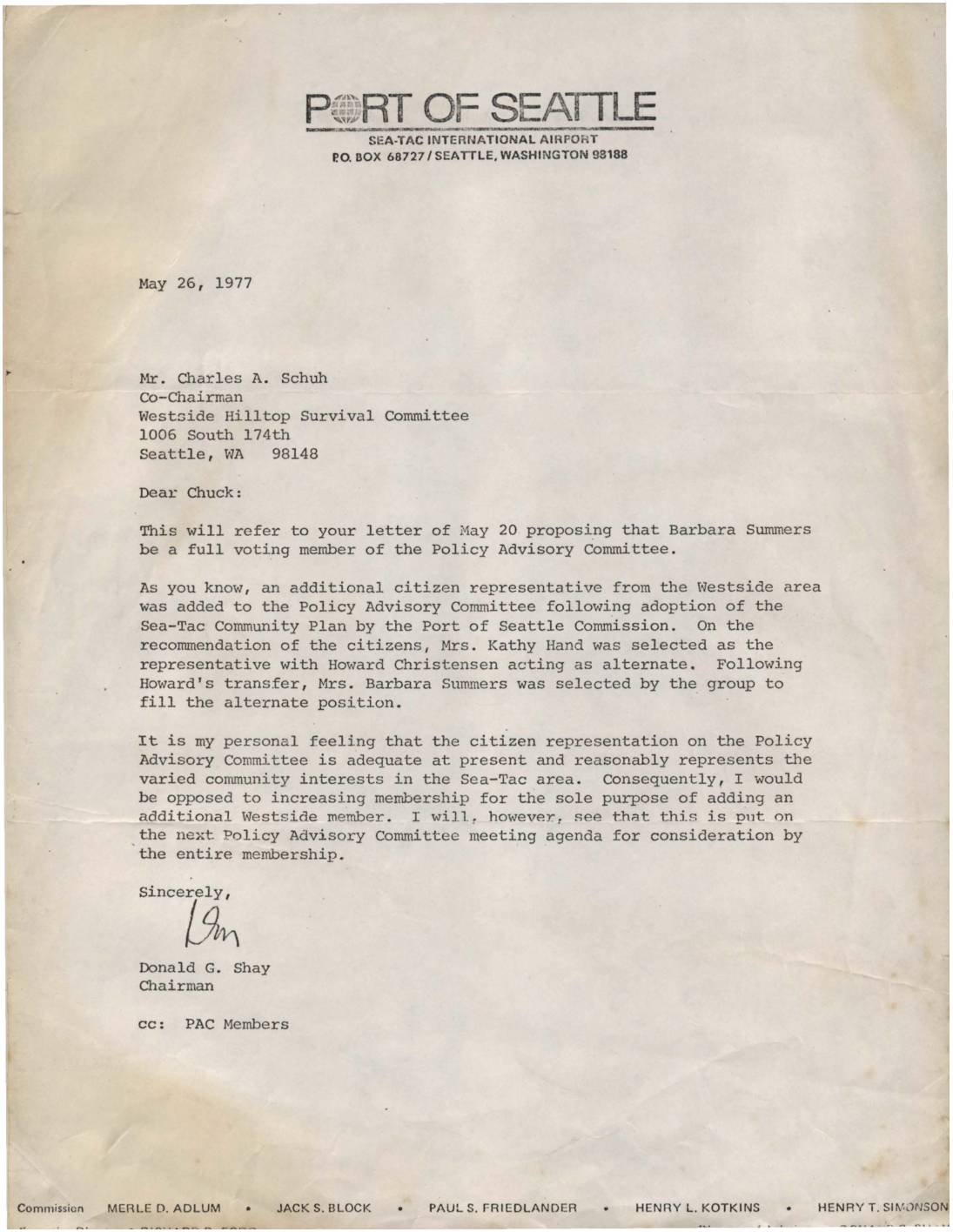
Letter to Charles Schuh regarding Barbara Summers and Policy Advisory Committee membership
In this May 26, 1977 letter, Port of Seattle Chairman Donald G. Shay responds to a request from the Westside Hilltop Survival Committee to make Barbara Summers a full voting member of the Policy Advisory Committee (PAC). Shay explains that Summers currently serves as an alternate representative for the Westside area and expresses his personal opposition to expanding PAC membership solely to add another Westside representative. He agrees, however, to place the matter on the next PAC meeting agenda for consideration by the full membership. -
 1974-01-06
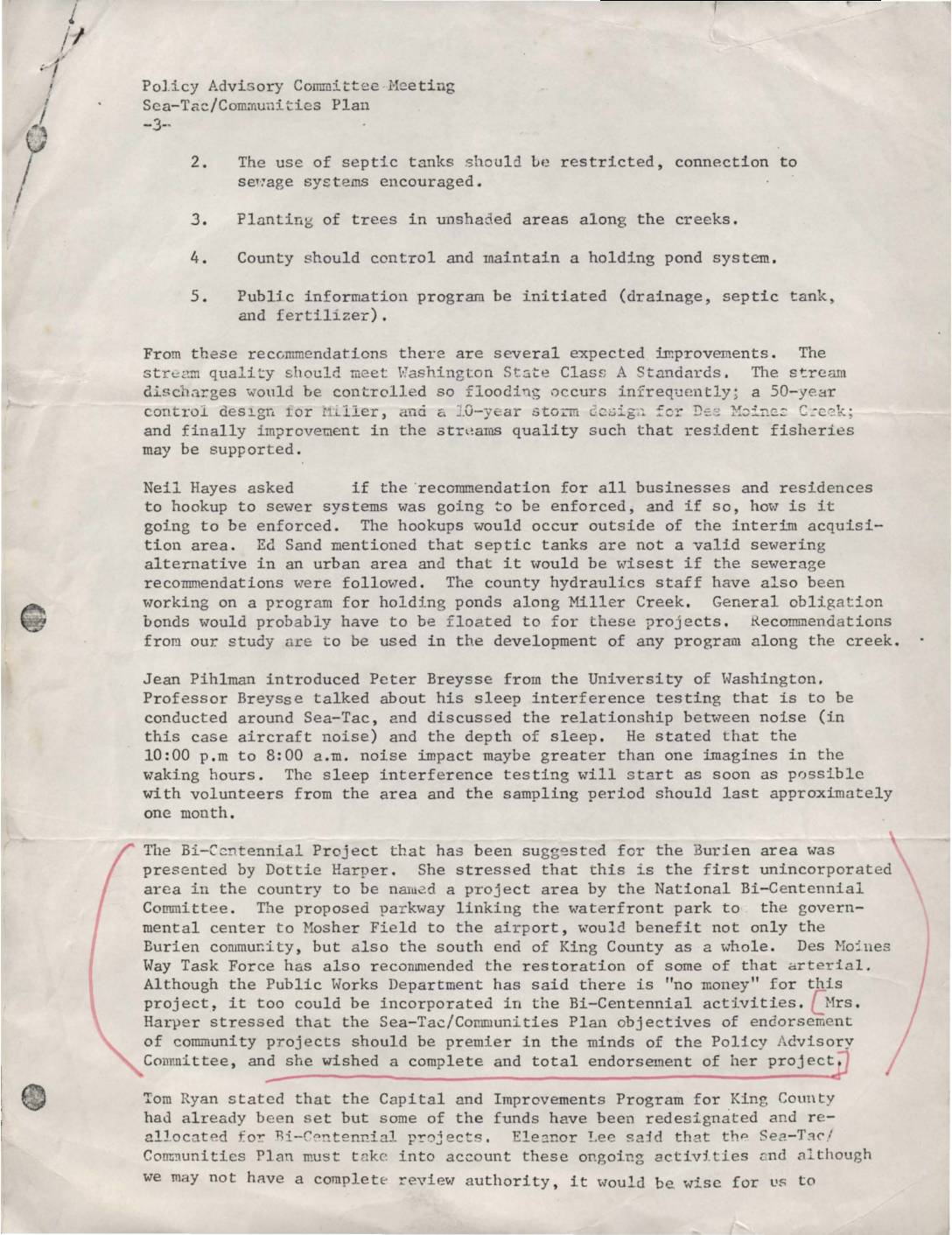
Policy Advisory Committee meeting, Sea-Tac-Communities Plan
This document summarizes a Policy Advisory Committee meeting for the Sea-Tac/Communities Plan, covering recommendations to improve local creek water quality through sewer hookups, tree planting, and holding ponds. It also describes a University of Washington study on how nighttime aircraft noise disrupts sleep for residents near Sea-Tac Airport. Additionally, a proposed Bi-Centennial parkway project linking Burien's waterfront to the airport was presented, with a request for the committee's full endorsement. -
 1973-09-01
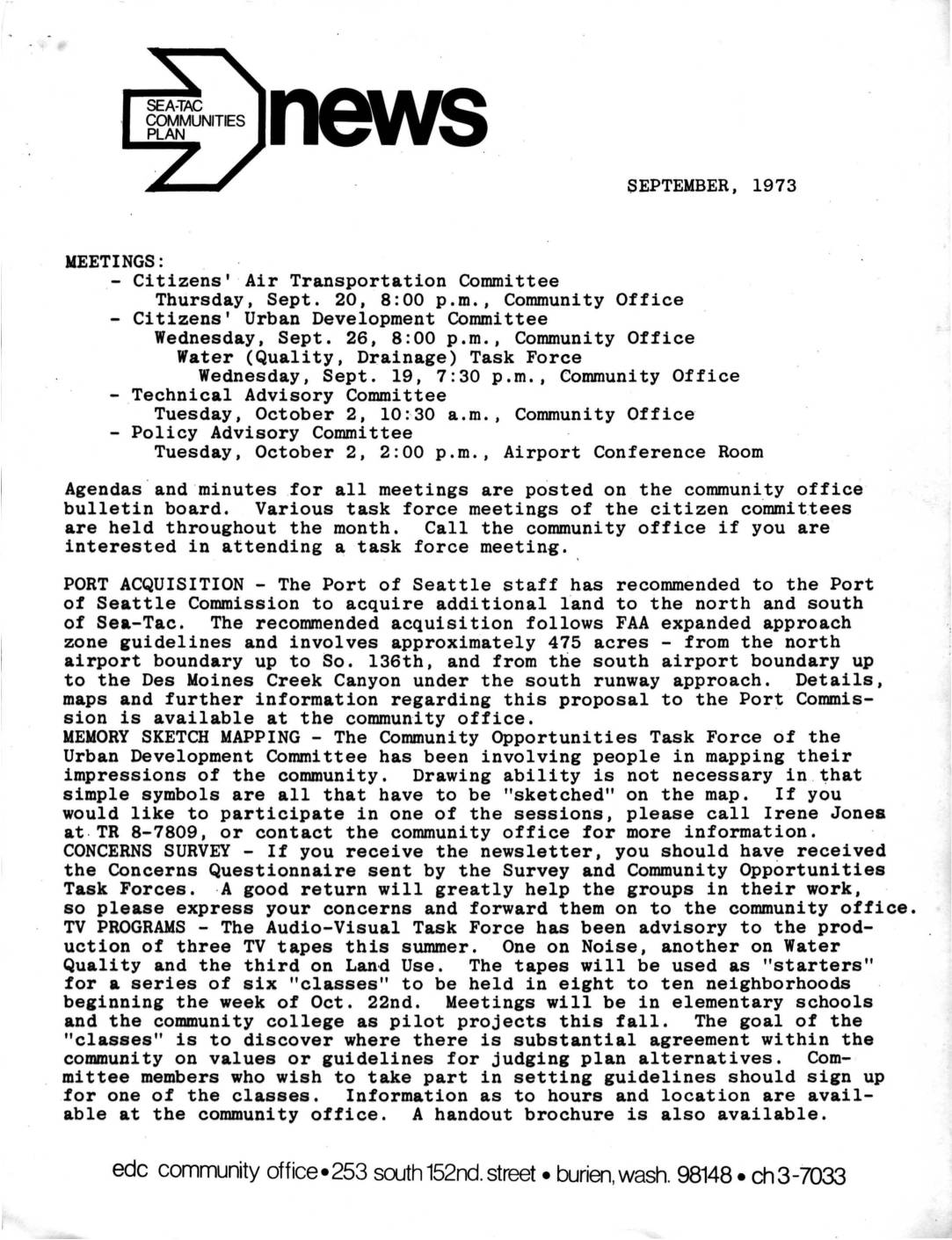
Sea-Tac Communities Plan Newsletter and Air Transportation Committee Minutes, September 1973
This September 1973 newsletter from the Sea-Tac Communities Plan covers community committee meetings, Port of Seattle land acquisition plans, and neighborhood engagement initiatives related to Sea-Tac Airport. The Port of Seattle proposed acquiring approximately 475 acres of land north and south of the airport following FAA approach zone guidelines, while citizen committees worked on noise, water quality, and land use concerns. Community outreach efforts included a memory sketch mapping project, a concerns survey, and a series of TV-based neighborhood classes aimed at building consensus on planning guidelines.