TagWater Quality(475)
-
 2023-06-23
Final Basis of Design Report: SEA IWTP Expansion
This document is the Final Basis of Design Report for the expansion of the Industrial Wastewater Treatment Plant (IWTP) at Seattle-Tacoma International Airport, prepared by Gresham Smith in June 2023 for the Port of Seattle. It outlines the engineering and design framework for upgrading the airport's wastewater treatment infrastructure. The report was developed in collaboration with Anchor QEA, Clearway Environmental, and RKI Planning & Engineering. -
 2023-06-07
Final Engineering Report: SEA IWTP Expansion
This final engineering report, prepared by Gresham Smith for the Port of Seattle, details the planned expansion of the Industrial Wastewater Treatment Plant (IWTP) at Seattle-Tacoma International Airport. Dated June 7, 2023, the report was developed in compliance with Washington Administrative Code 173-240-130 to satisfy permit requirements under Waste Discharge Permit #7810-05. It outlines technical plans for upgrading the airport's wastewater treatment infrastructure to meet current regulatory standards. -
2023-06-07
Final Engineering Report: SEA IWTP Expansion
This final engineering report, prepared by Gresham Smith for the Port of Seattle, details the planned expansion of the Industrial Wastewater Treatment Plant (IWTP) at Seattle-Tacoma International Airport. Dated June 7, 2023, the report was developed in compliance with Washington Administrative Code 173-240-130 to satisfy permit requirements under Waste Discharge Permit #7810-05. It outlines technical plans for upgrading the airport's wastewater treatment infrastructure to meet current regulatory standards. -
 2023-03-01
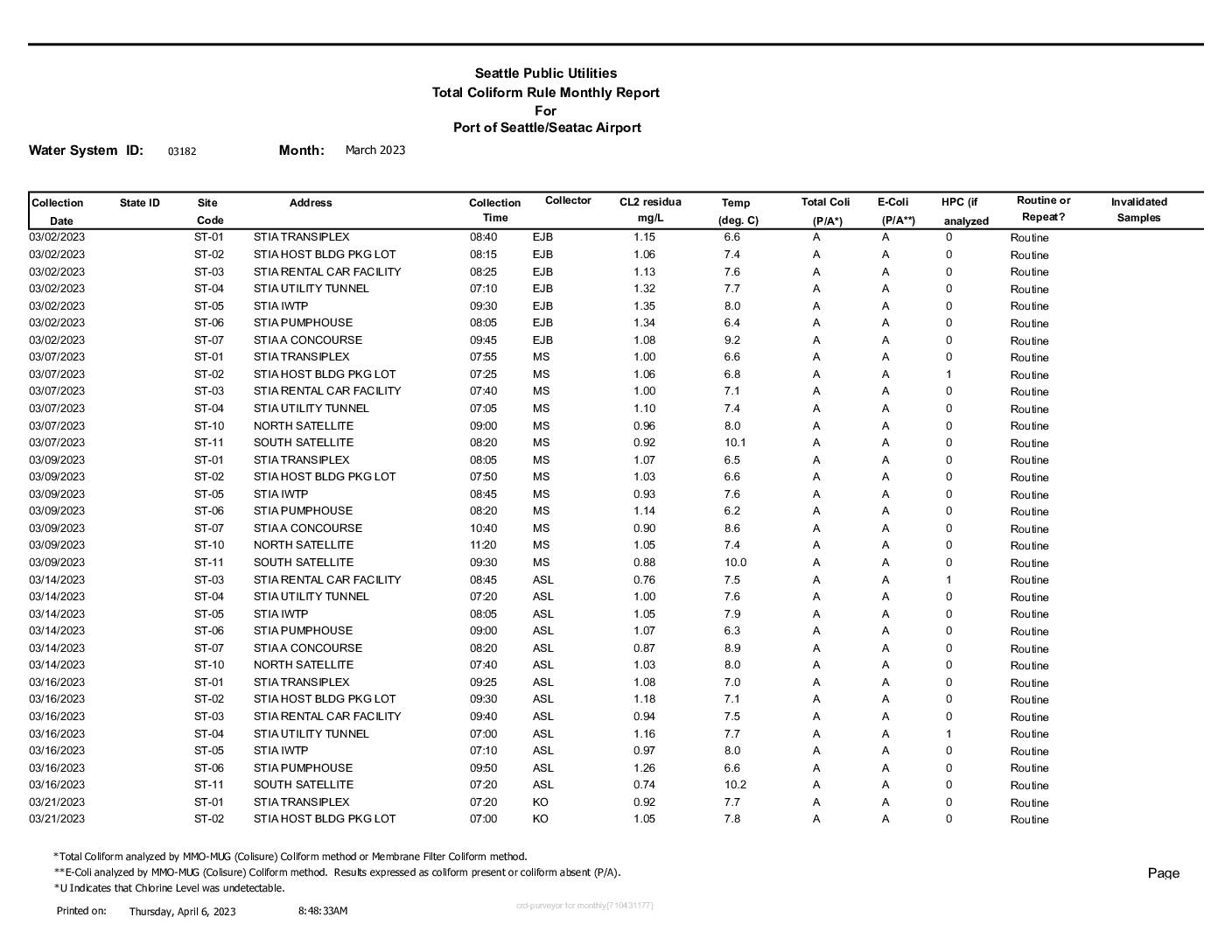
Seattle Public Utilities total coliform rule monthly report for Port Of Seattle/Seatac Airport – March 2023
This Seattle Public Utilities water quality report covers routine Total Coliform Rule monitoring at Seattle-Tacoma International Airport (Sea-Tac) for March 2023. A total of 52 water samples were collected from airport locations including the A Concourse, Rental Car Facility, Utility Tunnel, and satellite terminals, with all samples testing absent for total coliform and E. coli bacteria. The system met all regulatory standards, achieving 100% detectable chlorine levels and an average chlorine residual of 1.01 mg/L across the monitoring period. -
 2022-12-01
Seattle-Tacoma International Airport Stormwater Pollution Prevention Plan (SWPPP) December, 2022
Stormwater Pollution Prevention Plan (SWPPP) for Seattle-Tacoma International Airport (Sea-Tac Airport), published by Port Of Seattle in December 2022, in accordance with NPDES Permit No. WA-0024651. Covers facility assessment, IWS and SDS drainage areas, receiving waters, industrial activities, materials inventory, spills and leaks, monitoring plan, illicit non-stormwater discharges, best management practices (BMPs) including operational source -
 2022-11-29
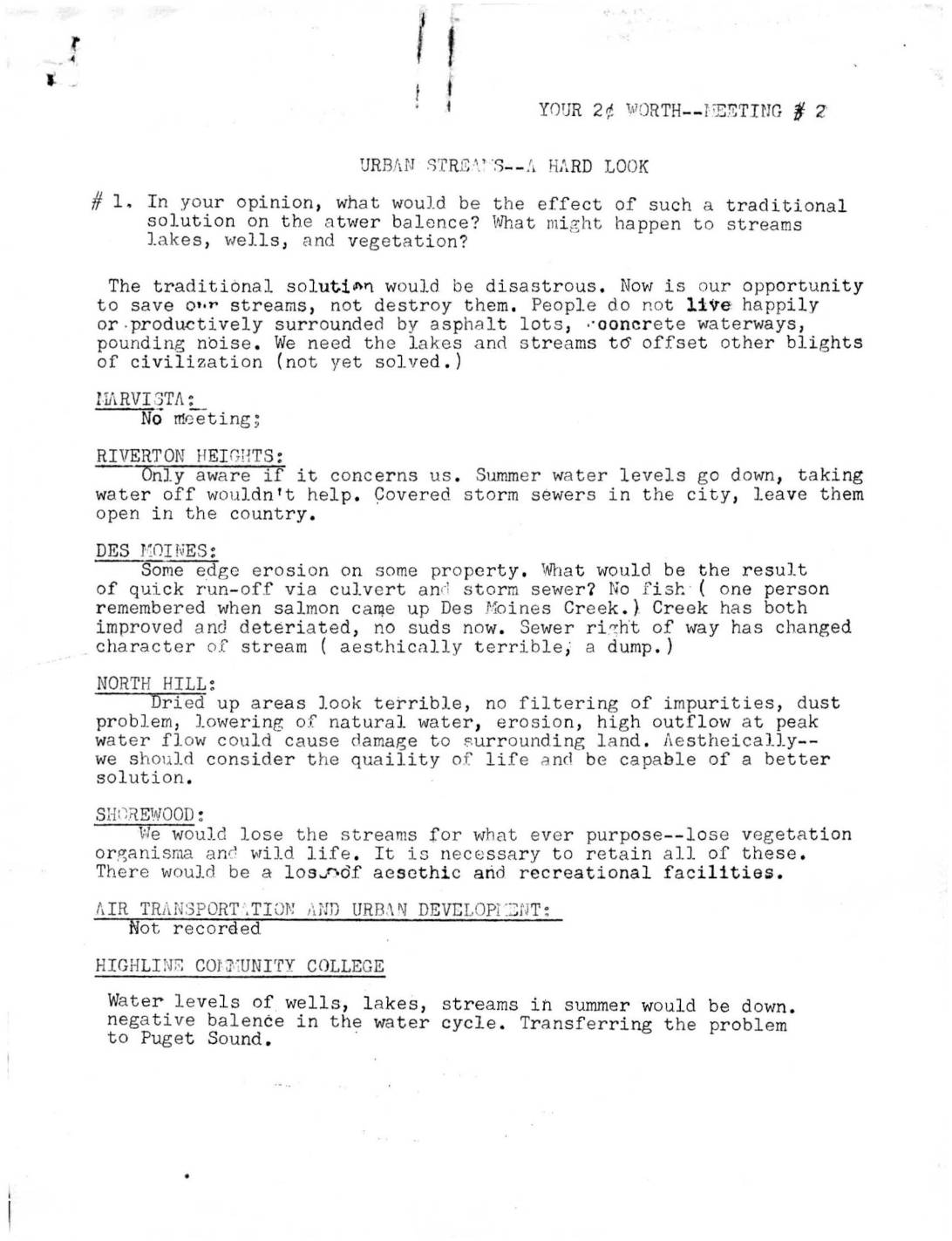
Your 2¢ Worth — Meeting #2: Urban Streams, A Hard Look
Community meeting notes from the Highline area (near Sea-Tac) capture neighborhood group responses to questions about urban streams and stormwater management. Residents from areas including Des Moines, North Hill, Shorewood, and Riverton Heights expressed strong opposition to traditional drainage solutions such as culverts and concrete channels, citing harm to water balance, wildlife, and quality of life. Groups broadly favored preserving natural streams for recreational, aesthetic, and ecological benefits, while debating appropriate levels of public access. -
 2022-09-12
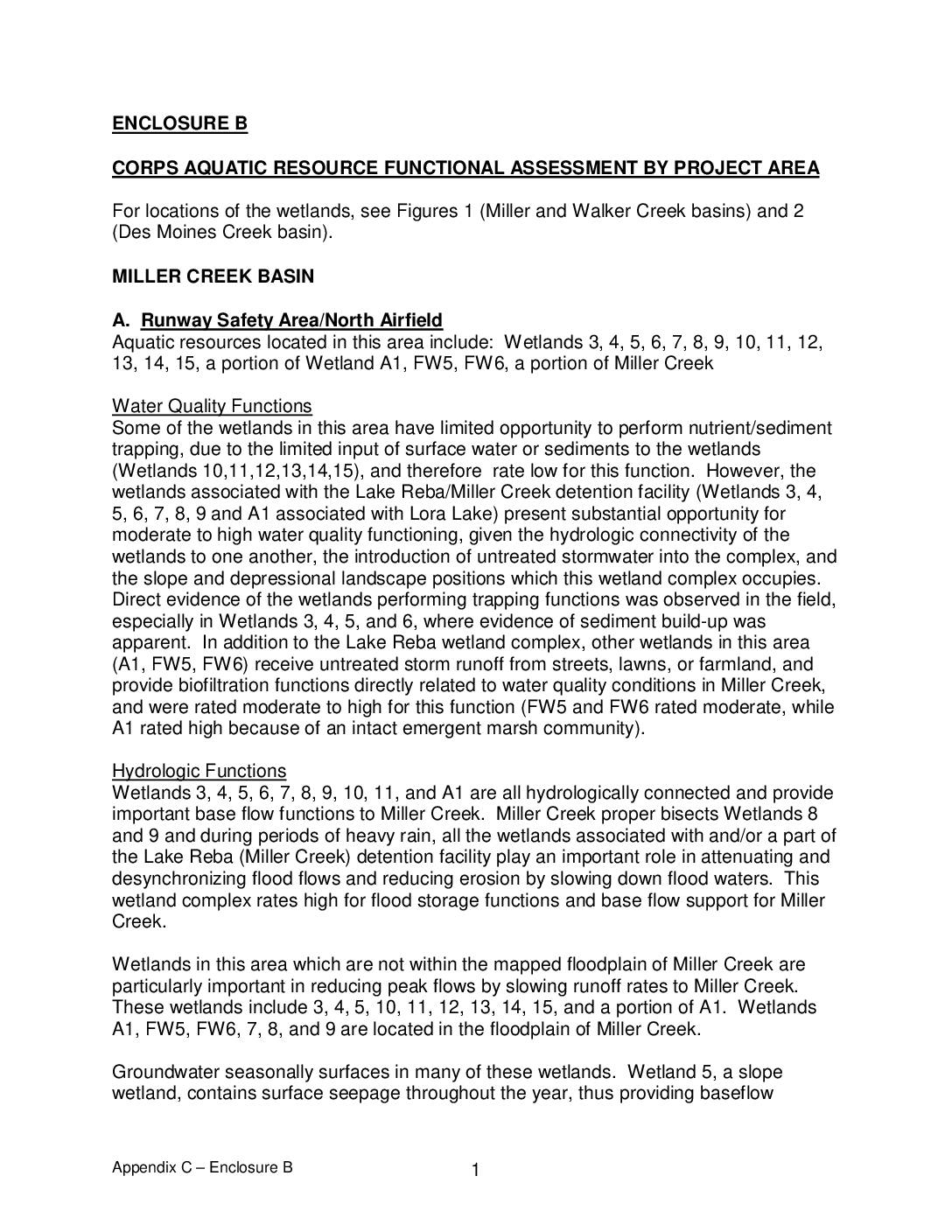
Corps aquatic resource functional assessment by project area
This document assesses the ecological functions of wetlands and aquatic resources in the Miller Creek and related basins near Sea-Tac Airport, evaluating their roles in water quality, flood storage, and wildlife habitat. Wetlands in the Runway Safety Area and Vacca Farm areas are rated across functions such as nutrient trapping, groundwater exchange, and habitat for fish, waterfowl, amphibians, and small mammals. The assessment finds that interconnected wetland complexes like Lake Reba provide high-value flood attenuation and baseflow support for Miller Creek, while farmed wetlands perform at lower functional levels due to sparse vegetation and agricultural runoff. -
 2022-09-12
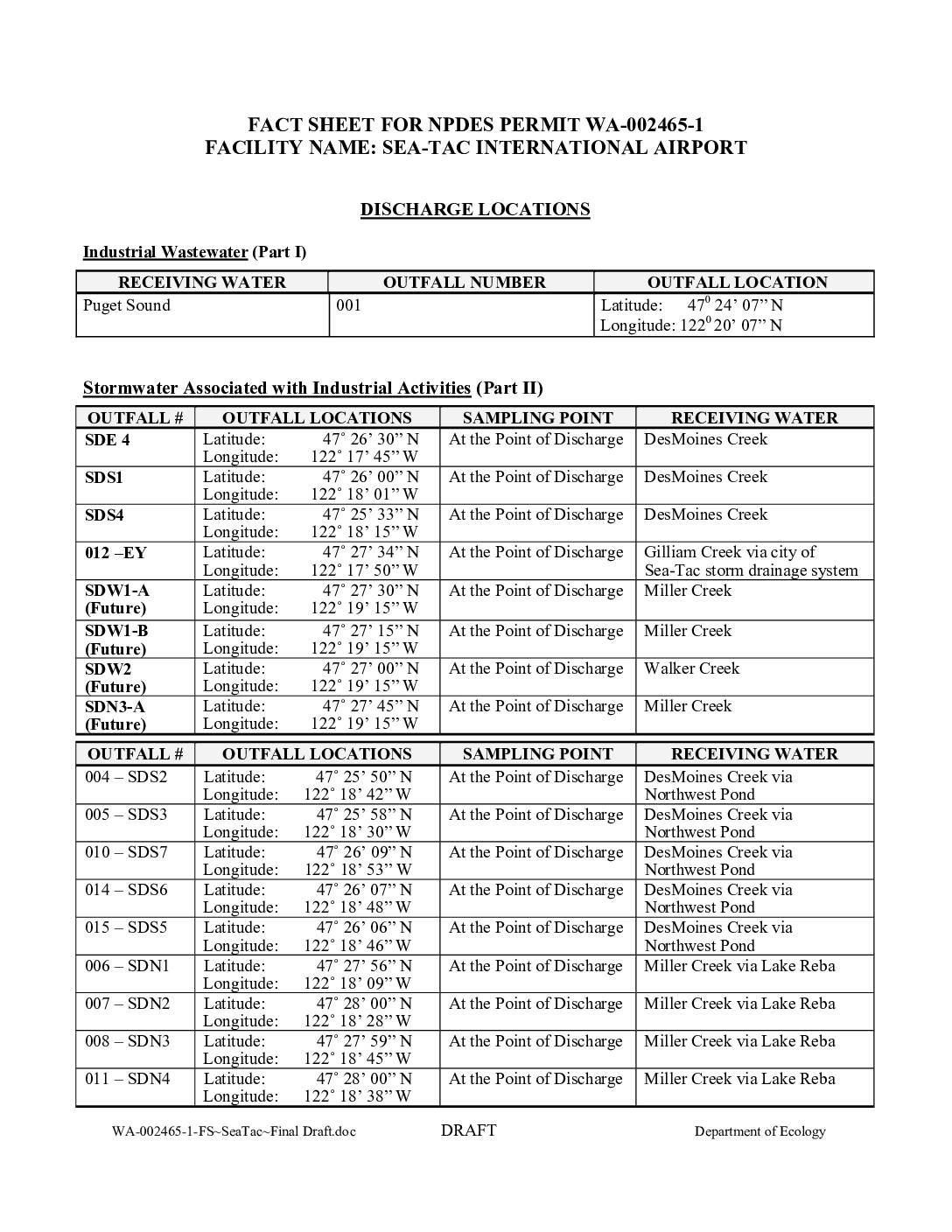
Fact sheet for NPDES permit WA-002465-1, Sea-Tac International Airport
This document is an NPDES (National Pollutant Discharge Elimination System) permit fact sheet for Sea-Tac International Airport, issued by the Washington State Department of Ecology. It details the locations of numerous water discharge outfalls across the airport property, covering industrial wastewater, stormwater from industrial activities, and stormwater from construction activities. The discharges flow into several local waterways including Des Moines Creek, Miller Creek, Walker Creek, Gilliam Creek, and Puget Sound. -
 2022-09-12
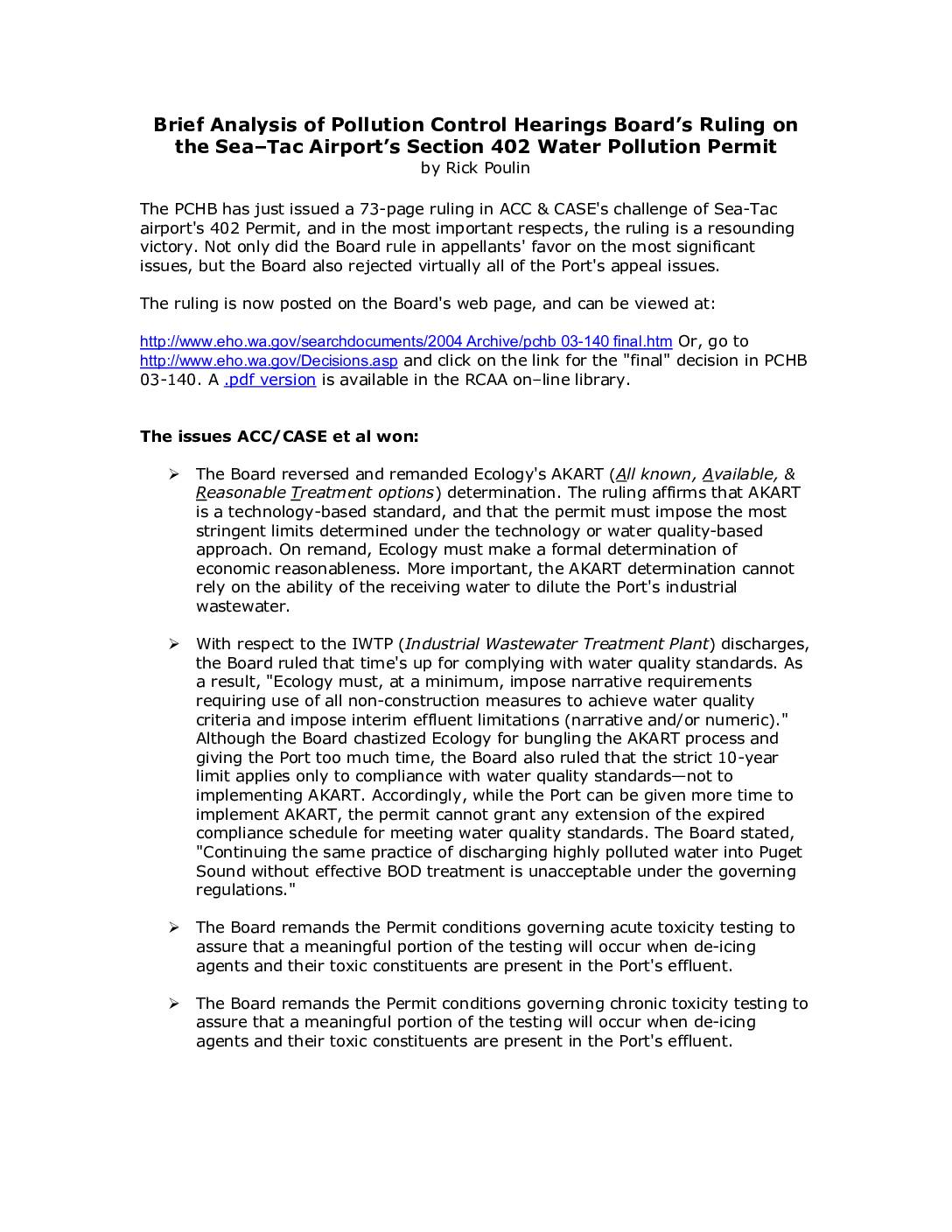
Brief analysis of Pollution Control Hearings Board’s ruling on the Sea–Tac Airport’s Section 402 water pollution permit
The Pollution Control Hearings Board ruled largely in favor of community groups ACC and CASE in their challenge to Sea-Tac Airport's water pollution permit, ordering stricter wastewater treatment standards and rejecting most of the Port's appeals. Key victories included requiring the airport to meet long-overdue water quality standards for its industrial wastewater discharged into Puget Sound, mandating improved toxicity testing during de-icing season, and directing a professional wetlands analysis of Lake Reba. Of the seven final directives issued by the Board, six favored the community appellants and only one favored the Port. -
 2022-09-12
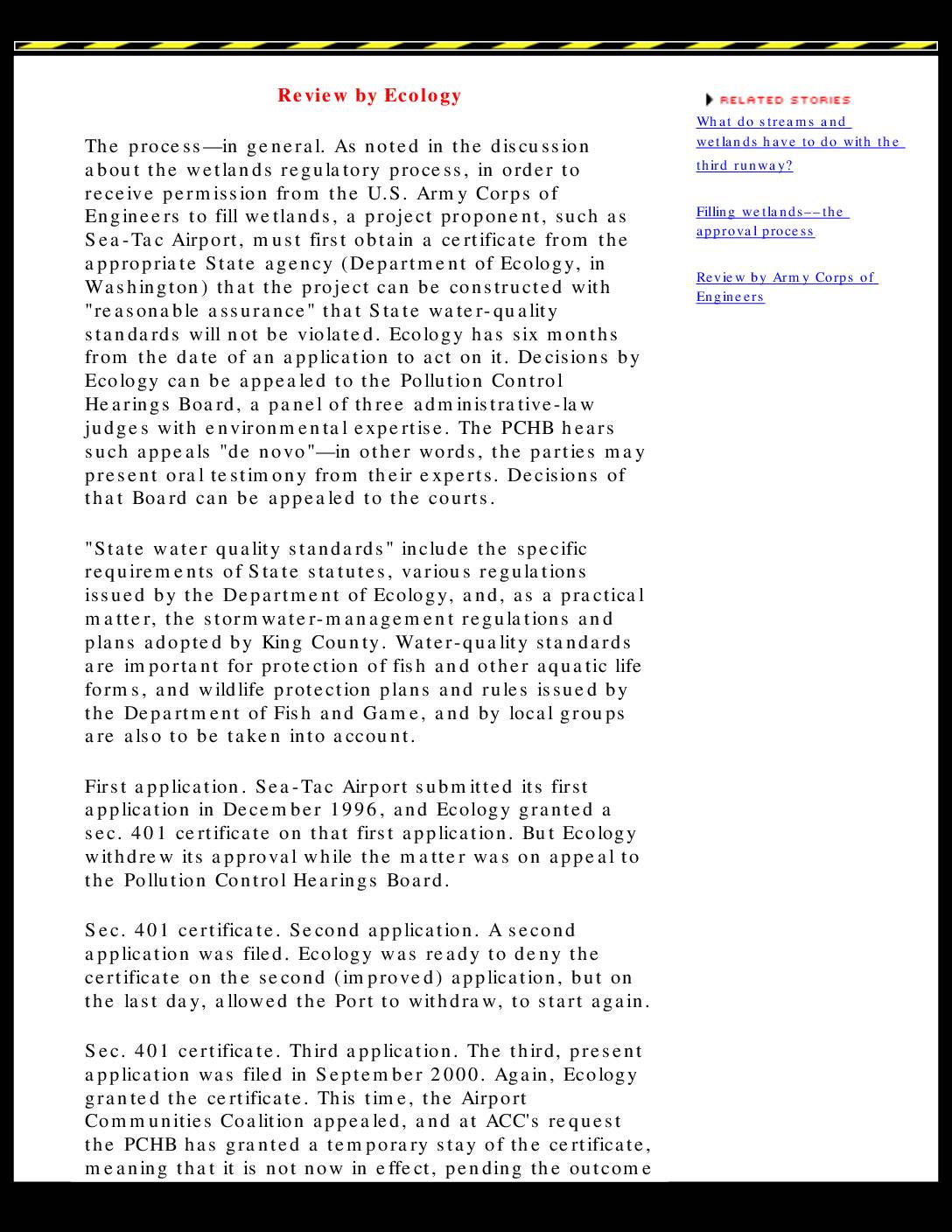
Review by Ecology
This document explains the Washington State Department of Ecology's review process for Sea-Tac Airport's applications to fill wetlands as part of its third runway project. Sea-Tac submitted three separate applications between 1996 and 2000, with the third ultimately receiving a Section 401 water-quality certificate that was later put on hold after the Airport Communities Coalition appealed. The Pollution Control Hearings Board identified three key concerns driving the stay: contaminated fill material, insufficient water rights for dry-season stream flow, and inadequate wetlands mitigation plans.