TagWater Quality(475)
-
 2025-06-10
Wetland Verification Memorandum: SEA Industrial Wastewater Treatment Plant Expansion Project
WSP conducted a wetland verification study in May 2025 to confirm the accuracy of a 2022 wetland delineation near the Seattle-Tacoma International Airport's Industrial Wastewater Treatment Plant (IWTP), which is being expanded to increase treatment capacity and meet permit requirements. The study assessed three previously identified wetlands — IWS-A, IWS-B, and WL28 — all located within the Lagoon 3 Study Area, ranging in size from 0.54 to 29.7 acres. The verification was conducted to ensure the existing delineation boundaries remain valid for environmental permitting purposes ahead of planned construction. -
2025-06-10
Wetland Verification Memorandum: SEA Industrial Wastewater Treatment Plant Expansion Project
WSP conducted a wetland verification study in May 2025 to confirm the accuracy of a 2022 wetland delineation near the Seattle-Tacoma International Airport's Industrial Wastewater Treatment Plant (IWTP), which is being expanded to increase treatment capacity and meet permit requirements. The study assessed three previously identified wetlands — IWS-A, IWS-B, and WL28 — all located within the Lagoon 3 Study Area, ranging in size from 0.54 to 29.7 acres. The verification was conducted to ensure the existing delineation boundaries remain valid for environmental permitting purposes ahead of planned construction. -
 2024-09-04
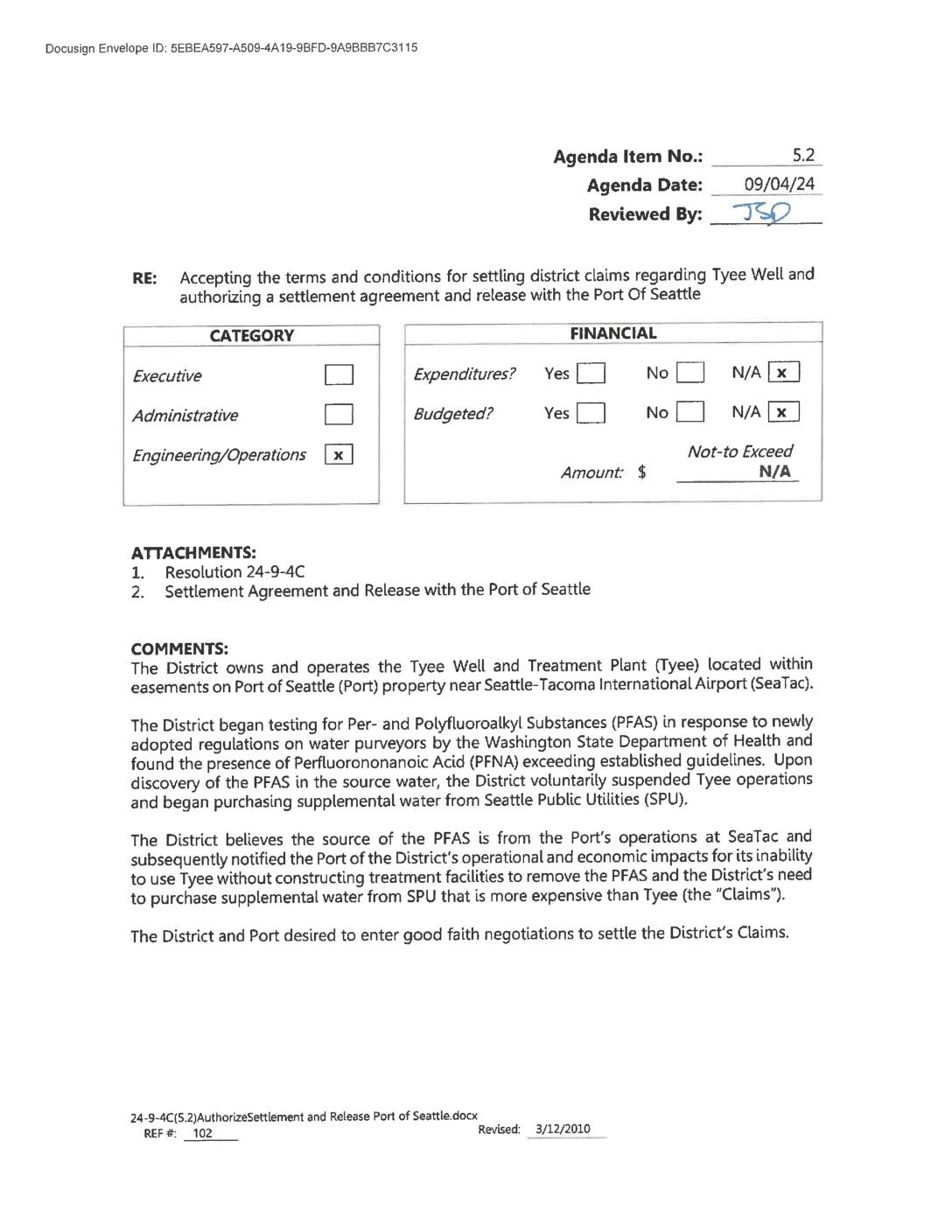
Resolution 24-9-4C: Settlement Agreement and Release — Highline Water District and Port Of Seattle Regarding Tyee Well PFAS Contamination
Highline Water District reached a settlement with the Port of Seattle after PFAS chemicals, likely originating from Seattle-Tacoma International Airport operations, were found to have contaminated the District's Tyee Well, forcing the District to suspend well operations in June 2022. The contamination required the District to purchase more expensive replacement water from Seattle Public Utilities, and new EPA regulations finalized in 2024 further prohibited resuming well use without installing costly treatment facilities. The two parties negotiated a mutual release of claims to resolve the District's operational and financial losses resulting from the contamination. -
Des Moines Creek Water Quality Monitoring Program, King County – DNRP
The Des Moines Creek benthos sampling is part of a larger Des Moines Creek Water Quality Monitoring Program that began in 2012. This program is designed to monitor and assess water quality in Des Moines Creek and will follow three broad goals: • Understand the status and trends of water quality and ecological health of -
 2024-02-01
Seattle-Tacoma International Airport SAMP Near Term Projects: Wetlands and Streams Report
This technical report, prepared by Parametrix for the Port of Seattle in February 2024, documents the wetlands and streams found at Seattle-Tacoma International Airport as part of the Sustainable Airport Master Plan (SAMP) Near Term Projects. It covers the delineation of wetland and stream boundaries, assesses potential impacts to these aquatic areas from planned airport improvements, and outlines mitigation measures and permitting approaches to address those impacts. -
 2024-02-01
Appendix M: SAMP Near Term Projects: Water Resources Wetlands and Streams Report
This technical report, prepared by Parametrix for the Port of Seattle in February 2024, documents the wetlands and streams found at Seattle-Tacoma International Airport as part of the Sustainable Airport Master Plan (SAMP) Near Term Projects. It covers the delineation of wetland and stream boundaries, assessments of potential impacts to these aquatic areas from planned airport projects, and proposed mitigation measures and permitting strategies to address those impacts. -
Our Transition to Fluorine-Free Foam
Randy Krause October 2023 The Port of Seattle Fire Department continues on a five-year journey to find the safest, most efficient aircraft firefighting foam (AFFF) replacement and make Seattle-Tacoma International (SEA) one of the first U.S. airports to complete the steps for the transition after federal approval. In 2018, it was obvious the FAA would -
 2023-08-30
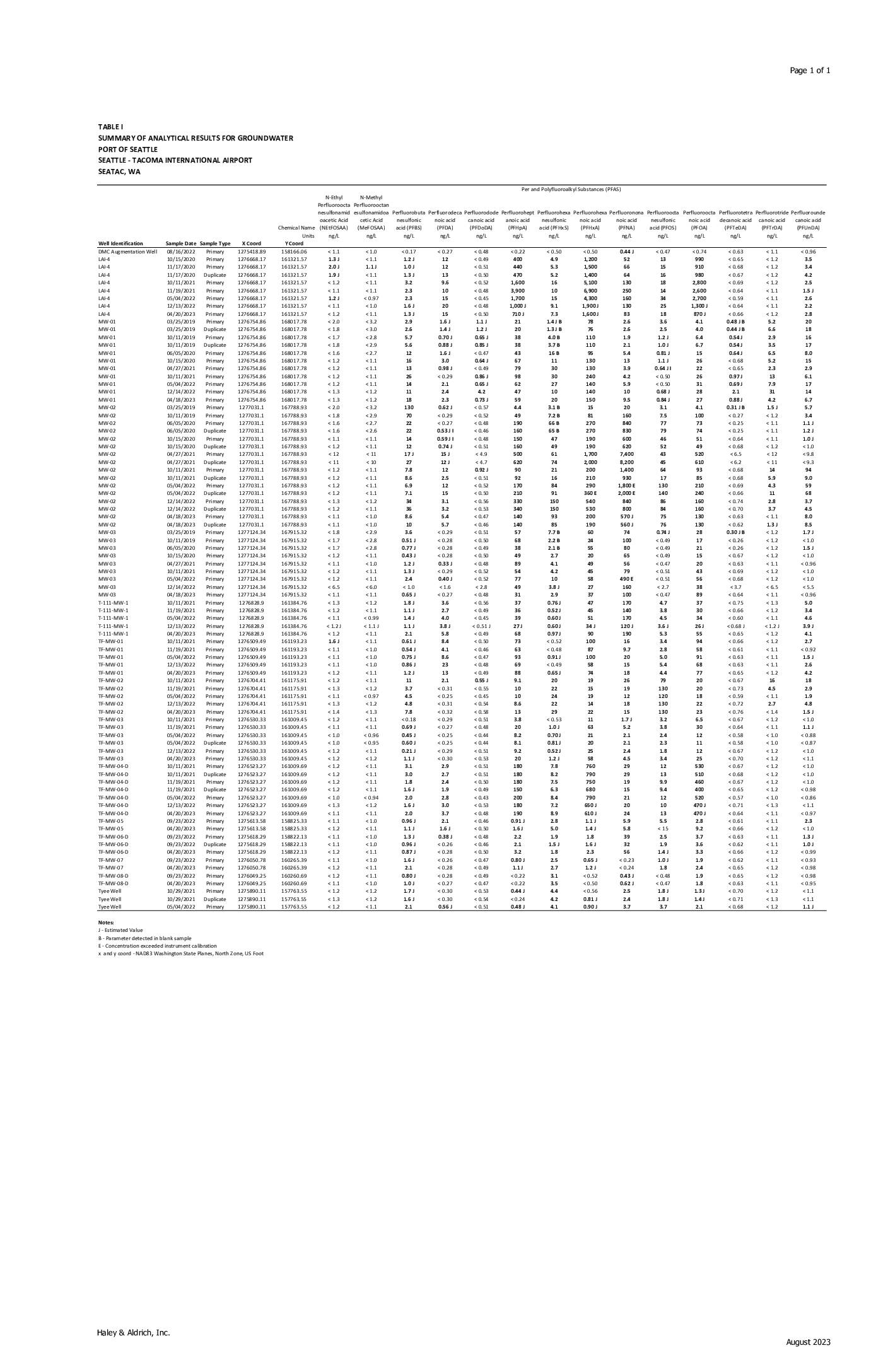
Summary of Analytical Results for Groundwater: Port Of Seattle, Seattle-Tacoma International Airport, Sea-Tac, WA
Table I summarizing analytical results for PFAS (per and polyfluoroalkyl substances) in groundwater at Sea-Tac Airport, prepared by Haley & Aldrich, Inc. in August 2023. Groundwater monitoring wells sampled include LAI-4, MW-01, MW-02, MW-03, T-111-MW-1, TF-MW-01 through TF-MW-08-D, DMC Augmentation Well, and Tyee Well, with sample dates ranging from March 2019 to April 2023. Analytes -
Tribes call for national ban on salmon-killing chemical in car tires
by John Ryan Three Northwest tribes have petitioned the federal government to ban a salmon-killing chemical found in tires and urban streams worldwide. As car and truck tires wear and leave behind skid marks and tire dust, the rubber stabilizer known as 6PPD turns into 6PPD-quinone (also called 6PPD-q), one of the most toxic substances -
 2023-06-23
Final Basis of Design Report: SEA IWTP Expansion
This document is the Final Basis of Design Report for the expansion of the Industrial Wastewater Treatment Plant (IWTP) at Seattle-Tacoma International Airport, prepared by Gresham Smith in June 2023 for the Port of Seattle. It outlines the engineering and design framework for upgrading the airport's wastewater treatment infrastructure. The report was developed in collaboration with Anchor QEA, Clearway Environmental, and RKI Planning & Engineering.