TagSEPA(232)
-
 2026-06-21
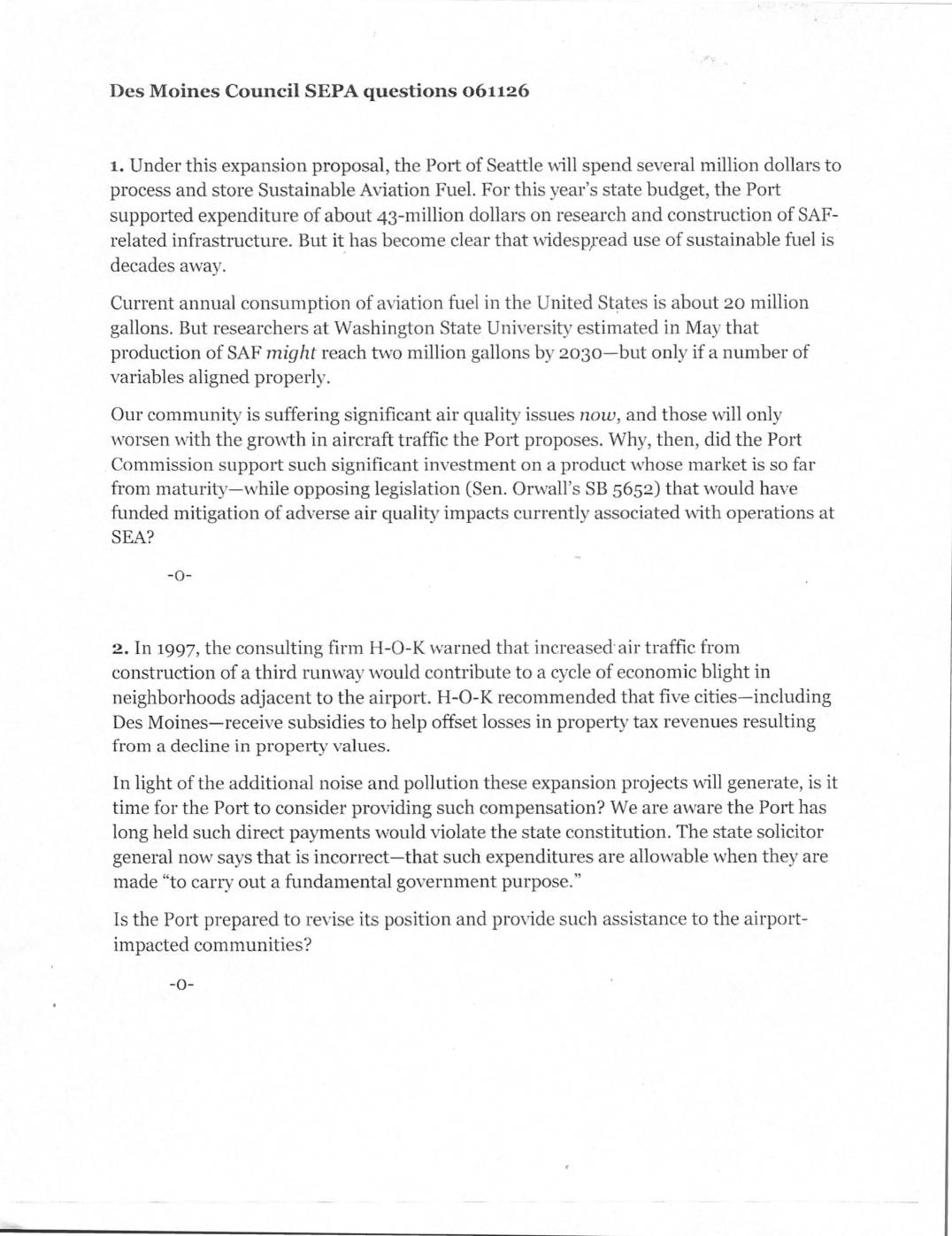
Des Moines Council SEPA questions 061126
The Des Moines City Council submitted a series of formal questions challenging the Port of Seattle's environmental review of its airport expansion plan, raising concerns about air quality, noise impacts, and community compensation. Key issues include the Port's heavy investment in Sustainable Aviation Fuel despite its limited near-term viability, the use of outdated federal noise standards, failed home noise-mitigation packages with no funding to repair them, and whether the SEPA review adequately analyzed hazardous air pollutants and peak traffic impacts. The Council also questioned whether the Port should provide direct financial assistance to affected neighboring cities, citing a state solicitor general opinion that such payments may be legally permissible. -
 2026-06-13
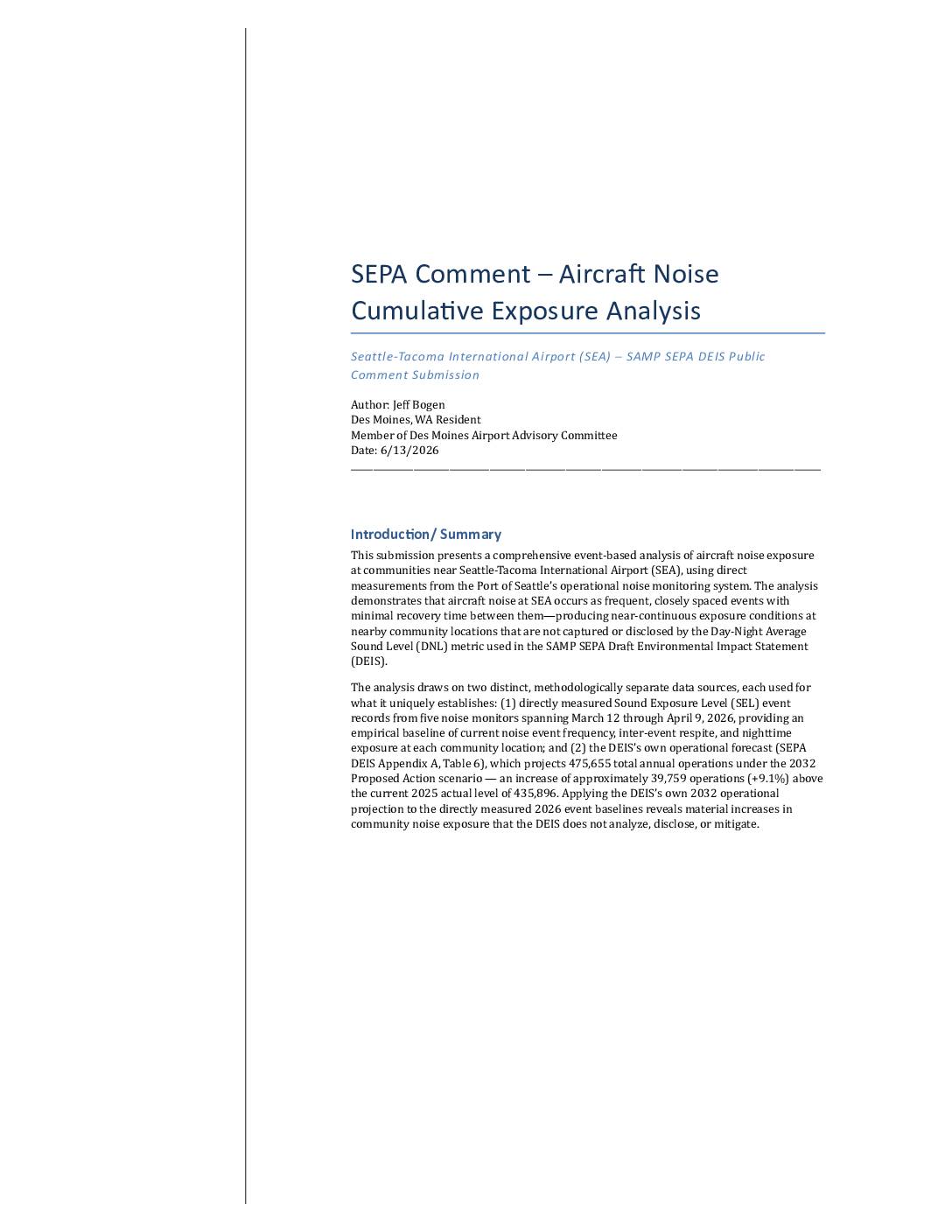
SEPA Comment: Aircraft Noise Cumulative Exposure Analysis – Sea-Tac Airport SAMP SEPA DEIS
A Des Moines, WA resident and airport advisory committee member submitted this public comment to challenge the noise analysis in the Sea-Tac Airport (SEA) expansion environmental review, arguing that the standard Day-Night Average Sound Level (DNL) metric fails to capture how frequently aircraft noise actually occurs in nearby neighborhoods. Using direct measurements from five Port of Seattle noise monitors, the analysis found that some community locations currently experience roughly 529 aircraft noise events per day with a median quiet gap of only 1.5 minutes between them—conditions the commenter projects will worsen by 2032. The submission calls on the Port of Seattle to supplement its environmental review with event-based noise metrics that reflect real community exposure, including nighttime event counts and inter-event recovery time, as required under Washington State's environmental review law (SEPA). -
 2026-06-13
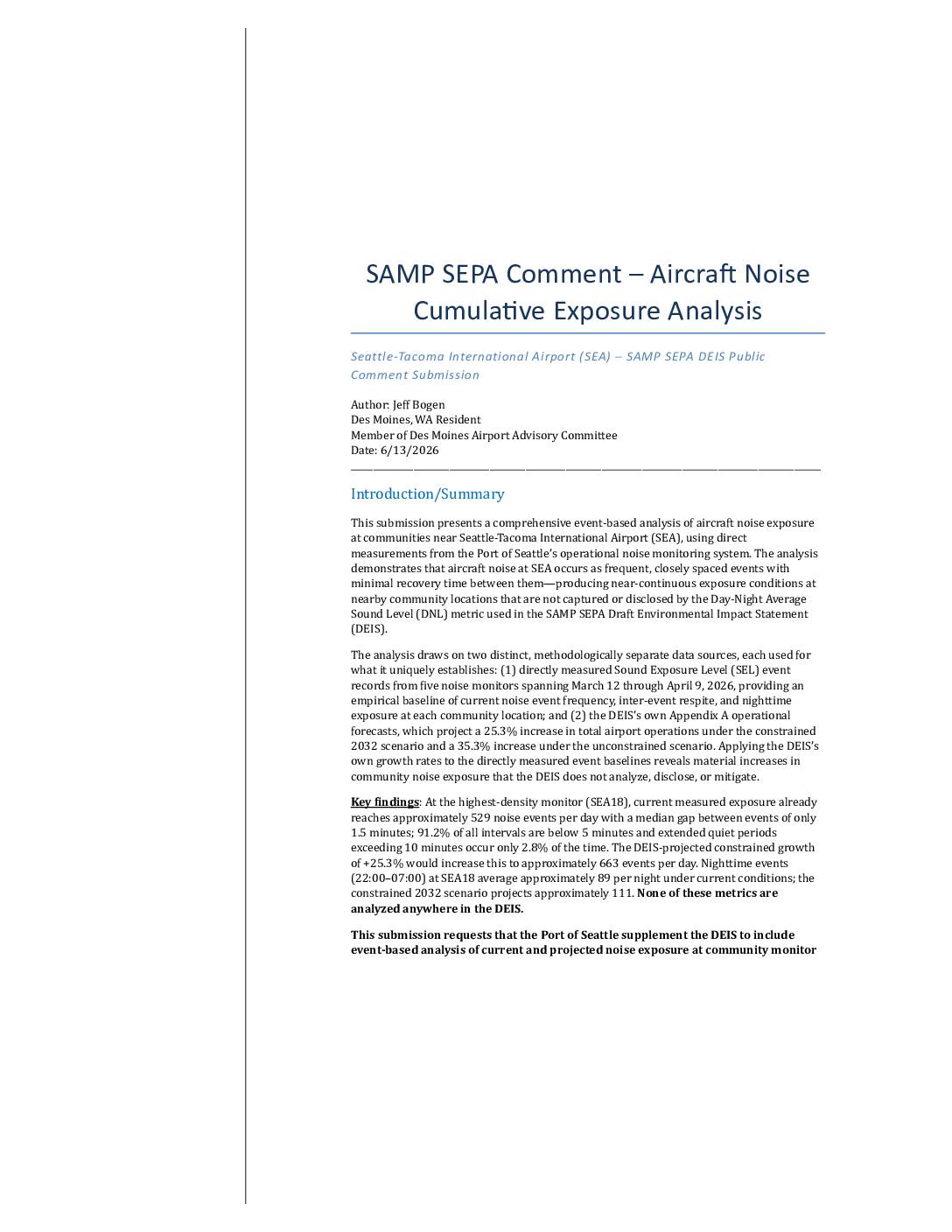
SAMP SEPA Comment – Aircraft Noise Cumulative Exposure Analysis
A Des Moines, WA resident and airport advisory committee member submitted this public comment challenging the noise analysis in the Sea-Tac Airport (SEA) expansion environmental review, arguing that the standard Day-Night Average Sound Level (DNL) metric used by the Port of Seattle fails to capture the true burden of aircraft noise on nearby communities. Using direct measurements from Port noise monitors, the analysis found that some locations currently experience around 529 noise events per day with a median gap of only 1.5 minutes between events, conditions projected to worsen significantly under the airport's own growth forecasts. The comment calls on the Port to supplement its environmental review with event-based noise metrics—such as event frequency, quiet-period gaps, and nighttime disturbances—that research links more directly to health impacts like sleep disruption and cardiovascular disease. -
Appendix k socioeconomics environmental justice and children8217s health page 5
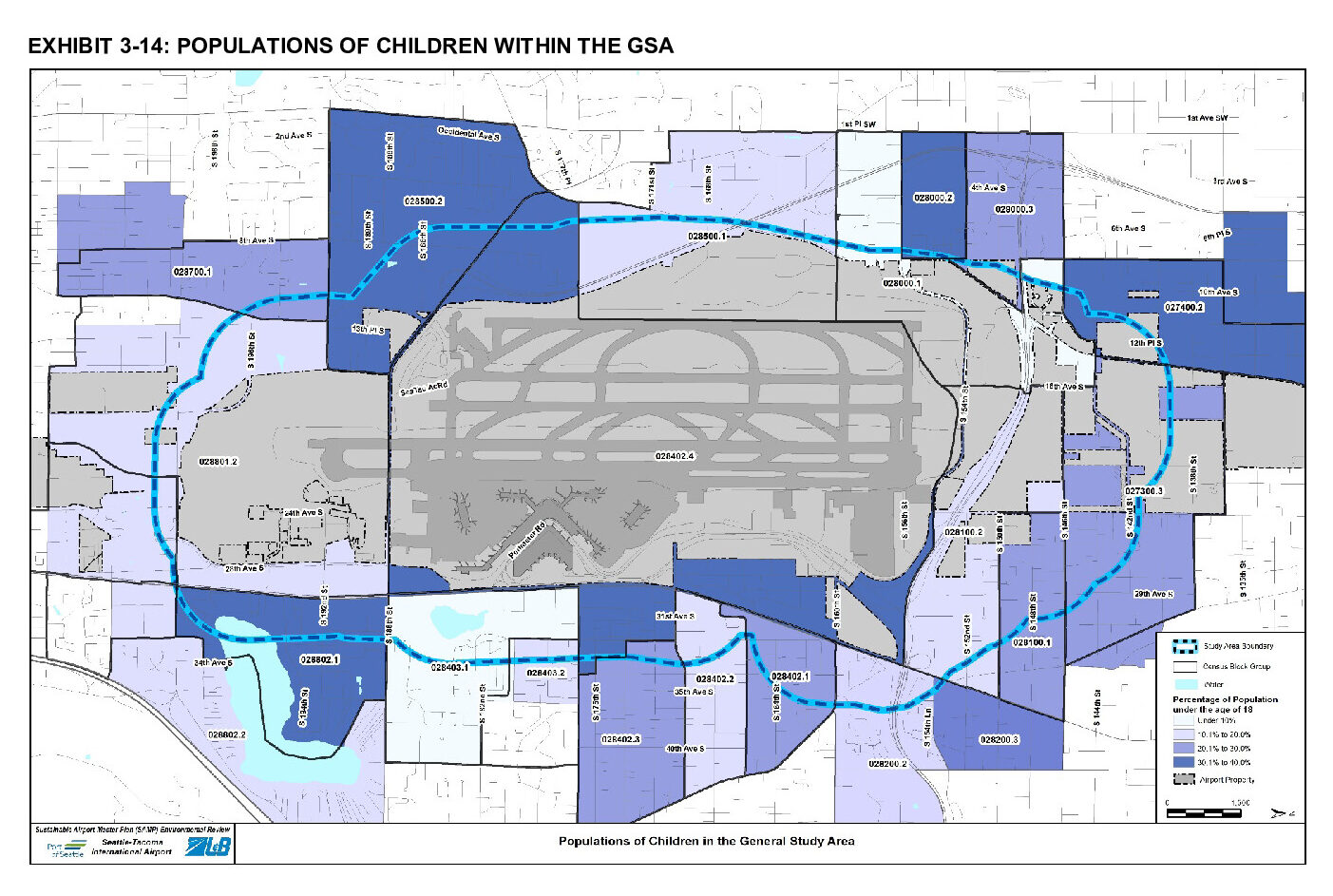
This map, from the Seattle-Tacoma International Airport Sustainable Airport Master Plan (SAMP) Environmental Review, shows census block group data on the percentage of population under age 18 within the General Study Area (GSA) surrounding Sea-Tac Airport. Shading indicates four tiers of child population density (under 10% through 30.1–40%), with the dashed blue line marking the study area boundary around the airport's runways and terminal facilities. -
 2026-05-28
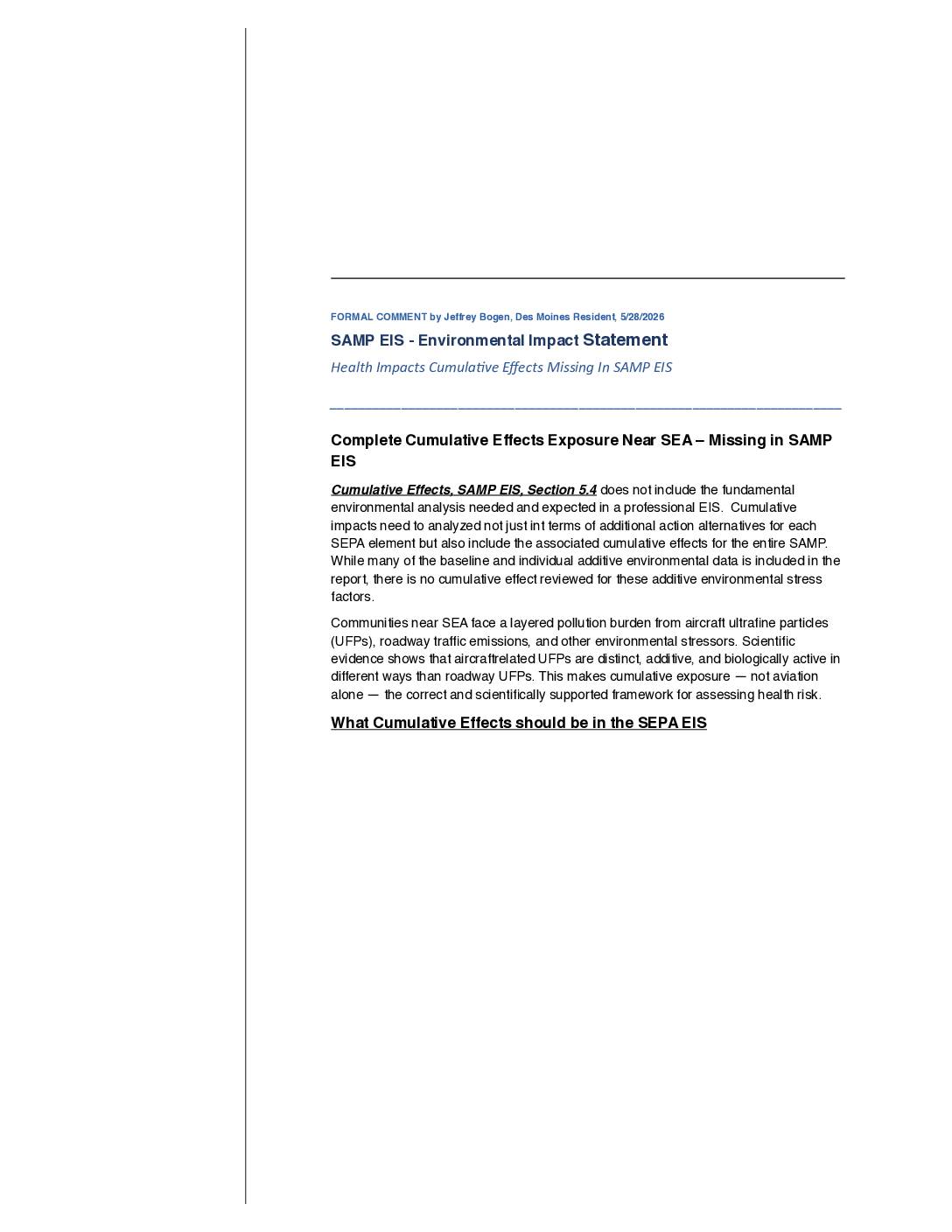
Formal Comment by Jeffrey Bogen: Cumulative Health Effects Missing in SAMP EIS
Des Moines resident Jeffrey Bogen submitted a formal comment arguing that the Sea-Tac Airport Master Plan (SAMP) Environmental Impact Statement fails to adequately analyze cumulative health effects on nearby communities. He contends that the EIS must go beyond examining individual pollution sources and instead assess the combined burden of aircraft ultrafine particles, roadway traffic emissions, chronic noise, and other stressors together, since scientific research shows these exposures interact and compound one another. Bogen calls for a comprehensive cumulative-risk framework, backed by ten peer-reviewed studies, to be incorporated into the EIS before any accurate public health or policy conclusions can be drawn. -
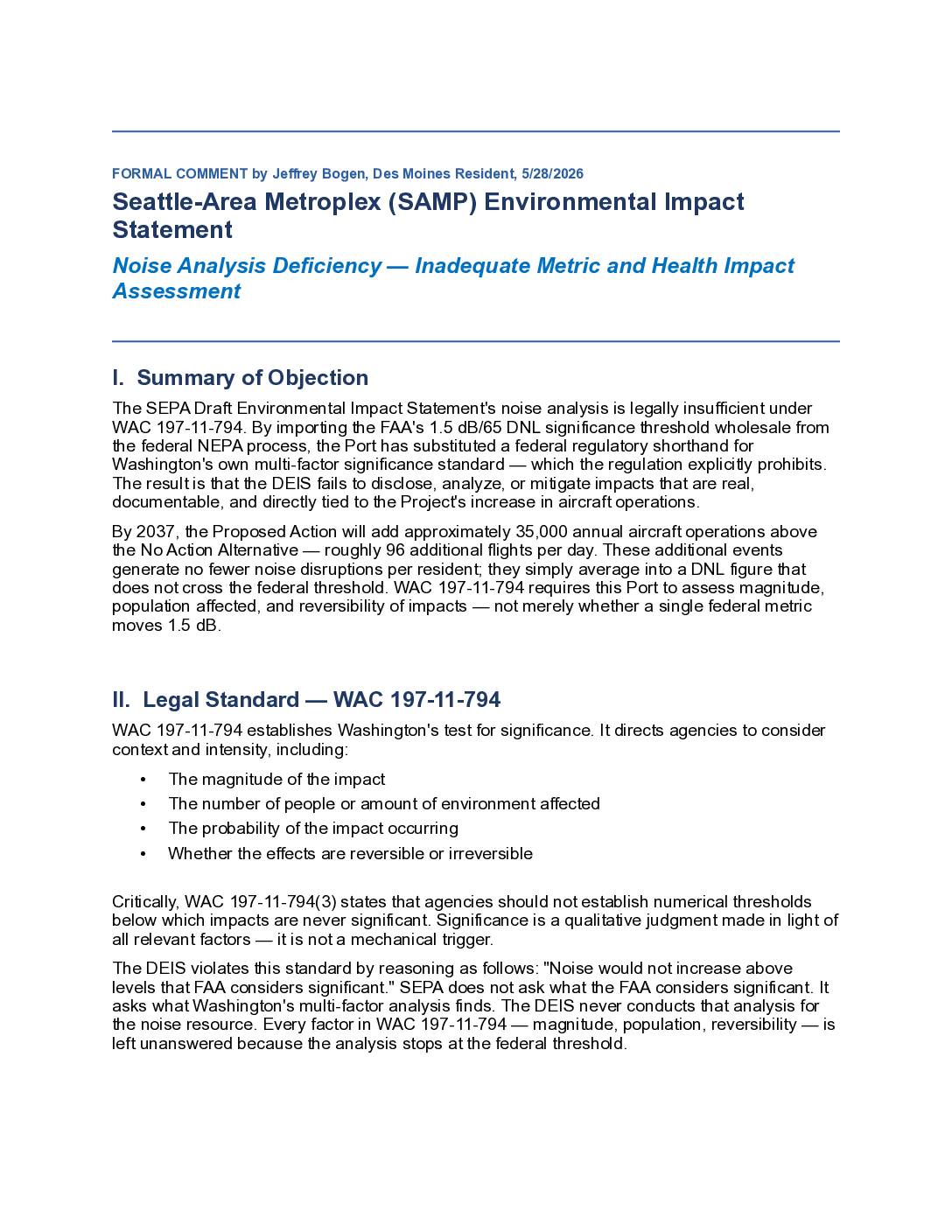 2026-05-28
Formal Comment of Jeffrey Bogen: SAMP Draft EIS Noise Analysis Deficiency — Inadequate Metric and Health Impact Assessment
A Des Moines resident's formal comment argues that the Seattle-Area Metroplex Environmental Impact Statement's noise analysis is legally inadequate because it relies solely on a federal FAA noise threshold rather than Washington State's own multi-factor significance standard. The comment contends that the standard noise metric used (DNL) masks the real impact of roughly 96 additional daily flights projected by 2037, since it averages out individual disturbance events rather than counting them. The commenter calls for supplemental analysis using alternative metrics—such as single-event sound levels and nighttime averages—supported by peer-reviewed health studies linking aircraft noise to sleep disruption and cardiovascular harm. -
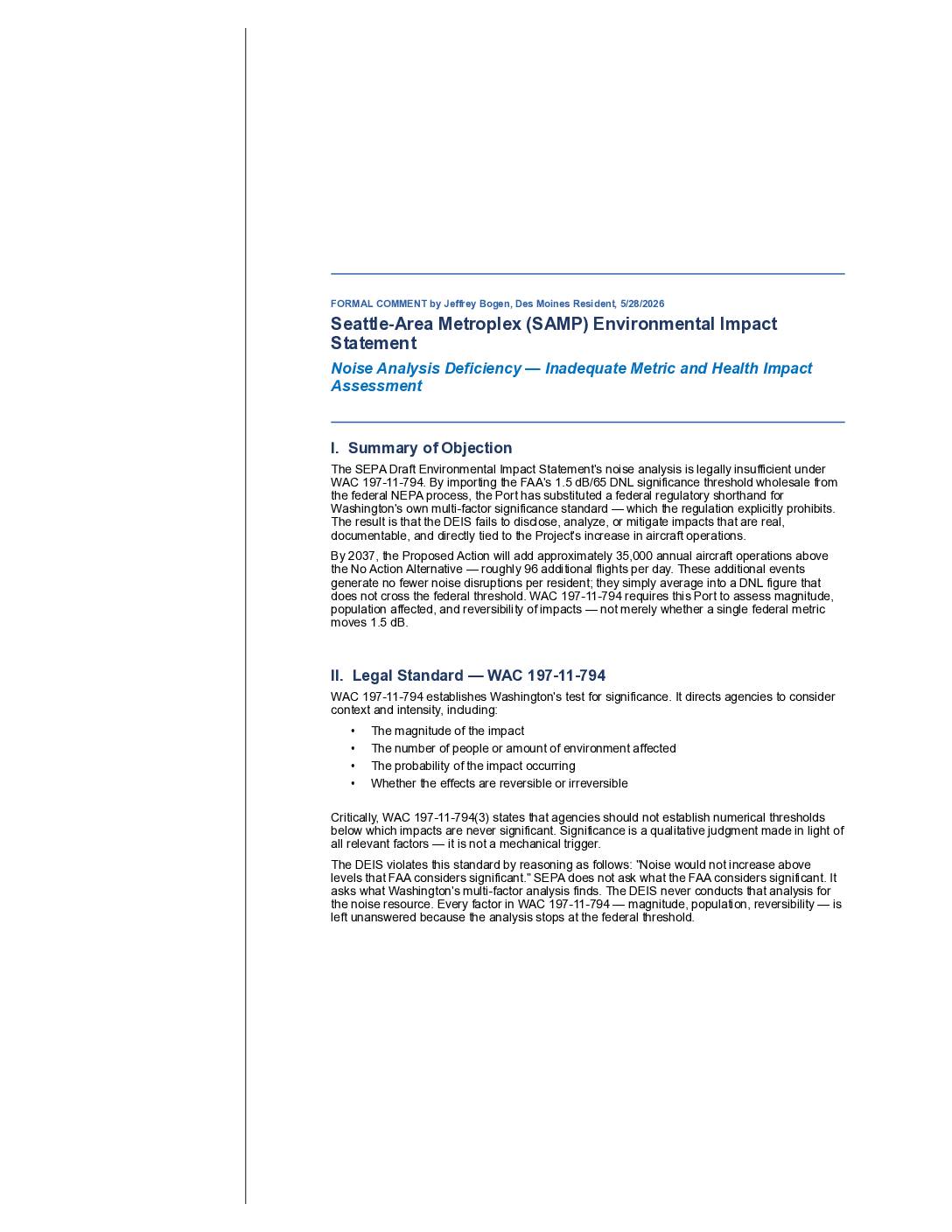 2026-05-28
Formal Comment by Jeffrey Bogen: SAMP SEPA Draft EIS Noise Analysis Deficiency — Inadequate Metric and Health Impact Assessment
Des Moines resident Jeffrey Bogen submitted a formal comment arguing that the Seattle-Area Metroplex Environmental Impact Statement's noise analysis is legally inadequate because it relies solely on a federal average-noise metric (DNL) rather than Washington State's broader, multi-factor significance standard. Bogen contends that with roughly 96 additional flights per day projected by 2037, residents will experience more frequent individual noise disruptions — including sleep disturbance and cardiovascular stress — that the DNL metric is mathematically incapable of detecting. He calls on the Port of Seattle to supplement its Final EIS with event-level and nighttime noise metrics supported by peer-reviewed health research, including the FAA's own National Sleep Study. -
 2026-05-26
Sustainable Airport Master Plan near-term projects: State Environmental Policy Act draft environmental impact statement and next steps
The Port of Seattle presented a draft Environmental Impact Statement under Washington State's environmental review law (SEPA) for a set of near-term construction projects at Seattle-Tacoma International Airport. The projects, part of the Sustainable Airport Master Plan, include expansions and improvements such as new gates, taxiway extensions, a second terminal, cargo facilities, and roadway upgrades. The presentation outlined the environmental review process and next steps, including public outreach and engagement. -
 2026-05-26
Sustainable airport master plan near-term projects state environmental policy act draft environmental impact statement and next steps
Presentation about the Port of Seattle’s Sustainable Airport Master Plan Near-Term Projects, covering the completed NEPA process and the required SEPA Draft Environmental Impact Statement. The document outlines various airport infrastructure projects including runway improvements, terminal facilities, maintenance facilities, and cargo operations planned for Sea-Tac Airport. -
 2026-05-22
Appendix O: Agency & Public Engagement
Appendix O is a placeholder section titled 'Agency & Public Engagement,' reserved for public comment and public engagement information that will be included in the final SEPA (State Environmental Policy Act) Environmental Impact Statement. No content has been populated in this draft version. The completed section will document how agencies and the public were involved in the environmental review process.