TagSea-Tac Airport(1835)
-
 2001-07-25
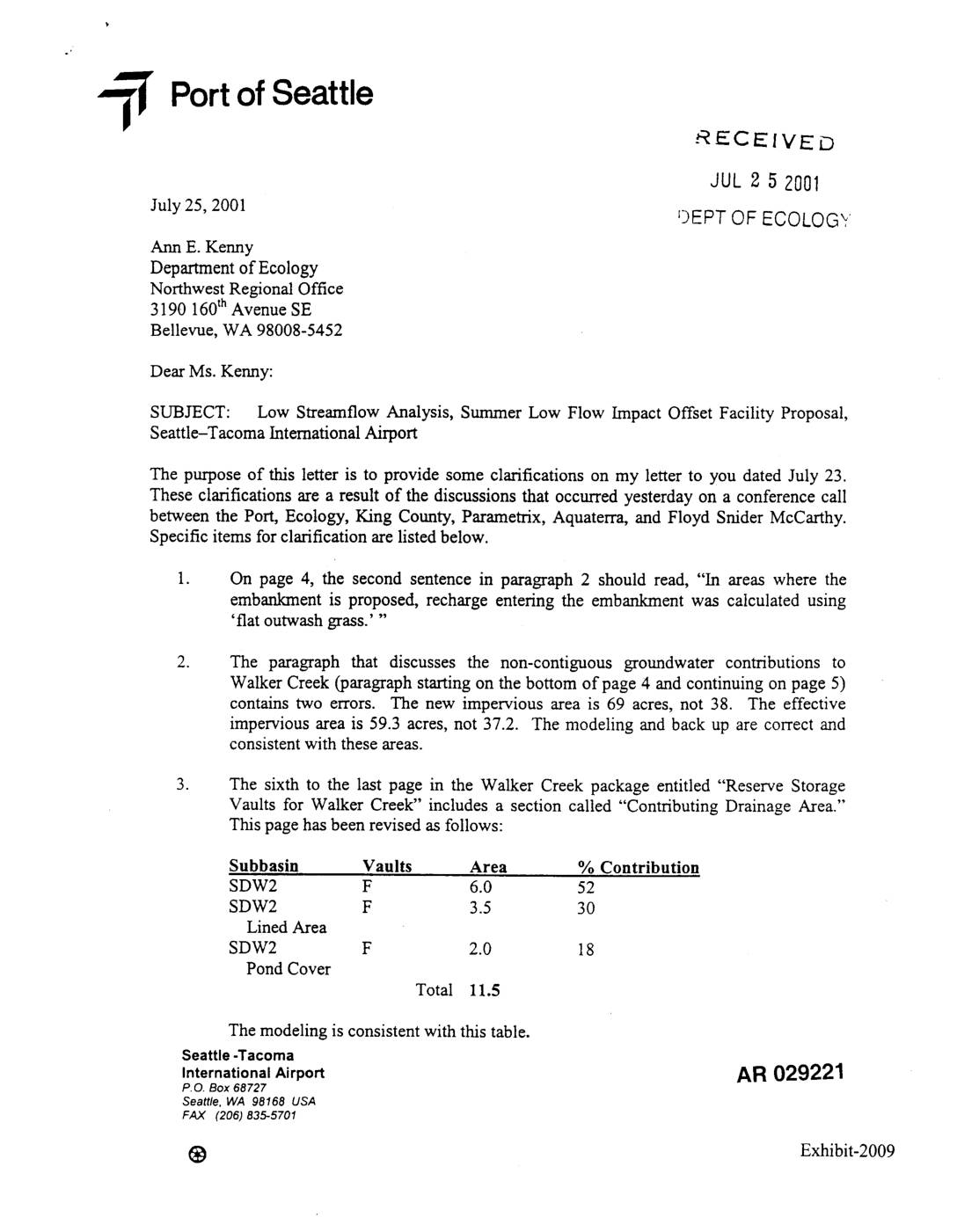
EXH AR029221: Port Of Seattle Letter to Ecology on Low Streamflow Analysis, Summer Low Flow Impact Offset Facility, STIA
Letter dated July 25, 2001 from Keith R. Smith, Water Resources Manager, Port Of Seattle, to Ann E. Kenny, Washington Department of Ecology Northwest Regional Office, clarifying the Low Streamflow Analysis and Summer Low Flow Impact Offset Facility Proposal for Seattle-Tacoma International Airport. Corrections address: embankment recharge calculation using ‘flat outwash grass’; non-contiguous groundwater contributions -
 2001-07-24
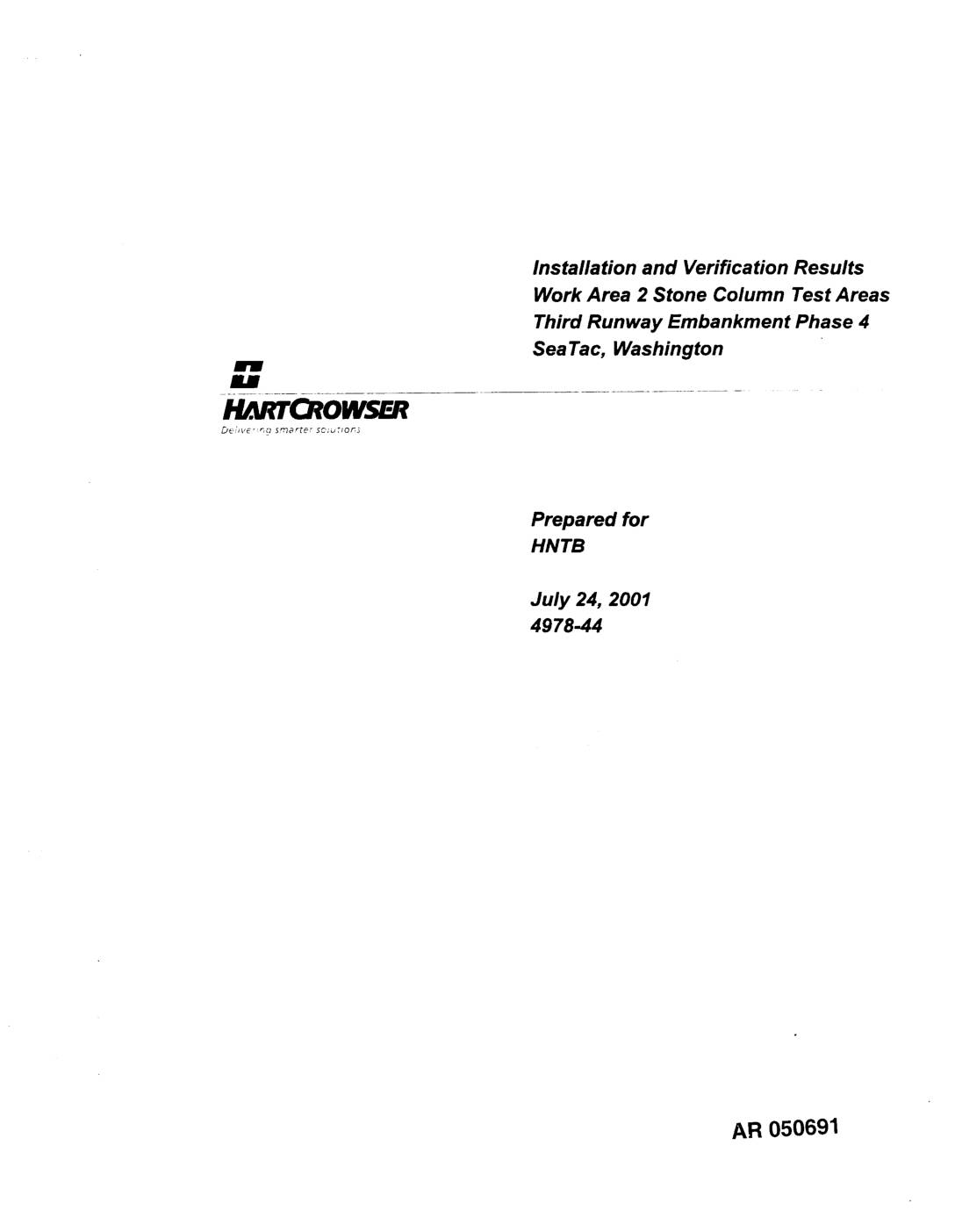
EXH AR050691: Installation and Verification Results, Work Area 2 Stone Column Test Areas, Third Runway Embankment Phase 4, Sea-Tac, Washington
Hart Crowser report (project 4978-44) prepared for HNTB documenting installation and verification results for Work Area 2 stone column test areas at the Third Runway Embankment Phase 4, SeaTac, Washington. Authored by Barry S. Chen, Ph.D., P.E. (Senior Associate Geotechnical Engineer) and John P. Laplante (Senior Staff Geotechnical Engineer). Report covers four test areas with -
 2001-07-23
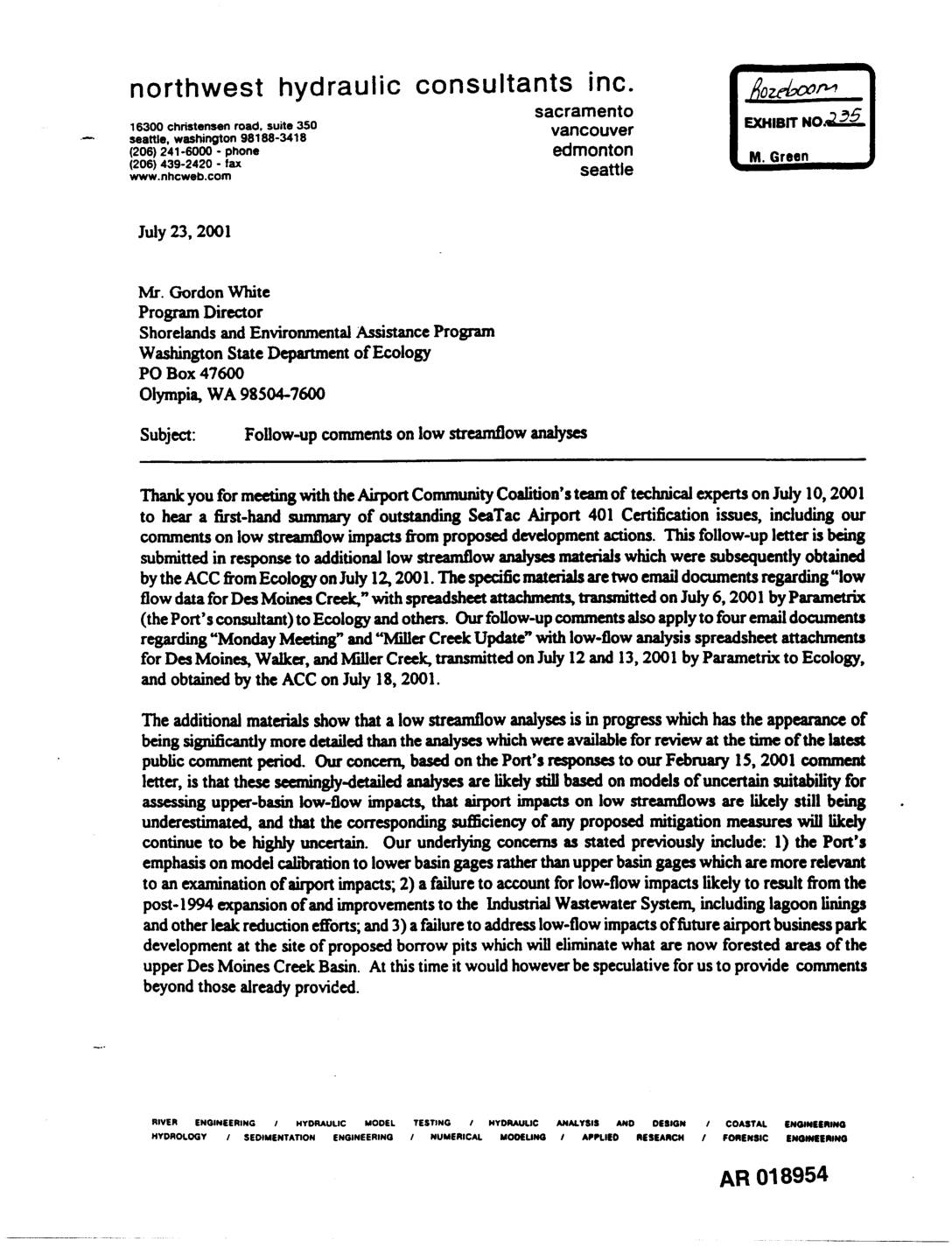
EXH 235: Follow-up Comments Low Streamflow Analyses — ACC Letter to Ecology
In a July 2001 letter to the Washington State Department of Ecology, Northwest Hydraulic Consultants raised concerns on behalf of the Airport Community Coalition that the Port of Seattle's ongoing low streamflow analyses for Des Moines, Walker, and Miller Creeks near Sea-Tac Airport were likely underestimating the airport's impact on local waterways. The consultants argued that the models were poorly calibrated for upper-basin conditions and failed to account for post-1994 improvements to the Industrial Wastewater System or the future loss of forested areas due to planned airport development. They requested that a final report on the streamflow analysis and any proposed mitigation measures be made available for public comment before Ecology used it to make its 401 Certification decision. -
 2001-07-17
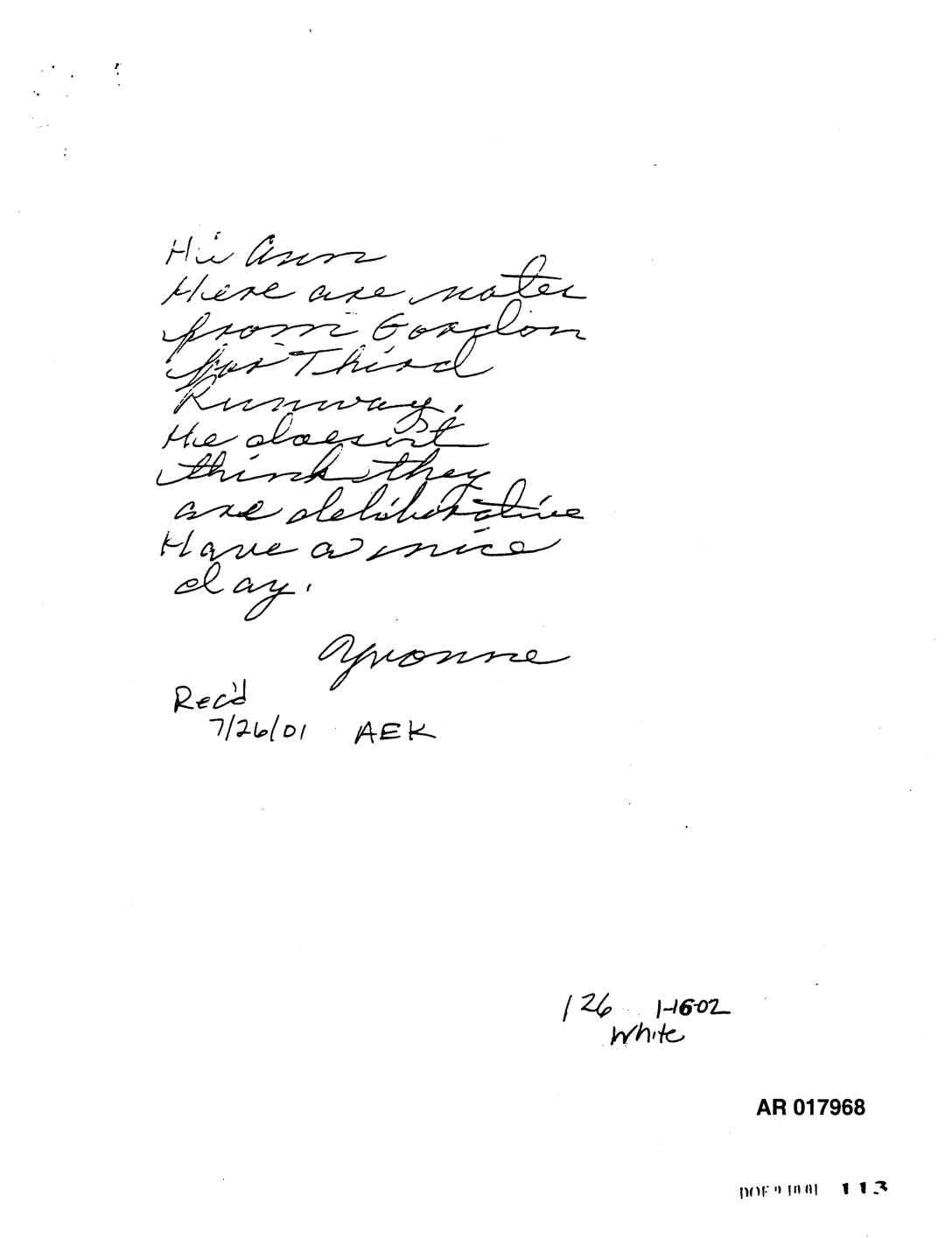
EXH AR017968: Handwritten Notes from Yvonne — Third Runway SMP/Low Flow Status Meeting, 7/17/01
Handwritten note from Yvonne to ‘Azura’ transmitting notes from Gordon regarding the Third Runway, noting he does not think they are deliberative. Also includes meeting notes dated 7/17/01 at 10pm for a Third Runway Project Update attended by Ann K, Ray H, John M, Kevin F, Tania Sorenson, Kelly Whittig. Notes cover SMP/Low Flow status: -
 2001-07-12
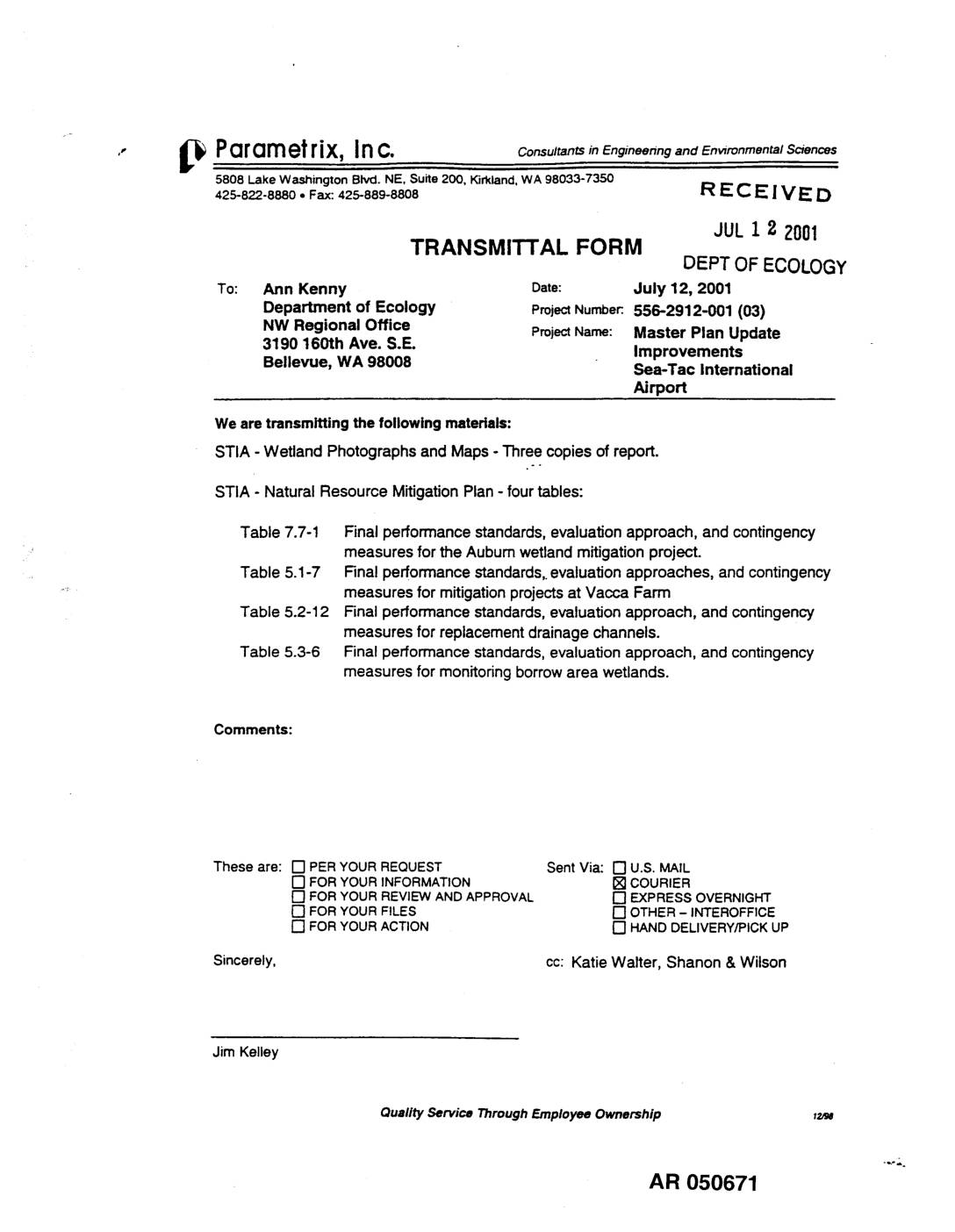
EXH AR050671: Transmittal Form — STIA Natural Resource Mitigation Plan Tables and Wetland Photographs, Parametrix to Ecology
Transmittal form dated July 12, 2001 from Jim Kelley at Parametrix, Inc. (Kirkland, WA) to Ann Kenny at Washington Department of Ecology NW Regional Office (Bellevue, WA), project number 556-2912-001 (03), transmitting materials for the Sea-Tac International Airport Master Plan Update Improvements. Materials include three copies of STIA Wetland Photographs and Maps report, and four -
 2001-07-04
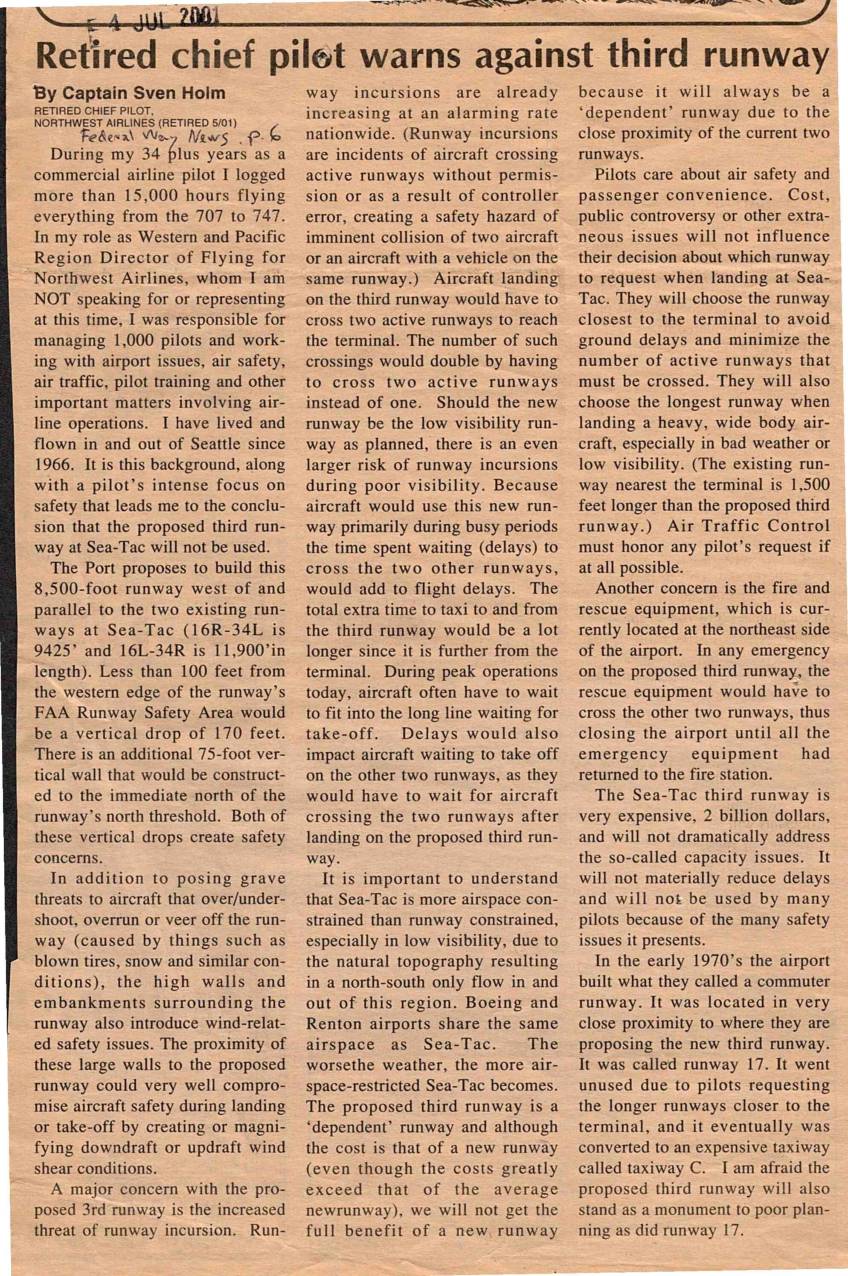
Retired chief pilot warns against third runway
A retired Northwest Airlines chief pilot with over 15,000 flight hours argues against the construction of a proposed third runway at Seattle-Tacoma International Airport, citing serious safety concerns including runway incursion risks, wind shear hazards from surrounding walls, and complications for fire and rescue operations. He contends that pilots will avoid the new runway because it is shorter and farther from the terminal than existing runways, meaning it will do little to reduce delays or increase capacity. Drawing a parallel to an unused commuter runway built at Sea-Tac in the 1970s, he warns that the $2 billion project will become a costly monument to poor planning. -
 2001-07-01
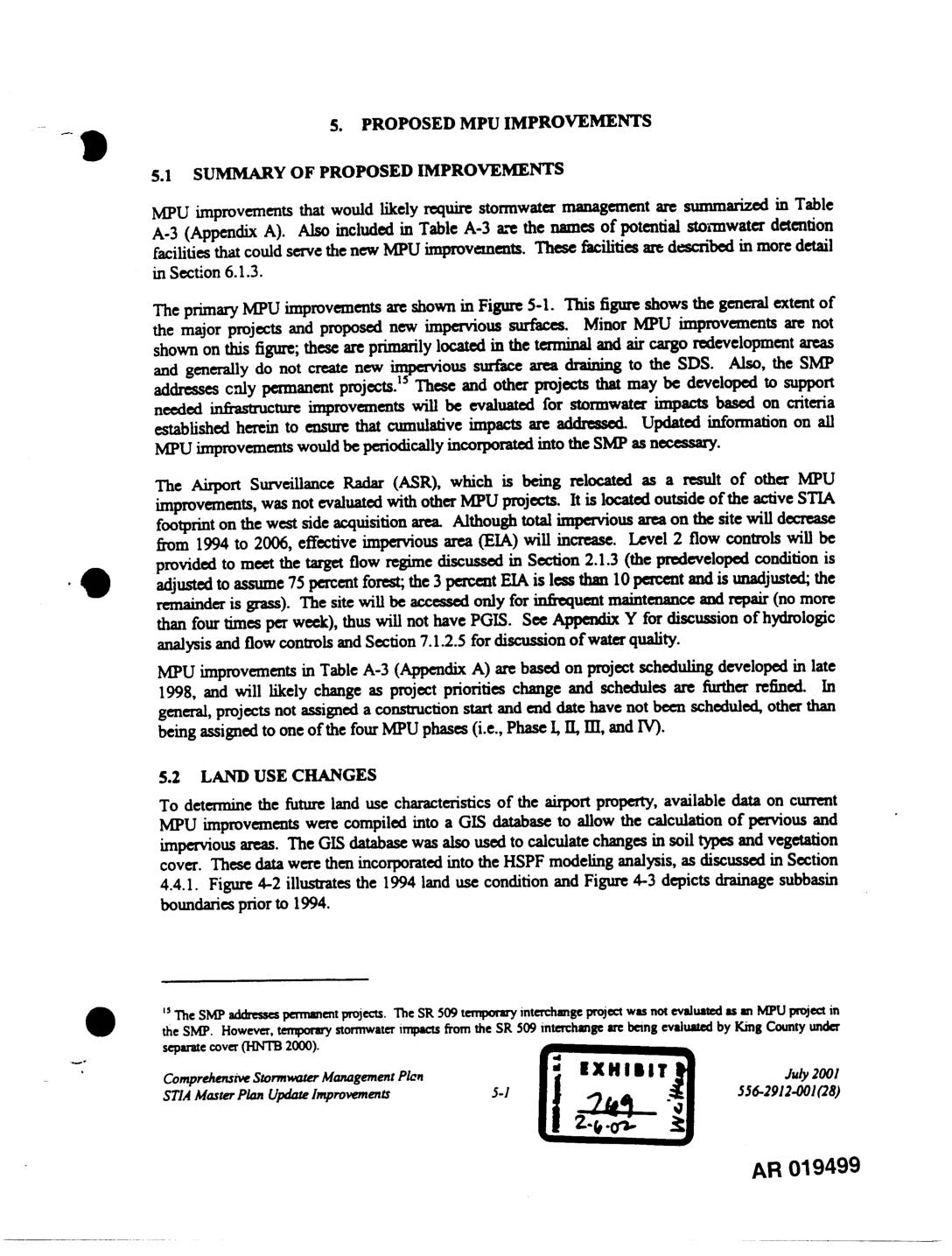
EXH AR019499: Proposed MPU Improvements — STIA Comprehensive Stormwater Mgmt Plan §5
This section of Sea-Tac International Airport's Comprehensive Stormwater Management Plan outlines proposed Master Plan Update (MPU) improvements and their likely stormwater management requirements. It describes how land use changes — including increases in impervious surfaces across various airport development phases — were analyzed using GIS and hydrologic modeling to assess drainage impacts. The document also notes that projects such as the relocated Airport Surveillance Radar required specific flow controls to manage stormwater runoff on the west side acquisition area. -
 2001-07-01
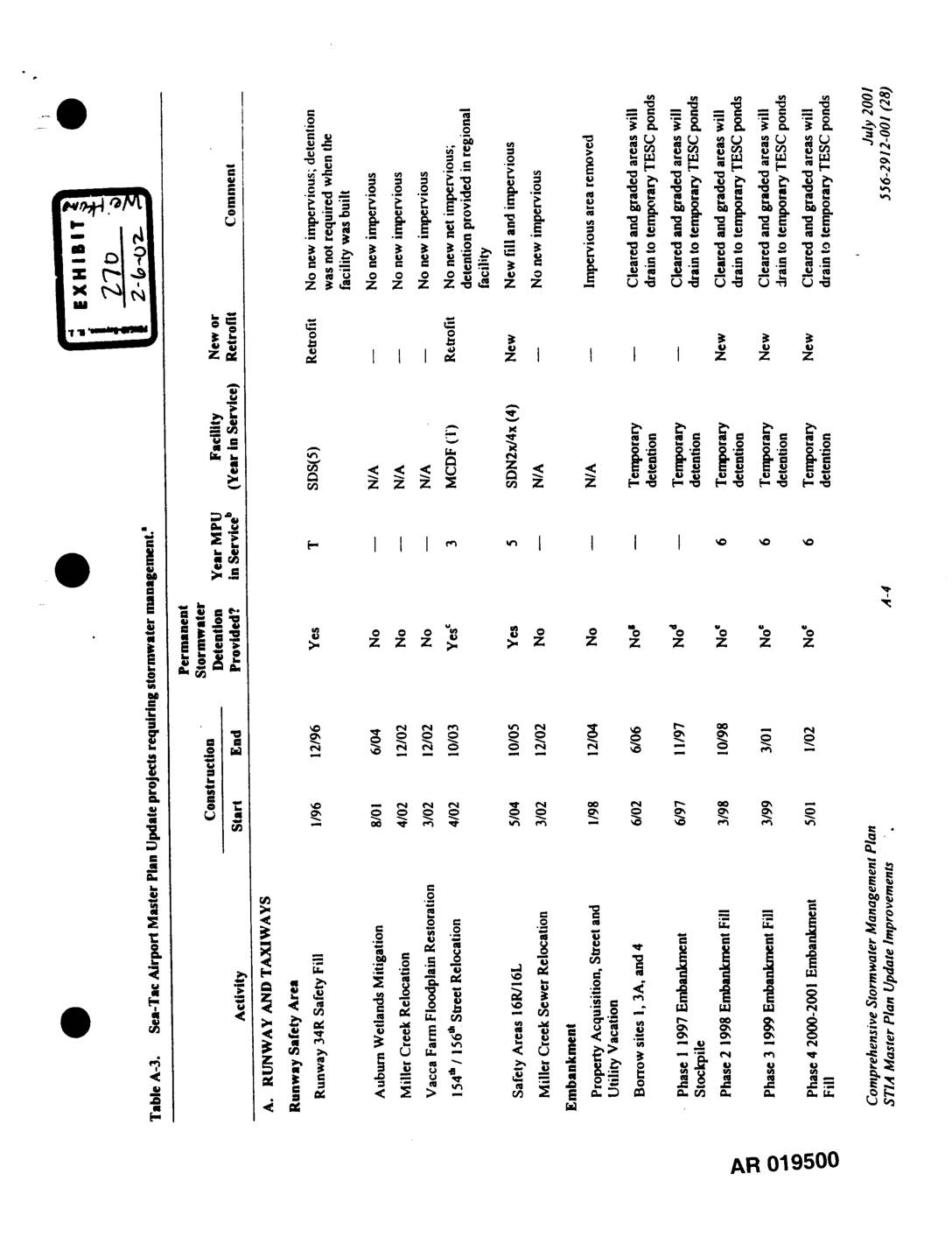
EXH 270: STIA Master Plan Update — Table A-3, Projects Requiring Stormwater Management
This document is Table A-3 from the Sea-Tac Airport Master Plan Update, outlining construction projects that require stormwater management. It details activities such as runway safety improvements, taxiway construction, terminal expansions, and embankment work, noting for each whether permanent stormwater detention was provided, the construction timeline, and the type of drainage facility used. Projects are categorized as either new or retrofit stormwater installations, with comments describing impervious surface impacts and drainage routing to temporary or permanent detention facilities. -
 2001-06-28
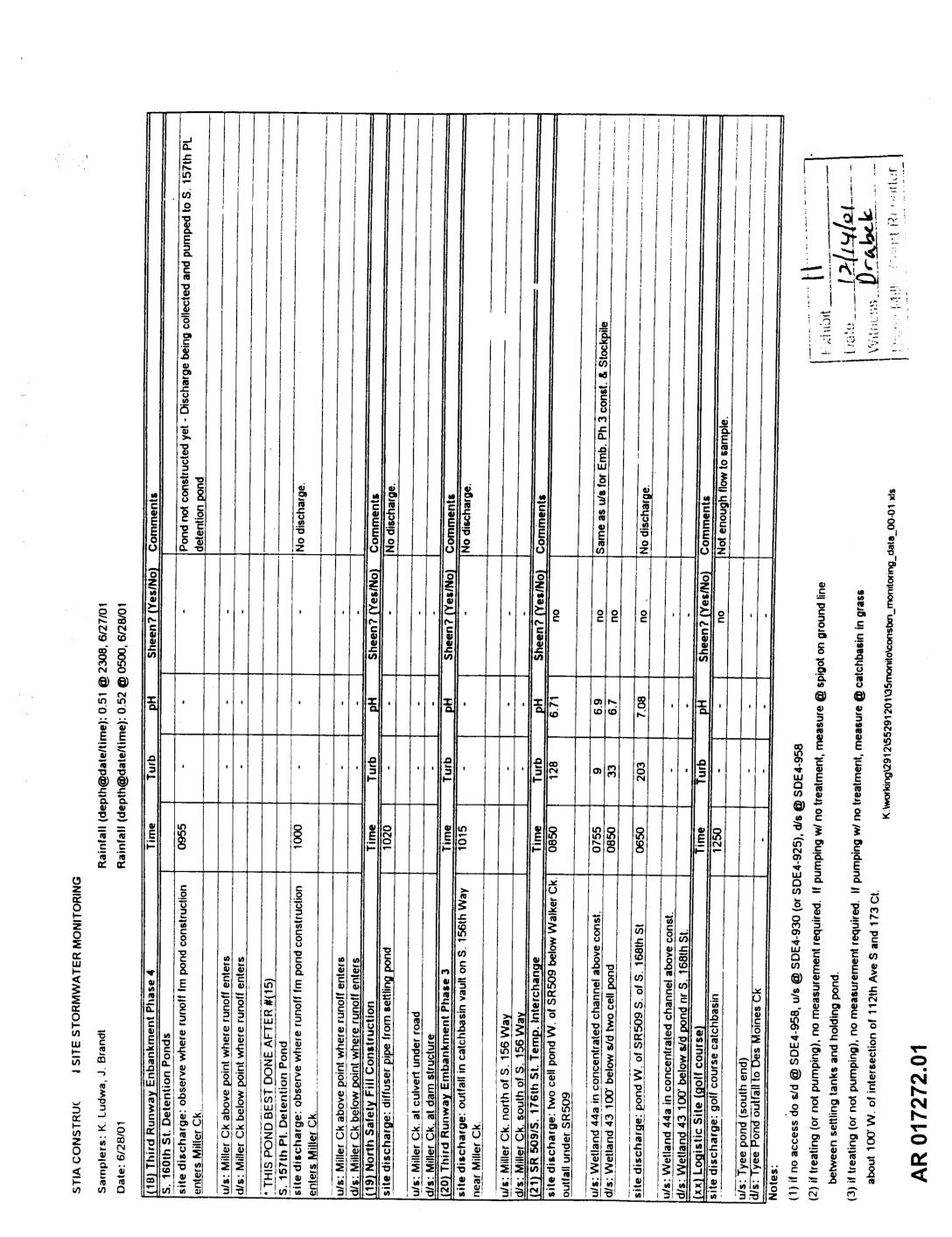
EXH AR017272: STIA Construction Site Stormwater Monitoring Report
STIA construction site stormwater monitoring report dated 6/28/01, sampled by K. Ludwa and J. Brandt. Documents monitoring of multiple construction sites including Third Runway Embankment Phase 4, S. 160th St. Detention Ponds, S. 157th Pl. Detention Pond, North Safety Fill Construction, Third Runway Embankment Phase 3, North Runway Embankment Phase 3, Wetland 44a, Lonistic Site -
 2001-06-28
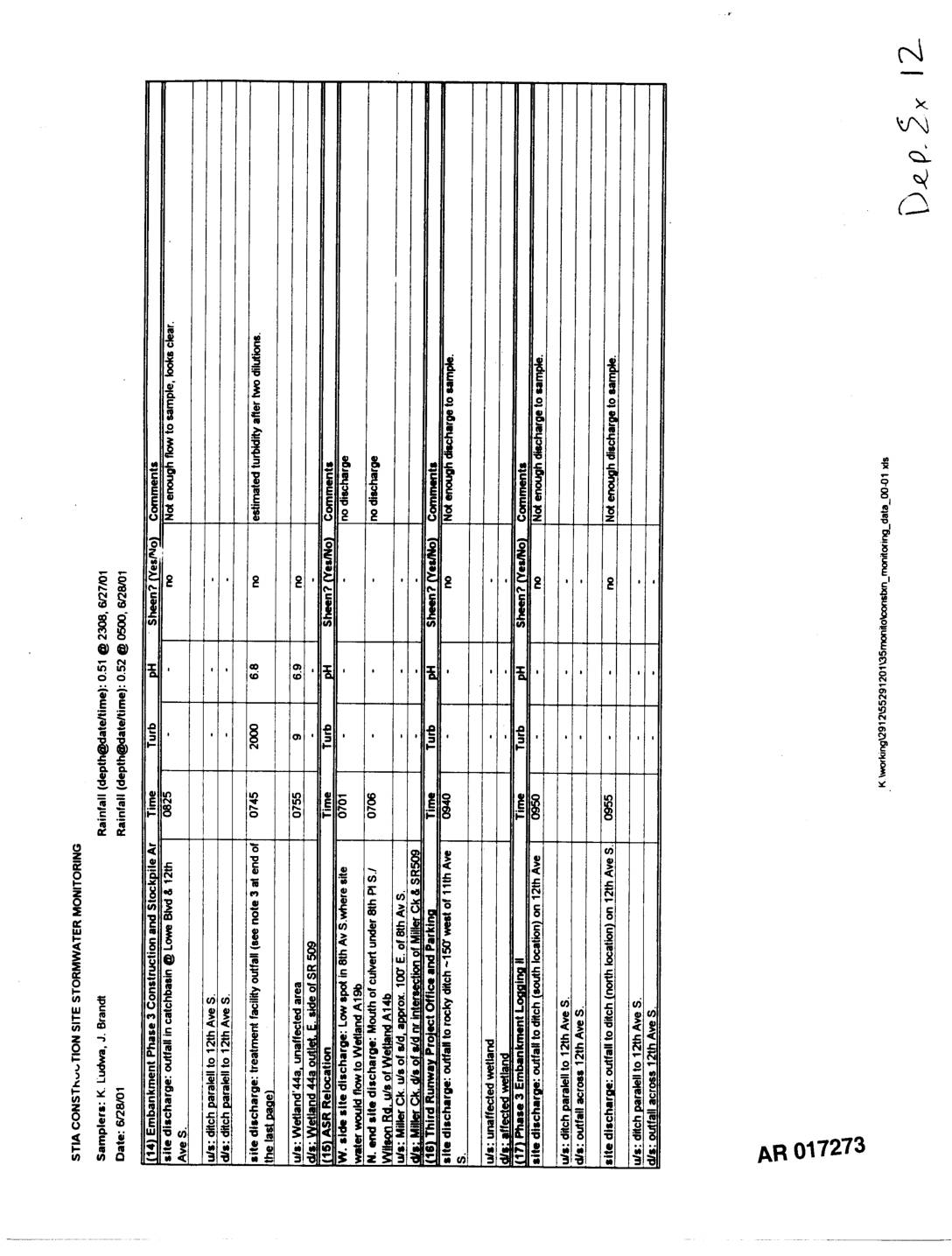
EXH AR017273: STIA Construction Site Stormwater Monitoring Report, 6/28/01
STIA construction site stormwater monitoring log dated 6/28/2001, samplers K. Ludwa and J. Brandt. Documents field observations for Phase 3 Embankment Construction, ASR Relocation, and Third Runway Project Office and Parking areas near Lowe Blvd & 12th Ave S, 8th Ave S, Miller Creek, SR509, Wilson Rd, and 12th Ave S. Records pH, turbidity, sheen