TagSAMP(650)
Articles tagged with the Sustainable Airport Master Plan.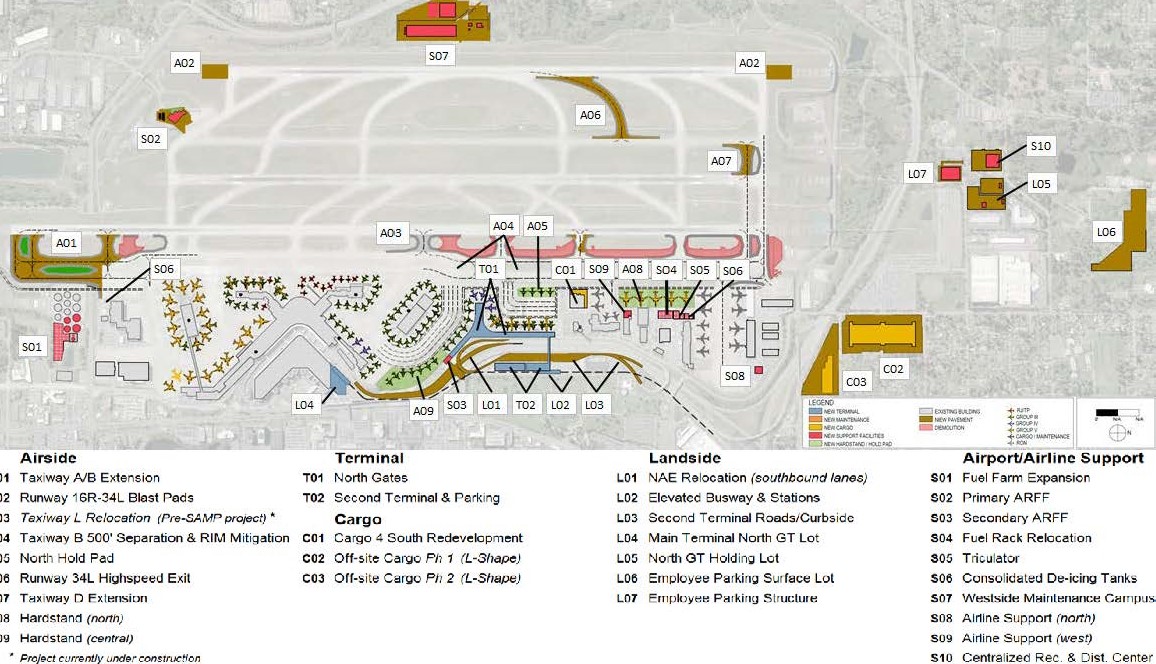
-
 2025-10-13
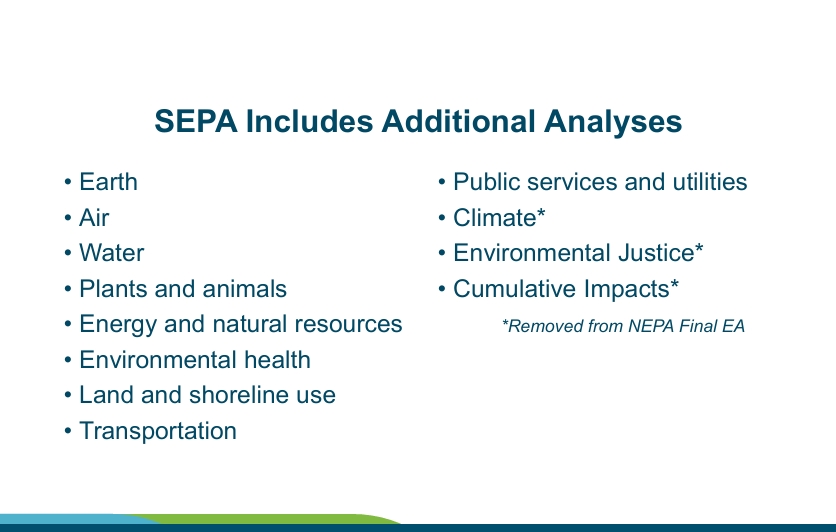
Port Commission briefing SAMP: SEPA Includes Additional Analyses
A presentation slide titled 'SEPA Includes Additional Analyses' lists environmental review topics covered under the State Environmental Policy Act (SEPA), including Earth, Air, Water, Plants and Animals, Energy and Natural Resources, Environmental Health, Land and Shoreline Use, Transportation, Public Services and Utilities, Climate, Environmental Justice, and Cumulative Impacts. A footnote notes that Climate, Environmental Justice, and Cumulative Impacts were removed from the NEPA Final EA, highlighting differences between state and federal environmental review processes relevant to Sea-Tac Airport proceedings. -
2025-10-08
Port of Seattle SAMP Webinar
Not deep. But a few good insights Airport Interim Aviation Director Arif Ghouse was joined by SAMP Environment Manager Steve Rybolt and Landrum & Brown’s Sarah Potter for a one hour and fifteen minute Q&A on the FAA’s recent Sustainable Airport Master Plan Record Of Decision. Both have been working on the project for many -
 2025-09-30
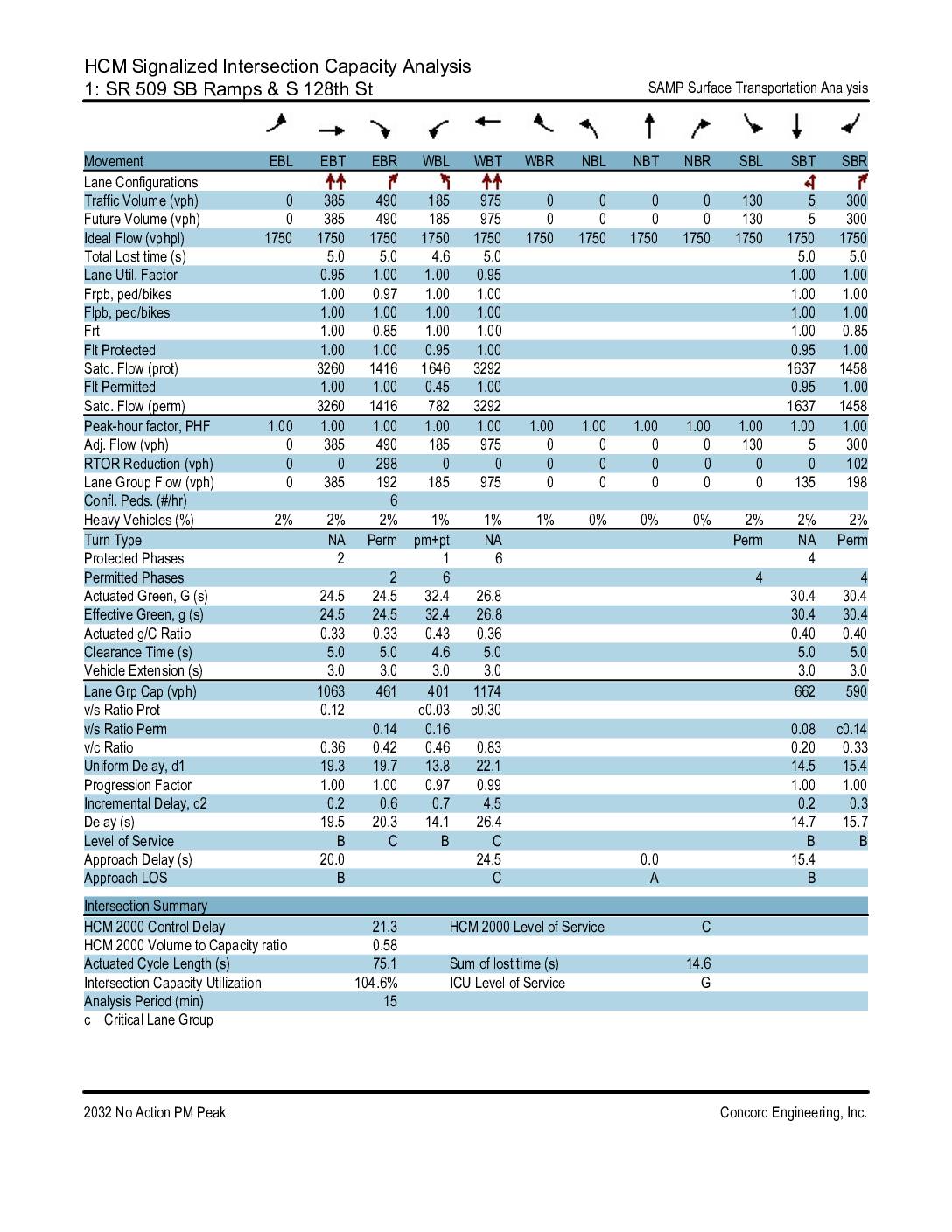
HCM Signalized Intersection Capacity Analysis: SR 509 SB Ramps, NB SR 509 Ramps, and Des Moines Way S at S 128th St — 2032 No Action PM Peak
This traffic engineering report analyzes three signalized intersections along S 128th Street near SR 509 in the Sea-Tac area under projected 2032 No Action conditions during the PM peak hour. The study finds that the SR 509 ramp intersections are operating well over capacity, with an Intersection Capacity Utilization of 104.6% and an ICU Level of Service G, while the Des Moines Way S intersection operates more acceptably at 63.3% ICU. Overall intersection control delays range from approximately 19 to 27 seconds, with most approaches functioning at Level of Service B or C. -
 2025-09-29
Appendix I: Natural Resources & Energy Supply — Bonneville Power Administration Strategic Plan Progress Update 2018–2023
The Bonneville Power Administration's 2018–2023 Strategic Plan Progress Update outlines the agency's efforts to improve its financial health, modernize its power grid assets, and better serve customers across the Pacific Northwest. The plan identifies five strategic goals, including strengthening financial performance, providing competitive power products, and valuing its workforce. This update, issued nearly three years after the original 2018 plan, documents accomplishments and highlights areas needing further attention. -
 2025-09-29
Appendix O: Agency & Public Engagement — Submitted Studies and Materials
The 1997 Sea-Tac International Airport Impact Mitigation Study is an initial assessment and recommendations report prepared for several cities near Seattle-Tacoma International Airport, including Burien, Des Moines, Federal Way, Normandy Park, and Tukwila, as well as the Highline School District and Highline Community Hospital. Funded by a State of Washington grant, the study was conducted by Hellmuth, Obata + Kassabaum, Inc. and Raytheon Infrastructure Services, Inc. to evaluate the airport's impacts on surrounding communities. The report was submitted as part of public engagement materials related to ongoing concerns about airport noise and air pollution affecting nearby residents and institutions. -
 2025-09-29
SAMP Draft EA Appendix O: Agency & Public Engagement Summary
Appendix O of the Sustainable Airport Master Plan (SAMP) Environmental Assessment documents how the FAA engaged the public and agencies during the NEPA review process for Sea-Tac Airport, including public meetings, briefings, and outreach to communities, elected officials, and underrepresented groups. The summary notes that several Executive Orders and CEQ regulations referenced during the Draft EA have since been revoked, and that the FAA's final decision will rely on updated federal guidance including FAA Order 1050.1F and Executive Order 14154. Public comments received and submitted studies are also included as part of this appendix. -
 2025-09-26
Appendix O: Agency & Public Engagement (with responses)
Appendix O of the FAA NEPA Draft Environmental Assessment (EA) for the Sustainable Airport Master Plan (SAMP) at Sea-Tac Airport. Documents agency and public engagement activities during the EA process, including coordination under NEPA (42 U.S.C. 4321 et seq.), FAA Orders 1050.1F and 5050.4B, and CEQ regulations (40 CFR parts 1500-1508). Notes regulatory changes including -
2025-09-26
FAA Signs Off on SAMP NTP
Finding of no significant impacts. 60 day appeal clock begins After an almost nine year process the Federal Aviation Administration (FAA) has issued its long-awaited Finding of No Significant Impact / Record of Decision (FONSI/ROD) for the Port of Seattle’s Sustainable Airport Master Plan Near-Term Projects (SAMP NTPs). This clears the way for construction on -
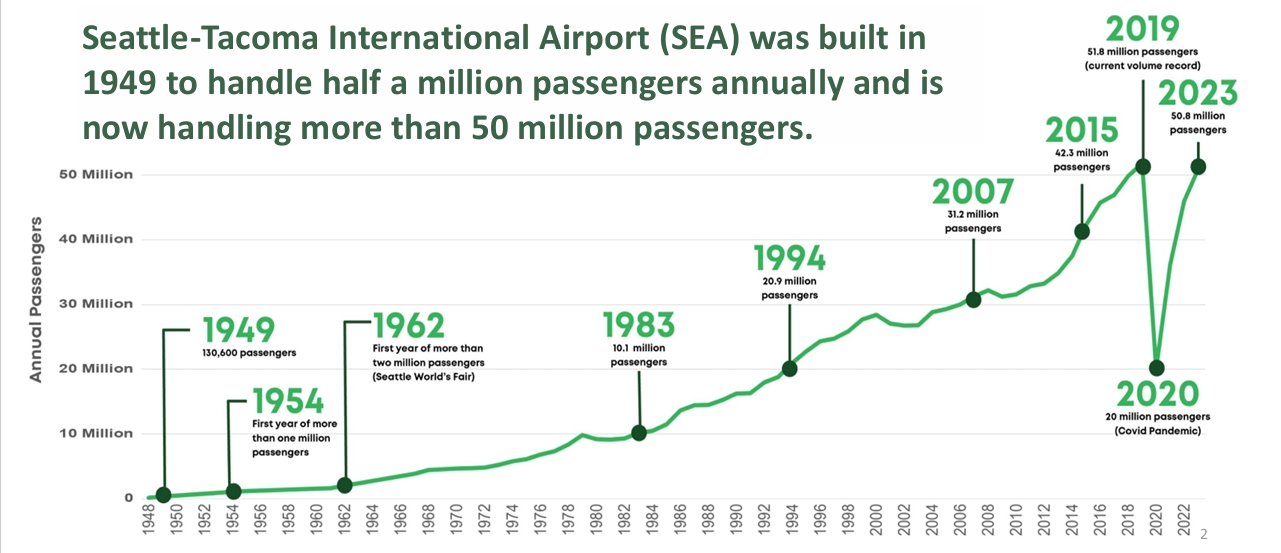
Seattle-Tacoma International Airport Annual Passenger Growth Chart, 1948–2023
A line graph documenting annual passenger volumes at Seattle-Tacoma International Airport (SEA) from 1948 to 2023, highlighting key milestones including 130,600 passengers at opening in 1949, a record 51.8 million passengers in 2019, a Covid-related drop to 20 million in 2020, and a recovery to 50.8 million in 2023. The chart notes the airport was originally built in 1949 to handle half a million passengers annually. -
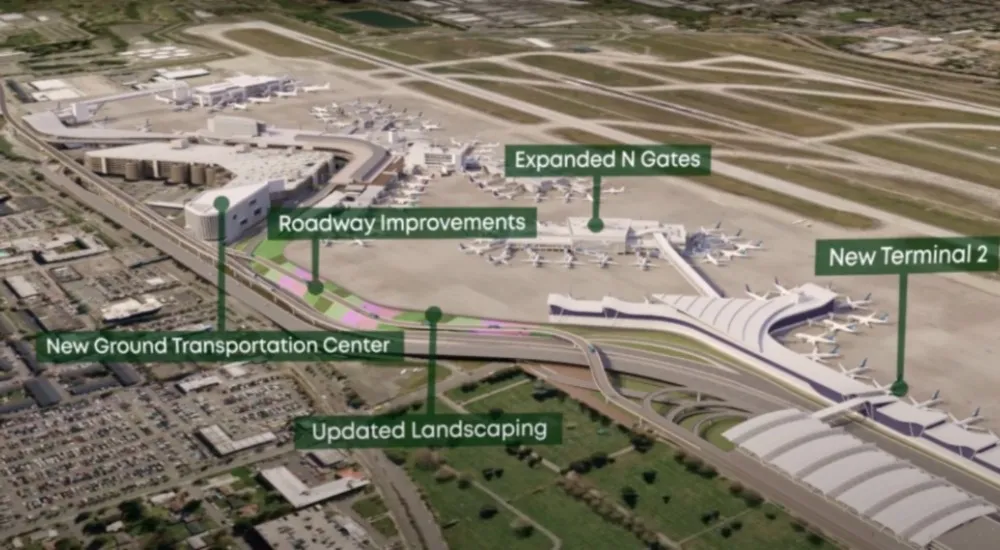
Airport-Merritt-resized-1
A 3D aerial rendering of an airport expansion plan highlighting five labeled elements: New Terminal 2, Expanded N Gates, Roadway Improvements, New Ground Transportation Center, and Updated Landscaping. The specific airport is not identified by name in any visible text within the image.