TagPuget Sound Regional Council(191)
-
 2023-05-01
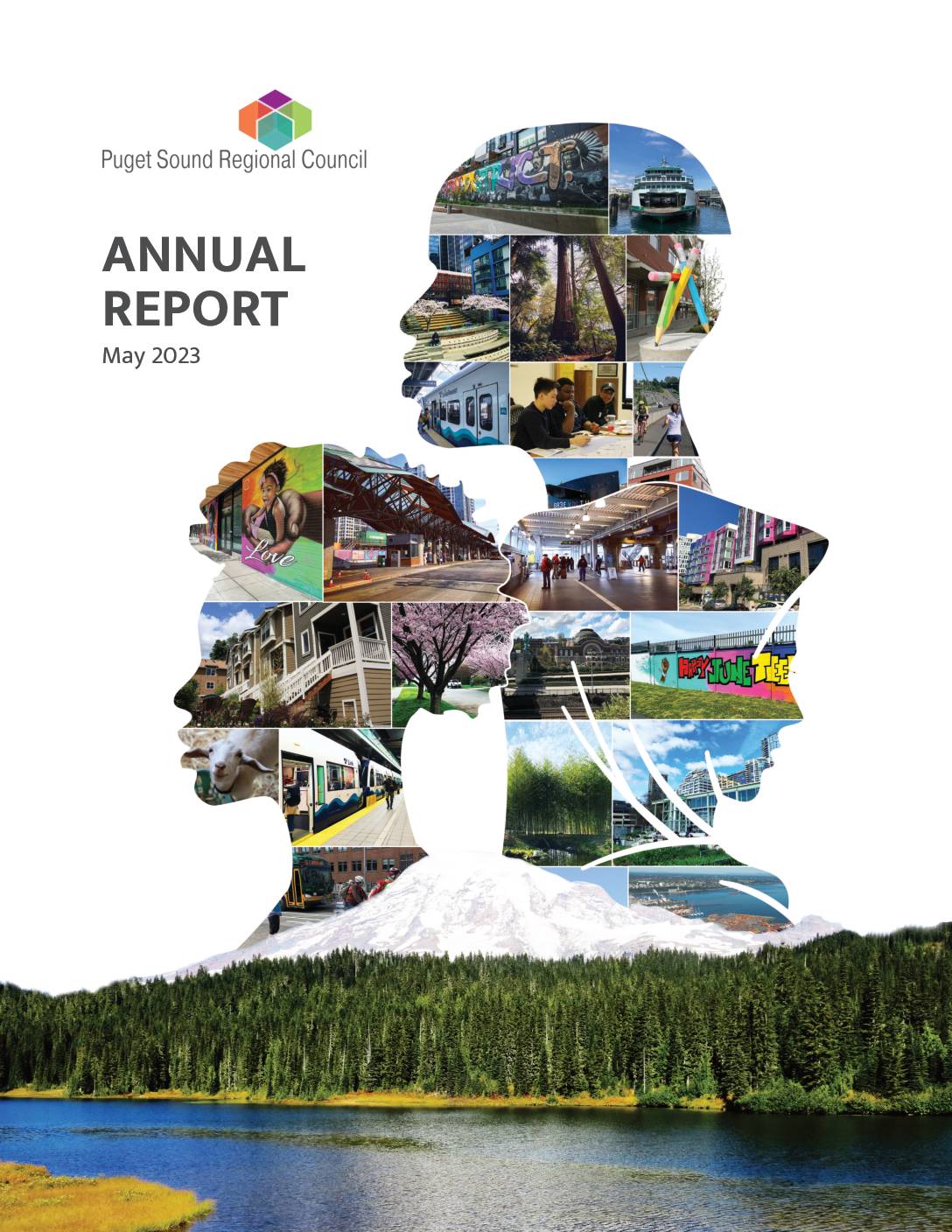
Puget Sound Regional Council Annual Report 2023
The Puget Sound Regional Council (PSRC) 2023 Annual Report highlights regional planning achievements including the adoption of a Regional Transportation Plan, a new Regional Housing Strategy, and Washington State's passage of House Bill 1110 to expand middle housing supply by an estimated 75,000 to 150,000 units over 20 years. The report also notes a $4.9 million grant secured for a Regional Safety Plan, progress on a Regional Equity Strategy, and efforts to support local comprehensive plan updates across the greater Puget Sound area. -
 2023-04-18
Engrossed Substitute House Bill 1791: Commercial Aviation Work Group
Washington State's Engrossed Substitute House Bill 1791, passed in 2023, establishes a new 19-member Commercial Aviation Work Group to study the state's long-term airport capacity needs, replacing the earlier Commercial Aviation Coordinating Commission. The bill responds to projections that by 2050, demand for flights in the central Puget Sound region will exceed Seattle-Tacoma International Airport's capacity, and directs the group to explore alternatives—including building or expanding other airports. The legislation acknowledges that any new airport site would carry significant environmental, health, and community impacts requiring decisions from federal, state, and local governments. -
 2023-03-08
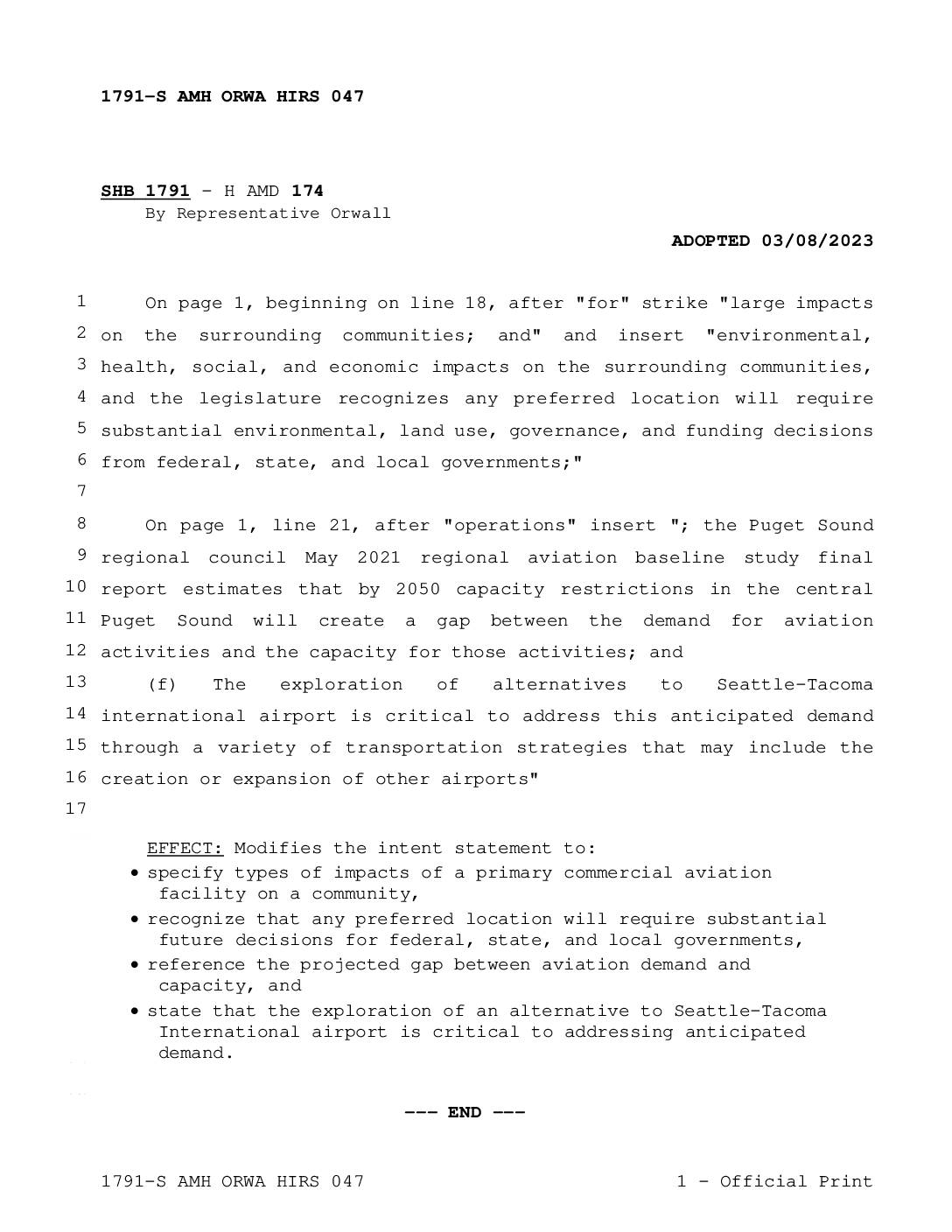
SHB 1791 – H AMD 174: Amendment to Modify Intent Statement on Commercial Aviation Facility Impacts and Sea-Tac Alternatives
This 2023 Washington State House amendment (adopted March 8, 2023) updates the intent statement of SHB 1791 to more specifically acknowledge the environmental, health, social, and economic impacts that a major commercial airport can have on surrounding communities. It references a Puget Sound Regional Council study projecting that by 2050, central Puget Sound will face a significant gap between aviation demand and capacity. The amendment emphasizes that exploring alternatives to Seattle-Tacoma International Airport — potentially including new or expanded airports — is critical to meeting future regional transportation needs. -
 2022-12-14
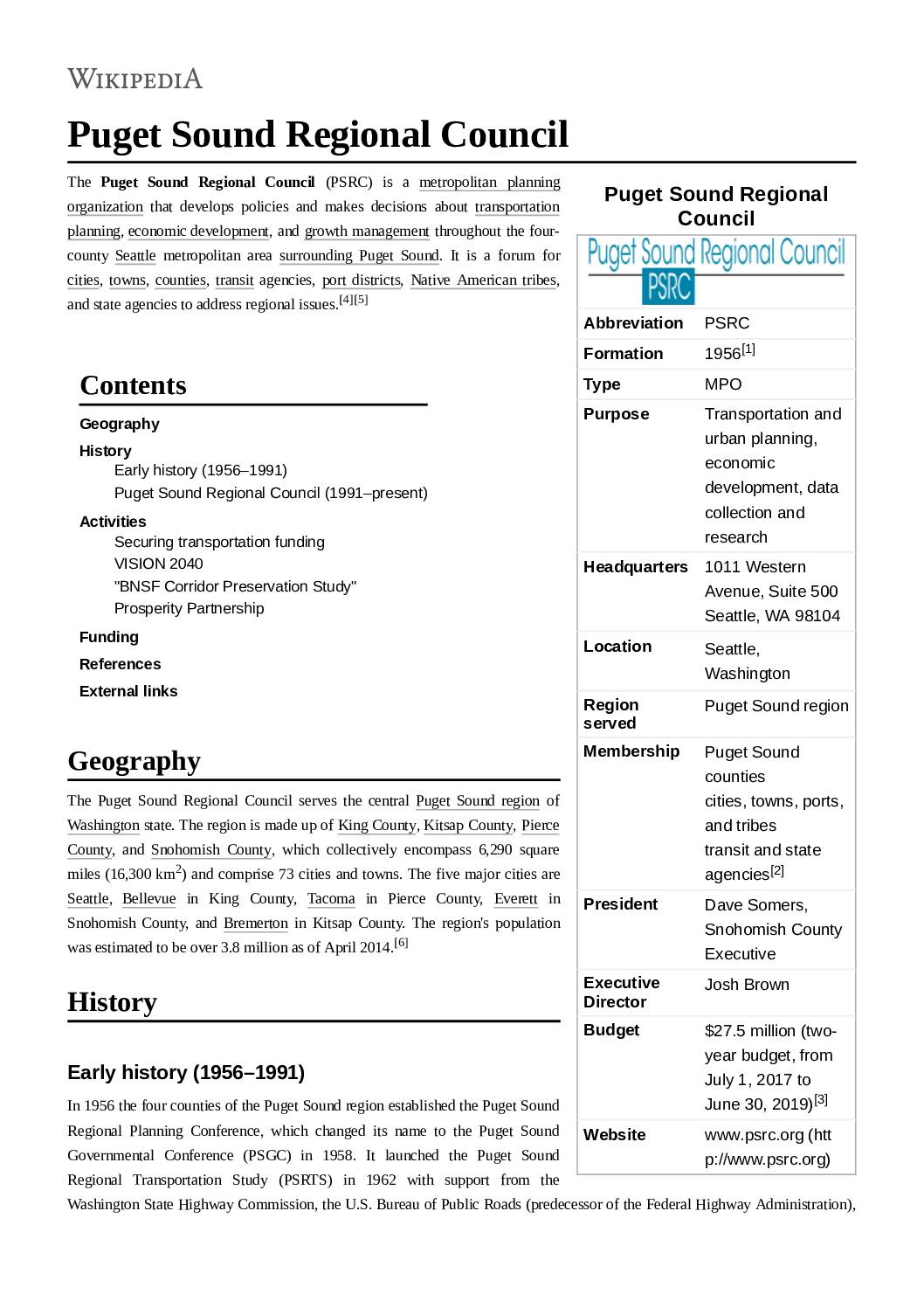
Puget Sound Regional Council
The Puget Sound Regional Council (PSRC) is a metropolitan planning organization founded in 1956 that oversees transportation planning, economic development, and growth management across King, Kitsap, Pierce, and Snohomish counties in the greater Seattle area. It serves as a collaborative forum for cities, counties, transit agencies, port districts, and tribal governments to address regional infrastructure and land-use issues. The PSRC maintains a regional Transportation Improvement Program and develops long-range strategies, such as VISION 2040, to guide the area's growth as its population approaches 5 million. -
 2022-09-01
Appendix 7: Regional aviation
The Puget Sound Regional Council adopted resolutions in 1993 and 1996 establishing the region's long-term commercial air transportation policy, concluding that a third runway at Seattle-Tacoma International Airport (Sea-Tac) should be pursued alongside additional noise reduction measures. The council determined that small supplemental airports, including Paine Field, would not serve as alternatives for meeting regional commercial air capacity needs. These decisions were incorporated into the 1995 Metropolitan Transportation Plan and are maintained in the Destination 2030 regional transportation framework. -
 2022-09-01
Guidance for plan amendment and capacity investment decisions
This appendix from the Puget Sound Regional Council's long-range transportation plan, Destination 2030, outlines the process for amending the plan and making major capacity investment decisions. It explains that the plan must be reviewed every three years under federal law and every two years under Washington State law, with air quality conformity statements required when amendments are made. The document also provides guidance on evaluating transportation corridor investments, assessing benefits and costs, and classifying projects as either 'Candidate' or 'Approved' for implementation. -
 2022-09-01
Regional high occupancy vehicle system policies
This document outlines regional policies for High Occupancy Vehicle (HOV) lanes in the central Puget Sound region, covering rules for lane operation, enforcement, and public education. It establishes that HOV lanes should be reserved 24 hours a day, seven days a week for buses, carpools, and vanpools, and calls for increased fines for violations and better use of technology to improve compliance. The policies were developed by the Regional HOV Policy Advisory Committee in 1998-1999 and are intended to reduce traffic volumes, lower vehicle emissions, and improve overall transportation efficiency. -
 2022-09-01
Destination 2030: The metropolitan transportation system
This document describes the central Puget Sound region's Metropolitan Transportation System (MTS), a multi-modal network of roads, ferries, transit, rail, and aviation facilities serving King, Kitsap, Pierce, and Snohomish counties. It outlines how regionally significant transportation facilities and services are identified and planned in accordance with federal and state requirements, including nine categories of statewide transportation significance. The document also provides a detailed breakdown of the region's approximately 16,790 miles of roadways by county, ownership, and functional classification as of 1999. -
 2022-09-01
Destination 2030: Air quality conformity
This document outlines the air quality conformity analysis for Destination 2030, the long-range transportation plan for the central Puget Sound region, ensuring that planned transportation projects meet federal and state clean air standards. The region, previously designated as a nonattainment area for carbon monoxide, ozone, and particulate matter, was redesignated as a maintenance area after meeting federal air quality standards, with EPA approvals granted between 1996 and 2001. The conformity process involved consultation with agencies including the EPA, FHWA, and Washington State Department of Ecology to ensure new transportation projects do not cause or worsen air quality violations. -
 2022-09-01
Destination 2030: Environmental justice appendix
This appendix from the Destination 2030 Metropolitan Transportation Plan examines environmental justice in the central Puget Sound region, analyzing how transportation costs and benefits are distributed among minority and low-income populations across King, Kitsap, Pierce, and Snohomish counties. Using 1990 Census data and 1997–1998 estimates, it finds that low-income populations are concentrated in Seattle, Tacoma, and Everett, while the region's minority population stands at roughly 15 percent, with the highest concentrations in northern Pierce County and southwestern King County. The analysis was conducted to ensure that burdens and benefits of the regional transportation plan are equitably shared across groups defined by race, income, age, or disability.