TagPSCAA(79)
Puget Sound Clean Air Agency
-
 2017-09-08
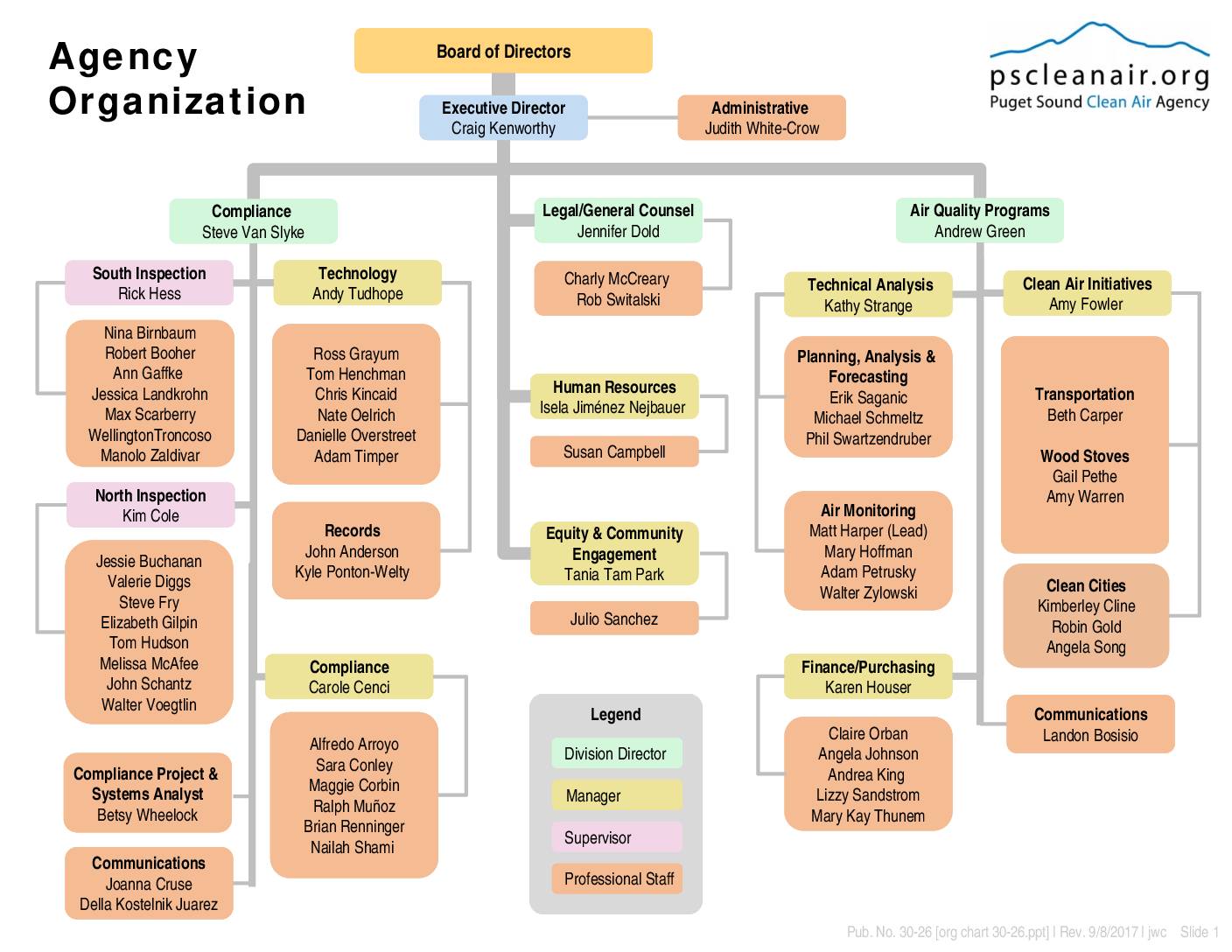
Puget Sound Clean Air Agency: Agency Organization Chart
This document is an organizational chart for the Puget Sound Clean Air Agency, dated September 2017, showing the agency's internal structure under Executive Director Craig Kenworthy. It outlines divisions including Compliance, Air Quality Programs, Legal/General Counsel, and support functions such as Human Resources, Finance, and Communications, along with the managers and staff assigned to each area. While the agency oversees regional air quality, this chart does not specifically address Sea-Tac Airport noise policy. -
 2015-07-01
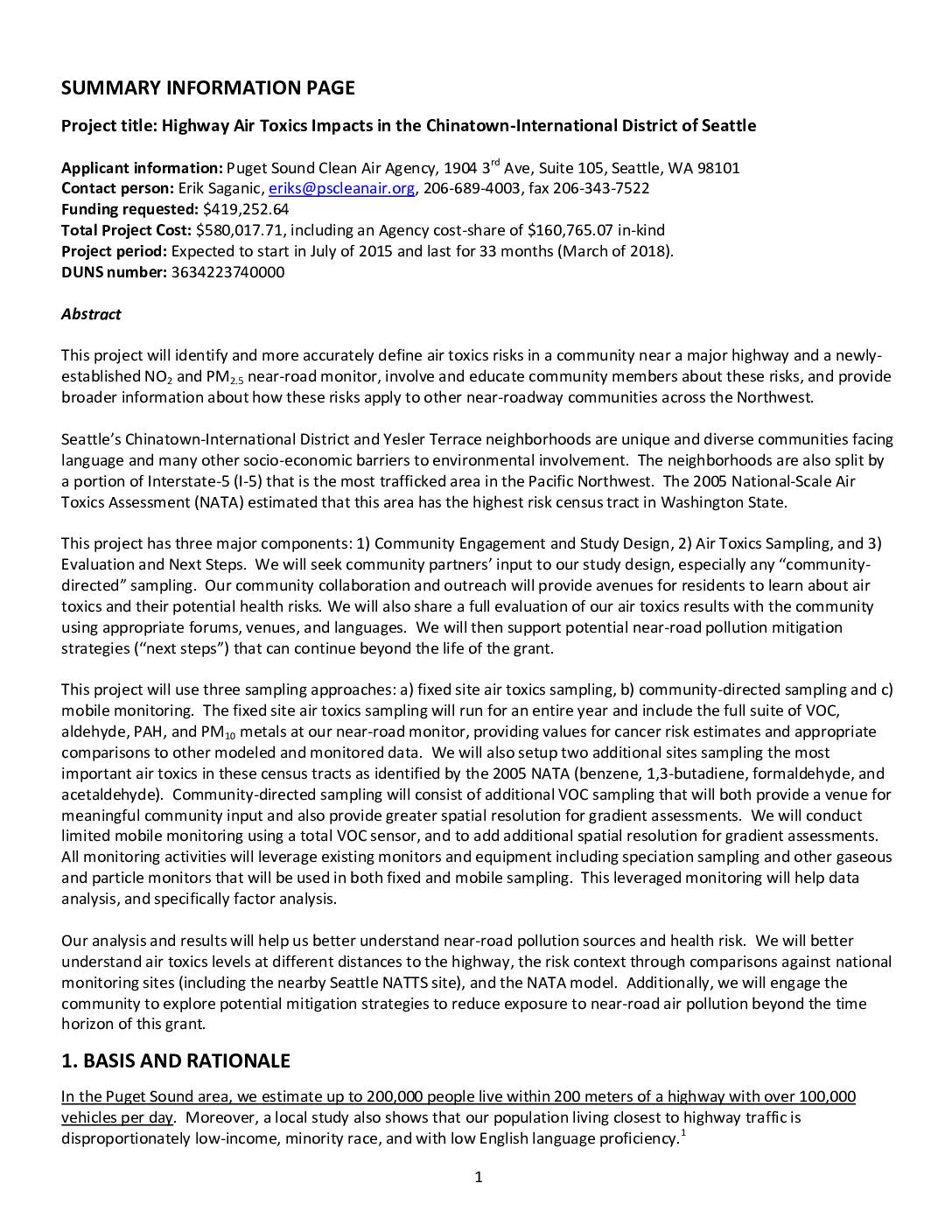
Highway Air Toxics Impacts in the Chinatown-International District of Seattle
This document describes a 2015–2018 air quality research project by the Puget Sound Clean Air Agency focused on measuring highway-related air toxics near Interstate 5 in Seattle's Chinatown-International District and Yesler Terrace neighborhoods. The study aimed to assess cancer risks from pollutants such as benzene, formaldehyde, and diesel particulate matter in communities identified as among the most environmentally and economically vulnerable in Washington State. While not directly related to Sea-Tac Airport noise policy, the project represents regional efforts to address transportation-related environmental health impacts on minority and low-income communities in the greater Puget Sound area. -
 2004-04-01
Air quality: Focus on Puget Sound
This April 2004 report by the League of Women Voters examines air quality in the Puget Sound region, tracing the history of air pollution regulation from King Edward I's coal ban in 1305 through the creation of the U.S. Environmental Protection Agency in 1970. It focuses on the role of the Puget Sound Clean Air Agency in monitoring and reducing local air pollutants, with particular attention to small particles and diesel emissions. The report provides background on federal clean air legislation and outlines the League's related policy positions. -
 2003-10-01
Final report: Puget Sound air toxics evaluation
This 2003 report by the Puget Sound Clean Air Agency evaluates air toxic chemicals in the Puget Sound region, assessing potential cancer and non-cancer health risks based on air monitoring data and EPA modeling. It identifies priority chemicals of concern, estimates human exposure levels, and draws conclusions about the health impacts of pollutants such as diesel exhaust and woodsmoke on local residents. -
 2001-03-21
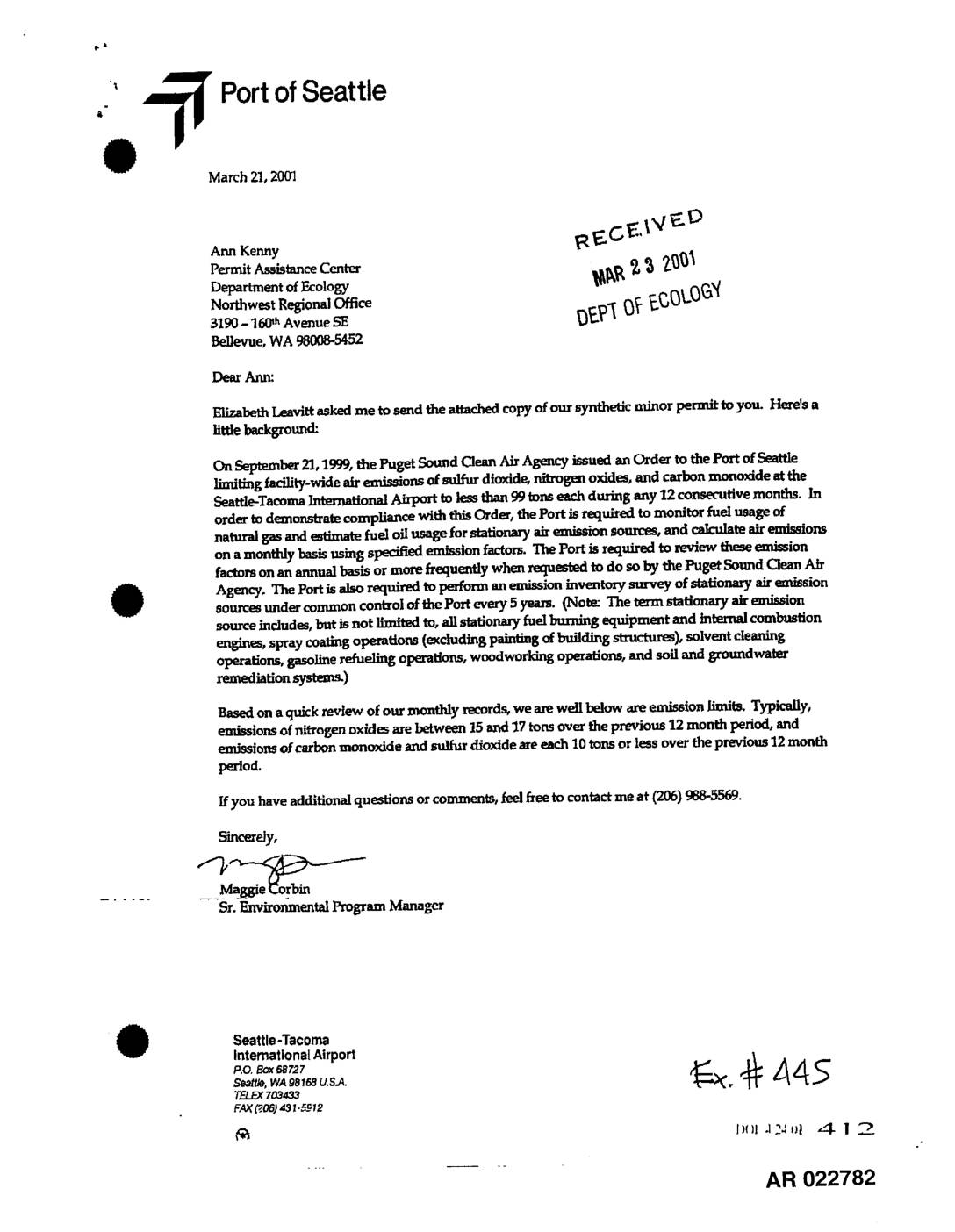
EXH 445: Letter to Ecology Transmitting Synthetic Minor Permit and PSCAA Order No. 7777 STIA Air Emissions
In September 1999, the Puget Sound Clean Air Agency issued an order limiting facility-wide air emissions of sulfur dioxide, nitrogen oxides, and carbon monoxide at Seattle-Tacoma International Airport to less than 99 tons each per any 12-month period. The Port of Seattle is required to monitor fuel usage, calculate monthly emissions using specified factors, and maintain rolling records for at least five years. A March 2001 letter from the Port's Environmental Program Manager confirms emissions were well within limits, with nitrogen oxides typically running 15–17 tons and both carbon monoxide and sulfur dioxide at 10 tons or less over the previous 12-month period. -
 2001-03-21
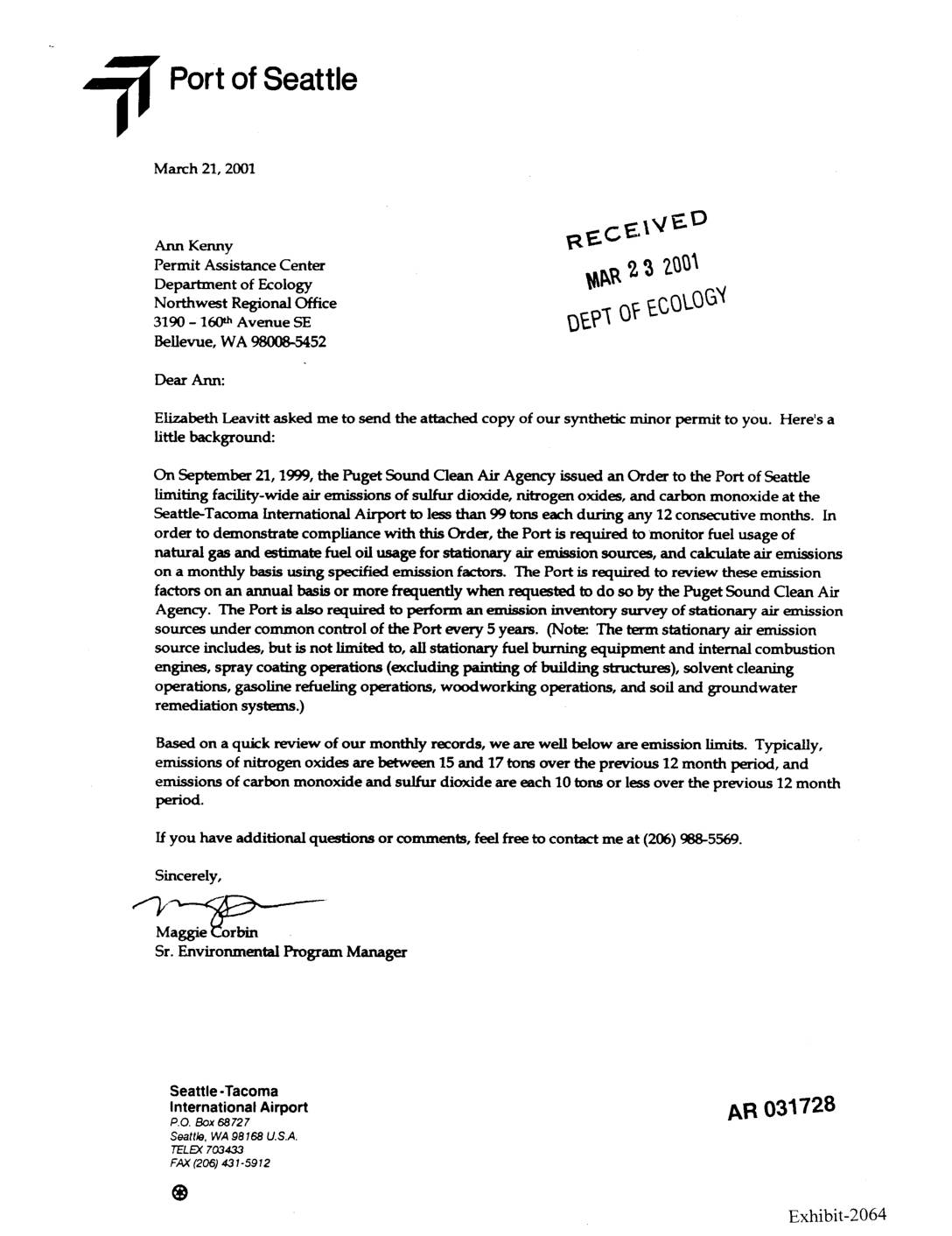
EXH AR031728: Port Of Seattle Letter to Ecology Transmitting Synthetic Minor Permit and PSCAA Order for Sea-Tac Airport Air Emissions
Letter dated March 21, 2001 from Maggie Corbin, Sr. Environmental Program Manager, Port Of Seattle Seattle-Tacoma International Airport, to Ann Kenny at the Washington Department of Ecology Northwest Regional Office, transmitting a synthetic minor permit. Background: Puget Sound Clean Air Agency (PSCAA) issued Order dated September 21, 1999 (Construction No. 7777, Registration No. 21408) limiting -
 2001-03-20
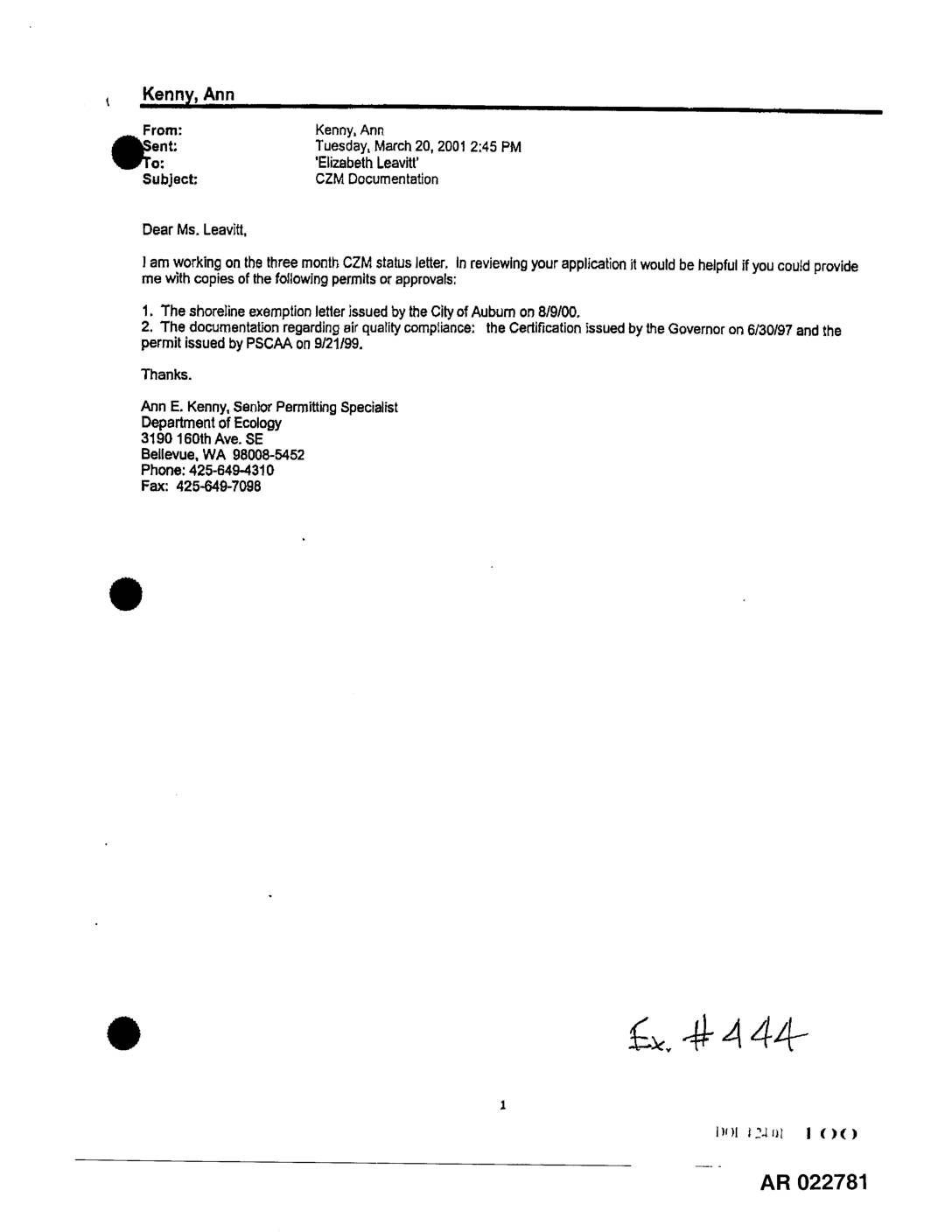
EXH 444: Email Ann Kenny (Ecology) to Elizabeth Leavitt Requesting CZM Documentation
In this March 20, 2001 email, Ann E. Kenny, a Senior Permitting Specialist at the Washington Department of Ecology, contacts Elizabeth Leavitt while working on a three-month Coastal Zone Management (CZM) status letter. Kenny requests copies of two key documents: a shoreline exemption letter issued by the City of Auburn on 8/9/00, and air quality compliance documentation including a Governor's Certification from 6/30/97 and a PSCAA permit from 9/21/99. -
 2000-03-01
Addressing community health concerns around SeaTac Airport: Response to the question, ‘Is it possible to monitor jet engine exhaust emissions or to model their path using data on prevailing winds and takeoff patterns?’
This March 2000 report, prepared by Washington State health and environmental agencies, examines whether jet engine exhaust emissions from Seattle-Tacoma International Airport can be monitored or modeled using wind and takeoff data. It reviews previous air quality studies, outlines health and environmental justice concerns for nearby communities, and recommends a structured air quality monitoring study with specific methods, data analysis approaches, and estimated costs. The report was developed in consultation with community representatives, the EPA, and local universities. -
 1996-10-01
Memorandum of Agreement: Air Quality Monitoring Program Activities Relating to the Seattle-Tacoma International Airport Vicinity
This 1996 Memorandum of Agreement establishes a 24-month air quality monitoring program near Seattle-Tacoma International Airport, involving the Port of Seattle, FAA, EPA, Washington State Department of Ecology, and the Puget Sound Air Pollution Control Agency. The program, funded at $195,000, focuses on measuring carbon monoxide, nitrogen oxides, and aircraft fuel particle residue to establish baseline air quality data and evaluate potential pollution impacts from planned airport expansion projects. The Port agreed not to proceed with expansion elements projected to cause carbon monoxide standard violations until monitoring is complete and, if necessary, mitigation measures are identified.