TagPort Of Seattle(2604)
-
 1973-05-02
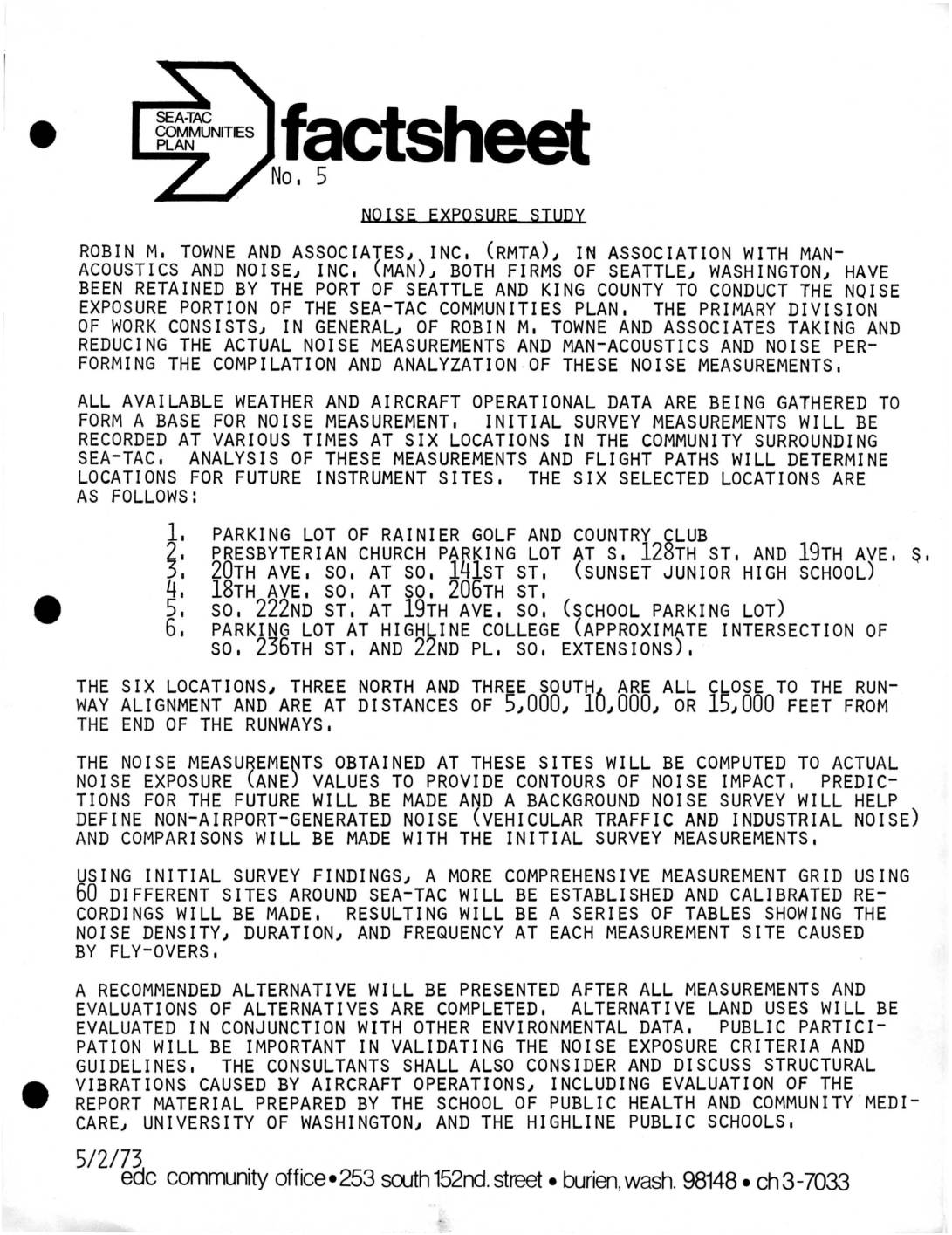
Sea-Tac Communities Plan Fact Sheet No. 5: Noise Exposure Study
This 1973 fact sheet describes a noise exposure study commissioned by the Port of Seattle and King County to measure aircraft noise impacts around Seattle-Tacoma International Airport. Two Seattle firms, Robin M. Towne and Associates and Man-Acoustics and Noise, Inc., conducted measurements at six community locations ranging from 5,000 to 15,000 feet from the runway ends, with plans to expand to 60 sites. The study aimed to produce noise exposure contours, future noise predictions, and alternative land-use recommendations, while also accounting for non-airport noise sources and structural vibrations caused by aircraft operations. -
 1973-05-01
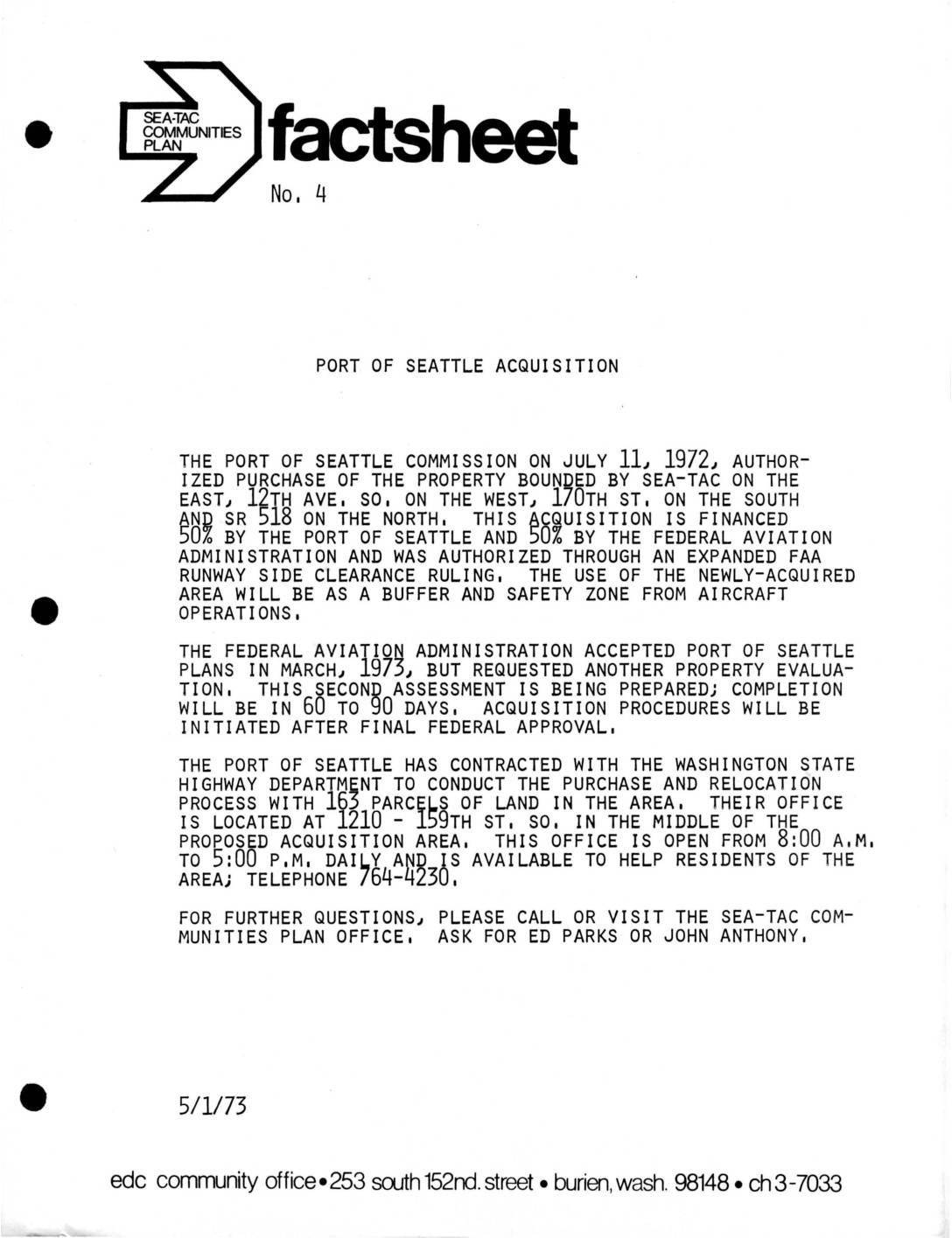
Fact Sheet No. 4: Port Of Seattle Acquisition
In July 1972, the Port of Seattle Commission authorized the purchase of property around Sea-Tac Airport, bounded by 12th Ave. S., 170th St., and SR 518, to serve as a buffer and safety zone from aircraft operations. The acquisition is split equally between the Port of Seattle and the Federal Aviation Administration under an expanded FAA runway side clearance ruling. As of May 1973, a second property evaluation was underway, with acquisition procedures set to begin after final federal approval of the 163 affected parcels. -
 1973-01-01
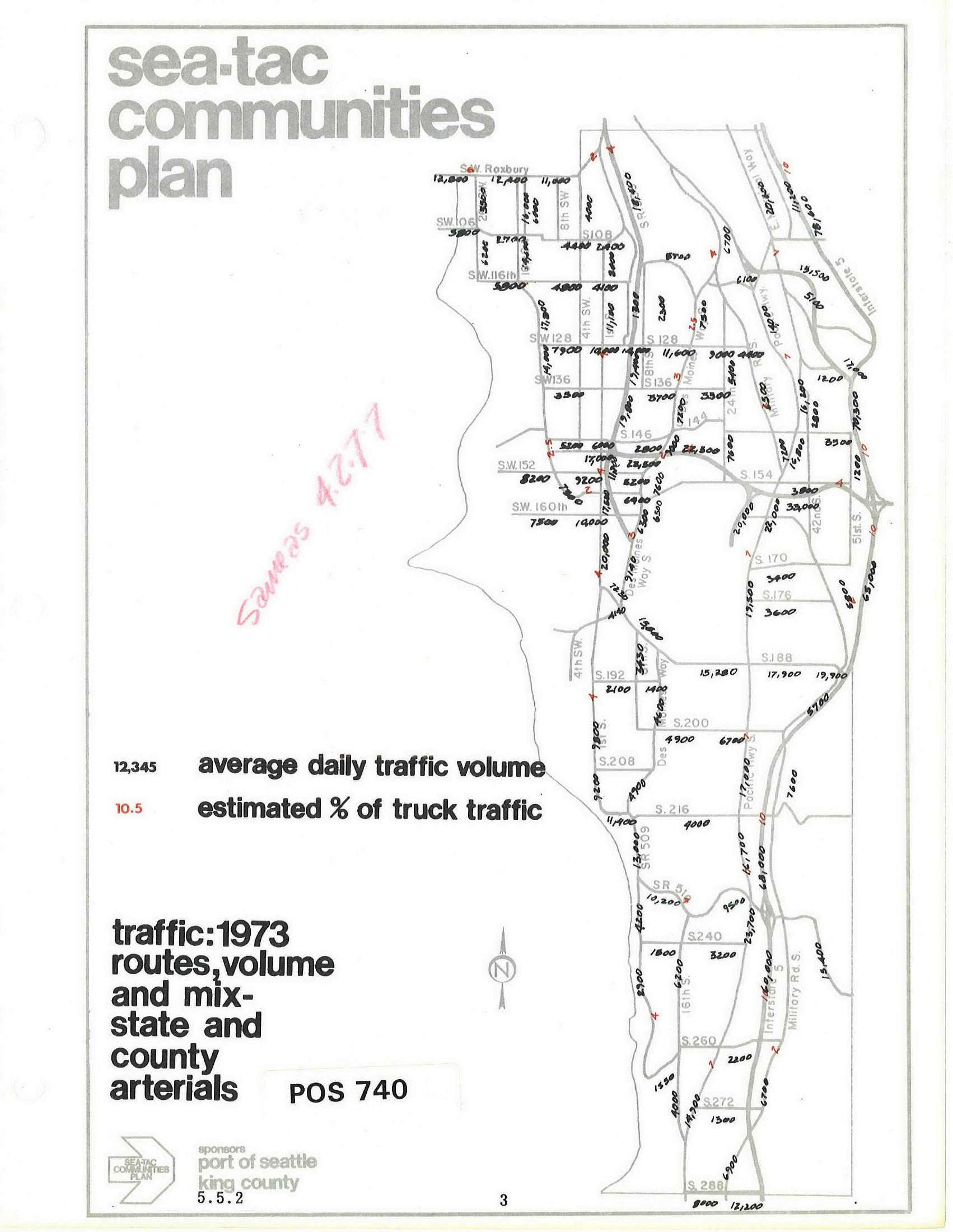
Sea-Tac Communities Plan: 1973 Average Daily Traffic Volumes on State and County Arterials
Map document from the Sea-Tac Communities Plan (document number POS 740, section 5.5.2) showing 1973 average daily traffic volumes and estimated truck traffic percentages on state and county arterials in the Sea-Tac area. Sponsored by the Port of Seattle and King County, the map displays street-level traffic counts across roads including SW 106th through S 288th, with a handwritten notation 'Savings 4,277' in red. -
 1973-01-01
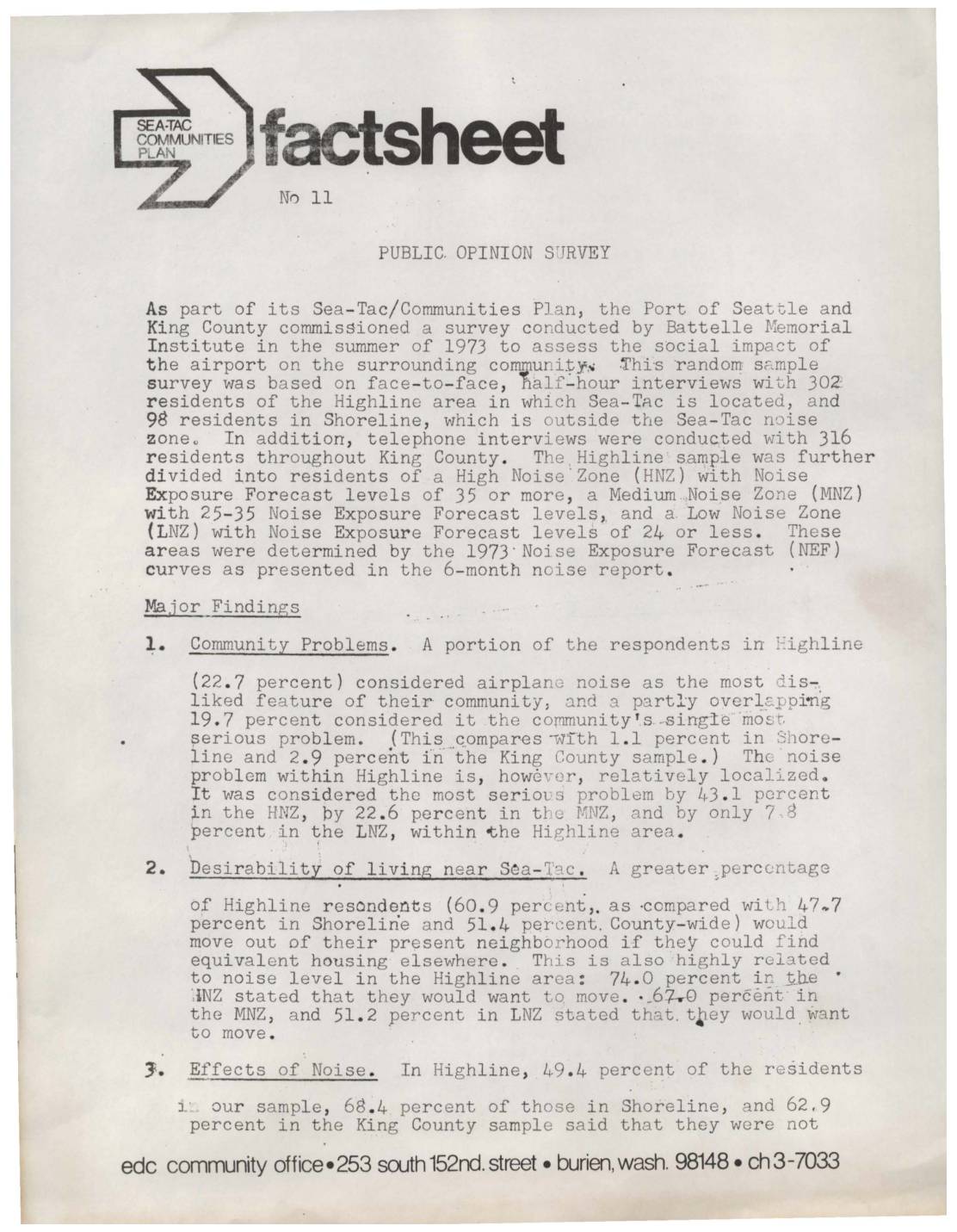
Public Opinion Survey: Sea-Tac Communities Plan Factsheet No. 11
A 1973 public opinion survey commissioned by the Port of Seattle and King County found that nearly one in five Highline-area residents considered airplane noise from Sea-Tac Airport their community's single most serious problem, with concern rising sharply among those living in the highest-noise zones. Highline residents were more likely to want to move than those in quieter comparison areas, though the survey also found that the Port of Seattle was viewed favorably by a strong majority across all groups surveyed. -
1973-01-01
Public Opinion Survey: Sea-Tac Communities Plan Factsheet No. 11
Factsheet No. 11 from the Sea-Tac Communities Plan (STCP), summarizing a 1973 public opinion survey conducted by Battelle Memorial Institute for the Port of Seattle and King County. The survey assessed social impacts of Sea-Tac Airport on surrounding communities via face-to-face interviews with 302 Highline area residents and 98 Shoreline residents, plus 316 telephone interviews -
 1972-11-27
Motion No. 1019: Authorizing Application for Federal Aviation Administration Grant for Joint Port Of Seattle–King County Master Plan Study of Seattle-Tacoma International Airport
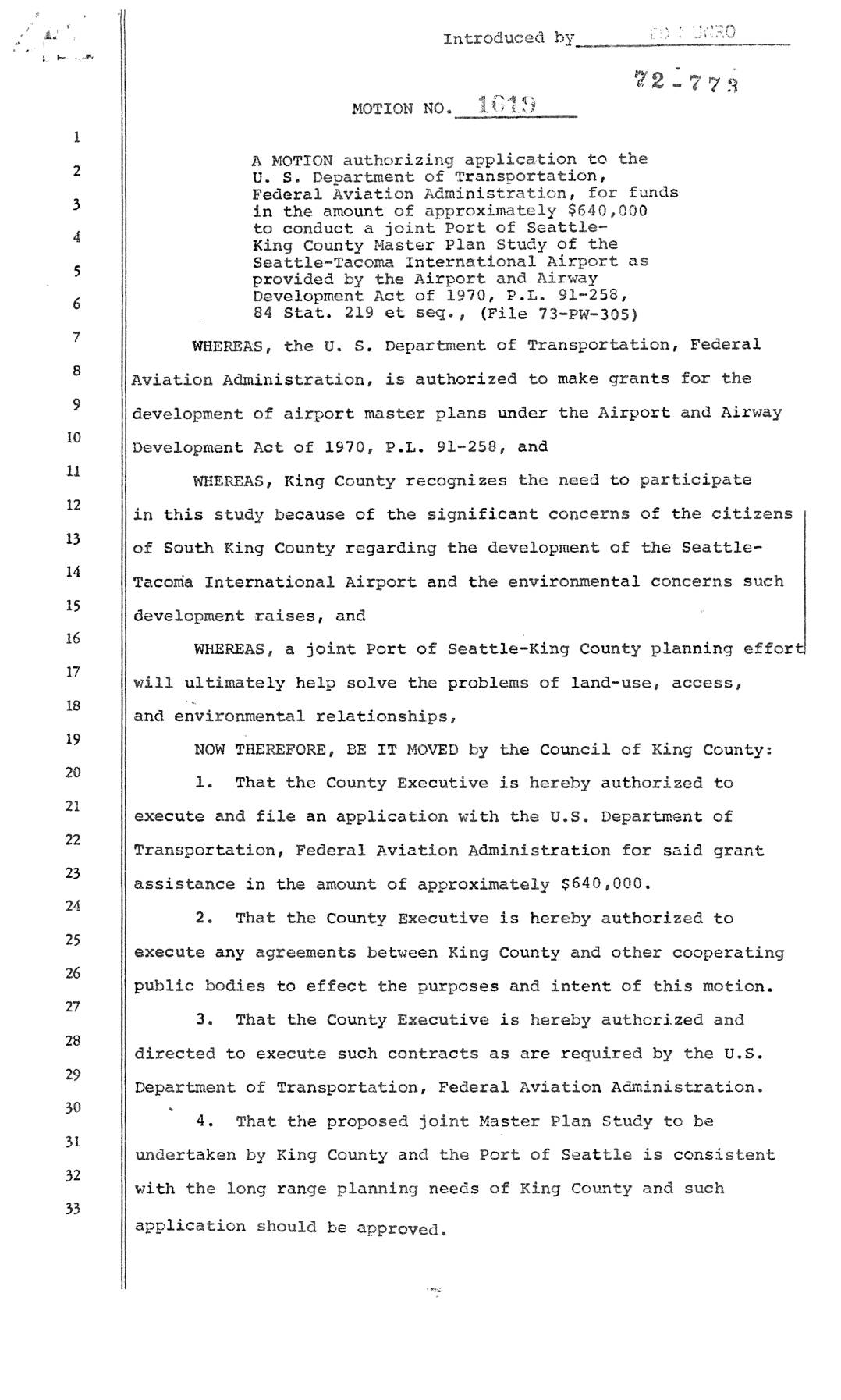
King County Council Motion No. 1019, passed November 27, 1972, authorizing the King County Executive to apply to the U.S. Department of Transportation, Federal Aviation Administration for grant funds of approximately $640,000 under the Airport and Airway Development Act of 1970 (P.L. 91-258, 84 Stat. 219) to conduct a joint Port of Seattle–King County Master -
1972-11-27
Motion No. 1019: Authorizing Application for Federal Aviation Administration Grant for Joint Port Of Seattle–King County Master Plan Study of Seattle-Tacoma International Airport
In November 1972, the King County Council passed Motion No. 1019, authorizing the County Executive to apply for approximately $640,000 in federal grant funding from the U.S. Department of Transportation's Federal Aviation Administration. The funds were intended to support a joint Port of Seattle–King County Master Plan Study of Seattle-Tacoma International Airport, prompted by citizen concerns in South King County about airport expansion and its environmental impacts. The motion also authorized the County Executive to enter into agreements with other public bodies and execute any contracts required by the FAA to carry out the study. -
 1972-11-06
King Lysen for King County Council Position 7 campaign mailer
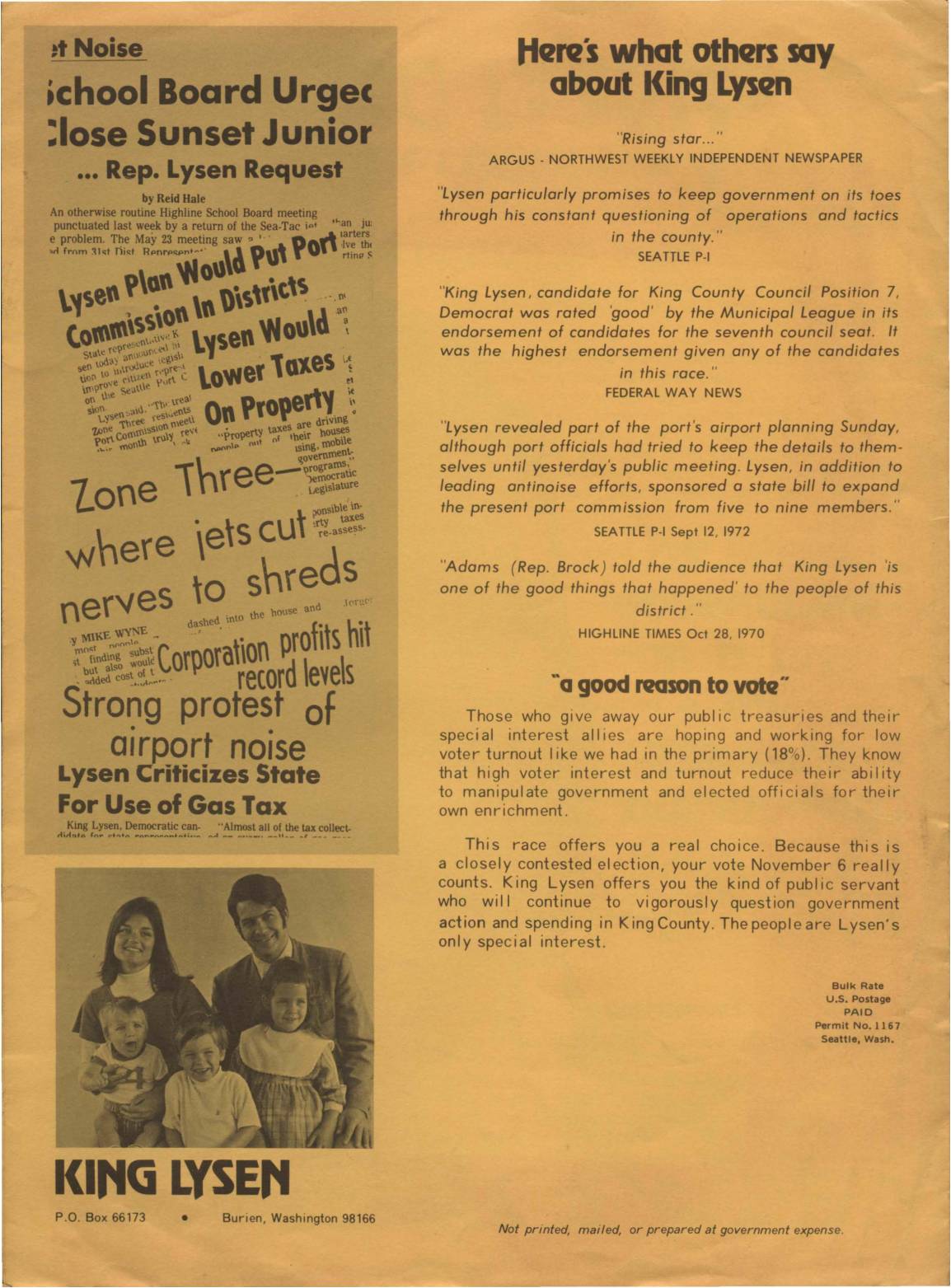
This is a campaign mailer for King Lysen, a Democratic candidate for King County Council Position 7 in the early 1970s, highlighting his record of challenging government spending and operations in King County, Washington. Lysen was notably active in anti-noise efforts related to Sea-Tac Airport, including revealing port airport planning details to the public and sponsoring a state bill to expand the port commission from five to nine members. The mailer compiles endorsements from outlets such as the Seattle Post-Intelligencer, the Argus, and the Federal Way News, emphasizing his reputation as a government watchdog and advocate for residents affected by airport noise. -
1972-11-06
King Lysen for King County Council Position 7 campaign mailer
Campaign mailer for King Lysen, Democratic candidate for King County Council Position 7, running in the November 6 general election. Features endorsement quotes from the Argus Northwest Weekly Independent Newspaper, Seattle PI, Federal Way News, and Highline Times. Highlights Lysen’s anti-airport noise efforts, sponsorship of a state bill to expand the Port of Seattle commission -
 1970-10-01
Air pollution by jet aircraft at Seattle-Tacoma Airport: Historical summary and commentary
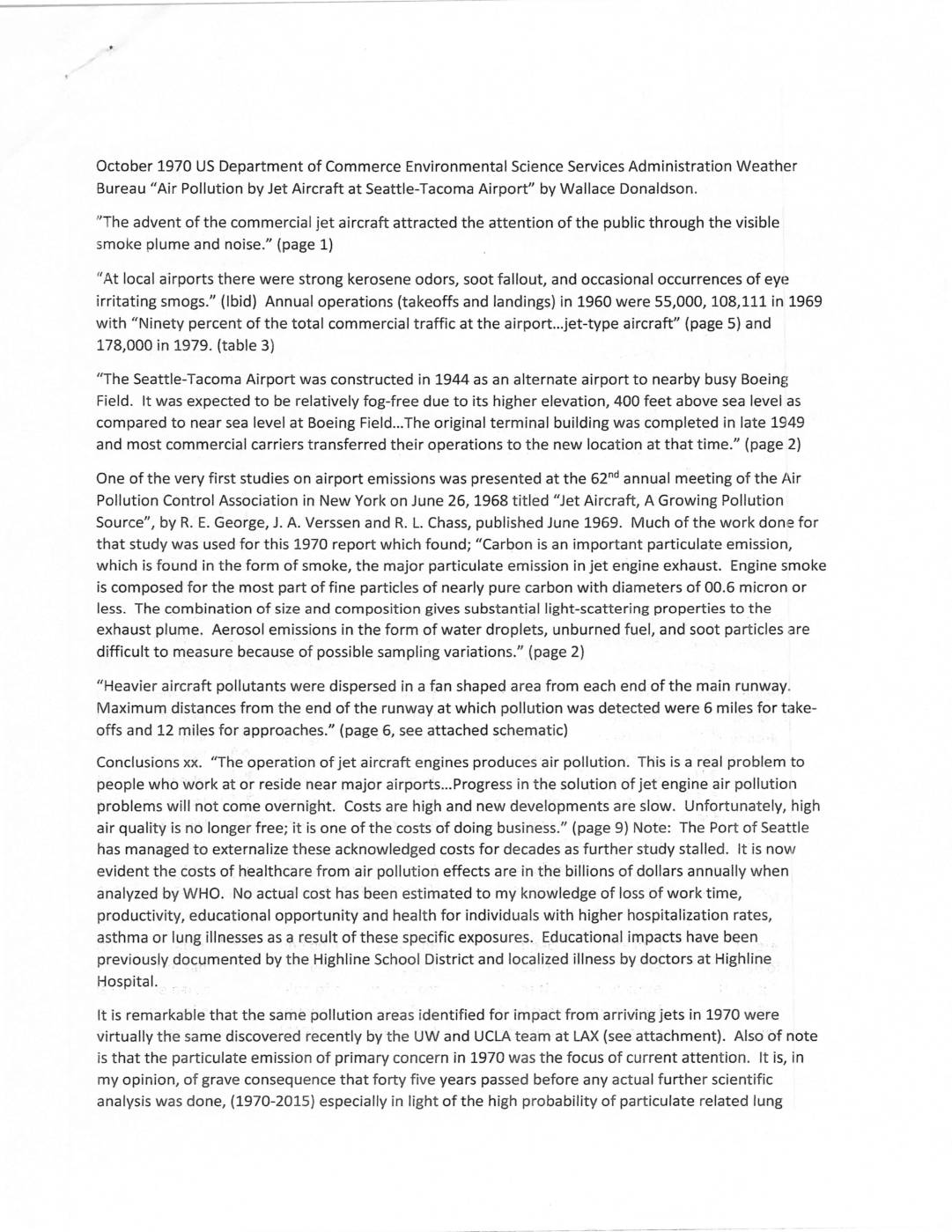
This document traces decades of air pollution concerns around Seattle-Tacoma International Airport, drawing on studies from 1970 through 1991 that documented harmful emissions including carbon particles, hydrocarbons, and nitrogen oxides affecting residents living near the airport. It highlights how early research identified health risks and pollution spread up to 12 miles from the runways, yet meaningful follow-up scientific study and regulatory action were largely delayed for 45 years. Community groups, lawsuits, and independent monitoring repeatedly confirmed that nearby residents faced noise, kerosene odors, soot, and air quality violations, while the Port of Seattle externalized the associated public health costs.