TagPort Of Seattle(2405)
-
 2000-10-03
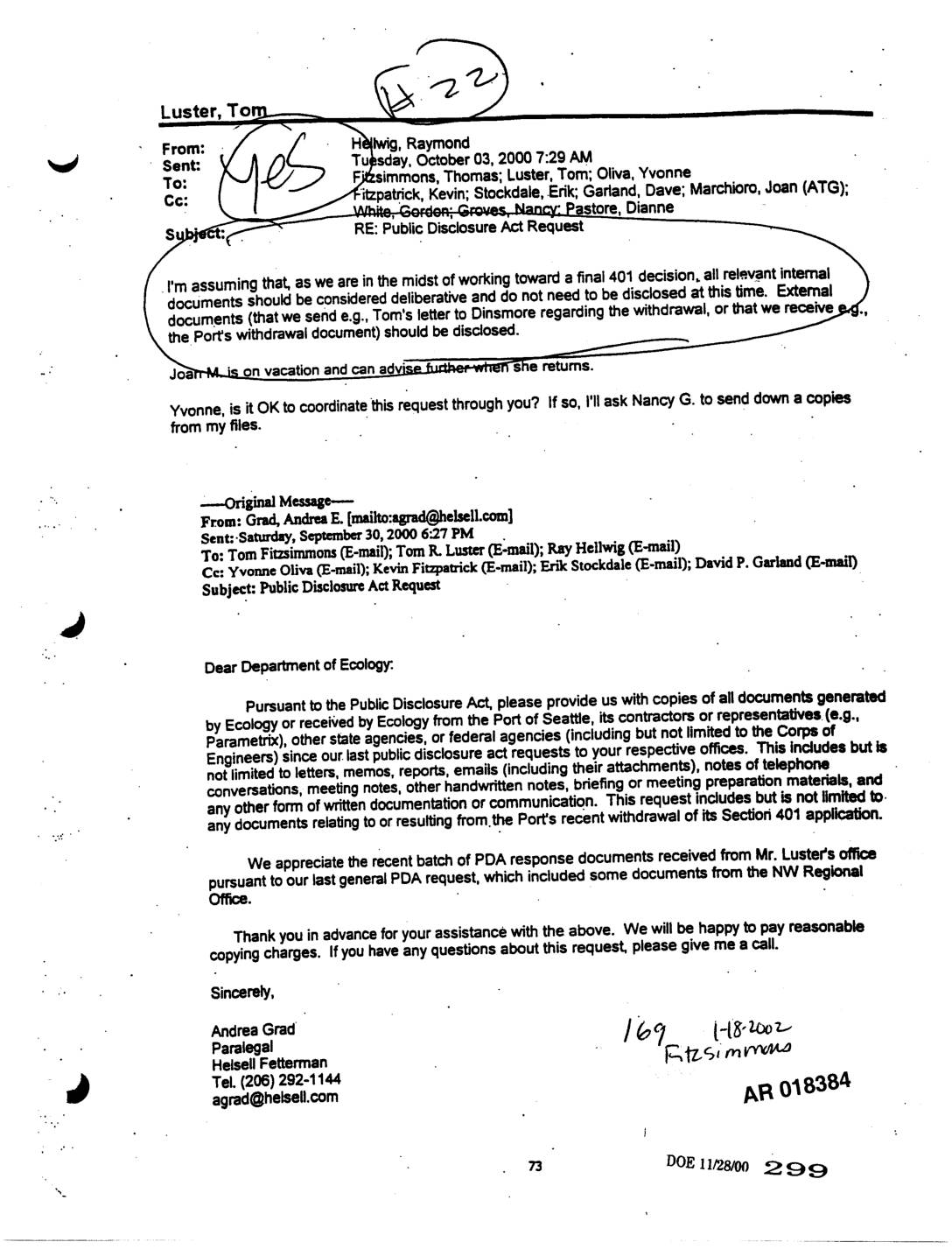
EXH AR018384: Email Chain RE: Public Disclosure Act Request — Ecology Response to Helsell Fetterman PDA Request re Port Of Seattle Section 401 Withdrawal
Email chain dated October 3, 2000 from Raymond Hellwig (Ecology) to Thomas Fitzsimmons, Tom Luster, Yvonne Oliva, Kevin Fitzpatrick, Erik Stockdale, Dave Garland, Joan Marchioro (ATG), and others regarding a Public Disclosure Act (PDA) request submitted by Andrea Grad, paralegal at Helsell Fetterman, on September 30, 2000. The PDA request seeks all documents generated or -
 2000-10-02
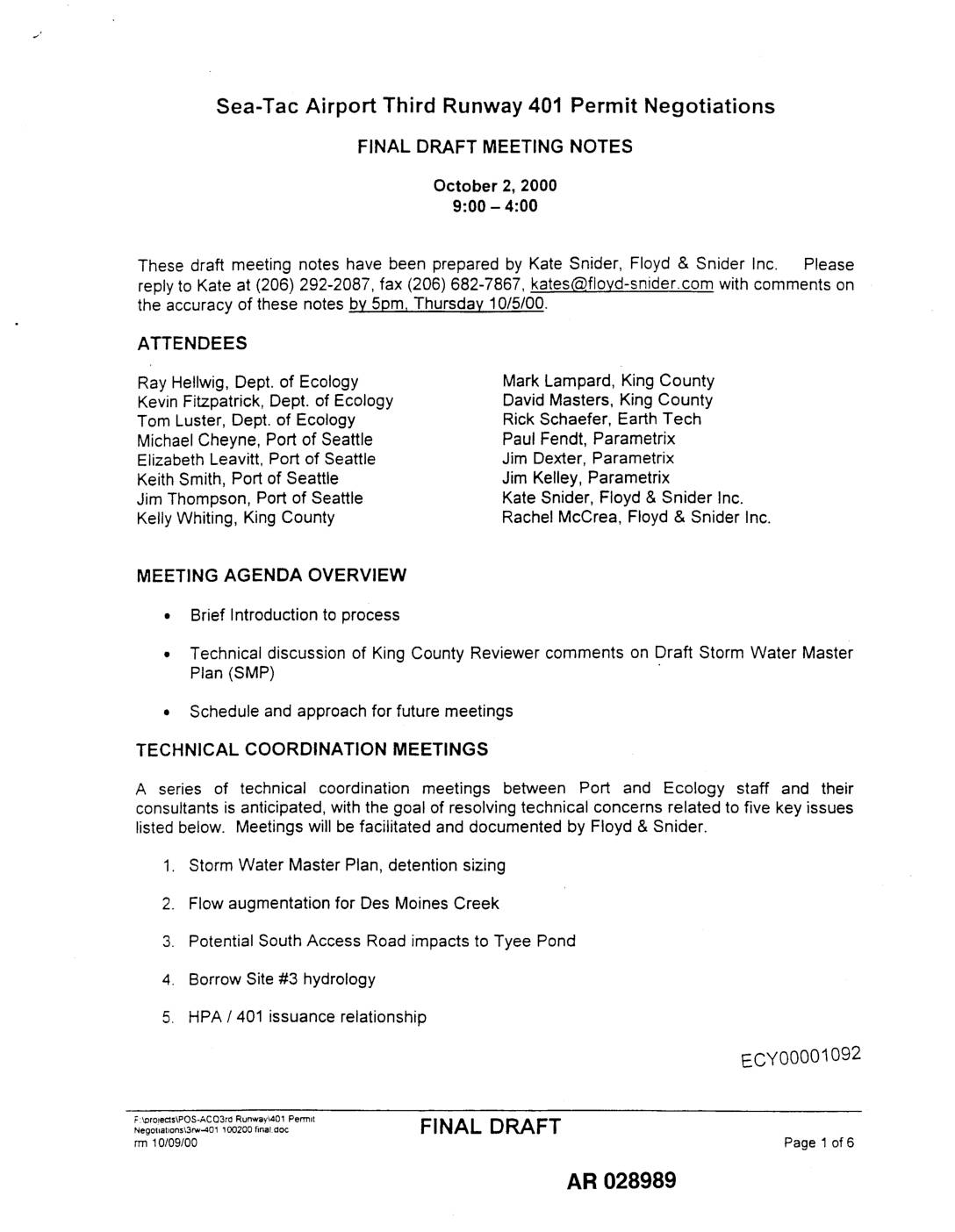
EXH AR028989: Sea-Tac Airport Third Runway 401 Permit Negotiations — Final Draft Meeting Notes, October 2, 2000
Final draft meeting notes from October 2, 2000 (9:00–4:00) for Sea-Tac Airport Third Runway 401 Permit Negotiations, prepared by Kate Snider of Floyd & Snider Inc. Attendees include representatives from Washington State Department of Ecology (Ray Hellwig, Kevin Fitzpatrick, Tom Luster), Port Of Seattle (Michael Cheyne, Elizabeth Leavitt, Keith Smith, Jim Thompson), King County (Kelly -
 2000-09-28
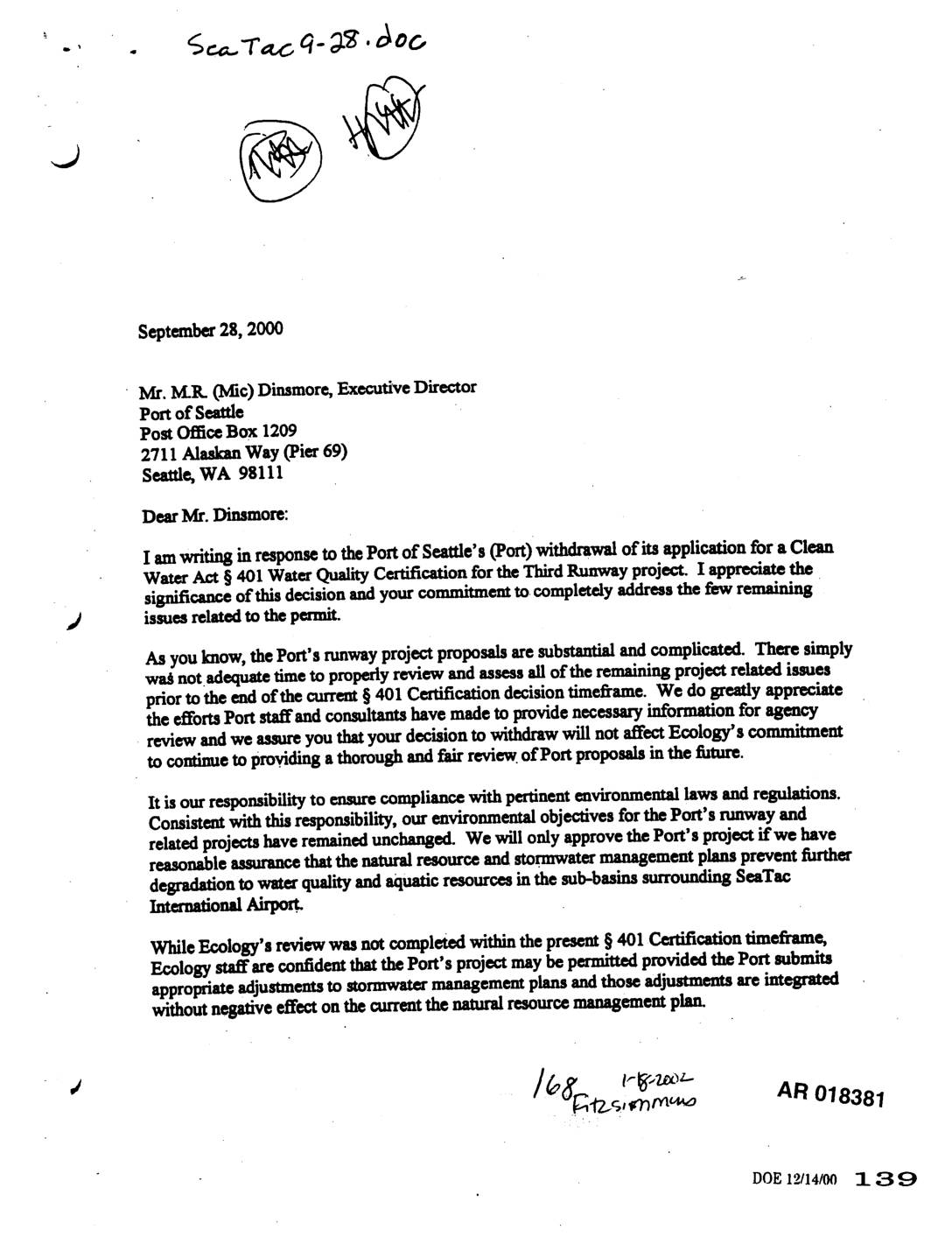
EXH AR018381: Letter from Ecology to Port Of Seattle Regarding § 401 Water Quality Certification Withdrawal for Third Runway
Letter dated September 28, 2000 from Tom Fitzsimmons, Director of Washington State Department of Ecology, to M.R. (Mic) Dinsmore, Executive Director of Port Of Seattle, responding to Port Of Seattle’s withdrawal of its Clean Water Act § 401 Water Quality Certification application for the Third Runway project at Seattle-Tacoma International Airport. Ecology outlines conditions for -
 2000-09-28
EXH AR017789: Ecology Letter to Port Of Seattle on Clean Water Act §401 Water Quality Certification for Third Runway
Washington State Department of Ecology Director Tom Fitzsimmons letter dated September 28, 2000 to Port Of Seattle Executive Director M.R. (Mic) Dinsmore regarding Clean Water Act §401 Water Quality Certification and §404 Permit for the Third Runway project at Seattle-Tacoma International Airport. Ecology states insufficient time remains to complete a legally defensible review within the -
 2000-09-28
EXH AR051605: Annual Stormwater Monitoring Report for Seattle-Tacoma International Airport, July 1, 1999 through June 30, 2000
Annual stormwater monitoring report prepared by Scott Tobiason, Environmental Management Specialist, Aviation Environmental Programs, Port Of Seattle, covering Sea-Tac Airport (STIA) for the period July 1, 1999 through June 30, 2000. Report covers STIA storm drainage subbasins, sampling locations, grab and composite sample results for total petroleum hydrocarbons (TPH), fecal coliforms, suspended solids, turbidity, biochemical -
 2000-09-28
EXH AR045668: Annual Stormwater Monitoring Report for Seattle-Tacoma International Airport, July 1999–June 2000
Annual Stormwater Monitoring Report for Seattle-Tacoma International Airport (STIA) covering the period July 1, 1999 through June 30, 2000, prepared by Scott Tobiason, Environmental Management Specialist, Aviation Environmental Programs, Port Of Seattle. Report AR 045668 documents stormwater sampling results from STIA storm drainage subbasins including total petroleum hydrocarbons (TPH), fecal coliforms, suspended solids, turbidity, biochemical -
 2000-09-28
EXH AR023705: Letter Fitzsimmons to Dinsmore §401 Water Quality Certification Third Runway
In a September 28, 2000 letter to Port of Seattle Executive Director Mic Dinsmore, Washington State Department of Ecology Director Tom Fitzsimmons explained that the agency could not complete its review of the Port's Clean Water Act Section 401 Water Quality Certification application for the Third Runway project within the required timeframe. Ecology outlined key outstanding concerns, including stormwater management plan deficiencies affecting Miller, Walker, and Des Moines Creeks, as well as wetlands protection issues. The letter proposed a path forward in which the Port would withdraw and resubmit its application, after which Ecology committed to completing its review and issuing a decision within 75 days. -
 2000-09-27
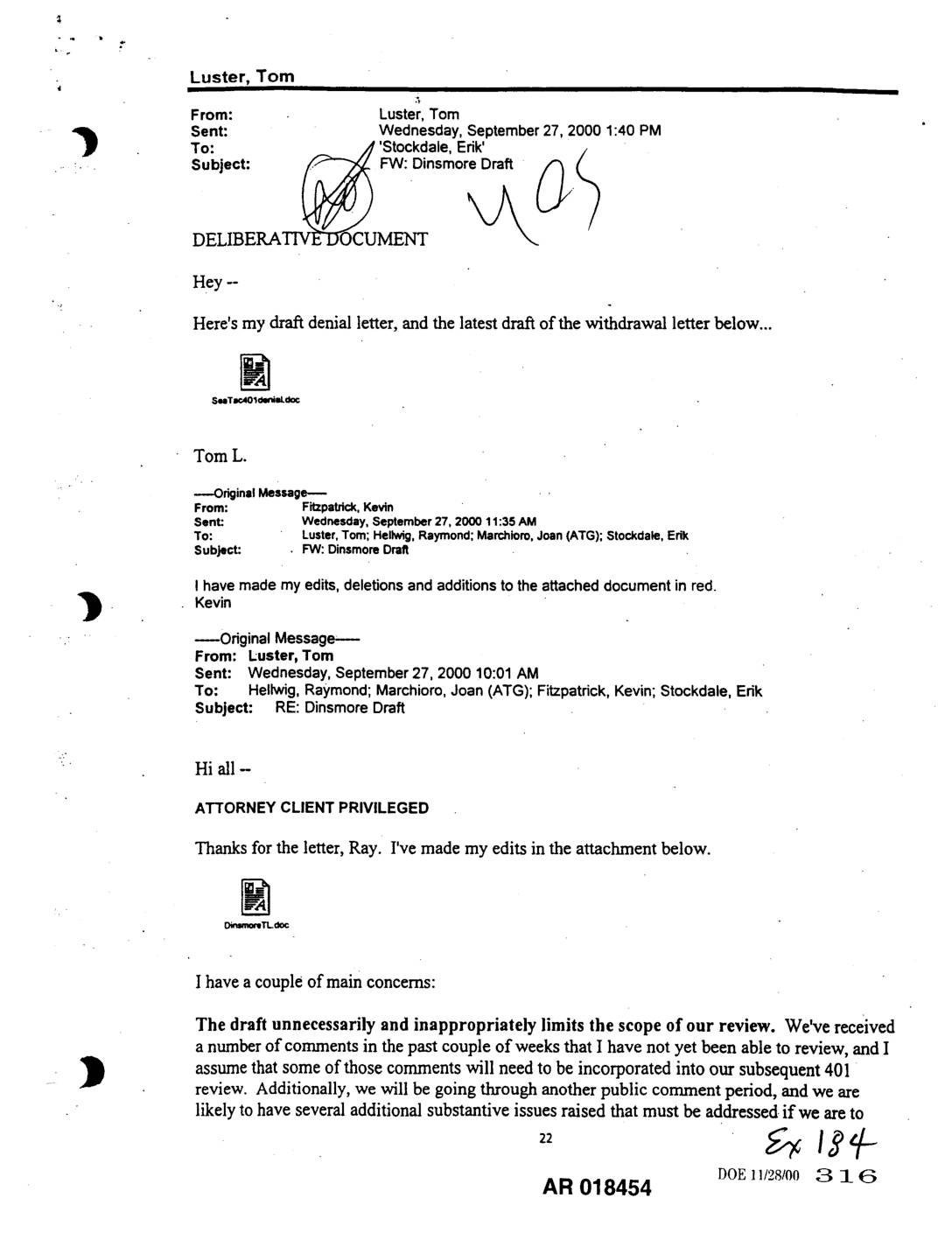
EXH AR018454: Internal Email Chain — Dinsmore Draft 401 Review Letter, Ecology Staff Deliberations
Internal deliberative email chain dated September 27, 2000, among Washington State Department of Ecology staff Tom Luster, Raymond Hellwig, Kevin Fitzpatrick, Joan Marchioro (ATG), and Erik Stockdale, marked Attorney Client Privileged. Discusses draft denial letter and withdrawal letter related to the Dinsmore 401 water quality certification review for a Port Of Seattle project (Sea-Tac Airport). -
 2000-09-27
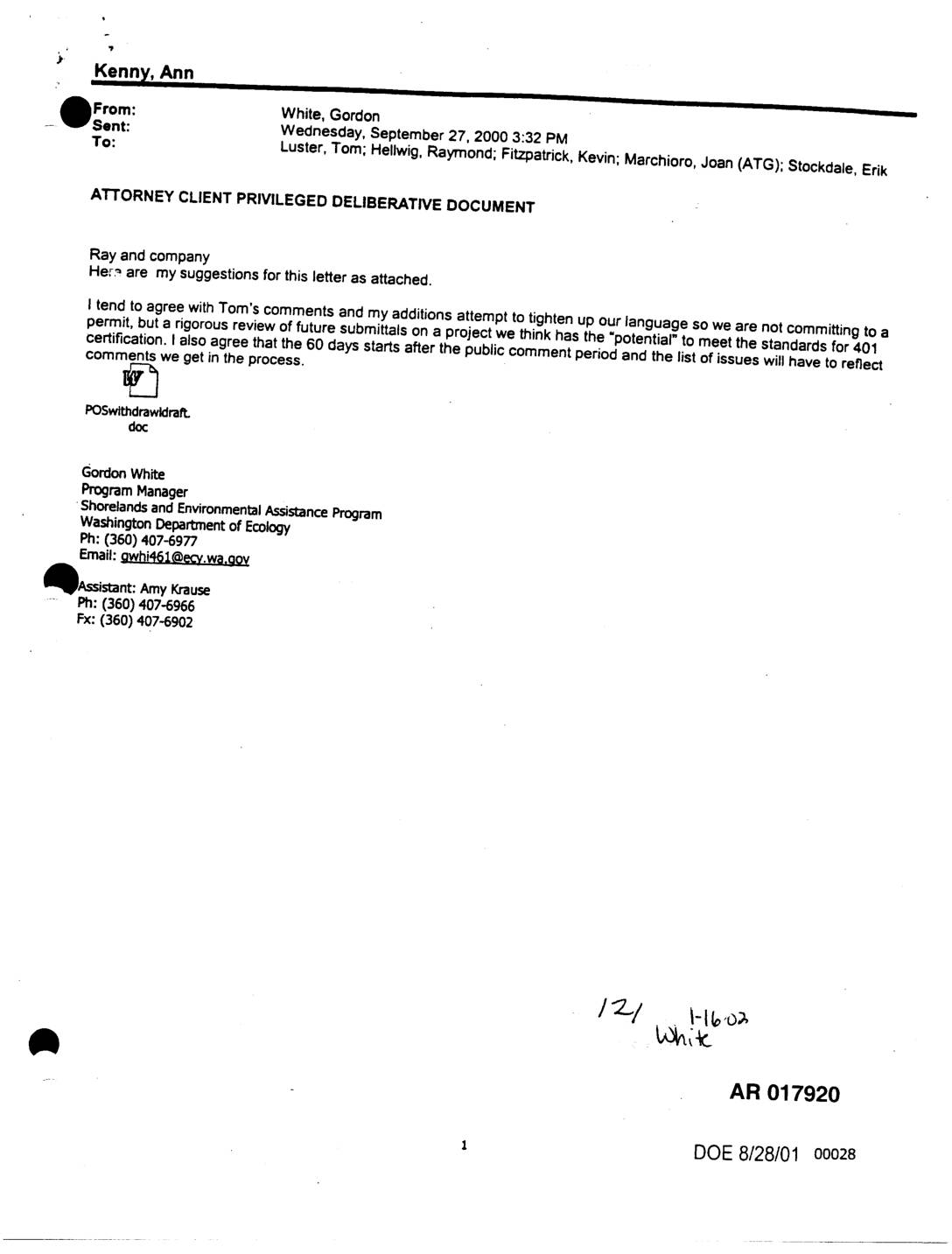
EXH AR017920: Ecology Draft Letter to Port Of Seattle on 401 Water Quality Certification Withdrawal and Reapplication Process — Third Runway
Attorney-client privileged deliberative document dated September 27, 2000, from Gordon White (Washington Department of Ecology, Shorelands and Environmental Assistance Program) to Tom Luster, Raymond Hellwig, Kevin Fitzpatrick, Joan Marchioro (ATG), and Erik Stockdale. Transmits draft letter to M.R. (Mic) Dinsmore, Executive Director, Port Of Seattle, regarding 401 Water Quality Certification review for the Third Runway -
 2000-09-27
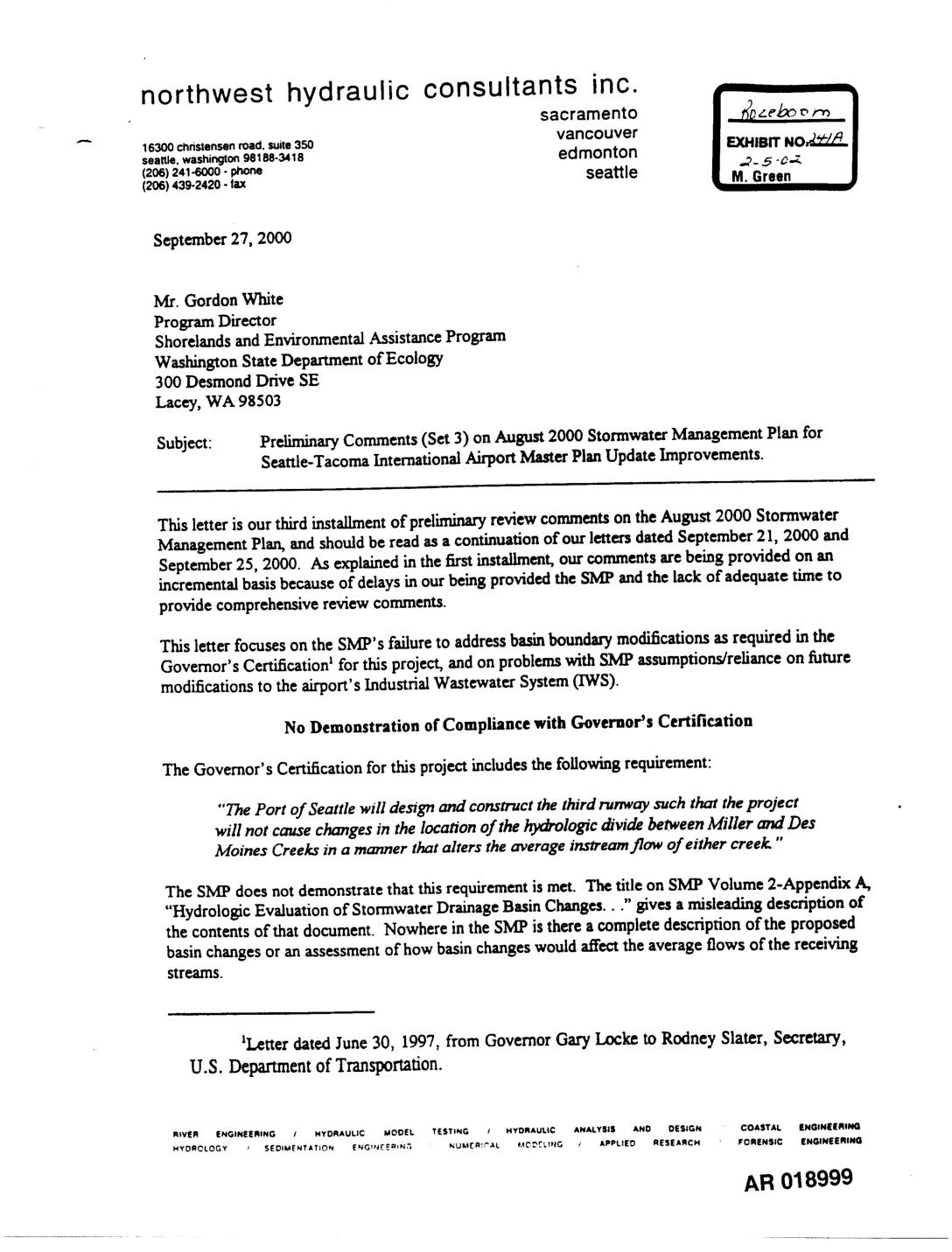
EXH 241A: Preliminary Comments Set 3 on Aug 2000 STIA Stormwater Management Plan
A September 2000 letter from Northwest Hydraulic Consultants raises concerns about the Stormwater Management Plan for Seattle-Tacoma International Airport's third runway expansion, finding that it fails to demonstrate compliance with the Governor's Certification requirement to protect water flow in Miller and Des Moines Creeks. The letter also identifies serious problems with the airport's plan to manage stormwater through expansions to its Industrial Wastewater System, including unresolved engineering uncertainties and potential conflicts with FAA wildlife safety guidelines that prohibit wastewater facilities within 10,000 feet of runway areas.