TagPollution Control Hearings Board(1531)
-
 1999-05-28
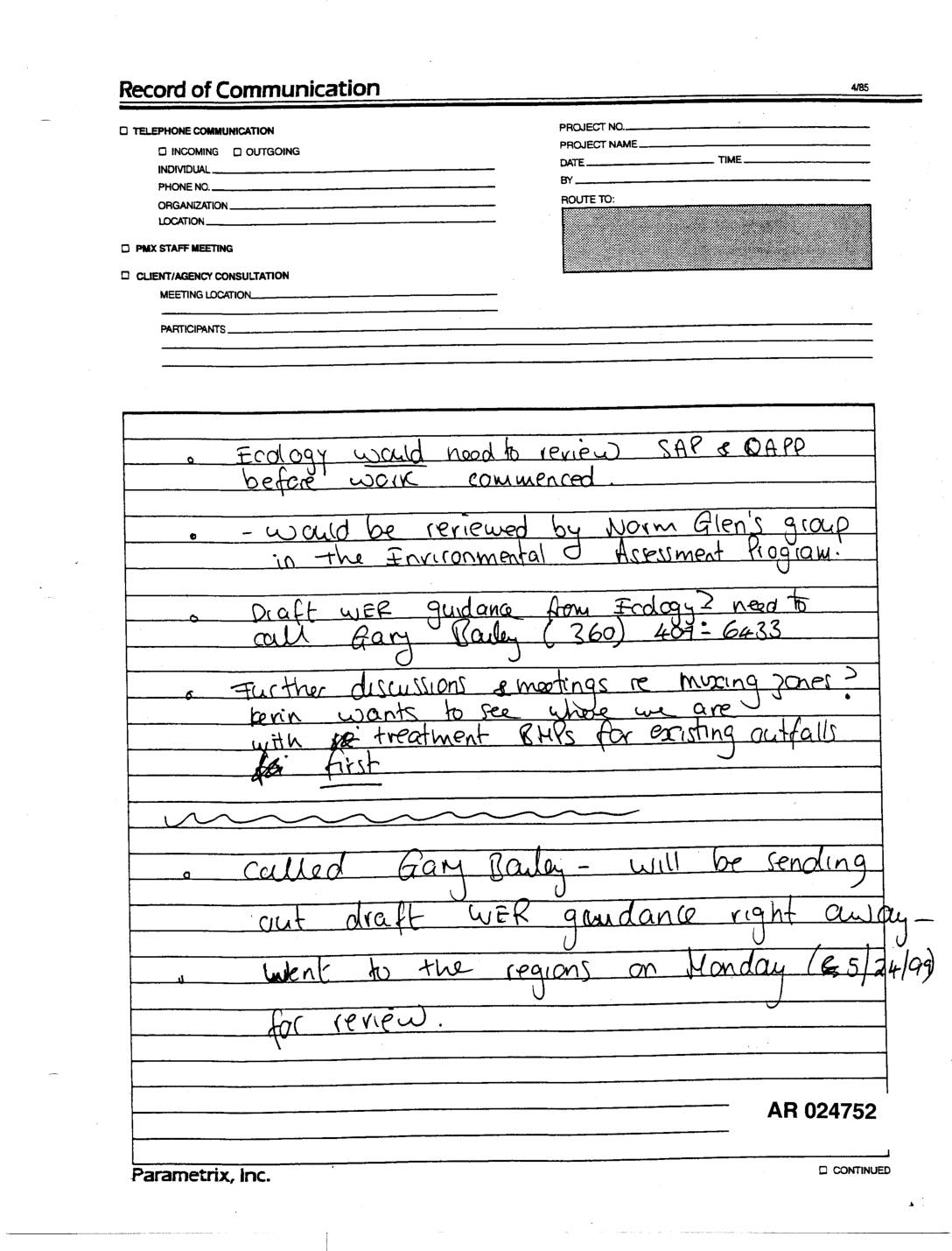
EXH AR024752: Ecology Review of SAP/QAPP and WER Guidance for Port Discharges
These internal communication records from Parametrix, Inc. (dated around May 1999) document discussions between environmental consultants and Washington State Department of Ecology staff regarding sampling and analysis protocols for port discharge outfalls. Key topics include the need for Ecology to review a Site Assessment Plan (SAP) and Quality Assurance Project Plan (QAPP) before work commenced, the applicability of clean sampling techniques for measuring copper concentrations in discharge water, and the distribution of draft Water Effluent Regulations (WER) guidance to regional offices for review. -
 1999-05-26
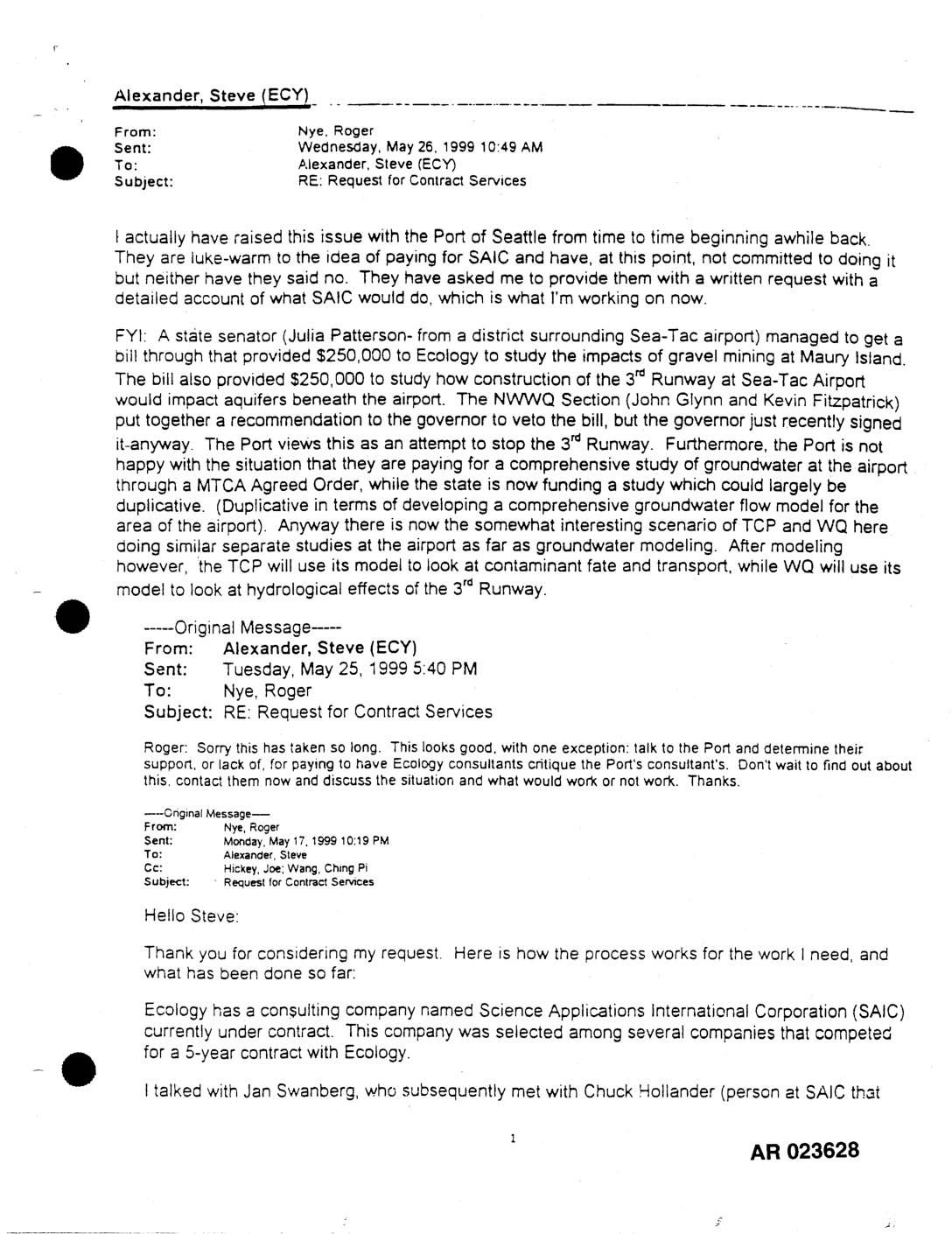
EXH AR023628: Email Chain — Ecology SAIC Contract Request, Third Runway Groundwater Study Funding
In May 1999, Washington State Department of Ecology staff exchanged emails discussing plans to hire consulting firm SAIC to review groundwater studies at Sea-Tac Airport, with the question of whether the Port of Seattle would fund the work remaining unresolved. The emails also note that state legislation signed by the governor allocated $250,000 to study how construction of Sea-Tac's proposed Third Runway would impact aquifers beneath the airport, a move the Port viewed as an attempt to block the runway project. This created an unusual situation where two separate Ecology divisions were conducting potentially duplicative groundwater modeling studies at the airport for different purposes. -
 1999-05-14
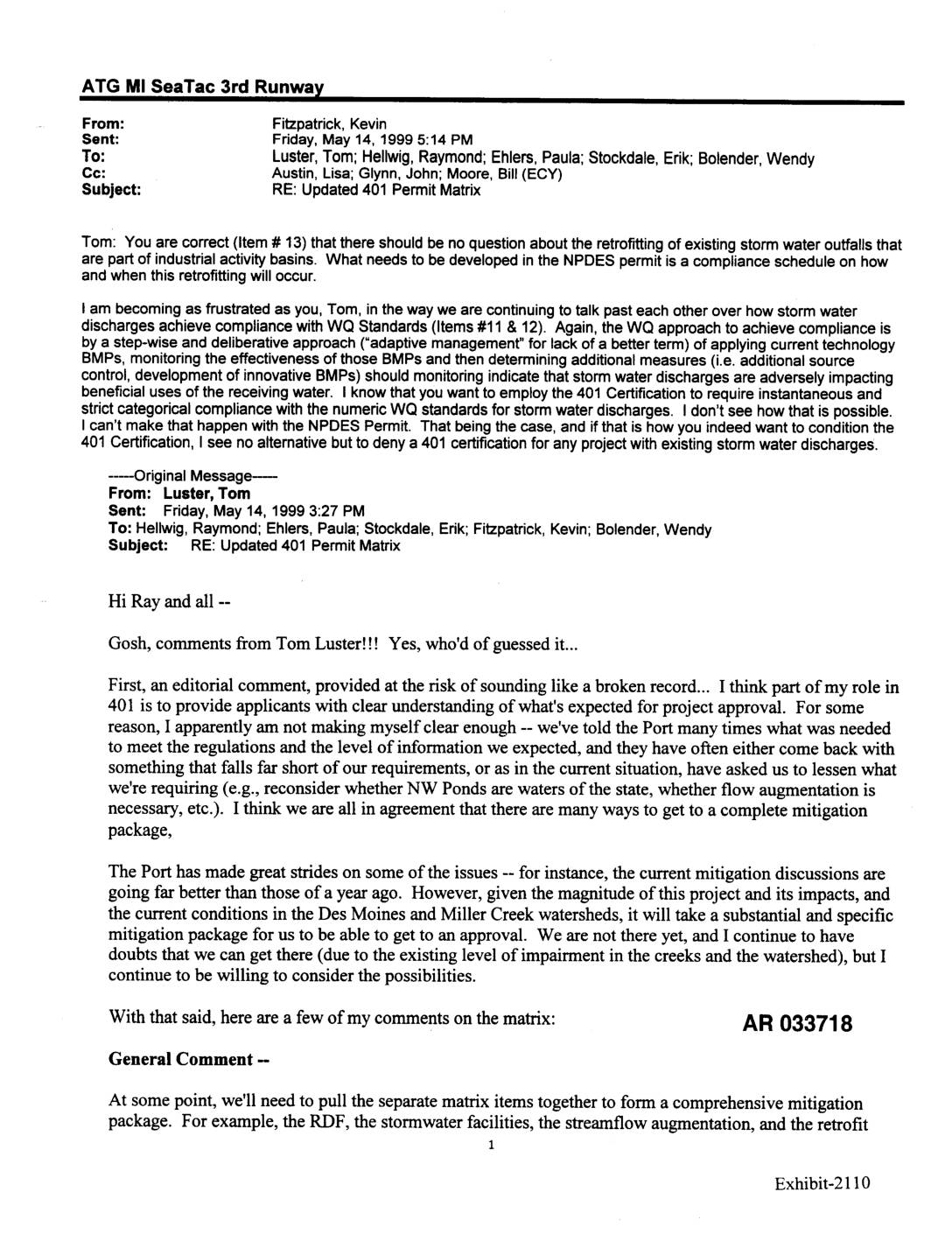
Exhibit 2110: AR 033718 — Ecology Internal Email Chain on 401 Certification and Stormwater for Sea-Tac Third Runway
Exhibit 2110, AR 033718. Internal Washington State Department of Ecology email chain dated May 14, 1999, among Kevin Fitzpatrick, Tom Luster, Raymond Hellwig, Paula Ehlers, Erik Stockdale, Wendy Bolender, Lisa Austin, John Glynn, and Bill Moore regarding the 401 Certification and NPDES permit matrix for the Sea-Tac Airport Third Runway project. Key issues include stormwater -
 1999-05-14
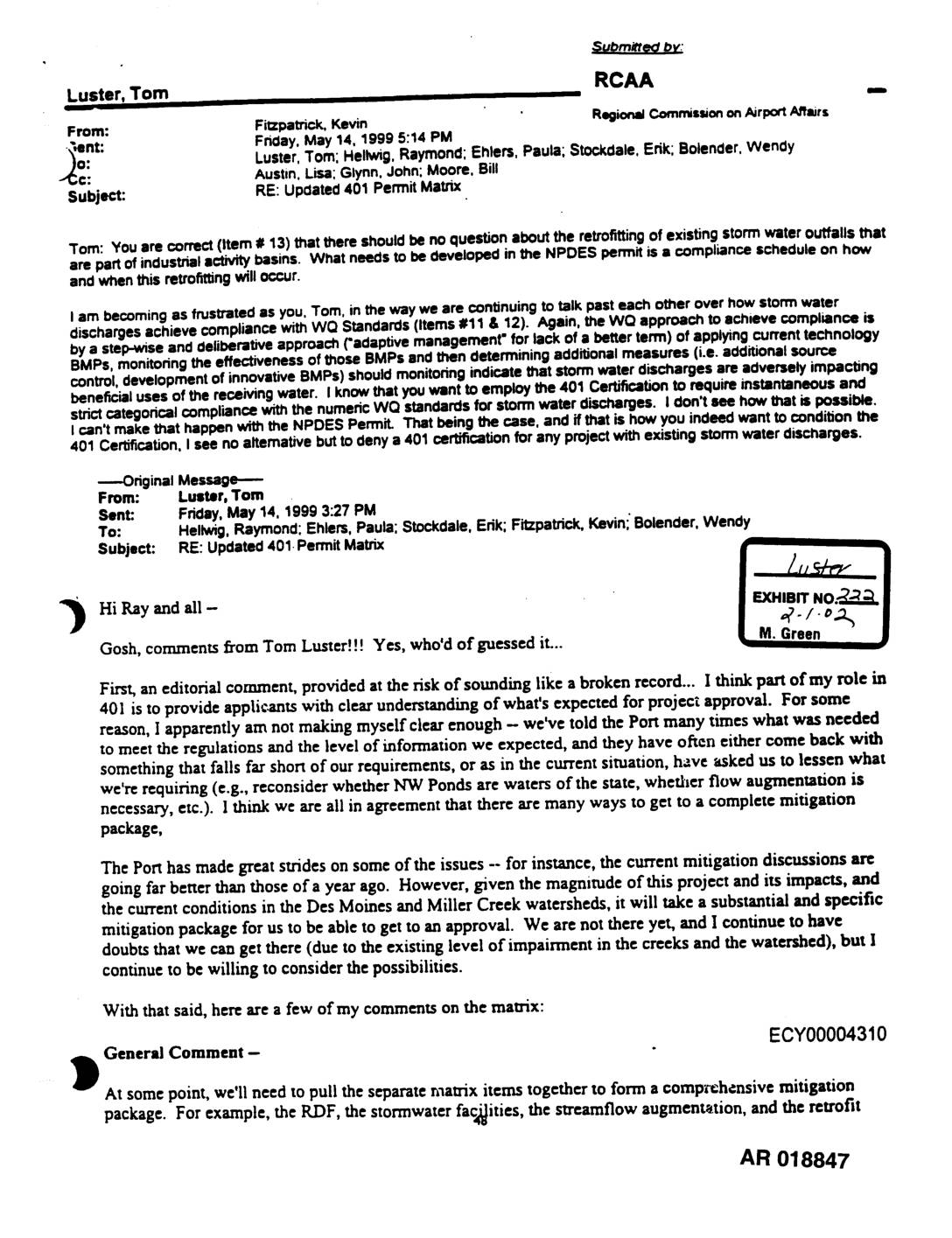
Exhibit 222: Email Chain RE: Updated 401 Permit Matrix — Luster (Ecology) and Fitzpatrick on Stormwater, NPDES, and Water Quality Standards for Sea-Tac Third Runway
This 1999 email chain between Washington State Department of Ecology officials discusses the 401 Water Quality Certification process for a major Port of Seattle project affecting Des Moines and Miller Creek watersheds near Sea-Tac Airport. Key disputes include stormwater discharge compliance with water quality standards, required mitigation measures such as riparian buffers and stream flow augmentation, and the retrofitting of existing stormwater outfalls. Officials warn that the creeks are already hydrologically impaired, with flood and erosion conditions far exceeding pre-development levels, making it difficult to approve the project without a comprehensive and specific mitigation package. -
 1999-05-12
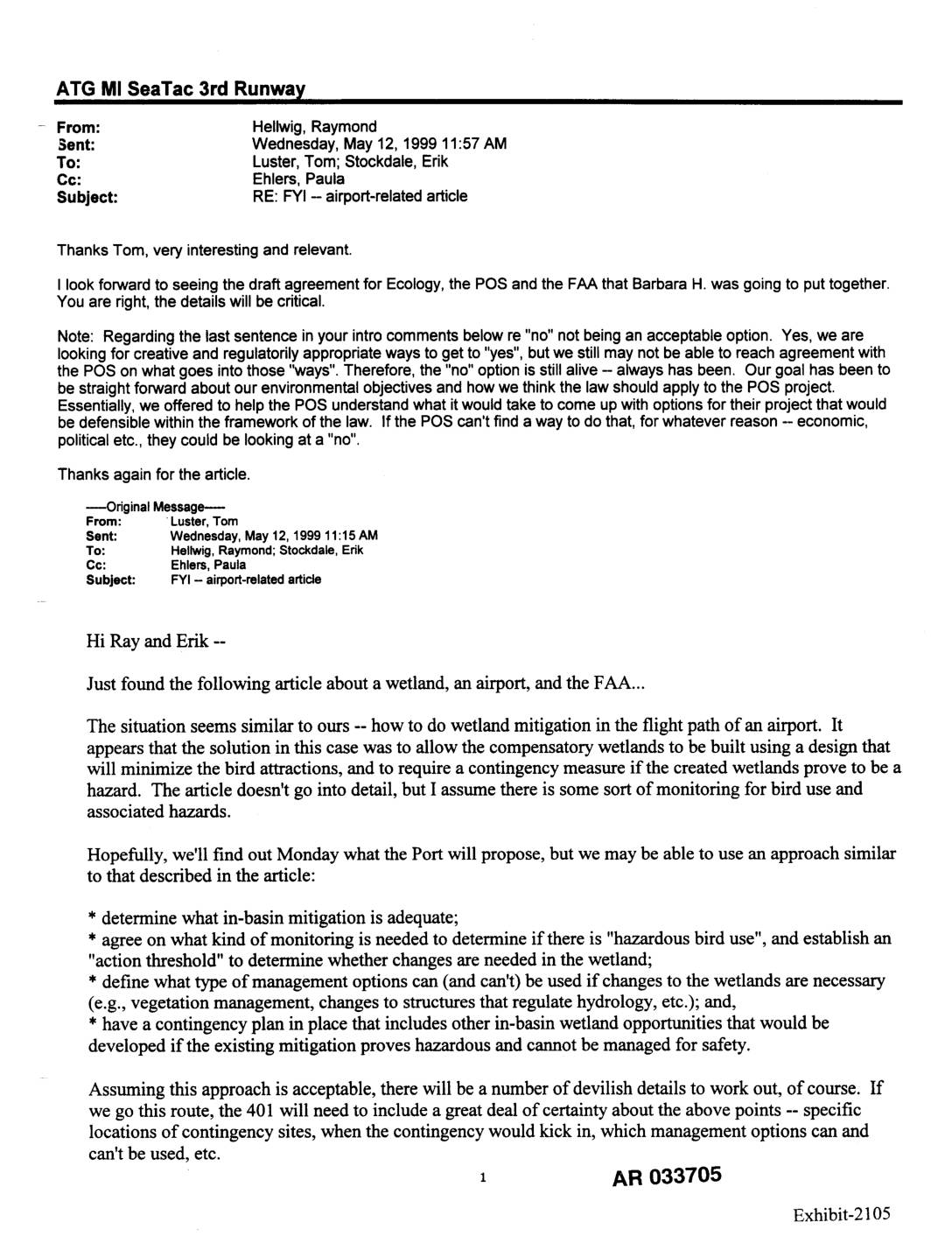
EXH AR033705: Email Chain Re: Sea-Tac Third Runway Wetland Mitigation and Airport Bird Hazard Article
Email chain dated May 12, 1999 among Raymond Hellwig, Tom Luster, Erik Stockdale, and Paula Ehlers (Washington State Department of Ecology) regarding wetland mitigation strategy for the SeaTac Third Runway project (Port of Seattle). Tom Luster shares a Press Democrat article about Petaluma municipal airport’s Cross Creek subdivision wetland resolution with the FAA, proposing a -
 1999-05-12
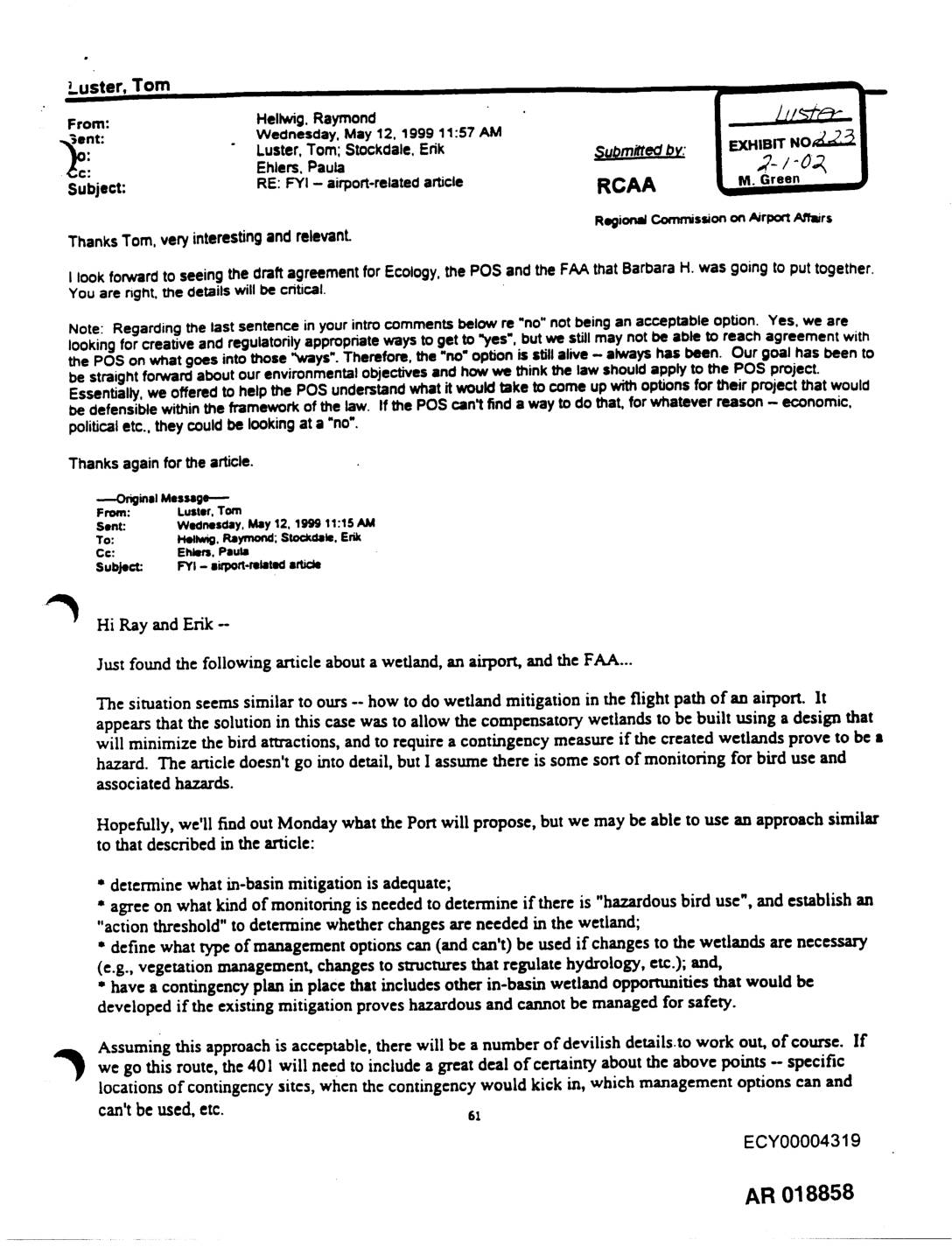
Exhibit 223: Email Thread — Ecology 401 Wetland Mitigation Strategy Near Airport Flight Path, with Cross Creek Article
A May 1999 email exchange between Washington State Department of Ecology staff discusses wetland mitigation challenges near an airport flight path, referencing a similar case in Petaluma, California where seasonal wetlands were allowed to remain near a municipal airport under strict conditions. The staff propose a framework involving monitoring for hazardous bird activity, defined management options, and contingency plans for replacement wetland sites if the existing mitigation proves unsafe. The emails emphasize that while the goal is to find creative regulatory solutions to approve the project under Section 401, denial remains a possibility if adequate safeguards cannot be agreed upon. -
 1999-05-10
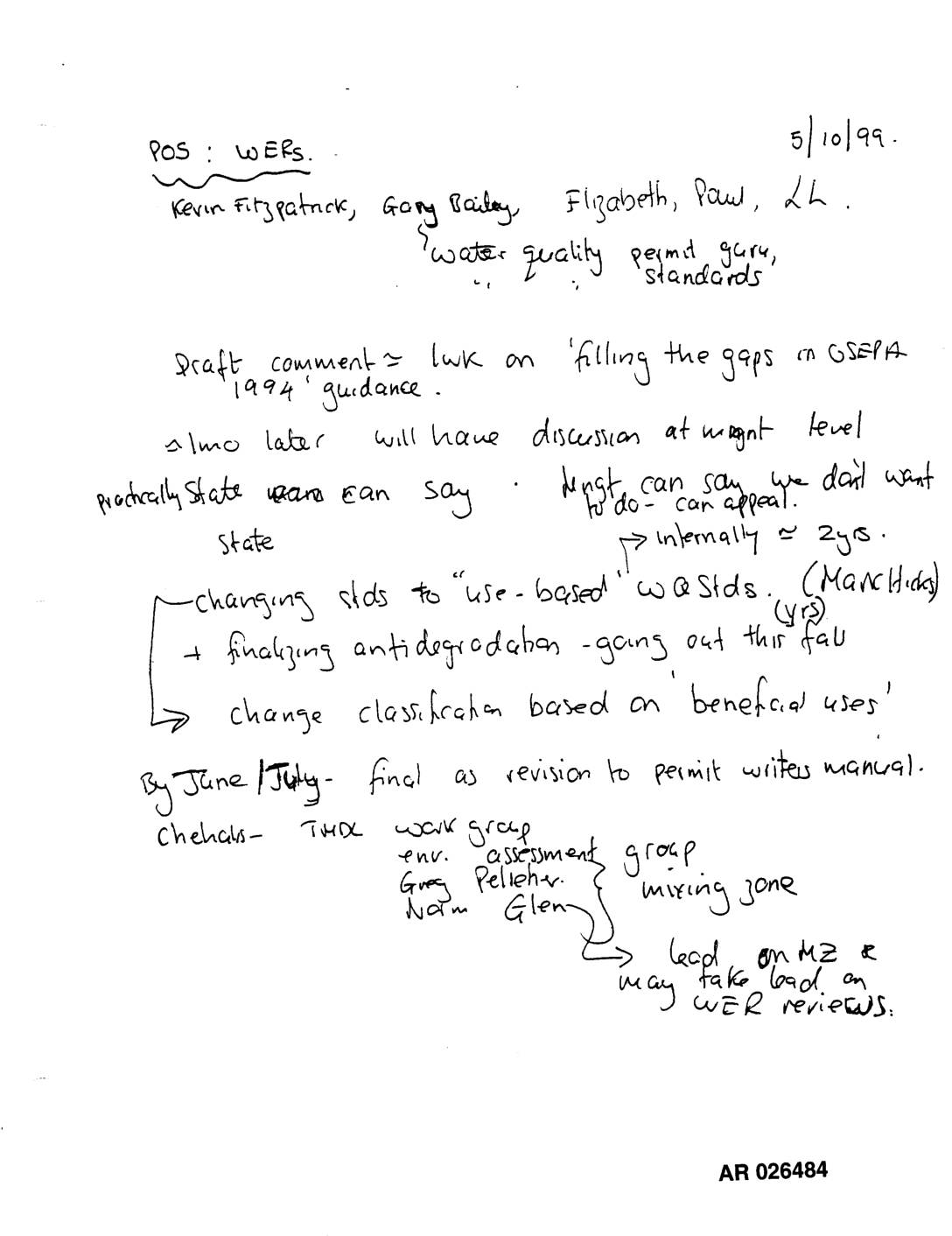
EXH AR026484: Handwritten Meeting Notes Water Quality Permit Standards WER Guidance POS/WERS 5/10/99
These handwritten meeting notes dated 5/10/99 document a discussion among water quality staff including Kevin Fitzpatrick and Gary Bailey regarding permit standards and guidance. Topics covered include updating water quality standards to 'use-based' classifications, finalizing antidegradation rules, and establishing sampling protocols such as requiring at least 5 days of sampling during critical low-flow conditions. The notes also address mixing zone limits, AKART conditions for permit outfalls, and revisions to the permit writer's manual expected by June or July. -
 1999-05-02
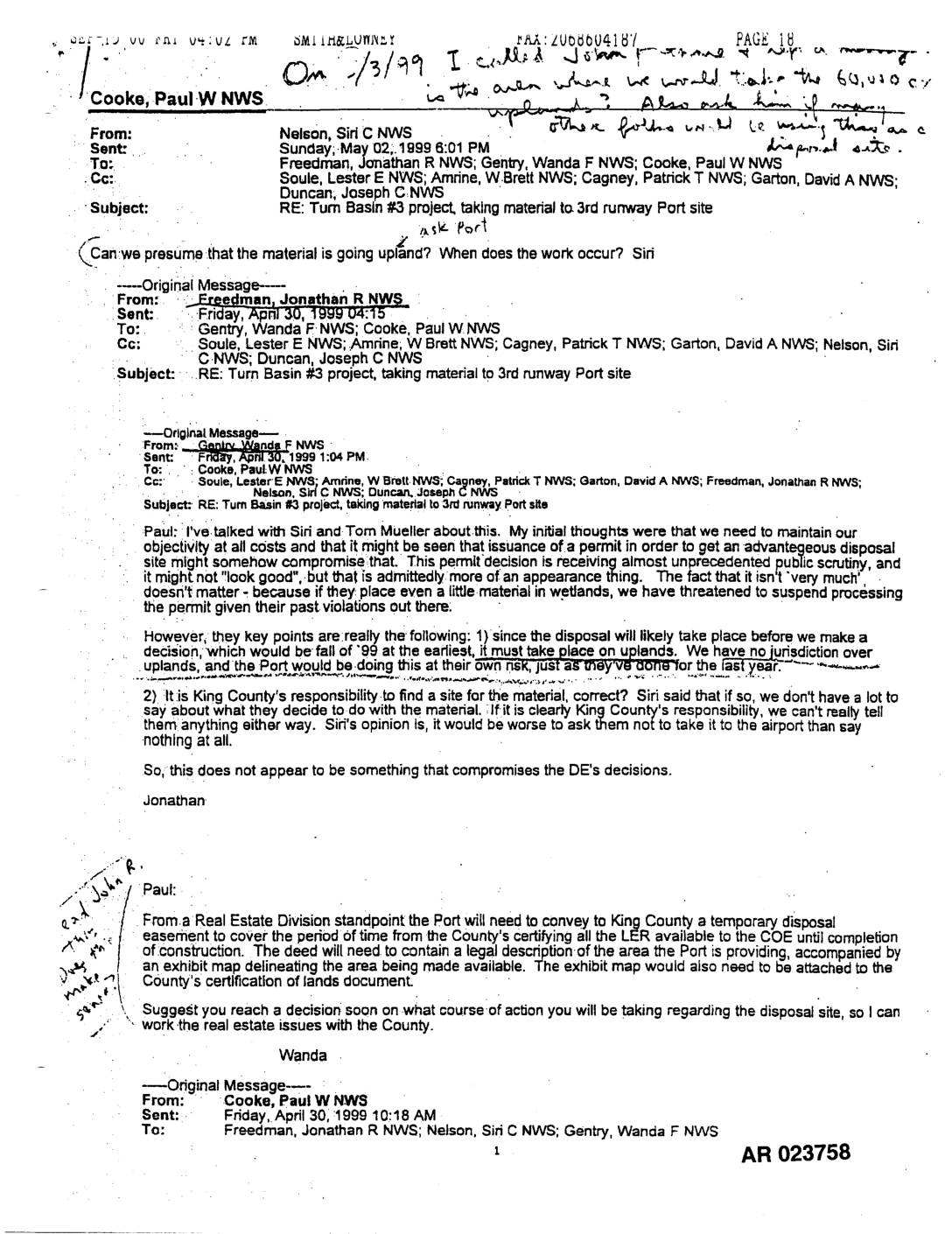
EXH AR023758: Internal NWS Email Chain — Turn Basin #3 Duwamish River Habitat Project, Material Disposal at STIA Third Runway Site
In April–May 1999, U.S. Army Corps of Engineers (NWS) staff exchanged emails debating whether to use a Port of Seattle Third Runway construction site as a disposal area for roughly 60,000 cubic yards of excavated material from the Duwamish River Turn Basin #3 habitat restoration project. Officials weighed whether this arrangement could compromise the Corps' impartiality in its pending permit decision for the Third Runway Project, ultimately concluding it would not, since disposal would occur on upland areas outside Corps jurisdiction and King County bore responsibility for finding a disposal site. The collaboration was seen as potentially saving the habitat restoration project up to $200,000 in disposal costs. -
 1999-05-01
EXH AR023630: STIA Ground Water Study — Public Participation Plan
This 1999 plan, prepared jointly by the Washington State Department of Ecology and the Port of Seattle, outlines how the public will be involved in a ground water study at Seattle-Tacoma International Airport. The study was prompted by decades of jet fuel and petroleum product releases from underground storage tanks and fuel systems in the Airport's Aircraft Operations and Maintenance Area, which contaminated soil and ground water across 13 known sites. The plan describes required and additional public participation activities, community outreach roles, and the two-phase study approach, which included computer modeling of ground water flow to assess contamination risks to public water supplies and surface water. -
 1999-05-01
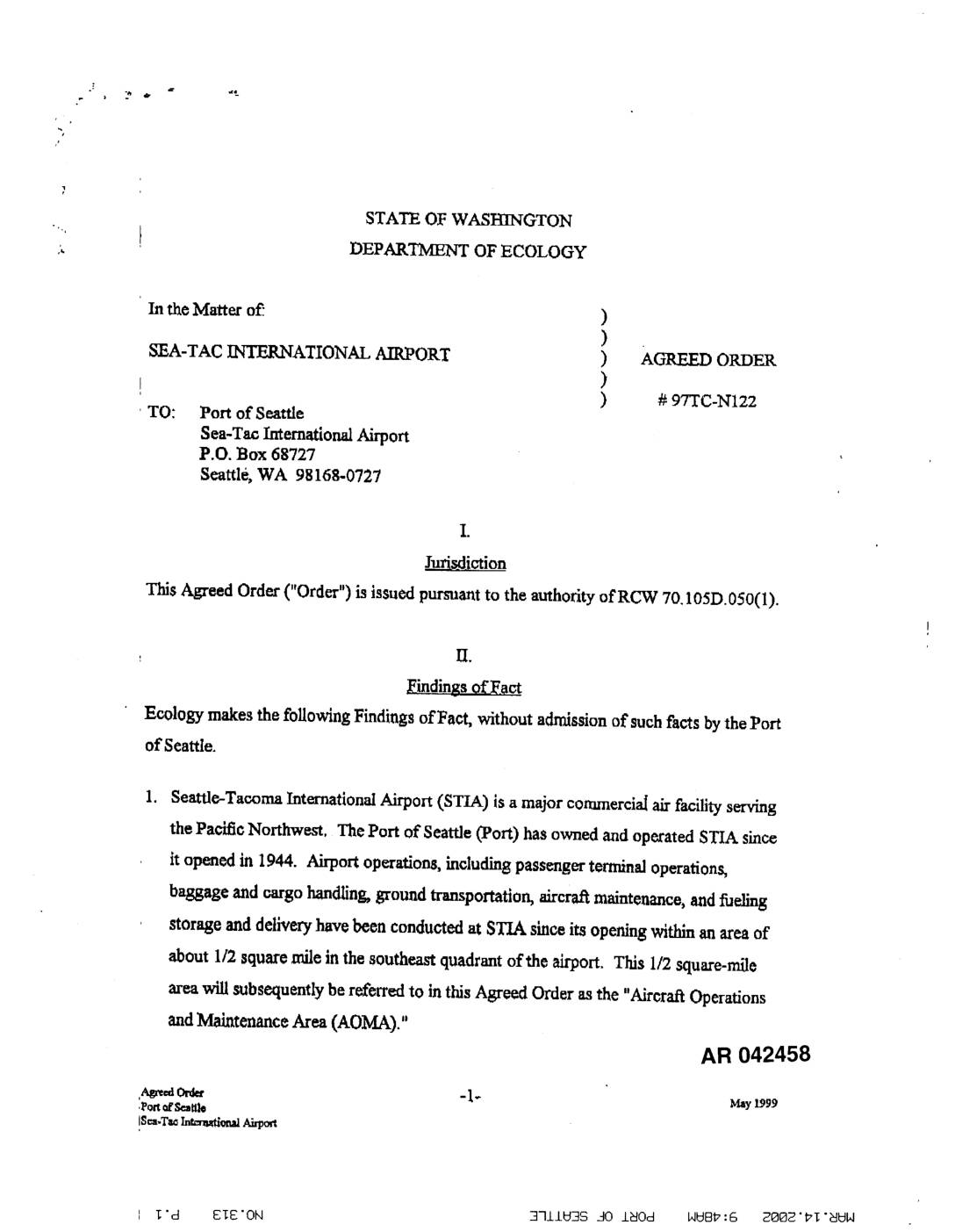
EXH AR042458: Agreed Order #97TC-N122 — State of Washington Ecology vs. Port Of Seattle, Sea-Tac Airport
Agreed Order #97TC-N122 issued by Washington State Department of Ecology under RCW 70.105D.050(1) directed to Port Of Seattle regarding hazardous substance contamination at Seattle-Tacoma International Airport (STIA). Documents thirteen contaminated sites within the Aircraft Operations and Maintenance Area (AOMA), a 1/2 square-mile area in the southeast quadrant of the airport, contaminated with jet fuel, gasoline,