Article Summary:
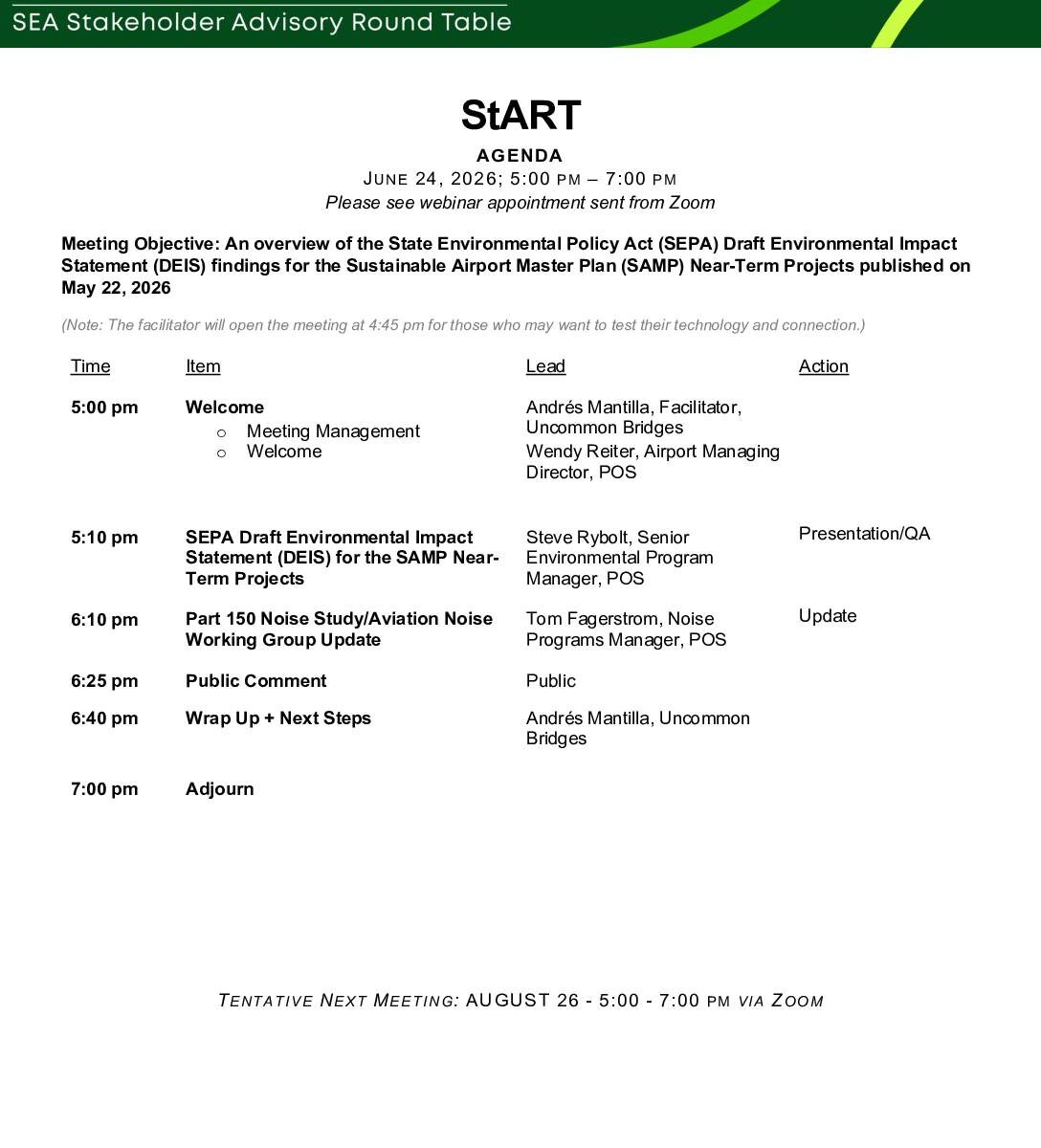
Meeting Objective
An overview of the State Environmental Policy Act (SEPA) Draft Environmental Impact Statement (DEIS) findings for the Sustainable Airport Master Plan (SAMP) Near-Term Projects published on May 22, 2026
Agenda
5:00 PM – Welcome
Lead: Andrés Mantilla, Facilitator, Uncommon Bridges; Wendy Reiter, Airport Managing Director, POS
– Meeting Management
– Welcome
5:10 PM – SEPA Draft Environmental Impact Statement (DEIS) for the SAMP Near-Term Projects
Lead: Steve Rybolt, Senior Environmental Program Manager, POS
Action: Presentation/QA
6:10 PM – Part 150 Noise Study/Aviation Noise Working Group Update
Lead: Tom Fagerstrom, Noise Programs Manager, POS
Action: Update
6:25 PM – Public Comment
6:40 PM – Wrap Up + Next Steps
Lead: Andrés Mantilla, Uncommon Bridges
7:00 PM – Adjourn
Tentative Next Meeting
August 26, 5:00 – 7:00 PM via Zoom
Transcript
“…what are these two subcommittees? When I met with Marco, I still hadn’t received an invite to join one of those subcommittees. I have no idea when I’m supposed to be there — there’s been nothing.”
**[00:50] Andres Mantilla**
“On that second point, I’ll check why that hasn’t been sent to you. It was my recollection that it had gone out during the meeting series, but if it hasn’t, that’s on me, and we’ll fix it immediately. Wendy — I saw your hand up, you’re on mute.”
**[01:14] Wendy Reiter**
“Thank you. We own this and we’ll take a look at it. Marco and I have had some discussion about changes after hearing from multiple people, so I think this is an opportunity for us to really sit down and talk about how to make this a more successful StART committee — and that includes everybody weighing in, not just [Ford — unclear in source audio]. I want to be clear about that. I’ve added this to the list of what we’ve heard, and I think it’s a good opportunity to talk it through. Marco, maybe after we get through tonight’s meeting we figure out how to get everybody together — maybe an in-person meeting next — and sit down and talk about how to make this a more successful committee.”
**[02:10] Andres Mantilla**
“Thanks, Wendy. Jeff, go ahead.”
**[02:12] Jeff Harbaugh**
“You know, eighteen months ago — maybe longer — Andres, you ran a meeting where some objections and concerns about StART were raised. Nothing happened. Now Wendy’s suggesting we do it again, and I guess I’m a little confused as to why I should expect a different result.”
**[02:34] Andres Mantilla**
“Yeah — I think what happened was, we set three strategic priorities: airport capacity and growth, noise and sound insulation, and environmental priorities. Those have shaped the agenda — for example, we’ve limited the number of agenda items on the list. And I think, as was discussed, there’s an opportunity at the next steering committee meeting to present some changes to the operating agreement around how StART operates, frankly. I also listed some of my own independent observations toward that goal at the Port Commission’s annual report meeting. Jeff — I’ve heard directly from you, and from others, the frustration around what you’re describing.”
**[03:46] Jeff Harbaugh**
“Just one other quick thing, then I’ll let it go. I still don’t understand — just send out the minutes. Is there any controversy around that?”
**[04:03] Marco Milanese**
“Jeff, I could try to answer that. Some of these conversations are pretty technical, so when [our note-takers] take a first stab at the notes, we want folks who are really involved with the SEPA process — or whatever the topic is, say the FAA presenting on a specific issue — to have a chance to go in and correct any language that wasn’t reflected accurately. It’s not an effort to change the feel of the notes, but to make sure they really capture what the discussion was.”
**[04:42] Jeff Harbaugh**
“But I agree it’s taken too long to get those minutes out. Here’s the request: give us a draft of the minutes two days after the meeting. If there are things we should know about later, happy to see those too — but there’s no justification for taking this long.”
**[05:01] Andres Mantilla**
“Yeah, Jeff — we hear you. I see Joe, then Brandon, and I do want to note we have a packed agenda tonight. I’m back — Joe, then Brandon, and then I’d like to move on to the presentation.”
**[05:19] Joe Dusenberry**
“If we do have a conversation about changes to StART and all the issues that have come up here this evening, will that take place exclusively in the steering committee, or will we have a chance to talk about it in this format?”
**[05:34] Andres Mantilla**
“The way that’s planned right now is an initial conversation in the steering committee, per the operating agreement, and then certainly a space to bring those broader conversations to the full StART membership at the next meeting. That’s definitely an option — but right now the steering committee is where that conversation is starting.”
**[06:02] Brandon**
“Thank you, everyone. I think this is a great conversation to be having. I do want to make a point of order, if I can: can we add this to an agenda properly, so people have time to think about it and discuss next steps? I’m not saying it’s not worth discussing, but I’d like us to keep to the agenda tonight.”
**[06:34] Andres Mantilla**
“Hear that, Brandon. The comments have been noted, we’re taking notes, the feedback’s been captured, and I’d like to move us on to the SEPA draft EIS conversation. We have a plan for bringing these comments to the steering committee and to the next full StART meeting. With that, I’ll turn it over to Steve to kick us off. There’s time for questions at the end, but I know folks have a lot of interest in this topic, so I’ll be monitoring the chat and hands raised. Steve, go ahead.”
## 2. SAMP Near-Term Projects & SEPA Draft EIS Presentation (Steve Rybolt, Port of Seattle)
**[07:16] Steve Rybolt**
“Thanks, Andres, and thanks everyone for having me back — nice to see some of the folks I’ve seen over the last couple days, and I appreciate you coming to the last days of our public hearing open houses. Quick update: we’ve slightly modified this presentation from what was sent out, based specifically on outreach and engagement, and I’ll talk through those. Andres and Marco will send out the updated version at the end, after questions and answers.
I want to be very clear that what you’re providing me today are not formal SEPA comments — I’ll talk about how those need to be provided going forward. I’ll do my best to answer all questions today, but there may be situations where your comment is exactly what we’re looking for in the SAMP near-term-projects environmental review, and I’ll encourage you to provide that formally through our process.
Agenda for today: I want to review the near-term projects at a high level, review what was done under NEPA — the final EA and the FAA’s Record of Decision — then go into what was completed under SEPA, what’s required, what’s in the draft SEPA EIS, discuss next steps, and dive into outreach and engagement, which is where we are right now.”
### Near-term projects overview
“The primary project the Port is proposing is a new terminal with 19 new gates. That includes relocating the roadway to make room for the new terminal. There’d be an automated people mover between the main terminal, the new terminal, and the rental car facility. We have additional facilities that will need to move — a westside maintenance campus, and the airport rescue and firefighting station, both of which need to move as a result of the new terminal.
We have airfield efficiency projects — taxiway Alpha/Bravo extension, some high-speed exits, runway blast pads. We need to increase the fuel farm — additional tanks to support jet fuel and, we hope, sustainable aviation fuel coming down the pipeline. And we have off-airport facilities, like the L-shaped off-site cargo facility, plus new parking to the north, and some other facilities to support the terminal.”
### Purpose of environmental review
“The purpose of an environmental review is to assess the potential impacts of proposed projects — in this case, 31 near-term projects — before decision-makers can act. The process is regulatory: we follow both NEPA (federal) and SEPA (state). We look for impacts of the proposed projects, identify ways to reduce or avoid them, and mitigate where required.
We look at the incremental impact between building the projects and not building them. The unconstrained forecast is what demand would look like at SEA with no constraints. We’re actually operating in a constrained environment — we need places to put aircraft, whether on pavement or at gates. If we do nothing, we go into a more constrained environment — that’s the no-action scenario, roughly a one-to-two-year horizon before very slow growth. The near-term projects are intended to relieve that congestion, but they will increase the operations SEA can accommodate. What NEPA and SEPA look at is the difference between no-action and action. By 2037, that difference is about a 2.7% increase in operations. It’s important to note: whether or not we build the near-term projects, aircraft are going to keep coming to SEA.”
**[12:48] Evan**
“From my understanding, what I thought I heard you say is that the SAMP near-term projects would allow for additional growth in airline travel. Did I understand that correctly?”
**Steve Rybolt:**
“The near-term projects are anticipated to accommodate existing and future demand at SEA.”
**Evan Maxim (SeaTac):**
“Would that additional demand become real if the near-term projects weren’t built?”
**Steve Rybolt:**
“Can you state that a different way?”
**Evan Maxim:**
“Looking at your dashed line on the chart — if the SAMP near-term projects were not built, would activity top out at the green line rather than the dashed blue line, and the light blue represents the additional growth that occurs following SAMP construction?”
**Steve Rybolt:**
“Yes — if we don’t build the near-term projects, growth will slow, probably to under 1%. What the near-term projects will do is accommodate additional demand — that’s the lighter blue line. The delta between the green line and the blue line is about 2.7% by 2037.”
### Port’s voluntary environmental programs
“I want to emphasize: the Port has a variety of policies and programs we voluntarily pursue that aren’t required by regulation. The near-term projects are analyzed under a regulatory framework — SEPA and special-purpose laws like the Clean Air Act and Clean Water Act — and if impacts are identified, we’re required to mitigate. Separately, the Port has proactively pursued emissions reduction programs, preconditioned air, electrified ground support equipment, noise management, sound insulation, minimizing ground run-ups, the South King County Fund for community/workforce programs, and our sustainable evaluation framework — really trying to minimize water, energy, and waste impacts in what we build today.”
### NEPA findings (final EA)
“Under NEPA, the FAA was the lead agency and produced an Environmental Assessment, now deemed complete. SEPA is where we are now — the Port is lead agency, and our SEPA Responsible Official, on this call, is Sarah Cox. We chose to pursue a full EIS from the outset.
For history: NEPA and SEPA were purposely split. During scoping in 2019, communities expressed interest in additional topics the FAA wasn’t willing to include in the NEPA documentation at that time. The Port wanted to include them, so we split the two — SEPA has followed what NEPA did.
Under the final NEPA EA, there was only one resource category with a significant impact: surface transportation. There were increases in air emissions, noise, and greenhouse gases, but none rose to the regulatory threshold of “significant.”
The FAA’s Record of Decision identified 18 conditions, in five categories: surface transportation (next slide); historical/architectural/archaeological/cultural resources (construction specifications for how and where we dig, and plans if anything new is found); biological resources; water resources (storm water requirements plus enhanced reporting to FAA and the National Marine Fisheries Service); and hazardous materials/pollution prevention/solid waste.”
**[18:33] Will Booth**
“Regarding historical, archaeological, and cultural resources — are local tribes consulted in any way?”
**Steve Rybolt:**
“Yes — the FAA is required to consult directly with tribes, and they were part of that process.”
**Will Booth:**
“Which tribes?”
**Steve Rybolt:**
“I’ll get back to you on that — they weren’t responsive to FAA’s outreach. All of that documentation is in the NEPA EA, on our web page.”
**Will Booth:**
“I’m curious — was that, say, the Spokane Tribe?”
**Steve Rybolt:**
“I don’t know off the top of my head — I can tell you the Duwamish were not part of that, since they aren’t federally recognized. But the Suquamish, Muckleshoot, and Puyallup, I know for certain, were.”
### Surface transportation findings
“I want to dive into surface transportation, since this is the one area with significant impacts. We categorized impacts into four types: Category 1 — near-term projects cause a decreased level of service; Category 2 — level of service is already degraded and the projects are a component of that; Category 3 — no change in level of service; Category 4 — an actual improvement in level of service.
We have 26 intersections we’re required to mitigate. Important point: if the Port moves forward with any traffic-related project, all of that mitigation is required — so the first project likely to move forward, the roadway reconfiguration into the terminal, would trigger all of the traffic mitigation.
We looked at 117 intersections, working with local cities and their transportation planners on the data — they gave us feedback and we added additional intersections at their request.”
**[21:57] Evan**
“When you say ‘significant impacts,’ is that under the DEIS or the NEPA EA?”
**Steve Rybolt:**
“We used a lot of the NEPA work because it met what was required under SEPA. Surface transportation isn’t a routinely included NEPA resource category — based on our analysis, we petitioned for it, the FAA included it in their analysis, and we carried it into the SEPA EIS with no updates, since it already met SEPA’s requirements.”
**Evan:**
“Follow-up — how is ‘significant impact’ defined under NEPA, and is it different under SEPA, for surface transportation specifically?”
**Steve Rybolt:**
“No difference. We typically look to the local cities’ code for their level-of-service standards — for example, in the City of SeaTac, working with [Florendo — name as heard, unclear] to use the appropriate levels of service and acceptable traffic counts.”
**Evan:**
“So a level-of-service drop from, say, C to D would be a significant impact in this context?”
**Steve Rybolt:**
“It depends on the type of road, the intersection, the roadway segment — not all roads are the same. Each city’s code clarifies what counts as a significant impact, and we worked with the cities and WSDOT — a huge player in this — and each jurisdiction to identify that.”
**[24:03] Brandon**
“Just to clarify — some cities, including Tukwila, have moved away from cars, and we define surface transportation as including bike and pedestrian. What is the Port looking at — just cars getting through an intersection, or non-motorized too?”
**Steve Rybolt:**
“We’re looking at motorized transportation specifically — cars. Side note: with the mitigation being proposed, we fully anticipate including non-motorized transportation in that mitigation, and we look forward to working with the cities on that once they’re ready. We also have the Ground Transportation Access Plan — the GTAP — which isn’t part of SAMP, where we look at non-motorized access to and from SEA.”
### Additional SEPA-required analyses
“SEPA requires some things NEPA doesn’t: greenhouse gas emissions and climate — these were removed from federal environmental reviews, but SEPA requires them, and actually requires more than the federal level did. Also surface transportation collision data, housing impacts/removals, state-listed plants and animals, and cumulative impacts. Cumulative impacts were removed from the federal NEPA EA but are a SEPA requirement.”
**[26:14] Jeff Harbaugh**
“Steve, can you give two sentences on what a cumulative impact is?”
**Steve Rybolt:**
“We look back five years, look at what exists today, and look forward five years — not just at the near-term projects, but other known Port and regional projects in the vicinity — and ask whether they have a cumulative impact, by resource category: air, transportation, and so on.”
**Jeff Harbaugh:**
“When you say you look back five years — do you mean you take the levels from five years ago, add the increasing levels of whatever you’re measuring, and use that as a baseline going forward? What’s the actual starting point in time?”
**Steve Rybolt:**
“We’re looking back at projects that occurred five years ago, as a whole.”
**Jeff Harbaugh:**
“But for a specific measurement — noise, pollution — what level do you start with? There’s a point-in-time measurement you begin from. What is that point in time?”
**Steve Rybolt:**
“Our baseline, or existing condition, is 2022. For the analysis, we project forward to when the projects would be built — 2032 — and further to 2037. SEPA requires looking at the incremental difference between with-projects and without-projects at those build years. So the question you’re asking is actually different from cumulative impacts.”
**Jeff Harbaugh:**
“But I’m still curious how you establish that 2022 starting point.”
**Steve Rybolt:**
“I’d encourage you to submit that as a formal SEPA comment — you’d be the first to hear that suggestion from me.”
**[28:59] Evan**
“Similar question to before — how did the Port define ‘significant impact’ for these additional analysis categories? Is there a general rule of thumb, for example for air quality?”
**Steve Rybolt:**
“For air quality, we use the Clean Air Act — the National Ambient Air Quality Standards, set by the EPA, health-based, delegated to states and then to regional clean air agencies — in our case, the Puget Sound Clean Air Agency, covering King, Pierce, and Snohomish counties. If we exceed those standards, that’s significant. The document itself lays out our methodology and significance levels for every resource category.”
**[30:28] Brandon**
“Did you talk about the additional, voluntary analyses yet? If not I’ll hold my question.”
**Steve Rybolt:**
“Let me cover that now. The Port also took on additional voluntary analysis in the SEPA EIS: dispersed-emissions modeling — a more detailed way of looking at air quality than standard modeling; noise specific to human health, including a literature review and a human health risk assessment; ultrafine particulate matter — reviewing the state of the science; and environmental justice, which isn’t a SEPA-required category — it was removed from NEPA, but we brought the analysis from the draft EA into the SEPA EIS, using Washington’s Department of Health disparity index and the Port’s own equity index. These are all things the Port took on based on what we heard in scoping and in NEPA comments.”
**[32:07] Roger Kaden (SeaTac)**
“You mentioned comparing against federal and state standards to determine significance — particularly for the voluntary analyses, what do you do when there’s no established standard to compare against? I’m thinking of ultrafine particulates specifically. How do you define significance without a standard?”
**Steve Rybolt:**
“For ultrafines specifically: they’re a subset of particulate matter under the NAAQS — PM10 and PM2.5 — but there’s no established significance threshold for ultrafines or ultra-ultrafines. Only the EPA has discretion to set one. It’s an emerging contaminant — we know it exists here, we reviewed the state of the science, but since there’s no significance threshold, we didn’t measure ultrafines directly, and that same approach applies anywhere else there’s no established threshold.”
**[34:14] Brandon**
“This may be a longer conversation, but — going into environmental justice — how do you baseline the impact? The Port commits to leading on equity and dismantling structural barriers for historically oppressed communities. South King County has been impacted by the airport for 60–70 years. How will the SEPA review account for that baseline? Are you simply saying ‘we won’t make it worse,’ or are you forecasting what the equity index looks like once fully built?”
**Steve Rybolt:**
“Really great question. I hope you get a chance to read what we did — I’m proud of it; our team put in effort beyond what’s typically done in SEPA, that I haven’t seen elsewhere in the state at this level. The Washington State disparities index was our primary tool for identifying vulnerable populations and their economic, social, and environmental vulnerabilities. The Port is one piece of the regional pollution picture — I-5 and other factors in South King County matter too, and I want to be transparent about that. From a regulatory standpoint, we use significance thresholds, identify vulnerable populations, and check for disproportionate impacts. I’ll acknowledge this was a regulatory-based program — that’s what we’re required to do — but the Port is doing other work outside SEPA too: the Port’s equity index, the South King County Fund, and other initiatives.”
**[37:09] Moira Bradshaw (Normandy Park)**
“Going back to Roger’s question — where there’s no federal, state, or local standard, did you look at World Health Organization or European standards, given the Port has gone beyond regulatory minimums in areas like air quality and environmental justice?”
**Steve Rybolt:**
“You’re fishing, and I appreciate that. To be clear — there’s really only one area with no established threshold at all, and that’s greenhouse gas and climate; there was some movement toward one until it was dismantled under the current administration, so there’s effectively no threshold for climate right now. As for world-based standards: yes, other noise standards exist globally. In the U.S., the FAA’s only tried-and-tested model is AEDT, using a 65 DNL threshold. It’s not a perfect threshold — there are pros and cons — but it’s what we use for noise. We looked at what the FAA might consider if they update it, and the Port is on record that when the FAA is ready to use a new metric, we’ll fully support that.”
### Addressing impacts
“Two things to note here: mitigation is triggered when we exceed significance thresholds — surface transportation is the only area where mitigation was triggered. Minimization measures are different — these are existing Port programs that reduce impacts generally, which is a big part of why we see fewer impacts in this analysis. Examples: our stormwater program (rooted in past regulatory work like the Third Runway), our sustainable evaluation framework, and our newly developed land stewardship plan — for instance, when the FAA requires us to remove trees because they’re too tall, we have our own replanting requirements, which don’t exist everywhere, so we built our own.”
### SEPA findings overview
“Similar to NEPA: surface transportation is the only area with significant impacts. We carried all 18 FAA-identified mitigation measures into the draft SEPA EIS. There are increases in air emissions, noise, and greenhouse gas emissions, but none exceed significance thresholds, so no additional mitigation was identified there.”
### Key updated analyses
**Air quality:** “We updated the NEPA baseline inventory using a more recent AEDT model, then ran dispersed-emissions modeling using EPA’s AERMOD model — a much more detailed approach. AEDT essentially looks at a box and the emissions within it; dispersed modeling looks at every grid point — how aircraft move, what emission sources exist, and what the emissions output is at each point.”
**[Unidentified member]:** “Steve, can you define the acronym AEDT for people who might not know it?”
**Steve Rybolt:**
“This one is — air emissions and data tool. It’s the FAA’s model for identifying air emissions and noise impacts. I’ll make sure that’s spelled out in the meeting notes; I routinely forget the exact acronym expansion.”
*[Editorial note: AEDT formally stands for the Aviation Environmental Design Tool. Kept Steve’s verbatim answer above since it’s on the record.]*
“Findings: there are temporary, small construction-related emissions, but in the long term the near-term projects show minimal increases in air emissions, consistent with the NEPA EA, with limited overall impacts.”
**Human health / air quality:** “We conducted a human health risk assessment focused on toxic air pollutants, exposure, and cancer risk. The dark green area on this map shows potentially increased cancer risk — these are highly conservative estimates. There are no residences in that area; it’s where the new terminal would be built, tied to construction emissions. The closest off-port feature is Washington Memorial Cemetery. Overall finding: emissions would not exceed health-based air quality standards.”
**Air quality minimization measures:** specific construction-equipment requirements (minimize idling, use newer equipment), preconditioned air, ground power, electric ground support equipment, renewable natural gas boilers, electric fleet vehicles, and the GTAP, which works to minimize single-occupancy vehicle trips and support non-motorized access to and from SEA.
**Ultrafine particulate matter:** “We did a literature review on ultrafine and ultra-ultrafine particulate matter to understand the state of the science. The science does not support an independent, causal link between ultrafine particulate matter and human health effects — meaning yes, they exist here, but there’s no way to attribute their source or separate them from PM10/PM2.5. What’s really needed is a broad-scale, multi-year epidemiological study on aviation emissions. We have two monitors — one north and one south of the airport — that should be up and running, which would be the next step.”
**Climate:** “Per Commission Resolution 3650, we have a process for how we look at climate and greenhouse gas emissions. We see a moderate increase in GHG emissions — 2.1% by 2032 and 7.7% by 2037 — primarily from aircraft operations, which we don’t control. Port-controlled emissions are relatively low and we’re working to reduce them further, including through sustainable aviation fuel programs.”
**[Evan]:**
“You said you don’t control aircraft emissions — but the additional airline emissions wouldn’t occur but for building the additional concourse. Can you help me understand that?”
**Steve Rybolt:**
“We physically don’t control aircraft emissions — EPA has sole authority there. I think what you’re describing is induced demand — ‘if you build it, they will come.’ I’ll be clear: the aircraft are coming whether we build these projects or not. You’re right that we don’t control the emissions, and as I mentioned, you’ll see slower growth at SEA if we don’t act — more congestion. The near-term projects aim to create efficiencies that minimize congestion, which should help minimize additional emissions in certain categories.”
**Evan (follow-up):**
“My understanding was that on the chart, activity would keep increasing along the green line regardless — but the near-term projects let that activity occur at a sooner date than it otherwise would. So I’m struggling to reconcile ‘induced demand’ with the idea that the climate impacts shown here would occur sooner than they would without the near-term projects. Am I tracking correctly?”
**Steve Rybolt:**
“Let me break it down. We could have a long discussion about induced demand at airports — generally, airports don’t induce demand; there are studies and examples of airports building new runways expecting more aircraft to come, and that doesn’t happen. It’s driven by local economy. We’re unique in the Northwest — we’re an origin-destination airport; people come here, there’s no substitute airport nearby — going to Portland doesn’t get you to Seattle very well. Second part of your question: yes, if we build the near-term projects, we will have higher operations sooner. That’s the intent — to accommodate demand that’s here and will come.”
**[49:26] Brandon**
“Building on Evan’s question — when you say a modest increase in emissions, 2.1% in 2032 and 7.7% in 2037 — does that include aircraft emissions?”
**Steve Rybolt:**
“Yes, it does. We consider that a modest increase.”
**Brandon:**
“And while you don’t control how someone gets to the airport — drive solo or take light rail — you still have to mitigate regardless, the same way the Port can’t control vehicle fuel economy but still has obligations. Where I’m going: you still have to mitigate even when you can’t direct an airline’s behavior, right?”
**Steve Rybolt:**
“You can find ways to reduce greenhouse gas impacts even when you can’t tell an airline how to operate, since that’s FAA’s purview — by mitigating somewhere the Port does have control. Specific to climate, though, there’s no significance threshold, which makes that harder to require. For air quality — which covers aircraft and automobile emissions together — that mitigation obligation does apply, because there are significance thresholds there.”
**Climate impact reduction measures:** same Port programs referenced above.
**Noise and human health:** “We heard a lot of interest in human health impacts specifically — I’d point to Moira’s question about WHO standards. We did a literature review; findings show aircraft noise exposure can increase annoyance and disturb sleep, but there are no regulatory standards for those specific impacts to date, and a lack of broad-scale aviation-focused health studies. That’s not to say the effects don’t exist — just that they haven’t risen to a regulatory standard yet. Again, the Port is on record supporting a new FAA noise standard whenever the FAA is ready.”
**Noise impact reduction (construction):** construction noise specifications and standards, local city code compliance, the Fly Quiet incentive program, the late-night noise limitation program, restricting noise run-ups where possible, and the current Part 150 program, which Tom will cover later.
**Environmental justice:** “We used the Washington State Department of Health’s environmental health disparities map as our primary tool for identifying vulnerable populations, validated against the Port’s newer equity index. Finding: the SAMP near-term projects would not substantially contribute to any of the factors or indicators analyzed in either tool — no significant impacts to EJ communities.”
**[53:58] Jack Dovey**
“When we see these maps, we see all the cities, and Federal Way is on the south end — how come we never see Federal Way’s name on any of these documents? It would help people understand where the city is and how this affects them. Just a comment.”
**Steve Rybolt:**
“Thank you for that — going forward, I’ll make sure Federal Way is labeled whenever it appears on a map.”
**EJ impact reduction:** same general Port programs referenced earlier.
**Cumulative impacts:** “We consider direct and indirect impacts of past, present, and reasonably foreseeable projects — five years back, five years forward. I’d encourage folks to look at that specific section of the EIS. Looking at all projects — near-term, other Port projects, other community projects — together, it would not result in significant cumulative environmental impacts. Again, this is focused on the delta of the projects with versus without — it does not look at Sea-Tac’s overall cumulative impact.”
### Next steps and comment period
“We released the SEPA draft EIS on May 22nd, after sending notice 30 days in advance. The comment period is 60 days. We’re hoping for a final SEPA EIS and decision by year-end, which would start the SEPA appeal period. One important note: even once environmental review is complete, that doesn’t mean the near-term projects move forward automatically — our Commission must still take action on any individual project or group of projects.”
**Andres Mantilla:**
“One question that’s come up — any clarification on the comment-period timeline?”
**Steve Rybolt:**
“SEPA typically requires 30 days for an EIS; the WAC allows up to a 14-day extension. The Port started with a 60-day comment period. I looked at what’s been done regionally — most EISs are 30 days, a handful were 60, one was 90. The EIS as a whole is large, but much of it is based on the NEPA EA, which has been out for over a year, so a lot of it isn’t new. Right now we’re holding 60 days; I can’t guarantee it won’t change, but as of today, July 21st is the end of the public comment period.”
**[59:15] Roger**
“Assuming everything’s approved and finalized, you’re looking at this being done just before 2027, correct?”
**Steve Rybolt:**
“By no later — I’d love to have this done by year-end, though that depends on the comments we get; I review and we respond to every comment, so anything could change between now and year-end.”
**Roger:**
“Underlying question — assuming you hit that date and everything’s good, how long before construction actually starts? And how many years to reach the projected blue-line level?”
**Steve Rybolt:**
“If we move forward, near-term projects would likely be constructed no earlier than 2028 — some straightforward projects, like blast pads, could move sooner. There are five projects that went through conceptual design years ago but haven’t been touched recently — those would need to go through design starting around 2028. Right now we’re looking at substantial completion of many of these projects around 2032, with full effect between 2032 and 2037.”
**Roger:**
“And for the main terminal itself, do you need the others in place first?”
**Steve Rybolt:**
“For some, yes — the roadway needs to move first, and that’s likely the first project the Port would pursue. Other projects, like the firefighting station relocation, or things like the blast pads or taxiway Alpha/Bravo, could move forward more independently.”
**Roger:**
“So realistically, no real capacity relief until about 2037?”
**Steve Rybolt:**
“Between 2032 and 2037, yes.”
—
## 3. Public hearing format discussion
**[1:02:38] Bob Larson (Burien)**
“I don’t want to debate the technicalities of whether public meetings constitute public hearings under the WAC, but I do appreciate the Port offering this fifth meeting — if Port Commissioners are actually convening it. I’d also encourage the Port to hold that fifth meeting out in one of the affected cities rather than down at Port headquarters — it can be a real hardship for people to get there. I think it would behoove the Commissioners to seriously consider having that public hearing at, say, Burien City Hall or another city hall that can accommodate it. I think it’d be great outreach to the communities.”
**Andres Mantilla / Steve Rybolt:**
“Thanks, Bob — I really want to encourage folks to participate. We’ll validate parking and try to make things as easy as possible. I’ll clarify: it would not be at Pier 69 — it would be at the airport conference center, where the Aviation Commission meetings are held. But I do hear you, and I’ll bring that message back to the team working through logistics.”
**Bob Larson:**
“I still think it’s fairly challenging for community members. I appreciate the four community meetings, but I’d hope you’d reconsider and hold it at one of the cities — Burien, for instance, can provide a venue.”
**[1:04:41] Barton DeLacy**
“I’ve been to a number of these public meetings, and I really find them an inadequate forum to raise issues — this is exactly why we petitioned for a public hearing, so people can respond to each other. These Zoom meetings make it very difficult — I can’t even get everyone on the screen, let alone address someone directly. I want to second what Bob said. I have a disability myself — going to either of those locations is a real hardship, and I imagine others have issues too. Holding it out in the cities — the Commissioners are, I think, well-intentioned, but quite insulated from the public. Maybe that’s by design, maybe it relates to the concerns about minutes too. It’s a very stunted process, and I think that’s why some of our longer-serving members have been frustrated. I’ve only been on this a year, but I see their point.”
**Andres Mantilla:**
“Bart, I really appreciate your comment. We’re trying to provide as wide a range of options as possible — we’ve found open houses make people feel more comfortable than standing at a microphone. We do have this fifth meeting now, and I want to emphasize: if anyone needs accommodations for these meetings, please reach out to me directly and I’ll do everything I can to make that happen — that’s important to the Port. Lastly, we do have a virtual meeting — there will be no formal comments accepted at that meeting; any question or comment still needs to be submitted formally. That’s June 30th, noon to 1:30.”
**[Relayed from chat — “Bill”]:**
“Question — does the July 9th meeting give commissioners the ability for public comment? Will there be a microphone, with commissioners present taking testimony, or is this just another open house where they circulate with everyone else?”
**Andres Mantilla / Steve Rybolt:**
“We’re still working through the logistics, and we’ll have that out Friday. … We’re taking that into account. There are a number of things we need to do to formally hold a public hearing per what people have asked and per SEPA’s requirements, so we want to make sure we can meet all of those. It’s not as simple as waving a magic wand.”
**[Bill, via chat, follow-up]:**
“Who has final say on the structure — the meeting format and public comment process?”
**Andres Mantilla:**
“That would go through the Executive Director, [Steve] Metruck.”
**[1:10:04] Will Booth**
“Going back — is the virtual meeting a Zoom meeting, or a webinar format?”
**Steve Rybolt:**
“It’ll be a Zoom webinar — people can submit questions, and I’ll answer them, similar to the format we’re using today.”
**[1:10:36] Bob Larson**
“I want to be clear about my request, in case I need to clarify further — I’d agree with Bill: the request for a public hearing means exactly that — Commissioners convening and presiding, listening to public comment, much like a city council would. If that wasn’t clear, I apologize, but I’d hope everyone would expect that’s what was intended by the cities, especially Burien. If it needs clarifying further, I’d be glad to send a follow-up email to [Burien Council] President [Caukins — as heard, please verify spelling].”
**[Sarah Cox]:**
“That request was understood — we just need to work through some of the formatting. I don’t want to give false expectations about exactly what that looks like right now, as we work through some of the notification processes and our own internal policies.”
**[Barton DeLacy Des Moines representative]:**
“Bob’s absolutely correct — I’m from Des Moines, we’ve had a joint meeting [among the cities], and that’s absolutely our sentiment.”
**Andres Mantilla:**
“Thank you, Martin — clear. So, to summarize: the request from several folks is not another public meeting — meaning an open-house-style public meeting. That’s not the request. The request is a public hearing, as several members put to the Commission, and the Port is hopefully going to have more clarification by Friday. I just want to clarify: the four meetings we’ve held meet the criteria as currently structured for a public hearing, but a different structure has been requested, and we’re working to accommodate that.”
—
## 4. How to comment / closing presentation items
**Steve Rybolt:**
“More information is at [sea-samp.com — as heard, please verify]. Takeaways: we completed substantial new analyses on air quality, noise, human health, and environmental justice; no new significant impacts were identified in the draft SEPA EIS; it was published May 22nd, and the 60-day public comment period ends July 21st.
How to comment: at our public hearing meetings — the two we’ve had, and the three coming up — by email to [samp@… — as heard, please verify exact address], through the web portal, by mail, or hand-delivered to me directly; I’d be happy to take it from you in person. I read every comment, and we will respond to all of them. Comments are due by July 21st, 4 p.m., or postmarked by that date.”
**[1:15:05] Joe Dusenberry**
“Question — given all the available literature already included by staff, and the things we think should have been included but weren’t, that we’ll get into the record — will our submissions receive the same level of analysis as the information the staff included in this process?”
**Steve Rybolt:**
“I treat all comments equitably — citizen, agency, or otherwise. I’ll read every one, and we’ll respond to all comments.”
**[Unidentified]:**
“I’ll note an important typo to fix before this goes out — it says ‘Thursday, June 9th’ for the SEA conference center meeting; it should read July 9th.”
**Steve Rybolt:**
“Yes, I’ll correct that — thank you. That’s our last slide. Happy to answer any questions; I really hope your communities will submit comments, and the more you can spread the word and come to the last three meetings, the better.”
**[1:17:06] Evan**
“I’m a little embarrassed to ask this, but I want to ask directly rather than keep assuming. This is a Sustainable Airport Master Plan — I’ve tended to read it as project-level SEPA review, not a planned-action/non-project review. Given Roger’s question about sequencing, and that construction of the concourse by itself could trigger its own SEPA project review — how does the Port anticipate environmental review occurring after this final EIS? Is this the last SEPA review for these projects, or do you expect, say, a separate project-level SEPA review for the concourse?”
**Steve Rybolt:**
“Good question. This is project-level review — right now, once this is done, there would be no additional environmental review of these specific 31 projects. However, if things change during design — locations shift and fall outside the framework of this review — subsequent evaluation may be required, which could mean going back out to the communities. My job going forward is to track what we do and ensure we’re following what’s in the SEPA EIS.”
**Evan:**
“I’ll make this a formal comment, but I think stating that explicitly in the documentation would help future participants in this process — I couldn’t find it anywhere in the DEIS.”
**Steve Rybolt:**
“Appreciate you raising that — thank you.”
**[1:19:27] Jeff Harbaugh**
“I appreciate the presentation — speaking for myself, and I think for Burien and probably others: we’re not, at this point, trying to stop these projects. We recognize the airport’s importance to the state, and honestly, I think you’ve done a pretty good job managing an airport in a really difficult location — it never should have been put there, but who knew.
But the SAMP, SEPA, and NEPA processes are administrative procedures that are going to conclude you need these projects — and that has almost nothing to do with the conditions on the ground that people are going to experience. When you say ‘no impact, no mitigation required,’ that grinds on me, because I have to imagine you all know that’s not really the case.
Burien hasn’t seen much return in tax revenue relative to what it’s paid, and not many jobs from the data I’ve seen. And I think some of your calculations — for example, using only the 65 DNL threshold when you have other monitor data available — and the impact of running parallel runways, which I think you’re going to do, is going to make this worse than you’re even estimating right now. If you all ever came to us and said — even if there are political or legal reasons you can’t say it outright — ‘yeah, we know this is going to be messy, how can we work with you,’ that would be a much easier conversation to have. That’s my philosophy for the night.”
**Andres Mantilla:**
“Thanks for the comment, Jeff — I don’t think there was a specific question there.”
**[1:21:30] Barton DeLacy**
“I’d just add — Steve, you’ve been good at deflecting, but there’s a rule for this, and there’s regulation for that, and that isn’t the point we’re trying to make. Fifty thousand flights a year — that’s one a minute, from 5 in the morning to 1 at night — and you’re going to add another 30,000. We know that’s coming, we can’t stop it. But to say there’s no impact is nonsense.
I have a nice view where I live, near the flight path — I wouldn’t move, I’ll live with it, my hearing’s fine, it bothers my wife more. But what about the people east of me, without the view, in neighborhoods where property values are lower and they can’t sell their homes? It’s going to get worse. At yesterday’s hearing, thank God Senator Orwall was there talking about impacts on schoolchildren and kids with asthma — and to say ‘there isn’t really science, so there’s no impact’ just isn’t right. Say there is an impact, and that we don’t fully know the health effects yet. With 33,000 more flights, what happens — flights at night, a fourth runway? It’s just going to get worse, and there needs to be some kind of compensation for our disproportionately affected communities. Maybe that doesn’t come in the form of a SEPA denial, but it certainly hasn’t addressed our concerns.”
**Andres Mantilla:**
“Bart, I know that’s more of a statement than a question, but I really appreciate your thoughts. Many of those are really good points — I hope you’ll put them in writing, and encourage your neighbors who are impacted to do the same. I encourage everyone to look at the ultrafine particulate literature review and the human health noise study — if something’s missing that should be included, I need to hear that.”
**Barton DeLacy:**
“I don’t think you’re missing anything that’s out there — I do impact studies myself, I’ve done literature reviews, and I get it, there isn’t a lot of research yet. One of our committee members, Jeff Boen, a retired FAA administrator, is a tremendous resource and has done some critiques — Joe and I will make sure he submits those in writing. It’s not that you haven’t followed the rules — you have, we’re not quibbling with that — it’s that we’re frustrated this doesn’t address what it’s actually like on the ground.”
**Andres Mantilla:**
“I’m seeing people in the chat saying ‘+1’ to both Barton’s and Jeff’s comments. We’re meeting until 7:00 and still need to hear from Tom, plus public comment — if there are any last questions for Steve, ask now, or put them in chat or email directly.”
**Steve Rybolt:**
“Thanks for having me again — I appreciate all your questions, and I look forward to more of them over the next few days and beyond. Please say hi if you see me at the public meetings — I’ve met a lot of you, but not everyone. Thank you for having me today.”
**Andres Mantilla:**
“Thank you, Steve. Tom, I’ll turn it over to you.”
—
## 5. Noise Working Group recap (Tom Fagerstrom, Port of Seattle)
**[1:25:51] Tom Fagerstrom**
“Thanks, Andres — nice to see a lot of you at the meetings the last couple days too. I’ve got a summary of the Noise Working Group meeting, a packed two hours on June 8th.
The first half was devoted to the Part 150 Technical Review Committee — the sixth TRC meeting since the Part 150 study began in 2024. Autumn Ward and the team from ESA, our noise consultant, presented on potential noise compatibility program measures — we’re just beginning to evaluate those now, and this was a first look at the analysis.
One measure was intersection departures — aircraft taking off further down the runway to lessen noise for those near the runway ends — found not effective. We also looked at increased glide-slope angles for arriving aircraft, which showed noise benefits for communities under the flight paths, and will be examined further. We discussed the challenge that a lot of these measures require FAA approval, which can be difficult — that’ll be a factor throughout the process. Another example was an offset approach path for a specific south-flow arrival, which could yield noise benefits for certain communities — we’re just starting that analysis, with more to come as we approach public meetings later this year.
The TRC slides are on the study website, [seapart150.com — as heard, please verify]. Other land-use measures discussed: noise-related real estate disclosures, possible building-code amendments, updates to King County’s noise database, and more information for people looking to buy a home near the airport. A programmatic measure discussed was noise certification for aircraft and encouraging airline fleet modernization — possibly tying that into our Fly Quiet or late-night programs.
The TRC wrapped up discussing the study schedule — public workshops most likely in October, where we’ll discuss these potential measures with the community, get feedback, and hear additional ideas, since we’re right in that process now. More immediately, we anticipate releasing our Noise Exposure Map report to the website in the coming days — it includes the noise maps we’ve discussed for months, plus land-use analysis and air traffic forecasts.
That concluded the TRC portion. We then turned to StART Noise Working Group business. I reviewed Q1 results from the late-night noise limitation program: Asiana Airlines had the most exceedances — that’s a passenger flight that leaves right around midnight. Air Transport International, which operates on behalf of Amazon, had the second-most, followed by Korean Air Cargo. As part of the program, we reach out to all carriers with exceedances and meet periodically with selected carriers about their plans. We plan to meet with ATI/Prime next to discuss their operations and any opportunities to reduce late-night noise. Asiana is in the process of being acquired by Korean Air, so their future plans are uncertain right now — we may wait to talk with them until those plans are clearer.
I then discussed late-night usage of our Third Runway — reminder, we have a voluntary agreement with the FAA limiting its use between midnight and 5 a.m., same window as the late-night noise limitation program. This June, we’ve averaged just over five landings per night on the Third Runway in that window, a bit higher than last year, mostly due to about a month and a half of center-runway closure for maintenance, which pushes operations onto other runways. The center runway’s open again now, mostly to accommodate midsummer and World Cup traffic, but there will be more closures later this year, so we’ll see those numbers rise again.
Paris Edwards briefed the group on aircraft go-arounds, highlighting a few days in April and May with elevated occurrences — we averaged just over two per day across those two months. He also briefed on complaint data: 5,887 complaints in March, 5,776 in April — both significantly lower than the same period last year.
We then looked specifically at the 5–6 a.m. hour — the second part of an analysis on the feasibility of expanding the late-night noise limitation hours from midnight–5 a.m. to 11 p.m.–6 a.m. The data showed a predominance of passenger aircraft operations in that hour, not much cargo, and mostly arrivals — getting aircraft in ahead of the vital early-morning departure rush that airline schedules depend on. With input from consultant Vince Mestre, it would be very difficult to get airlines to shift their schedules out of that hour — echoing what we found earlier this year looking at the 11 p.m.–midnight hour.
Paris then reviewed the 2026 Fly Quiet Awards, which he manages — criteria include low noise-monitor readings, adherence to noise-abatement flight procedures, ground run-up rule compliance, and few late-night program exceedances. This year’s winners: Air Canada, Frontier Airlines, and Icelandair.
Finally, Ryan McMullen gave a verbal update on the sound insulation programs. The Port has completed sound insulation work on 57 apartment units this year, across five complexes, with 127 more units on track for completion by year-end. Work continues on three places of worship, with a fourth starting construction next year. For single-family homes: design is complete on three of the five homes that tested eligible, and those will be under construction next year as part of the sound insulation repair-and-replacement pilot program. The Port has completed acoustic testing on 60 of 73 homes tested so far in 2026, and including five homes that tested eligible last year, we’re now up to nine eligible homes total for that pilot program. With that, the Noise Working Group meeting adjourned.”
**[1:37:18] Joe Dusenberry**
“Does the FAA regulate ground run-ups that are maintenance-related, or is that purely a Port matter?”
**Tom Fagerstrom:**
“That’s something the Port does have authority over. We have a fairly restrictive rule between 10 p.m. and 7 a.m. — run-ups can’t exceed two minutes. We have authority to enforce that, and if there are multiple violations, authority to issue fines — since the wheels are on our asphalt.”
**[1:38:23] Moira Bradshaw**
“Are the blast pads [mentioned earlier] used for run-ups?”
**Tom Fagerstrom:**
“No — not related to what Steve was describing as blast pads for the near-term projects. I’d defer to Steve, but I believe those relate to areas around aircraft parking and cargo, mitigating jet blast — not noise, but the physical force of jet blast, which can move ground equipment. There are two primary locations on the airfield for actual run-ups, away from structures, with tails pointed toward the airfield.”
**[Jeff, via chat]:**
“Have you ever issued any fines?”
**Tom Fagerstrom:**
“It’s been many years — maybe 15 — since we’ve had to go that far. The process is: a letter of admonishment, a second letter within a year if it happens again, and a fine on the third violation. Over a year, we might see a total of two or three violations — it’s well known and well understood by everyone.”
**[1:40:21] Joe Dusenberry**
“Some airports have a dedicated structure for run-ups — any plans for something like that at SEA?”
**Tom Fagerstrom:**
“That’s been studied extensively over the years. The basic answer is, we’re so space-constrained there isn’t a spot for one — it’s roughly the size of a small hangar. In the long-term planning, decades out, there may be a spot for a ground run-up enclosure. Honestly, run-ups don’t happen often — much less than ten years ago — averaging less than one a day, almost always in daytime.”
—
## 6. Public comment
**Andres Mantilla:**
“We have one public comment today — David Goebel. David, I’ll move you over now.”
**[1:42:37] David Goebel**
“I’m David Goebel, president of Vashon Fair Skies. I’ve attended virtually every StART meeting since the inaugural one in February 2018 — Marco might recall me missing one or two right after COVID hit, when there was also a 30–40% drop in operations that really helped, made things less pressing.
I wanted to say that just publishing the meeting video would be really helpful. I’m retired now, but I was at Microsoft eighteen months ago, and AI has gotten scary good at generating accurate meeting summaries — you just feed it the video, and it picks up the most relevant themes well. So even if you don’t get the full editorialized minutes out quickly, just posting the video would help — let the AI generate a draft, then do a quick read-through to catch anything glaringly wrong.
Beyond that — the current webinar/panelist format is completely inadequate. I’d really encourage anyone to try participating in one of the Public Health [Seattle–King County Board of Health, presumably] meetings — they pull off a hybrid meeting really well. They use Teams, but people on video can actually see who’s attending, and it’s run well. I’d recommend more in-person hybrid options — everyone going to these meetings is nearly within walking distance of the airport, and it’s 2026 now; COVID isn’t the obstacle it used to be. You need some kind of hybrid in-person option — it’s not really acceptable anymore. It’s a public meeting, and people need to be able to see and interact with each other. Thank you, and that’s my comment.”
**Andres Mantilla:**
“Thank you, David.”
—
## 7. Closing
**Andres Mantilla**
“Thank you for a productive meeting today — a lot of questions, a lot of comments, and I’m taking all of it into consideration. As I mentioned, at the next steering committee meeting there’s a conversation planned around changes to the operating agreement — meeting format, meeting location, public comment location and format, and procedural items like meeting minutes and agenda topics.
Several of you have already reached out with ideas — I’ve captured those, but I’d strongly recommend also making your city representatives aware, so they can bring it into that meeting. And I believe there’s an intent to bring a fuller discussion back to the full StART membership — so if you haven’t sent me your ideas yet, individually or as a group, please do.
I’ll also note — right after this meeting, I’ll make sure the policy and noise working group meetings are on your calendars; that’s on my to-do list. Our next meeting will be the full StART meeting, August 26th, 2026.
Really appreciate everybody’s time tonight — have a good night.”
This is a machine-generated transcript generated on the fly by Google/Youtube/AI. Accuracy totally not guaranteed. Provided only as a convenience and to help people with disabilities. Caveat lector!