TagPart 150(269)
-
 2026-08-10
SEA Part 150 Technical Review Committee Meeting #7 Summary
Meeting summary for TRC Meeting #7 of the SEA Part 150 Noise Study, held August 10, 2026 via Zoom, facilitated by Ryan McMullan and Tom Fagerstrom of Port Of Seattle with ESA consultants Chris Nottoli and Scott Tatro. Topics include analysis of Noise Compatibility Program (NCP) measures: increased glideslopes for arrivals (3.0 to 3.5 degrees -
 2026-08-10
SEA Part 150 Technical Review Committee Meeting #7 Summary
Meeting summary for TRC Meeting #7 of the SEA Part 150 Noise Study, held August 10, 2026 via Zoom, facilitated by Ryan McMullan and Tom Fagerstrom of Port Of Seattle with ESA consultants Chris Nottoli and Scott Tatro. Topics include analysis of Noise Compatibility Program (NCP) measures: increased glideslopes for arrivals (3.0 to 3.5 degrees -
 2026-08-09
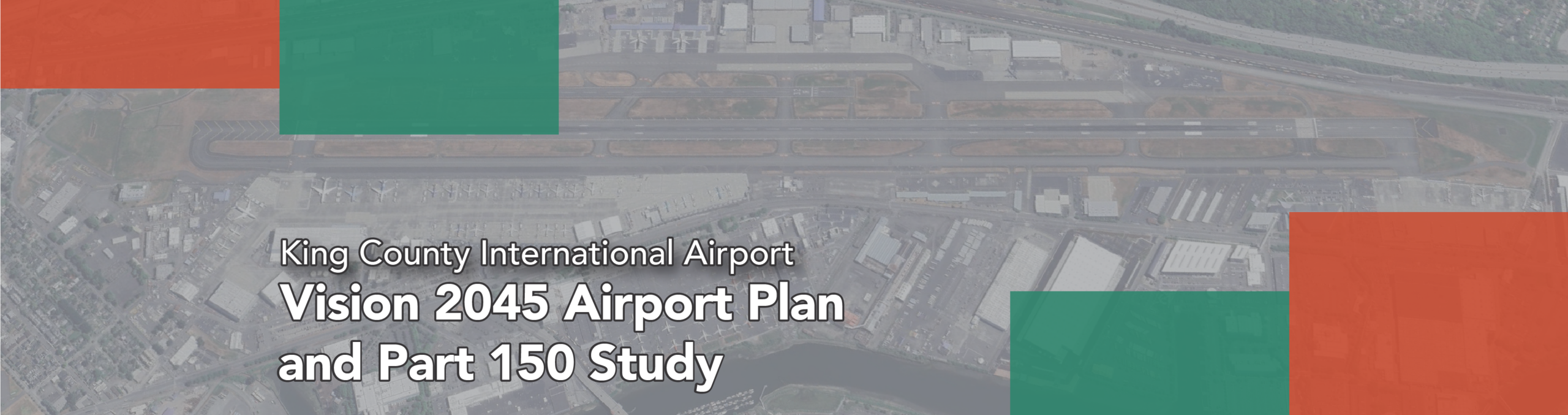
KCIA Vision 2045 Airport Plan and Part 150 Study
King County International Airport is planning for the future. Learn more about the Vision 2045 Airport Plan and the Part 150 Study and how to provide your input throughout the planning process. Help us plan for the future of King County International Airport King County International Airport (KCIA) is undertaking two important studies to plan -
2026-07-15
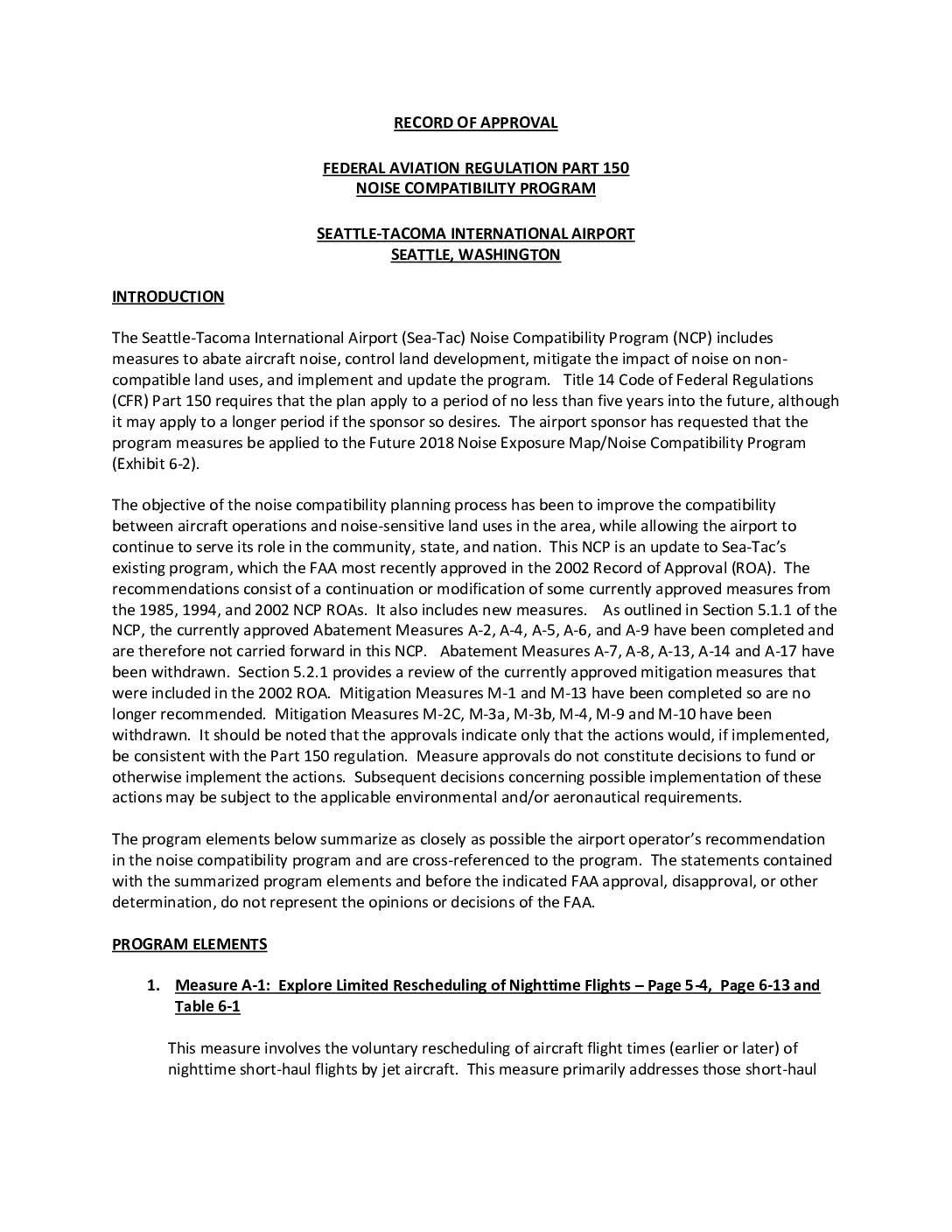
FAA Approval of Noise Compatibility Program 14 CFR Part 150 Dane County Regional Airport, Madison, Wisconsin
Department of Transportation Federal Aviation Administration Federal Aviation Administration, DOT. Notice. The Federal Aviation Administration (FAA) announces its findings on the noise compatibility program submitted by the Dane County for Dane County Regional Airport (MSN). On December 21, 2023, the FAA determined that the noise exposure maps (NEMs) submitted by Dane County were in -
 2026-07-08
Ep #37 Dear City Managers
What if the solution to decades of airport noise and community impacts has been hiding in plain sight all along? In this open letter to city managers across airport communities, we revisit a landmark yet largely forgotten document: the Sea-Tac Communities Plan of 1976. Built on the Port of Seattle's promise — *"As we do better, you'll do better"* — this collaborative plan was supposed to be the long-term answer for neighborhoods living under the flight path. So why has it been reduced to little more than an expensive property buyout program? The answer reveals a critical gap that neither elected officials nor community advocates can fill alone. Real, lasting solutions require sustained professional commitment to airport community planning — something that should have been established 50 years ago. If you work in city management, this episode speaks directly to you and the unique role only you can play in finally delivering on that broken promise. -
-
 2026-07-01
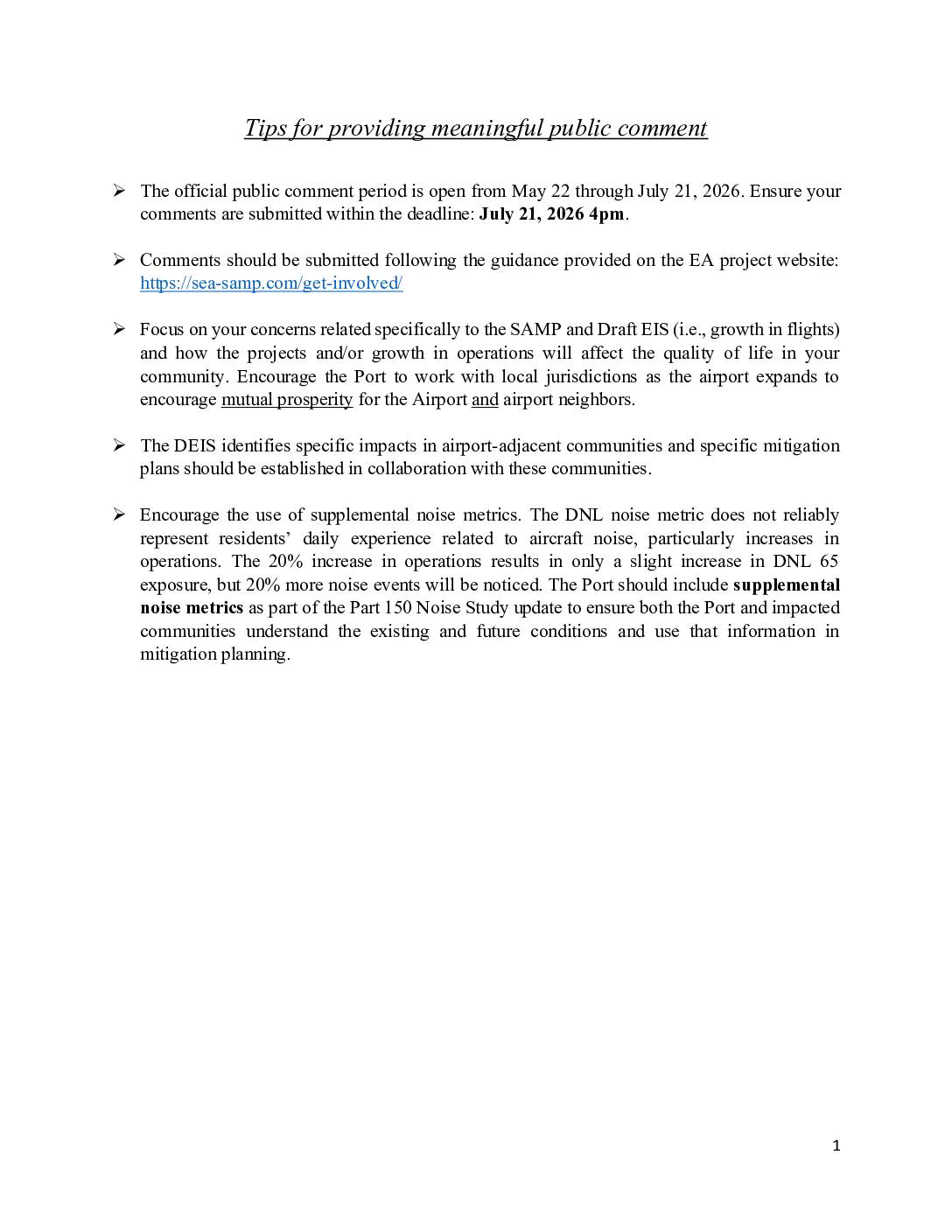
Tips for Providing Meaningful Public Comment on the Seattle-Tacoma SAMP Draft EIS
This document provides guidance for residents near Seattle-Tacoma International Airport (SEA) on how to submit public comments about the Sustainable Airport Master Plan (SAMP) and its Draft Environmental Impact Statement before the July 21, 2026 deadline. It highlights key concerns including aircraft noise, air quality, traffic, and economic impacts on neighboring communities, with sample comment language residents can adapt. A central argument is that the standard DNL noise metric understates the real impact of a 20% increase in flight operations, and that supplemental noise metrics should be used to better reflect residents' daily experiences. -
 2026-06-29
Appendix H Official Noise Exposure Maps
This document presents the official Noise Exposure Maps (NEMs) for Seattle-Tacoma International Airport (SEA), developed as part of the FAA Part 150 noise study. It includes maps showing 2022 existing noise conditions and projected 2032 future conditions, along with the flight tracks used in the Aviation Environmental Design Tool (AEDT) modeling for both north and south flow operations. The maps illustrate the geographic extent of aircraft noise impacts across surrounding communities, including Seattle, Burien, SeaTac, Tukwila, and Des Moines. -
2026-06-29
Appendix H Official Noise Exposure Maps
This document presents the official Noise Exposure Maps (NEMs) for Seattle-Tacoma International Airport (SEA), developed as part of the FAA Part 150 noise study. It includes maps showing 2022 existing noise conditions and projected 2032 future conditions, along with the flight tracks used in the Aviation Environmental Design Tool (AEDT) modeling for both north and south flow operations. The maps illustrate the geographic extent of aircraft noise impacts across surrounding communities, including Seattle, Burien, SeaTac, Tukwila, and Des Moines. -
2026-06-28
Ep #36 Orphans
**Discover why environmental progress stalled for airport communities while cars got cleaner** Ever wonder why your car's emissions have dramatically improved over decades, but aviation seems stuck in the past? In this eye-opening episode of The Airport Communities Podcast, we explore the fascinating tale of two environmental paths that diverged after 1970. While Washington Senator Scoop Jackson spearheaded NEPA—one of the largest expansions of environmental policy in American history—and California secured game-changing carve-outs in the Clean Air Act that led to massive air quality improvements, aviation somehow got left behind. Despite Boeing being headquartered in Washington, aviation environmental standards never caught up. UW Meteorologist Cliff Mass delivers some stark perspective: those two annual flights to Europe generate more greenhouse gases than most people produce in their entire homes over a year. Meanwhile, Boeing's monopoly status has eliminated market incentives for cleaner technology. This wasn't an oversight—it was intentional. Today, every airport community continues paying the price for decisions made decades ago that exempted aviation from automotive-level engineering standards.