TagNoise Abatement Procedures(92)
-
 2024-06-13
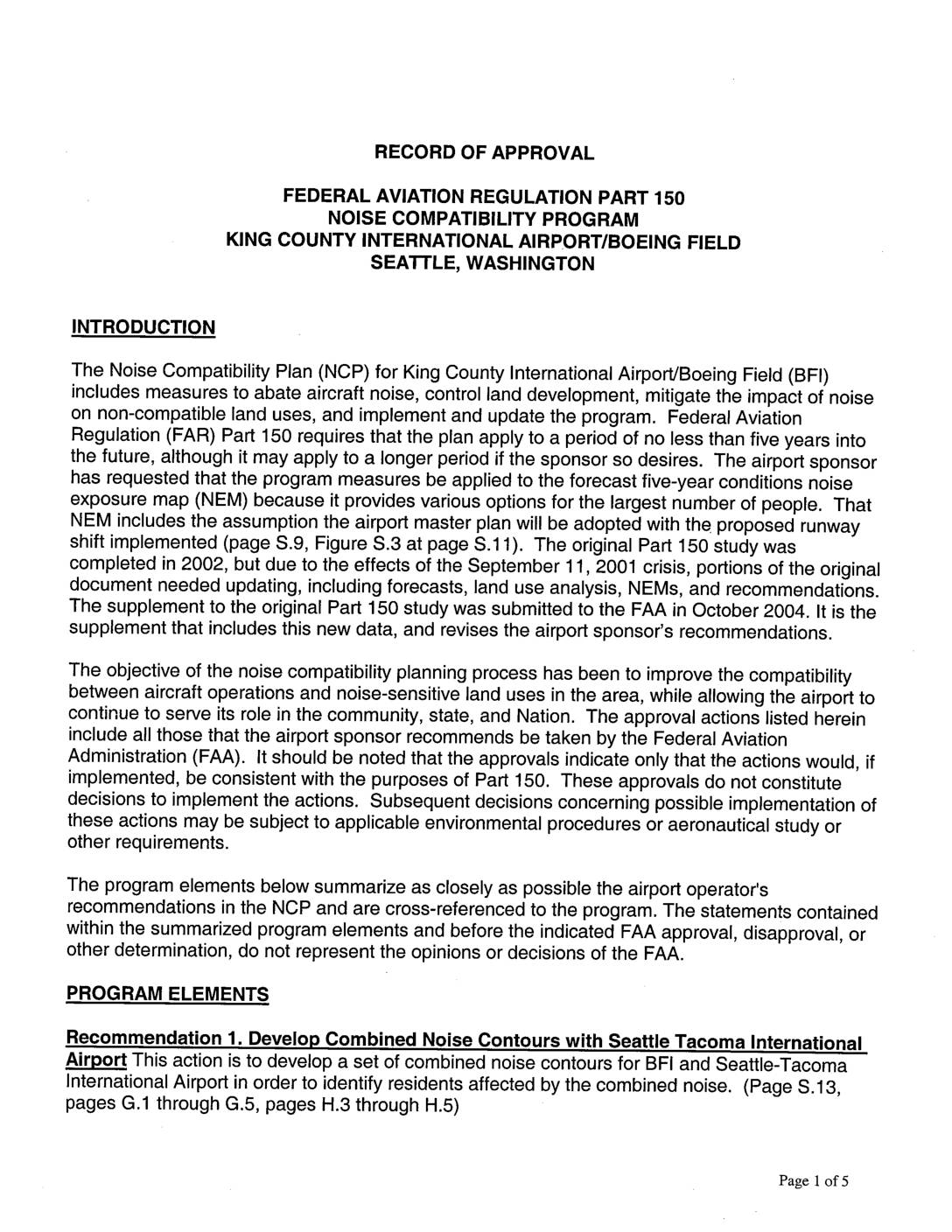
Record of Approval: FAA Part 150 Noise Compatibility Program, King County International Airport/Boeing Field
This document is the FAA's official Record of Approval for King County International Airport/Boeing Field's (Boeing Field/BFI) Noise Compatibility Program under Federal Aviation Regulation Part 150. It outlines six key recommendations to reduce aircraft noise impacts on nearby residents, including developing combined noise contours with Seattle-Tacoma International Airport, implementing quieter flight approach and departure procedures, and upgrading noise monitoring systems. The FAA reviewed and issued determinations on each recommendation, approving most measures on a voluntary basis while noting that approvals do not constitute commitments to implement the actions. -
 2024-05-13
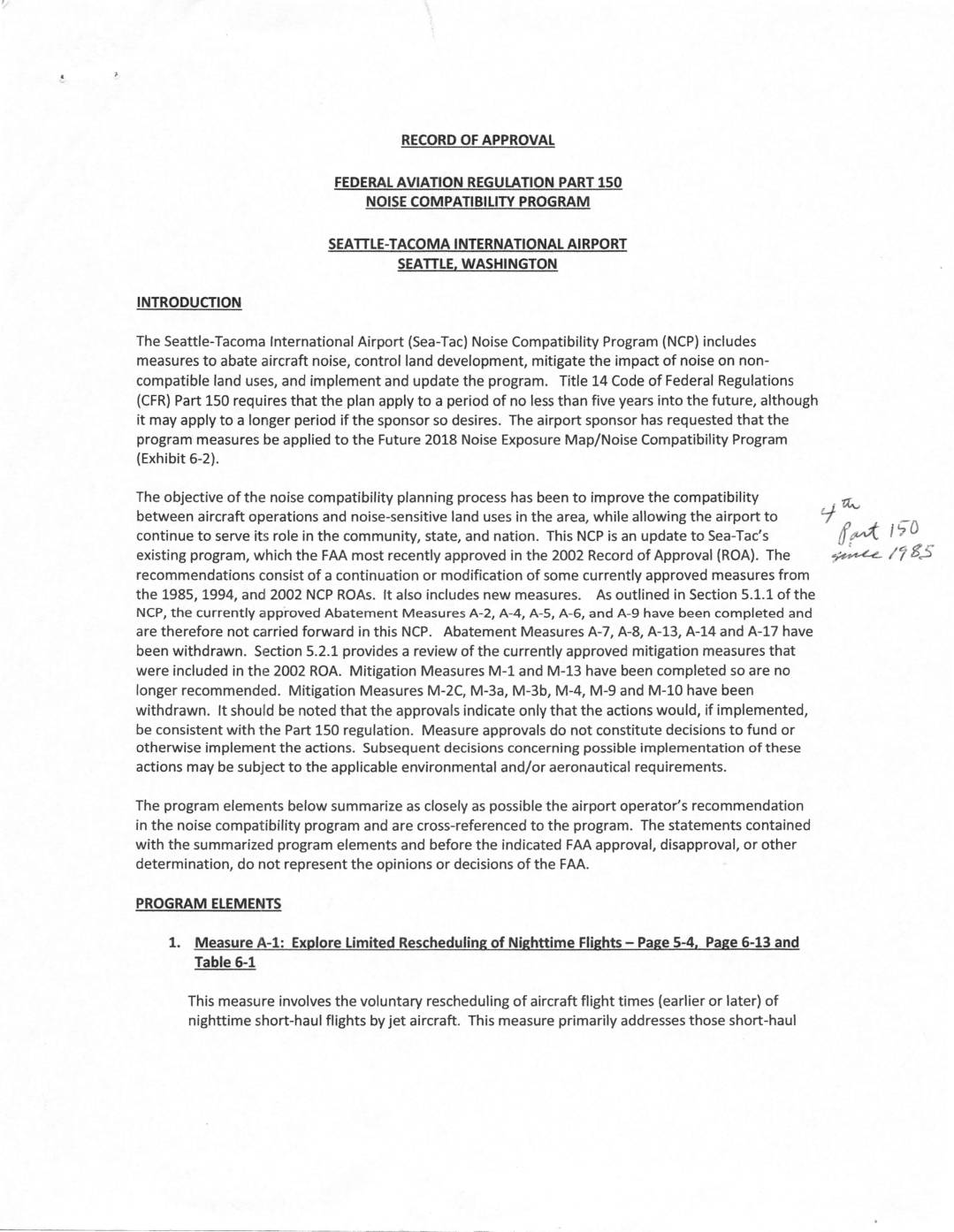
Record of approval: Federal Aviation Regulation Part 150 noise compatibility program, Seattle-Tacoma International Airport, Seattle, Washington
This document is the FAA's Record of Approval for Seattle-Tacoma International Airport's Noise Compatibility Program, which outlines measures to reduce aircraft noise and manage land use around the airport. It covers both new and updated measures, including voluntary rescheduling of nighttime flights, preferential runway use during nighttime hours, and a Fly Quiet Program to encourage airlines to follow noise abatement procedures. The FAA approved most measures as continuations of previously approved programs dating back to 1985, while disapproving the engine maintenance run-up regulations. -
 2024-05-07
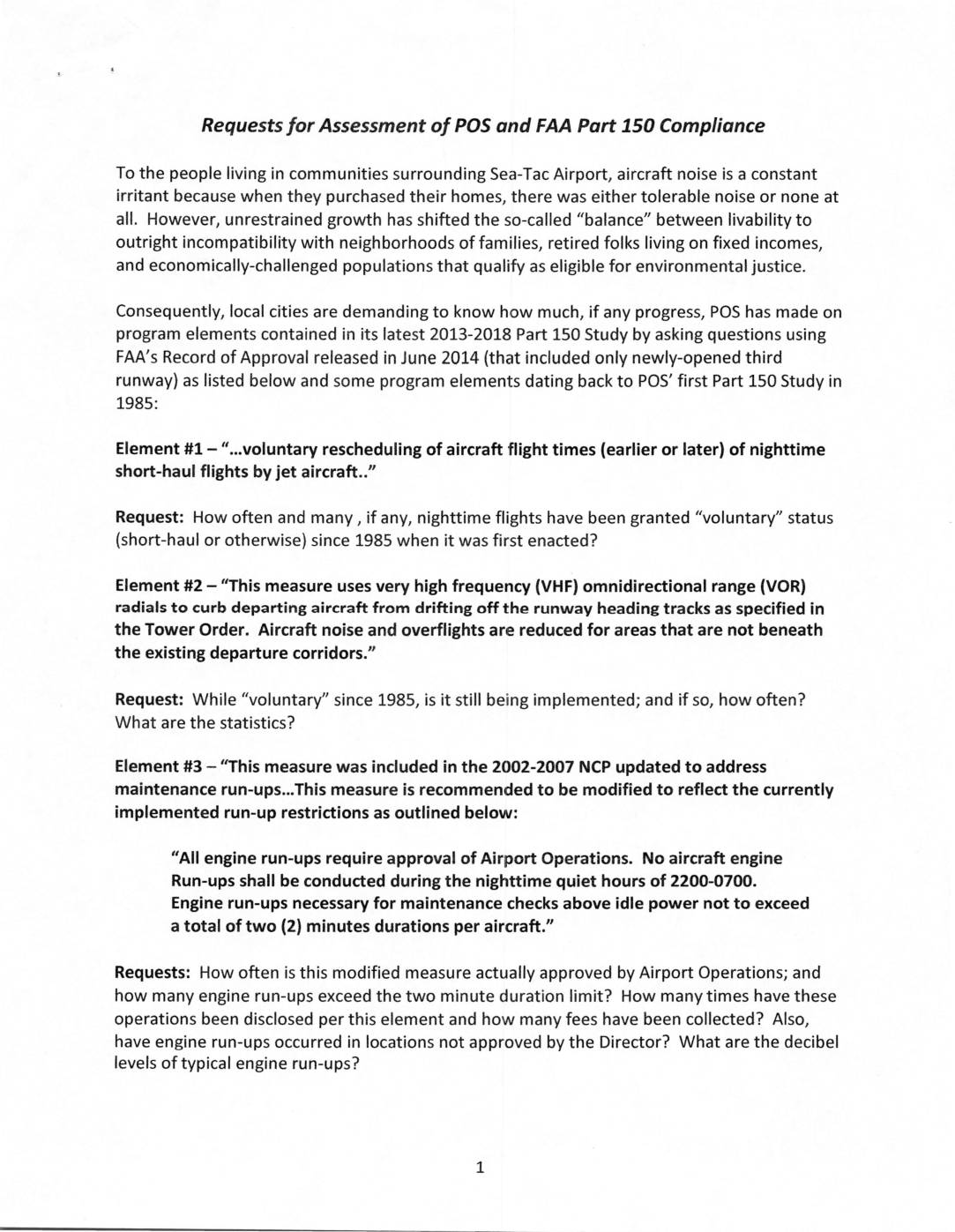
Requests for assessment of POS and FAA Part 150 compliance
Local communities surrounding Seattle-Tacoma International Airport are demanding accountability from the Port of Seattle (POS) regarding its compliance with FAA Part 150 noise mitigation measures, some dating back to 1985. The document raises detailed questions about ten specific program elements — including voluntary flight rescheduling, engine run-up restrictions, noise abatement corridors, the Fly Quiet Program, and home sound insulation — asking for data on how consistently and effectively each measure has actually been implemented. Critics argue that despite decades of commitments, key noise reduction tools such as a Ground Run-Up Enclosure have been quietly dropped, while growing air traffic continues to harm residential neighborhoods and environmentally vulnerable populations. -
 2024-03-31
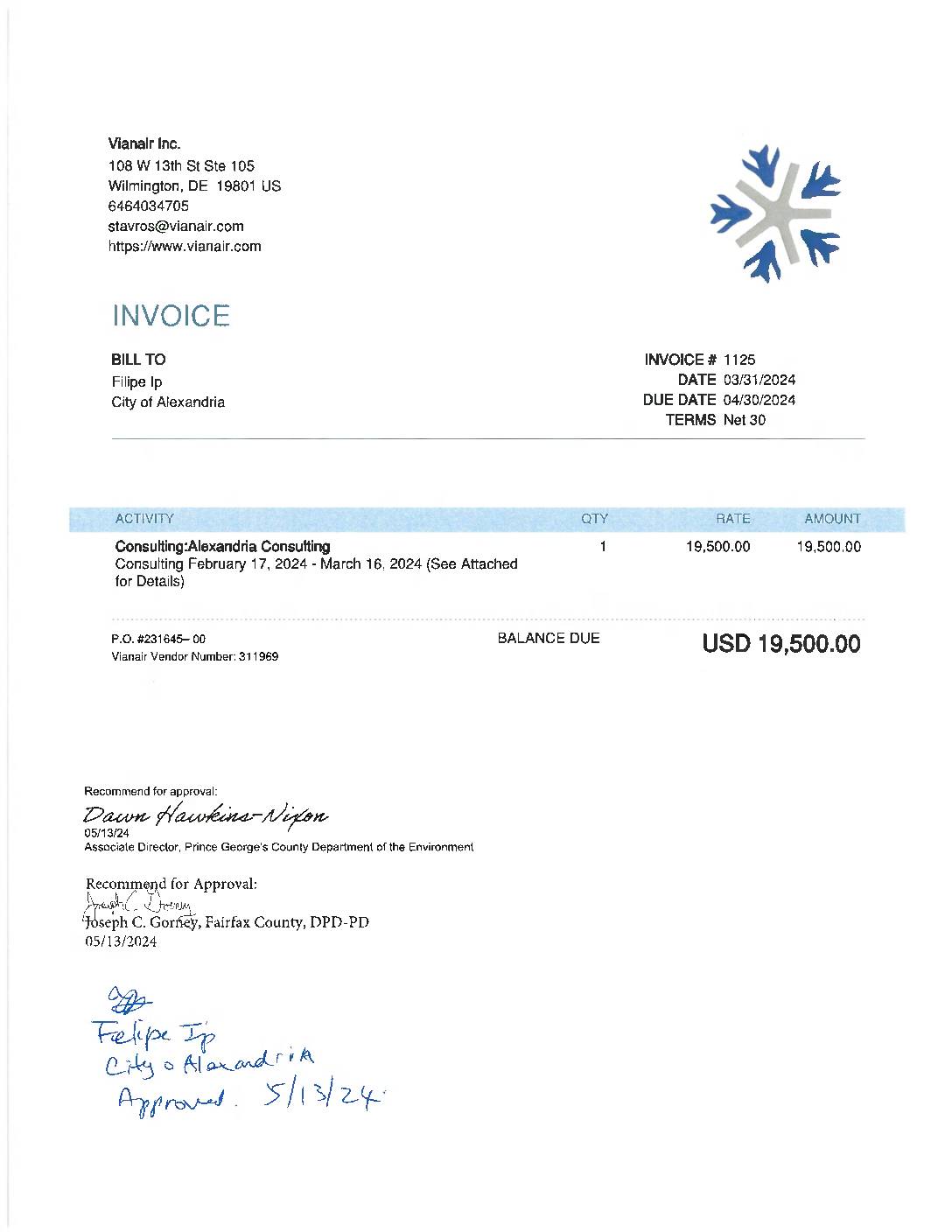
Vianair Inc. invoice #1125 and monthly status report — Alexandria consulting, February 17 – March 16, 2024
This document is an invoice and supporting monthly status report from Vianair, Inc. to the City of Alexandria for consulting services related to flight procedure design and noise analysis conducted between February 17 and March 16, 2024. The total billed amount of $19,500 covers work by multiple consultants including flight procedure design, steering committee meetings, website content development, and software analysis services, and was approved by City of Alexandria representative Felipe Ip on May 13, 2024. -
 2024-02-22
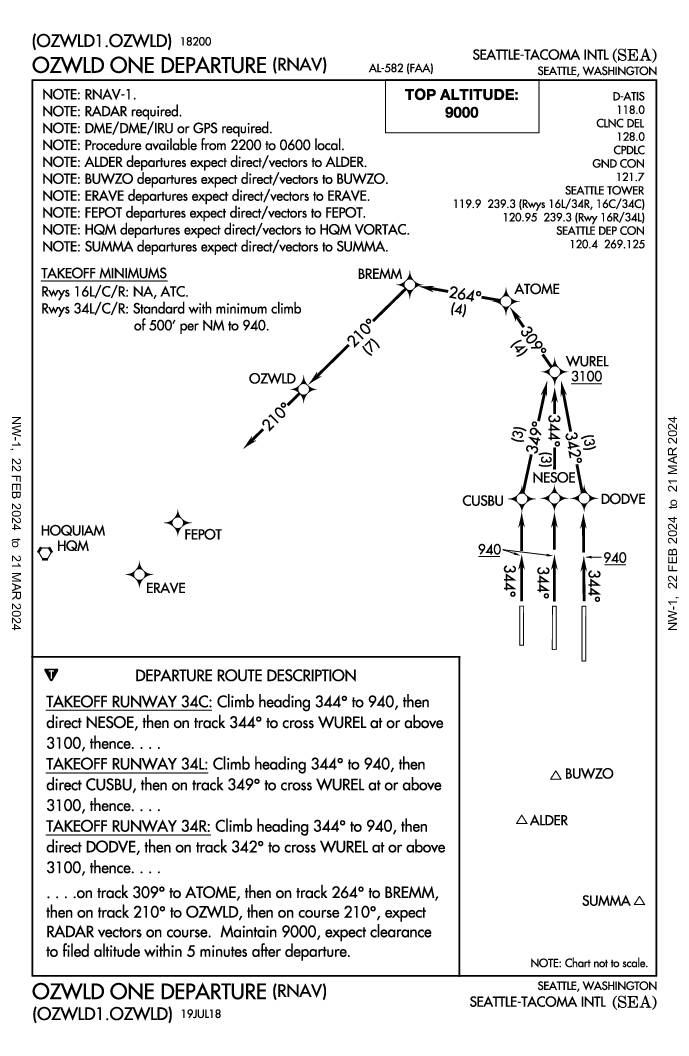
OZWLD One Departure (RNAV): Seattle-Tacoma International Airport Standard Instrument Departure Chart
The OZWLD One Departure (RNAV) is an instrument departure procedure for Seattle-Tacoma International Airport (SEA) that routes aircraft departing from runways 34L, 34C, and 34R northwestward through a series of waypoints—including NESOE, CUSBU, DODVE, WUREL, ATOME, BREMM, and OZWLD—before continuing on course. The procedure is only available between 2200 and 0600 local time, a restriction that reflects noise-mitigation efforts limiting certain departure routes to overnight hours. Aircraft must maintain a minimum climb gradient of 500 feet per nautical mile to 940 feet, cross WUREL at or above 3,100 feet, and maintain 9,000 feet until cleared to their filed altitude. -
 2024-02-22
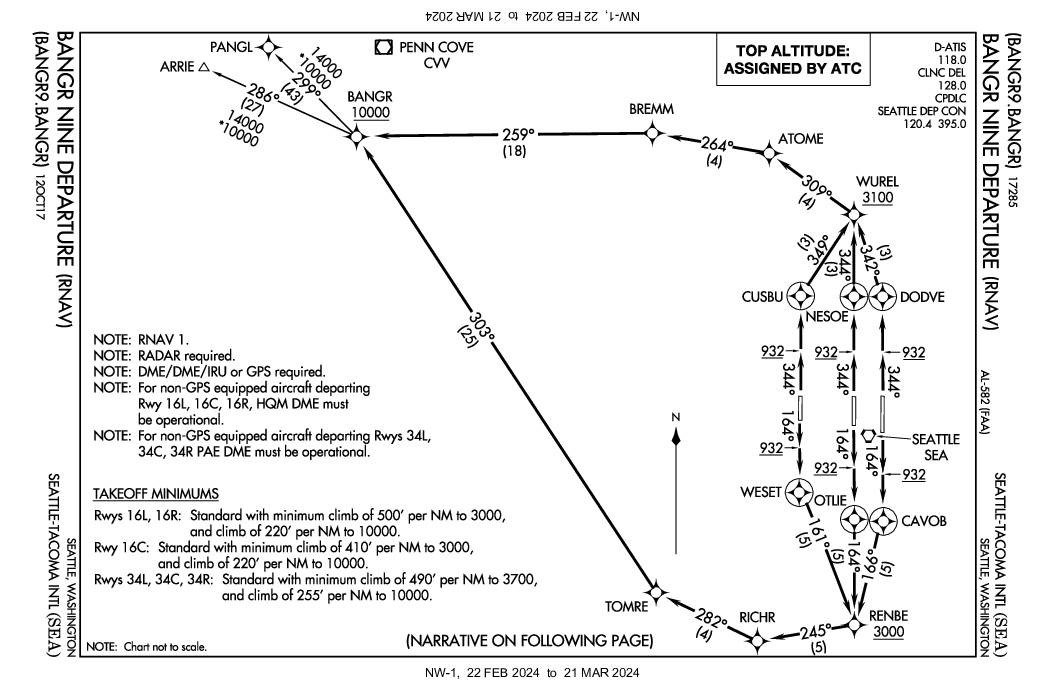
BANGR Nine Departure (RNAV) — Seattle-Tacoma International Airport (SEA)
The BANGR Nine Departure is a standardized instrument departure procedure (SID) for pilots flying out of Seattle-Tacoma International Airport (SEA), directing aircraft on specific headings and altitudes depending on which runway they use. Aircraft departing on northbound runways (34L, 34C, 34R) climb to at least 932 feet before routing through waypoints like CUSBU, NESOE, or DODVE, crossing WUREL at or above 3,100 feet, while southbound runway departures (16L, 16C, 16R) follow similar climb profiles through waypoints like CAVOB, OTLIE, or WESET, crossing RENBE at or above 3,000 feet. All routes converge at the BANGR waypoint, which must be crossed at or above 10,000 feet, with specific minimum climb gradients established to manage aircraft noise and terrain clearance in the surrounding communities. -
 2024-02-03
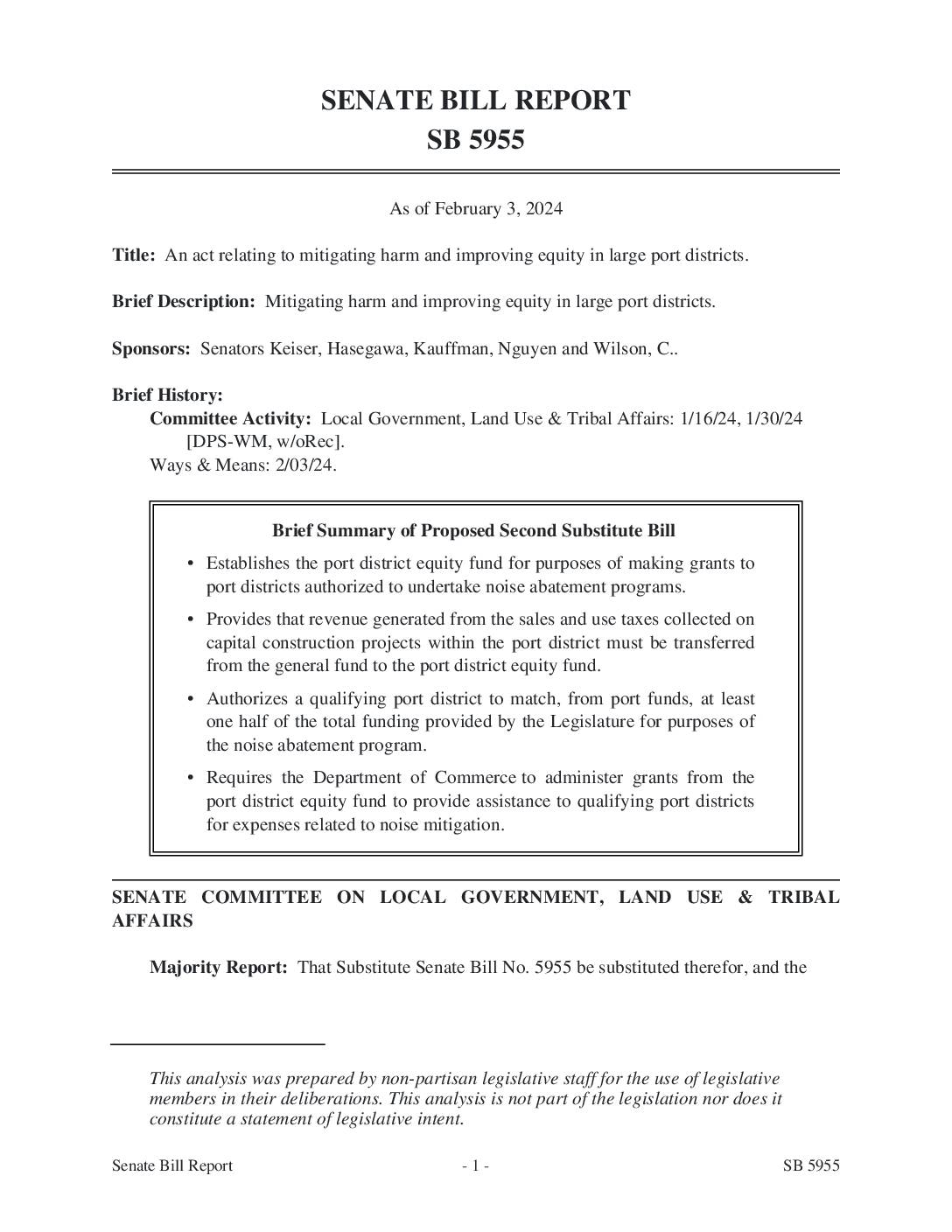
Senate bill report SB 5955: Mitigating harm and improving equity in large port districts
Washington Senate Bill 5955 proposes creating a 'port district equity fund' to help large port districts—such as the one operating Sea-Tac Airport—pay for aircraft noise mitigation programs. The fund would be seeded with a $10 million appropriation for fiscal year 2025 and subsequently replenished by sales and use tax revenue collected on capital construction projects at the airport, with the port district required to match at least half of state-provided funds. The Department of Commerce would administer grants from the fund to cover costs such as inspecting and repairing soundproofing equipment in nearby homes and addressing any structural damage caused by its installation. -
 2024-01-01
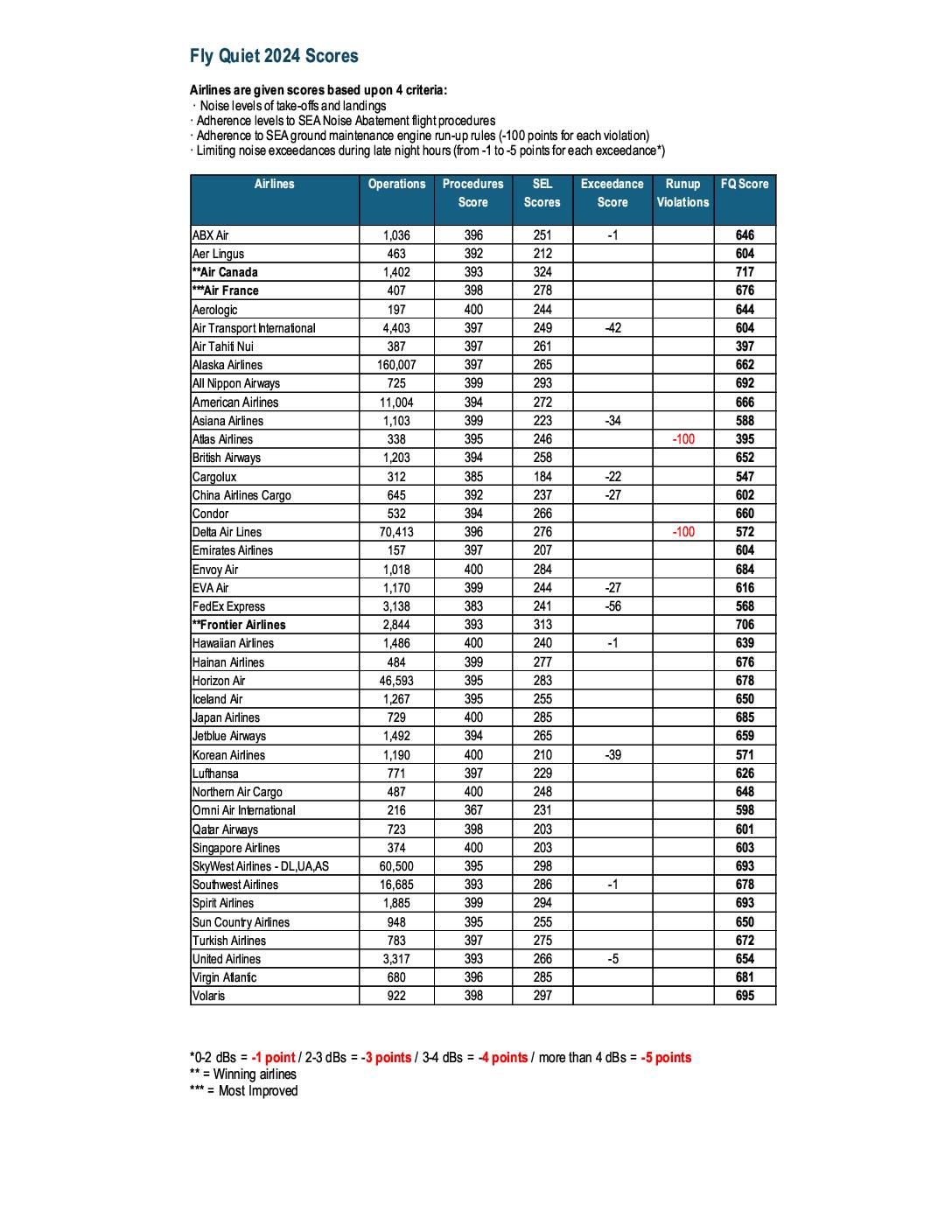
Fly Quiet 2024 Scores
The Fly Quiet 2024 Scores report ranks airlines operating at Seattle-Tacoma International Airport based on four criteria: noise levels during take-offs and landings, adherence to SEA Noise Abatement flight procedures, compliance with ground maintenance engine run-up rules, and limiting late-night noise exceedances. Airlines receive a composite FQ Score, with top performers including Air Canada (717) and Frontier Airlines (706), while carriers with runup violations or poor noise adherence, such as Delta Air Lines (572) and Atlas Airlines (395), scored significantly lower. The report identifies Air Canada as a winning airline and Air France as the most improved, serving as a public accountability tool for noise management at Sea-Tac Airport. -
 2024-01-01
LaGuardia Airport Fly Quiet Program Annual Report 2024
The Port Authority of New York and New Jersey's 2024 Fly Quiet Program Annual Report for LaGuardia Airport outlines a voluntary initiative encouraging airlines to reduce noise by flying quieter aircraft and following noise abatement procedures. Airlines are scored on a 100-point scale, with half the points based on fleet noise quality—using FAA aircraft noise stage ratings from Stage 3 (loudest) to Stage 5 Plus (quietest)—and half based on community engagement and pilot training efforts. The program was developed through collaboration with airlines, the FAA, and the public to address the unique challenges of the busy New York/New Jersey airspace. -
2024-01-01
Fly Quiet 2024 Scores
Port Of Seattle Fly Quiet 2024 annual scores for airlines operating at Sea-Tac Airport, scored on four criteria: noise levels of take-offs and landings, adherence to SEA Noise Abatement flight procedures, adherence to SEA ground maintenance engine run-up rules (-100 points per violation), and limiting late-night noise exceedances (-1 to -5 points per exceedance). Table