TagFAA(687)
-
 2001-05-31
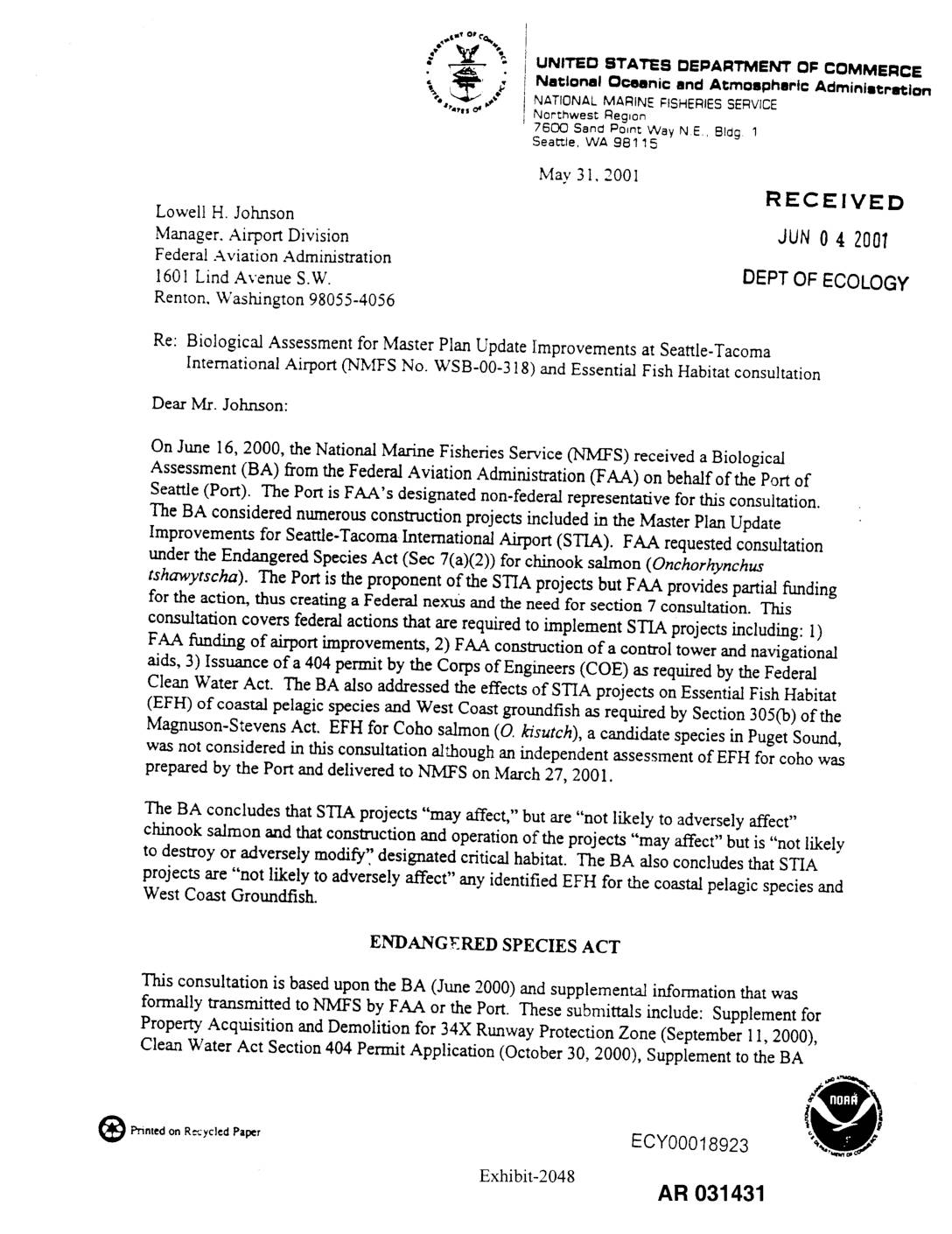
Exhibit 2048: NMFS Biological Opinion Letter on STIA Master Plan Update Improvements — Chinook Salmon and Essential Fish Habitat Consultation
Letter dated May 31, 2001 from NMFS Northwest Region to FAA Airport Division Manager Lowell H. Johnson (NMFS No. WSB-00-318) concurring with the ‘may affect, not likely to adversely affect’ determination for threatened Puget Sound chinook salmon (Onchorhynchus tshawytscha) and designated critical habitat under ESA Section 7(a)(2), and finding STIA projects ‘not likely to adversely -
 2001-05-31
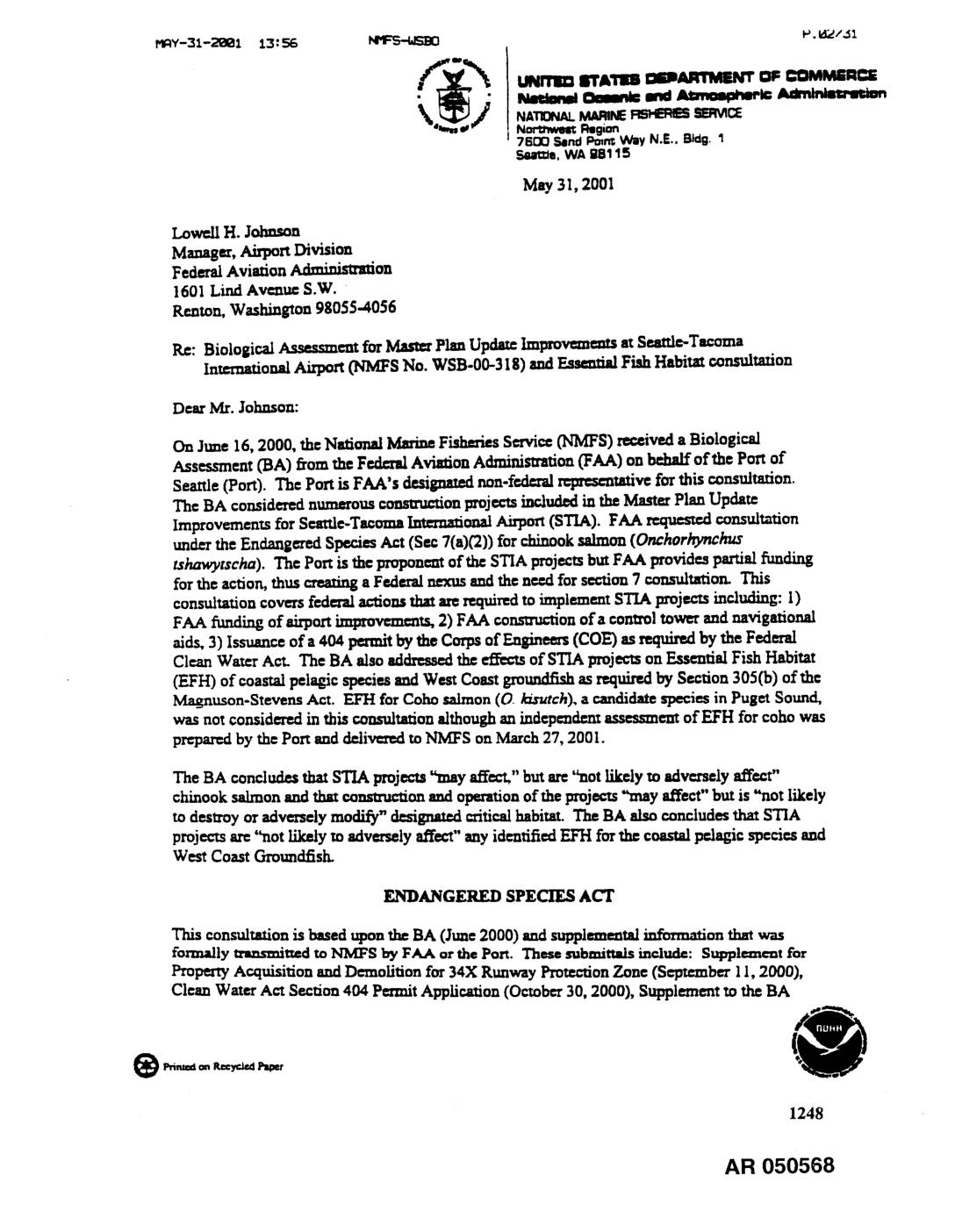
EXH AR050568: NMFS Biological Opinion Letter — STIA Master Plan Update Improvements, Chinook Salmon ESA Section 7 Consultation and Essential Fish Habitat
Letter dated May 31, 2001 from NMFS Northwest Region (Seattle, WA) to Lowell H. Johnson, FAA Airport Division Manager, concurring with the ‘may affect, not likely to adversely affect’ determination for threatened Puget Sound chinook salmon (Oncorhynchus tshawytscha) and designated critical habitat under ESA Section 7(a)(2) for Seattle-Tacoma International Airport (STIA) Master Plan Update Improvements -
 2001-05-22
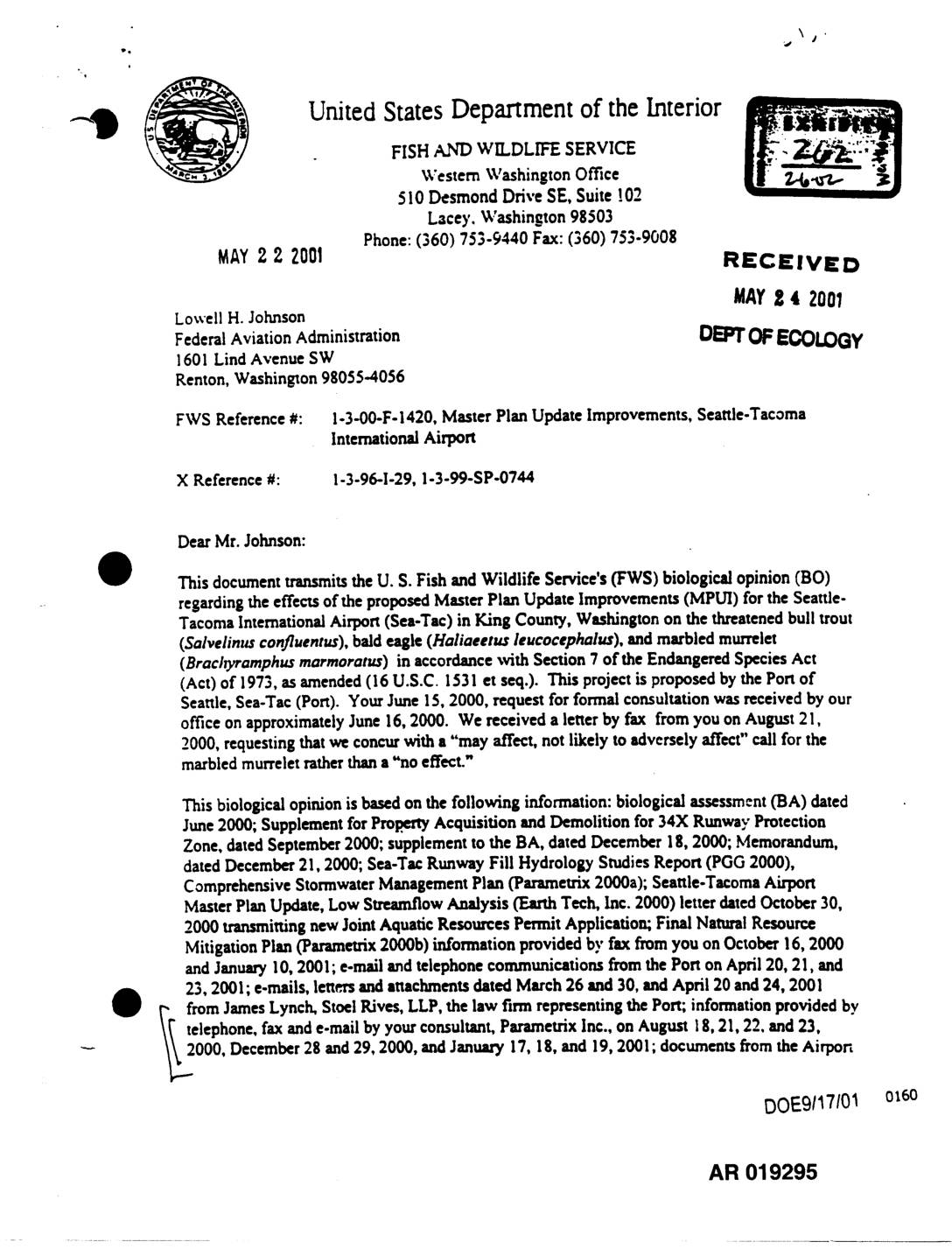
EXH AR019295: Biological Opinion — FWS Sec 7 Consultation STIA Master Plan Update (Bull Trout, Bald Eagle, Marbled Murrelet)
The U.S. Fish and Wildlife Service issued a biological opinion in May 2001 evaluating the potential effects of proposed Master Plan Update Improvements at Seattle-Tacoma International Airport on three protected species: bull trout, bald eagle, and marbled murrelet. The review was conducted under Section 7 of the Endangered Species Act at the request of the Federal Aviation Administration, which had determined the project was 'not likely to adversely affect' any of the three species. The opinion covers planned airport development in the cities of SeaTac and Des Moines, along with off-site wetland mitigation near the Green River in Auburn, Washington. -
 2001-05-22
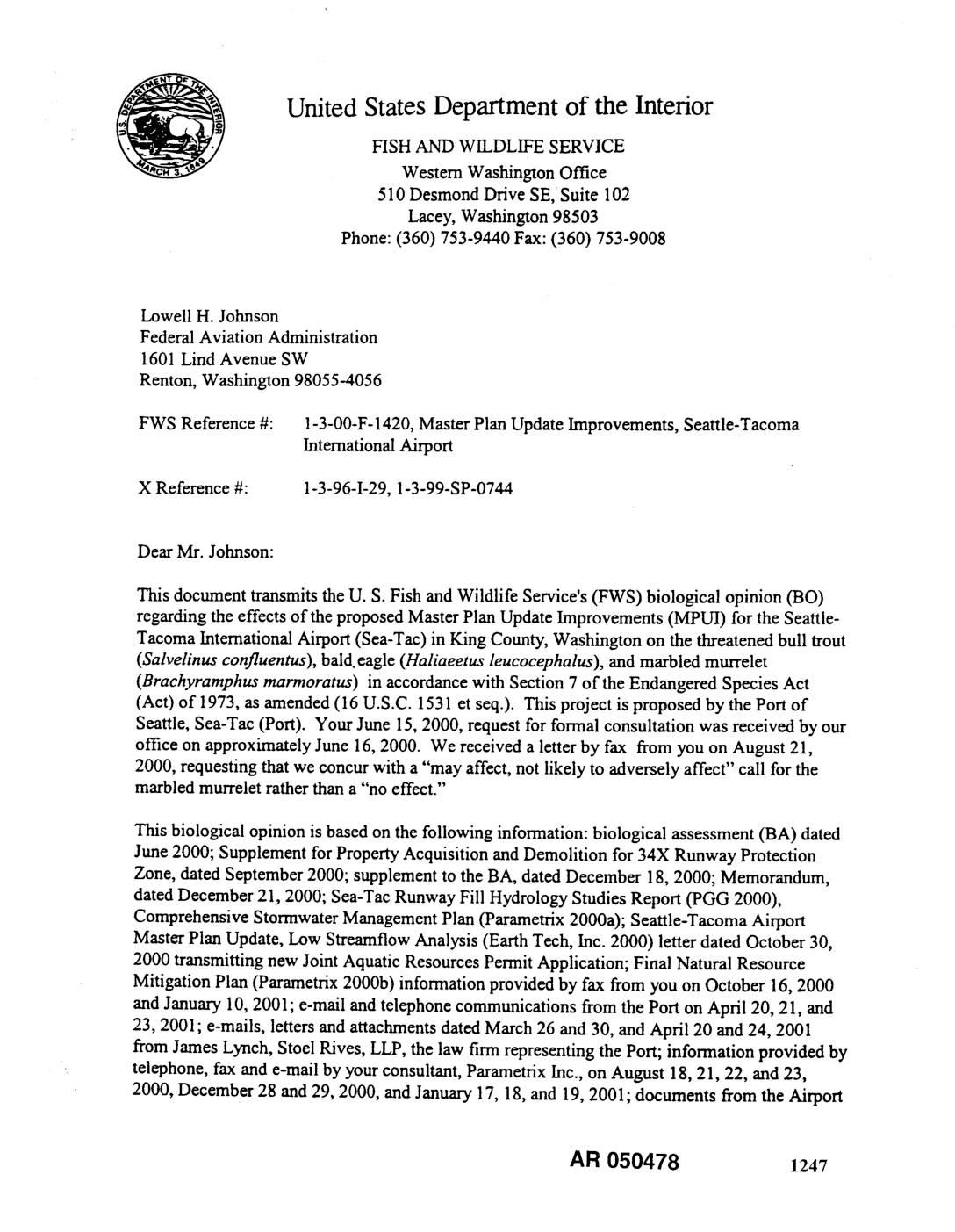
EXH AR050478: U.S. Fish and Wildlife Service Biological Opinion — Master Plan Update Improvements, Sea-Tac Airport
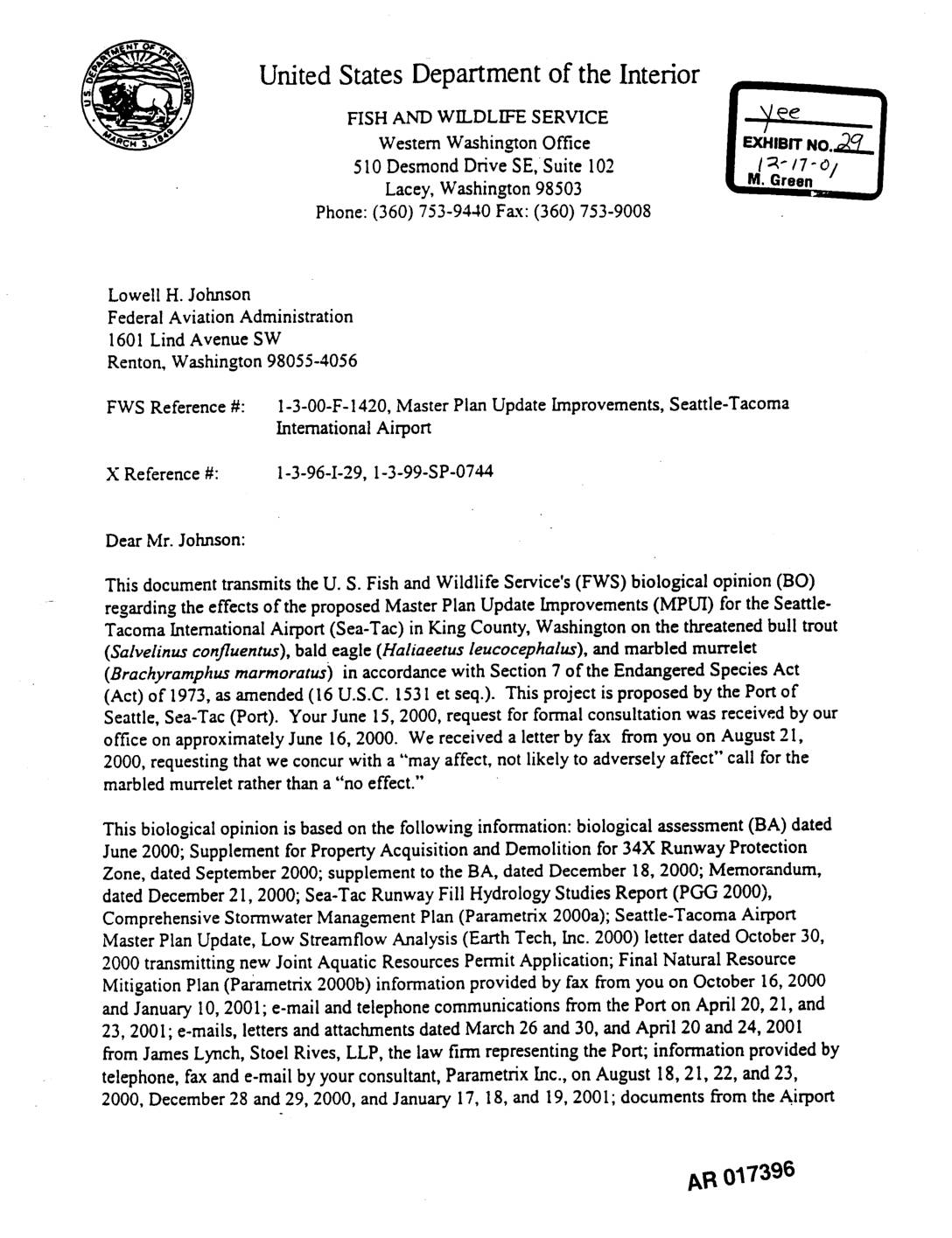
U.S. Fish and Wildlife Service (FWS) biological opinion (FWS Reference #1-3-00-F-1420) transmitted to Lowell H. Johnson of the Federal Aviation Administration (FAA) regarding effects of the proposed Master Plan Update Improvements (MPUI) for Seattle-Tacoma International Airport (Sea-Tac) in King County, Washington on threatened bull trout (Salvelinus confluentus), bald eagle (Haliaeetus leucocephalus), and marbled murrelet (Brachyramphus -
 2001-05-22
EXH AR017396: FWS Biological Opinion — Master Plan Update Improvements, Seattle-Tacoma International Airport
U.S. Fish and Wildlife Service (FWS) biological opinion (FWS Reference #1-3-00-F-1420) transmitted to Lowell H. Johnson, Federal Aviation Administration, regarding effects of the proposed Master Plan Update Improvements (MPUI) for Seattle-Tacoma International Airport (Sea-Tac) in King County, Washington on threatened bull trout (Salvelinus confluentus), bald eagle (Haliaeetus leucocephalus), and marbled murrelet (Brachyramphus marmoratus) under Section -
 2001-03-01
EXH AR049873: Essential Fish Habitat Assessment — Master Plan Update Improvements, STIA
Essential Fish Habitat (EFH) Assessment prepared by Parametrix, Inc. for the Federal Aviation Administration and Port Of Seattle for Master Plan Update Improvements at Seattle-Tacoma International Airport (STIA), March 2001. Document AR049873 (project 556-2912-001) evaluates Pacific Coast salmon EFH — Chinook, Coho, and Puget Sound Pink salmon — in Miller Creek Basin, Des Moines Creek -
 2001-01-01
Airport Capacity Benchmark Report 2001
The FAA's Airport Capacity Benchmark Report 2001 measures the maximum number of flights 31 of the nation's busiest airports can handle per hour under both good and adverse weather conditions. The benchmarks were developed between October 2000 and April 2001 by the FAA and MITRE/CAASD to help understand the relationship between airline demand and runway capacity, and to inform long-term aviation policy decisions. While useful as a reference point, the report notes that these benchmarks are starting points for discussion rather than definitive guides for major investment or scheduling decisions. -
 2000-12-01
EXH 263: Pacific Coast Salmon Essential Fish Habitat Assessment, STIA Master Plan Update
This December 2000 report assesses the impact of Seattle-Tacoma International Airport's Master Plan Update improvements on Pacific Coast salmon Essential Fish Habitat (EFH) in nearby waterways, including Miller Creek, Des Moines Creek, and the Green River Basin. Prepared by Parametrix, Inc. for the Federal Aviation Administration and the Port of Seattle, it evaluates water quality, aquatic habitat, and hydrological effects of airport expansion on local salmon species such as Chinook, Coho, and Pink salmon. The report also outlines conservation and mitigation measures proposed to offset adverse effects on salmon habitat in the airport's surrounding watersheds. -
 2000-12-01
EXH AR049788: Supplement Biological Assessment — Master Plan Update Improvements, Seattle-Tacoma International Airport
Supplement Biological Assessment prepared by Parametrix, Inc. (December 2000) for the Federal Aviation Administration and Port Of Seattle for reinitiation and initiation of ESA Section 7 consultation on STIA Master Plan Update Improvements. AR 049788. Document covers hydrologic impacts and mitigation for Miller Creek, Walker Creek, and Des Moines Creek watersheds, including stormwater detention facility -
 2000-08-01
Indoor air quality and student performance
This EPA document explains how poor indoor air quality (IAQ) in schools can harm students' health and academic performance, causing absences due to respiratory illnesses and reducing the ability to concentrate, calculate, and remember. Studies show that high pollution levels, inadequate ventilation, and improper temperature and humidity control contribute to these problems. The EPA recommends schools use the IAQ Tools for Schools Kit to identify and address indoor air quality issues at little or no cost.