TagFAA(238)
-
HR 5874 – Decrease Noise Levels Act
116th CONGRESS 2d Session H. R. 5874 To require the Administrator of the Federal Aviation Administration to amend regulations concerning the day-night average sound level, and for other purposes. IN THE HOUSE OF REPRESENTATIVES February 12, 2020 Ms. Meng (for herself, Mr. Smith of Washington, Mr. Espaillat, Ms. Brownley of California, Mr. Beyer, Mr. -
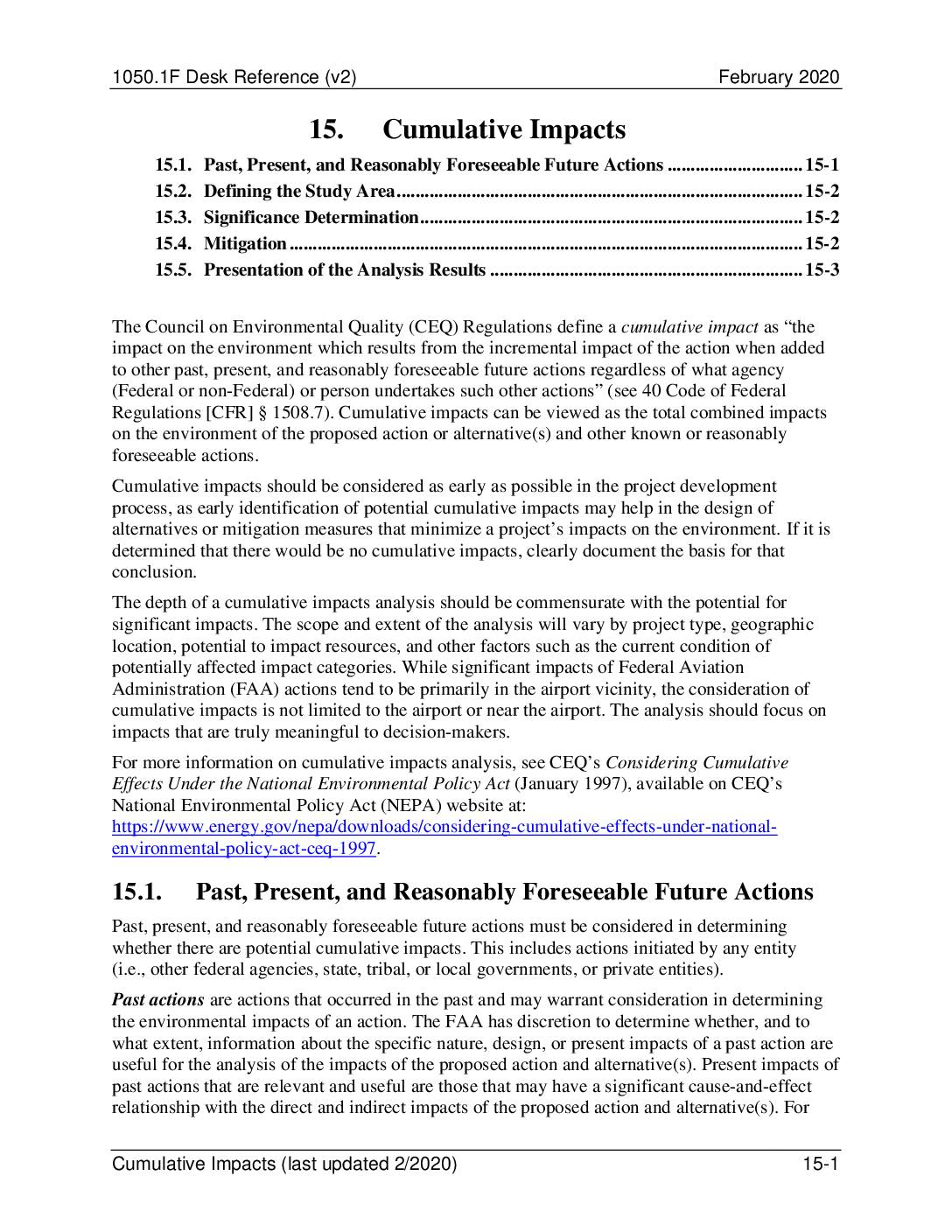
1050.1F 15 Cumulative Impacts
15.1. Past, Present, and Reasonably Foreseeable Future Actions ............................. 15-1 15.2. Defining the Study Area ....................................................................................... 15-2 15.3. Significance Determination .................................................................................. 15-2 15.4. Mitigation .............................................................................................................. 15-2 15.5. Presentation of the Analysis Results ................................................................... 15-3 The Council on Environmental Quality (CEQ) Regulations define a cumulative impact as “the impact on the environment which results from the incremental impact of the action when added to other past, present, and reasonably foreseeable future actions regardless of what agency (Federal or non-Federal) or person undertakes such other actions” (see 40 Code of Federal Regulations [CFR] § 1508.7). Cumulative impacts can be viewed as the total combined impacts on the environment of the proposed action or alternative(s) and other known or reasonably foreseeable actions. Cumulative impacts should be considered as early as possible in the project development process, as early identification of potential cumulative impacts may help in the design of alternatives or mitigation measures that minimize a project’s impacts on the environment. If it is determined that there would be no cumulative impacts, clearly document the basis for that conclusion. The depth of a cumulative impacts analysis should be commensurate with the potential for significant impacts. The scope and extent of the analysis will vary by project type, geographic location, potential to impact resources, and other factors such as the current condition of potentially affected impact categories. While significant impacts of Federal Aviation Administration (FAA) actions tend to be primarily in the airport vicinity, the consideration of cumulative impacts is not limited to the… -
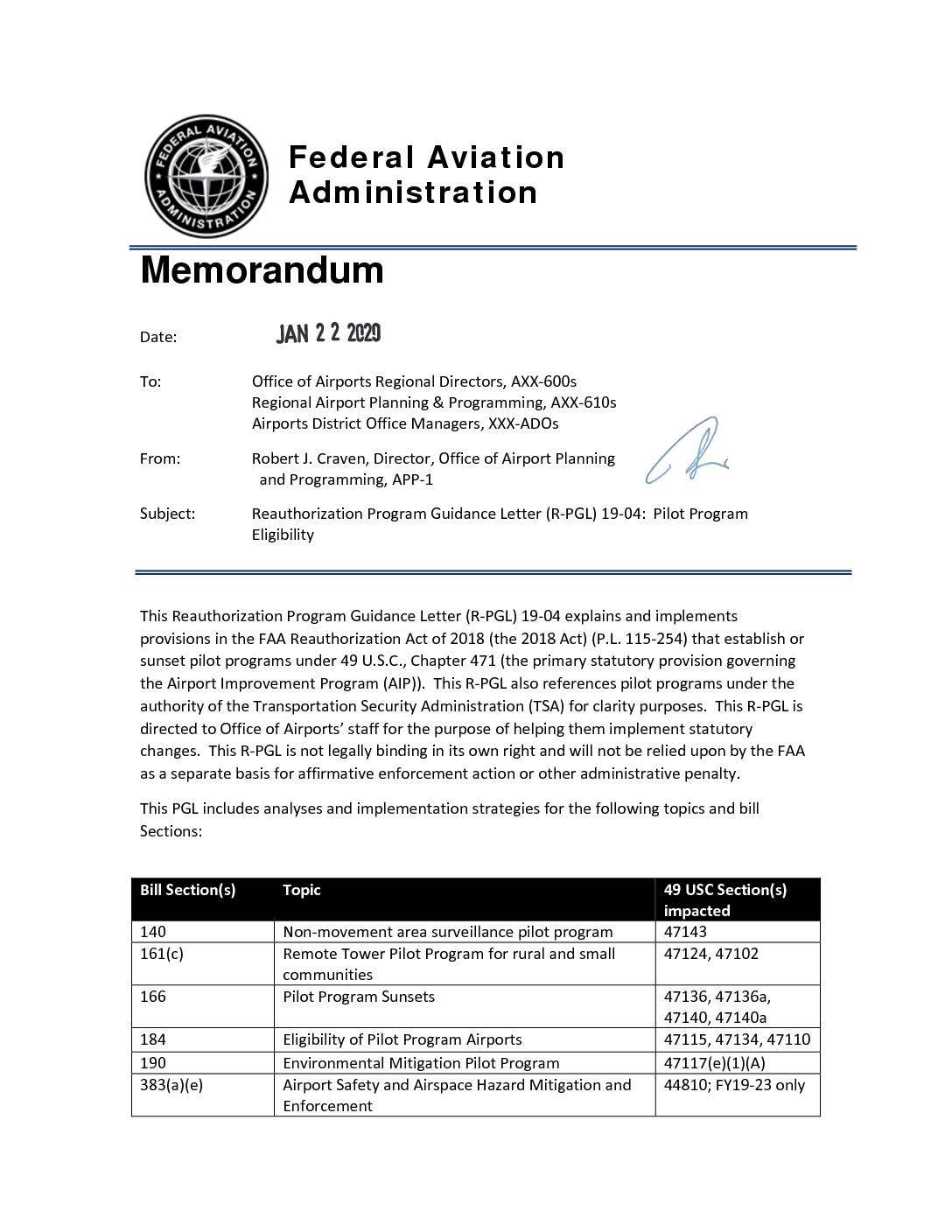
FAA 2018 Reauthorization Section 190 Pilot-Programs
To: Office of Airports Regional Directors, AXX‐600s Regional Airport Planning & Programming, AXX‐610s Airports District Office Managers, XXX‐ADOs From: Robert J. Craven, Director, Office of Airport Planning and Programming, APP‐1 Subject: Reauthorization Program Guidance Letter (R‐PGL) 19‐04: Pilot Program Eligibility This Reauthorization Program Guidance Letter (R‐PGL) 19‐04 explains and implements provisions in the FAA Reauthorization Act of 2018 (the 2018 Act) (P.L. 115‐254) that establish or sunset pilot programs under 49 U.S.C., Chapter 471 (the primary statutory provision governing the Airport Improvement Program (AIP)). This R‐PGL also references pilot programs under the authority of the Transportation Security Administration (TSA) for clarity purposes. This R‐PGL is directed to Office of Airports’ staff for the purpose of helping them implement statutory changes. This R‐PGL is not legally binding in its own right and will not be relied upon by the FAA as a separate basis for affirmative enforcement action or other administrative penalty. This PGL includes analyses and implementation strategies for the following topics and bill Sections: Bill Section(s) Topic 49 USC Section(s) impacted 140 Non‐movement area surveillance pilot program 47143 161(c) Remote Tower Pilot Program for rural and small communities 47124, 47102 166 Pilot Program Sunsets 47136, 47136a, 47140, 47140a 184 Eligibility of Pilot Program Airports 47115, 47134, 47110 190 Environmental Mitigation Pilot Program 47117(e)(1)(A) 383(a)(e) Airport Safety and Airspace Hazard Mitigation and Enforcement 44810; FY19‐23 only JAN 2 2 2020 -
2019-12-09 20:57
CATEX Controversy: The Ninth Circuit Strikes Down FAA Decision to Exempt a Sea-Tac Operational Change from Environmental Review
The process for approving changes in airport operations and development projects may now be more complicated, time-consuming, expensive and uncertain, due to a new federal appeals court decision. The decision faults the Federal Aviation Administration (FAA) for rushing through its approval of a new procedure for turning southbound turboprops to the west in certain wind -
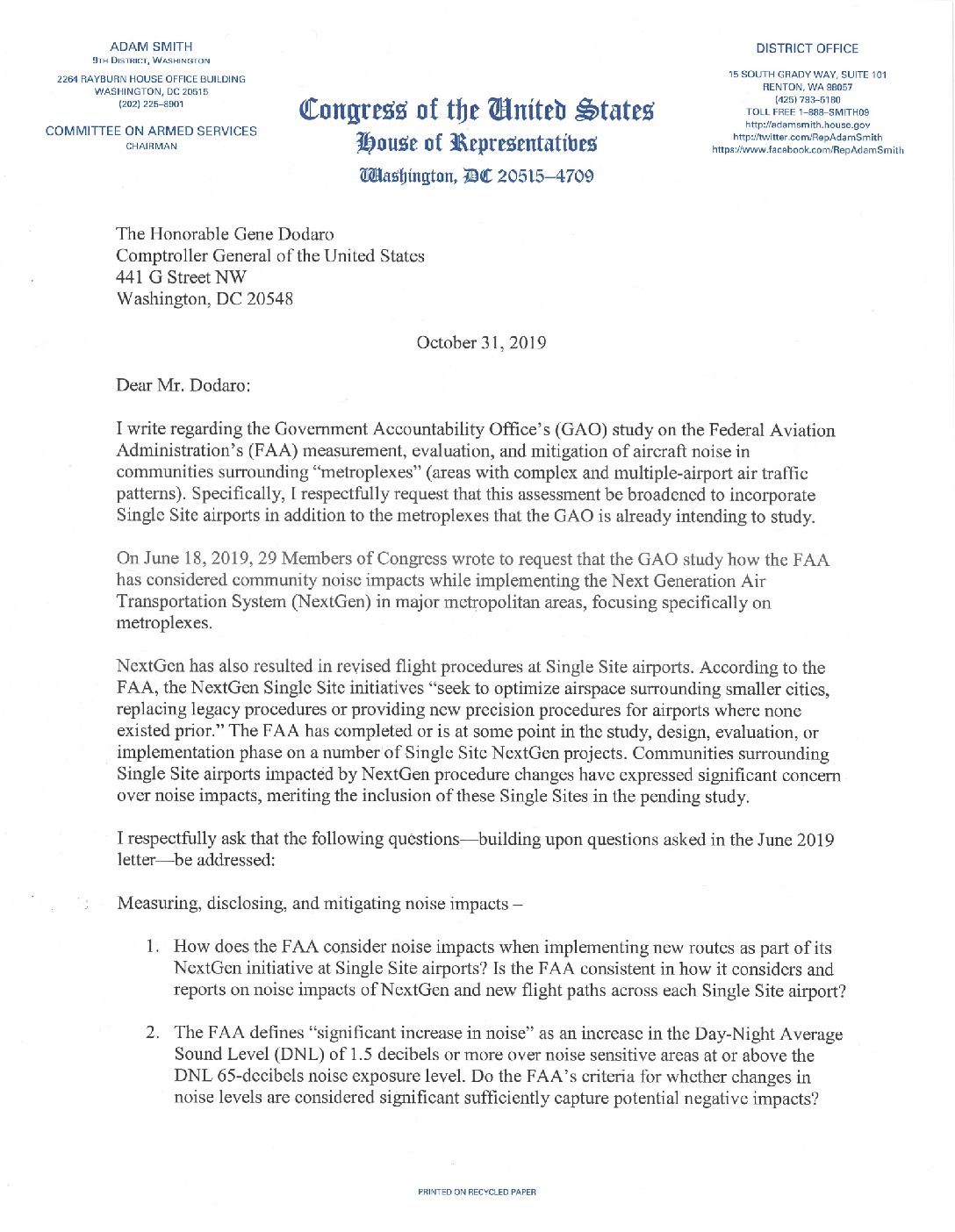
Adam Smith Letter to GAO study on FAA impacts
The Honorable Gene Dodaro Comptroller General of the United States 441 G Street NW Washington, DC 20548 October 31, 2019 Dear Mr. Dodaro: I write regarding the Government Accountability Office’s (GAO) study on the Federal Aviation Administration’s (FAA) measurement, evaluation, and mitigation of aircraft noise in communities surrounding “metroplexes” (areas with complex and multiple-airport air -
Quiet Skies Coalition Update
Good Friends & Citizens of Burien, On Wednesday, the City of Burien appeared before the United States Court of Appeals for the Ninth Circuit in Seattle. Our attorney Matt Adams of Dentons law firm and the FAA’s attorney presented oral arguments before a panel of three judges who asked pointed questions of both sides. My -
 2019-10-23 01:41
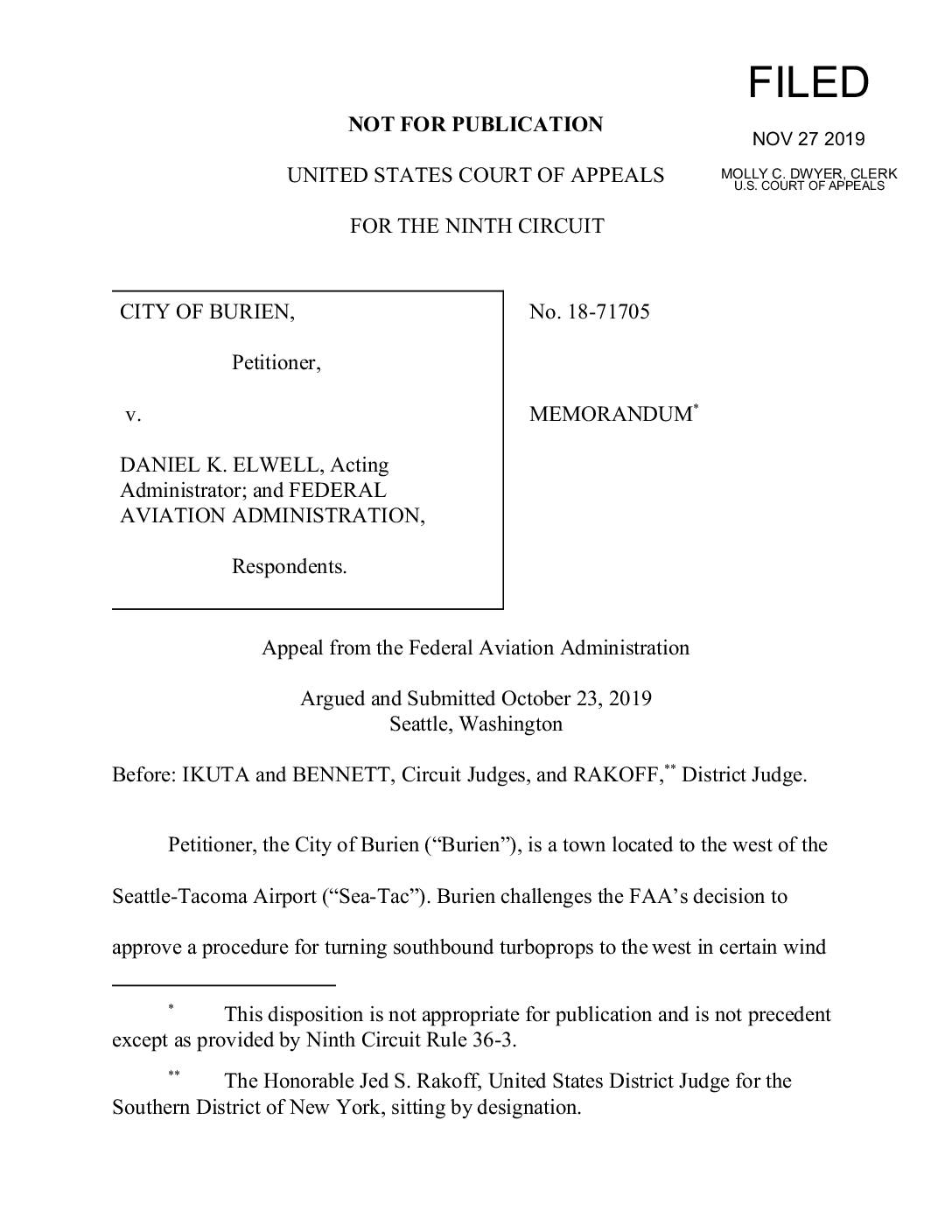
18-71705 United States Court of Appeal Ninth Circuit (decision)
Before: IKUTA and BENNETT, Circuit Judges, and RAKOFF,** District Judge. Petitioner, the City of Burien (“Burien”), is a town located to the west of the Seattle-Tacoma Airport (“Sea-Tac”). Burien challenges the FAA’s decision to approve a procedure for turning southbound turboprops to the west in certain wind FILED NOV 27 2019 MOLLY C. DWYER, CLERK U.S. COURT OF APPEALS * This disposition is not appropriate for publication and is not precedent except as provided by Ninth Circuit Rule 36-3. * * The Honorable Jed S. Rakoff, United States District Judge for the Southern District of New York, sitting by designation. conditions (“the Procedure”). The Procedure automates a formerly manual process of assigning headings to such turboprops, and has the effect of concentrating low- flying planes over Burien after takeoff. Burien argues that the FAA failed to comply with the National Environmental Policy Act (“NEPA”), 42 U.S.C. §§ 4321 et seq., when it approved the Procedure. We agree in part. NEPA requires agencies such as the FAA to consider and document the environmental impacts of their actions prior to implementing them. 42 U.S.C. § 4332(2)(c). Although NEPA usually requires agencies to conduct some form of environmental analysis before they act, an agency may identify certain actions as “categorical exclusions” (“CATEXs”) that are exempt from environmental review. CATEXs are reserved for actions that do not “individually or cumulatively have a significant effect on the human environment.” 40 C.F.R. § 1508.4. While agencies promulgate their own rules for identifying and applying CATEXs, all… -
UproarLA: Nextgen Nightmare @ Burbank Airport (FAA and BUR LIED)
FAA and BUR LIED | www.uproarla.org UproarLA has discovered the truth of how San Fernando Valley communities were sacrificed by the FAA and Burbank Airport in the name of efficiency and NextGen technology. Burbank Airport was alerted back in 2015 that new “condensed” flight paths would inundate quiet neighborhoods with airplane noise and pollution, and -
FAA concern might mean less noise relief for O’Hare’s DuPage neighbors
DuPage County Finding a way to evenly distribute nighttime jet noise is proving difficult for the O’Hare Noise Compatibility Commission. Daily Herald File Photo Marni Pyke Months of discussions on creating an overnight runway rotation at O’Hare International Airport hit turbulence after federal officials warned Tuesday that one option for incoming jets was potentially unsafe.