TagEcology(788)
-
 1999-08-23
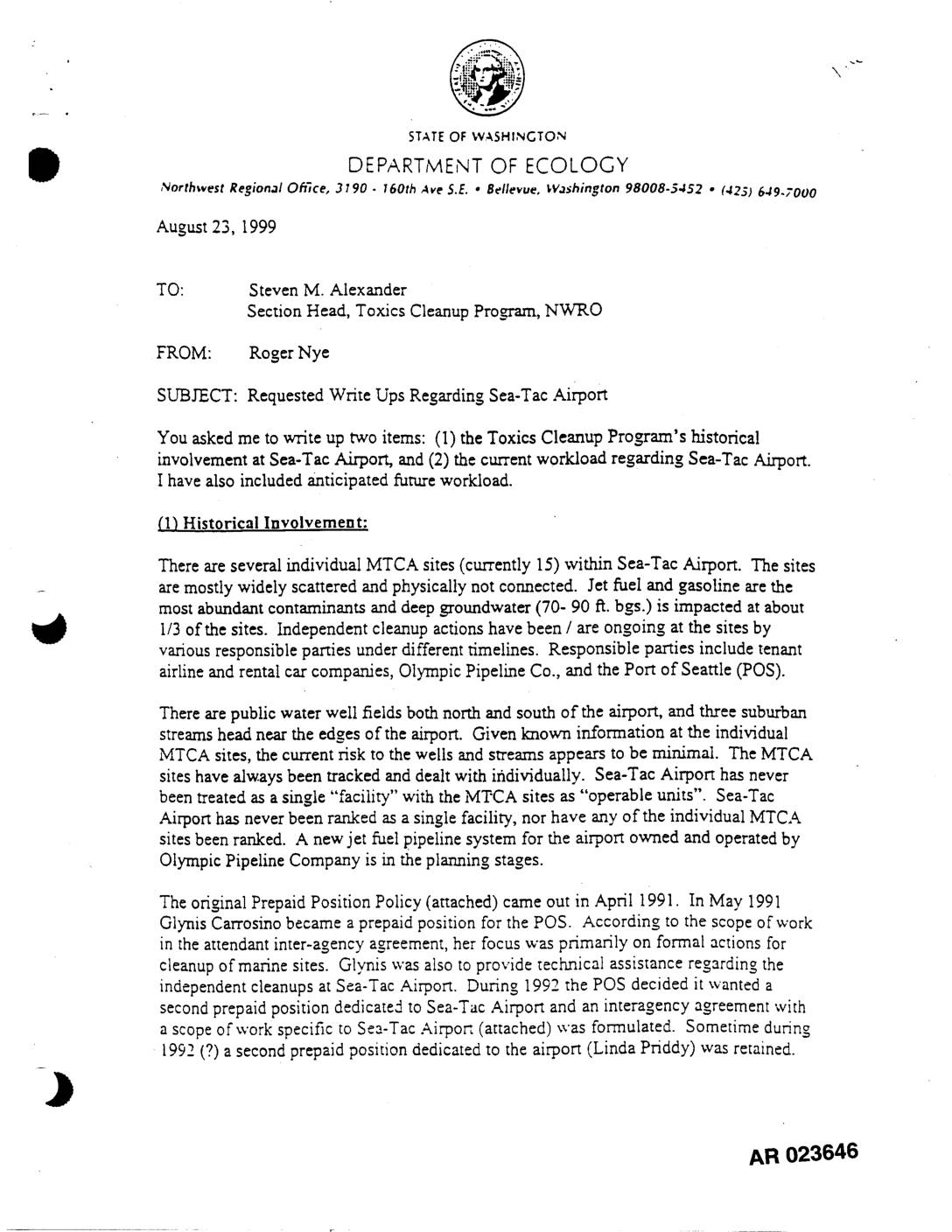
EXH AR023646: Ecology Internal Memo — Toxics Cleanup Program History & Workload at STIA
This 1999 internal memo from the Washington State Department of Ecology details the history of environmental cleanup oversight at Seattle-Tacoma International Airport, where 15 separate contaminated sites involving jet fuel and gasoline were managed individually under the state's Model Toxics Control Act. The memo describes a series of prepaid staff positions funded by the Port of Seattle to coordinate cleanup efforts with airline and pipeline companies, and the challenges in getting formal Agreed Orders signed. It concludes with an update that a key groundwater study Agreed Order was finally signed in May 1999 after receiving over 600 public comments in opposition. -
 1999-08-10
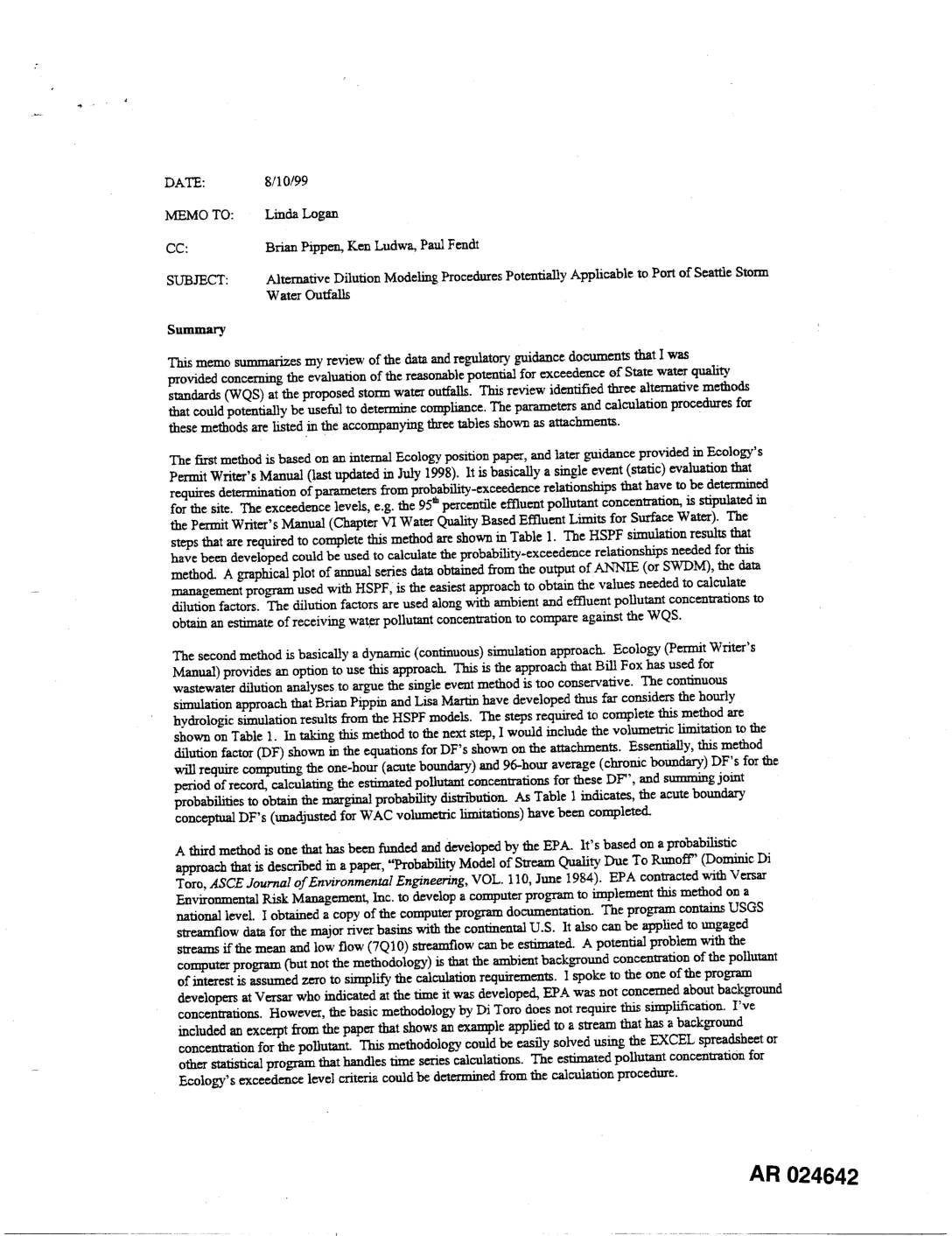
EXH AR024642: Memo Alternative Dilution Modeling Procedures Storm Water Outfalls
A 1999 internal technical memo from Parametrix, Inc. evaluates three alternative water-quality dilution modeling methods for assessing whether proposed stormwater outfalls at the Port of Seattle could exceed Washington State water quality standards. The methods range from a static single-event approach based on Ecology's Permit Writer's Manual to a dynamic continuous simulation using HSPF hydrologic models and a probabilistic EPA-funded model developed by researcher Dominic Di Toro. The memo recommends continuing with the continuous simulation approach while considering budget, Ecology's involvement, and the nature of ambient and effluent pollutant concentration data. -
 1999-08-09
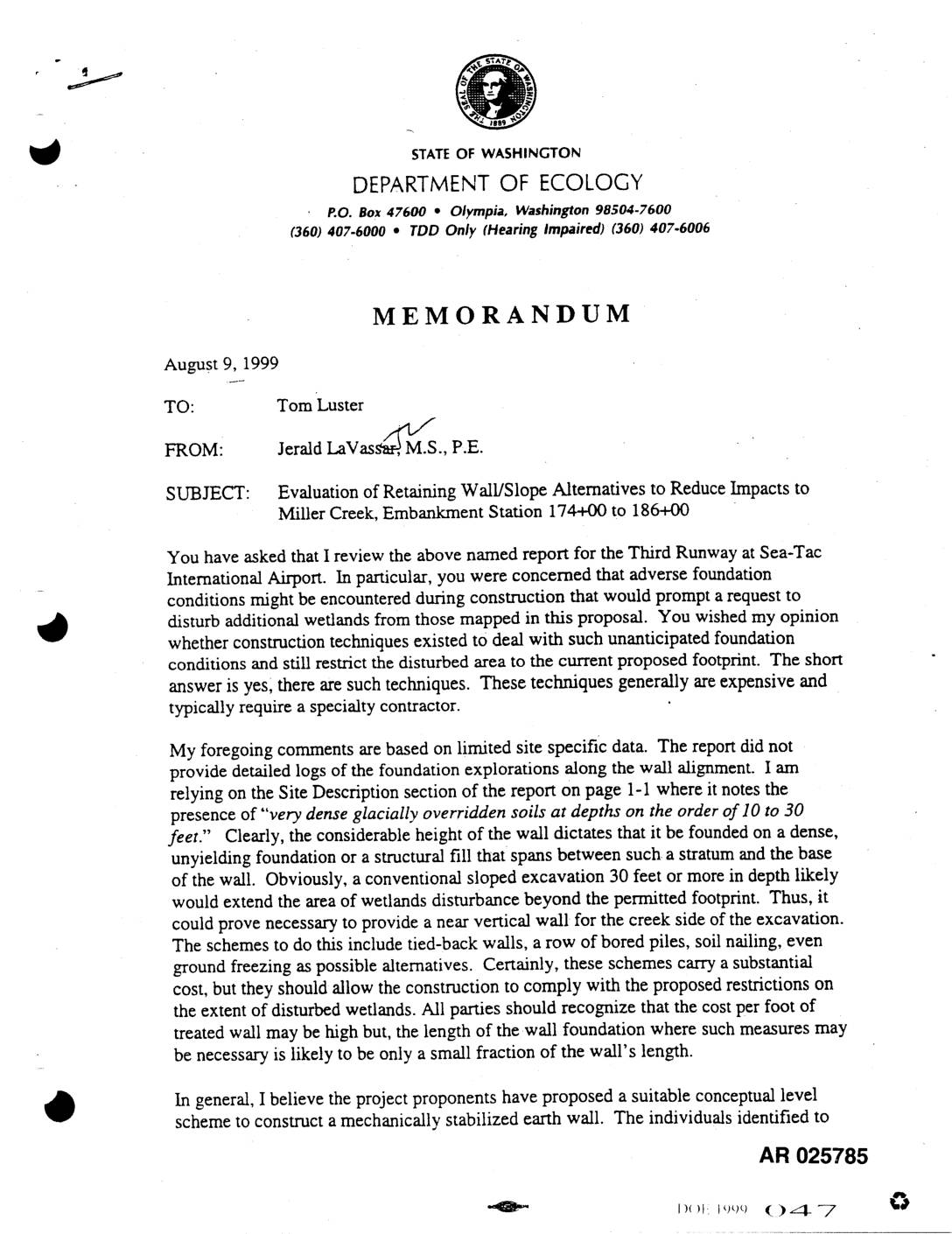
EXH AR025785: Ecology Memo — Retaining Wall/Slope Alternatives, Miller Creek, Sta 174+00–186+00
A 1999 memo from the Washington State Department of Ecology evaluates construction techniques for a retaining wall near Miller Creek at Sea-Tac International Airport's Third Runway project. The memo concludes that specialized methods such as tied-back walls, bored piles, soil nailing, or ground freezing can address difficult underground soil conditions while keeping construction within the approved wetlands disturbance footprint, though at significant cost. The author also recommends installing monitoring devices in the wall and backfill to confirm the structure performs as designed throughout its service life. -
 1999-07-01
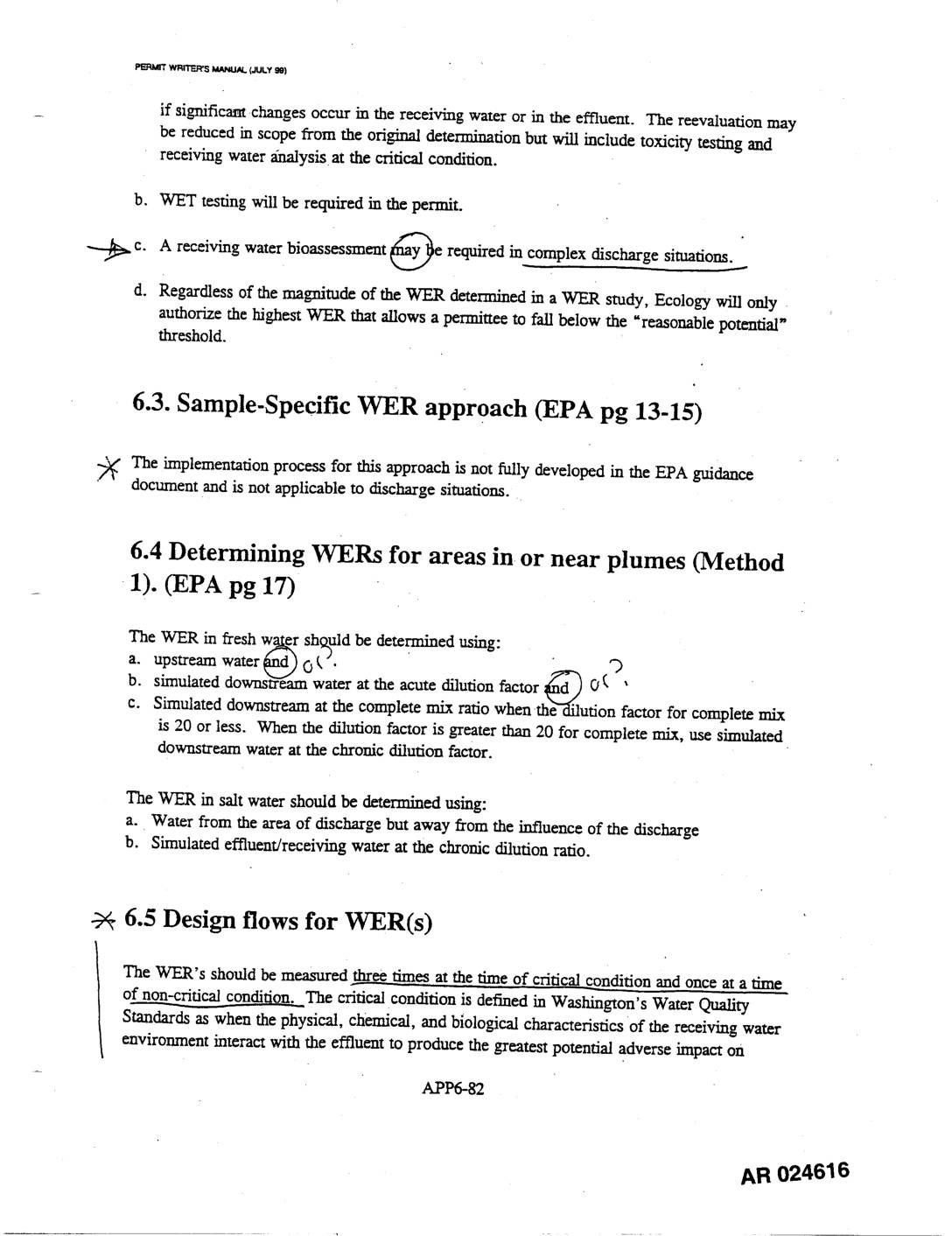
EXH AR024616: Permit Writer’s Manual (July 1999) WER Methodology Sections 6.3–6.7
This document is a section of Washington State's Permit Writer's Manual covering Water Effect Ratio (WER) methodology for water quality permitting. It outlines procedures for determining how receiving water conditions affect the toxicity of discharged effluents, including required toxicity testing species, sampling schedules at critical and non-critical flow conditions, and guidelines for freshwater and saltwater discharge situations. The document is unrelated to Sea-Tac Airport noise policy. -
 1999-06-30
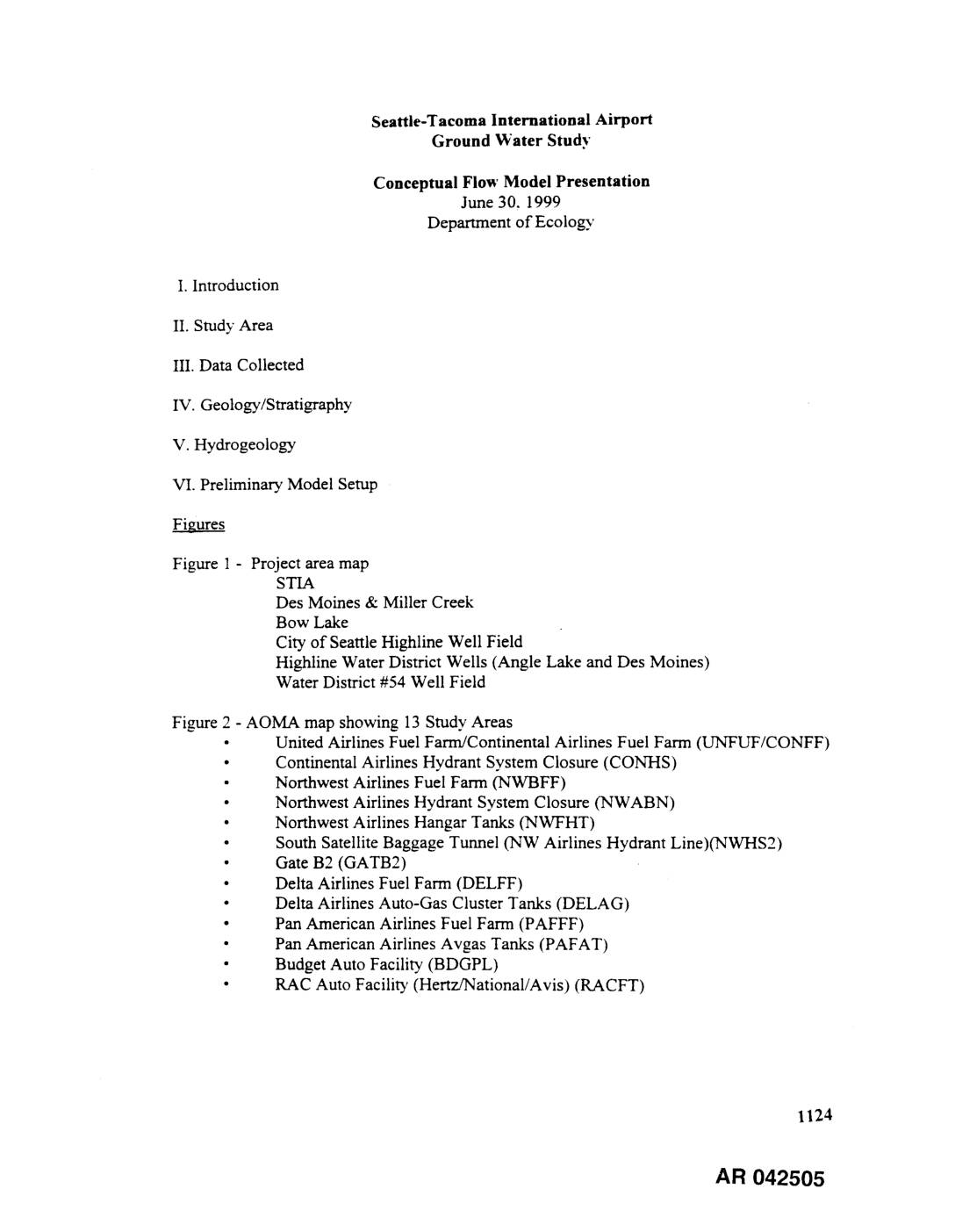
EXH AR042505: STIA Ground Water Study — Conceptual Flow Model Presentation
Conceptual Flow Model Presentation for the Seattle-Tacoma International Airport (STIA) Ground Water Study, prepared by Associated Earth Sciences, Inc. and S.S. Papadopulos and Associates, Inc. for the Port of Seattle, presented to the Washington State Department of Ecology on June 30, 1999. Document outlines study area including Des Moines Creek, Miller Creek, Bow Lake, City -
 1999-06-13
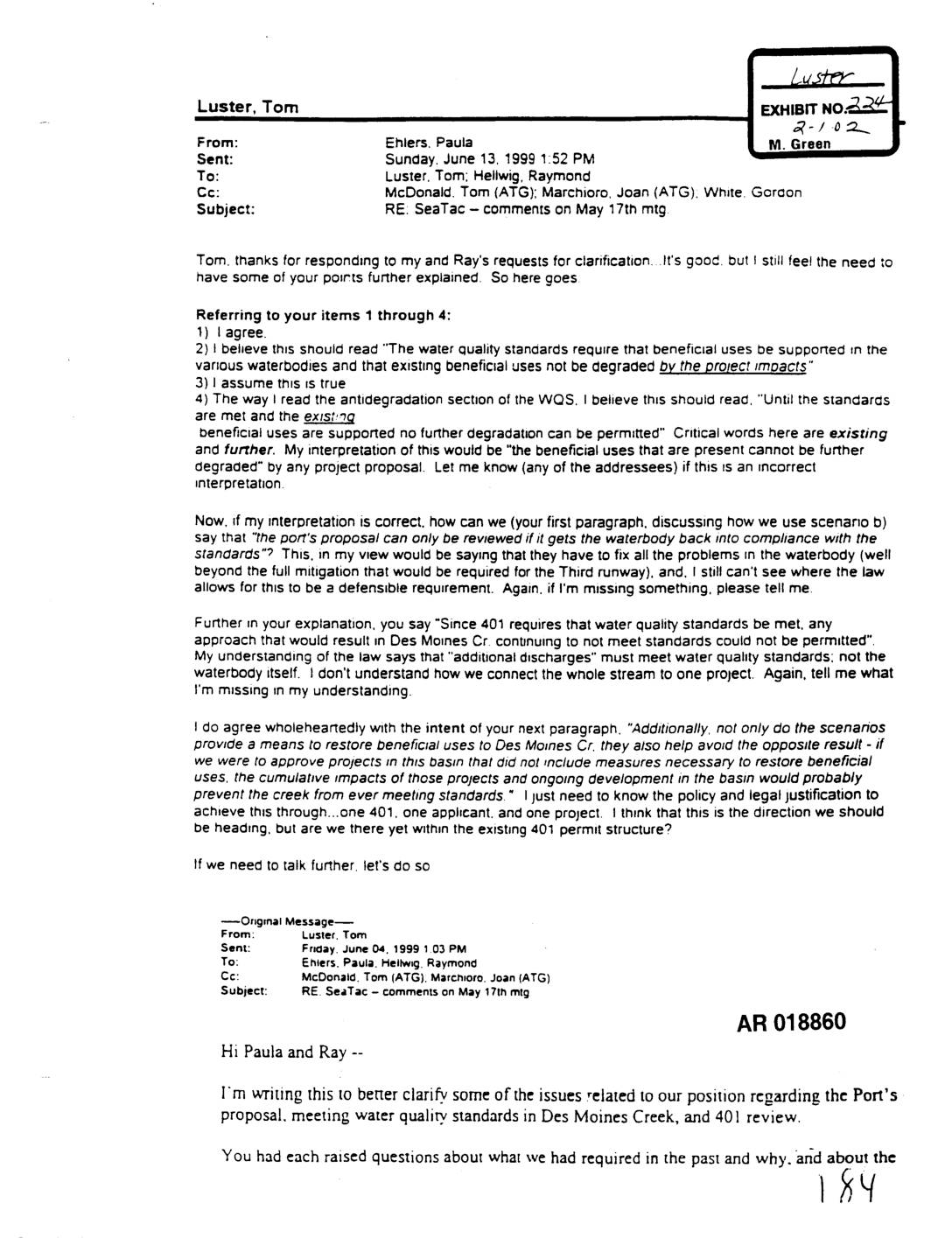
Exhibit 224: Email Chain RE: Sea-Tac – Comments on May 17th Meeting, Water Quality Standards and 401 Certification for Des Moines Creek
This 1999 email exchange between Washington State Department of Ecology staff debates the legal basis for requiring the Port of Seattle to restore water quality in Des Moines Creek as a condition of receiving a Section 401 water quality certification for the Sea-Tac Airport third runway project. The central question is whether Ecology can require a single applicant to fix broader watershed problems that pre-exist their project, or whether mitigation can only address the applicant's direct project impacts. Staff ultimately conclude that under antidegradation requirements, no further degradation of the creek can be permitted until existing beneficial uses are restored, meaning the Port's mitigation plan must include measures such as flow augmentation and stormwater controls to bring the creek into compliance with water quality standards. -
 1999-06-09
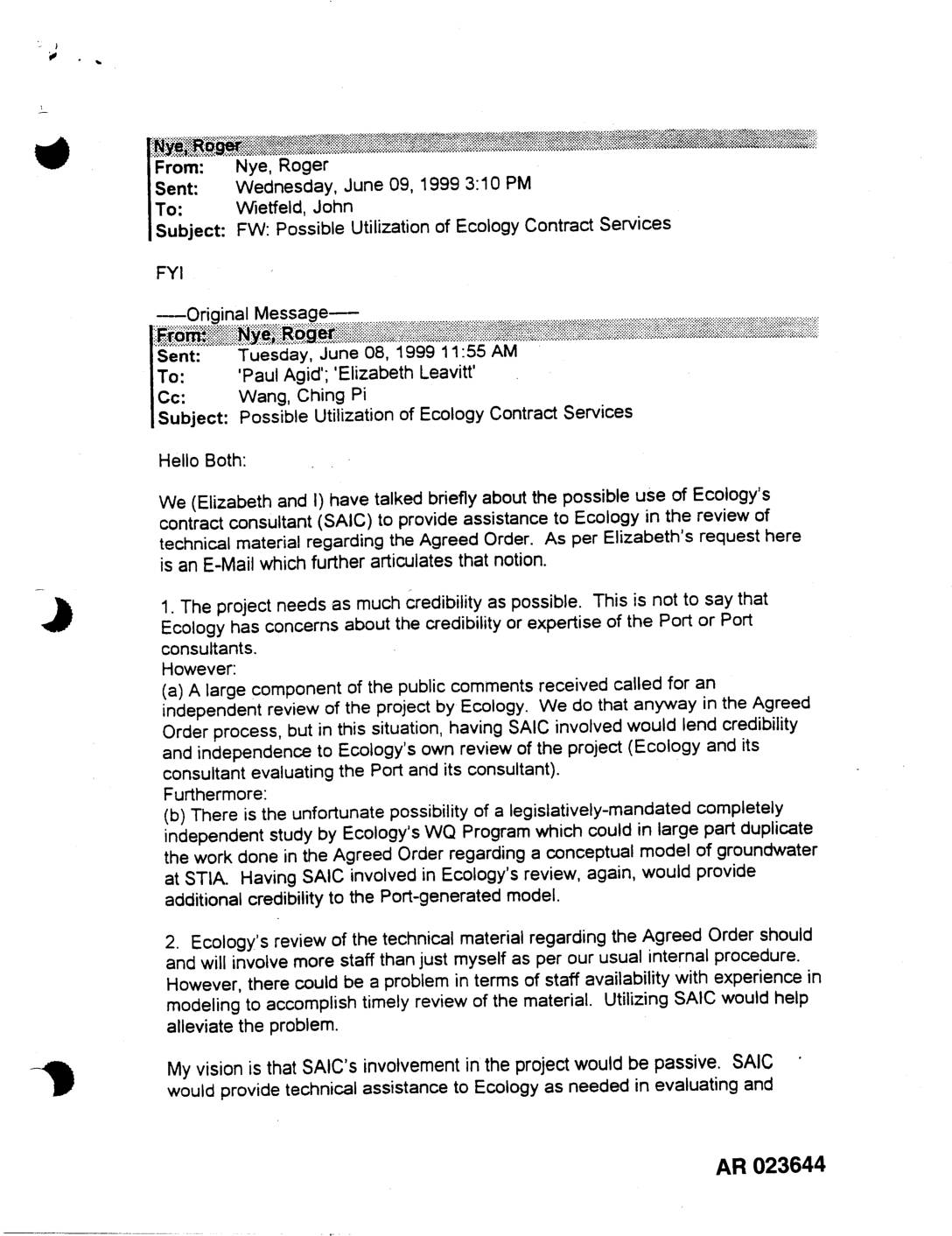
EXH AR023644: Email Chain – Possible Utilization Ecology Contract Services (SAIC) Agreed Order Review STIA
In a June 1999 email chain, Washington State Department of Ecology staff member Roger Nye proposed bringing in an outside consulting firm (SAIC) to help review technical groundwater studies related to an environmental cleanup agreement (Agreed Order) at Seattle-Tacoma International Airport (STIA). The goal was to add credibility and independence to Ecology's review process, particularly in response to public demands for an independent assessment. Nye also requested that the Port of Seattle agree to cover SAIC's costs as part of the overall project expenses under state cleanup regulations (MTCA). -
 1999-05-28
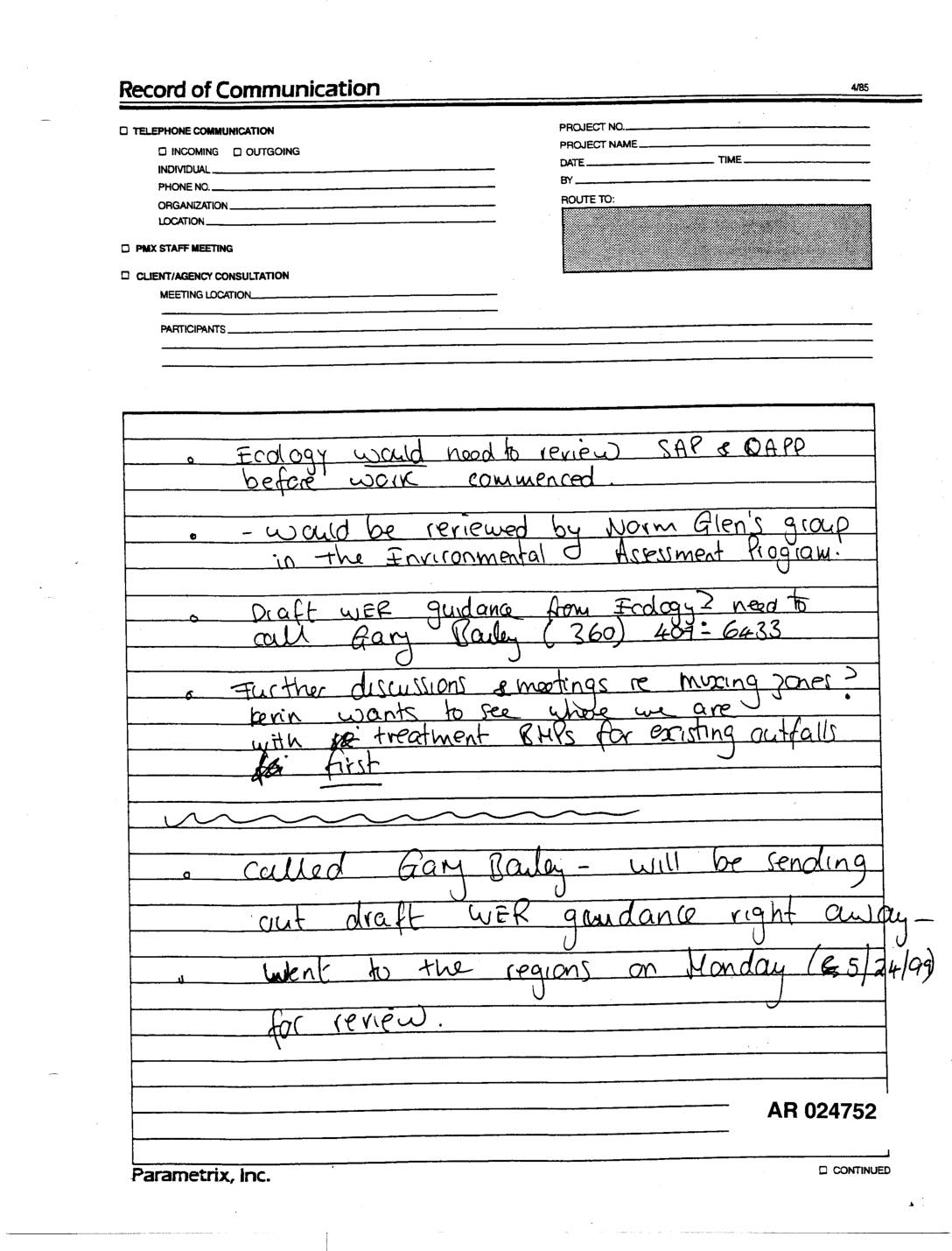
EXH AR024752: Ecology Review of SAP/QAPP and WER Guidance for Port Discharges
These internal communication records from Parametrix, Inc. (dated around May 1999) document discussions between environmental consultants and Washington State Department of Ecology staff regarding sampling and analysis protocols for port discharge outfalls. Key topics include the need for Ecology to review a Site Assessment Plan (SAP) and Quality Assurance Project Plan (QAPP) before work commenced, the applicability of clean sampling techniques for measuring copper concentrations in discharge water, and the distribution of draft Water Effluent Regulations (WER) guidance to regional offices for review. -
 1999-05-26
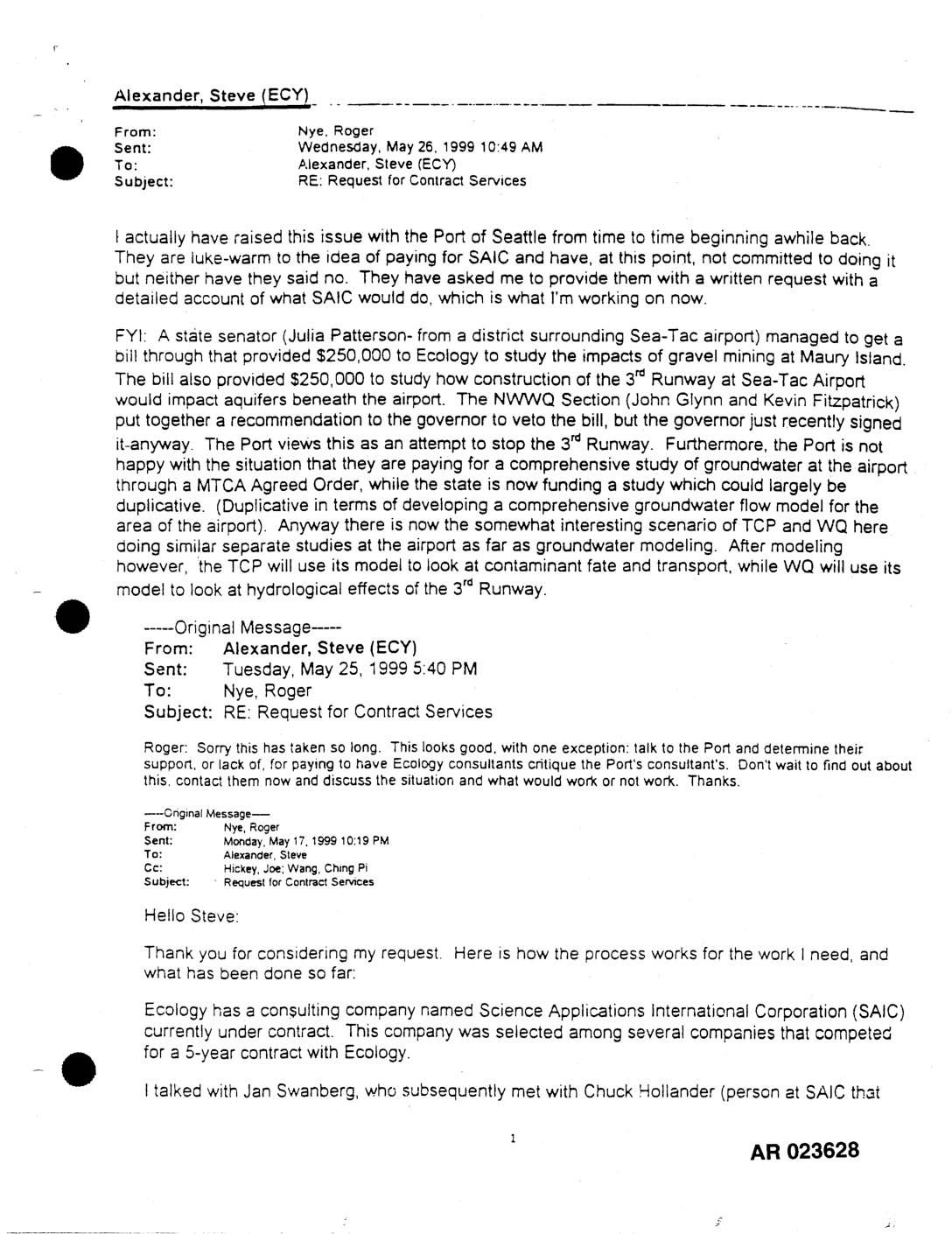
EXH AR023628: Email Chain — Ecology SAIC Contract Request, Third Runway Groundwater Study Funding
In May 1999, Washington State Department of Ecology staff exchanged emails discussing plans to hire consulting firm SAIC to review groundwater studies at Sea-Tac Airport, with the question of whether the Port of Seattle would fund the work remaining unresolved. The emails also note that state legislation signed by the governor allocated $250,000 to study how construction of Sea-Tac's proposed Third Runway would impact aquifers beneath the airport, a move the Port viewed as an attempt to block the runway project. This created an unusual situation where two separate Ecology divisions were conducting potentially duplicative groundwater modeling studies at the airport for different purposes. -
 1999-05-20
Sea-Tac Airport spatial nitrogen dioxide study final report
A 1999 University of Washington study measured nitrogen dioxide (NO2) levels around Seattle-Tacoma International Airport to determine whether aircraft operations were harming local air quality. Researchers found that NO2 levels at all monitoring sites remained well below federal safety standards, and that regional conditions and nearby freeways — not aircraft — were the primary drivers of local pollution. The study concluded that airport operations had only a small, difficult-to-isolate effect on community NO2 levels, estimated at less than 7 parts per billion above background levels.