TagCapacity(26)
-
 2021-07-21
Activity update & outlook: Highline Forum
A July 2021 presentation to the Highline Forum reported that Seattle-Tacoma International Airport (SEA) was steadily recovering from pandemic-related declines, with passenger traffic reaching 71% and scheduled seat capacity reaching 83% of 2019 levels as of June 2021. By August 2021, the flight schedule had climbed to 85% of pre-pandemic capacity, with Alaska Airlines leading the recovery at 97% of its 2019 schedule, while United Airlines lagged at 66%. The document highlights that airlines had largely restored operations to meet rebounding traveler demand. -
SEA Airport Approaches Capacity and Faces Difficult Decisions
Steinbrueck, Peter The Puget Sound Regional Council (PSRC) recently published preliminary findings of an air capacity study that shows what Port leadership and the traveling public have known for a while — the region is rapidly approaching a crisis. Seattle-Tacoma International Airport (SEA) has one of the smallest footprints of any major airport in the -
 2019-06-27
Regional Aviation Baseline Study
The Regional Aviation Baseline Study, published by the Puget Sound Regional Council in June 2019, examines the roles and interactions of 29 airports across the central Puget Sound region, including Sea-Tac as the area's primary large hub. The study aims to provide a regional perspective on how aviation activities affect communities and the broader economy, while gathering stakeholder input on aviation and airspace constraints. Its findings are intended to identify future aviation needs and lay the groundwork for long-term regional planning. -
 2016-11-07
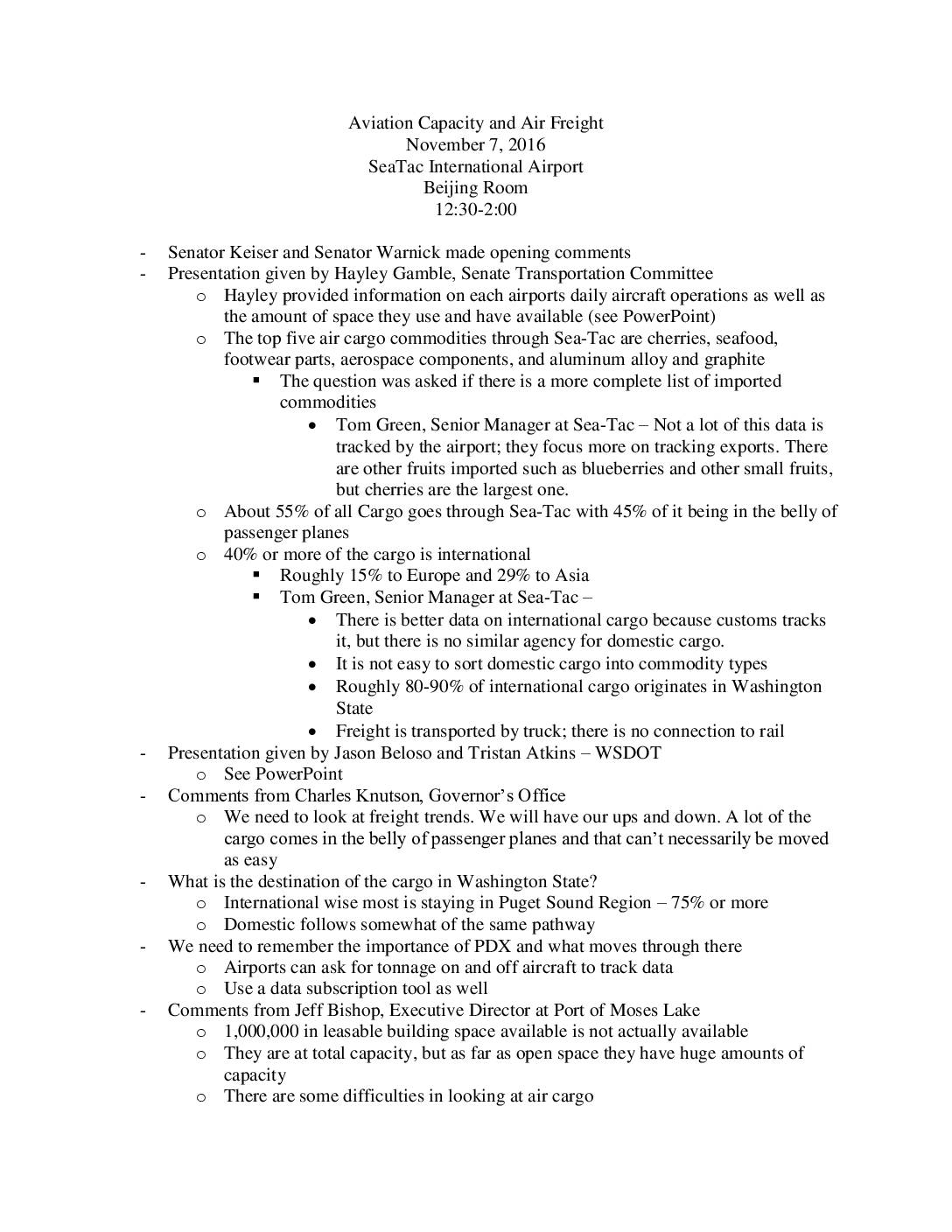
Aviation Capacity and Air Freight Meeting Notes: November 7, 2016
Meeting notes from a November 7, 2016 aviation capacity and air freight session held at SeaTac International Airport, covering topics such as top cargo commodities, airport capacity constraints, and cargo data tracking challenges. Speakers including port commissioners, WSDOT representatives, and airport managers discussed Sea-Tac's approaching operational capacity, the heavy reliance on passenger belly cargo, and the potential for other Washington airports like Spokane and Moses Lake to absorb freight demand. The group explored possible next steps including an air freight study, shipper outreach, and intermodal coordination strategies. -
 2009-07-01
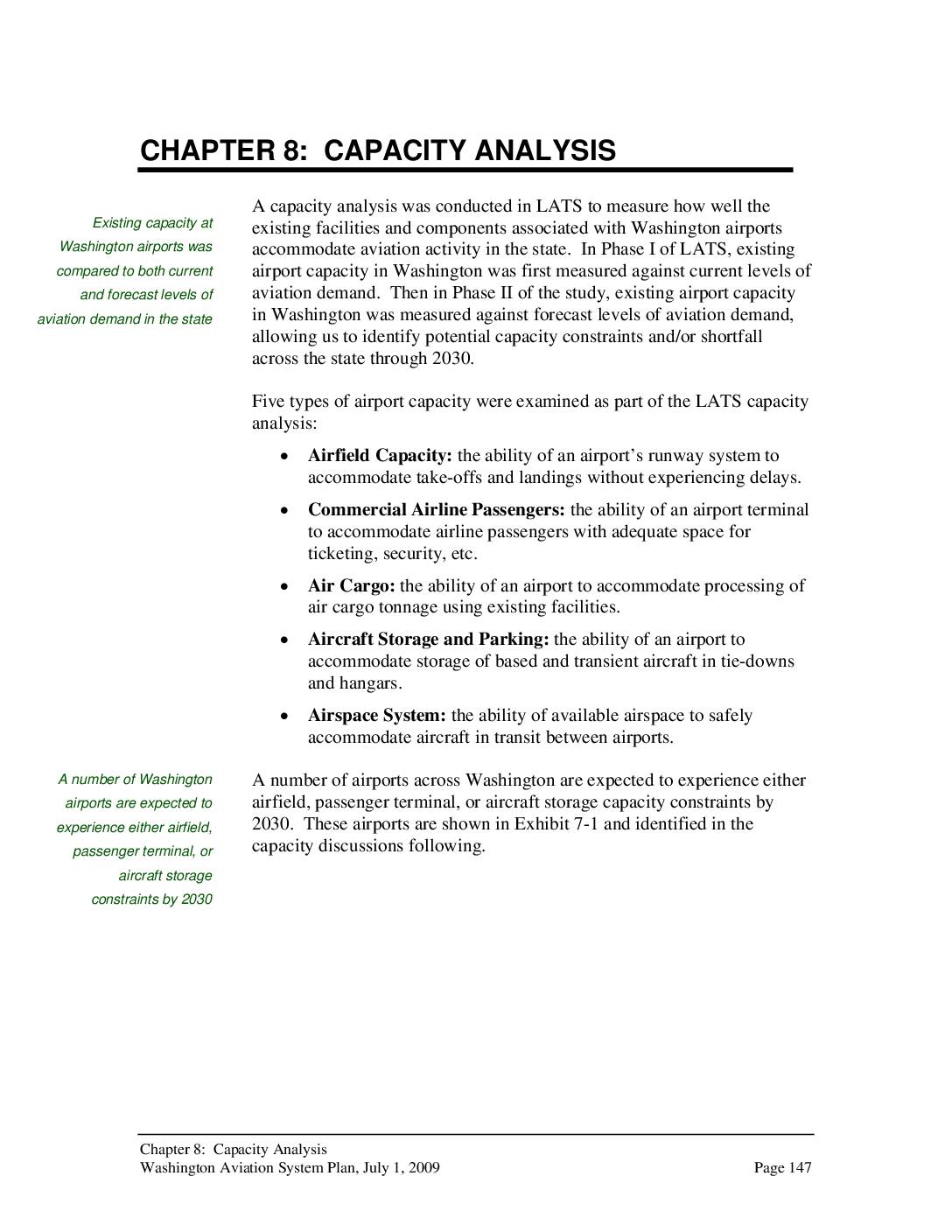
Washington Aviation System Plan: Chapter 8 — Capacity Analysis
A 2009 Washington Aviation System Plan capacity analysis found that Sea-Tac International Airport is expected to approach or exceed 100% capacity by 2030, facing constraints in aircraft operations, passenger facilities, and aircraft storage. The study examined five types of airport capacity statewide, including airfield capacity, commercial airline passengers, air cargo, aircraft storage, and airspace, measuring existing infrastructure against both current and forecast aviation demand. Exceeding airfield capacity can lead to increased delays, higher costs for airlines and airports, and greater air and noise pollution. -
 2005-06-24
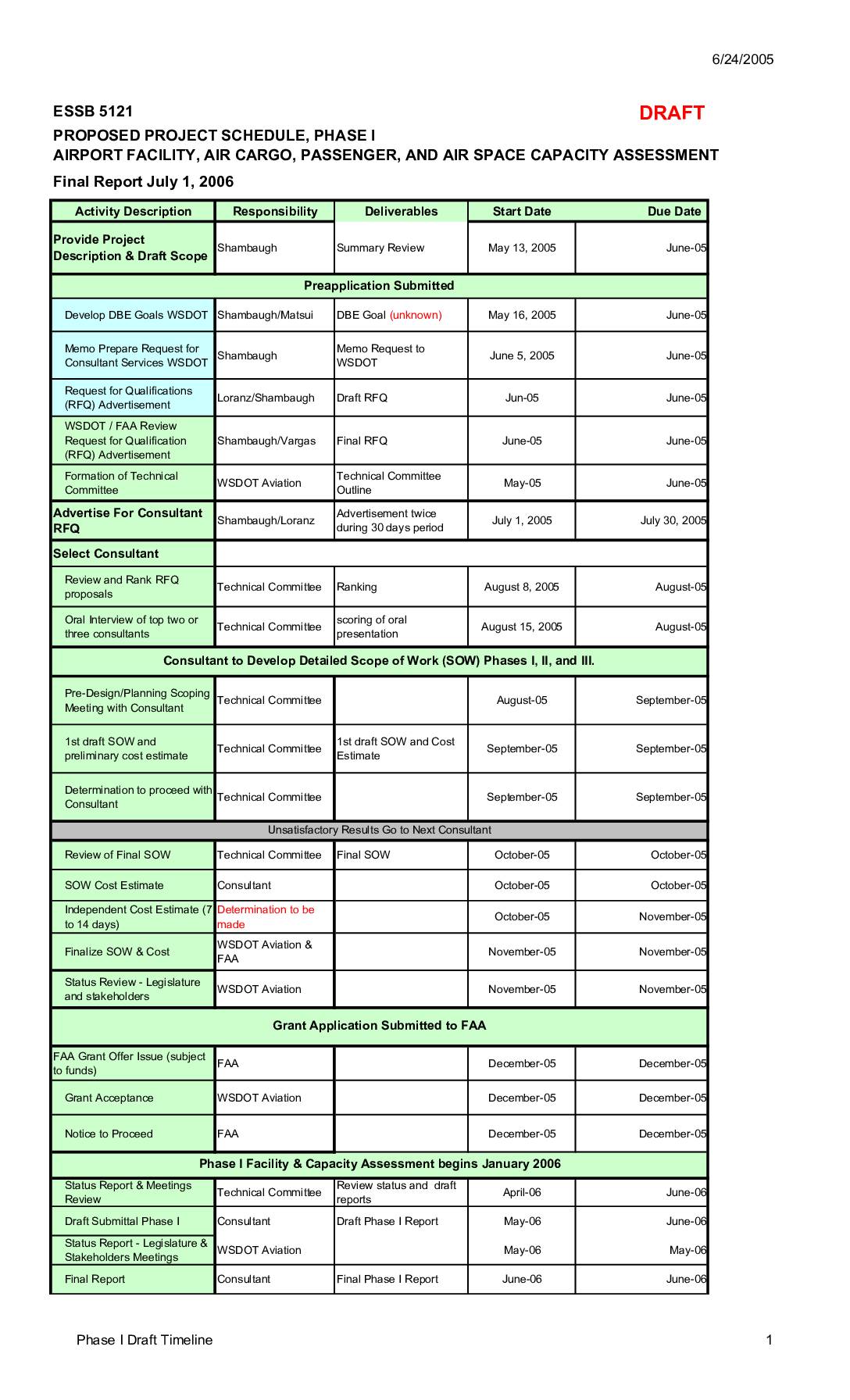
ESSB 5121 proposed project schedule, Phase I: Airport facility, air cargo, passenger, and air space capacity assessment
This draft project schedule outlines the planned timeline for Phase I of Washington State's airport facility, air cargo, passenger, and airspace capacity assessment under ESSB 5121, running from May 2005 through August 2006. Key milestones include advertising for a consultant, developing a detailed scope of work, securing an FAA grant, and completing a final Phase I report by July 1, 2006. WSDOT Aviation was responsible for submitting the findings to legislative committees, the governor, transportation commission, and regional planning organizations. -
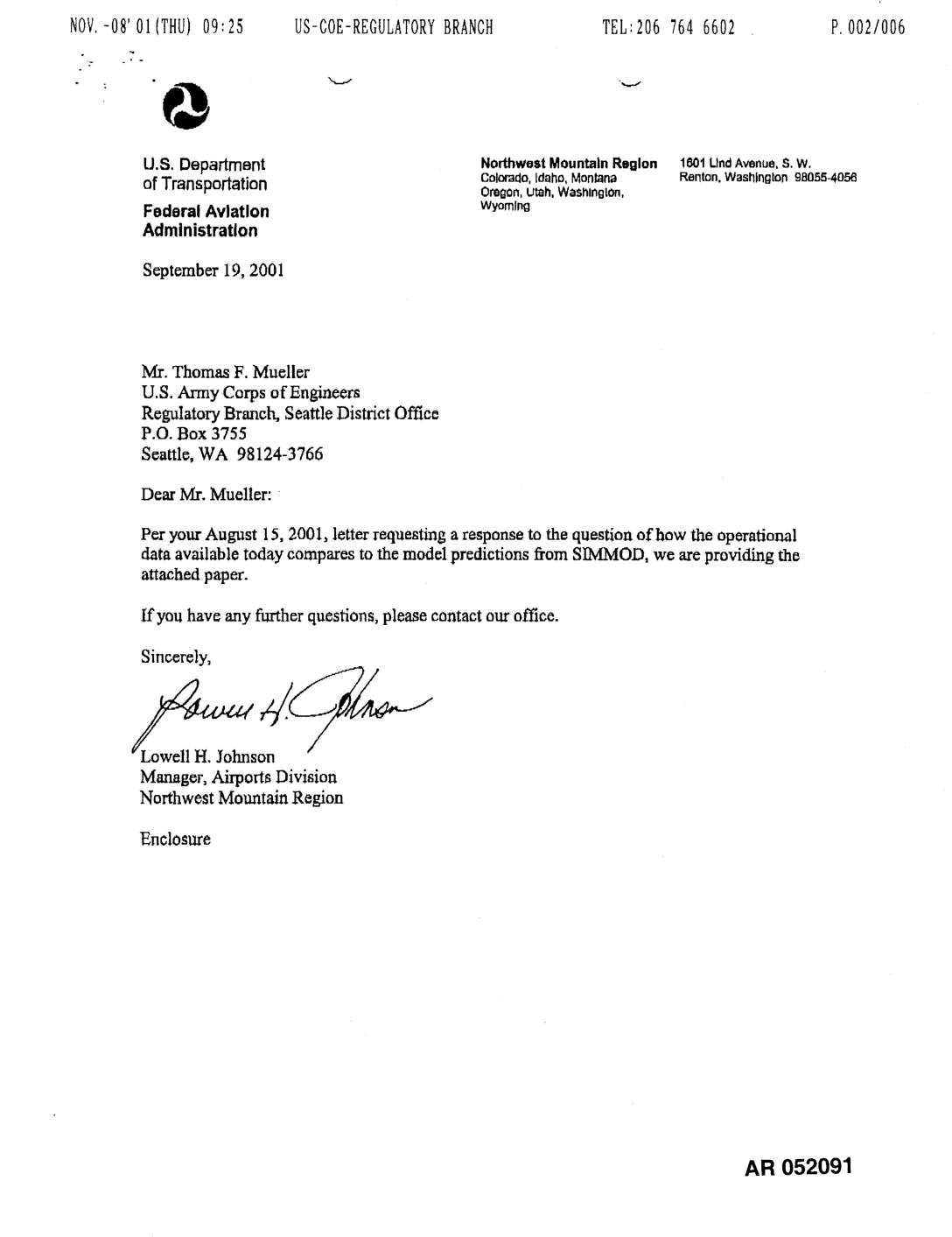 2001-09-19
EXH AR052091: FAA Letter to U.S. Army Corps of Engineers — Delay at Seattle-Tacoma International Airport SIMMOD Comparison
Letter dated September 19, 2001 from Lowell H. Johnson, Manager, FAA Airports Division, Northwest Mountain Region, to Thomas F. Mueller, U.S. Army Corps of Engineers, Regulatory Branch, Seattle District Office, responding to Mueller’s August 15, 2001 inquiry comparing operational data to SIMMOD model predictions for Sea-Tac Airport (KSEA). Enclosure paper titled ‘Delay at Seattle-Tacoma International -
 2001-01-01
Airport Capacity Benchmark Report 2001
The FAA's Airport Capacity Benchmark Report 2001 measures the maximum number of flights 31 of the nation's busiest airports can handle per hour under both good and adverse weather conditions. The benchmarks were developed between October 2000 and April 2001 by the FAA and MITRE/CAASD to help understand the relationship between airline demand and runway capacity, and to inform long-term aviation policy decisions. While useful as a reference point, the report notes that these benchmarks are starting points for discussion rather than definitive guides for major investment or scheduling decisions. -
 1995-07-01
EXH AR038694: STIA Capacity Enhancement Plan Update
Seattle-Tacoma International Airport (STIA) Capacity Enhancement Plan Update, July 1995, AR 038694. Prepared jointly by the U.S. Department of Transportation, Federal Aviation Administration (FAA), Port Of Seattle, and airlines and general aviation community serving Sea-Tac Airport. Document covers airport capacity planning and enhancement initiatives. -
 1995-06-01
Seattle-Tacoma International Airport data package no. 12: Airport capacity enhancement plan update
This 1995 Federal Aviation Administration report provides detailed technical data supporting the Seattle-Tacoma International Airport Capacity Enhancement Plan Update. Prepared by the FAA Technical Center in Atlantic City, New Jersey, it uses airport capacity and delay simulation analysis to evaluate options for improving airport operations. The information was subject to change as the Design Team's analysis progressed.