Skip to content
  • STNI
  • Statistics
    • Ops and Passengers
      • King County International Airport (Boeing Field) Annual Operations
    • Financials
    • Aviation fuel uplift in the State of Washington 2018 – 2025
      • Aviation Fuel Uplift at Sea-Tac Airport
    • Air Quality Monitoring
    • Flight Tracking
      • Flow and Flight Tracks
      • Five Year Comparison
      • Busiest Hours and Days
    • SEL Noise Reports & Graphs
      • About The Permanent Noise Monitors
      • Minutes of Quiet by Noise Monitor
      • Noise Events mapped
      • Noise Events (SEL)
    • Runways
    • Employees
    • Real Estate
      • Port Properties and Trees mapped
    • Parking
  • Events
  • Protest
    • Regular Events
    • Legislation 2026
    • Complain about a particular flight
    • Advocacy Organizations
    • Media Outlets
    • People
    • The Port of Seattle
      • Commission Meetings
      • Public Records Requests
      • StART
      • Highline Forum
    • Contact Your Electeds
  • Resources
    • FAQs
      • FAA Occurrences/Accidents/Indents
    • The unSustainable Airport Master Plan
      • SAMP Public Comment Template
        • Two versions of Appendix K: NEPA/SEPA 2018 vs 2023
      • SAMP NTP: 31 projects by the numbers
      • SEPA Draft EIS (2026)
      • SAMP Record of Decision/FONSI (2025)
      • SAMP Draft EA (October 2024)
      • 2018 Scoping
    • Port Packages
      • Port Package Property Costs
      • Port Packages mapped
      • The Port Package Explainer
      • So you want a (first-time) Port Package? Start here
      • Port Package Looker Upper
      • How do I determine if I have a Port Package or Avigation Easement?
      • Progress on Port Package Update legislation
      • Having a Port Package Problem?
      • Port Package Site Visit Follow-Up
    • Document Library
    • Explainers
      • The Airport Law Cheat Sheet
      • The Grant Explainer
    • External Articles
    • History
      • Timeline
      • The Sea-Tac Communities Plan
        • Sea-Tac Communities Plan – Planning Maps
      • PSRC Third Runway Decision Process
    • Studies
    • Videos
  • Stories
  • Mission
  • Subscribe
  • Contact
Scroll down to content

Get InformedStay Informedx

I understand that you will never share my information with anyone, you will only use it to keep me updated on relevant events and that I may unsubscribe at any time.

STNI

STNISea-Tac Noise.Info

  • Solve for Sea-Tac. Solve for every airport.
  • Since 2016, working to obtain justice for everyone living under the flight path.
  • Less Noise. Cleaner Air. Better Public Health. Compensation.
  • Everything you think you know about the airport is wrong.

TagATC(39)

Advanced Search Options

  • Dates
  • Media
    • External Articles
    • Images
    • PDFs
    • Video
    • Audio
  • Order By
  • Summa TWO SID Flightaware SEA DP All 7 Pdf
    2024-02-22

    SUMMA Two Departure (SUMMA2.SUMMA) — Seattle-Tacoma International Airport Standard Instrument Departure

    FAA Standard Instrument Departure (SID) chart AL-582 for the SUMMA TWO DEPARTURE (SUMMA2.SUMMA) from Seattle-Tacoma International Airport (KSEA/SEA), effective NW-1, 22 FEB 2024 to 21 MAR 2024. Includes graphical departure route and full text Departure Route Description. Covers takeoff runways 16L, 16C, 16R, 34L, 34C, and 34R with specific climb headings, takeoff minimums, and crossing
    TagsATC, FAA, Runways, Sea-Tac Airport
  • 2023-11-06

    History of air traffic control

    Simon Golstein At any given moment, there are more than 10,000 aircraft in the air. They fly along the same routes and use the same airports, taking off and landing within moments of each other. And yet, statistics show that flying is by far the safest way to travel. This is thanks to air traffic
    CategoriesFrom The Web TagsAir Traffic Control, ATC, High Lander
  • Close Calls and the New York Times: What You Need to Know

    The U.S. aviation system is the safest in the world, but one close call is one too many. The FAA and the aviation community are pursuing a goal of zero serious close calls, a commitment from the Safety Summit in March. The same approach virtually eliminated the risk of fatalities aboard U.S. commercial airlines. Since 2009,
    CategoriesFrom The Web TagsATC, Commercial Aviation, FAA, Safety
  • 2023-05-24

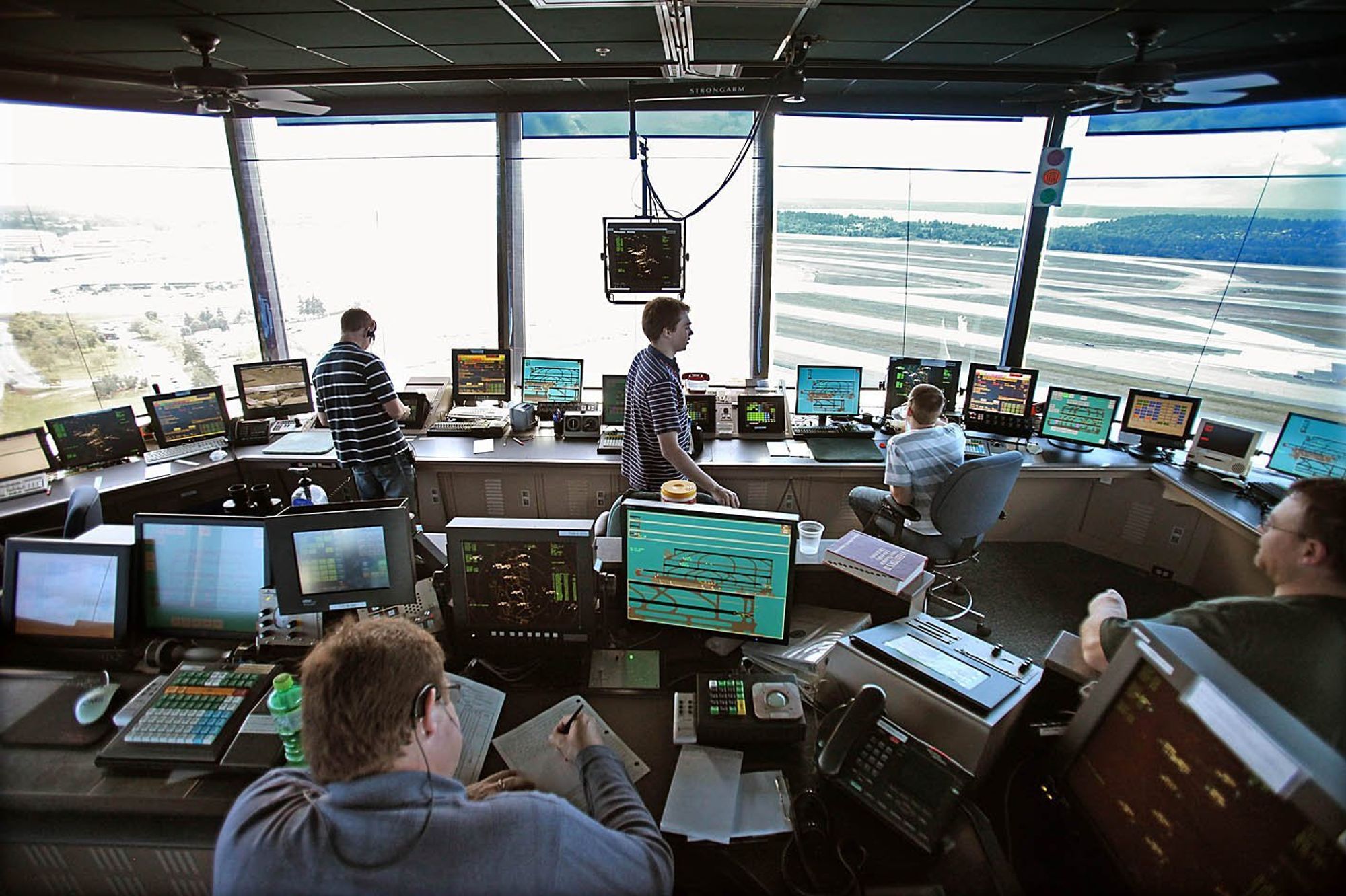
    Airport Control Tower Interior

    A person wearing a badge/lanyard stands in an airport control tower cab surrounded by multiple monitors and radar displays. Delta Air Lines aircraft are visible at gates on the ramp below, consistent with Sea-Tac Airport's terminal configuration.
    TagsAir Traffic Control, ATC, Delta, Sea-Tac Airport
  • FAA Safety Summit

    CategoriesFrom The Web TagsATC, FAA, Safety
  • 2022-07-14

    Mountain Two Departure (MONTN2.SEA) — Seattle-Tacoma International Airport Standard Instrument Departure

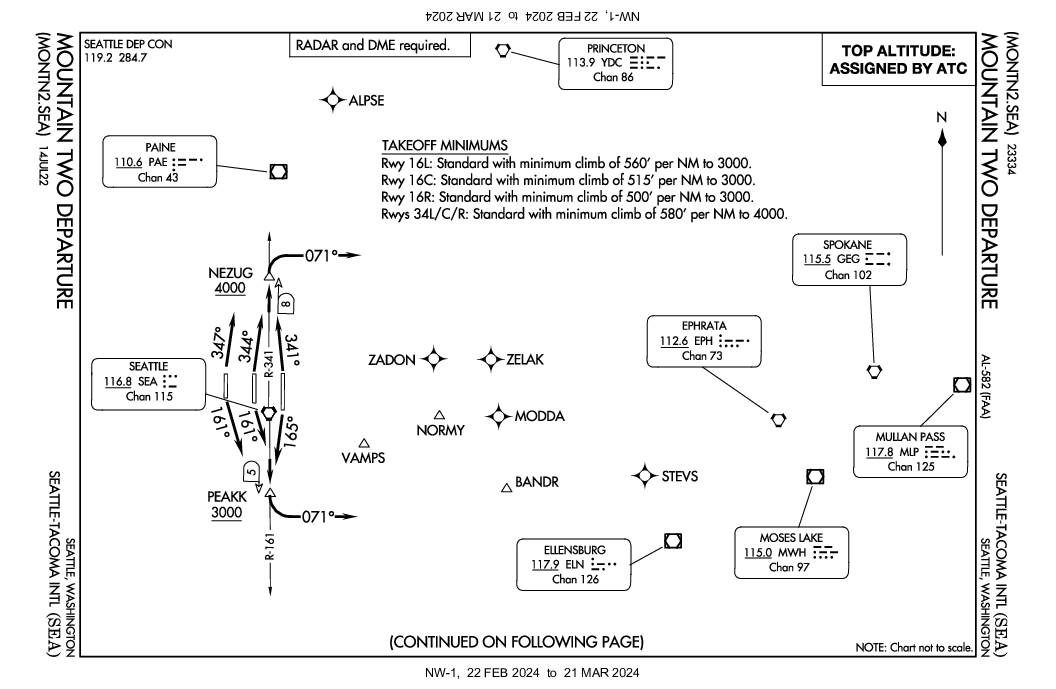
    The Mountain Two Departure (MONTN2.SEA) is an instrument departure procedure for Seattle-Tacoma International Airport (SEA) that provides pilots with specific climb and routing instructions based on which runway they are using. Departing aircraft must meet minimum climb gradients ranging from 500 to 580 feet per nautical mile depending on the runway, and are directed to fly specific headings before turning eastbound on a 071° heading toward fixes like PEAKK or NEZUG. The procedure requires radar and DME equipment, with top altitude assigned by ATC and a lost communications protocol directing pilots to proceed direct to the SEA VORTAC at 4,000 feet.
    TagsATC, FAA, Flight Tracks, Sea-Tac Airport
  • Mountain TWO SID Flightaware SEA DP All 5 Pdf
    2022-07-14

    Mountain Two Departure (MONTN2.SEA) — Seattle-Tacoma International Airport Standard Instrument Departure

    FAA Standard Instrument Departure (SID) chart AL-582 for the Mountain Two Departure (MONTN2.SEA) from Seattle-Tacoma International Airport (SEA/KSEA). Covers departure route descriptions for Runways 16L, 16C, 16R, 34L, 34C, and 34R. Specifies climb headings (165°, 161°, 341°, 344°, 347°), fixes PEAKK (SEA 5 DME at or above 3000 ft) and NEZUG (SEA 8 DME at
    TagsATC, FAA, Flight Tracks, Sea-Tac Airport
  • 2022-07-14

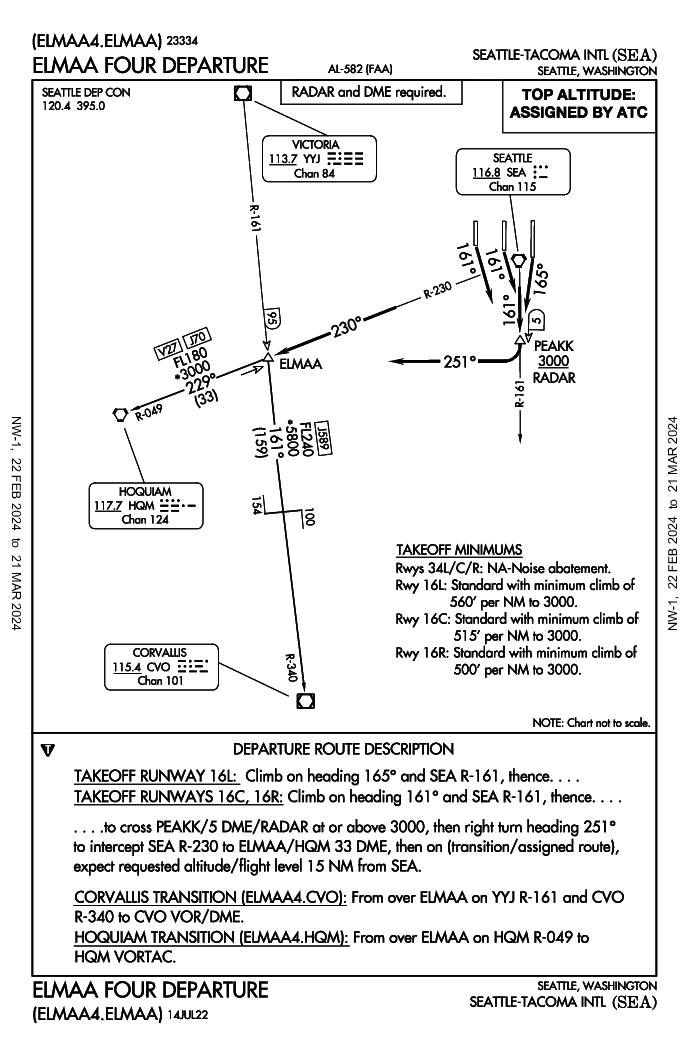
    ELMAA Four Departure (ELMAA4.ELMAA) — Seattle-Tacoma International Airport Standard Instrument Departure

    The ELMAA Four Departure is a standard instrument departure procedure for Seattle-Tacoma International Airport (SEA) that routes aircraft southward after takeoff on runways 16L, 16C, or 16R. Departing aircraft climb on headings of 161°–165°, cross the PEAKK waypoint at or above 3,000 feet, then turn right to intercept the SEA R-230 radial toward the ELMAA fix, with onward transitions available to Hoquiam (HQM) or Corvallis (CVO). Notably, departures from runways 34L, 34C, and 34R are not authorized due to noise abatement restrictions, and minimum climb gradients of up to 560 feet per nautical mile are required depending on the runway used.
    TagsATC, FAA, Map, Noise Abatement Procedures, Sea-Tac Airport
  • Elmaa FOUR SID Flightaware SEA DP All Pdf
    2022-07-14

    ELMAA Four Departure (ELMAA4.ELMAA) — Seattle-Tacoma International Airport Standard Instrument Departure

    FAA Standard Instrument Departure (SID) procedure chart AL-582 for the ELMAA FOUR DEPARTURE (ELMAA4.ELMAA) at Seattle-Tacoma International Airport (KSEA/SEA), Seattle, Washington. Covers departure routes for Runways 16L, 16C, and 16R (Rwys 34L/C/R NA for noise abatement), with minimum climb gradients of 560’/NM (16L), 515’/NM (16C), and 500’/NM (16R) to 3000 feet. Includes CORVALLIS TRANSITION (ELMAA4.CVO)
    TagsATC, FAA, Map, Noise Abatement Procedures, Sea-Tac Airport
  • 2022-05-19

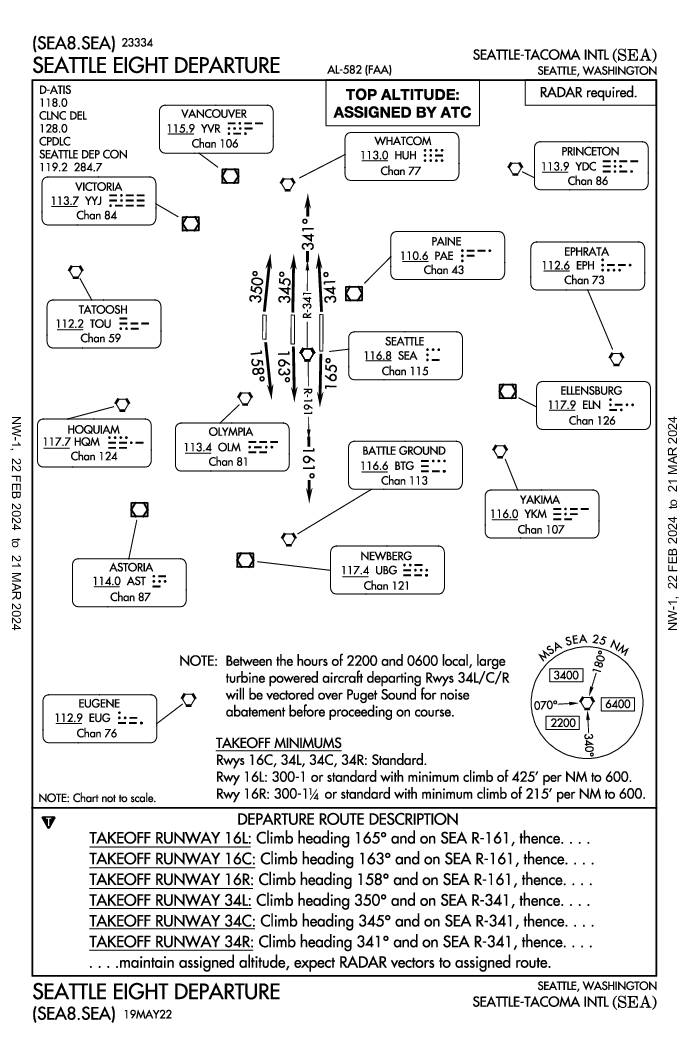
    Seattle Eight Departure (SEA8.SEA) — Standard Instrument Departure Chart

    The Seattle Eight Departure (SEA8.SEA) is a standard instrument departure procedure for Seattle-Tacoma International Airport, outlining specific climb headings and routes for each runway to guide aircraft safely after takeoff. A notable noise-abatement provision requires large turbine-powered aircraft departing runways 34L, 34C, and 34R between 10 PM and 6 AM local time to be vectored over Puget Sound before proceeding on course. The procedure requires radar and assigns top altitude by ATC, with special minimum climb gradients applicable to runways 16R and 16L.
    TagsATC, FAA, Noise Abatement Procedures, Sea-Tac Airport

Posts pagination

Page 1 Page 2 Page 3 Page 4
Sidebar On/Off

Upcoming Events

  • StART SEA Stakeholder Advisory Round Table
    Add to CalendarMWednesday Aug 26, 5:00pm - 7:00pm
    Zoom (Virtual Meeting)
    START meetingagenda 2026826 final 0 pdf

    Meeting Objectives Introduce the primary feedback themes identified by StART members regarding StART’s Operating Procedures and determine areas that may warrant future discussion. 5:00 PM – Welcome Meeting Management Welcome Lead: Andrés Mantilla, Facilitator, Uncommon Bridges; Wendy Reiter, Airport Managing Director, POS 5:15 PM – Dinner: All participants eat. 5:30 PM – StART Operating Procedures

    [...]
  • Commercial Aviation Work Group
    Add to CalendarMThursday Sep 3, 10:00am - 1:30pm
    Virtual Meeting (Zoom)
    Cawg agenda sep 3 26 virtual pdf

    Meeting Agenda 10:00 a.m. – 10:15 a.m. | Welcome – Evan Nordby, Chair a. Introductions and Agenda Reviewb. Status of appointments and non-voting member invitationsc. Other updates as necessary 10:15 a.m. – 11:00 a.m. | Is it practical and legal to operate the western Washington [Puget Sound] airports as a single airport system? – Consultant

    [...]

[See all...]


Help study childhood asthma. Get free HEPA filter!

read more...

Issues

Sea-Tac Airport is currently undergoing the largest and longest expansion in its history, collectively known as the Sustainable Airport Master Plan (SAMP). Some of it you can already hear, but you’re probably not aware of what it all means. Here’s what you need to know.
read more...

Read This!

As the source for federal transportation grants, the Puget Sound Regional Council was charged with developing a system to meet the growing need for commercial aviation. When the search for a second airport failed, they authorized the Port of Seattle to build the Third Runway, with a mandate to develop a noise abatement and mitigation program. In their effort to stop the Third Runway, the ACC argued over every detail of the Port's efforts--including property buyouts and sound insulation. The dispute was meant to be settled by a three member Expert Arbitration Panel. This is their final report. It finds 2-1, that the Port's program was insufficient in several respects. Despite that, funding for the Third Runway was approved by the PSRC, and the 'Port Package' program, proceeded largely unchanged. Expert Arbitration Panel's final decision finding that the Port of Seattle had not shown sufficient reduction in real on-the-ground noise impacts to satisfy noise reduction conditions required for approval of a third runway at Sea-Tac International Airport. The majority decision concluded the Port's noise abatement programs were insufficient despite being impressive in scope.
continue...

The Podcast!

Subscribe to the only podcast devoted to policies, politics, history, impacts for people living under the flight path everywhere. It’s definitely not just about noise!
  • Sea-Tac Noise.Info
  • Connect with STNI

    • Subscribe
    • Port Package Problem?
    • Donate
    • Podcast
    • Socials
      • Facebook
      • X (Twitter)
      • Bluesky
      • Instagram

    "NEPA flow to SEPA Screenshot_30-9-2024_205354_www.airportprojects.net" — , 2024

  • Learn

    • Frequently Asked Questions
    • Explainers
    • Youtube
    • Research Requests
    • Make a complaint
  • Goals

    Fulfill the promises of 1976:
    • Compensation
    • Reduced noise
    • Improved air quality
    • Environmental remediation
Login/Register
©2026•Data Privacy

Message

We use cookies to provide basic functionality. We also provide access to search engines in order to provide site analytics. We do not sell or share your data.
V V