• 2022-05-19

    Seattle Eight Departure (SEA8.SEA) — Standard Instrument Departure Chart

    FAA Standard Instrument Departure (SID) chart AL-582 for the Seattle Eight Departure (SEA8.SEA) from Seattle-Tacoma International Airport (KSEA), Seattle, Washington, effective 19 MAY 2022, revised NW-1 22 FEB 2024 to 21 MAR 2024. Covers departure routes for runways 16R, 16C, 16L, 34R, 34C, and 34L using SEA VOR (116.8, Chan 115) radials R-341 and R-161.
  • Air Route Traffic Control

    Knowing the ATC system structure provides insight into its effective use. Rose Marie Kern In 22 facilities across the U.S., thousands of air traffic controllers actively watch the skies over their assigned sectors. Each Air Route Traffic Control Center (ARTCC) is almost a small town in itself. The Operations Room contains 50 to 60 consoles
  • 2019-09-28

    FAA Order JO 7110.126A: Consolidated Wake Turbulence (CWT) Separation Standards

    FAA Order JO 7110.126A, effective September 28, 2019, updates the rules air traffic controllers use to maintain safe distances between aircraft to avoid wake turbulence. The order introduces a nine-category system for classifying aircraft by their wake turbulence characteristics, replacing older weight-based separation standards with more precise, data-driven minimums that can reduce unnecessary spacing between certain aircraft pairs. These updated standards are designed to improve traffic flow and runway efficiency at busy airports across the national airspace system.
  • 2016-07-26

    (LOA) 1-01 SEA-S46 LOA 7-26-16 (MASTER)

    This July 2016 Federal Aviation Administration Letter of Agreement establishes coordination and control procedures between Seattle Terminal Radar Approach Control (TRACON) and Seattle Airport Traffic Control Tower, replacing a prior agreement from June 2013. It outlines responsibilities for managing air traffic, including pre-arranged coordination protocols, handling of Boeing Field arrivals and departures, and conditions under which those procedures may be suspended. The document governs how controllers at both facilities communicate and share airspace authority around the Seattle area.
  • 2012-06-10

    Sea-Tac airliner tests could yield quieter, more efficient landings

    Four passenger flights into Seattle-Tacoma International Airport on Monday evening will launch a Federal Aviation Administration (FAA) test project that promises to leave Seattle’s skies quieter and greener. By Dominic Gates Seattle Times aerospace reporter Shortly after 11 p.m. Monday evening, Alaska Airlines flight 432 from Los Angeles will be the first passenger flight into
  • 1982-09-01

    Evaluation of Alternative Measures: Chapter 7

    This draft chapter evaluates alternative measures to address growing aircraft delays caused by airspace interactions between Seattle-Tacoma International Airport (Sea-Tac) and Boeing Field, which are projected to worsen significantly from 1990 through 2000. The measures examined include improved air traffic control (ATC) technology, airport facility improvements such as a new runway and reliever airports, and demand management strategies like flight quotas and peak-period surcharges. The chapter emphasizes that, despite delays not being critical until around 1990, immediate planning and commitment from various agencies is necessary given the lengthy implementation timelines involved.
  • 1982-09-01

    Evaluation of Alternative Measures: Chapter 7

    Chapter 7 of a draft study evaluating alternative measures to reduce aircraft delays resulting from airspace interactions between Sea-Tac Airport and Boeing Field. Topics include improved ATC technology, reduced aircraft separations, Microwave Landing System (MLS) instrument approaches, new Runway 13-31 at Sea-Tac, reliever airports, IFR quotas, IFR peak period surcharges, and cooperative rescheduling of flights.
  • 1982-02-24

    Forecasts of Peak Hour and Annual Aircraft Operations by Aircraft Classification: Sea-Tac International Airport and King County International Airport, 1980–2000

    This document presents forecasts of aircraft operations at Seattle-Tacoma (Sea-Tac) International Airport and King County International Airport from 1980 to 2000, broken down by aircraft classification and flight category including air carrier, general aviation, and military. It projects that total annual operations at Sea-Tac will grow from approximately 213,600 in 1980 to over 260,800 by 2000, driven largely by increases in larger Class D air carrier aircraft. Peak hour operation estimates are provided for both Visual Flight Rules (VFR) and Instrument Flight Rules (IFR) conditions, offering planners a detailed basis for noise impact and capacity assessments.
  • 1981-08-03

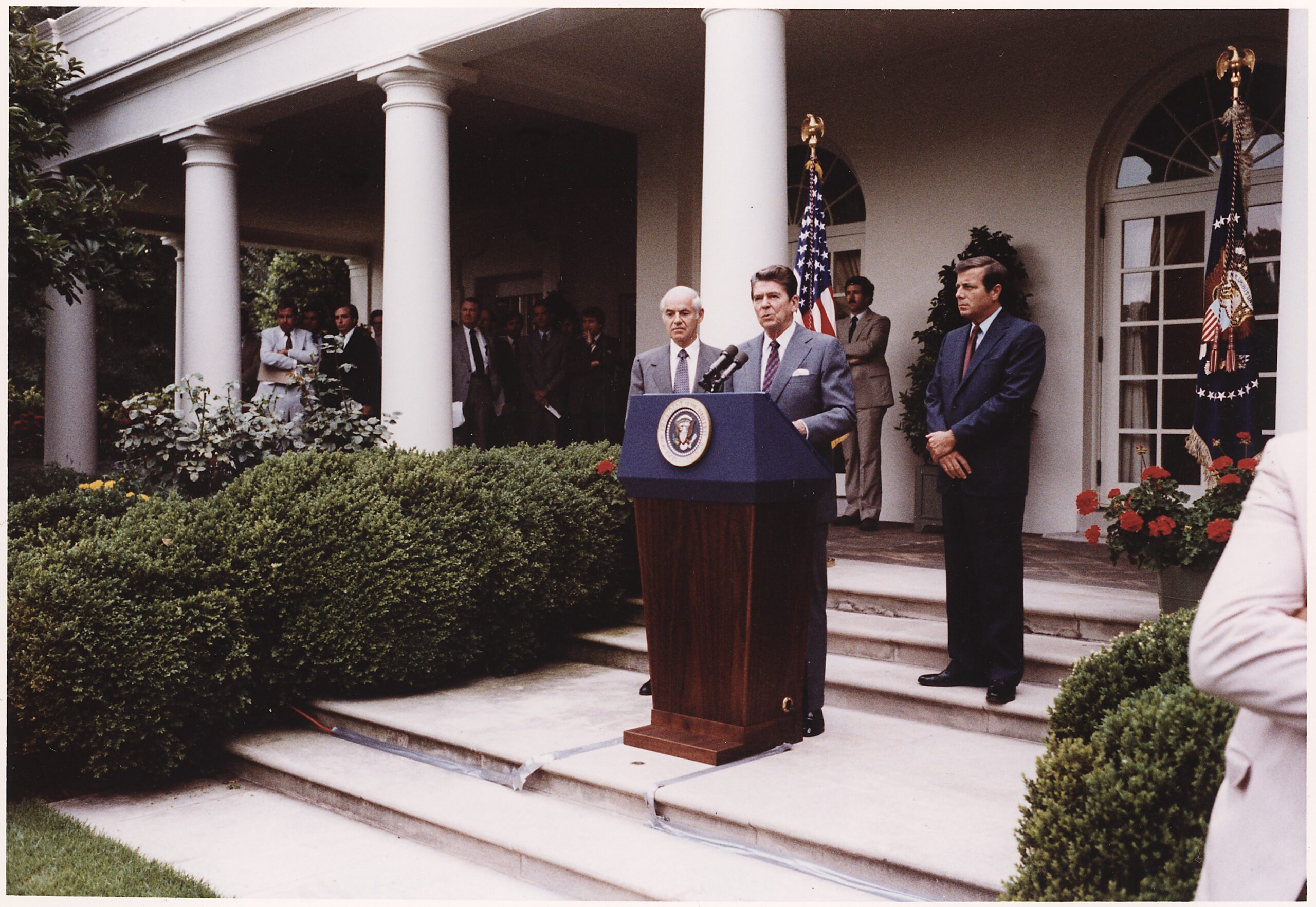
    Ronald Reagan Press Conference PATCO 1981 at White House

    Three men stand at a presidential podium bearing the Presidential Seal in what appears to be the White House Rose Garden. The setting includes American flags, white columns, and a gathered audience of officials and press in the background, consistent with an official White House announcement or press conference.