TagAIP(61)
-
 2023-11-15
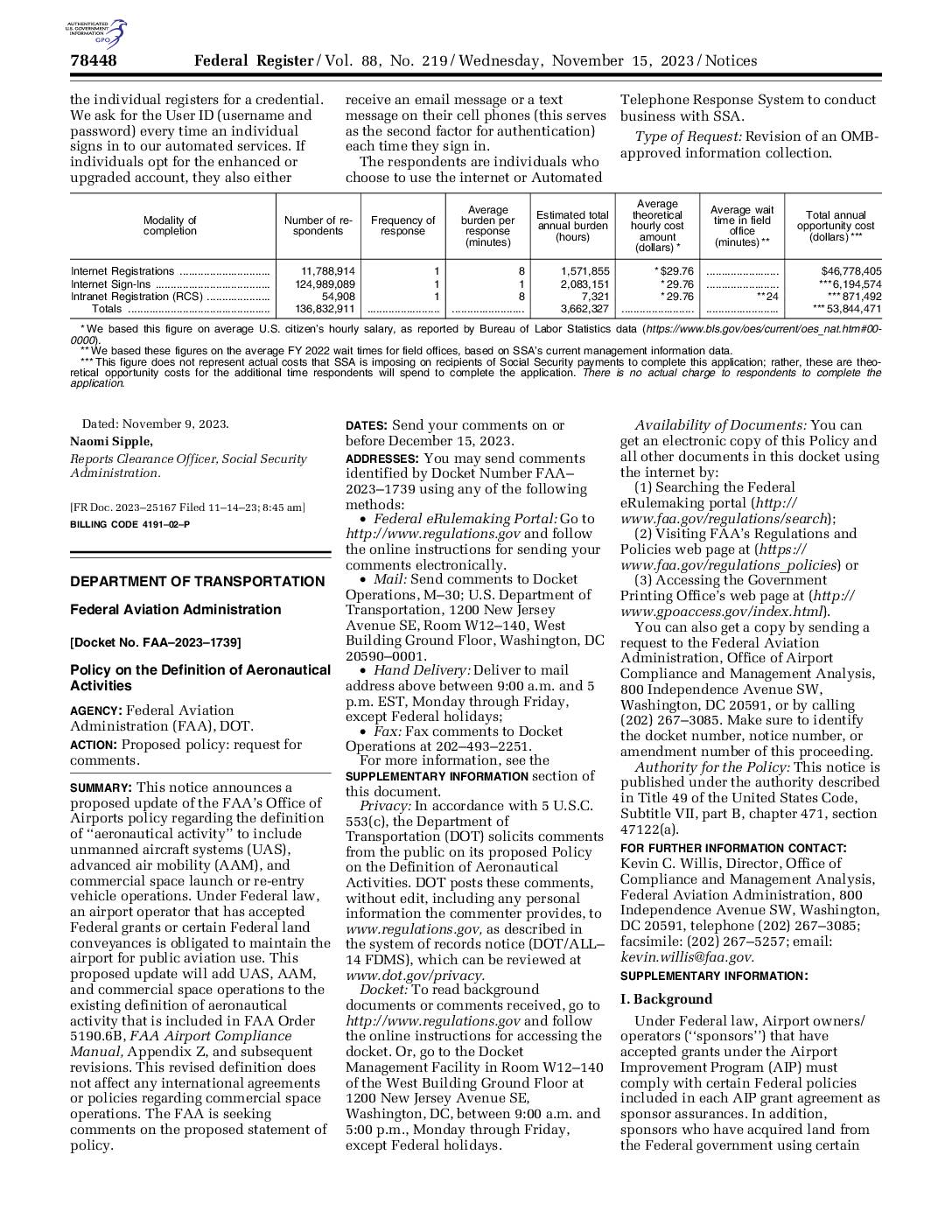
Federal Register Policy on Definition of Aeronautical Activities
★ 32The FAA proposed updating its definition of 'aeronautical activity' to include unmanned aircraft systems (UAS), advanced air mobility (AAM), and commercial space launch operations, meaning federally obligated airports must provide non-discriminatory access to these emerging technologies. The policy clarifies that while these new operations qualify for airport access, the FAA retains authority to assess safety risks and set conditions for accommodating them. Recreational UAS, model aircraft, and model rockets are explicitly excluded from the updated definition. -
 2023-07-01
Airport Law Digest: 2023 Mid-Year Update
The Kaplan Kirsch & Rockwell Airport Law Digest 2023 Mid-Year Update covers key developments in U.S. airport law and policy from the first half of 2023, including proposed FAA reauthorization legislation that would affect airport funding, land use approvals, and grant assurances. Both the House and Senate introduced bills that would increase Airport Improvement Program grants to $4 billion annually and clarify the FAA's limited role in airport land use decisions. The digest also summarizes recent litigation, federal rules, and regulatory guidance relevant to airport operators and legal professionals. -
 2023-04-17
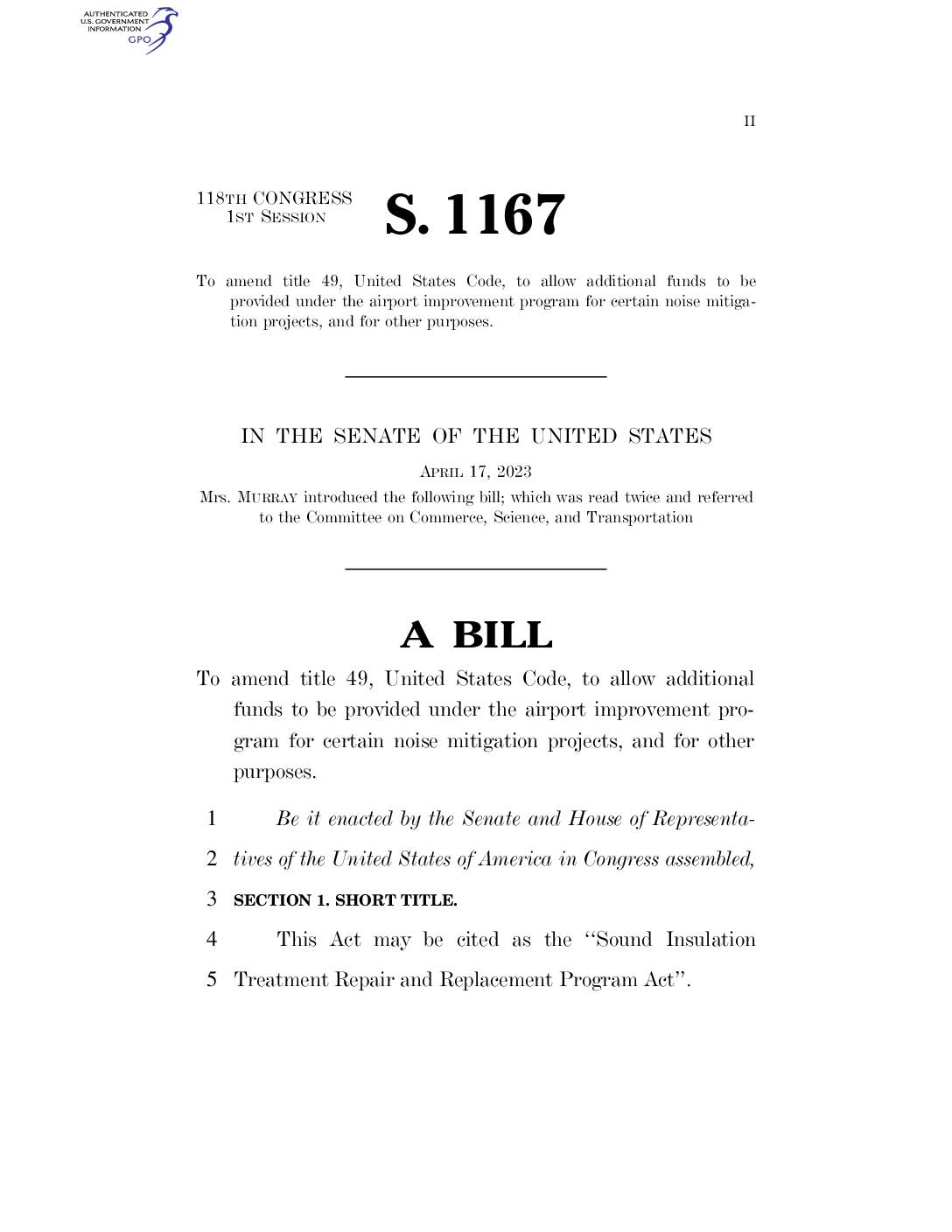
Sound Insulation Treatment Repair and Replacement Program Act (S. 1167)
Senate Bill 1167, introduced by Sen. Patty Murray in April 2023, would allow airports to receive additional federal funding to repair or replace sound insulation previously installed in nearby homes under the Airport Improvement Program. The bill provides a one-time waiver allowing airports to seek new federal assistance for sound insulation projects without prior government costs counting against them, provided the homes fall within the DNL 65 noise threshold or the original insulation caused physical damage. This legislation is particularly relevant to communities around Sea-Tac Airport, where aging soundproofing materials and ongoing aircraft noise concerns have prompted calls for updated noise mitigation support. -
2023-04-10
Port Package Update Letter – Spring 2023
Greetings, As always, this is behind schedule. However, in addition to the the usual procrastination, things change all the time. Sorry, but for newcomers we always start with some background. If you’ve heard all this, just skip down… Your original Port Package was almost certainly financed through FAA funding called the Airport Improvement Program (AIP). -
 2023-04-06
Sound Insulation Treatment Repair and Replacement Program Act
The Sound Insulation Treatment Repair and Replacement Program Act, introduced by Rep. Adam Smith (WA-09), would allow the FAA to waive a rule that currently prevents airports from using Airport Improvement Program (AIP) funds to repair or replace sound insulation in the same home more than once. The bill addresses problems caused by faulty materials and poor installation during noise mitigation programs in the 1980s and 1990s, which have led to structural damage and mold in some homes near airports like Sea-Tac. Eligible homeowners must have their issues verified by an FAA-compliant noise auditor, and repairs are generally limited to residences still within the airport's current 65 DNL noise contour. -
 2023-04-06
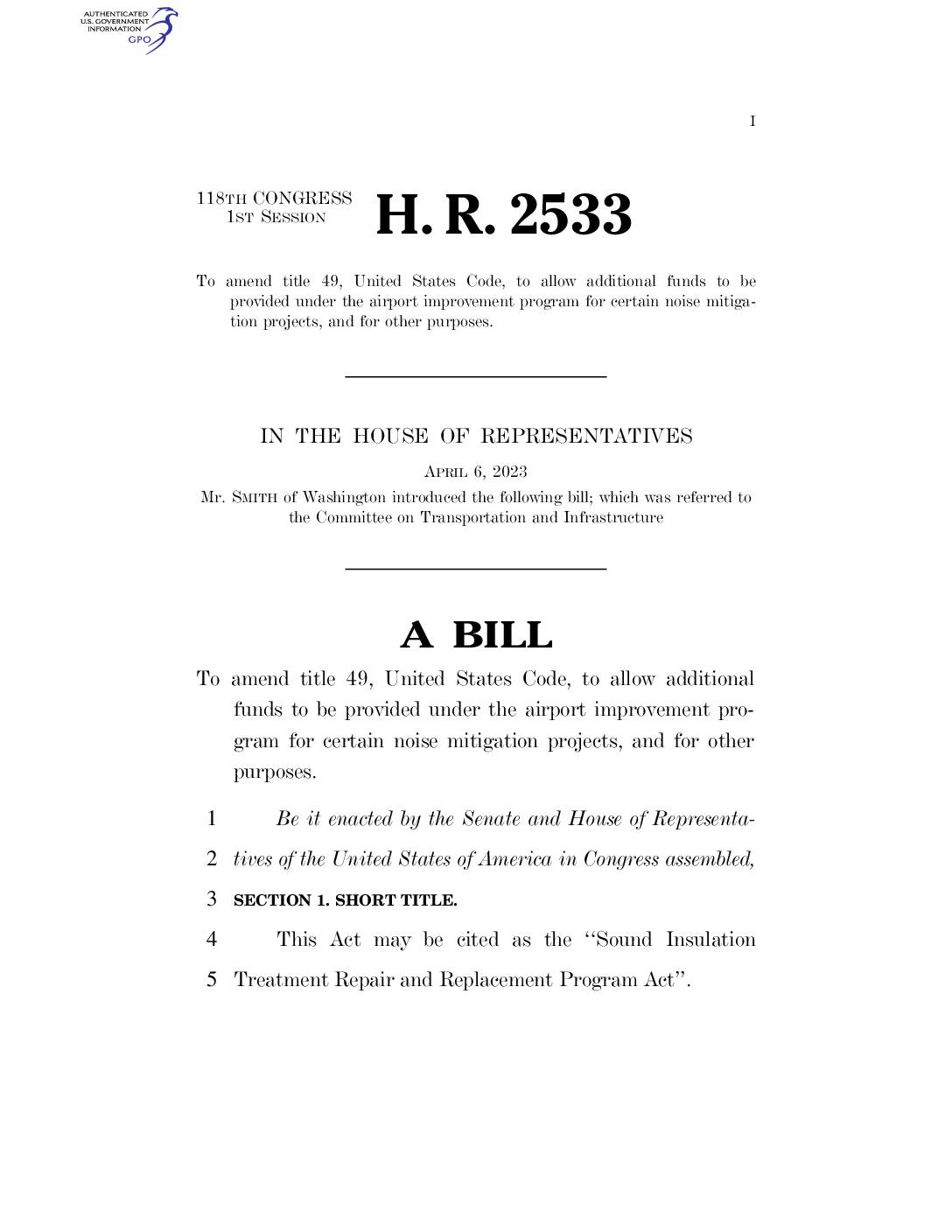
H.R. 2533 – Sound Insulation Treatment Repair and Replacement Program Act
H.R. 2533, the Sound Insulation Treatment Repair and Replacement Program Act, was introduced in April 2023 to allow airports to receive additional federal funding to repair or replace previously installed sound insulation in homes affected by aircraft noise. The bill allows the Secretary of Transportation to grant a one-time waiver so that prior government spending on a home's soundproofing does not count against the allowable project cost for new work. Homes are eligible if they fall within the FAA's DNL 65 noise standard or if an FAA-certified auditor determines that the original soundproofing caused physical damage to the residence. -
 2022-12-06
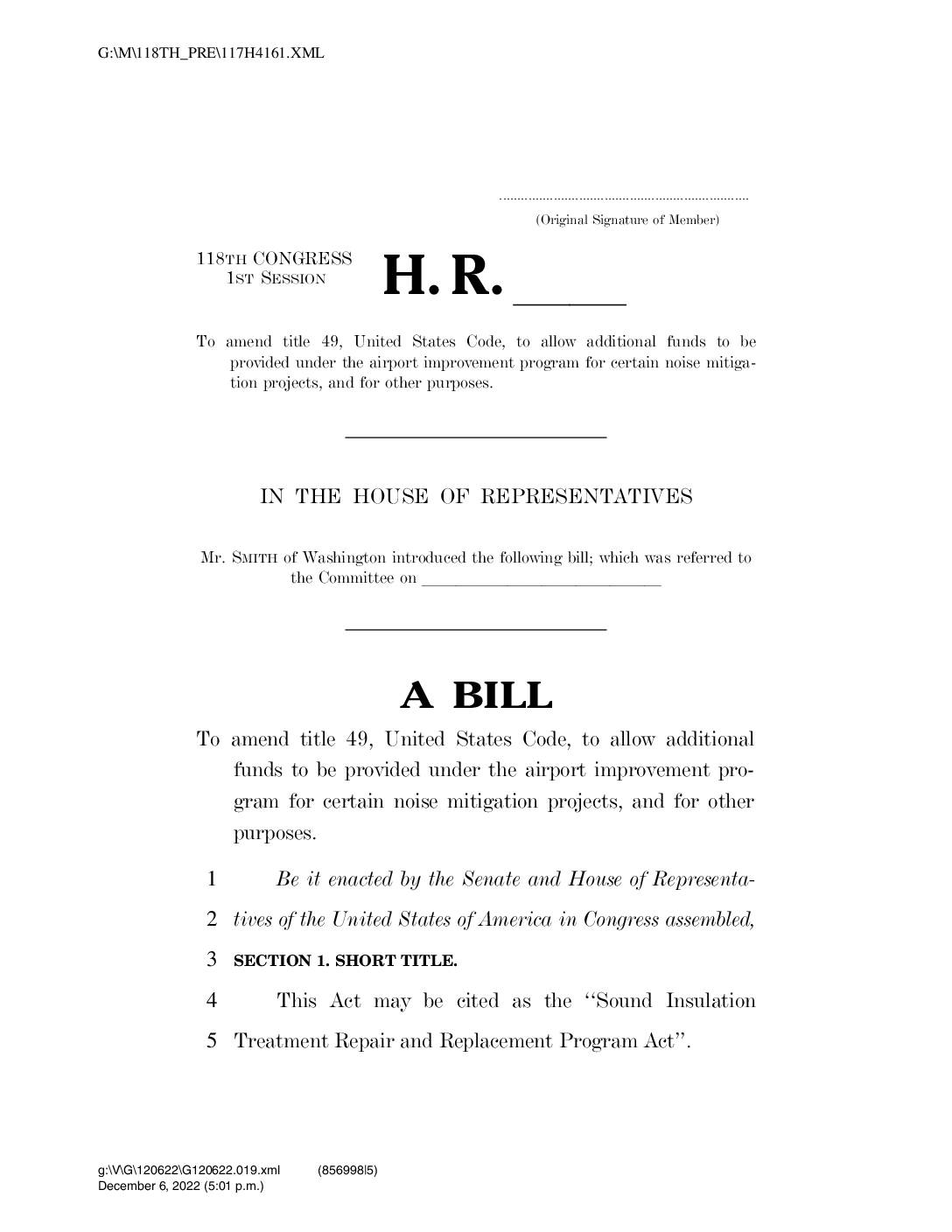
Sound Insulation Treatment Repair and Replacement Program Act
The Sound Insulation Treatment Repair and Replacement Program Act, introduced in the 118th Congress by Mr. Smith of Washington, would allow airports to receive additional federal funds under the Airport Improvement Program to repair or replace previously installed sound insulation in residential homes affected by aircraft noise. The bill provides a one-time waiver so that prior government spending on a home's soundproofing would not count against the allowable project cost for new work. Eligibility is tied to whether the building falls within the FAA's Day Night Level (DNL) 65 noise standard or suffered damage from the original sound insulation treatment. -
 2022-09-15
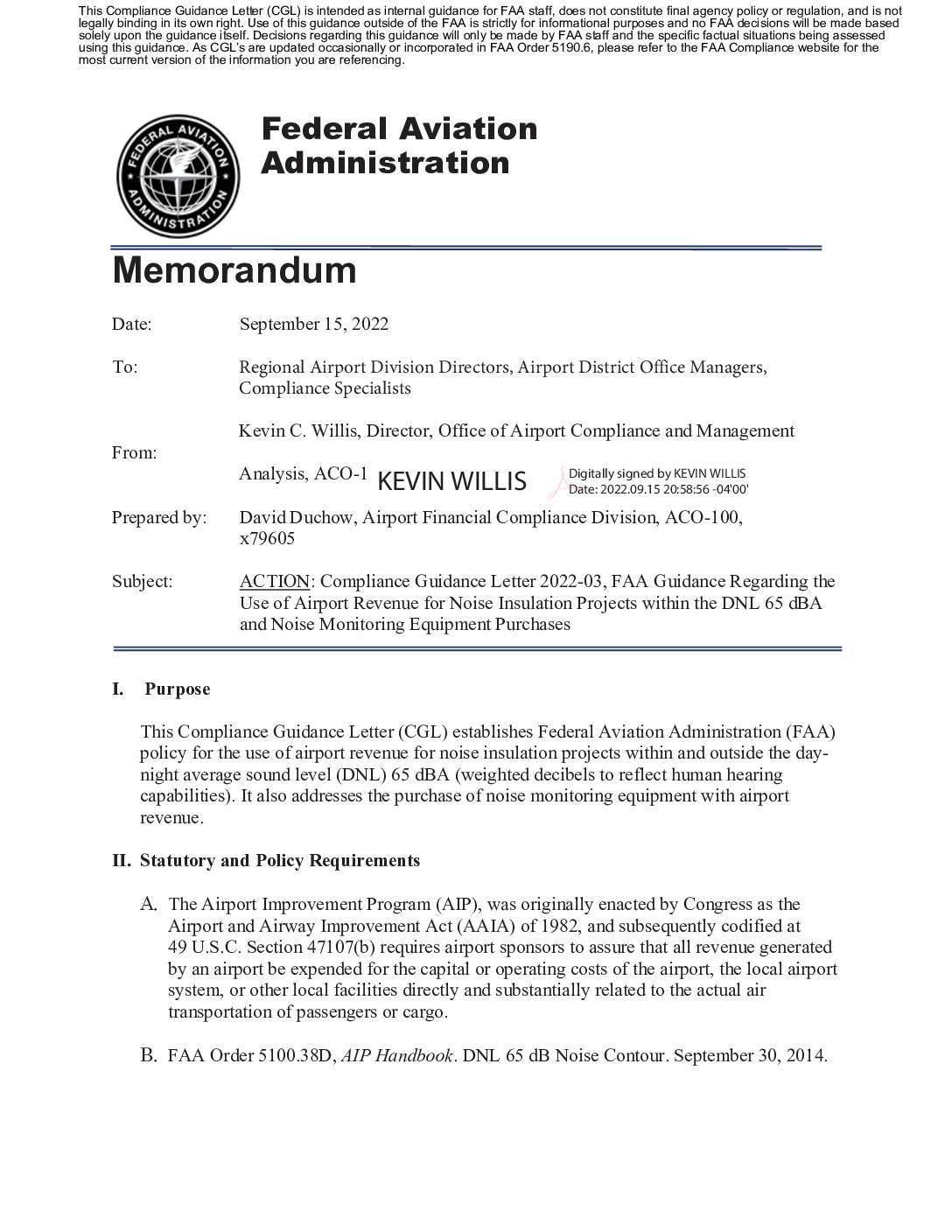
Compliance Guidance Letter 2022-03, FAA guidance regarding the use of airport revenue for noise insulation projects within the DNL 65 dBA and noise monitoring equipment purchases
This 2022 FAA guidance letter explains how airports can legally spend airport revenue on noise insulation projects, such as new windows, doors, and air conditioning, for homes and schools located within the DNL 65 dBA noise contour — the federal threshold for significant aircraft noise impact. Spending airport revenue on noise insulation for properties outside that noise boundary is generally prohibited as revenue diversion, unless a lower local noise standard has been officially adopted or 'block rounding' has been approved. The letter also clarifies that airports may purchase mobile or permanent noise monitoring equipment using airport revenue, provided certain conditions are met, but monitors cannot be used to enforce noise abatement flight procedures. -
 2022-05-01
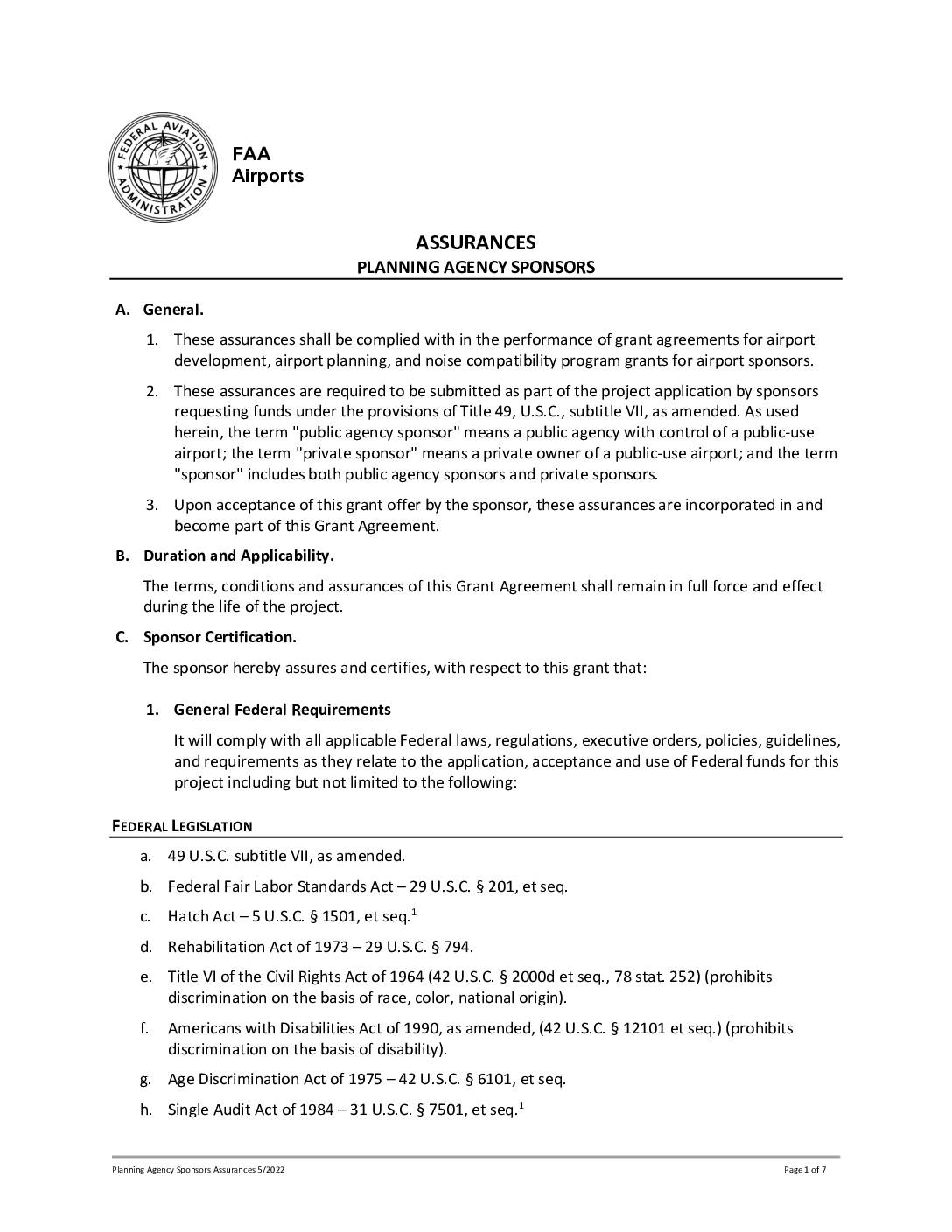
Assurances: Planning agency sponsors
This FAA document outlines the legal assurances that planning agency sponsors must agree to when receiving federal grant funds for airport development, planning, or noise compatibility programs. Sponsors certify compliance with a broad range of federal laws, executive orders, and regulations—including civil rights, disability, and environmental requirements—and must maintain proper financial records subject to federal audit. The agreement remains binding for the full life of the funded project. -
 2022-05-01
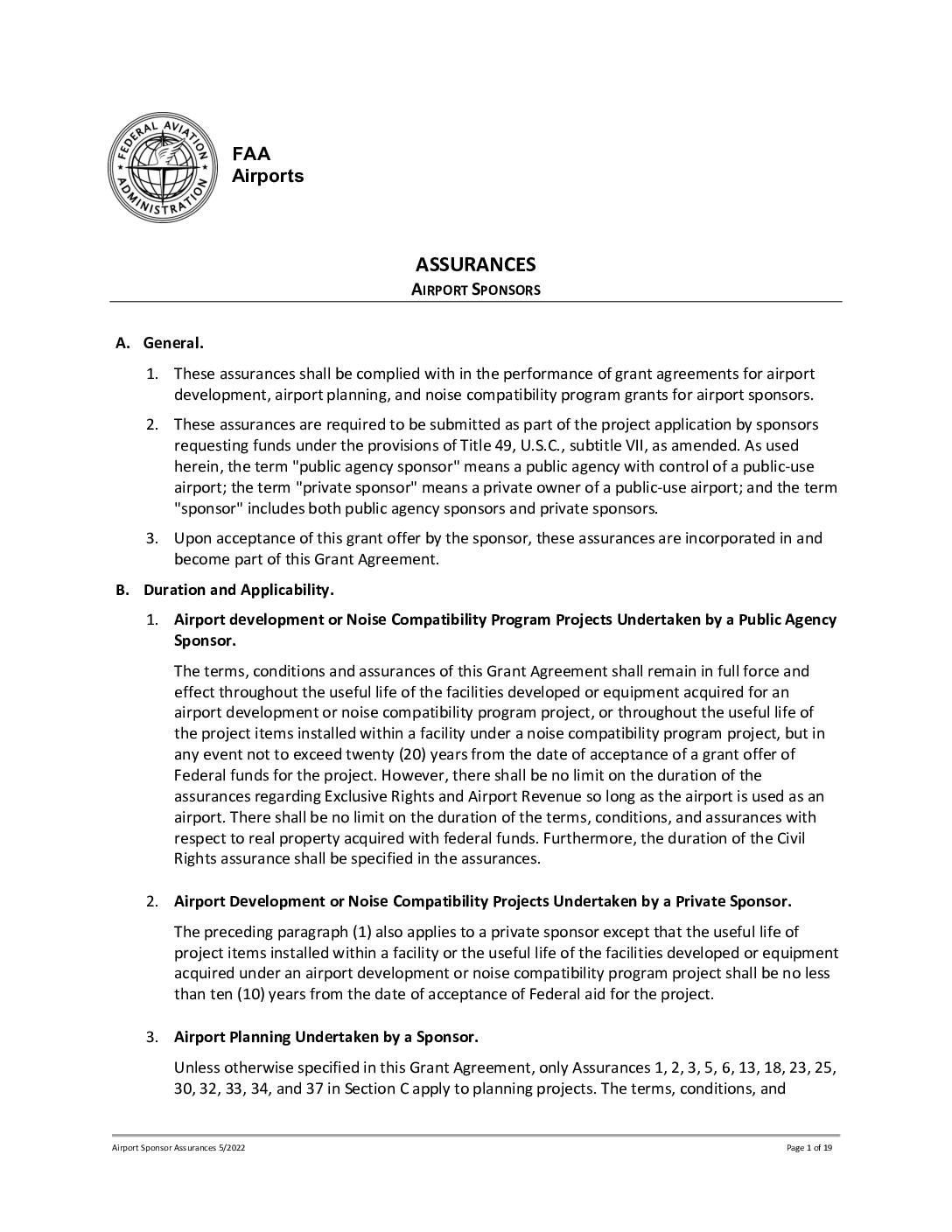
Assurances: Airport sponsors
This FAA document outlines the legally binding assurances that airport sponsors must agree to when accepting federal grant funds for airport development, planning, or noise compatibility programs. Sponsors certify compliance with a broad range of federal laws, executive orders, and regulations—including civil rights, environmental, and labor standards—for the duration of the project's useful life, which can extend up to 20 years. Certain obligations, such as those related to exclusive rights, airport revenue, and real property acquired with federal funds, have no expiration as long as the airport remains in operation.