Skip to content
  • STNI
  • Statistics
    • Ops and Passengers
      • King County International Airport (Boeing Field) Annual Operations
    • Financials
    • Aviation fuel uplift in the State of Washington 2018 – 2025
      • Aviation Fuel Uplift at Sea-Tac Airport
    • Air Quality Monitoring
    • Flight Tracking
      • Flow and Flight Tracks
      • Five Year Comparison
      • Busiest Hours and Days
    • SEL Noise Reports & Graphs
      • About The Permanent Noise Monitors
      • Minutes of Quiet by Noise Monitor
      • Noise Events mapped
      • Noise Events (SEL)
    • Runways
    • Employees
    • Real Estate
      • Port Properties and Trees mapped
    • Parking
  • Events
  • Protest
    • Regular Events
    • Legislation 2026
    • Complain about a particular flight
    • Advocacy Organizations
    • Media Outlets
    • People
    • The Port of Seattle
      • Commission Meetings
      • Public Records Requests
      • StART
      • Highline Forum
    • Contact Your Electeds
  • Resources
    • FAQs
      • FAA Occurrences/Accidents/Indents
    • The unSustainable Airport Master Plan
      • SAMP Public Comment Template
        • Two versions of Appendix K: NEPA/SEPA 2018 vs 2023
      • SAMP NTP: 31 projects by the numbers
      • SEPA Draft EIS (2026)
      • SAMP Record of Decision/FONSI (2025)
      • SAMP Draft EA (October 2024)
      • 2018 Scoping
    • Port Packages
      • Port Package Property Costs
      • Port Packages mapped
      • The Port Package Explainer
      • So you want a (first-time) Port Package? Start here
      • Port Package Looker Upper
      • How do I determine if I have a Port Package or Avigation Easement?
      • Progress on Port Package Update legislation
      • Having a Port Package Problem?
      • Port Package Site Visit Follow-Up
    • Document Library
    • Explainers
      • The Airport Law Cheat Sheet
      • The Grant Explainer
    • External Articles
    • History
      • Timeline
      • The Sea-Tac Communities Plan
        • Sea-Tac Communities Plan – Planning Maps
      • PSRC Third Runway Decision Process
    • Studies
    • Videos
  • Stories
  • Mission
  • Subscribe
  • Contact
Scroll down to content

Get InformedStay Informedx

I understand that you will never share my information with anyone, you will only use it to keep me updated on relevant events and that I may unsubscribe at any time.

STNI

STNISea-Tac Noise.Info

  • Solve for Sea-Tac. Solve for every airport.
  • Since 2016, working to obtain justice for everyone living under the flight path.
  • Less Noise. Cleaner Air. Better Public Health. Compensation.
  • Everything you think you know about the airport is wrong.

TagACC(1534)

Advanced Search Options

  • Dates
  • Media
    • External Articles
    • Images
    • PDFs
    • Video
    • Audio
  • Order By
  • 2001-07-09

    EXH AR020456: Draft Meeting Notes – Low Flow Analysis, STIA Third Runway 401 Permit, July 9, 2001

    These draft meeting notes from a July 9, 2001 technical meeting cover low flow analysis related to the 401 Permit decision-making process for Sea-Tac International Airport's Third Runway project. Attendees from the Department of Ecology, King County, Port of Seattle, and several consulting firms discussed methods for determining low stream flow impacts and mitigation requirements across affected watersheds. Key topics included biological effects on fish habitat, a proposed 0.1 cfs mitigation flow for the Des Moines Watershed, and the use of 2-year 7-day low flow rates to guide mitigation planning.
    TagsACC, Des Moines, Ecology, King County, Pollution Control Hearings Board, Port Of Seattle, Third Runway
  • 2001-07-09

    EXH 272: Draft Meeting Notes — Low Flow Analysis, 401 Permit Decision-Making, STIA Third Runway (July 9, 2001)

    These draft meeting notes from July 9, 2001 document a technical working session between the Port of Seattle, Washington Department of Ecology, and King County regarding low stream flow analysis for the Sea-Tac International Airport Third Runway project. The group discussed methods for determining low flow impacts on fish habitat, reviewed a mitigation proposal for the Des Moines Watershed involving a 0.1 cfs compensatory flow release from July 24 through October 24, and received a status briefing on the Miller and Walker watershed analyses. Key topics included the use of 2-year 7-day low flow rates to calculate mitigation requirements, reserve vault sizing, and how to handle non-hydrologic effects such as water rights removal and septic system impacts in the property acquisition area.
    TagsACC, Des Moines, Ecology, PCHB, Pollution Control Hearings Board, Port Of Seattle, Third Runway
  • 2001-07-09

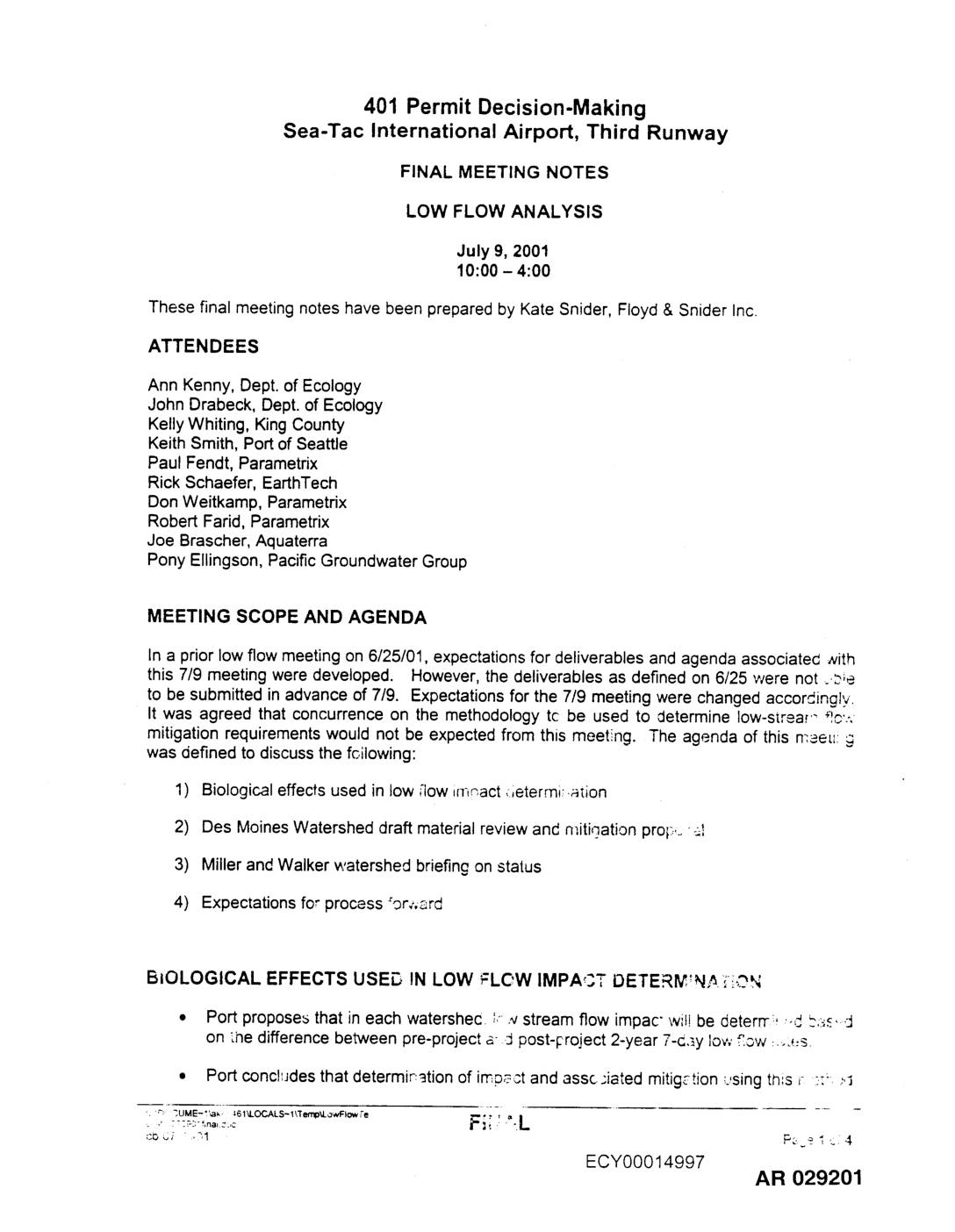
    EXH AR029201: Final Meeting Notes – Low Flow Analysis, Sea-Tac Airport Third Runway, July 9, 2001

    Final meeting notes prepared by Kate Snider of Floyd & Snider Inc. for the 401 Permit Decision-Making process for Seattle-Tacoma International Airport Third Runway, covering a Low Flow Analysis meeting held July 9, 2001. Attendees included representatives from Washington Department of Ecology (Ann Kenny, John Drabeck), King County (Kelly Whiting), Port Of Seattle (Keith Smith),
    TagsACC, Des Moines, Ecology, PCHB, Pollution Control Hearings Board, Port Of Seattle, Third Runway
  • 2001-07-06

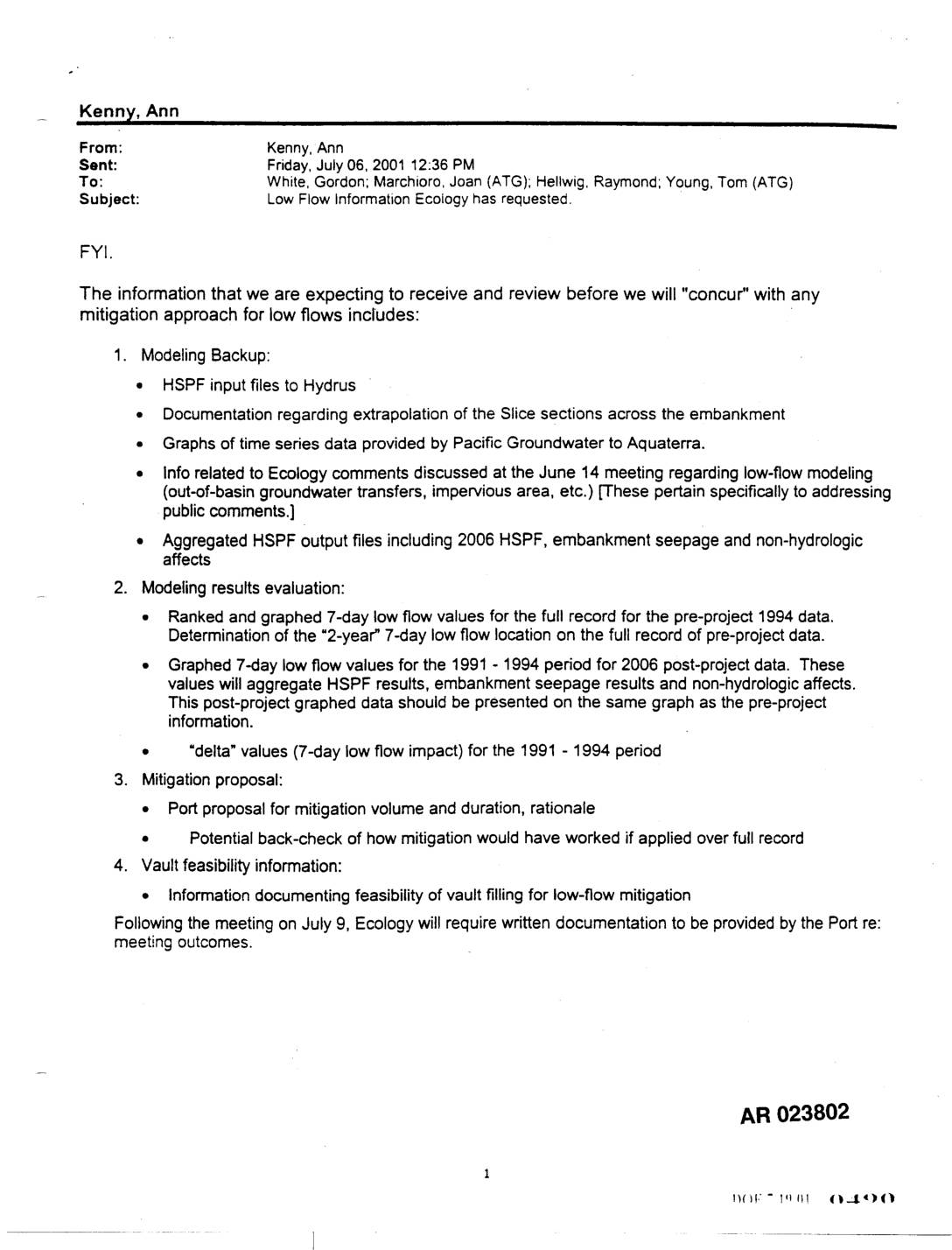
    EXH AR023802: Ecology Internal Memo — Low Flow Info Required Before Third Runway Mitigation Concurrence

    In a July 6, 2001 internal email, Ann Kenny outlines the technical information that the Washington State Department of Ecology required before approving any mitigation approach for low-flow water impacts related to a Port project. The requested materials included hydrological modeling files, 7-day low-flow analysis data comparing pre- and post-project conditions, a formal mitigation volume proposal, and documentation on the feasibility of vault filling as a mitigation method. Ecology also indicated that written documentation of outcomes would be required following a scheduled July 9 meeting with the Port.
    TagsACC, Ecology, PCHB, Pollution Control Hearings Board, Port Of Seattle, Third Runway
  • 2001-07-06

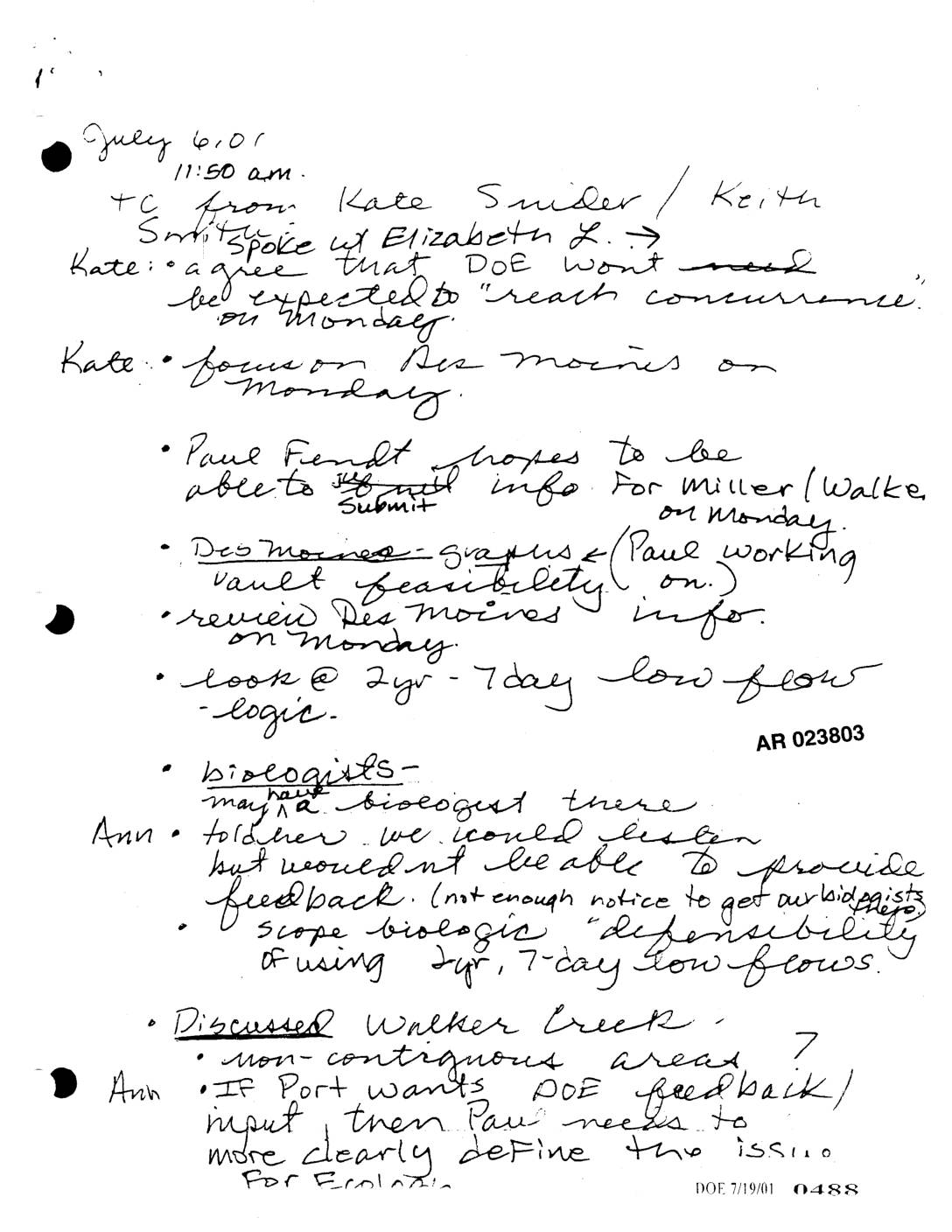
    EXH AR023803: Handwritten Notes – Jul 6 2001 Teleconference, Des Moines, Walker Creek, Low-Flow Logic

    Notes from a July 6, 2001 telephone conference involving Kate Snider, Keith Smith, and others discuss coordination with the Department of Energy (DOE) and review of Des Moines-related graphics and vault feasibility information. Topics include biologist availability, the biological defensibility of using 2-year and 7-day low flow data, and the status of Walker Creek non-contiguous areas. Ann reminds participants that Ecology is seeking all backup information in the format agreed upon at the June 25th meeting.
    TagsACC, Des Moines, Ecology, Handwritten Notes, PCHB, Pollution Control Hearings Board, Third Runway
  • 2001-07-06

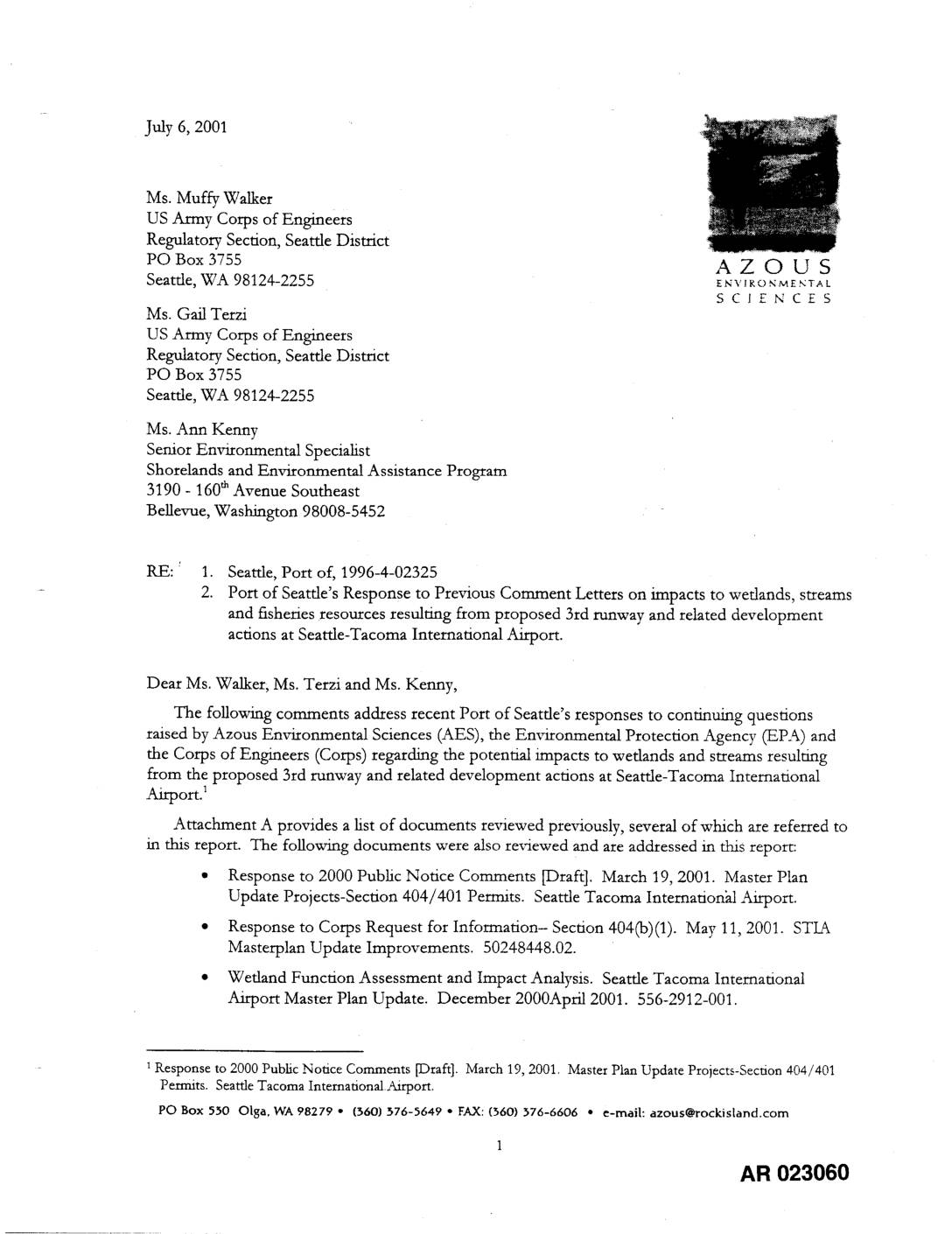
    EXH AR023060: ACC Letter to Corps & Ecology – Wetland Mitigation Deficiencies, Third Runway STIA

    A July 2001 letter from Azous Environmental Sciences to the U.S. Army Corps of Engineers and Washington State argues that the Port of Seattle's proposed Third Runway expansion at Seattle-Tacoma International Airport fails to meet Clean Water Act requirements by inadequately compensating for the destruction of wetlands and streams in the Miller and Des Moines Creek watersheds. The letter contends that the Port's mitigation plan does not provide the required one-for-one functional replacement of lost wetlands, lacks quantitative analysis, and ignores cumulative environmental impacts. The authors warn that approving insufficient mitigation would set a damaging precedent for wetlands protection across the region.
    TagsACC, Army Corp of Engineers, Clean Water Act, Pollution Control Hearings Board, Third Runway
  • 2001-07-05

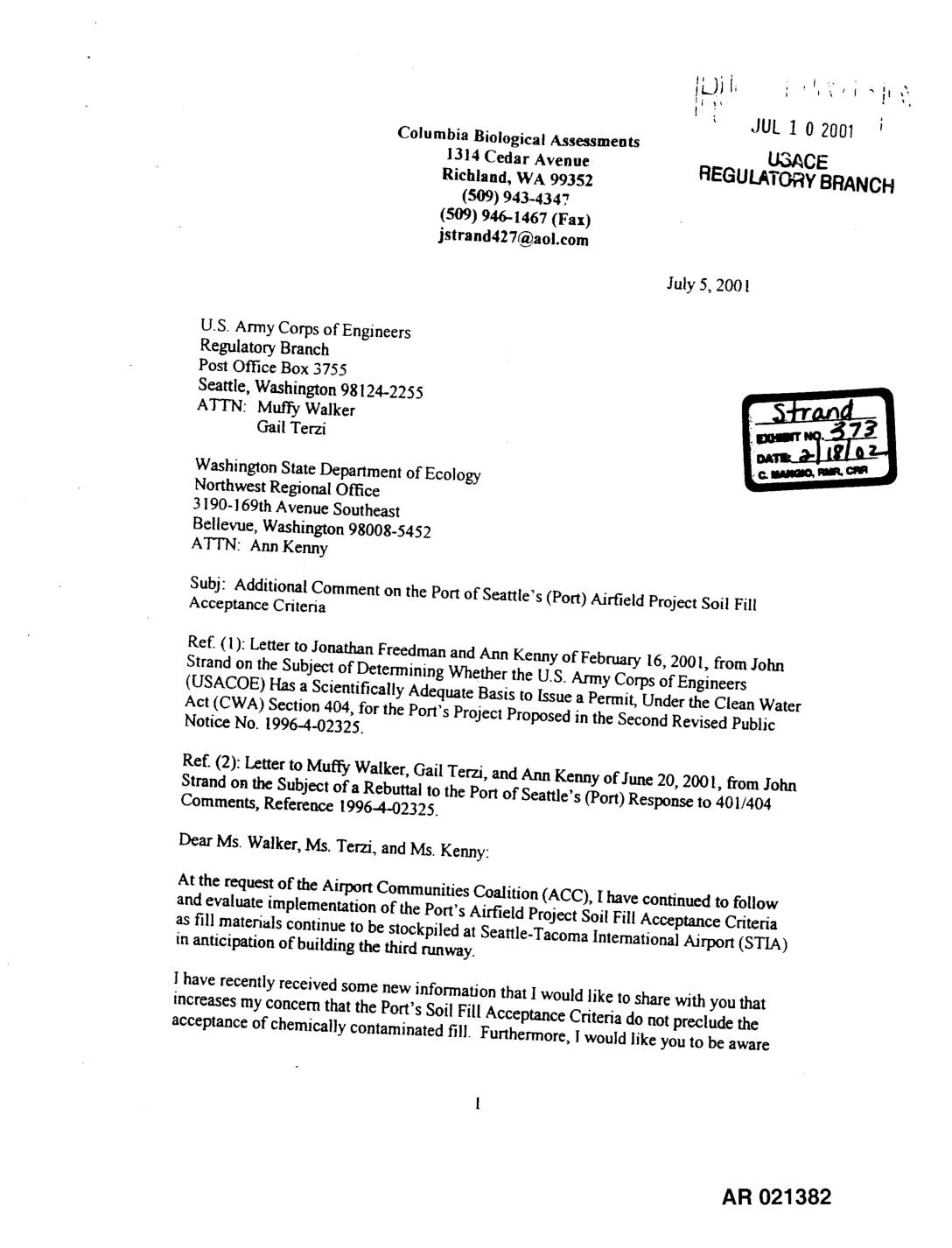
    EXH 373: Letter John Strand Columbia Biological Assessments to USACE Ecology Airfield Project Soil Fill Acceptance Criteria Black River Quarry TPH Contamination

    A July 2001 letter from environmental consultant John Strand raises concerns that the Port of Seattle accepted chemically contaminated soil fill for the proposed third runway at Seattle-Tacoma International Airport. Testing revealed petroleum hydrocarbons (TPH) in soil from Black River Quarry that exceeded cleanup standards, yet the Port transferred the soil to the airport anyway and delayed reporting the results. The letter argues that the Port's Soil Fill Acceptance Criteria are seriously flawed and that approving the project under the Clean Water Act would be ill-advised.
    TagsACC, Clean Water Act, Model Toxics Control Act, Pollution Control Hearings Board, Port Of Seattle, Third Runway
  • 2001-07-05

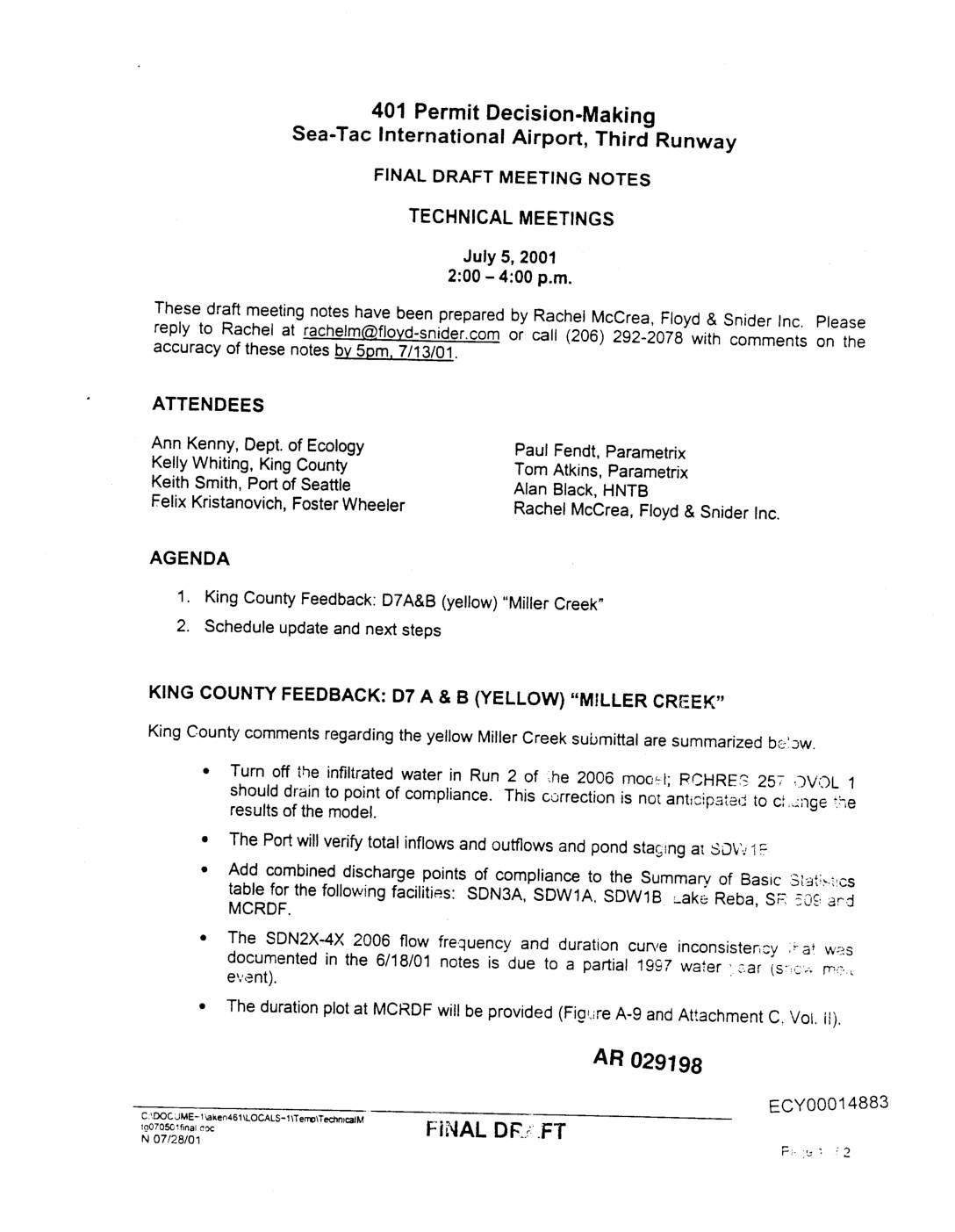
    EXH AR029198: 401 Permit Decision-Making, Sea-Tac Airport Third Runway — Technical Meeting Notes and Schedule Update, July 5, 2001

    Final draft meeting notes from July 5, 2001 technical meeting on 401 Permit Decision-Making for the Sea-Tac Airport Third Runway, prepared by Rachel McCrea of Floyd & Snider Inc. Attendees include Ann Kenny (Dept. of Ecology), Kelly Whiting (King County), Keith Smith (Port of Seattle), Felix Kristanovich (Foster Wheeler), Paul Fendt and Tom Atkins (Parametrix),
    TagsACC, Ecology, King County, Miller Creek, Pollution Control Hearings Board, Port Of Seattle, Third Runway
  • 2001-07-03

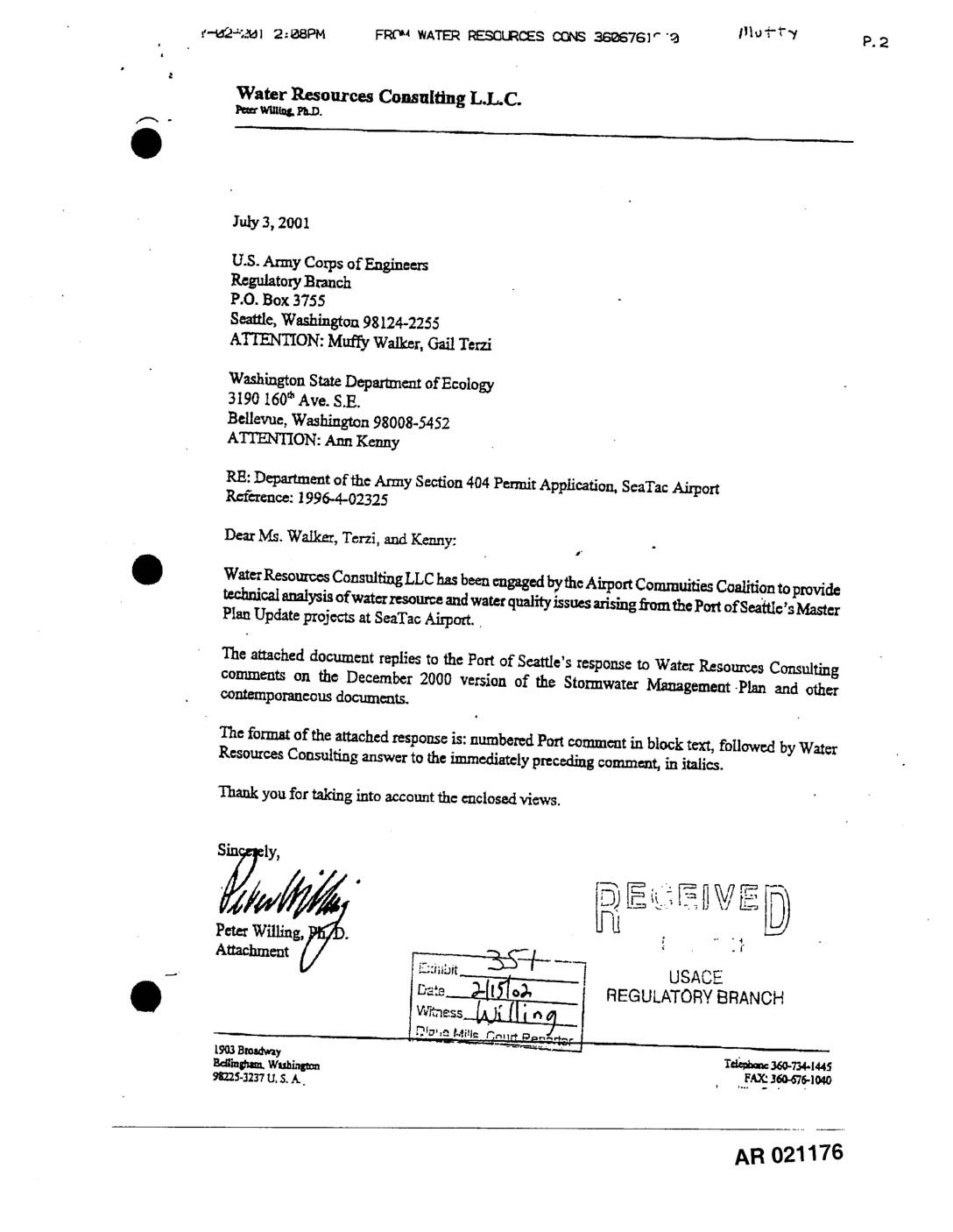
    EXH AR021176: Water Resources Consulting LLC Follow-Up Response Section 404/401 Permit Comments STIA Master Plan Update

    Water Resources Consulting LLC submitted technical comments in July 2001 on behalf of the Airport Communities Coalition, challenging the Port of Seattle's stormwater management plans for SeaTac Airport expansion. The document disputes Port claims about impervious surface increases, water diversions affecting Miller, Walker, and Des Moines creeks, and the effectiveness of bioswale filtration systems for removing pollutants such as metals from airport runoff.
    TagsACC, Miller Creek, Pollution Control Hearings Board, Port Of Seattle, Stormwater, Water Quality
  • 2001-07-02

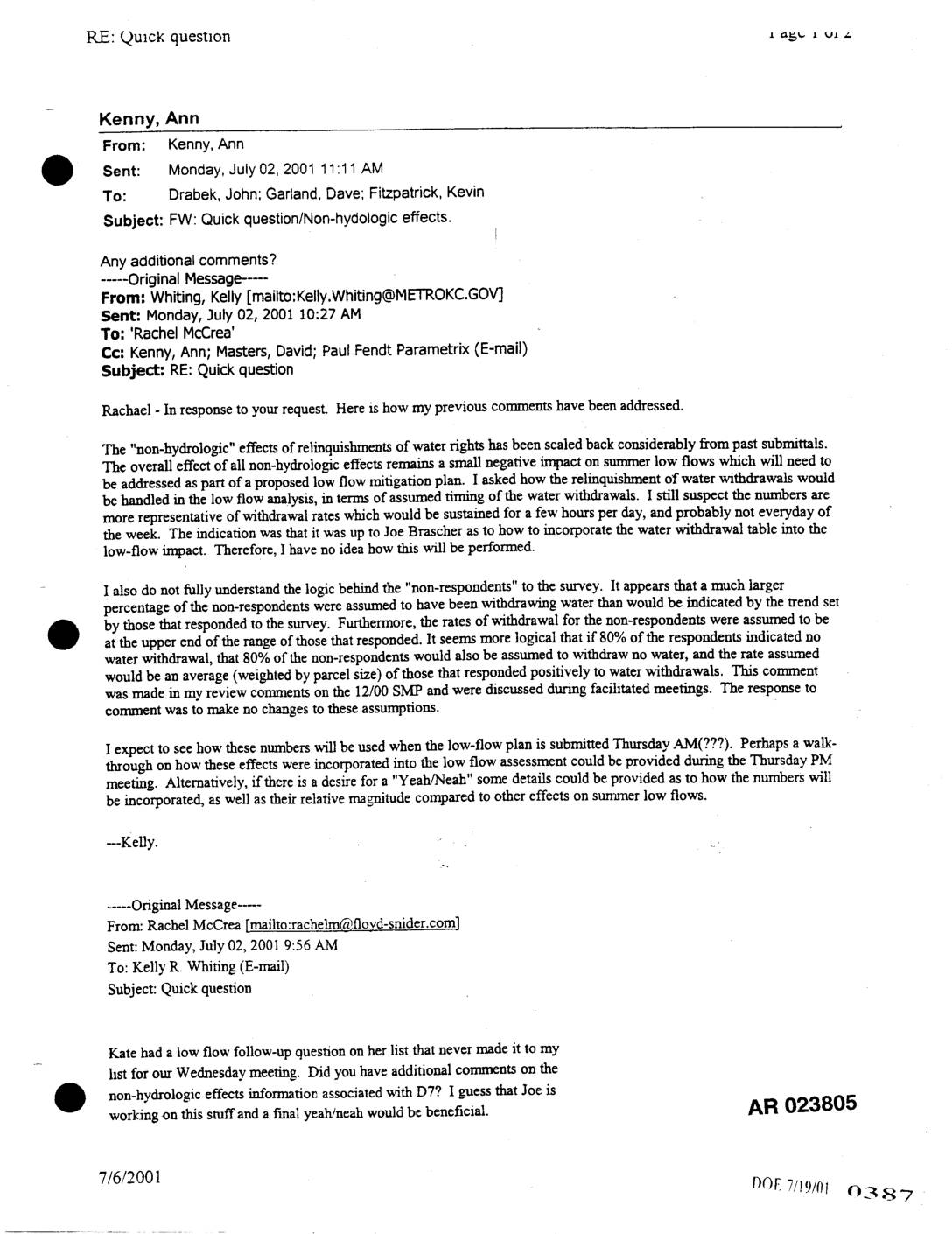
    EXH AR023805: Email Chain – Non-Hydrologic Effects Water Rights Relinquishments & Summer Low Flow Analysis

    In a July 2, 2001 email chain, Kelly Whiting of Metro King County raises concerns about the analysis of 'non-hydrologic' effects related to water rights relinquishments and their impact on summer low flows in a Sammamish River watershed study. Whiting questions the assumptions made about non-respondents to a water withdrawal survey, arguing that the rates assigned to them appear disproportionately high compared to trends shown by actual survey respondents. The email requests a walkthrough during an upcoming Thursday meeting to clarify how these figures would be incorporated into a low-flow mitigation plan.
    TagsACC, King County, PCHB, Pollution Control Hearings Board, Third Runway, Water Quality

Posts pagination

Page 1 … Page 87 Page 88 Page 89 Page 90 Page 91 … Page 154
Sidebar On/Off

Upcoming Events

  • StART SEA Stakeholder Advisory Round Table
    Add to CalendarMWednesday Aug 26, 5:00pm - 7:00pm
    Zoom (Virtual Meeting)
    START meetingagenda 2026826 final 0 pdf

    Meeting Objectives Introduce the primary feedback themes identified by StART members regarding StART’s Operating Procedures and determine areas that may warrant future discussion. 5:00 PM – Welcome Meeting Management Welcome Lead: Andrés Mantilla, Facilitator, Uncommon Bridges; Wendy Reiter, Airport Managing Director, POS 5:15 PM – Dinner: All participants eat. 5:30 PM – StART Operating Procedures

    [...]
  • Commercial Aviation Work Group
    Add to CalendarMThursday Sep 3, 10:00am - 1:30pm
    Virtual Meeting (Zoom)
    Cawg agenda sep 3 26 virtual pdf

    Meeting Agenda 10:00 a.m. – 10:15 a.m. | Welcome – Evan Nordby, Chair a. Introductions and Agenda Reviewb. Status of appointments and non-voting member invitationsc. Other updates as necessary 10:15 a.m. – 11:00 a.m. | Is it practical and legal to operate the western Washington [Puget Sound] airports as a single airport system? – Consultant

    [...]

[See all...]


Help study childhood asthma. Get free HEPA filter!

read more...

Issues

Sea-Tac Airport is currently undergoing the largest and longest expansion in its history, collectively known as the Sustainable Airport Master Plan (SAMP). Some of it you can already hear, but you’re probably not aware of what it all means. Here’s what you need to know.
read more...

Read This!

As the source for federal transportation grants, the Puget Sound Regional Council was charged with developing a system to meet the growing need for commercial aviation. When the search for a second airport failed, they authorized the Port of Seattle to build the Third Runway, with a mandate to develop a noise abatement and mitigation program. In their effort to stop the Third Runway, the ACC argued over every detail of the Port's efforts--including property buyouts and sound insulation. The dispute was meant to be settled by a three member Expert Arbitration Panel. This is their final report. It finds 2-1, that the Port's program was insufficient in several respects. Despite that, funding for the Third Runway was approved by the PSRC, and the 'Port Package' program, proceeded largely unchanged. Expert Arbitration Panel's final decision finding that the Port of Seattle had not shown sufficient reduction in real on-the-ground noise impacts to satisfy noise reduction conditions required for approval of a third runway at Sea-Tac International Airport. The majority decision concluded the Port's noise abatement programs were insufficient despite being impressive in scope.
continue...

The Podcast!

Subscribe to the only podcast devoted to policies, politics, history, impacts for people living under the flight path everywhere. It’s definitely not just about noise!
  • Sea-Tac Noise.Info
  • Connect with STNI

    • Subscribe
    • Port Package Problem?
    • Donate
    • Podcast
    • Socials
      • Facebook
      • X (Twitter)
      • Bluesky
      • Instagram

    "ANES 2026 maa bwi vianair 0004 pdf" — , 2026

  • Learn

    • Frequently Asked Questions
    • Explainers
    • Youtube
    • Research Requests
    • Make a complaint
  • Goals

    Fulfill the promises of 1976:
    • Compensation
    • Reduced noise
    • Improved air quality
    • Environmental remediation
Login/Register
©2026•Data Privacy

Message

We use cookies to provide basic functionality. We also provide access to search engines in order to provide site analytics. We do not sell or share your data.
V V