TagACC(1548)
-
 2002-02-14
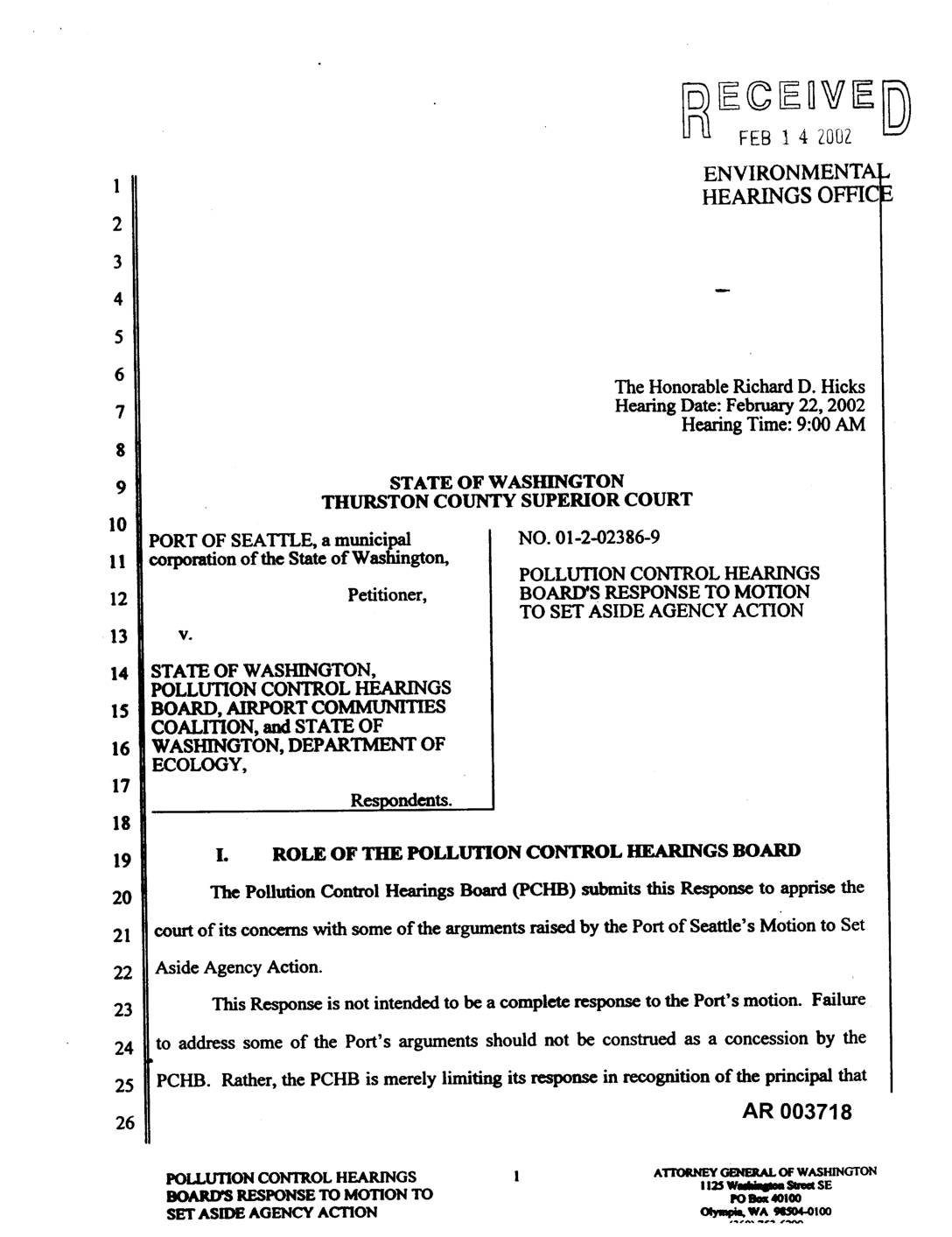
PCHB Doc 3718: Pollution Control Hearings Board’s Response to Motion to Set Aside Agency Action (Port Of Seattle v. PCHB, ACC, Ecology)
Pollution Control Hearings Board (PCHB) response filed in Thurston County Superior Court case No. 01-2-02386-9, Port Of Seattle v. State of Washington Pollution Control Hearings Board, Airport Communities Coalition, and State of Washington Department of Ecology. Filed February 14, 2002, hearing set February 22, 2002 before Judge Richard D. Hicks. Addresses Port Of Seattle’s Motion -
 2002-02-14
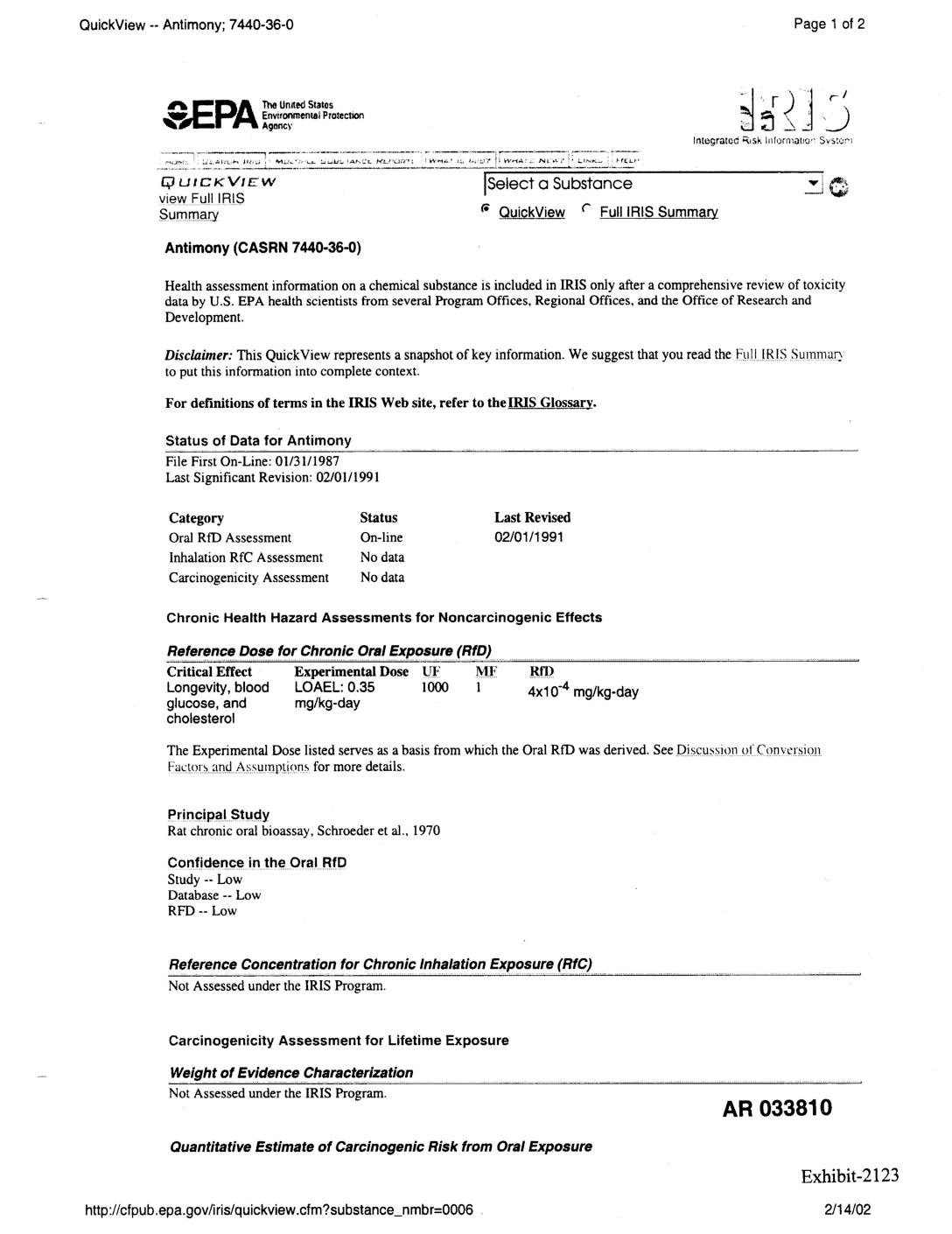
Exhibit 2123: EPA IRIS QuickView — Antimony (CASRN 7440-36-0) and Arsenic, Inorganic (CASRN 7440-38-2)
EPA Integrated Risk Information System (IRIS) QuickView pages for Antimony (CASRN 7440-36-0) and Arsenic, inorganic (CASRN 7440-38-2), accessed February 14, 2002. Antimony oral RfD is 4×10⁻⁴ mg/kg-day based on LOAEL of 0.35 mg/kg-day from Schroeder et al. 1970 rat chronic oral bioassay; confidence rated Low. Arsenic oral RfD is 3×10⁻⁴ mg/kg-day based on NOAEL of -
 2002-02-14
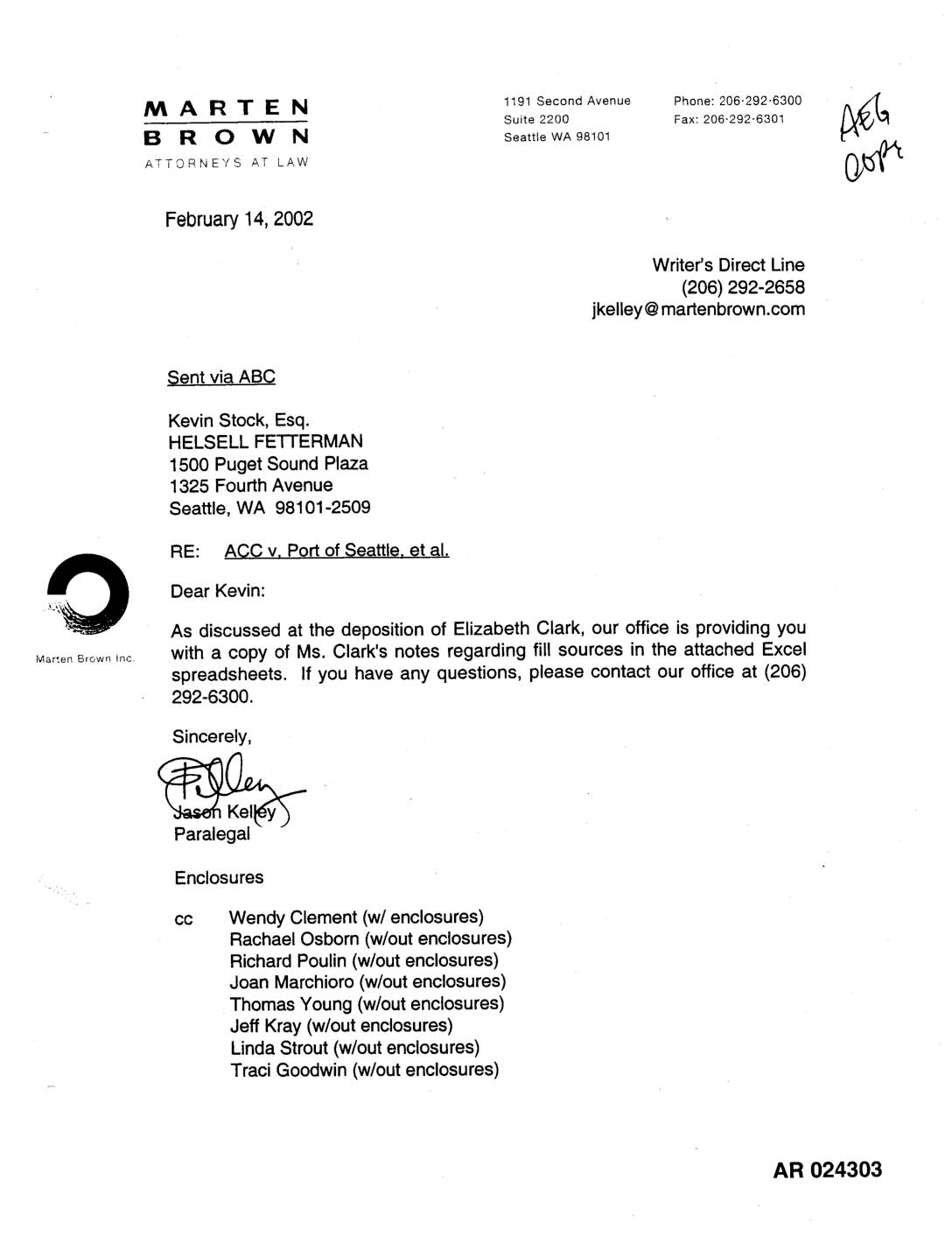
EXH AR024303: Marten Brown Letter to Kevin Stock Transmitting Elizabeth Clark Fill Sources Notes
A February 2002 letter from Marten Brown Attorneys at Law transmits Excel spreadsheets containing Elizabeth Clark's notes on fill sources related to the case ACC v. Port of Seattle. The attached spreadsheets provide a cumulative fill summary for the Draft Third Runway project at Sea-Tac Airport, detailing fill sources, suppliers, volumes, and placement locations across three construction phases spanning 1997–2001. Sources include borrowed pit materials, city transfers, and various property acquisitions used to build runway embankments and stockpiles. -
 2002-02-13
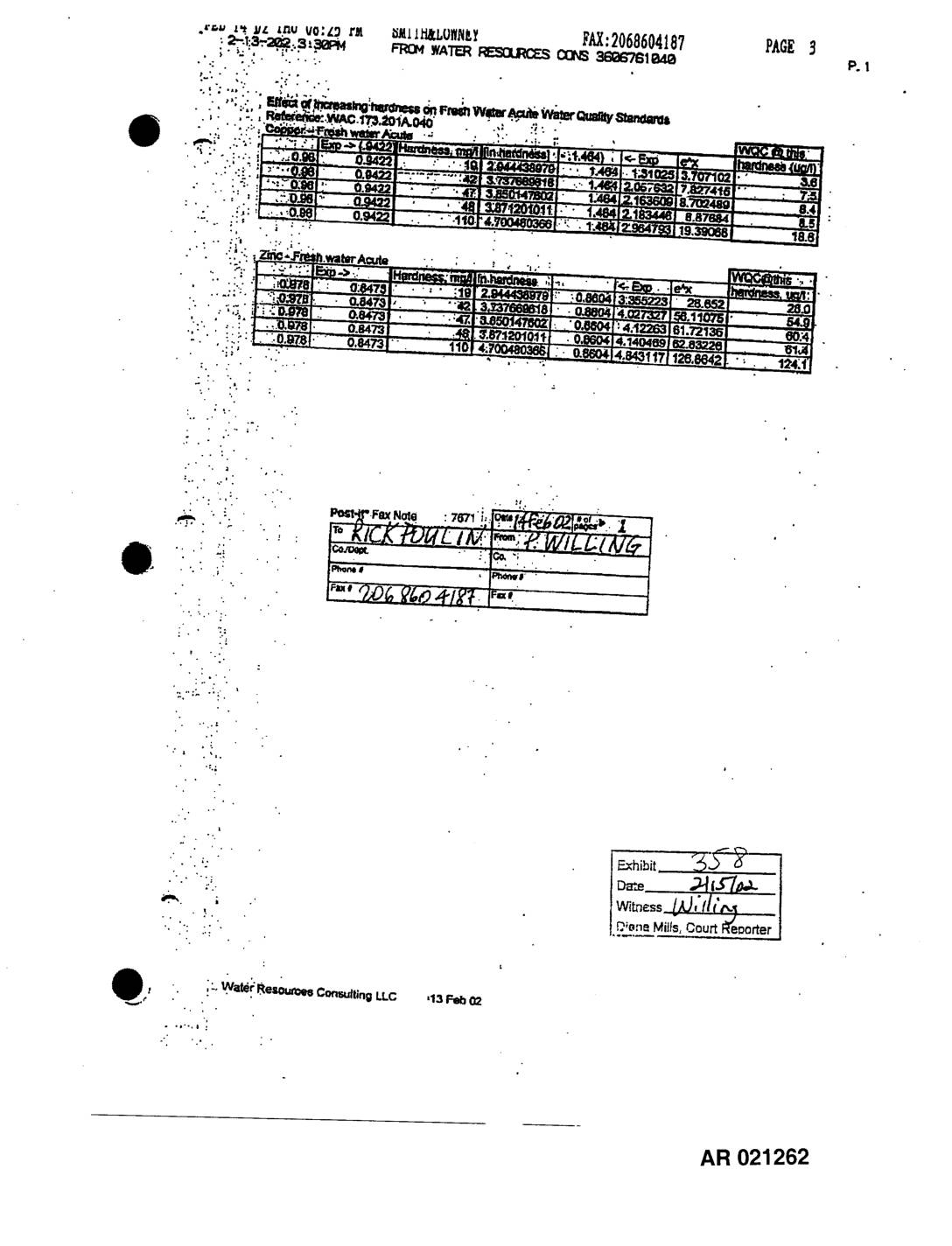
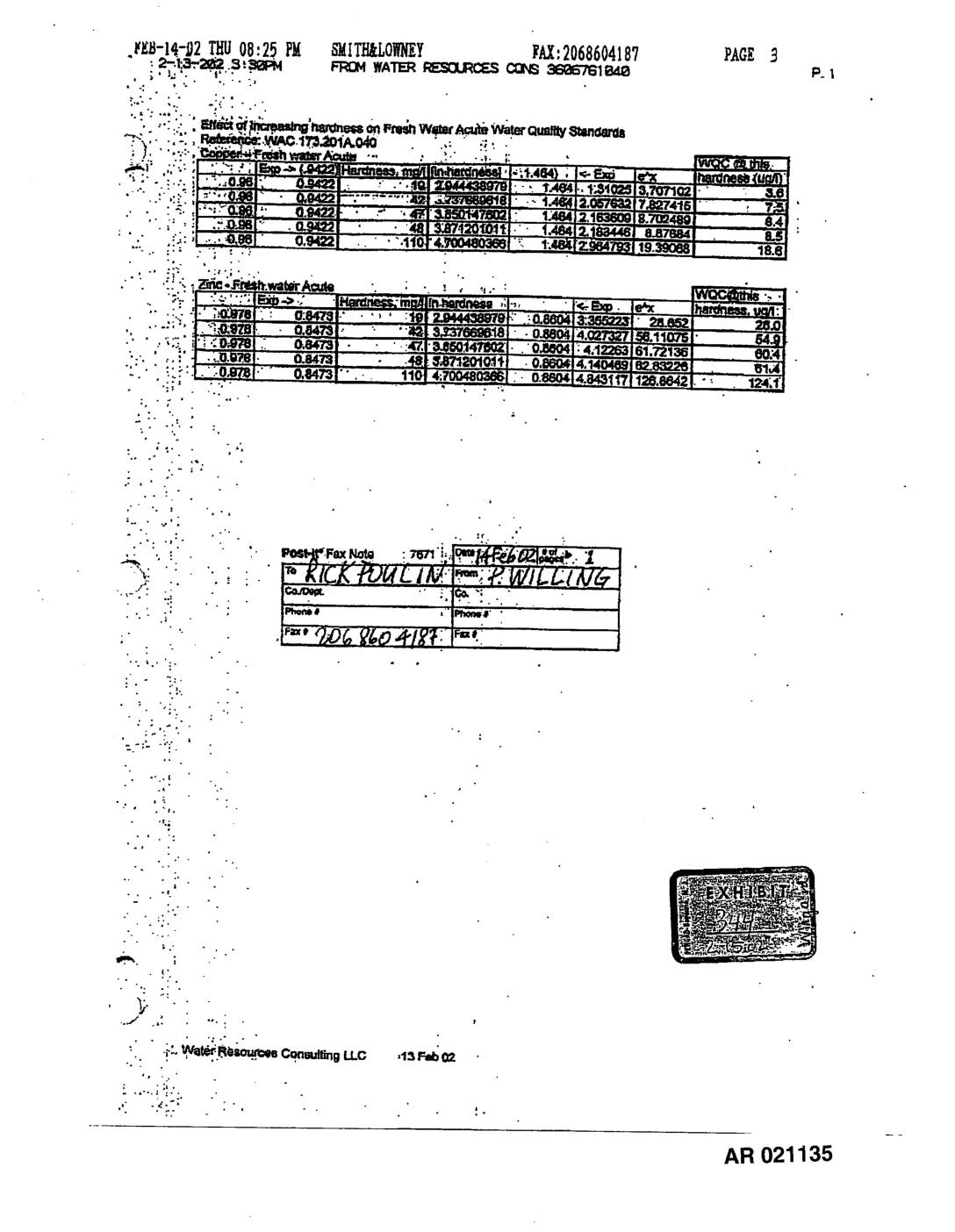
EXH 358: Increasing Hardness Effect on Freshwater Acute WQ Standards — Copper & Zinc, WAC 173.201A.040
This document is a February 2002 fax from Water Resources Consulting LLC addressing the effect of increasing water hardness on fresh water acute water quality standards, referencing WAC 173.201A.040. It contains tables calculating acute water quality standards for copper and zinc at varying hardness levels in fresh water. The document appears to be part of an administrative record (AR 021262) and was transmitted between consultants, though its connection to Sea-Tac Airport noise policy is not evident from the content. -
 2002-02-13
EXH AR021135: Increasing Hardness Effect on Freshwater Acute WQ Standards WAC 173.201A.040 — Copper & Zinc
This document presents a technical analysis of the effect of increasing water hardness on Fresh Water Acute Water Quality Standards, referencing WAC 173.201A.040. It includes calculated values for copper and zinc acute water quality criteria at varying hardness levels (ranging from 10 to 110 mg/L), showing how the allowable concentrations change as hardness increases. The document was transmitted via fax in February 2002 from Water Resources Consulting LLC. -
 2002-02-12
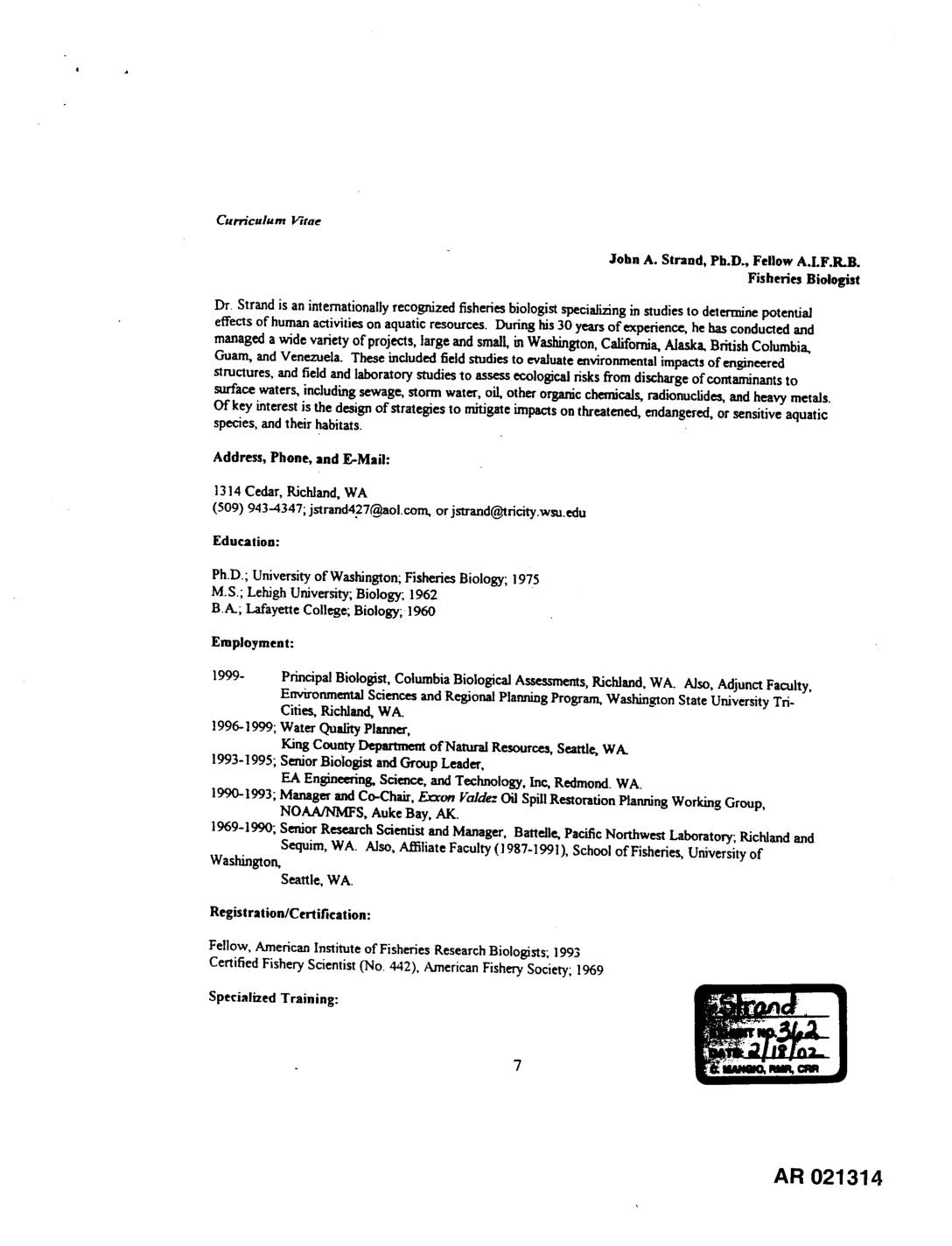
EXH 362: CV John A. Strand PhD FAIFR Fisheries Biologist
This document is the curriculum vitae of Dr. John A. Strand, a fisheries biologist with 30 years of experience studying the effects of human activities on aquatic resources. His work spans Washington, California, Alaska, and other regions, covering environmental impact assessments, aquatic toxicology, and regulatory compliance related to contaminants such as oil, heavy metals, and radionuclides. While not directly related to airport noise policy, his expertise in endangered species protection and habitat mitigation may have been relevant to environmental review processes in the Seattle-area region. -
 2002-02-11
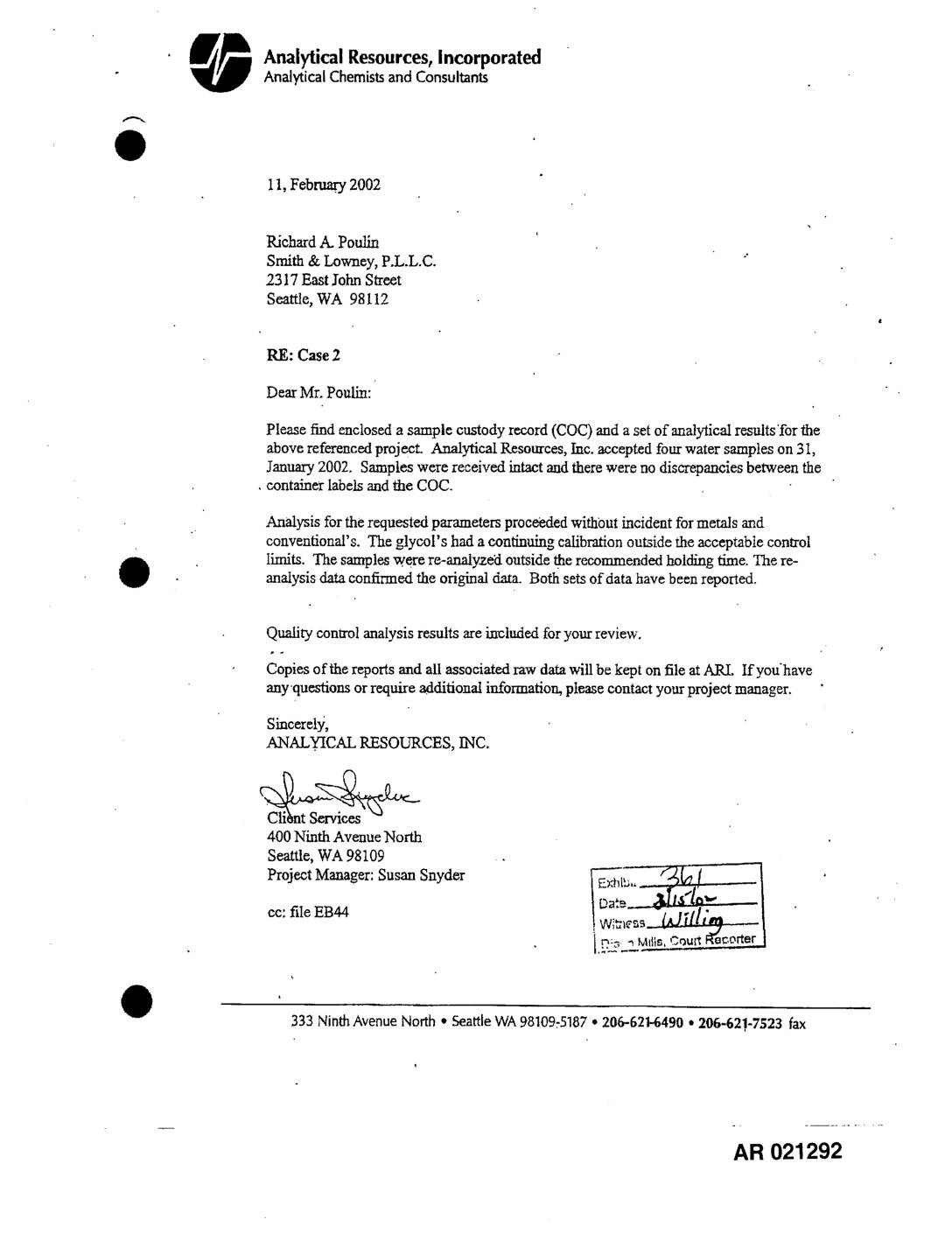
EXH AR021292: Analytical Resources Inc. Letter to Smith & Lowney — CASE Water Sample Analysis Results, EB44
A February 2002 analytical laboratory report from Analytical Resources, Inc. to Seattle law firm Smith & Lowney, documenting water sample testing results for a project referenced as Case 2. Four water samples were collected on January 31, 2002, and analyzed for metals, conventional parameters, and glycols, with the glycol analysis requiring re-testing due to calibration issues outside acceptable control limits. The results showed no detectable levels of ethylene glycol or propylene glycol above the 5.0 mg/L detection limit. -
 2002-02-11
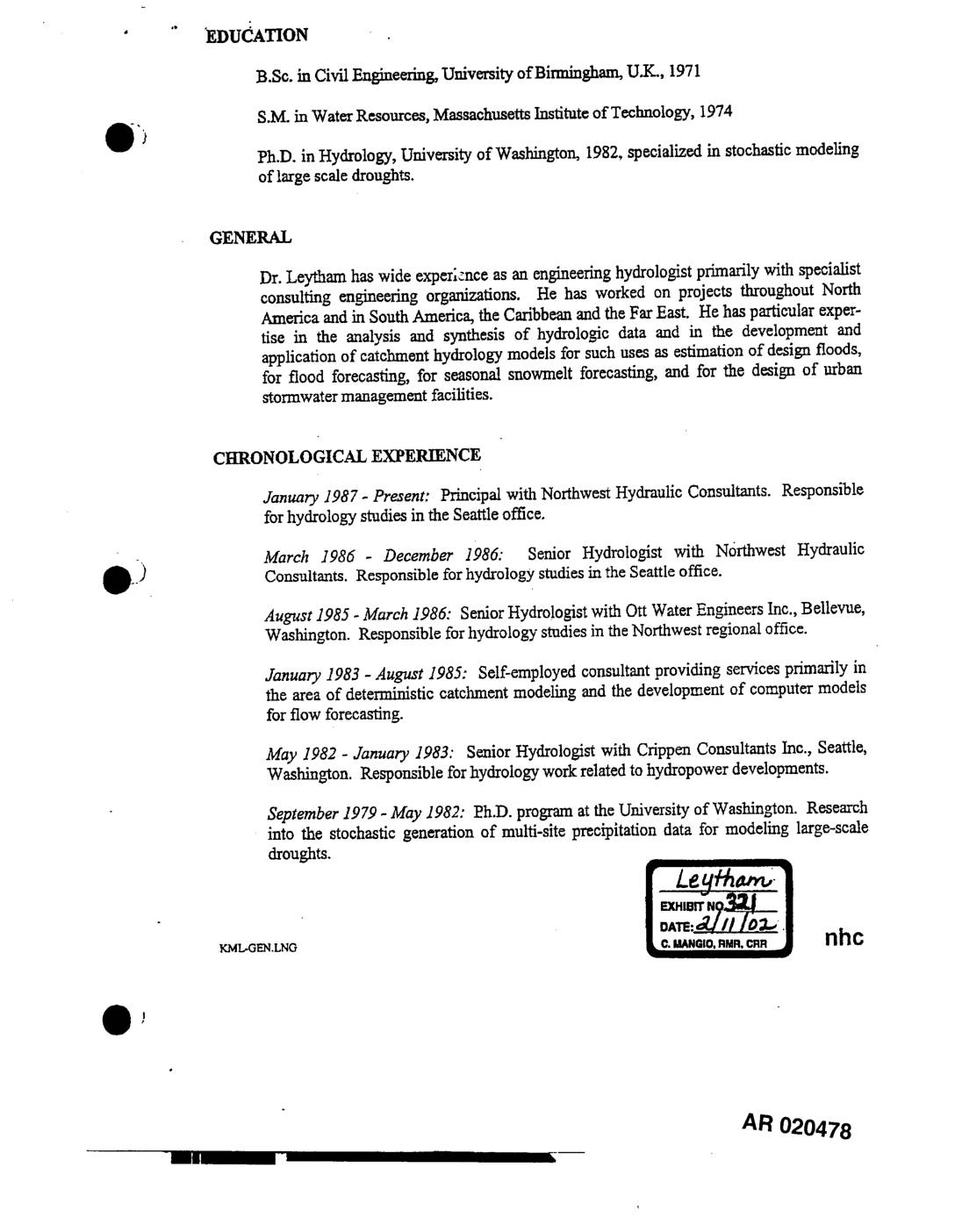
EXH 321: CV K.M. Leytham PhD PE, Engineering Hydrologist, Northwest Hydraulic Consultants
This document is a professional curriculum vitae for Dr. K.M. Leytham, Ph.D., P.E., an engineering hydrologist with extensive experience in flood analysis, stormwater management, and catchment hydrology modeling. Dr. Leytham holds degrees from the University of Birmingham, MIT, and the University of Washington, and has worked on projects across North America and internationally. His project experience includes dam safety reviews, flood reduction studies, and reservoir inflow analyses, primarily with Northwest Hydraulic Consultants in Seattle. -
 2002-02-11
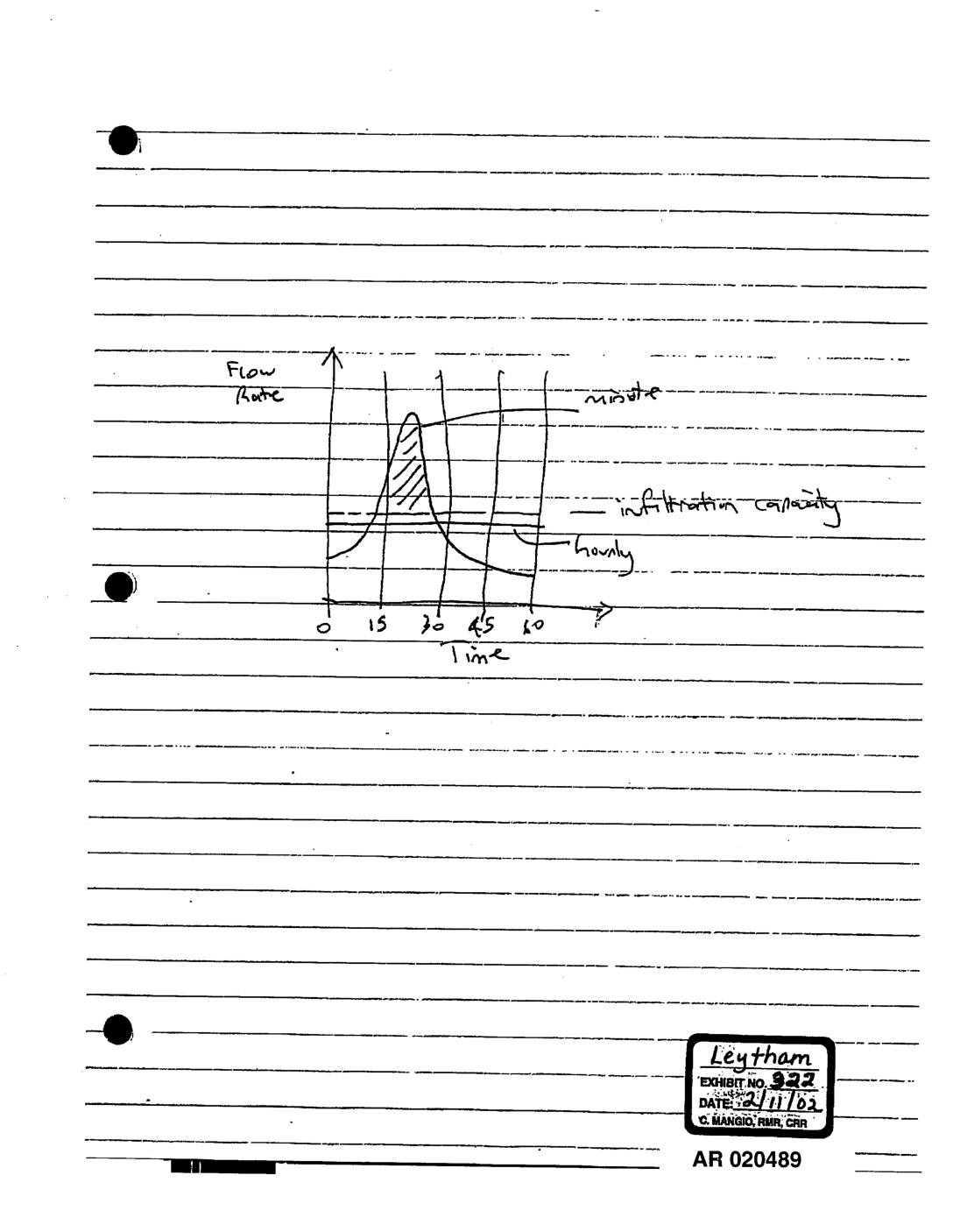
EXH 322: Flow Rate vs. Time — Minute, Hourly & Infiltration Capacity Diagram
This document, marked as Leytham Exhibit 222 (dated 2/11/02), contains a hand-drawn diagram illustrating flow rate over time, showing the relationship between minute and hourly measurements alongside an infiltration capacity curve. The sketch plots flow rate on the vertical axis against time intervals (15, 30, 45, 60 minutes) on the horizontal axis, with a shaded area indicating peak flow. It appears to be a technical exhibit related to stormwater or drainage analysis presented in proceedings concerning Sea-Tac Airport policy. -
 2002-02-11
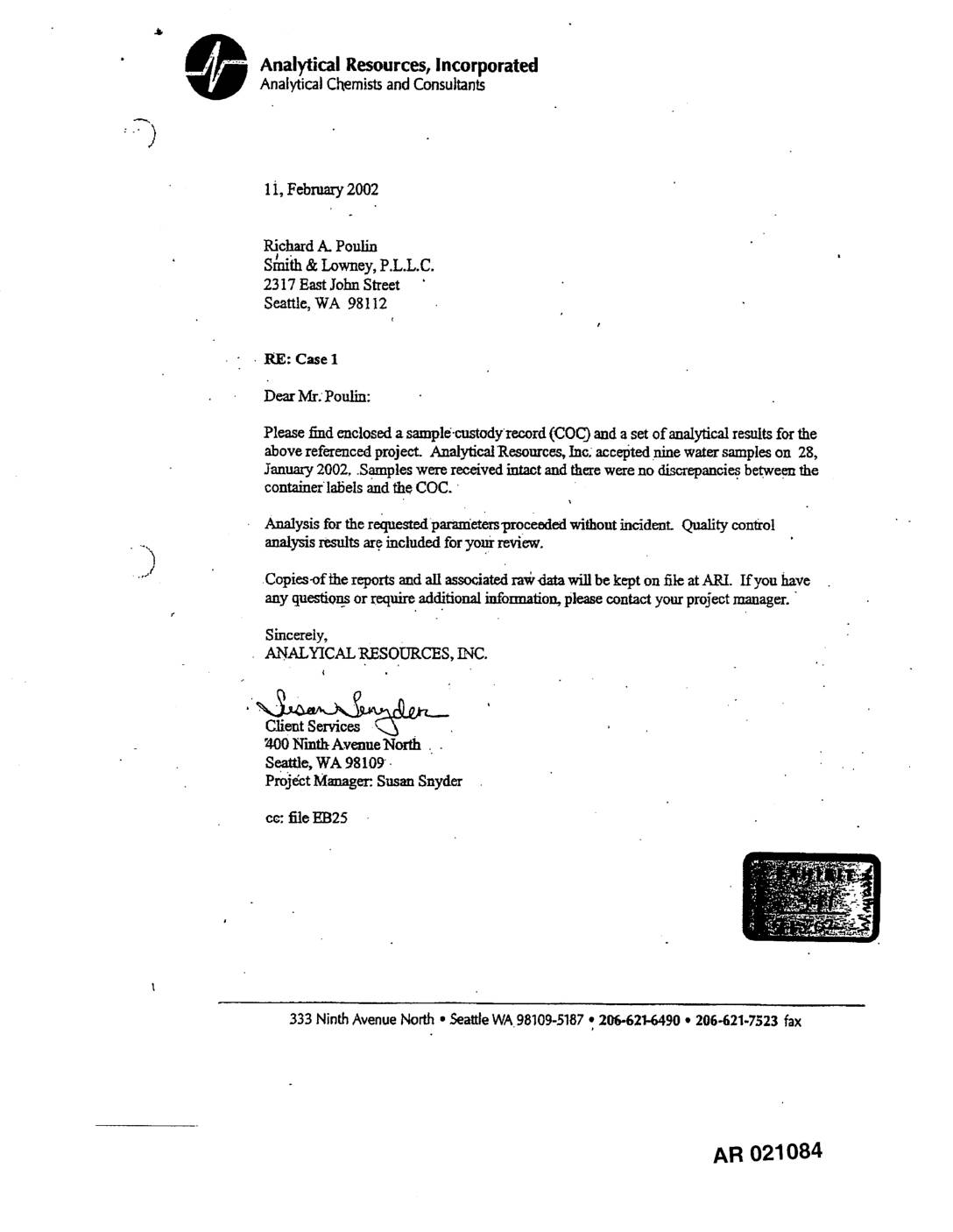
EXH AR021084: Analytical Resources Inc. Cover Letter & Chain of Custody — CASE 1 Water Sample (Glycols, Metals, TSS)
A February 2002 letter from Analytical Resources, Inc. to attorney Richard Poulin of Smith & Lowney, P.L.L.C. transmits laboratory analytical results for nine water samples accepted on January 28, 2002, under Case 1. The samples were received intact with no discrepancies noted on the chain of custody record, and analysis for requested parameters including glycols, TSS, copper, zinc, and hardness proceeded without incident. Quality control results, including a method blank showing no detected ethylene or propylene glycol above 5.0 mg/L, are included in the report.