TagACC(1548)
-
 1999-10-20
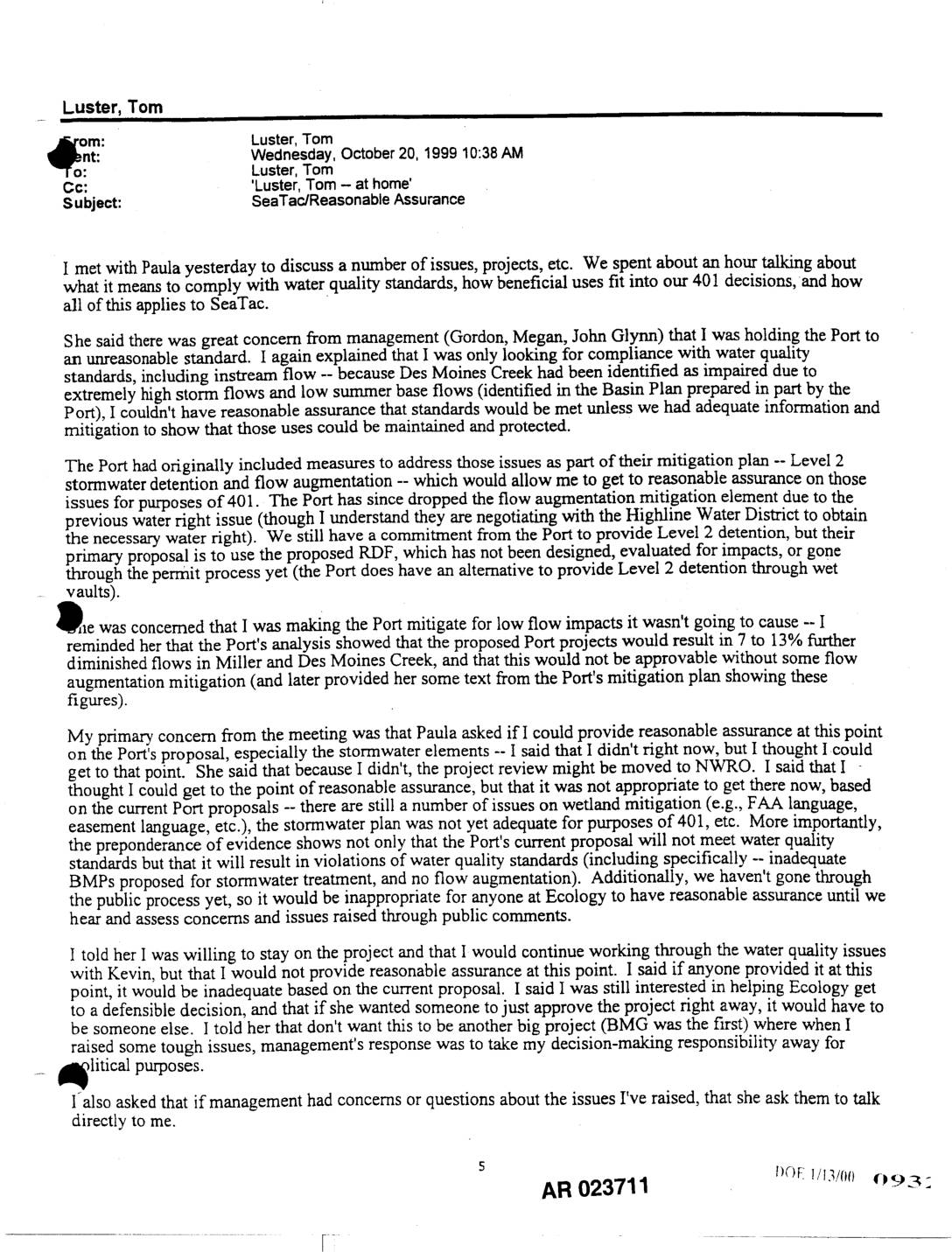
EXH AR023711: Internal Email — Tom Luster on Sea-Tac Third Runway 401 Certification and Reasonable Assurance
In this October 1999 internal memo, Washington State Department of Ecology staffer Tom Luster describes a meeting with his supervisor Paula regarding the agency's water quality review of Sea-Tac Airport expansion. Luster explains that he cannot yet provide 'reasonable assurance' that the Port of Seattle's proposal will meet water quality standards for Des Moines Creek, citing inadequate stormwater treatment plans and the Port's removal of flow augmentation measures from its mitigation plan. He expresses concern that management pressure to approve the project quickly could compromise the integrity of the regulatory review process. -
 1999-10-08
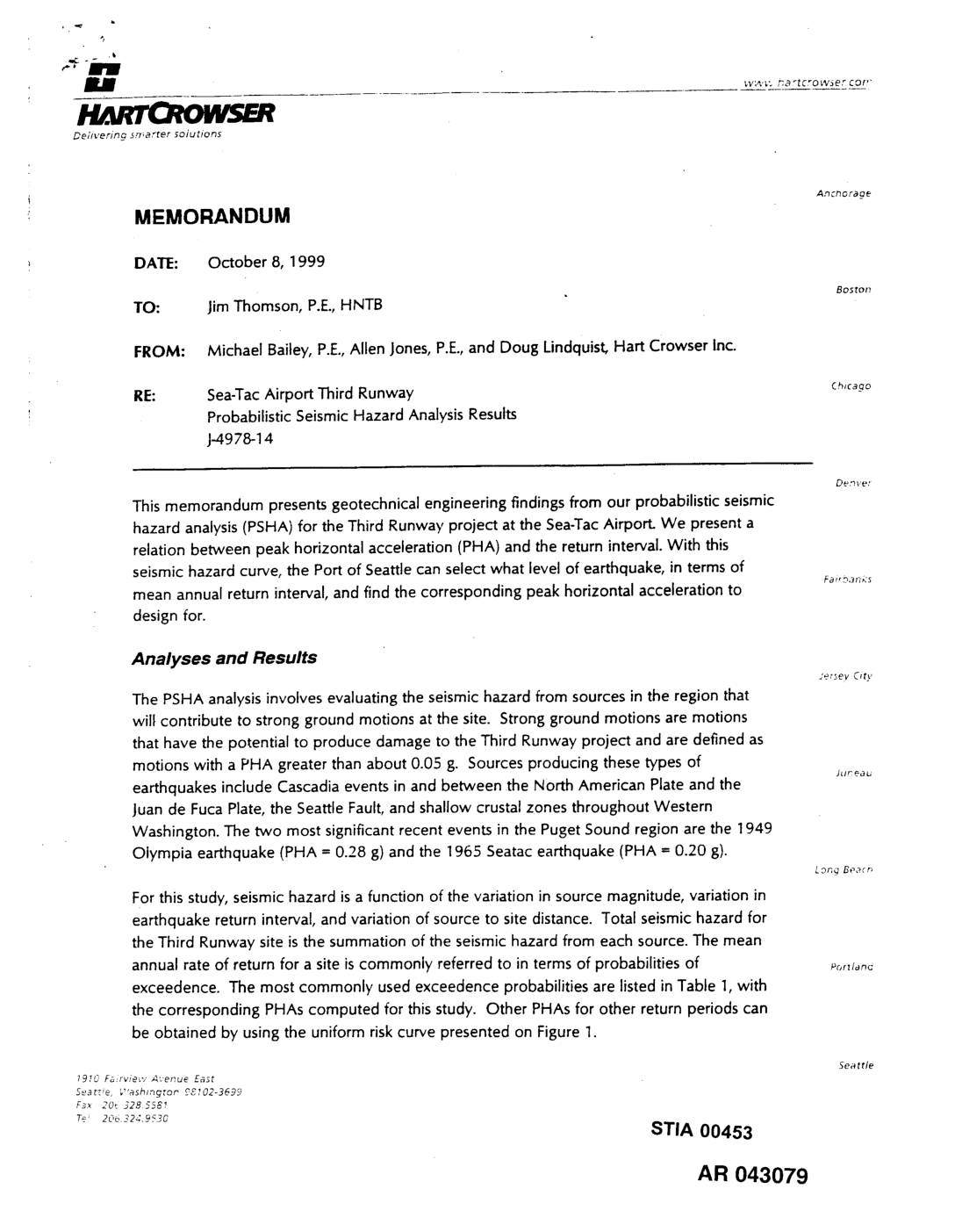
EXH AR043079: Hart Crowser Memorandum — Sea-Tac Airport Third Runway Probabilistic Seismic Hazard Analysis Results
Hart Crowser memorandum from Michael Bailey, Allen Jones, and Doug Lindquist to Jim Thomson (HNTB), dated October 8, 1999, presenting probabilistic seismic hazard analysis (PSHA) results for the Sea-Tac Airport Third Runway project (J-4978-14). Reports peak horizontal acceleration (PHA) values for common design return intervals: 0.16 g (72-year), 0.36 g (475-year), 0.47 g (975-year), and -
 1999-09-24
EXH AR042987: Subsurface Conditions Data Report, Borrow Areas 1, 3, and 4, Sea-Tac Airport Third Runway
Hart Crowser subsurface conditions data report (project J-4978.02) prepared for HNTB and Port Of Seattle, dated September 24, 1999, covering Borrow Areas 1, 3, and 4 for the Sea-Tac Airport Third Runway project. Report includes generalized geologic conditions, subsurface soil conditions, hydrogeologic regime, groundwater elevation data, and perched water-bearing zone analysis. Field explorations used dual-wall -
 1999-09-20
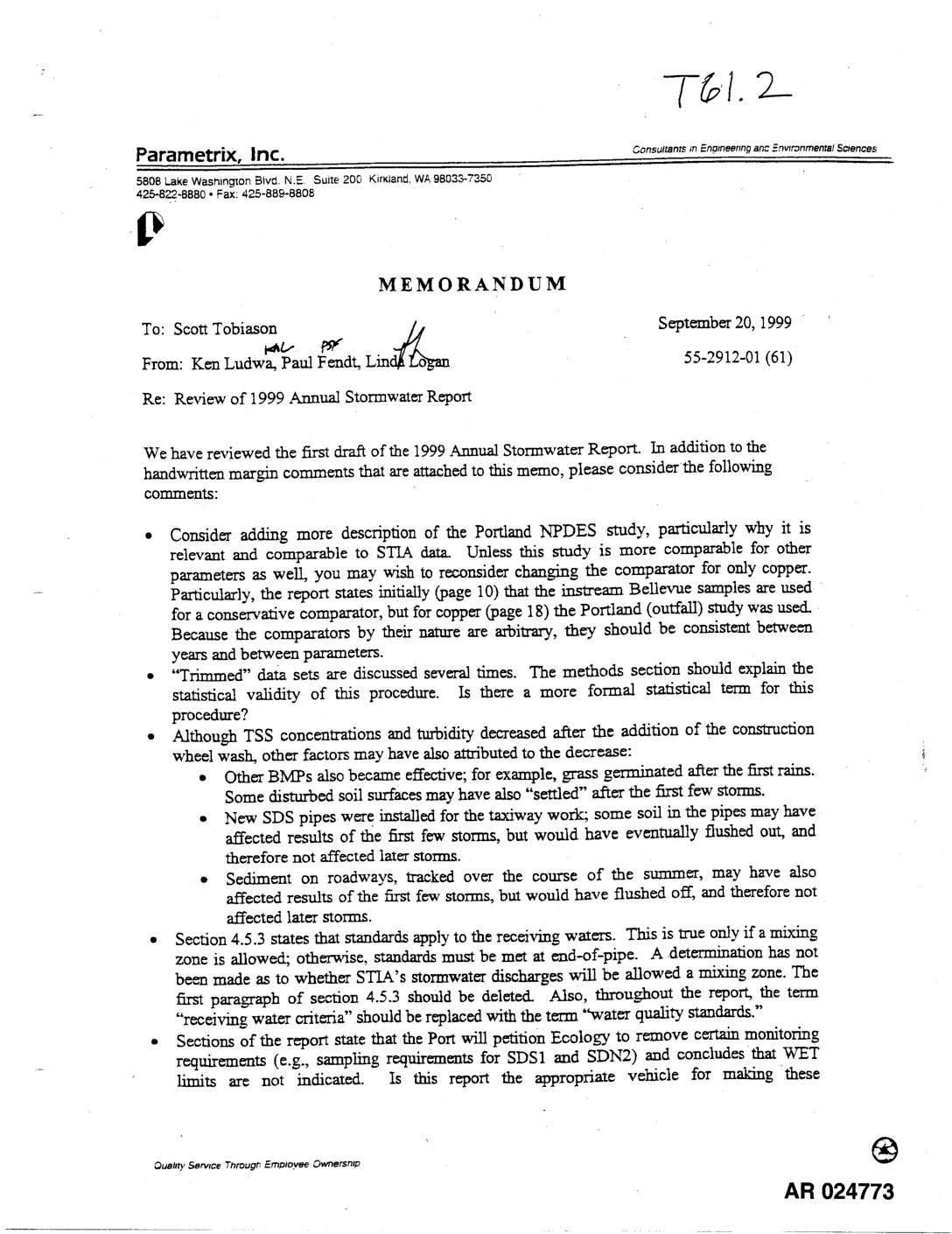
EXH AR024773: Parametrix Memo — Review of 1999 Annual Stormwater RP, STIA
A September 20, 1999 internal memorandum from Parametrix, Inc. consultants to Scott Tobiason provides technical review comments on the first draft of the 1999 Annual Stormwater Report for Seattle-Tacoma International Airport (STIA). The memo raises concerns about consistency in water quality comparators, statistical methods for 'trimmed' data sets, and the attribution of reduced sediment levels to construction wheel wash versus other factors. It also flags regulatory issues regarding mixing zones, water quality standards language, and potential NPDES permit compliance implications of identifying pollution sources in the annual report. -
 1999-09-17
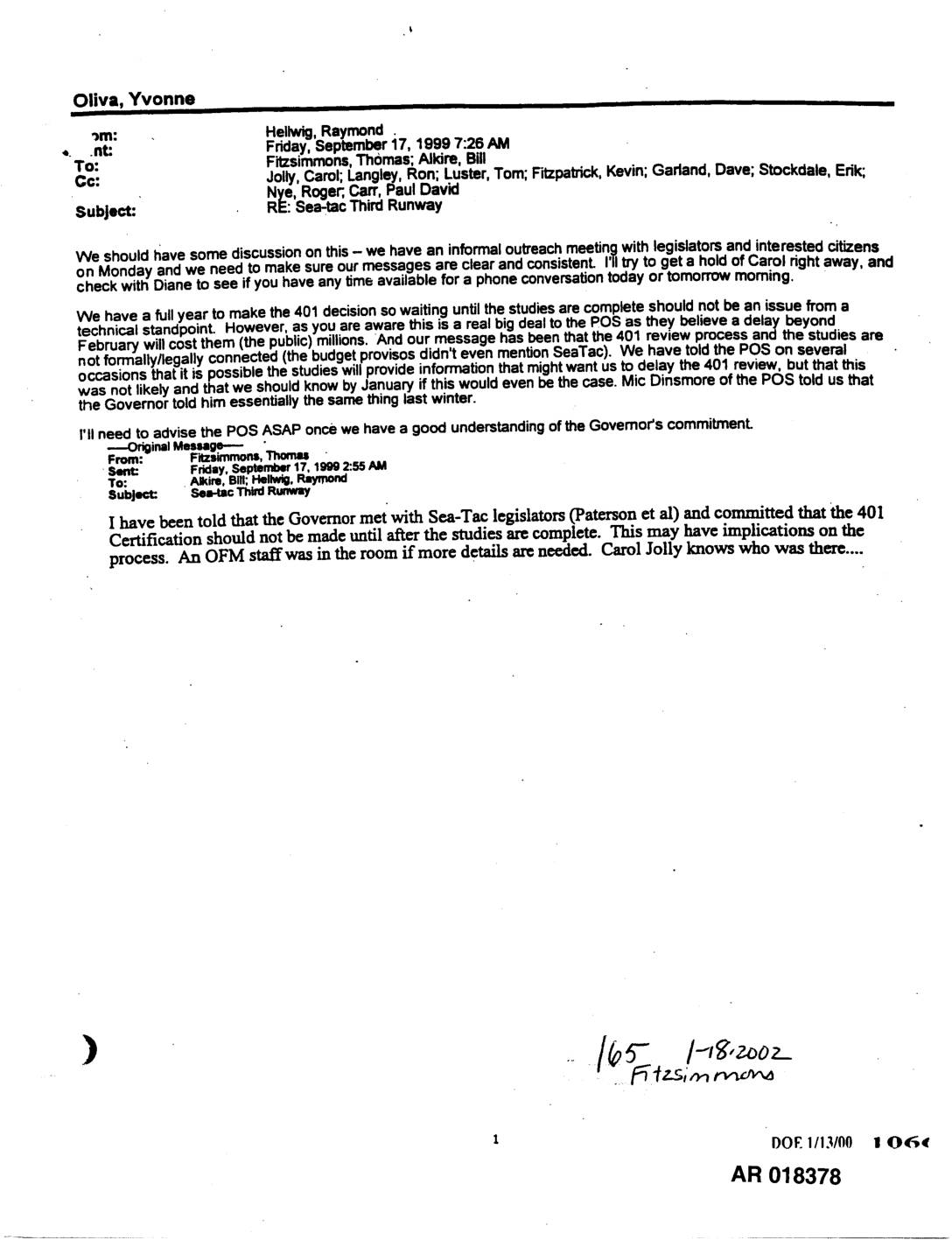
Exhibit 165: RE: Sea-Tac Third Runway — 401 Certification Timing and Governor’s Commitment
Email chain from Raymond Hellwig (Washington State Department of Ecology) to Thomas Fitzsimmons and Bill Alkire, cc’ing Carol Jolly, Ron Langley, Tom Luster, Kevin Fitzpatrick, Dave Garland, Erik Stockdale, Roger Nye, and Paul David Carr, dated September 17, 1999. Discusses Governor’s reported commitment to Sea-Tac legislators (Paterson et al.) that the Section 401 Water Quality -
 1999-09-16
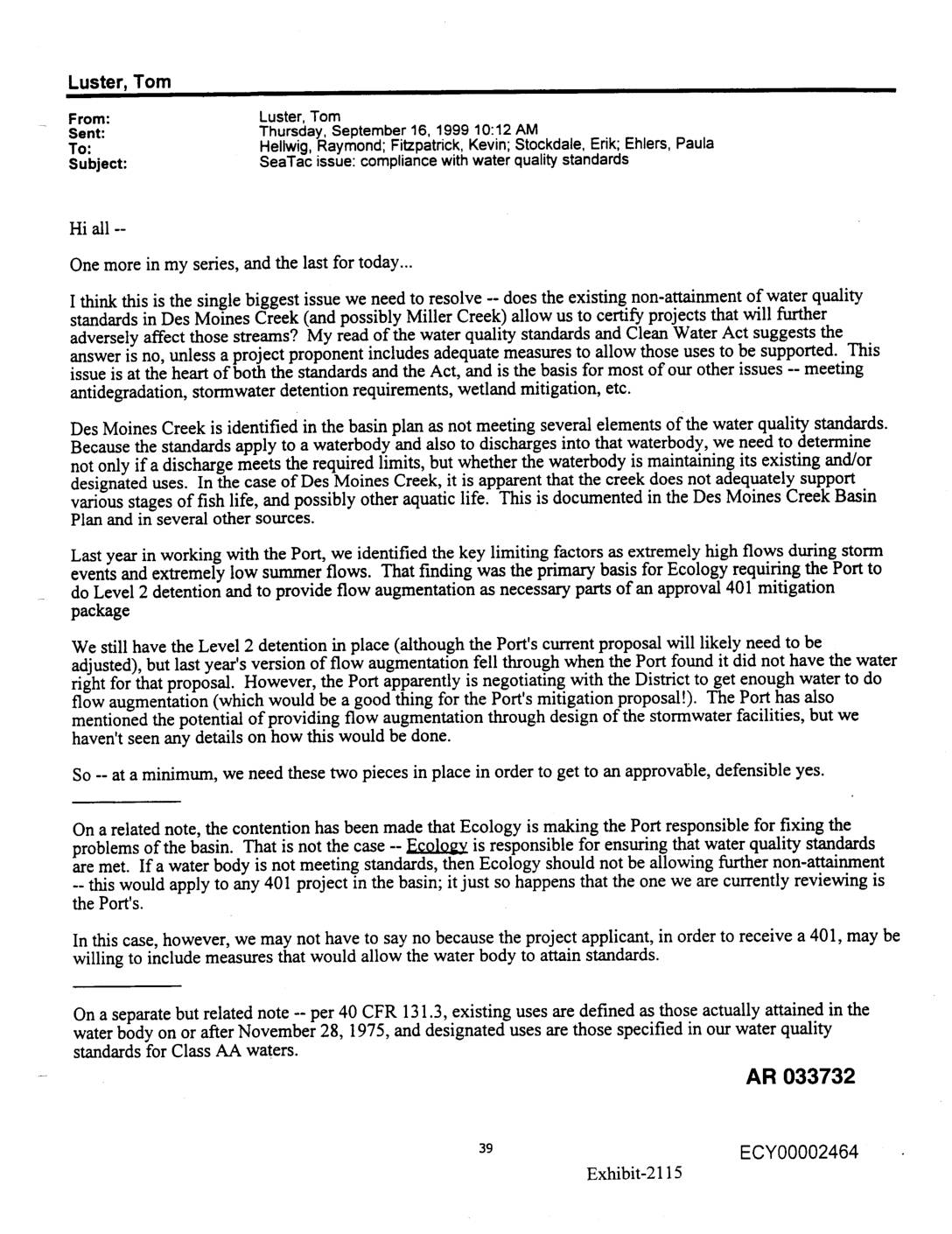
Exhibit 2115: Internal Email — Ecology on Sea-Tac Water Quality Standards Compliance, Des Moines Creek 401 Certification
Internal email from Tom Luster (Ecology) to Raymond Hellwig, Kevin Fitzpatrick, Erik Stockdale, and Paula Ehlers, dated September 16, 1999, regarding SeaTac Airport 401 certification and compliance with water quality standards under the Clean Water Act. Discusses non-attainment of water quality standards in Des Moines Creek and Miller Creek, antidegradation requirements, Level 2 detention requirements, -
 1999-09-16
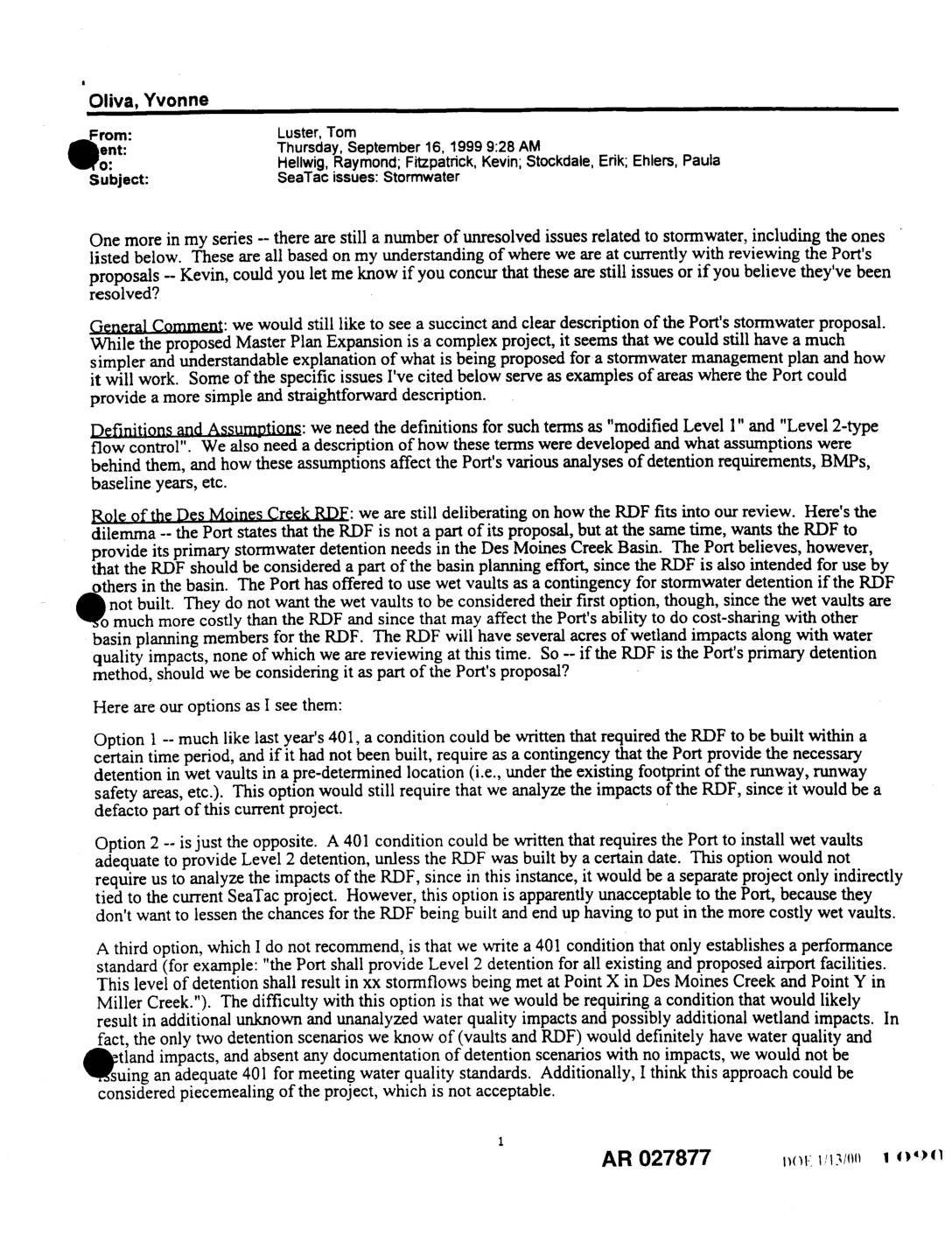
EXH AR027877: Internal Email on Unresolved Sea-Tac Stormwater Issues — 401/CZM Review, Des Moines Creek RDF, and Water Quality BMPs
Internal email from Tom Luster (Washington State Department of Ecology) to Raymond Hellwig, Kevin Fitzpatrick, Erik Stockdale, and Paula Ehlers dated September 16, 1999, outlining unresolved stormwater issues in the 401/CZM review of Port Of Seattle’s Sea-Tac Airport Master Plan Expansion. Topics include: definitions of ‘modified Level 1’ and ‘Level 2-type flow control’; role of -
 1999-09-16
EXH AR042985: Fax Transmittal and Map — Proposed Groundwater Level Monitoring Well Network, STIA Groundwater Study
Fax transmittal dated 9/16/99 from John Strunk of Associated Earth Sciences, Inc. (Bainbridge Island, WA) to Roger Nye at Ecology, transmitting a map showing proposed well locations for measuring groundwater levels at Seattle-Tacoma International Airport (STIA). The attached map titled ‘Proposed Groundwater Level Monitoring Well Network, STIA Groundwater Study’ (September 16th, 1999) shows on-site and -
1999-09-08
ACC: Letter to the Editor: It’s never too late to save over a billion dollars in public funds
City of Burien City of Tukwila City of Des Moines City of Federal Way City of Normandy Park Highline School District AIRPORT COMMUNITIES COALITION September 8, 1999 To the Editor: It’s never too late to save over a billion dollars in public funds. It’s not too late to ease freeway gridlock. And it’s not -
 1999-09-07
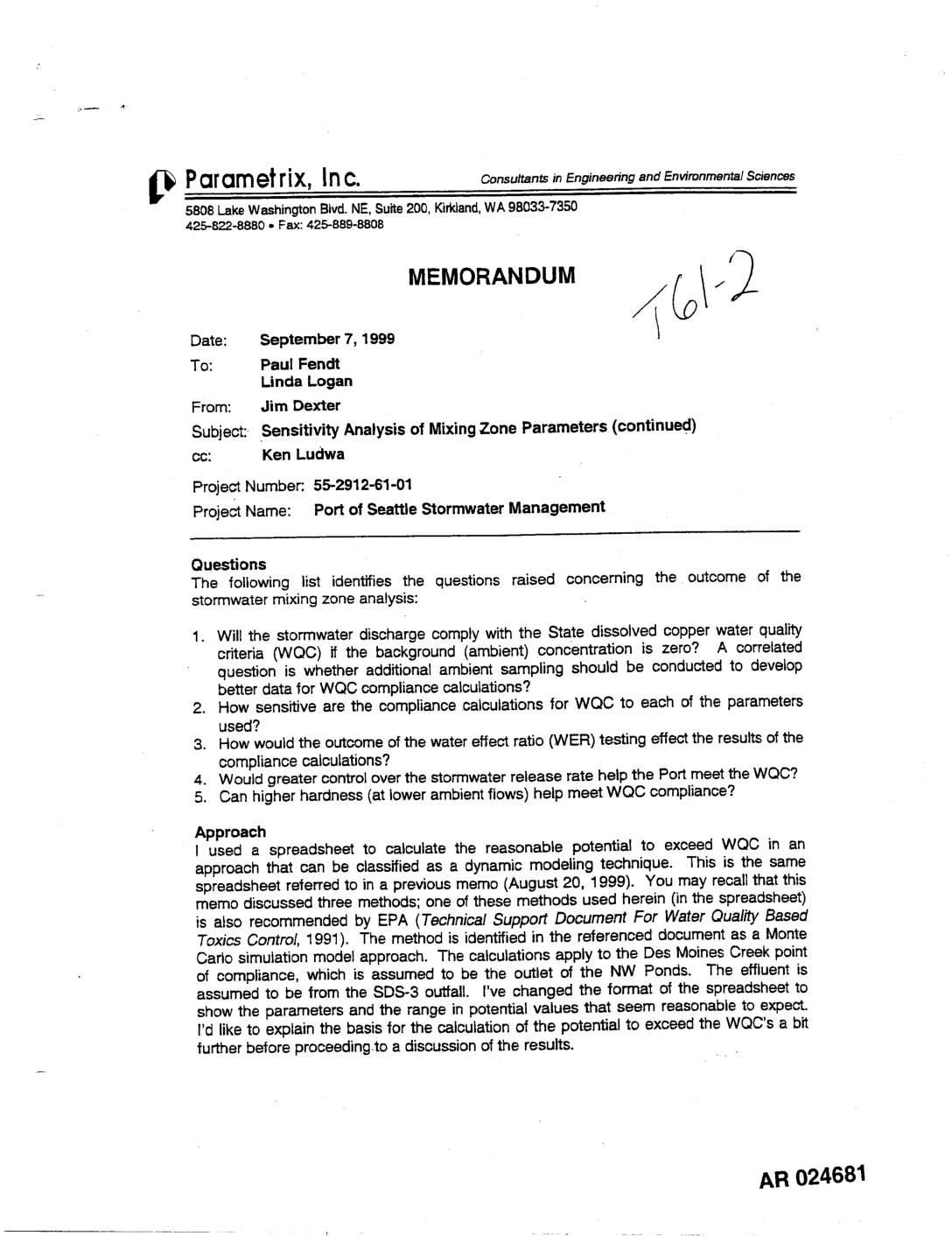
EXH AR024681: Sensitivity Analysis Mixing Zone Parameters (cont.) — Stormwater Mgmt
A 1999 technical memorandum from Parametrix, Inc. analyzes whether stormwater discharged near Des Moines Creek meets Washington State dissolved copper water quality criteria, using a Monte Carlo simulation model. The analysis finds that copper levels in the stormwater effluent consistently exceed water quality standards regardless of background ambient concentrations, with dilution factors generally less than 2. The study evaluates several potential remedies, including increased onsite detention, expanded mixing zones, and water effect ratio adjustments, finding that the Water Effect Ratio (WER) is the most influential factor in achieving compliance.