TagACC(1548)
-
 2000-09-25
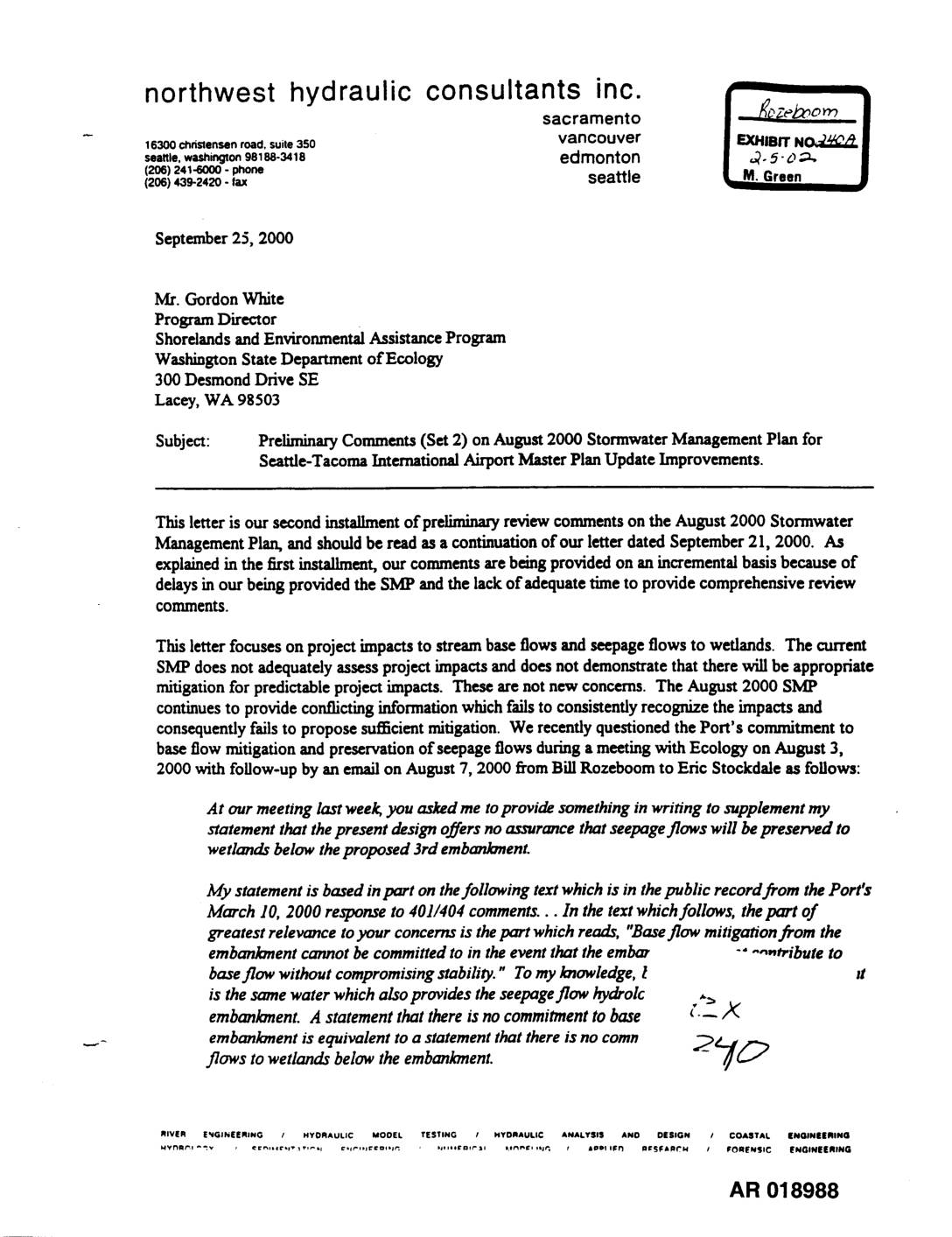
EXH 240A: Preliminary Comments Set 2 on Aug 2000 Stormwater Management Plan STIA Master Plan Update
A September 2000 letter from Northwest Hydraulic Consultants raises concerns that the Seattle-Tacoma International Airport's Stormwater Management Plan fails to adequately assess or mitigate the third runway embankment's impact on stream base flows and seepage flows to nearby wetlands. The consultants argue that the Port of Seattle's own data contradicts its claims that the embankment fill would maintain groundwater recharge, and that independent re-analysis suggests summer groundwater reductions to Miller Creek could be roughly twice what the Port reported. The letter calls for more rigorous and consistent hydrologic modeling before construction commitments are made. -
 2000-09-21
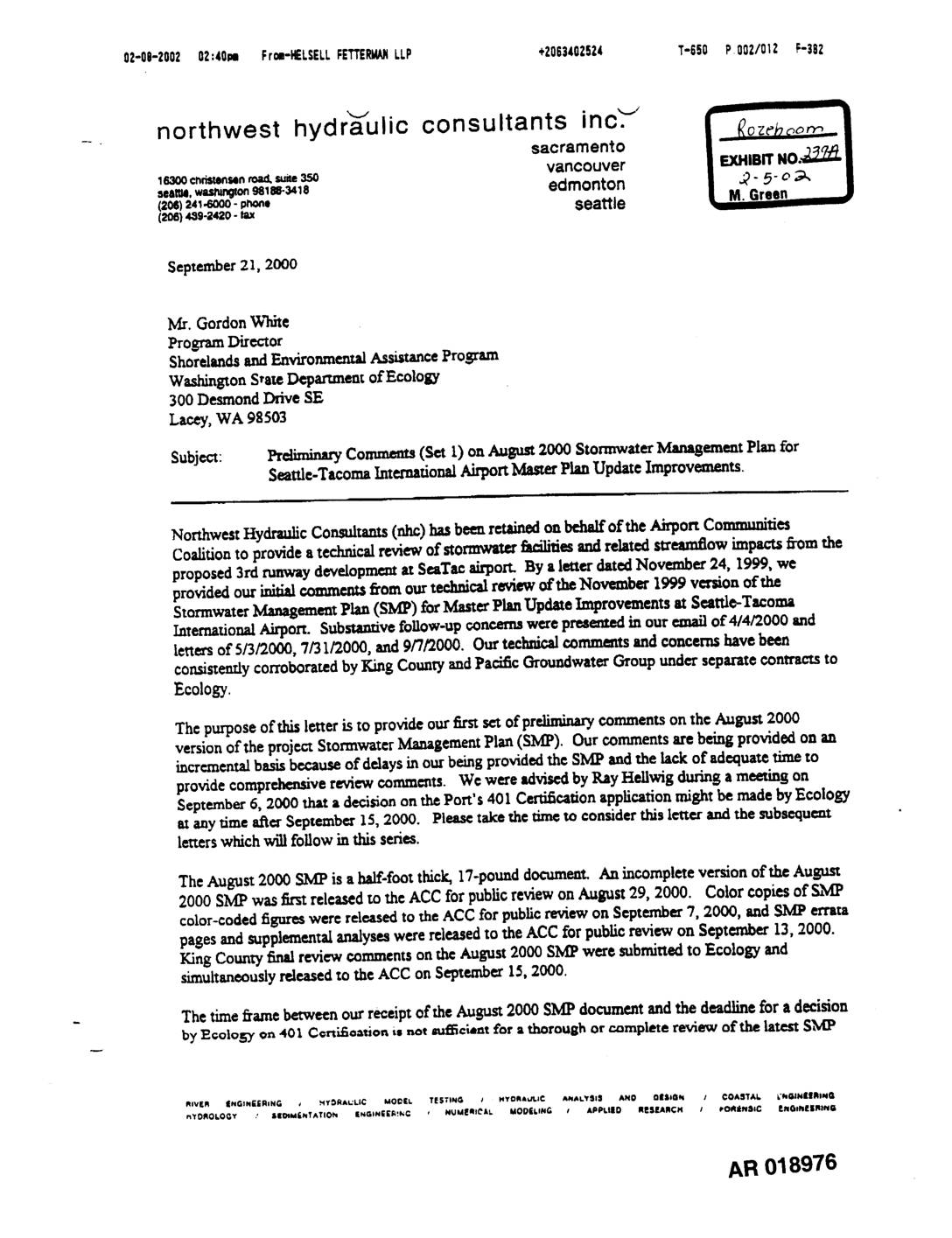
EXH AR018976: Preliminary Comments Set 1 on Aug 2000 STIA Stormwater Management Plan Master Plan Update
In September 2000, Northwest Hydraulic Consultants submitted preliminary technical comments on behalf of the Airport Communities Coalition, raising serious concerns about the adequacy of the Stormwater Management Plan for Seattle-Tacoma International Airport's proposed third runway expansion. The letter highlights findings from King County's independent review, which identified numerous cases where proposed stormwater control facilities were unverified, infeasible, or unlikely to meet required flow control performance standards. The consultants warned that the compressed public review timeline was insufficient for thorough evaluation of the plan before Ecology's 401 Certification decision. -
 2000-09-21
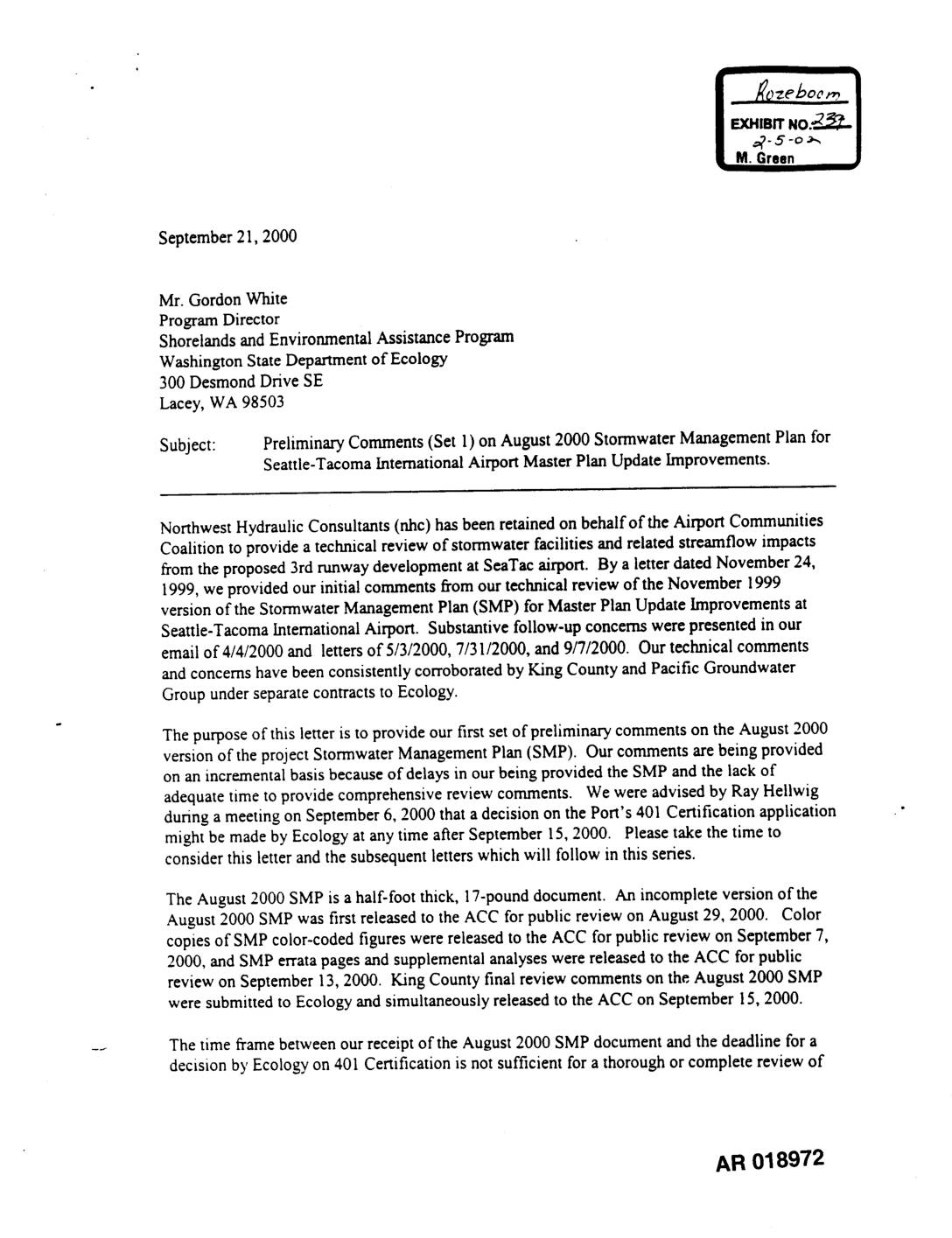
EXH 239: Preliminary Comments Set 1 on Aug 2000 Stormwater Management Plan STIA Master Plan Update
A September 2000 letter from Northwest Hydraulic Consultants, written on behalf of the Airport Communities Coalition, raises serious technical concerns about the Stormwater Management Plan for Seattle-Tacoma International Airport's proposed third runway. The letter highlights findings from King County reviewers showing that multiple stormwater facilities in the plan were unverified, potentially infeasible, or unlikely to meet required flow control performance standards. The consultants argue that the review timeline was insufficient and that the Port of Seattle had a history of failing to deliver promised stormwater mitigation measures. -
 2000-09-19
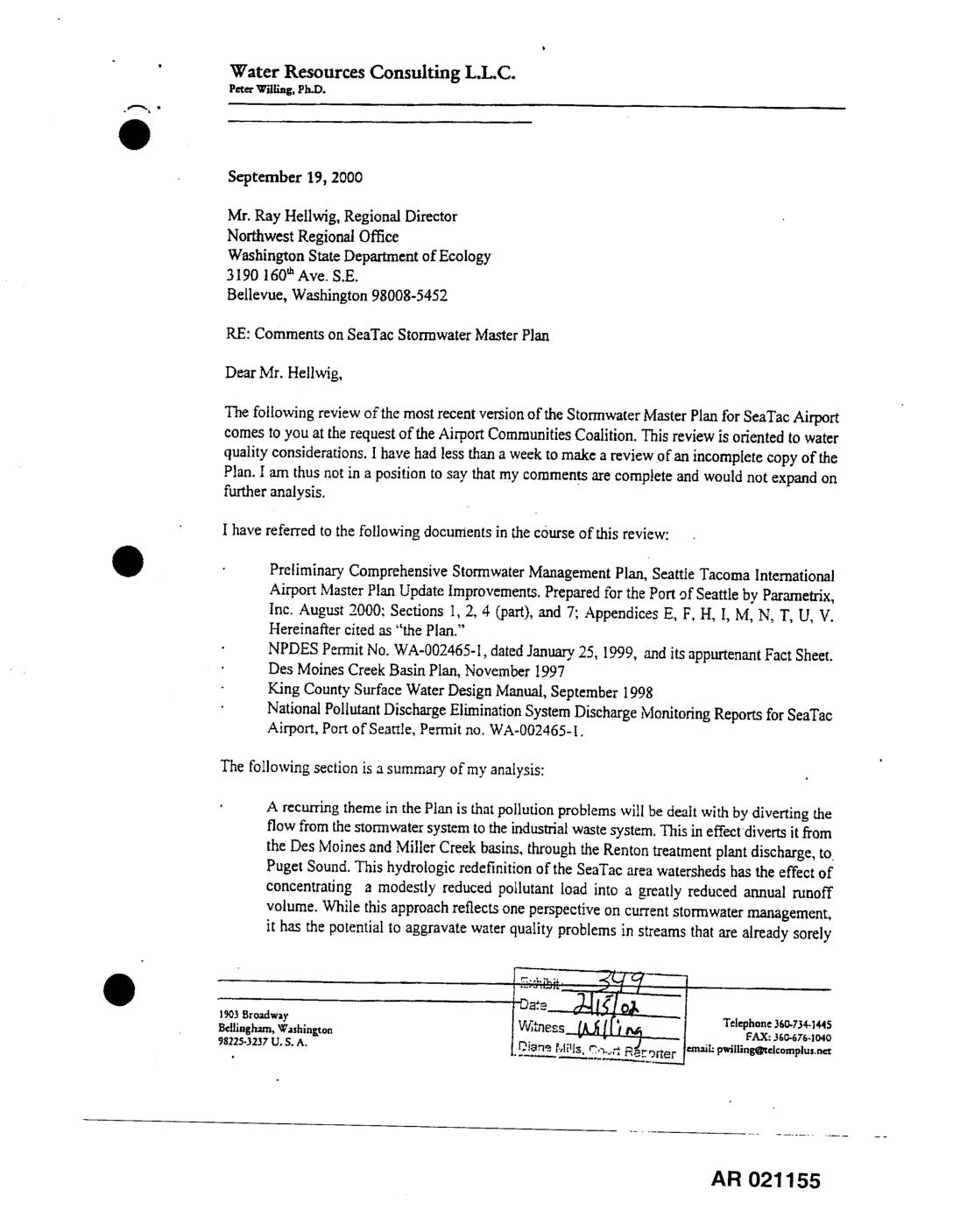
EXH AR021155: Water Resources Consulting LLC to Ecology — Comments STIA Stormwater Master Plan
A water resources consultant hired by the Airport Communities Coalition reviewed Sea-Tac Airport's August 2000 Stormwater Master Plan and found it seriously deficient in protecting local water quality. The review concludes that existing pollution controls at the airport are not working, that stormwater discharges regularly violate Washington State Water Quality Standards, and that the Plan's proposed measures fail to provide reasonable assurance that those standards will be met in the future. Key concerns include the diversion of polluted runoff away from local creeks, inadequate handling of metal roof runoff, and the lack of meaningful mass-balance accounting for long-lived pollutants. -
 2000-09-15
EXH AR023015: Azous Environmental Sciences Letter to WA Dept of Ecology — Unidentified Tributary Miller Creek Third Runway Docs
A September 2000 letter from environmental consulting firm Azous Environmental Sciences alerts Washington State Department of Ecology officials to an unidentified tributary of Miller Creek that was overlooked in the Port of Seattle's environmental planning documents for Sea-Tac Airport's proposed third runway. The tributary, listed in King County Sensitive Areas records and confirmed to have active water flow, feeds into a Class 2 salmon-bearing stream but was never assessed for potential impacts in the Port's Natural Resource Mitigation Plan. The letter argues this omission—despite four years of environmental analysis—leaves the creek unprotected from planned construction and future aviation operations in the area. -
 2000-09-15
EXH AR023555: Letter Water Resources Consulting to WA Ecology — Lake Youngs Outlet Temp Data, Des Moines Creek Flow Augmentation Facility
A water resources consultant wrote to the Washington State Department of Ecology in September 2000, arguing that Seattle Public Utilities' Lake Youngs water supply is too warm to effectively cool Des Moines Creek during summer months. Temperature data showed that Lake Youngs outlet water exceeds 16°C from mid-June through mid-October — the exact period when cooler stream temperatures are needed — reaching as high as 20°C in summer 2000. The letter concludes that the Port of Seattle's proposed flow augmentation facility for Des Moines Creek cannot rely on this water source for temperature improvement, undermining the Port's claims about its water supply plan. -
 2000-09-15
EXH AR026129: King County DNR Letter to Ecology — Comprehensive Stormwater Mgmt Plan STIA Master Plan Update
In September 2000, King County's Department of Natural Resources provided a technical review of the Port of Seattle's Comprehensive Stormwater Management Plan (SMP) for proposed Master Plan Update improvements at Seattle-Tacoma International Airport. The review found no fatal flaws in the plan's approach to meeting King County's stormwater standards, but identified inconsistencies in flow control calculations and water quality measures that needed to be resolved before final permitting. King County also emphasized the importance of rigorous erosion and sediment control during construction and recommended that Ecology and the Port establish a joint compliance team to oversee implementation of the complex, multi-year project. -
 2000-09-12
EXH AR045977: Evaluation of Perched Zone Interception and Possible Impacts to Wetland Hydrology, Borrow Area 3, Sea-Tac Third Runway
Hart Crowser report prepared for Port of Seattle, dated September 12, 2000 (J-4978-13), evaluating perched groundwater zone interception at Borrow Area 3 for the Sea-Tac Third Runway project. Analyzes shallow perched groundwater flow from northwest to southeast beneath Borrow Areas 3 and 4, its role in sustaining Wetland 29, and the impact of borrow area -
 2000-09-11
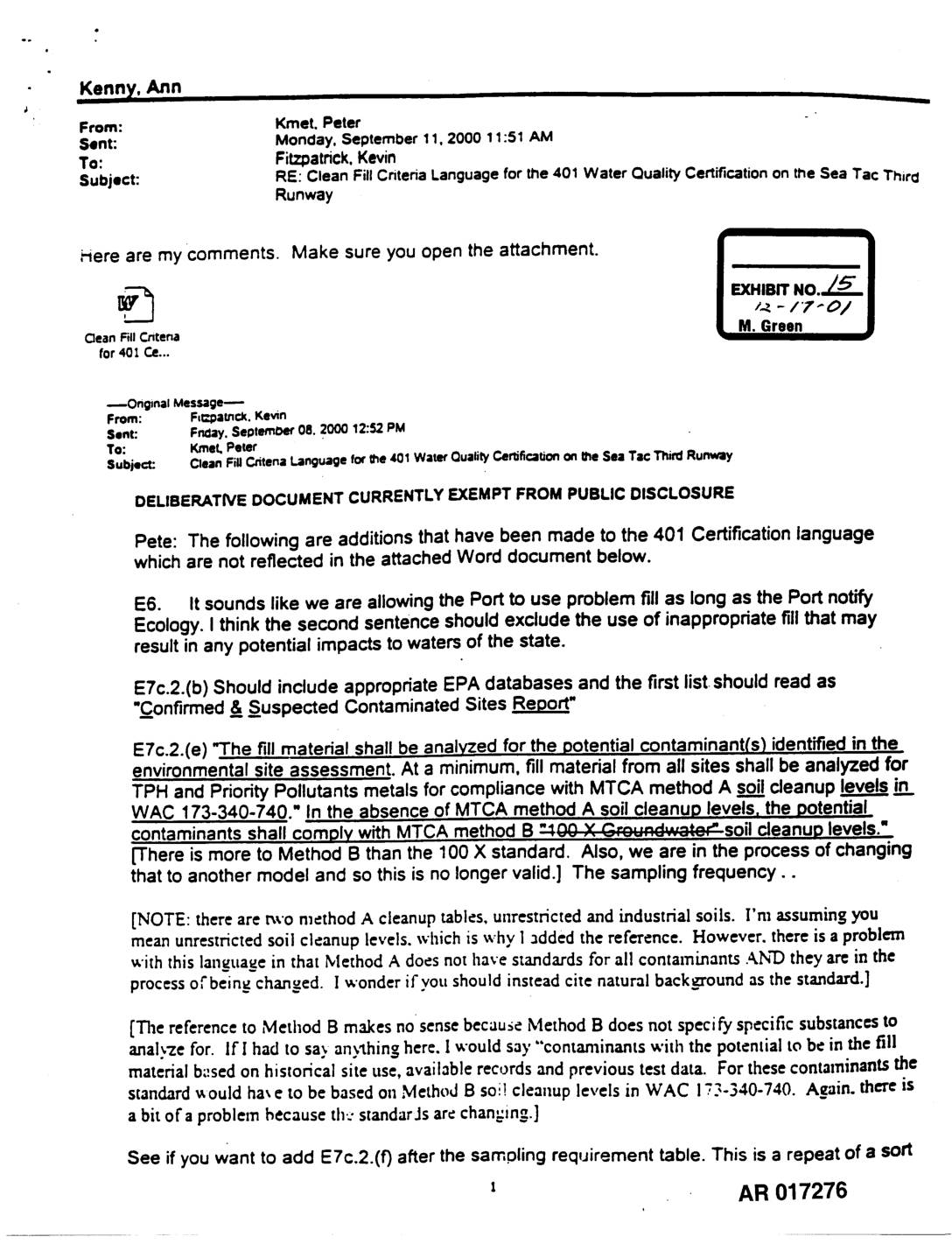
EXH AR017276: Clean Fill Criteria Language for the 401 Water Quality Certification on the Sea-Tac Third Runway
Email from Peter Kmet to Kevin Fitzpatrick, Washington State Department of Ecology (Ecology), dated September 11, 2000, providing comments on proposed Clean Fill Criteria language for the Section 401 Water Quality Certification for the Sea-Tac Airport Third Runway project. Kmet comments on sections E6, E7, E7a, E7b, E7c regarding Port Of Seattle borrow sites, fill -
 2000-09-11
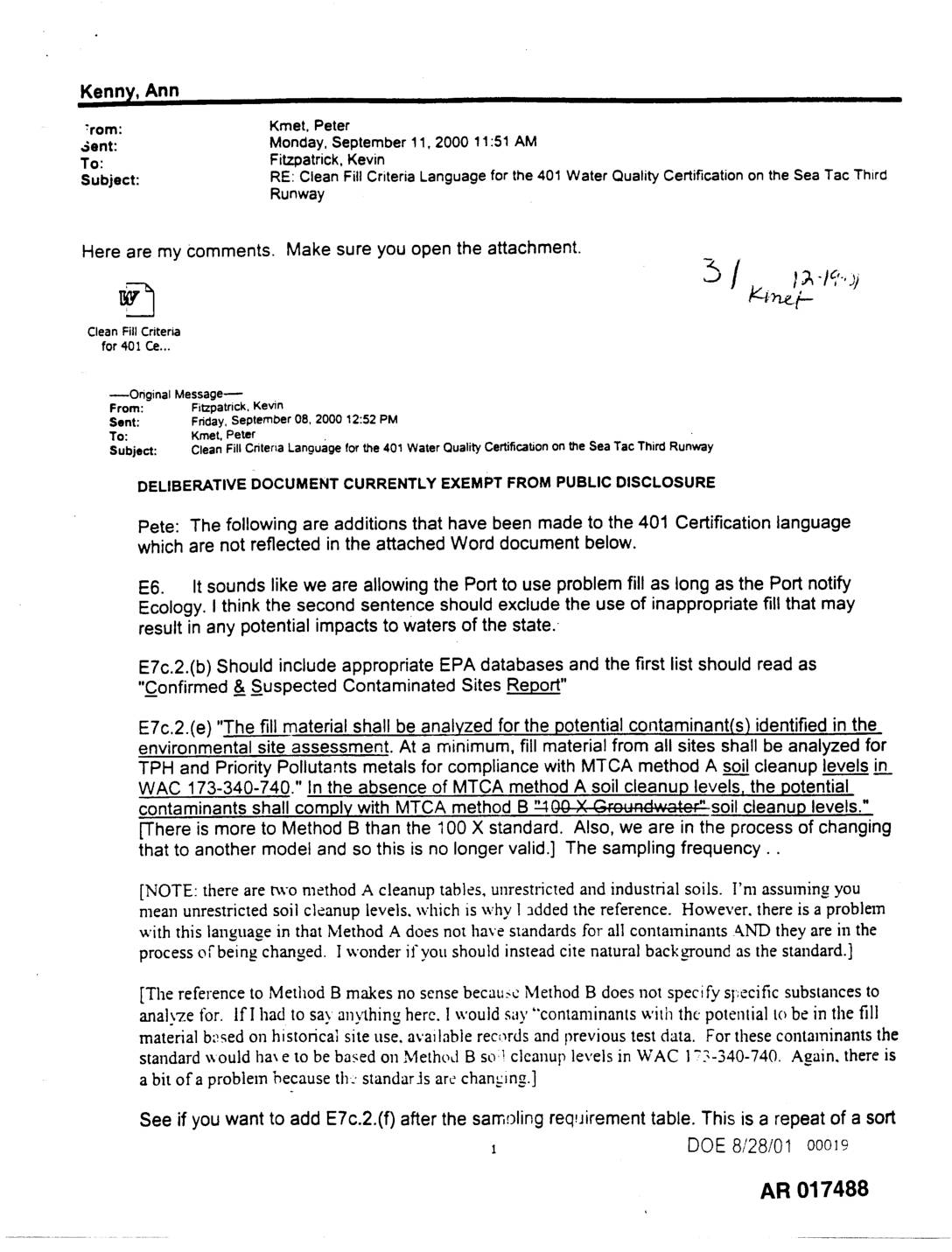
EXH AR017488: Internal Email — Clean Fill Criteria Language for 401 Water Quality Certification on Sea-Tac Third Runway
Internal email exchange between Peter Kmet and Kevin Fitzpatrick (Supervisor, Industrial Permit Unit, Water Quality Program, NWRO) dated September 11, 2000, regarding Clean Fill Criteria language for the 401 Water Quality Certification on the Sea-Tac Third Runway project. Document marked ‘Deliberative Document Currently Exempt From Public Disclosure.’ Kmet comments on draft certification conditions E6 (borrow