TagACC(1531)
-
 2001-03-02
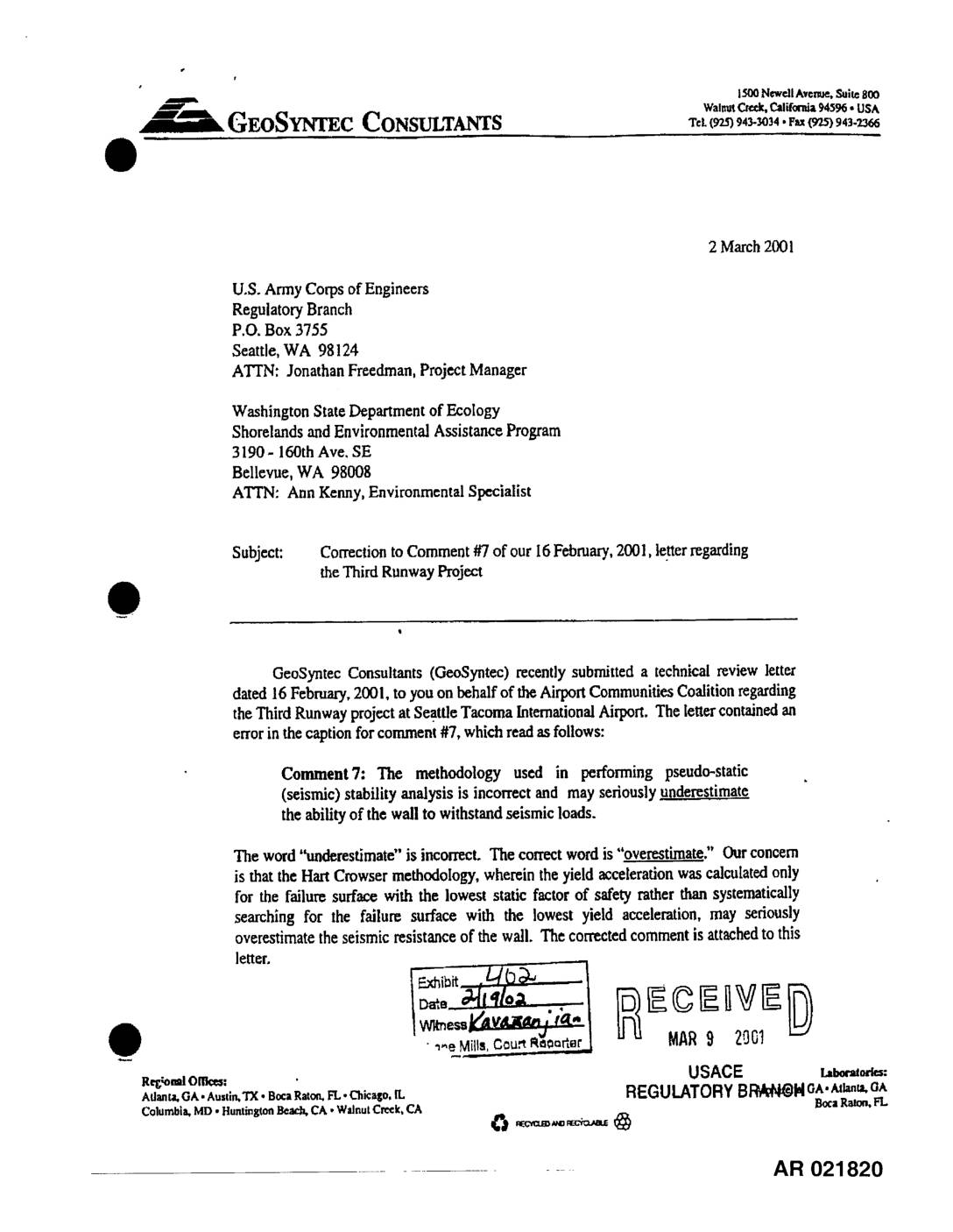
EXH AR021820: GeoSyntec Correction Comment #7 Pseudo-Static Seismic Stability Third Runway Wall ACC Technical Review
In March 2001, GeoSyntec Consultants submitted a correction to a technical review letter concerning the Third Runway Project at Seattle-Tacoma International Airport, clarifying that the seismic stability analysis used by Hart Crowser may seriously overestimate—not underestimate—the wall's ability to withstand earthquake loads. The firm argued that analyzing only the failure surface with the lowest static safety factor, rather than independently searching for the critical seismic failure surface, is an incorrect methodology. GeoSyntec recommended a proper pseudo-static slope stability analysis to ensure adequate ground improvement measures are applied in the right areas. -
 2001-03-01
EXH AR049873: Essential Fish Habitat Assessment — Master Plan Update Improvements, STIA
Essential Fish Habitat (EFH) Assessment prepared by Parametrix, Inc. for the Federal Aviation Administration and Port Of Seattle for Master Plan Update Improvements at Seattle-Tacoma International Airport (STIA), March 2001. Document AR049873 (project 556-2912-001) evaluates Pacific Coast salmon EFH — Chinook, Coho, and Puget Sound Pink salmon — in Miller Creek Basin, Des Moines Creek -
 2001-03-01
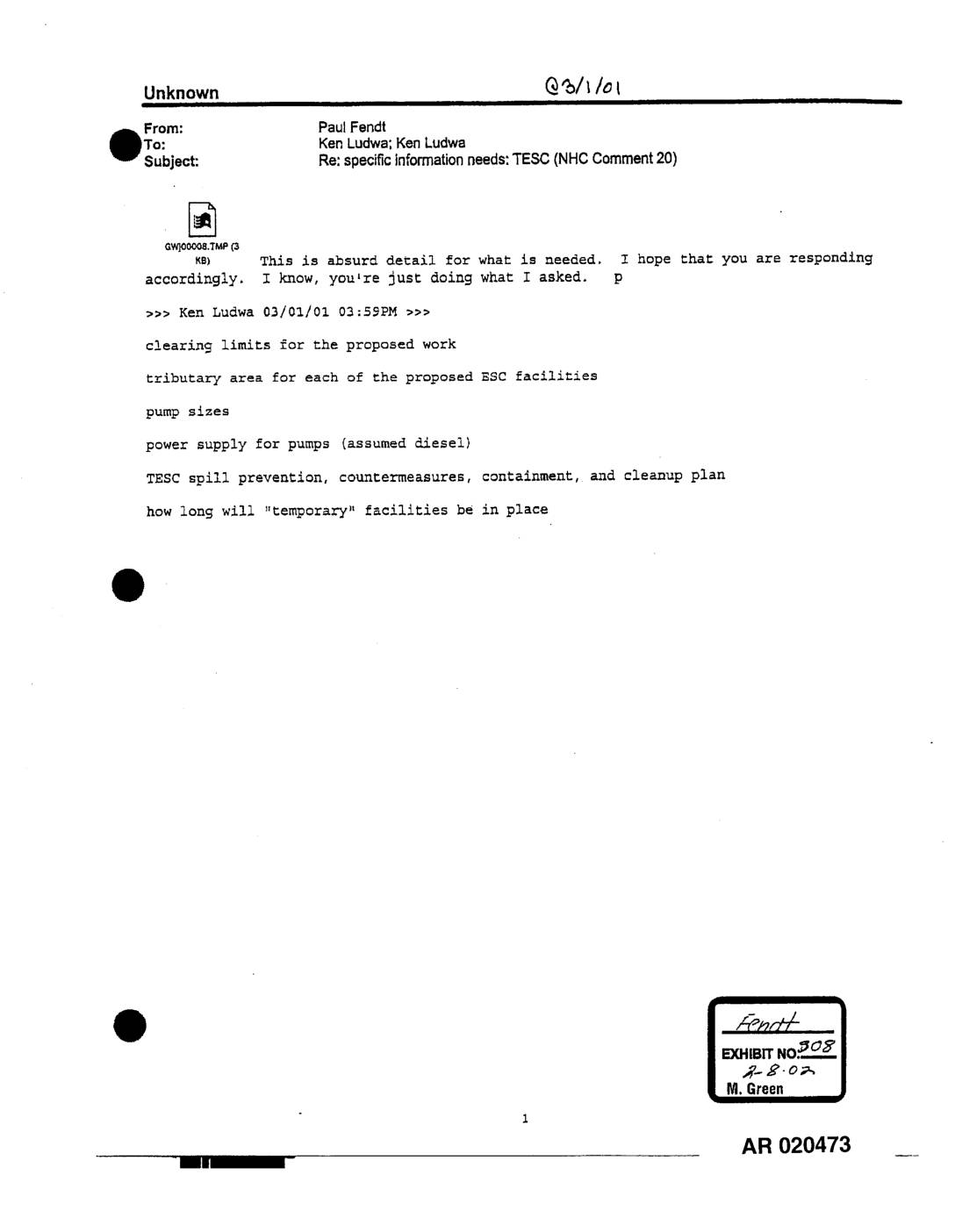
EXH 308: Email Fendt to Ludwa – Specific Information Needs TESC NHC Comment 20
In a March 2001 email exchange, Paul Fendt responds to Ken Ludwa regarding specific information requests related to TESC (Temporary Erosion and Sediment Control) facilities, calling the level of detail requested 'absurd.' The information requests from Ludwa included clearing limits, tributary areas for ESC facilities, pump sizes, power supply specifications, spill prevention plans, and the expected duration of temporary facilities. The document appears to be part of an administrative record related to construction or environmental control planning at or near Sea-Tac Airport. -
 2001-03-01
EXH AR050023: Draft Conceptual Reclamation Permit Package, Borrow Areas 3 and 4, Sea-Tac International Airport
Draft Conceptual Reclamation Permit Package for Borrow Areas 3 and 4 at Sea-Tac International Airport, City of SeaTac, Washington. Prepared by Hart Crowser for Port Of Seattle for presentation to the Washington Department of Natural Resources (DNR), March 1, 2001, project J-4978-62. Document covers site preparation activities, mining practices, operating plan, conceptual reclamation plan, revegetation -
 2001-02-26
EXH AR021605: Columbia Analytical Svcs Water/Sediment Quality Monitoring Lab Results Ltr SR K2101038
A February 2001 laboratory report from Columbia Analytical Services transmits water and sediment quality monitoring results to Columbia Biological Assessments in Richland, Washington, under service request K2101038. The report confirms that all analyses were conducted in accordance with the laboratory's quality assurance program, with samples received on February 12, 2001 and preliminary results faxed on February 23, 2001. The accompanying documentation includes standard data qualifier codes for inorganic, metals, and organic results used to interpret analytical findings. -
 2001-02-26
Exhibit 2061: Ecology Dam Safety Office — MSE Wall and Stormwater Pond Dam Safety Review, Port Of Seattle Third Runway Project
Email chain (Exhibit 2061, AR031718-AR031720) dated February 26, 2001, from Jerald LaVassar (Ecology Dam Safety Office) to Ann Kenny (Ecology), responding to Andrea Grad (Helsell law firm, representing ACC/Airport Communities Coalition). LaVassar explains why the Mechanically Stabilized Earth (MSE) wall at Sea-Tac Airport’s third runway project does not qualify as a dam under WAC 173-175-020, -
 2001-02-22
Exhibit 48: King County Letter to Ecology on Port Of Seattle Stormwater Management Plan Review for Sea-Tac Airport Master Plan Improvements
Letter dated February 22, 2001 from Pam Bissonnette, Director, King County Department of Natural Resources, to Ann Kenny, Senior Permit Specialist, Washington State Department of Ecology Northwest Regional Office, regarding King County’s technical review of the Port Of Seattle’s Comprehensive Stormwater Management Plan (SMP) for Master Plan Improvements at SeaTac International Airport. The letter references -
 2001-02-22
Exhibit 2040: King County Letter to Ecology Reviewing Port Of Seattle Comprehensive Stormwater Management Plan for Sea-Tac Airport Master Plan Improvements
Letter dated February 22, 2001 from Pam Bissonnette, Director of King County Department of Natural Resources, to Ann Kenny, Senior Permit Specialist at Washington State Department of Ecology (DOE) Northwest Regional Office, regarding King County’s technical review of the Port Of Seattle’s Comprehensive Stormwater Management Plan (SMP) for Master Plan Improvements at SeaTac International Airport. -
 2001-02-21
EXH AR025289: Five-Year Project RP — Des Moines Water Quality Monitoring Program
This February 2001 report by Herrera Environmental Consultants presents a five-year summary of water quality monitoring conducted for the City of Des Moines, Washington, covering three creek basins: Des Moines Creek, Massey Creek, and North Fork McSorley Creek. The report examines a range of water quality parameters including temperature, pH, dissolved oxygen, metals, nutrients, turbidity, and fecal coliform bacteria, as well as benthic invertebrate conditions as indicators of stream health. It was prepared for the City's Surface Water Management Utility and provides data intended to inform stormwater and surface water management decisions in the Des Moines area near Sea-Tac Airport. -
 2001-02-16
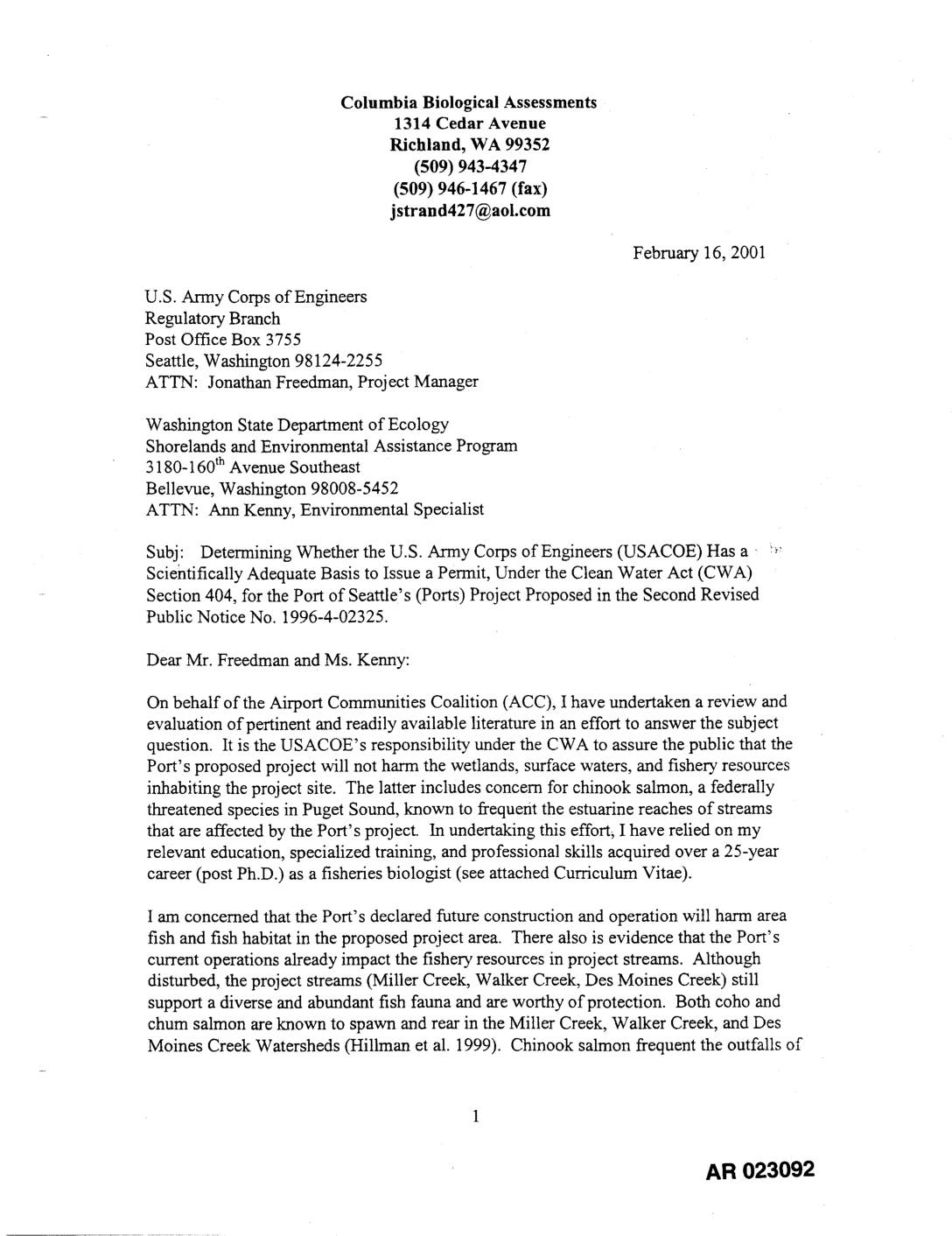
EXH AR023092: ACC Letter to USACOE & Ecology — Scientific Adequacy Section 404 CWA Permit Third Runway
A fisheries biologist writing on behalf of the Airport Communities Coalition argues that the Port of Seattle has not provided sufficient scientific evidence to justify a Clean Water Act Section 404 permit for its proposed third runway expansion at Seattle-Tacoma International Airport. The letter contends that the project would harm local streams (Miller Creek, Walker Creek, and Des Moines Creek) and their fish populations — including federally threatened Chinook salmon — through stream relocation, contaminated fill materials, and toxic stormwater runoff containing copper, zinc, and de-icing chemicals. The author concludes that the U.S. Army Corps of Engineers lacks an adequate scientific basis to approve the permit without additional environmental study and mitigation measures.