TagStormwater(373)
-
 1999-10-29
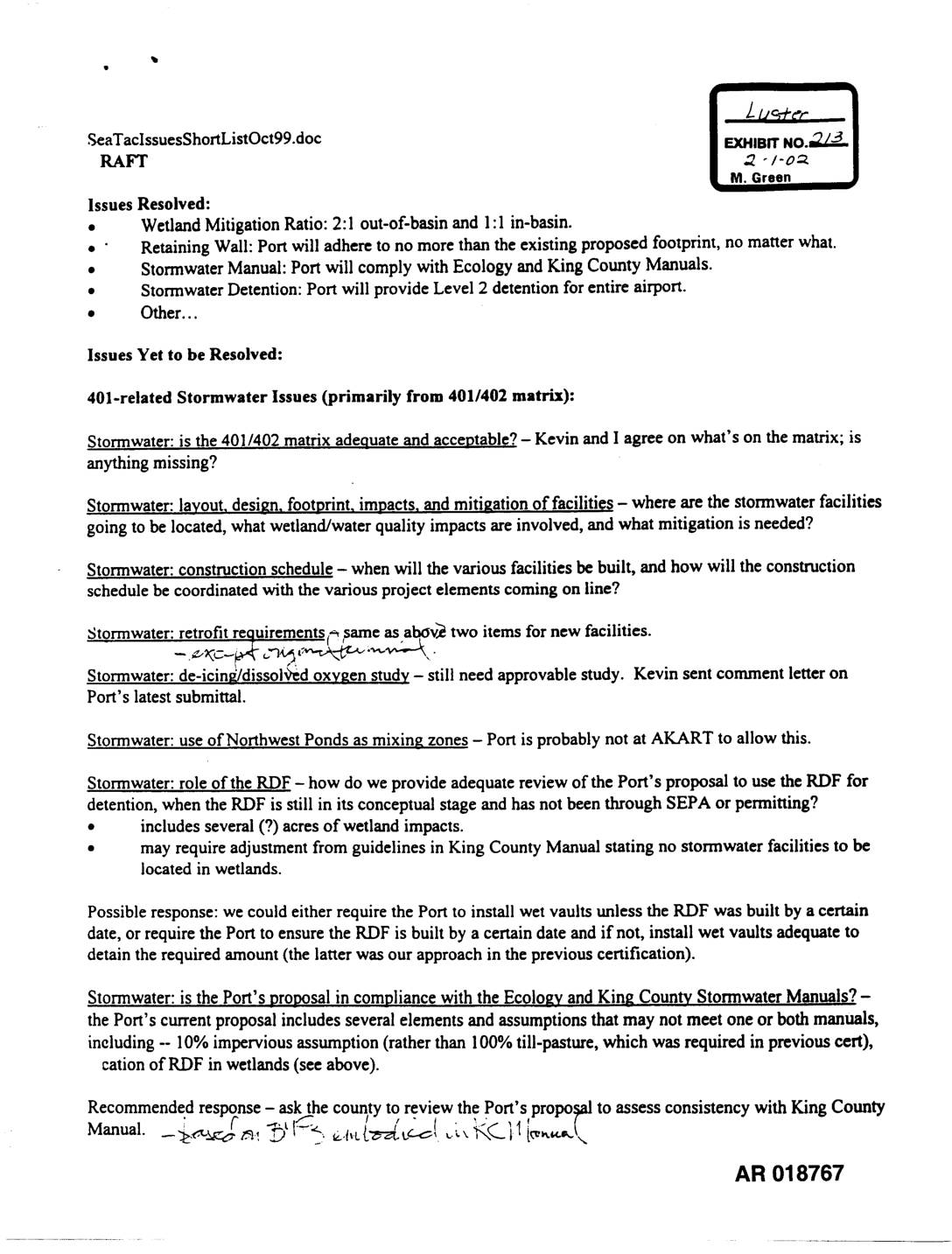
Exhibit 213: DRAFT Sea-Tac Issues Short List – Unresolved 401/402 Stormwater, Water Quality, and Permitting Issues (October 1999)
This October 1999 draft document outlines resolved and unresolved regulatory issues related to a Sea-Tac Airport expansion project, focusing primarily on stormwater management, wetland mitigation, and water quality concerns. Key unresolved issues include compliance with Ecology and King County Stormwater Manuals, the role of a proposed Regional Detention Facility (RDF) in wetlands, de-icing impacts on dissolved oxygen levels, and instream flow reductions in Des Moines Creek. Additional concerns involve NPDES permit compliance, clean fill criteria, legal proceedings before the Pollution Control Hearings Board, and whether a shoreline permit is needed for an Auburn mitigation site. -
 1999-09-20
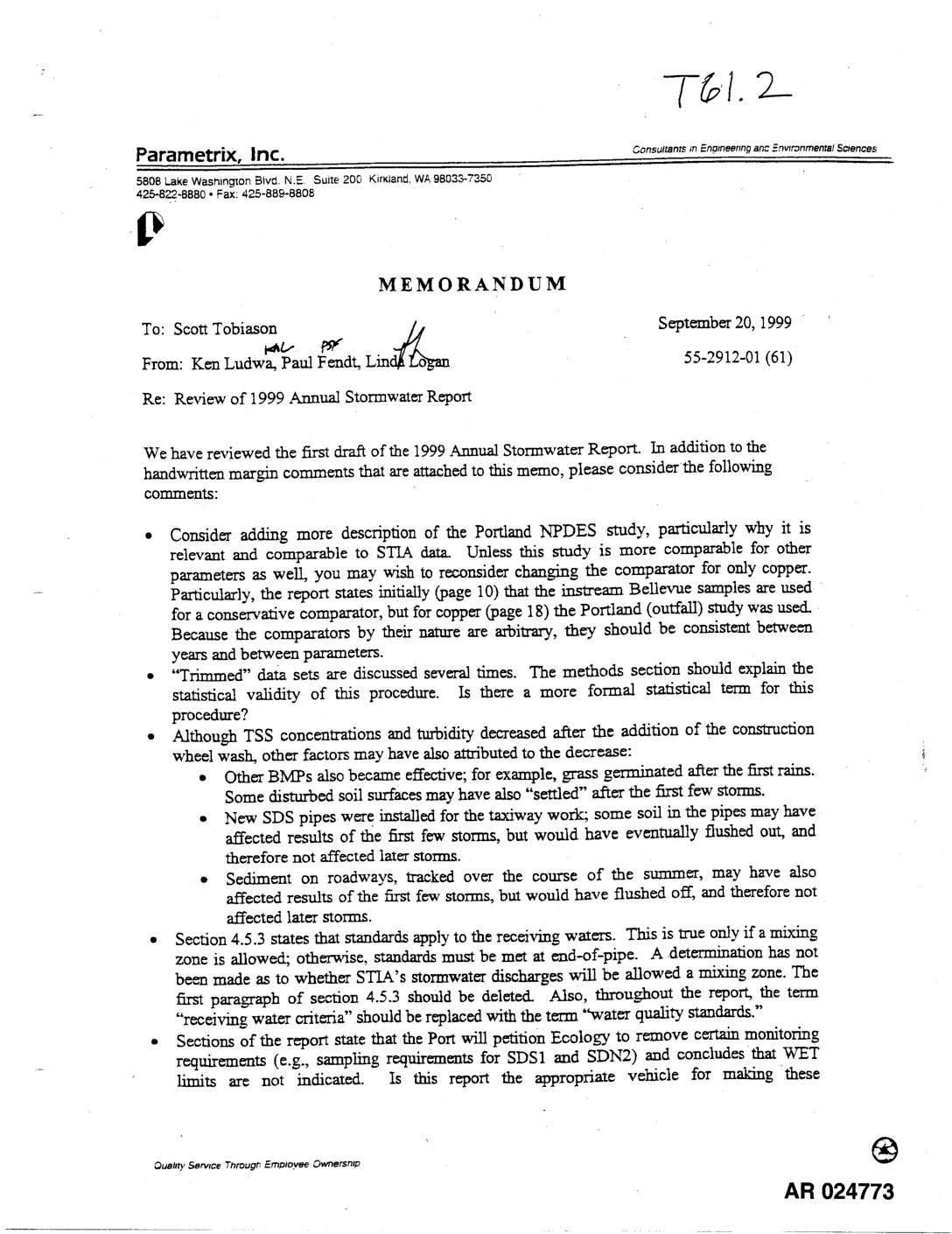
EXH AR024773: Parametrix Memo — Review of 1999 Annual Stormwater RP, STIA
A September 20, 1999 internal memorandum from Parametrix, Inc. consultants to Scott Tobiason provides technical review comments on the first draft of the 1999 Annual Stormwater Report for Seattle-Tacoma International Airport (STIA). The memo raises concerns about consistency in water quality comparators, statistical methods for 'trimmed' data sets, and the attribution of reduced sediment levels to construction wheel wash versus other factors. It also flags regulatory issues regarding mixing zones, water quality standards language, and potential NPDES permit compliance implications of identifying pollution sources in the annual report. -
 1999-09-16
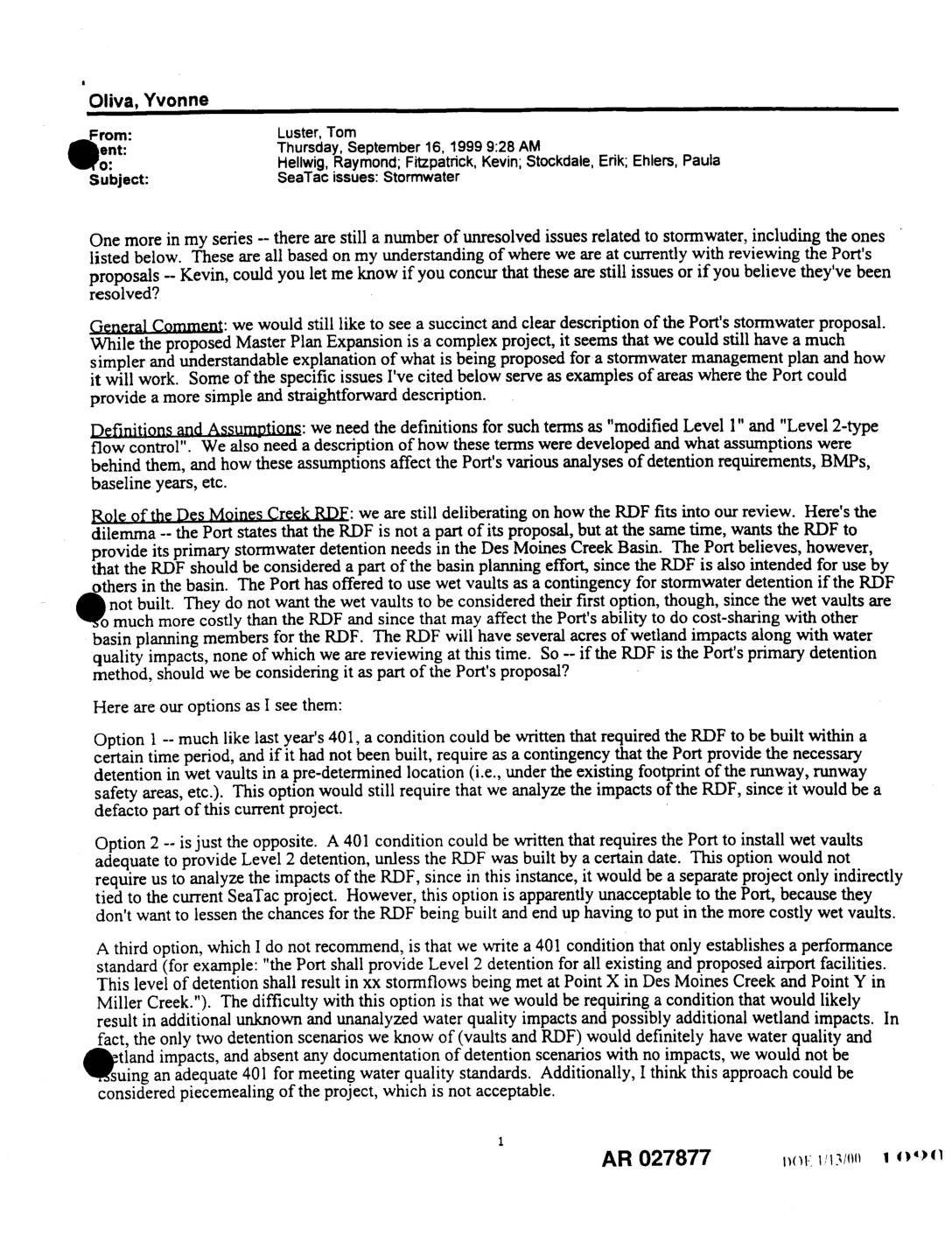
EXH AR027877: Internal Email on Unresolved Sea-Tac Stormwater Issues — 401/CZM Review, Des Moines Creek RDF, and Water Quality BMPs
Internal email from Tom Luster (Washington State Department of Ecology) to Raymond Hellwig, Kevin Fitzpatrick, Erik Stockdale, and Paula Ehlers dated September 16, 1999, outlining unresolved stormwater issues in the 401/CZM review of Port Of Seattle’s Sea-Tac Airport Master Plan Expansion. Topics include: definitions of ‘modified Level 1’ and ‘Level 2-type flow control’; role of -
 1999-09-07
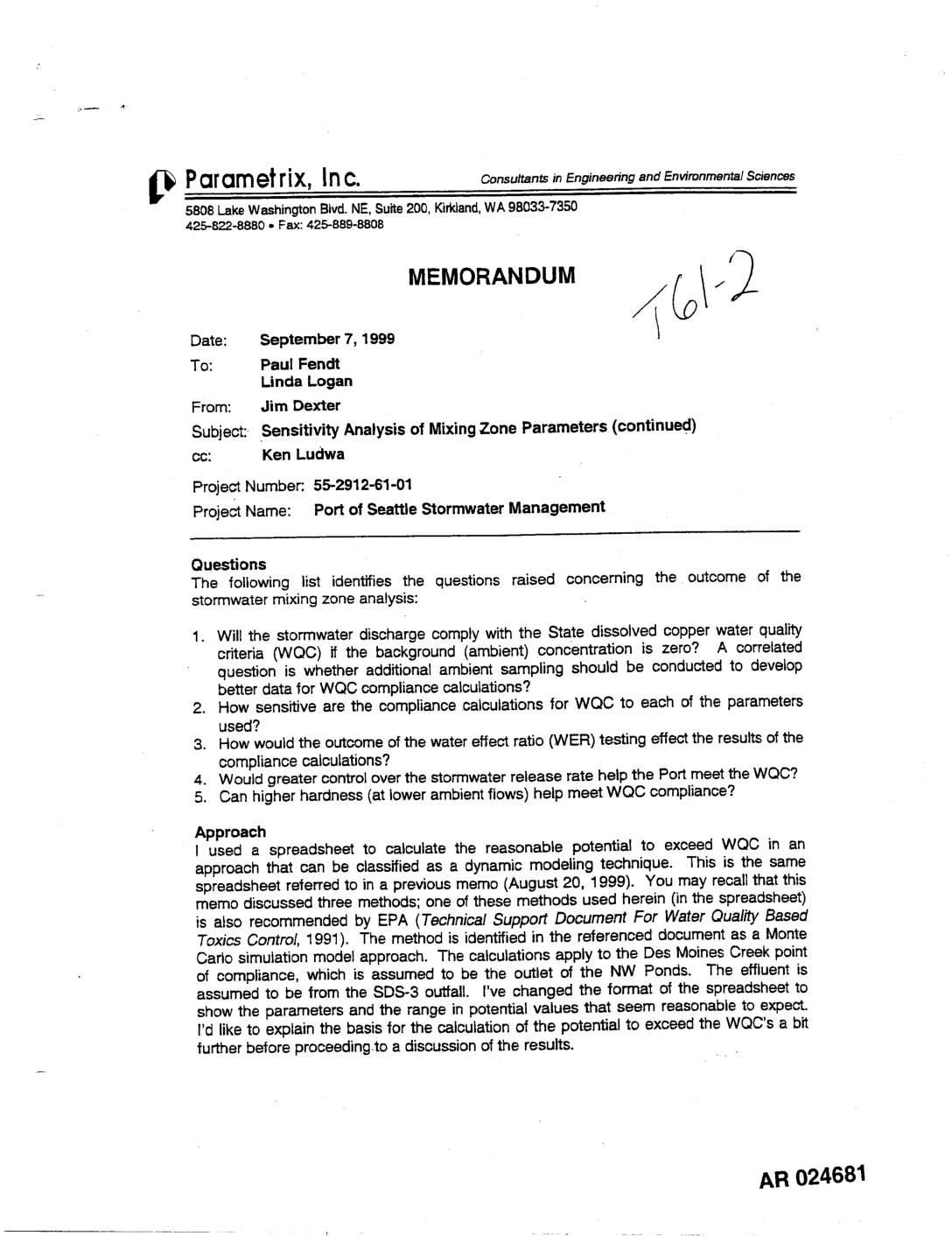
EXH AR024681: Sensitivity Analysis Mixing Zone Parameters (cont.) — Stormwater Mgmt
A 1999 technical memorandum from Parametrix, Inc. analyzes whether stormwater discharged near Des Moines Creek meets Washington State dissolved copper water quality criteria, using a Monte Carlo simulation model. The analysis finds that copper levels in the stormwater effluent consistently exceed water quality standards regardless of background ambient concentrations, with dilution factors generally less than 2. The study evaluates several potential remedies, including increased onsite detention, expanded mixing zones, and water effect ratio adjustments, finding that the Water Effect Ratio (WER) is the most influential factor in achieving compliance. -
 1999-09-01
EXH AR018047: Annual Stormwater Monitoring Report for Seattle-Tacoma International Airport, July 1, 1998 – June 30, 1999
Annual stormwater monitoring report (AR018047) prepared by Port Of Seattle for Seattle-Tacoma International Airport (STIA) covering the period July 1, 1998 through June 30, 1999. Documents NPDES stormwater sampling results across STIA storm drainage subbasins including grab and composite samples for total petroleum hydrocarbons (TPH), fecal coliforms, suspended solids (TSS), turbidity, biochemical oxygen demand (BOD5), -
 1999-09-01
EXH 428: Annual Stormwater Monitoring Report STIA Jul 1 1998–Jun 30 1999
This is the Annual Stormwater Monitoring Report for Seattle-Tacoma International Airport, covering the period from July 1, 1998 through June 30, 1999, prepared by the Port of Seattle. The report documents water quality sampling results from airport storm drainage systems, including measurements of petroleum hydrocarbons, metals, fecal coliforms, and the effects of aircraft and ground deicing activities on runoff. It includes data summaries, outfall inspections, and source tracing studies aimed at tracking and managing stormwater pollution from airport operations. -
 1999-09-01
EXH AR042872: Annual Stormwater Monitoring Report for STIA, July 1998–June 1999
Annual Stormwater Monitoring Report for Seattle-Tacoma International Airport (STIA) covering the period July 1, 1998 through June 30, 1999, prepared by Port Of Seattle, September 1999. Report AR 042872 covers NPDES stormwater sampling at STIA storm drainage subbasins including grab and composite sample results for total petroleum hydrocarbons (TPH), fecal coliforms, suspended solids (TSS), turbidity, -
 1999-09-01
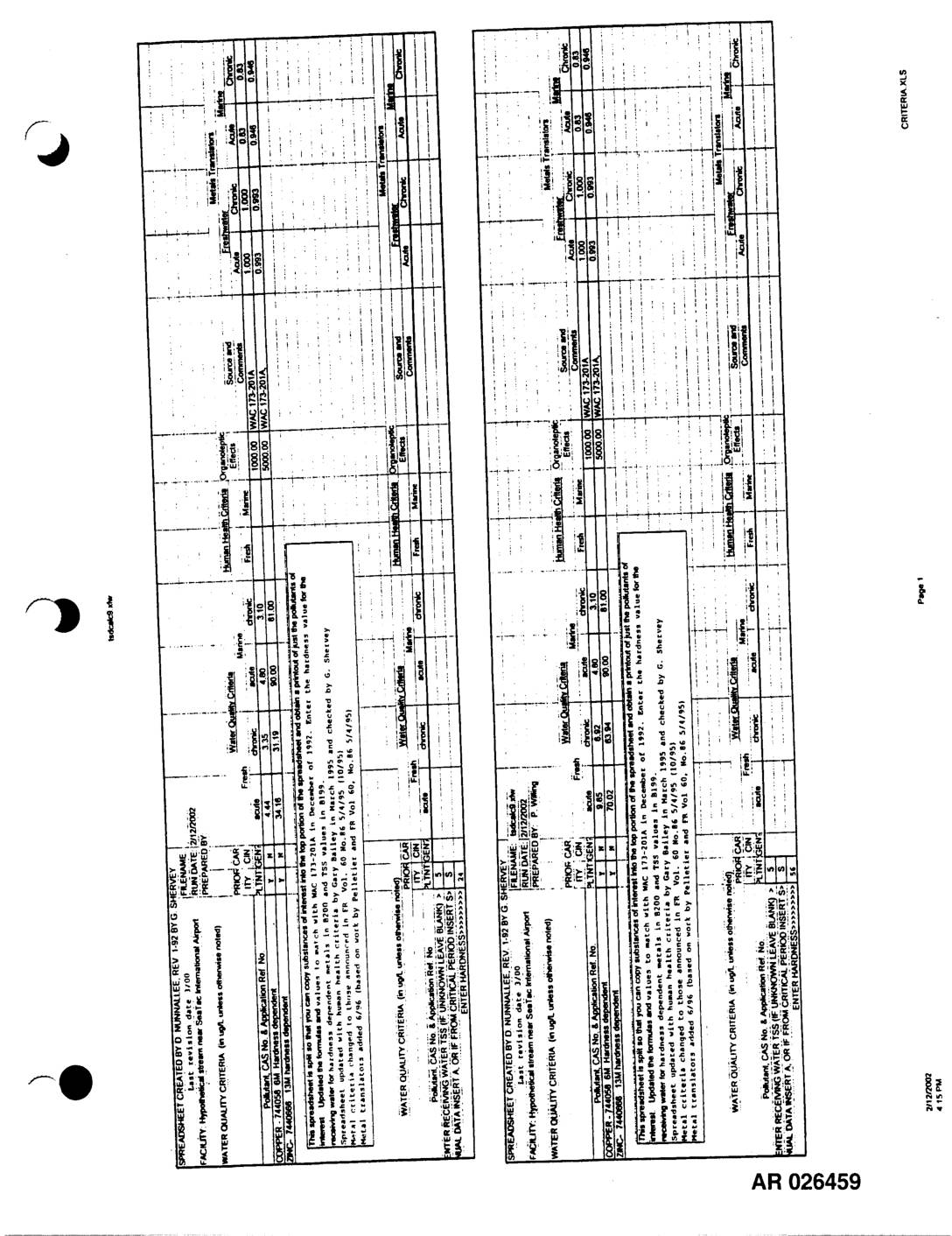
Exhibit 717: Annual Stormwater Monitoring Report for Seattle-Tacoma International Airport, July 1998–June 1999
Annual Stormwater Monitoring Report for Seattle-Tacoma International Airport (Sea-Tac Airport) covering July 1, 1998 through June 30, 1999, prepared by Port Of Seattle, September 1999 (AR 026459–AR 026461). Includes stormwater quality data tables for outfalls SDE4, SDS3, SDN1, and SDN4 with copper (CAS No. 7440-50-8) concentration measurements in micrograms per liter, hardness-dependent freshwater acute water -
 1999-08-20
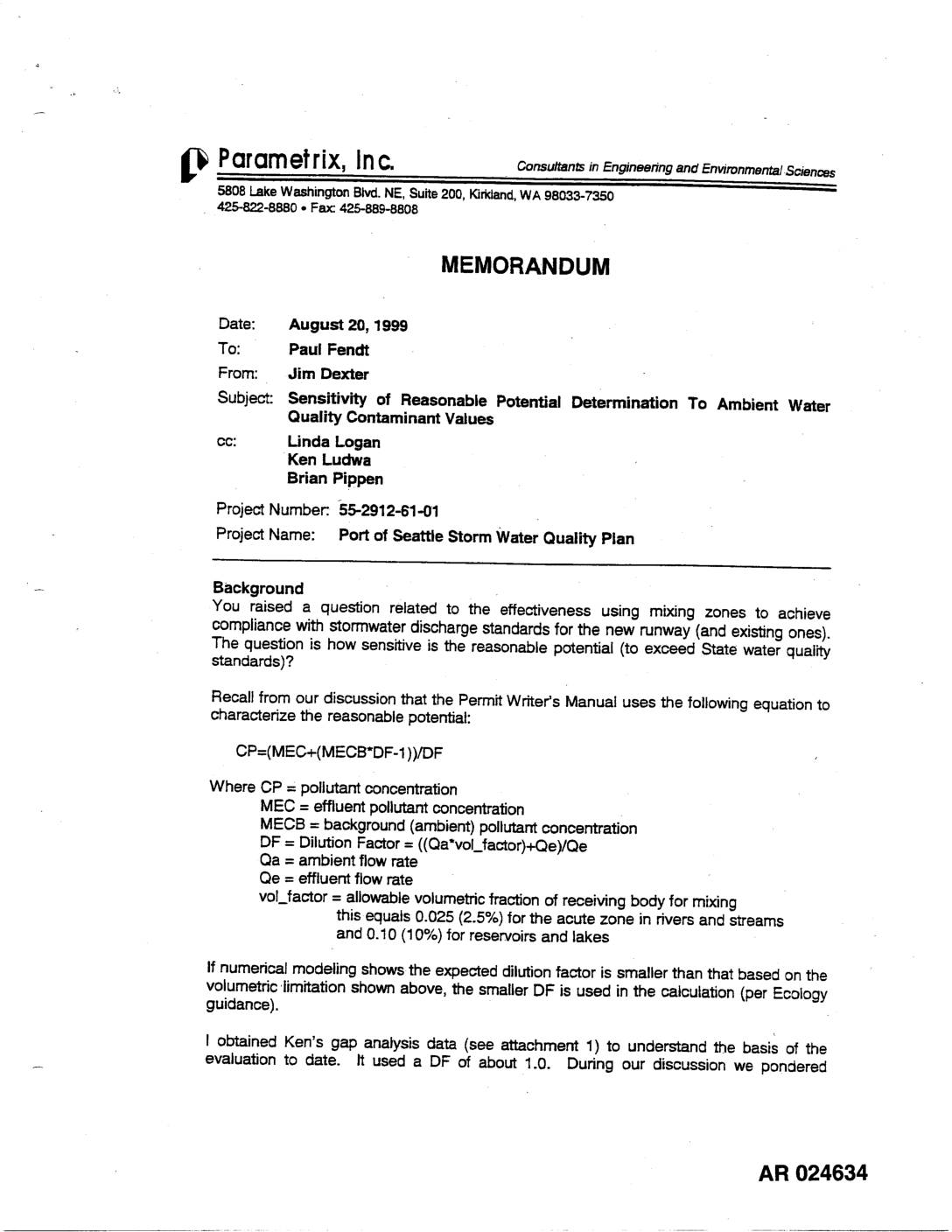
EXH AR024634: Memo — Sensitivity of Reasonable Potential Determination to Ambient Water Quality Contaminant Values
A 1999 technical memorandum from Parametrix, Inc. to the Port of Seattle analyzes the sensitivity of stormwater discharge compliance determinations for Sea-Tac Airport's runways, focusing on dissolved copper concentrations in Des Moines Creek. The memo evaluates whether mixing zones and dilution factors could offset elevated copper levels in stormwater runoff, finding that ambient copper concentrations already exceeded water quality criteria in 37–65% of samples. The analysis concludes that dilution factors based on streamflow alone are unlikely to be significantly greater than 1.0, though accounting for the Northwest Ponds' reservoir volume raises the estimated dilution factor to approximately 1.7. -
 1999-08-10
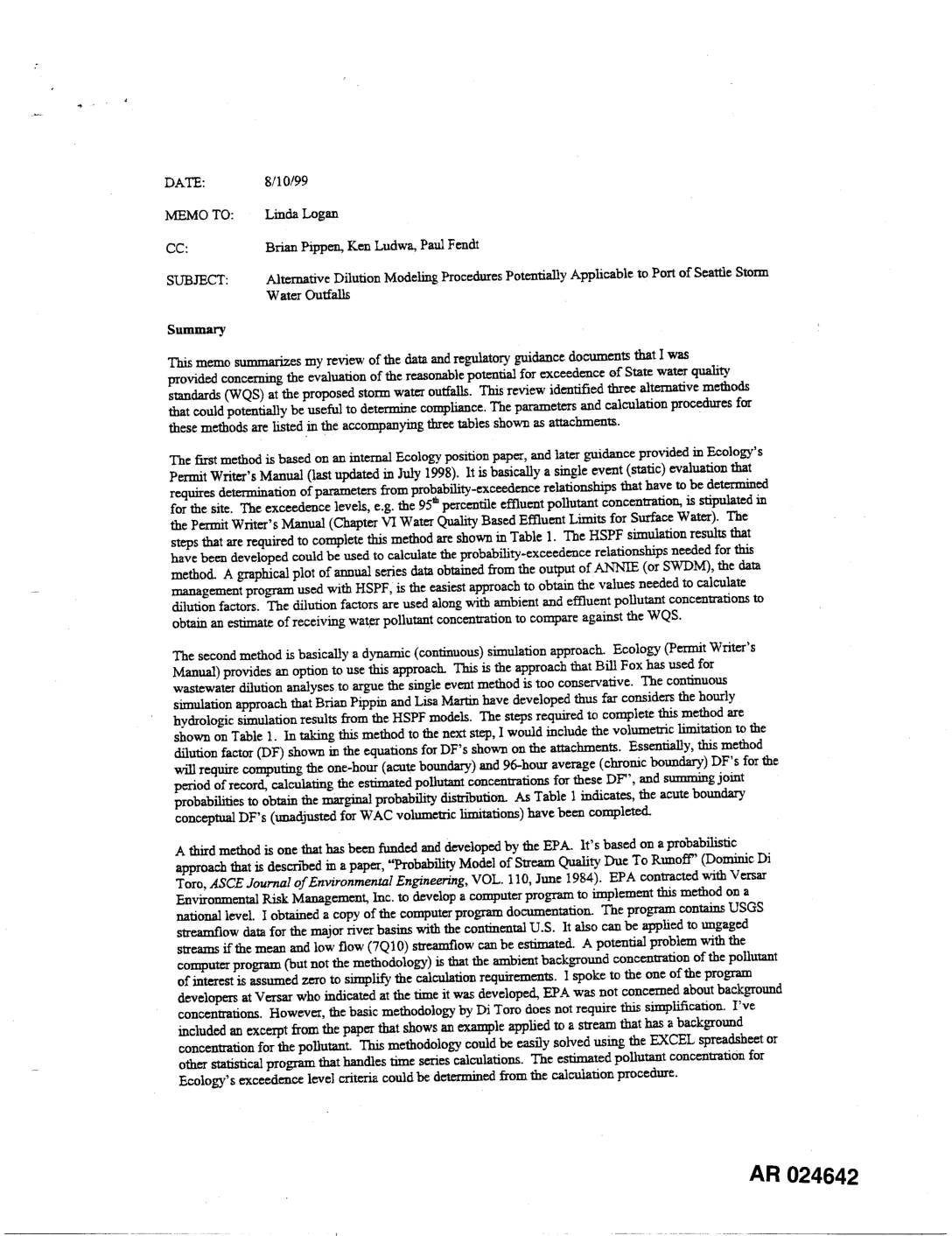
EXH AR024642: Memo Alternative Dilution Modeling Procedures Storm Water Outfalls
A 1999 internal technical memo from Parametrix, Inc. evaluates three alternative water-quality dilution modeling methods for assessing whether proposed stormwater outfalls at the Port of Seattle could exceed Washington State water quality standards. The methods range from a static single-event approach based on Ecology's Permit Writer's Manual to a dynamic continuous simulation using HSPF hydrologic models and a probabilistic EPA-funded model developed by researcher Dominic Di Toro. The memo recommends continuing with the continuous simulation approach while considering budget, Ecology's involvement, and the nature of ambient and effluent pollutant concentration data.