TagStART(508)
-
 2023-06-07
Sea-Tac Stakeholder Advisory Round Table annual report
The Sea-Tac Stakeholder Advisory Round Table (StART) is a forum created by the Port of Seattle to strengthen relationships between Sea-Tac Airport and six neighboring communities, working cooperatively to identify issues and possible solutions. Development of StART began in mid-2017, with each city appointing two community members and one city employee to participate, alongside the Airport's Managing Director as chair. Airlines Alaska and Delta, as well as Lynden, also serve as members of the round table. -
 2023-06-07
Airport noise programs overview
This presentation by Stan Shepherd, Senior Manager of Airport Noise Programs at Seattle-Tacoma International Airport, provides an overview of SEA's key noise management initiatives. The programs covered include Noise Abatement (such as flight procedure monitoring and the Fly Quiet program), the StART stakeholder roundtable, noise monitoring, noise mitigation, and community outreach. Together, these efforts reflect the airport's commitment to reducing the impact of aircraft noise on surrounding communities. -
 2023-04-24
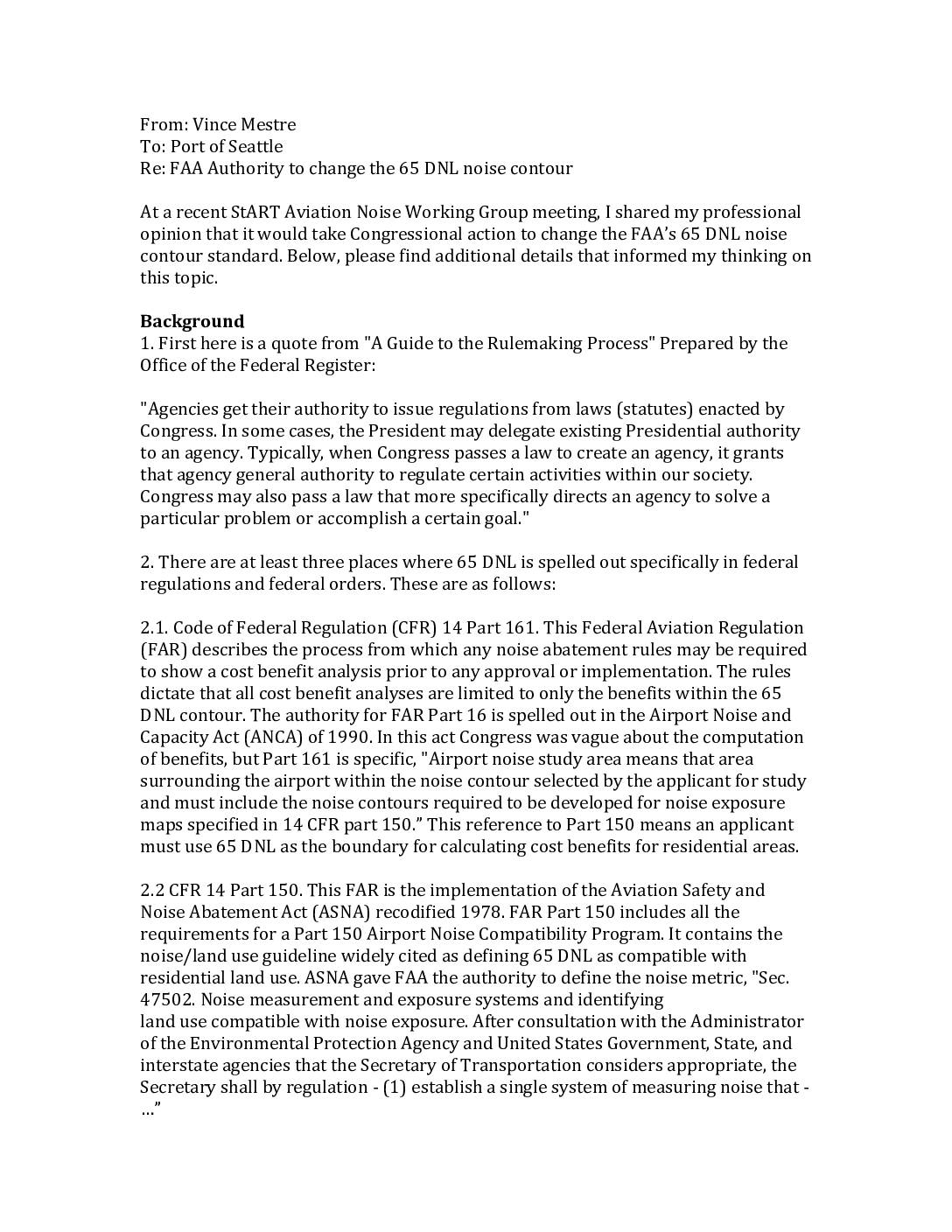
FAA authority to change the 65 DNL noise contour
Aviation noise consultant Vince Mestre explains to the Port of Seattle why changing the FAA's 65 DNL noise contour standard — the threshold used to determine acceptable aircraft noise near residential areas — would likely require an act of Congress rather than a simple regulatory update. The 65 DNL standard is embedded in at least three federal regulations and orders (CFR 14 Parts 150 and 161, and FAA Order 1050.1F), all of which trace their authority back to enabling legislation such as the Aviation Safety and Noise Abatement Act (ASNA) of 1978 and the Airport Noise and Capacity Act (ANCA) of 1990. Because the FAA's rulemaking authority is granted and bounded by those Congressional statutes, modifying ASNA would most likely be required before the FAA could formally lower or otherwise change the noise compatibility standard. -
 2023-04-10
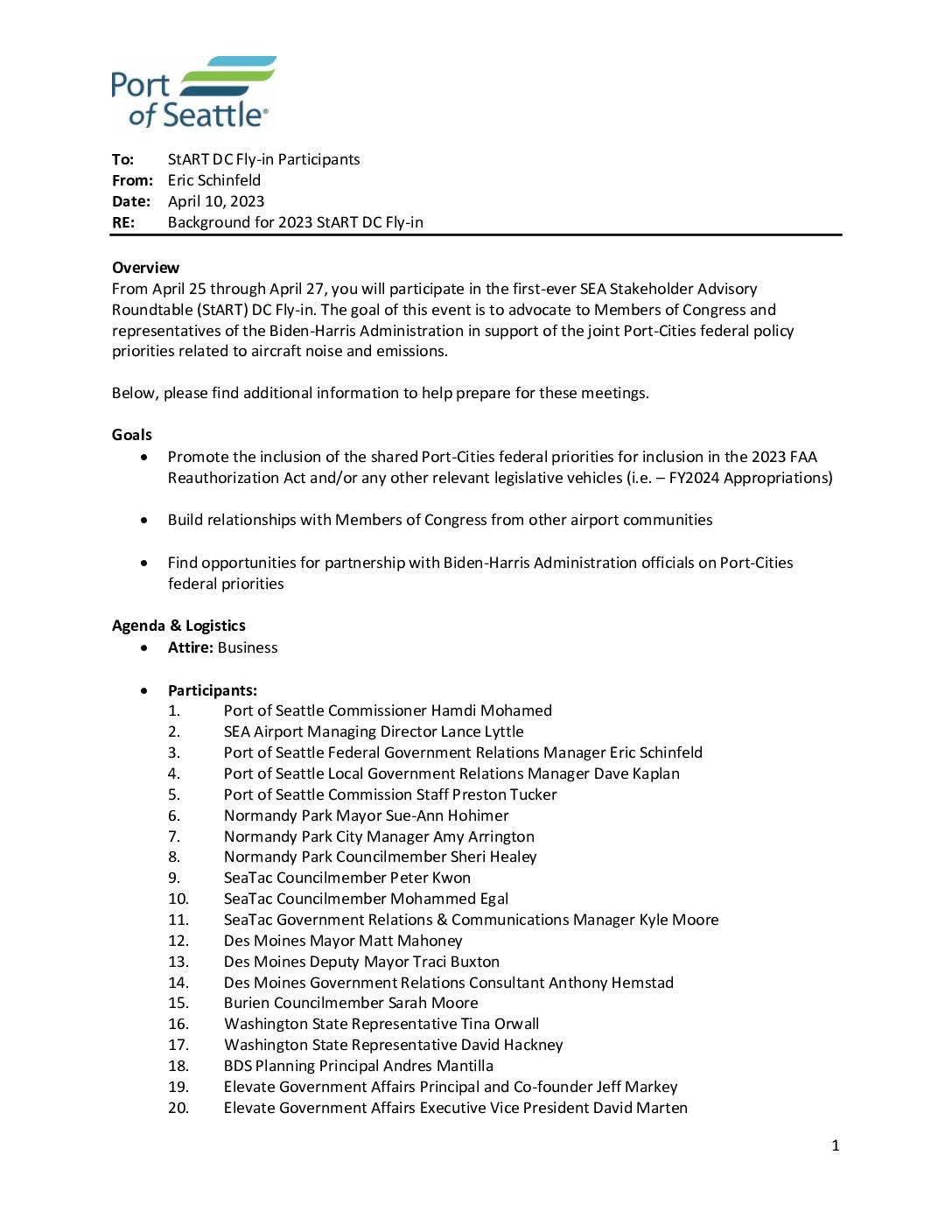
Background for 2023 StART DC Fly-in
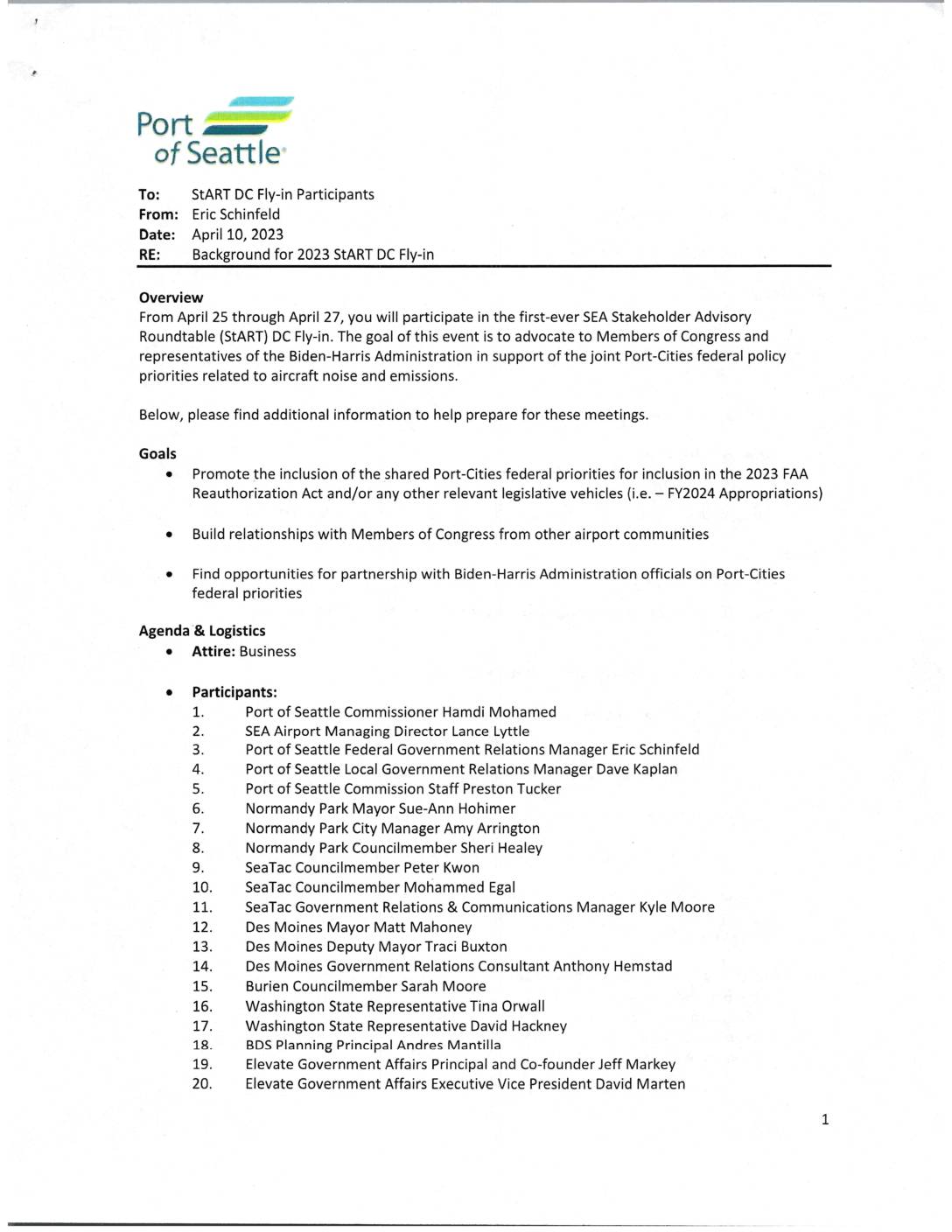
This April 2023 briefing memo prepared by the Port of Seattle outlines the agenda and federal policy goals for the first-ever StART (Stakeholder Advisory Roundtable) DC Fly-in, held April 25–27, 2023. A delegation of roughly 20 Port officials, city representatives, and government affairs consultants traveled to Washington, DC to meet with members of Congress and Biden administration officials about aircraft noise and emissions issues affecting communities near Seattle-Tacoma International Airport. Key legislative priorities included passing the Sound Insulation Treatment Repair and Replacement Program Act, the Aviation Noise and Emissions Mitigation Act, and establishing a formal Aircraft Noise Advisory Committee with binding deadlines for FAA action on noise policy reform. -
 2023-04-10
Background for 2023 StART DC Fly-in
This April 2023 memo from the Port of Seattle outlines the agenda and goals for the first-ever StART DC Fly-in, a trip in which Port and local city officials traveled to Washington, DC to advocate for federal policies addressing aircraft noise and emissions near Seattle-Tacoma International Airport. The delegation met with members of Congress, including Senator Maria Cantwell and several House Representatives, to push for legislation such as the Sound Insulation Treatment Repair and Replacement Program Act and the Aviation Noise and Emissions Mitigation Act. Key priorities included expanding eligibility for home sound insulation funding, involving the EPA in noise mitigation efforts, and establishing a formal Aircraft Noise Advisory Committee with a clear timeline for policy action. -
 2022-12-05
Letter to Washington congressional delegation on aircraft noise and emissions policy priorities for FAA Reauthorization
In December 2022, the Port of Seattle and six nearby cities (SeaTac, Burien, Des Moines, Normandy Park, Tukwila, and Federal Way) wrote to Washington's congressional delegation urging them to include aircraft noise and emissions reforms in the 2023 FAA Reauthorization bill. Their seven proposals cover topics such as expanding federal funding for noise insulation upgrades in homes near Sea-Tac Airport, creating a new Aircraft Noise Advisory Committee, and accelerating the adoption of sustainable aviation fuels (SAF) to cut carbon and air pollution. The letter reflects the work of the SEA Stakeholder Advisory Round Table (StART), a collaborative forum the Port and cities jointly established to address the growing impact of airport operations on surrounding communities. -
 2022-11-16
Highline Forum agenda: South King County Community Impact Fund update and Port Noise Program update
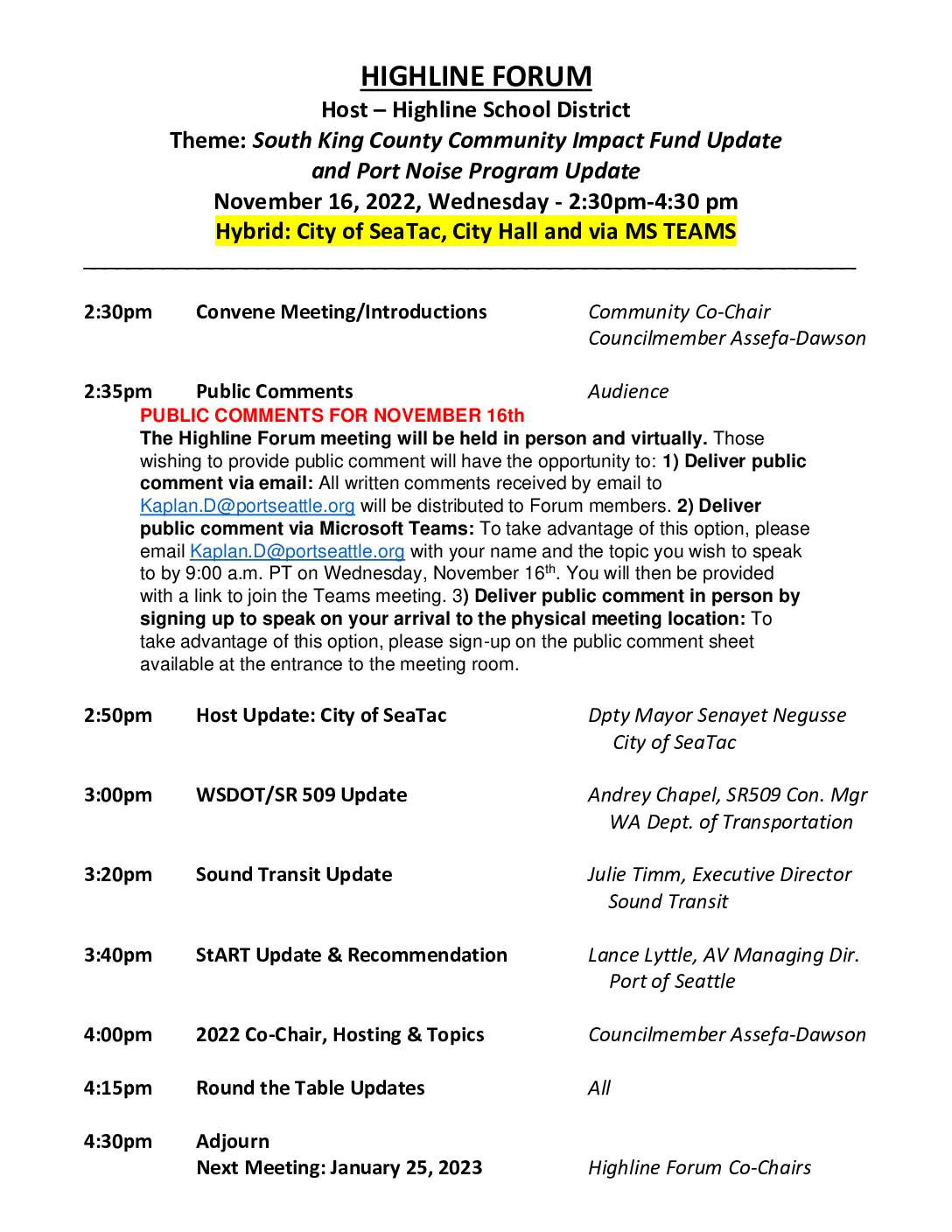
The Highline Forum met on November 16, 2022, hosted by the Highline School District at SeaTac City Hall, with a focus on the South King County Community Impact Fund and Port Noise Program updates. The agenda included presentations from the Port of Seattle, Sound Transit, and the Washington Department of Transportation, alongside public comment opportunities offered both in-person and virtually via Microsoft Teams. The document also lists six bimonthly Highline Forum meeting dates scheduled throughout 2023, each running from 2:30pm to 4:30pm. -
 2022-11-15
Agenda: Burien Airport Committee, November 15, 2022
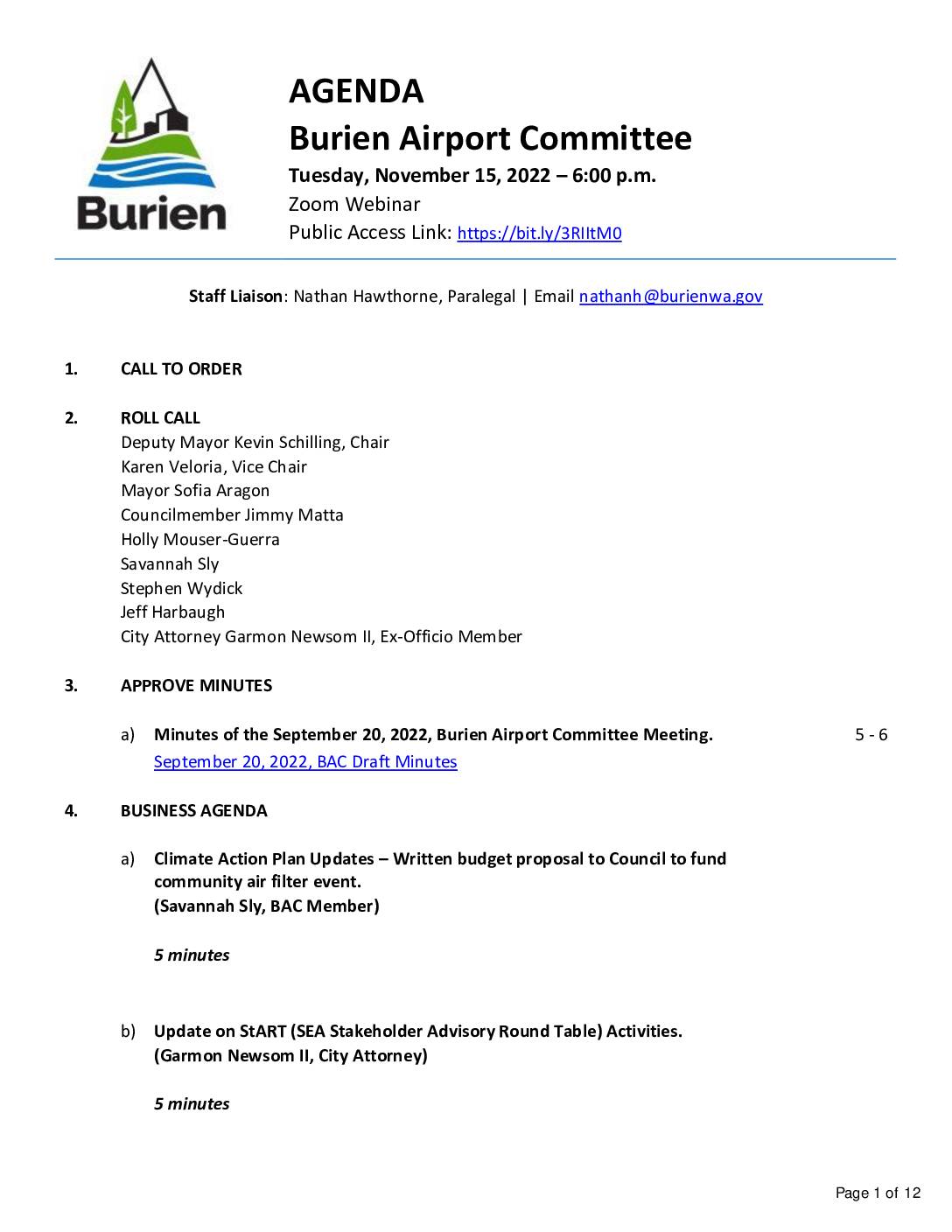
The Burien Airport Committee held a public meeting on November 15, 2022, via Zoom to discuss issues related to Seattle-Tacoma International Airport and its impact on the community. Agenda items included a climate action plan proposal to fund a community air filter event, updates on the SEA Stakeholder Advisory Round Table (StART), federal legislative updates, and a review of the committee's workplan. The meeting also covered potential volunteers for the Comprehensive Plan Advisory Committee and a discussion about returning to in-person meetings. -
 2022-10-26
Delta Air Lines Sustainability Overview
Delta Air Lines has committed to reaching net zero carbon emissions by 2050, with shorter-term goals including using 10% Sustainable Aviation Fuel (SAF) by 2030 and setting science-based emissions targets aligned with aviation industry guidance. To reduce its environmental footprint, Delta has retired over 200 older aircraft and replaced them with newer, more fuel-efficient models that burn 20-25% less fuel. The airline's emissions reduction strategy relies on three main levers: fleet renewal, operational improvements, and increased use of SAF. -
 2022-10-26
Air pollution emission reduction actions
Seattle-Tacoma International Airport is taking steps to reduce air pollution by targeting fossil fuel combustion from diesel vehicles, aircraft engines, and roadway traffic. Key initiatives include providing electric vehicle incentives for rideshare drivers like Uber and Lyft, electrifying rental car and Port-owned fleets, and exploring programs to encourage travelers to use greener transit options. These efforts aim to address both local air quality and broader greenhouse gas emissions at the airport.