TagSEPA(232)
-
 2025-08-21
SEPA Determination of Non-Significance: Sea-Tac Airport Flight Corridor Management Program (POS SEPA No. 2025-05)
The Port of Seattle has issued a Determination of Non-Significance (DNS) under Washington's State Environmental Policy Act (SEPA) for its Flight Corridor Management Program at Seattle-Tacoma International Airport. The program, conducted approximately every five years, identifies and removes trees and other obstructions near the airport's runways that could interfere with flight paths, while also requiring ongoing ecological monitoring and tree replacement. A 15-day public comment period ran through September 11, 2025, after which the Port planned to formally adopt the determination, with any appeals required to be filed in King County Superior Court within 21 days of formal adoption. -
 2025-08-20
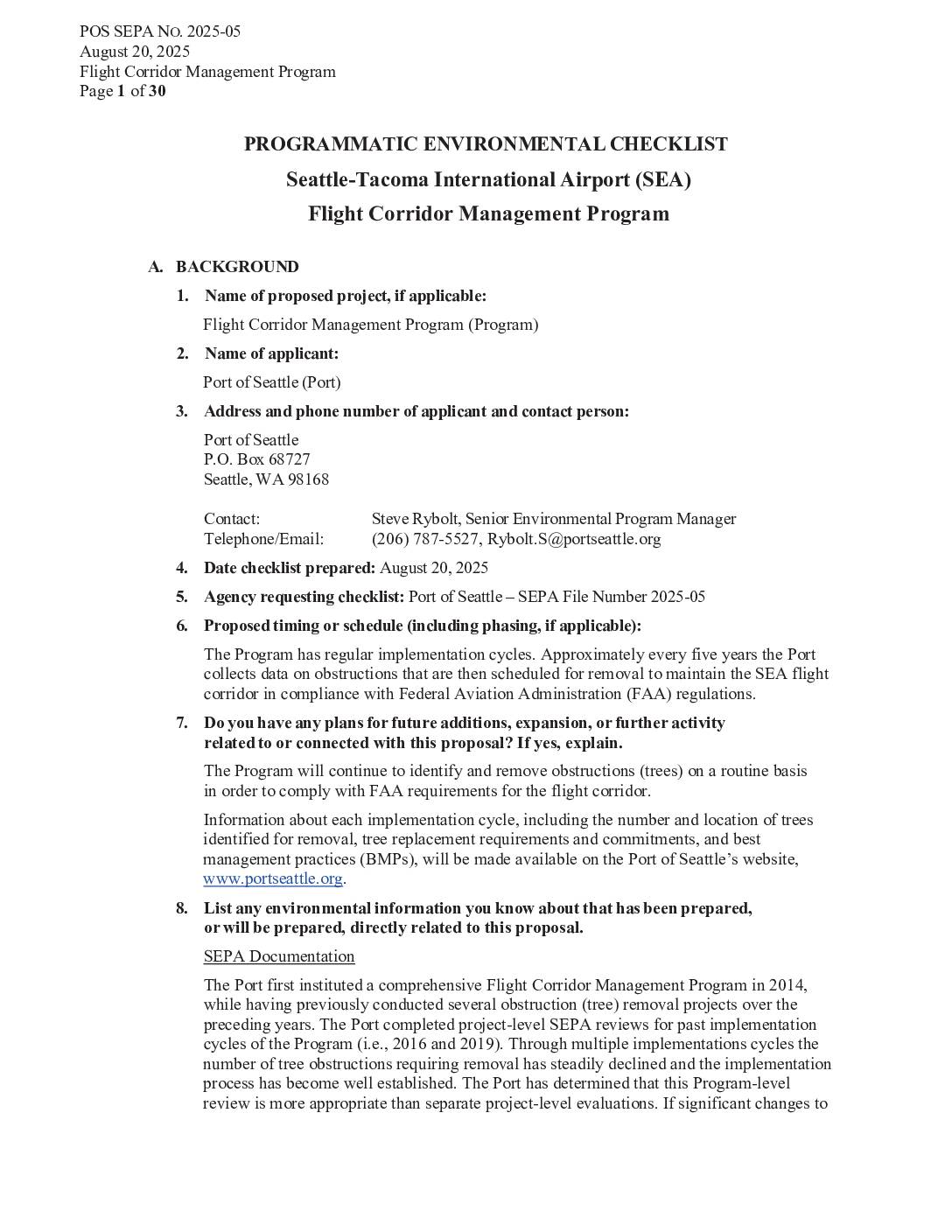
Programmatic Environmental Checklist: Seattle-Tacoma International Airport Flight Corridor Management Program
The Port of Seattle's Flight Corridor Management Program is an ongoing effort to identify and remove trees near Seattle-Tacoma International Airport (SEA) that obstruct the flight paths of its three parallel runways, as required by FAA regulations. Approximately every five years, the Port surveys the area, removes obstructing trees, and replants replacements, with each cycle documented in publicly available Implementation Plans and Regulatory Memoranda. This 2025 programmatic environmental review under Washington's State Environmental Policy Act (SEPA) covers the long-term program rather than individual removal projects. -
 2025-07-28
Appendix D: Biological Opinion and Essential Fish Habitat Response for Seattle-Tacoma International Airport Sustainable Airport Master Plan Near-Term Projects
The National Marine Fisheries Service (NMFS) issued a Biological Opinion on July 28, 2025, in response to a Federal Aviation Administration consultation request regarding near-term construction projects outlined in the Seattle-Tacoma International Airport Sustainable Airport Master Plan. The opinion evaluates potential effects of these projects on endangered species and critical fish habitat under the Endangered Species Act and the Magnuson-Stevens Fishery Conservation and Management Act. NMFS reviewed and independently verified analyses from the FAA's Biological Evaluation, incorporating findings related to the proposed action area, species status, and effects on critical habitat. -
 2025-06-26
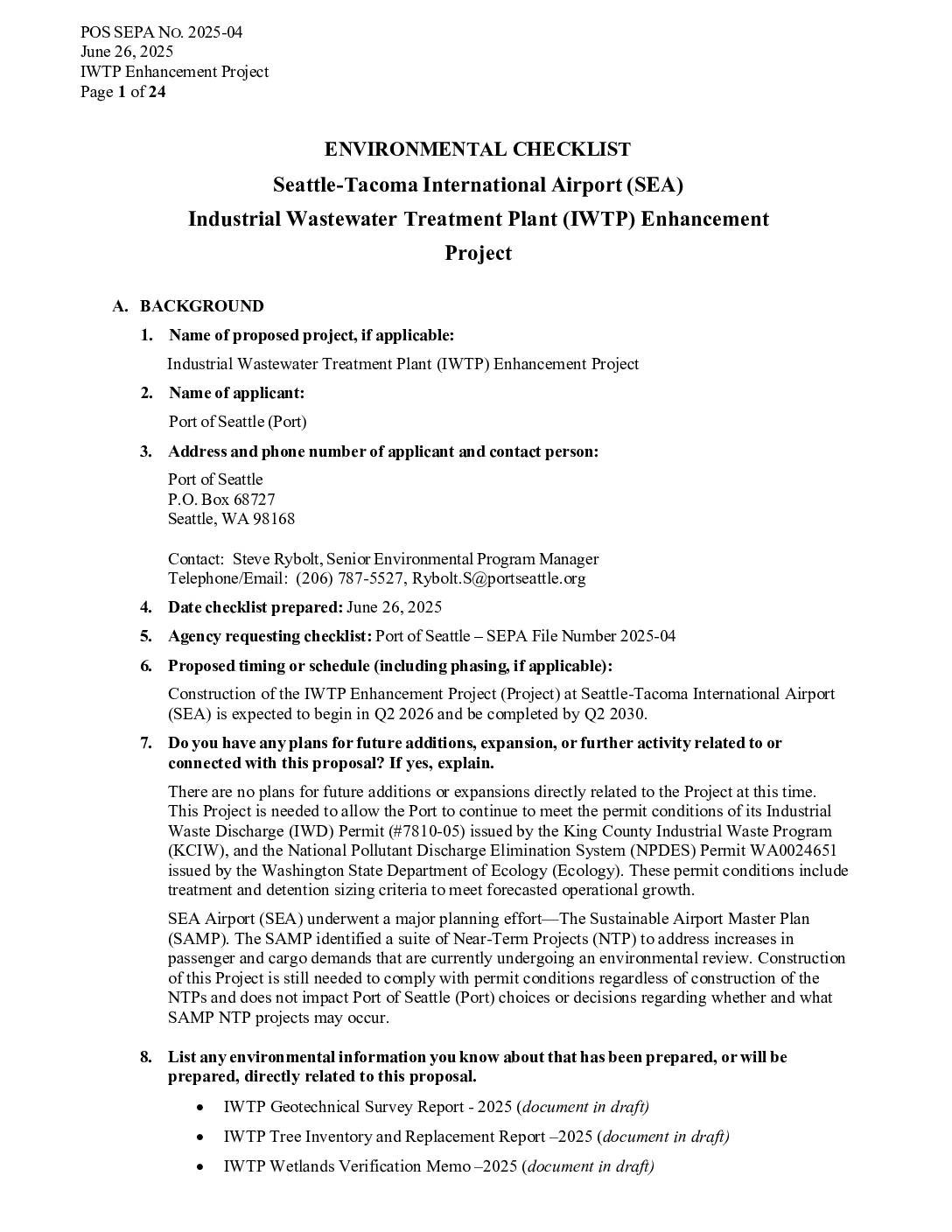
Environmental checklist: Seattle-Tacoma International Airport (SEA) Industrial Wastewater Treatment Plant (IWTP) Enhancement Project
The Port of Seattle is proposing upgrades to Seattle-Tacoma International Airport's Industrial Wastewater Treatment Plant (IWTP) to better handle wastewater from aircraft deicing operations, with construction planned from 2026 to 2030. The project involves replacing aging treatment equipment at the existing facility and building a new aerated gravel bed (AGB) treatment system on a 10.6-acre site nearby to process high levels of biochemical oxygen demand (BOD) on-site. These upgrades are required to comply with tightening discharge limits set by King County and state environmental permits. -
 2025-06-10
Wetland Verification Memorandum: SEA Industrial Wastewater Treatment Plant Expansion Project
WSP conducted a wetland verification study in May 2025 to confirm the accuracy of a 2022 wetland delineation near the Seattle-Tacoma International Airport's Industrial Wastewater Treatment Plant (IWTP), which is being expanded to increase treatment capacity and meet permit requirements. The study assessed three previously identified wetlands — IWS-A, IWS-B, and WL28 — all located within the Lagoon 3 Study Area, ranging in size from 0.54 to 29.7 acres. The verification was conducted to ensure the existing delineation boundaries remain valid for environmental permitting purposes ahead of planned construction. -
2025-06-10
Wetland Verification Memorandum: SEA Industrial Wastewater Treatment Plant Expansion Project
WSP conducted a wetland verification study in May 2025 to confirm the accuracy of a 2022 wetland delineation near the Seattle-Tacoma International Airport's Industrial Wastewater Treatment Plant (IWTP), which is being expanded to increase treatment capacity and meet permit requirements. The study assessed three previously identified wetlands — IWS-A, IWS-B, and WL28 — all located within the Lagoon 3 Study Area, ranging in size from 0.54 to 29.7 acres. The verification was conducted to ensure the existing delineation boundaries remain valid for environmental permitting purposes ahead of planned construction. -
 2025-02-12
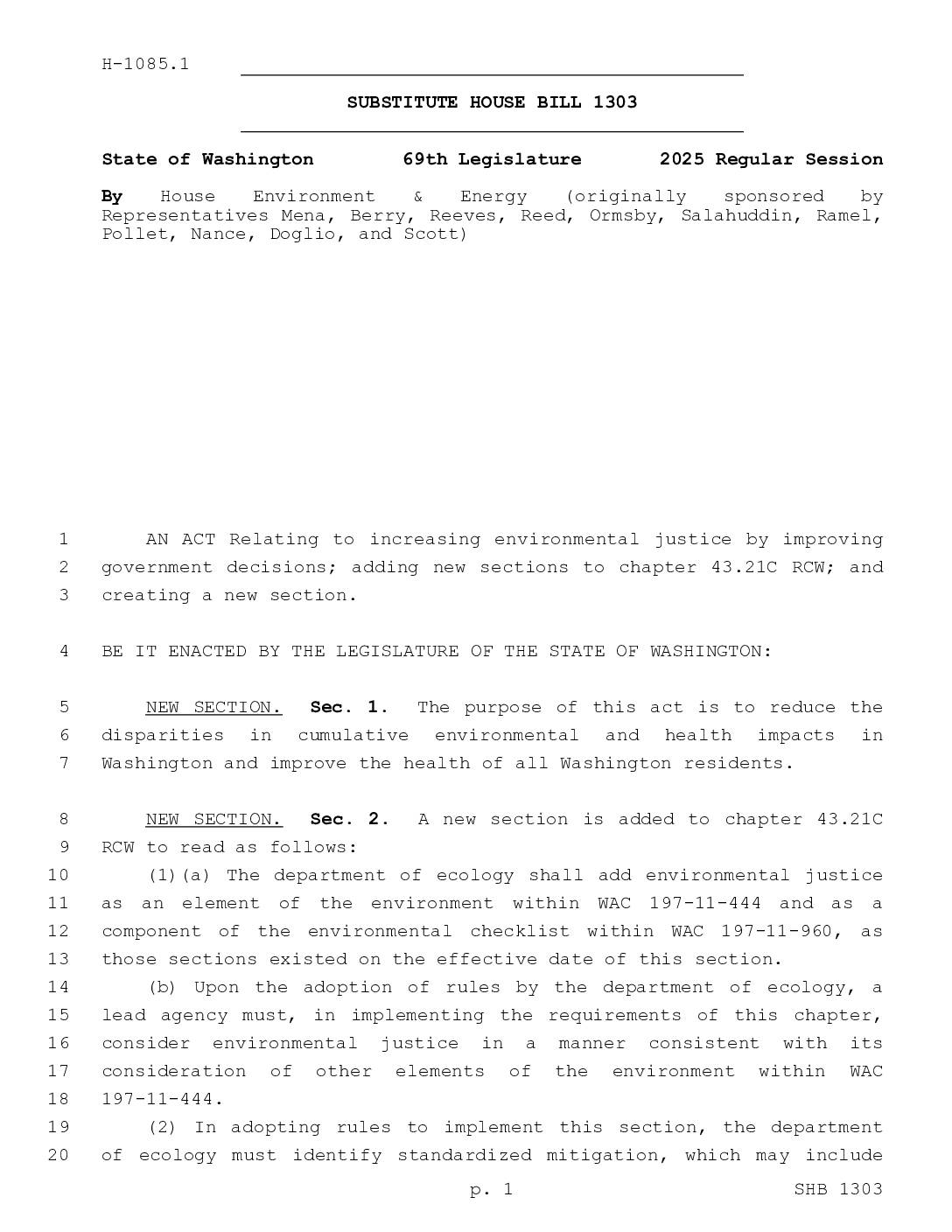
Substitute House Bill 1303: Increasing environmental justice by improving government decisions
Washington State Substitute House Bill 1303 requires the Department of Ecology to add environmental justice as a formal element of environmental review under the State Environmental Policy Act (SEPA), including updates to environmental checklists and impact assessments. The bill directs the agency to develop standardized mitigation measures for potential environmental justice impacts, which must be factored into project threshold determinations. These new requirements are intended to reduce disparate environmental and health burdens on overburdened communities across Washington State. -
 2025-01-28
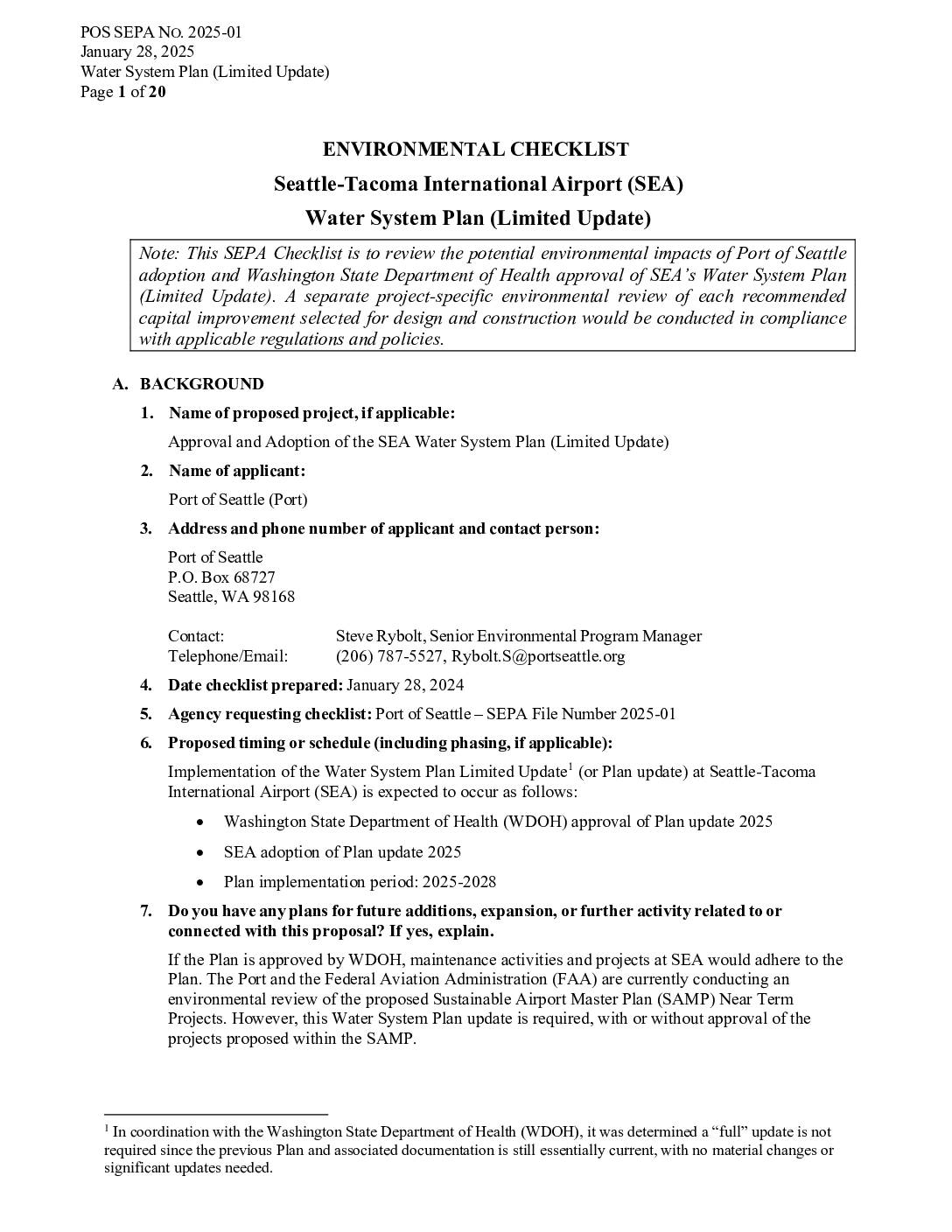
Environmental checklist: Seattle-Tacoma International Airport (SEA) Water System Plan (Limited Update)
The Port of Seattle submitted an environmental checklist in January 2025 for a limited update to Seattle-Tacoma International Airport's Water System Plan, covering the period 2025–2028. The update addresses routine maintenance and infrastructure improvements to SEA's drinking water and fire protection system, including pipe replacements, new surge tanks, additional water storage, and a backup water supply connection to Highline Water District. Washington State Department of Health approval and Port of Seattle Commission adoption are required before the plan can be implemented. -
 2025-01-23
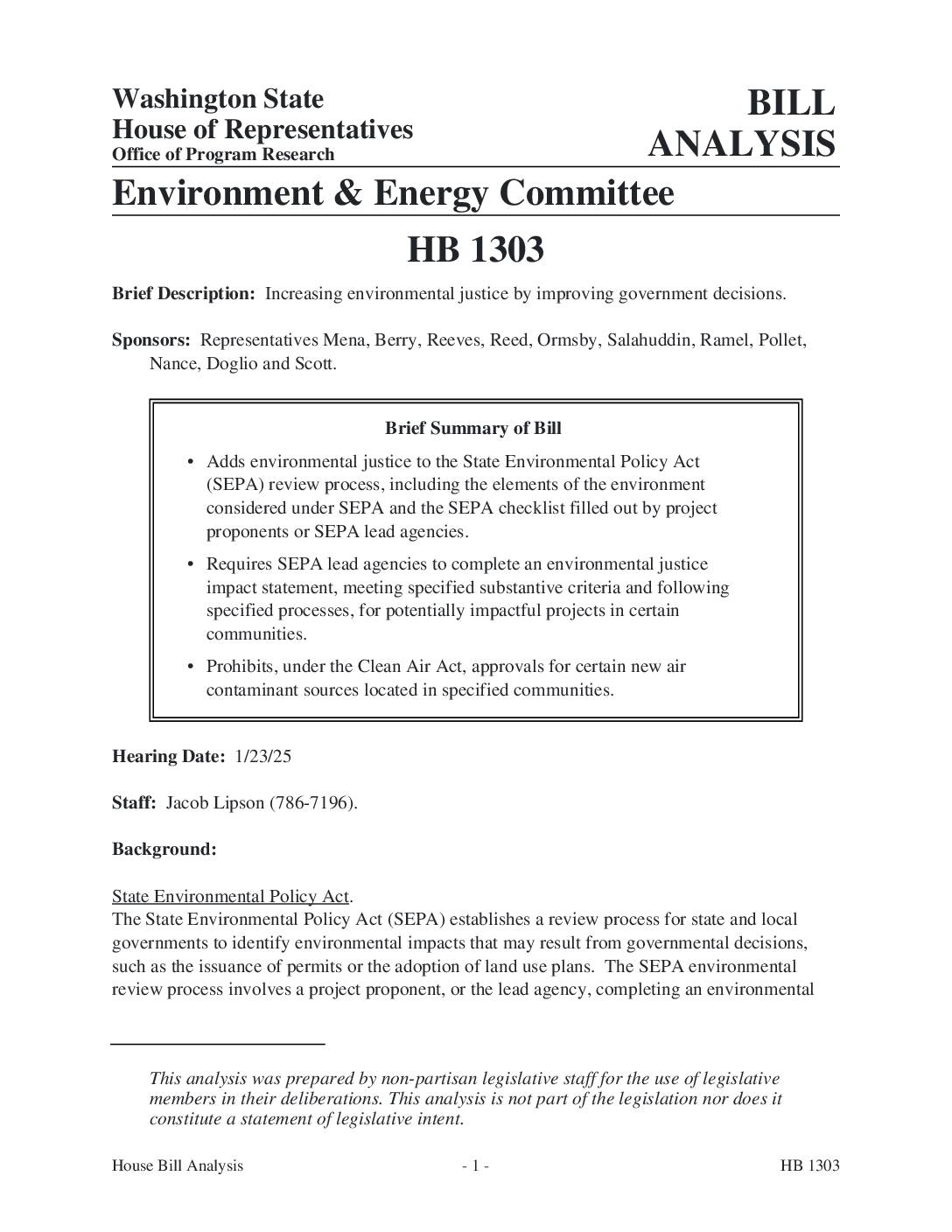
Bill analysis: HB 1303 — Increasing environmental justice by improving government decisions
HB 1303 is a Washington State bill focused on environmental justice, not Sea-Tac Airport noise policy. It proposes adding environmental justice considerations to the State Environmental Policy Act (SEPA) review process and prohibiting certain air pollution permits in overburdened communities. This document does not contain relevant content for a Sea-Tac Airport noise policy archive. -
 2025-01-21
Senate Bill 5380: Increasing environmental justice by improving government decisions
Washington Senate Bill 5380 (2025) requires state agencies to evaluate environmental justice impacts when reviewing permits for industrial or potentially harmful projects located in pollution-burdened communities. It mandates the completion of an Environmental Justice Impact Statement and a public hearing within affected communities before project approvals can move forward. The bill aims to reduce cumulative environmental and health disparities across Washington State.