TagSAMP Draft SEPA EIS(47)
-
 2026-06-13
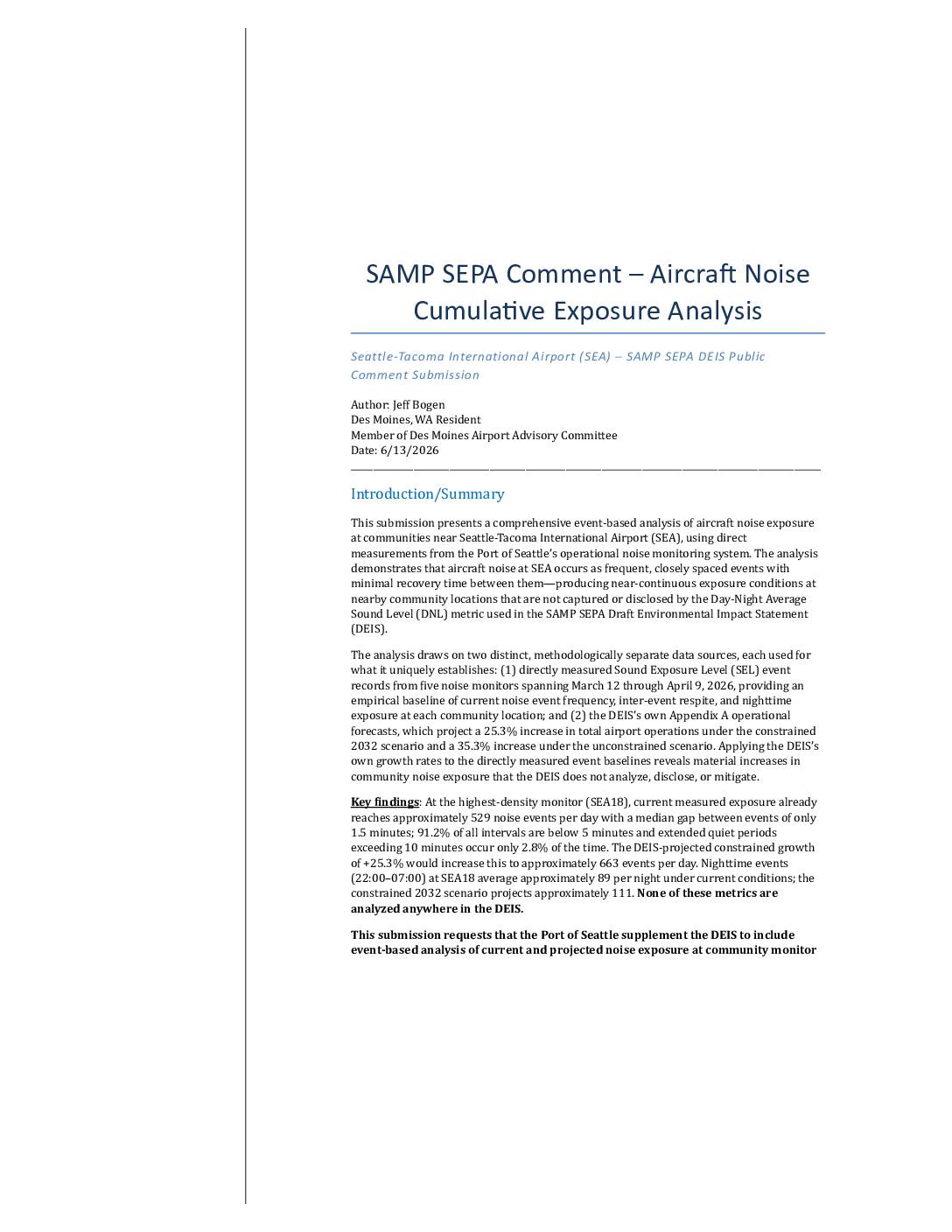
SAMP SEPA Comment – Aircraft Noise Cumulative Exposure Analysis
A Des Moines, WA resident and airport advisory committee member submitted this public comment challenging the noise analysis in the Sea-Tac Airport (SEA) expansion environmental review, arguing that the standard Day-Night Average Sound Level (DNL) metric used by the Port of Seattle fails to capture the true burden of aircraft noise on nearby communities. Using direct measurements from Port noise monitors, the analysis found that some locations currently experience around 529 noise events per day with a median gap of only 1.5 minutes between events, conditions projected to worsen significantly under the airport's own growth forecasts. The comment calls on the Port to supplement its environmental review with event-based noise metrics—such as event frequency, quiet-period gaps, and nighttime disturbances—that research links more directly to health impacts like sleep disruption and cardiovascular disease. -
 2026-06-11
Ep #34 Emergency! Do This… (Part 3/3 Don’t reinvent the wheel!)
Don't start from scratch—the 2026 comment period is a do-over from 2018! As the 2026 Sustainable Airport Master Plan public comment period opens, activists face the same challenges tackled in 2018, but with less preparation and smaller budgets. Rather than drowning in thousands of SAMP pages, this episode reveals a powerful shortcut: use the extensive work already completed by hundreds of concerned residents and professionals. This isn't just about avoiding wheel reinvention; it's about standing on the shoulders of previous advocates to make stronger, more informed public comments that actually address systemic community impacts. -
 2026-06-11
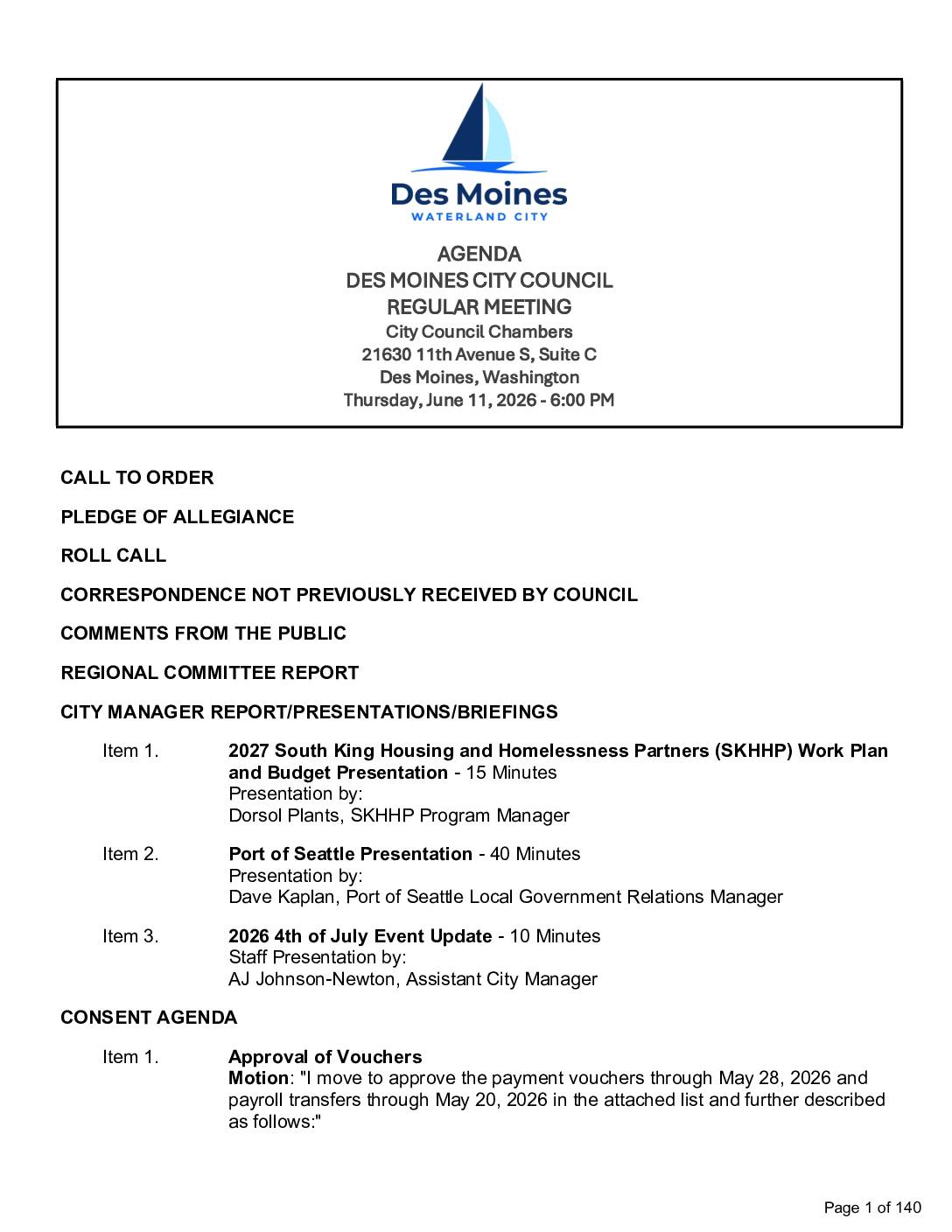
Des Moines City Council Regular Meeting June 11, 2026
Call to Order Pledge of Allegiance Roll Call Correspondence and Public Comments Correspondence Not Previously Received by Council Comments from the Public Regional Committee Report City Manager Report/Presentations/Briefings 2027 South King Housing and Homelessness Partners (SKHHP) Work Plan and Budget Presentation – 15 Minutes Presentation by: Dorsol Plants, SKHHP Program Manager Port of Seattle Presentation -
 2026-06-11
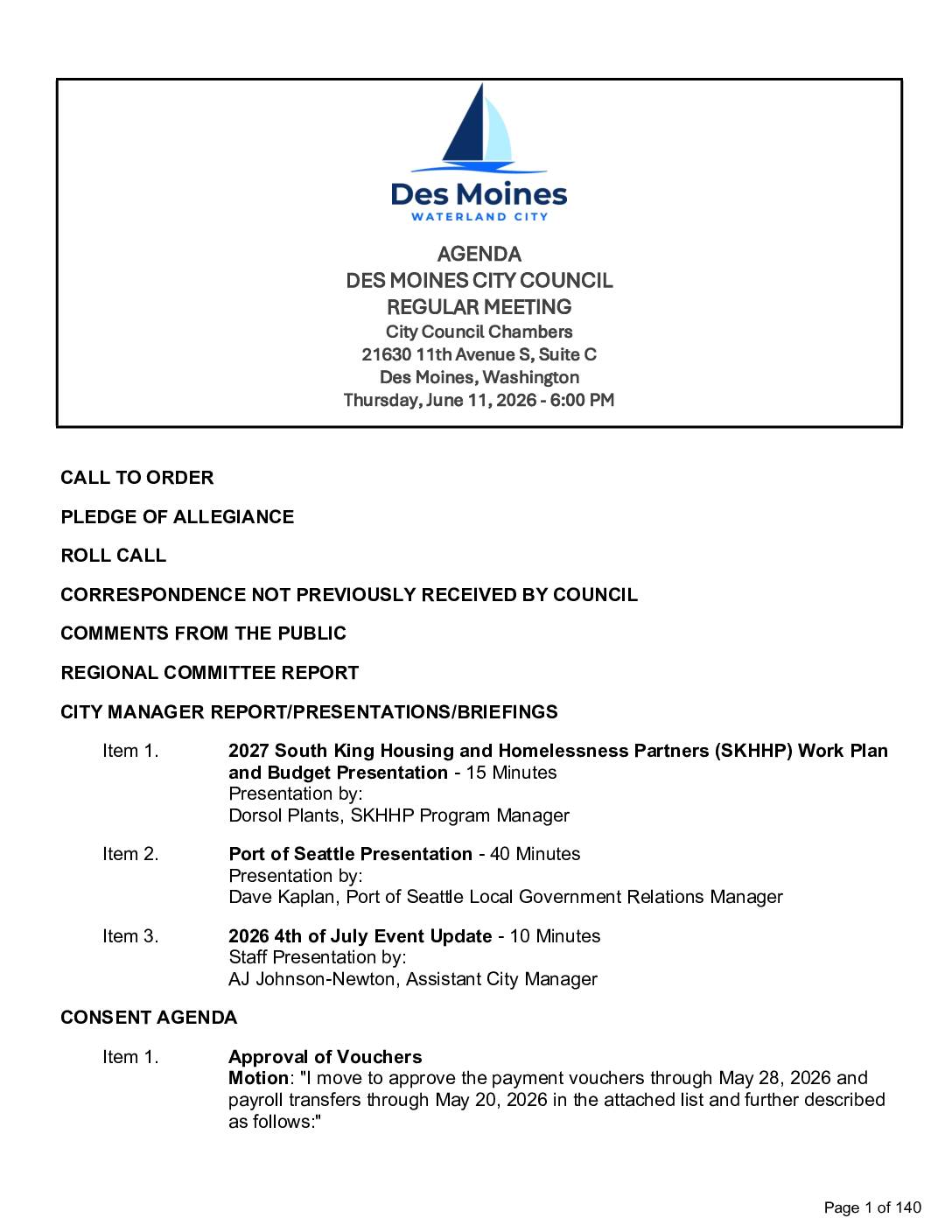
Des Moines City Council June 11, regular meeting
The Des Moines, Washington City Council held a regular meeting on June 11, 2026, featuring a Port of Seattle presentation by Local Government Relations Manager Dave Kaplan, which is relevant to ongoing discussions about Sea-Tac Airport's impact on the surrounding community. The agenda also included routine city business such as budget approvals, proclamations, and infrastructure matters, alongside a review of the city's strategic priorities plan titled 'Charting Our Course.' Members of the public were able to participate in person or via Zoom by registering with the city clerk in advance. -
2026-06-09
Ep #33 Emergency! Do This… (Part 2/3 Appendix K-Socioeconomics)
The Port of Seattle's Sustainable Airport Master Plan promises community benefits, but decades of evidence suggest otherwise. The FAA and Port have systematically underestimated airport impacts on nearby communities—particularly affecting public health, children's wellbeing, and local socioeconomic stability. Appendix K's socioeconomic analysis is merely copied from flawed earlier documents, and how you can challenge this in the public comment period. The stakes are real: while the airport claims to boost the region, surrounding communities face declining municipal services and ongoing budget crises. Understand the disconnect between promised prosperity and lived reality, and find out exactly what your comments should address to make them count during this crucial 60-day window. -
 2026-06-08
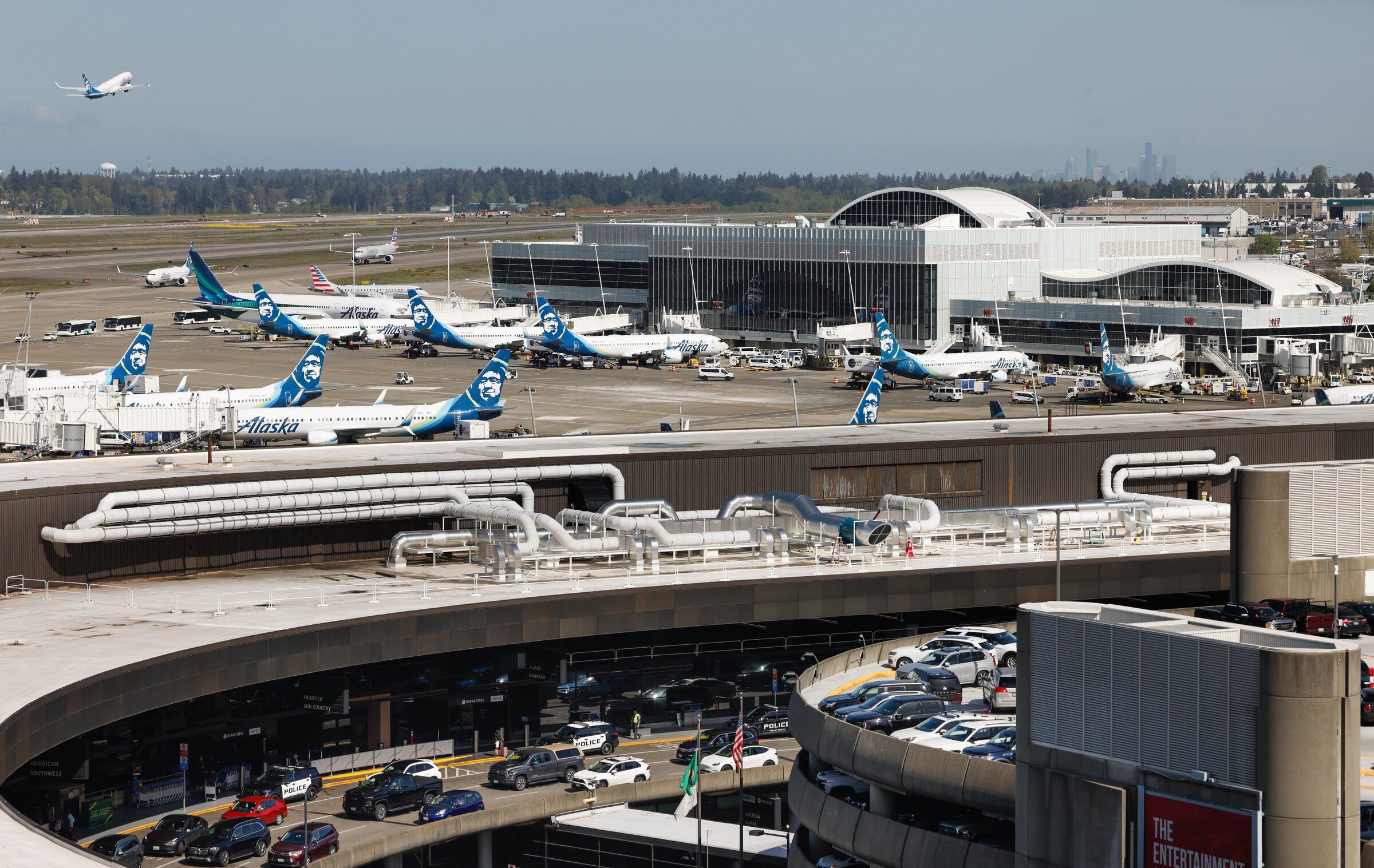
Proposed Seattle Tacoma airport expansion will be good for region
By Angela Birney and Dana Ralph Special to The Seattle Times As elected officials, we are committed to serving the public good. That requires us not only to think beyond what’s needed for our communities to thrive today but also to focus on long-term planning for current and future residents. That is why we both -
2026-06-08
Ep #32 Emergency! Do This… (Part 1/3 Mind The Gaps)
**Discover why environmental progress stalled for airport communities while cars got cleaner** Ever wonder why your car's emissions have dramatically improved over decades, but aviation seems stuck in the past? In this eye-opening episode of The Airport Communities Podcast, we explore the fascinating tale of two environmental paths that diverged after 1970. While Washington Senator Scoop Jackson spearheaded NEPA—one of the largest expansions of environmental policy in American history—and California secured game-changing carve-outs in the Clean Air Act that led to massive air quality improvements, aviation somehow got left behind. Despite Boeing being headquartered in Washington, aviation environmental standards never caught up. UW Meteorologist Cliff Mass delivers some stark perspective: those two annual flights to Europe generate more greenhouse gases than most people produce in their entire homes over a year. Meanwhile, Boeing's monopoly status has eliminated market incentives for cleaner technology. This wasn't an oversight—it was intentional. Today, every airport community continues paying the price for decisions made decades ago that exempted aviation from automotive-level engineering standards. -
 2026-06-04
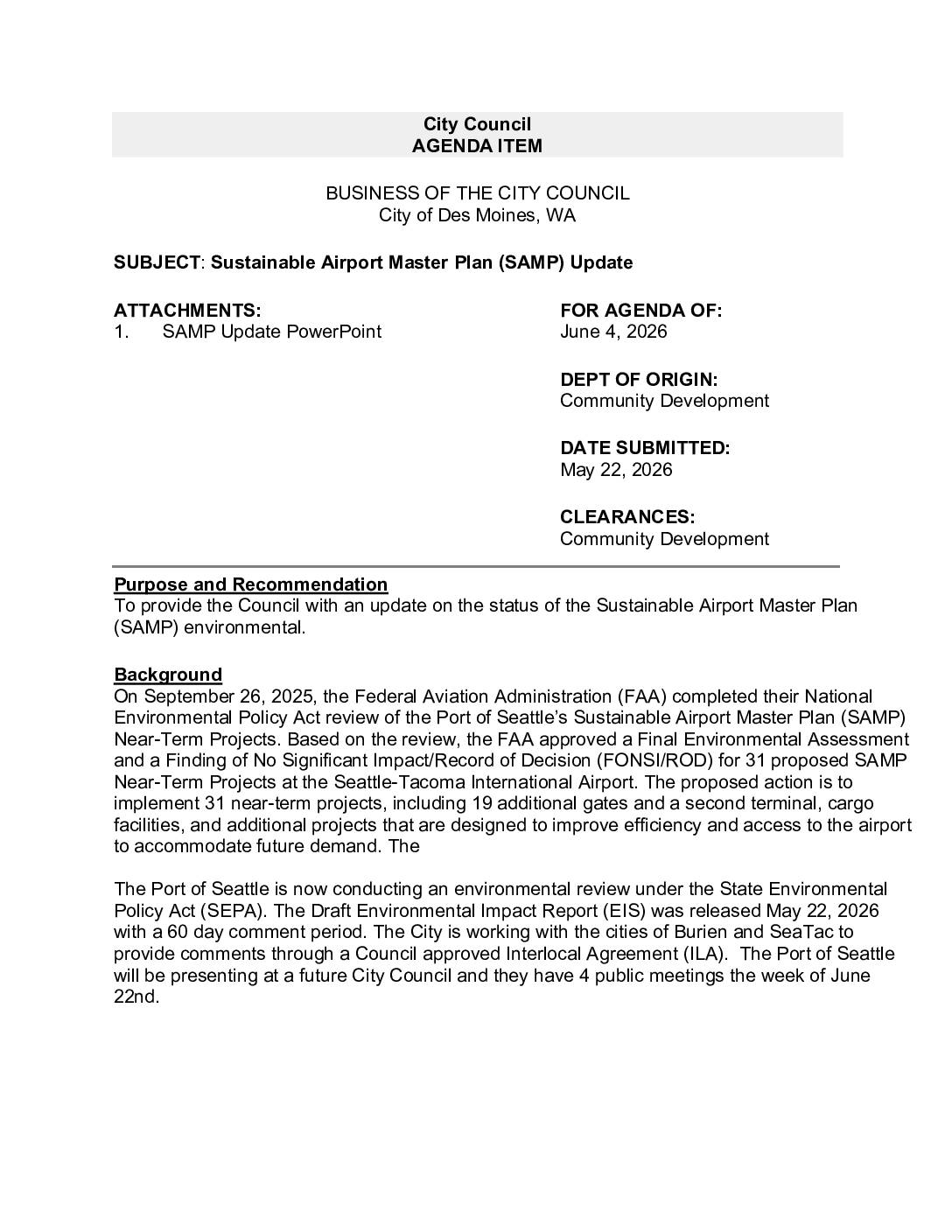
Des Moines City Council – SAMP Update
Purpose and Recommendation To provide the Council with an update on the status of the Sustainable Airport Master Plan (SAMP) environmental review. Background Federal Aviation Administration (FAA) Approval On September 26, 2025, the FAA completed their National Environmental Policy Act review and approved a Final Environmental Assessment and Finding of No Significant Impact/Record of Decision -
2026-06-04
Des Moines City Council (SAMP) update
The City of Des Moines, WA provided its City Council with an update on the Sustainable Airport Master Plan (SAMP) for Seattle-Tacoma International Airport, following the FAA's September 2025 approval of 31 near-term expansion projects — including 19 new gates, a second terminal, and cargo facilities. The Port of Seattle launched a state-level environmental review (SEPA) in May 2026, releasing a Draft Environmental Impact Statement with a 60-day public comment period. Des Moines is collaborating with the cities of Burien and SeaTac through an Interlocal Agreement to submit coordinated comments, with the final report expected in 2027. -
2026-06-03
Ep #31 Emergency! The only winning move (3/3)
**Discover why environmental progress stalled for airport communities while cars got cleaner** Ever wonder why your car's emissions have dramatically improved over decades, but aviation seems stuck in the past? In this eye-opening episode of The Airport Communities Podcast, we explore the fascinating tale of two environmental paths that diverged after 1970. While Washington Senator Scoop Jackson spearheaded NEPA—one of the largest expansions of environmental policy in American history—and California secured game-changing carve-outs in the Clean Air Act that led to massive air quality improvements, aviation somehow got left behind. Despite Boeing being headquartered in Washington, aviation environmental standards never caught up. UW Meteorologist Cliff Mass delivers some stark perspective: those two annual flights to Europe generate more greenhouse gases than most people produce in their entire homes over a year. Meanwhile, Boeing's monopoly status has eliminated market incentives for cleaner technology. This wasn't an oversight—it was intentional. Today, every airport community continues paying the price for decisions made decades ago that exempted aviation from automotive-level engineering standards.