TagPublic Records(23)
-
 2022-09-29
Complaint for Disclosure Under the Public Records Act: Steve Edmiston v. Port Of Seattle
Attorney Steve Edmiston filed a lawsuit against the Port of Seattle, alleging it violated Washington's Public Records Act by heavily redacting a consultant's report (the "Ramboll Report") that assessed a 2020 public health study linking Sea-Tac Airport's noise and air pollution to serious health harms in nearby communities, including lower life expectancy and higher rates of heart disease and premature births. The Ramboll Report, commissioned by the Port days after the public health study was released and shared with the Port's CEO, was intended to evaluate the study's findings and recommendations. Edmiston is seeking court-ordered disclosure of the unredacted documents, along with attorney fees and penalties to deter future violations. -
 2020-10-01
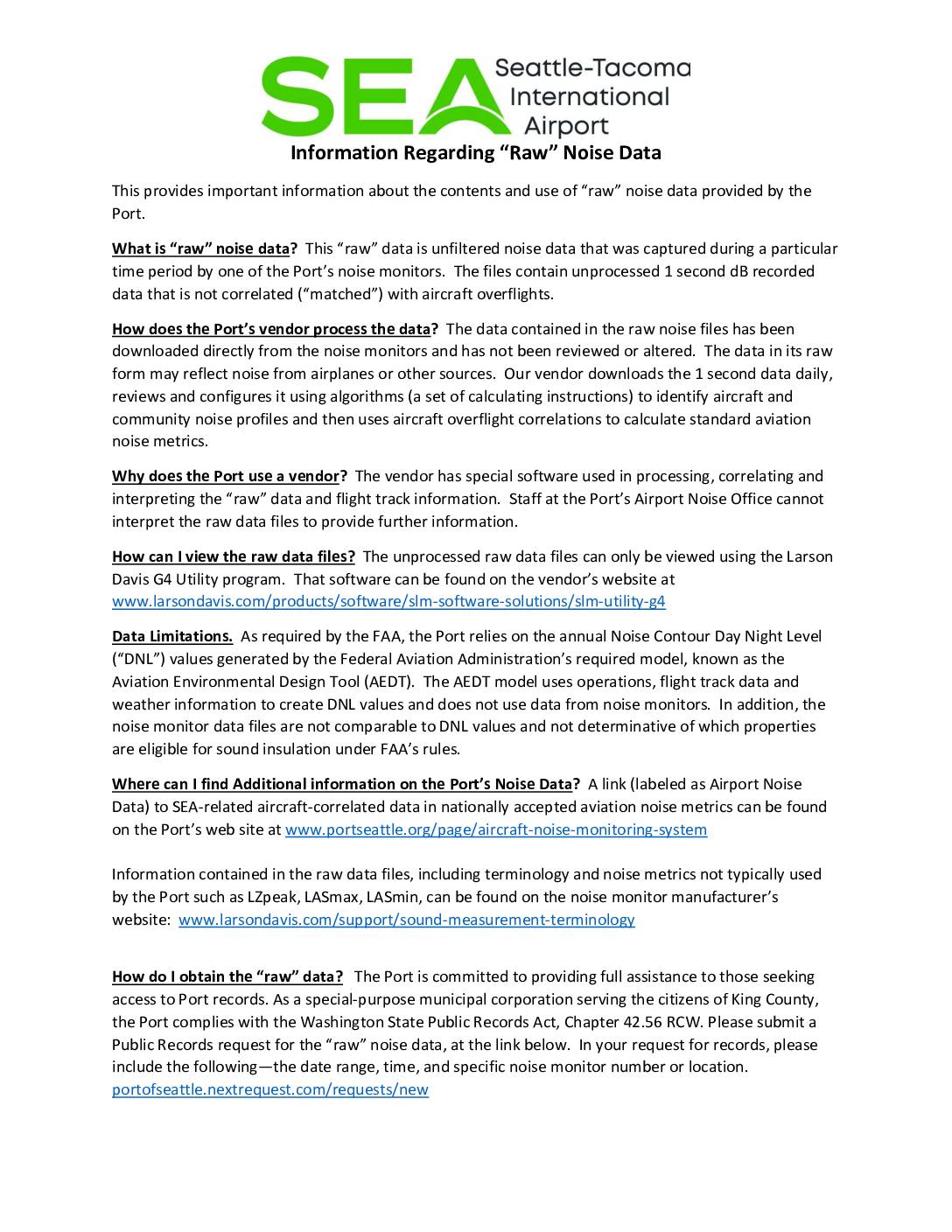
Information Regarding “Raw” Noise Data
This document from Seattle-Tacoma International Airport explains what 'raw' noise data is, how it is collected and processed, and how the public can request it. The unfiltered, one-second decibel readings captured by the Port's noise monitors are not matched to specific aircraft and must be viewed with specialized Larson Davis software; a vendor processes the data using algorithms to produce standard aviation noise metrics. Residents can request raw data through the Washington State Public Records Act portal, though the Port disclaims any liability for how the data is used and notes it cannot be directly compared to the FAA-required DNL noise contour values used for sound insulation eligibility. -
 2020-07-22
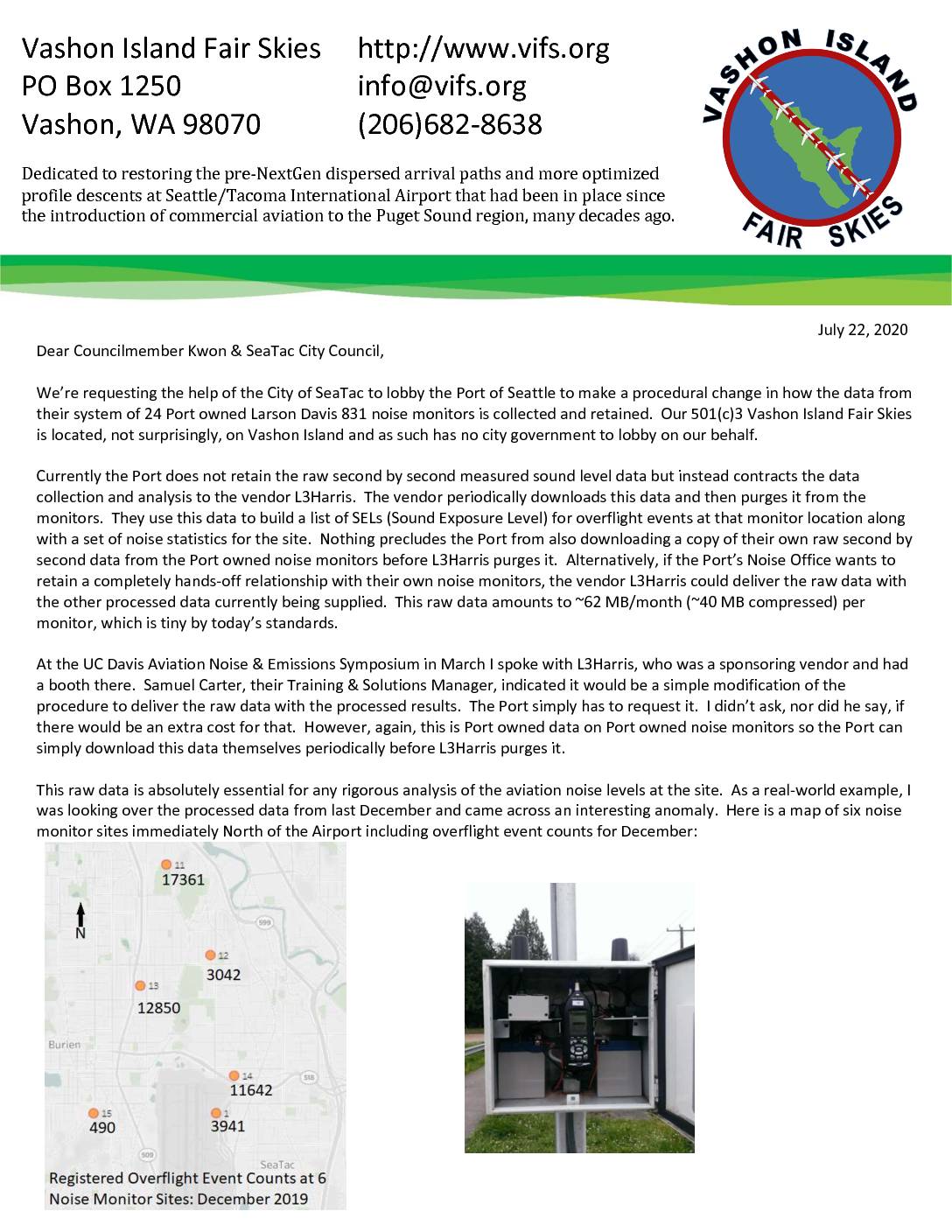
Letter From Vashon Island Fair Skies to City of Sea-Tac Requesting Lobbying Support for Port Of Seattle Noise Monitor Raw Data Retention
Vashon Island Fair Skies, a 501(c)3 nonprofit, wrote to the SeaTac City Council in July 2020 requesting help pressuring the Port of Seattle to retain raw second-by-second data from its 24 airport noise monitors, which vendor L3Harris currently purges after processing. The letter argues this raw data is essential for accurate noise analysis, demonstrating with December 2019 monitor data that high background noise at some sites causes the processing software to miss many actual aircraft overflight events. The group asks the city to urge the Port to make a simple procedural change — either downloading the data itself or requiring L3Harris to deliver it — noting the storage requirement is a modest ~62 MB per monitor per month. -
 2019-08-01
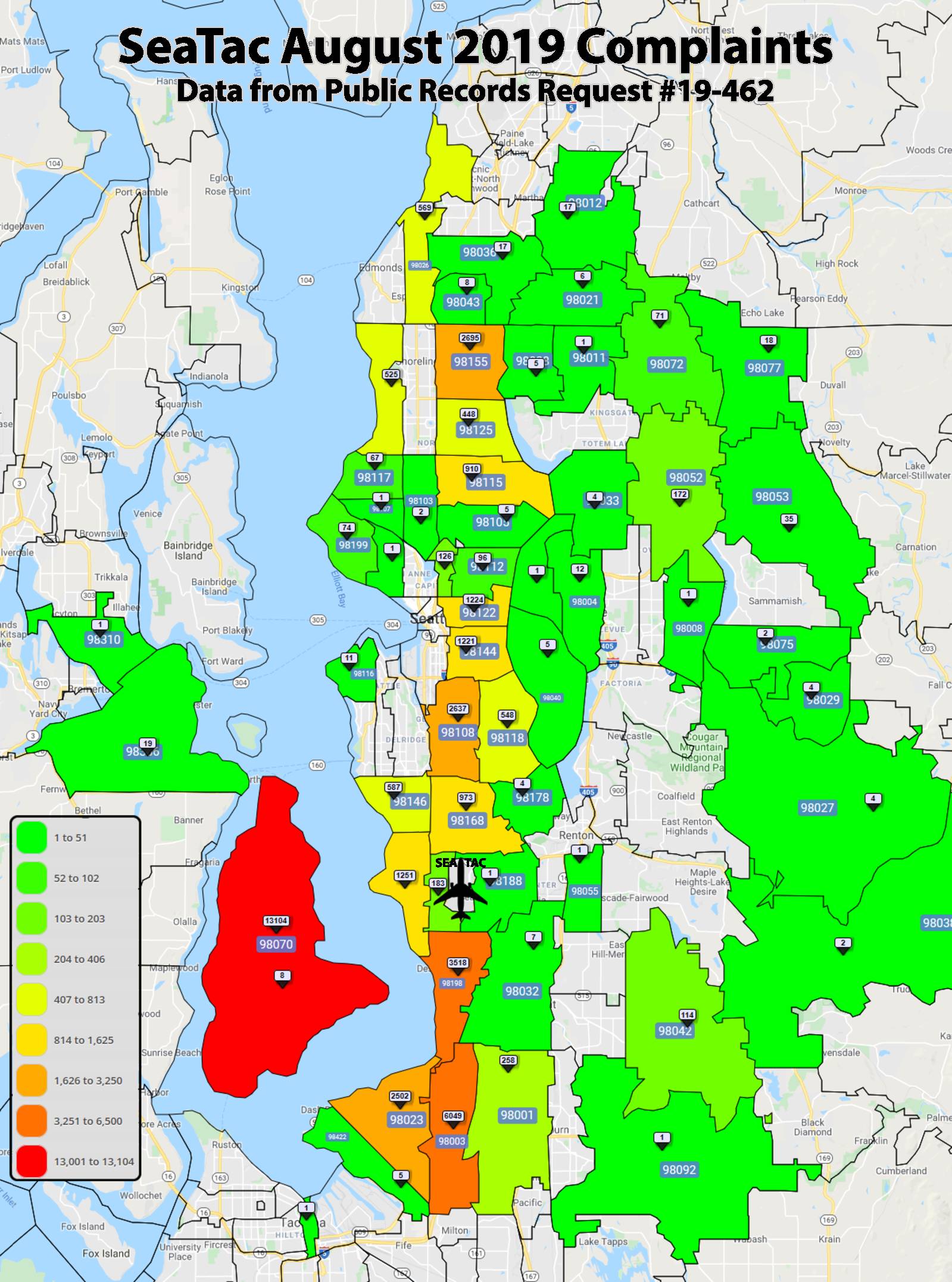
Sea-Tac August 2019 Noise Complaints (Vashon Island Fair Skies)
A color-coded map showing complaint data by ZIP code in the SeaTac area for August 2019. The map displays different complaint volume ranges from 1-51 complaints (green) to over 13,000 complaints (red), with ZIP code 98070 showing the highest complaint levels in red. -
2017-09-04
Records Request
Every so often we remind people that we want any documents, newspapers, web page links, sound recordings, VHS Tapes, Pan Am cocktail napkins, etc. Literally anything which has anything to do with the airport. For all intents and purposes, information you cannot find does not exist. (What’s that old line about the tree falling in -
 2001-10-09
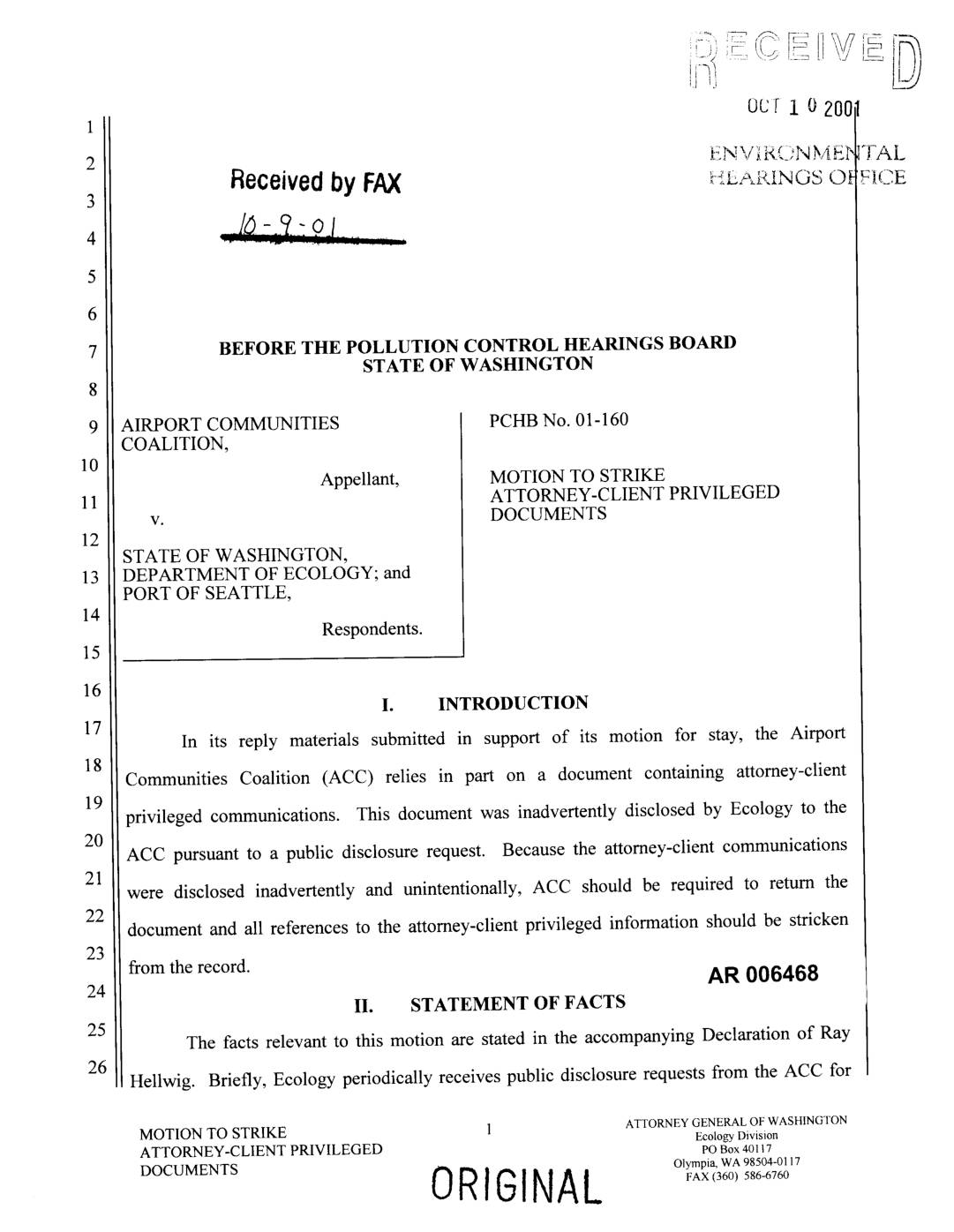
EXH AR006468: Motion to Strike Attorney-Client Privileged Documents — ACC v. Ecology and Port Of Seattle
Motion to Strike Attorney-Client Privileged Documents filed by State of Washington Department of Ecology (Ecology) before the Pollution Control Hearings Board (PCHB), PCHB No. 01-160, Airport Communities Coalition (ACC) v. State of Washington Department of Ecology and Port Of Seattle. Ecology seeks to strike privileged communications inadvertently disclosed to ACC via public disclosure request relating -
 2001-10-09
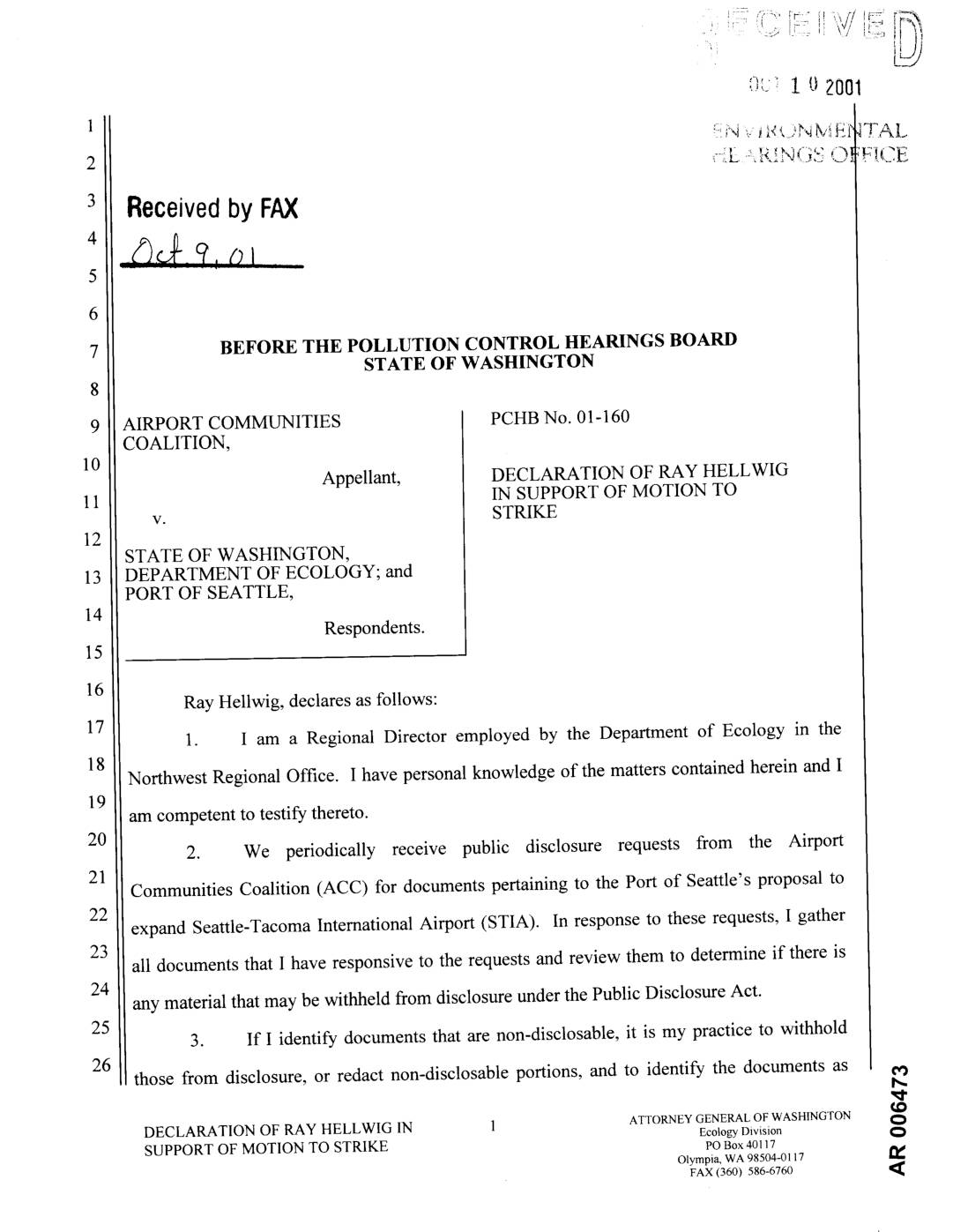
EXH AR006473: Declaration of Ray Hellwig in Support of Motion to Strike — PCHB No. 01-160, ACC v. Ecology and Port Of Seattle
Declaration by Ray Hellwig, Regional Director at the Washington Department of Ecology Northwest Regional Office, filed October 9, 2001 in PCHB No. 01-160, Airport Communities Coalition (ACC) v. State of Washington Department of Ecology and Port Of Seattle. Hellwig declares that he inadvertently disclosed to ACC, pursuant to a public disclosure request under RCW 42.17.310(1)(i), -
 2001-09-21
EXH AR023912: Letter Wingard to Drabek (Ecology) — State Public Disclosure Request Third Runway Construction Monitoring Records
In a September 21, 2001 fax to John Drabek, Permit Manager at the Washington State Department of Ecology's Northwest Regional Office, Greg Wingard of Smith & Lowney followed up on a delayed State Public Disclosure Request concerning environmental monitoring data from construction activities at the airport. The letter clarifies that documents requested as far back as June 5, 2001—including upstream/downstream construction monitoring records and turbidity discharge data—had not yet been produced, despite being roughly three months overdue. Wingard requested that the documents be made available no later than September 25, 2001, and offered to pick them up in person to avoid further delay. -
 2001-08-21
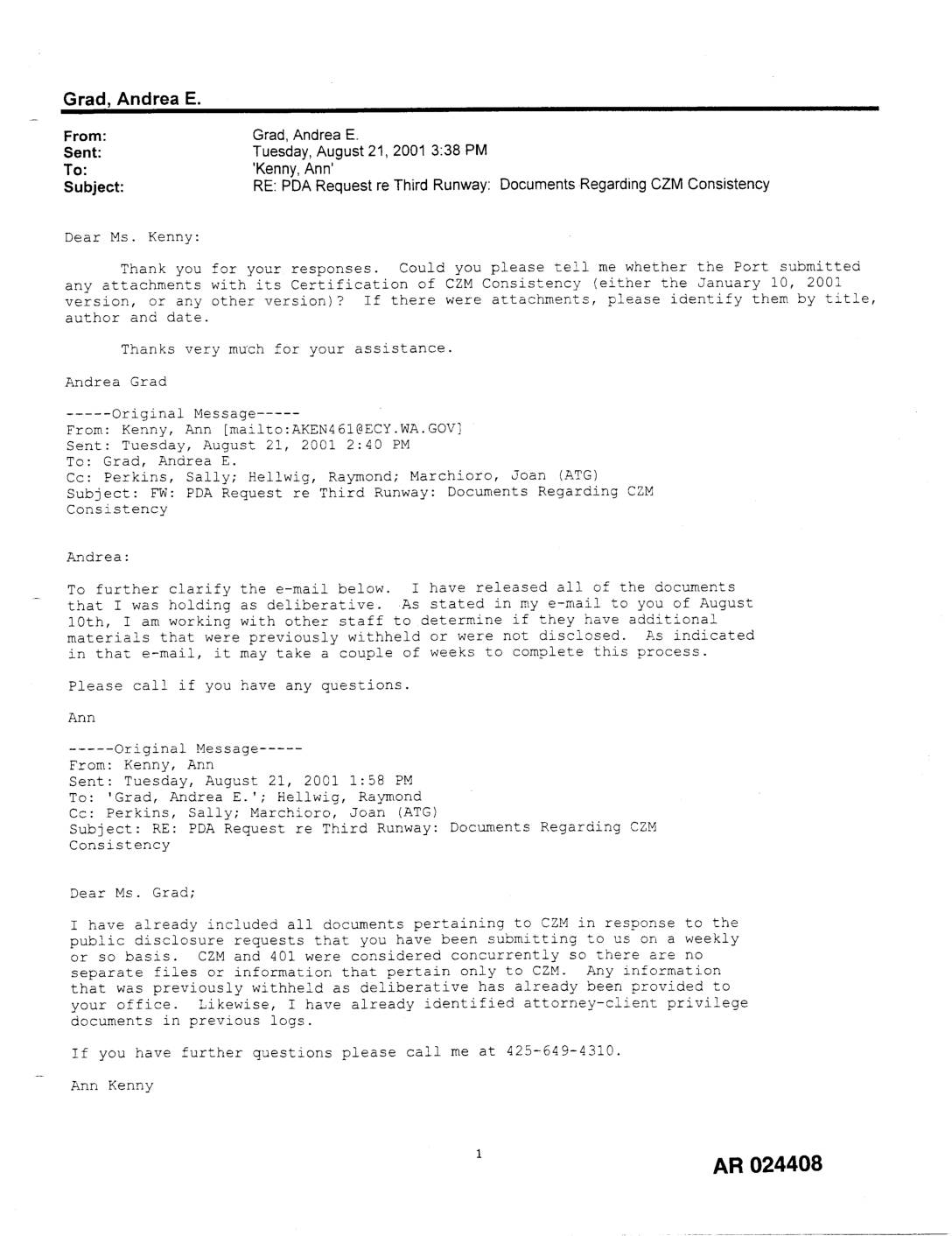
EXH AR024408: Email Chain PDA Request Third Runway CZM Consistency Documents
In August 2001, paralegal Andrea Grad of Helsell Fetterman submitted a Public Disclosure Act request to Washington State Department of Ecology seeking all documents related to the Sea-Tac Airport third runway project's consistency with the Coastal Zone Management (CZM) Program. Ecology's Ann Kenny responded that all relevant CZM documents had already been provided, noting that CZM and Section 401 water quality matters were handled together with no separate files, and that previously withheld deliberative documents had been released. Kenny also indicated she was still checking with other staff to determine if any additional materials had been overlooked. -
 2001-08-03
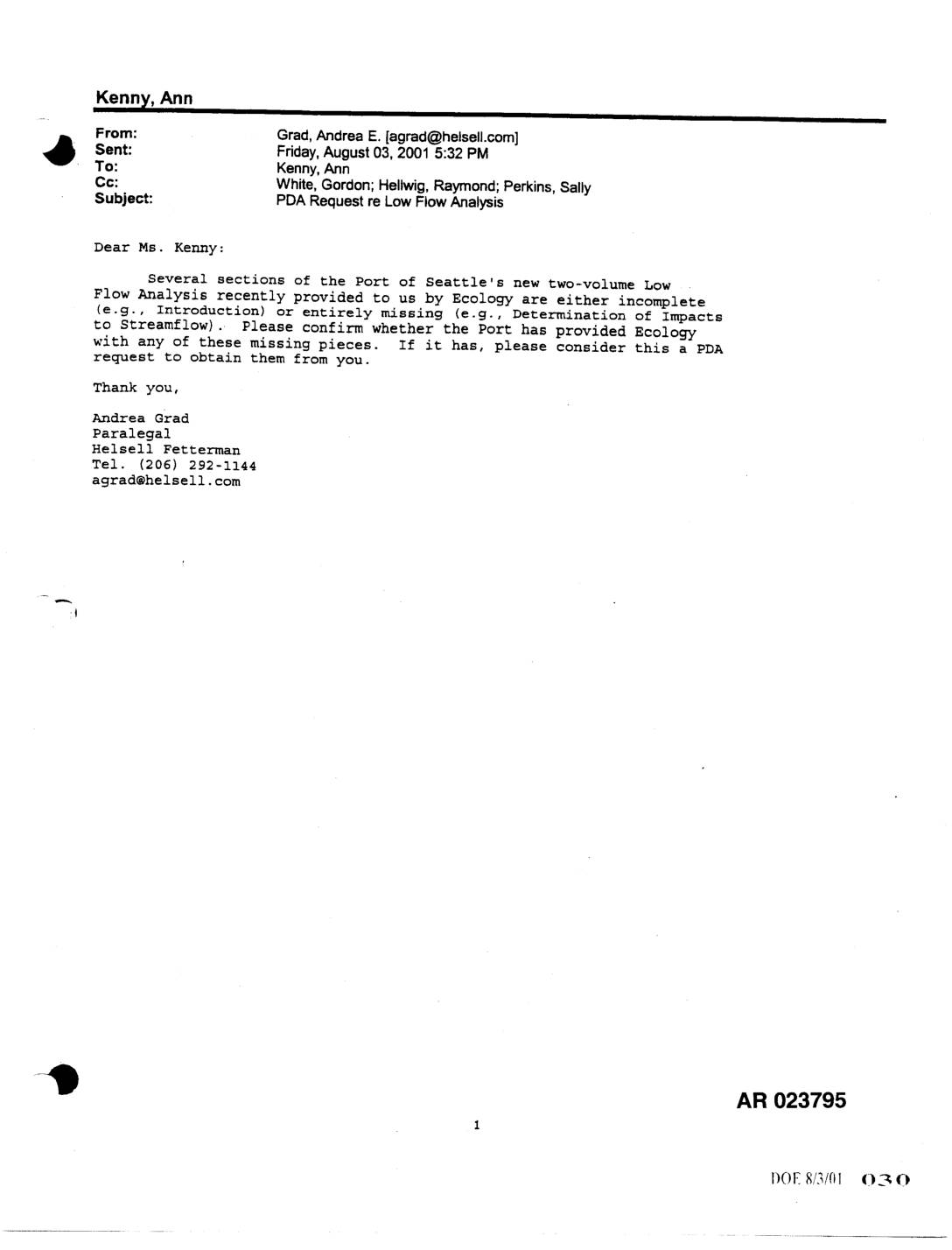
EXH AR023795: PDA Request Low Flow Analysis — Helsell Fetterman to Ecology
In this August 3, 2001 email, Andrea Grad, a paralegal at Helsell Fetterman, submits a Public Disclosure Act (PDA) request to Ann Kenny at the Washington State Department of Ecology. Grad notes that several sections of the Port of Seattle's two-volume Low Flow Analysis — including the Introduction and the section on Determination of Impacts to Streamflow — were either incomplete or entirely missing from the copy provided by Ecology. She asks Ecology to confirm whether the Port had submitted the missing sections, and requests copies of any such materials.