TagProperty Tax Levy(83)
-
 2024-02-13
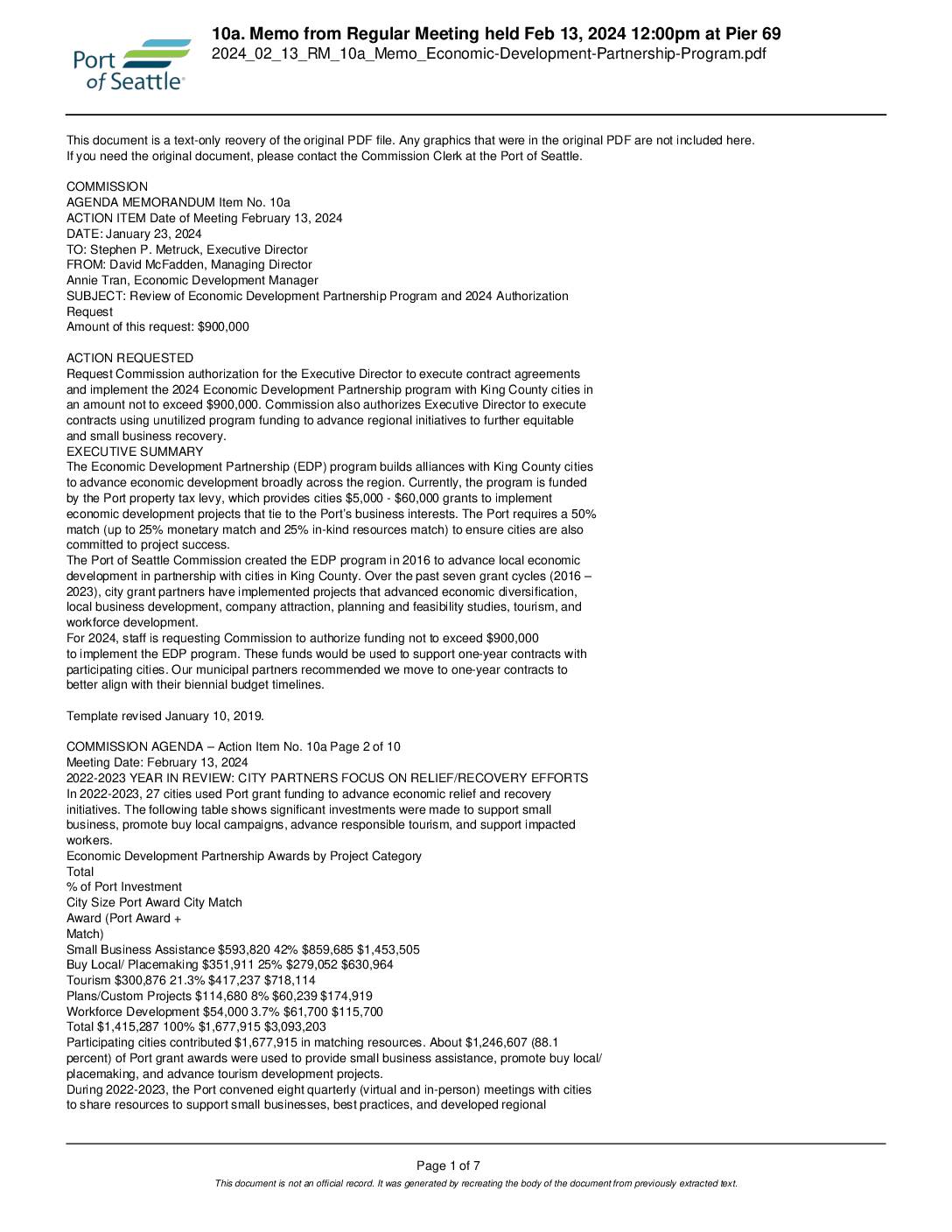
Port Of Seattle Commission Agenda Memorandum: Review of Economic Development Partnership Program and 2024 Authorization Request
The Port of Seattle is requesting $900,000 to continue its Economic Development Partnership (EDP) program, which provides grants of $5,000–$60,000 to King County cities for local economic development projects such as small business assistance, tourism promotion, and workforce development. In the 2022–2023 cycle, 27 cities participated and collectively leveraged over $1.6 million in matching resources, supporting nearly 700 businesses and generating millions of marketing impressions. For 2024, the program is shifting to one-year contracts to better align with cities' biennial budget timelines. -
 2024-01-16
Senate bill report SB 5955: Mitigating harm and improving equity in large port districts
Washington Senate Bill 5955 would require large port districts operating airports with more than 900 daily flights — such as Sea-Tac — to launch a remedial mitigation program addressing failed soundproofing, air quality, green space, and community facilities in noise-impacted neighborhoods. The bill would fund these programs through a portion of the port's annual property tax levy revenue and establish a state environmental equity fund, managed by the Department of Commerce, to provide grants and loans to qualifying ports. Property owners within ten miles of the airport experiencing 55 decibels or more of aircraft noise would be eligible for free inspections and mitigation equipment, with priority given to homes where previously installed soundproofing has failed. -
 2024-01-03
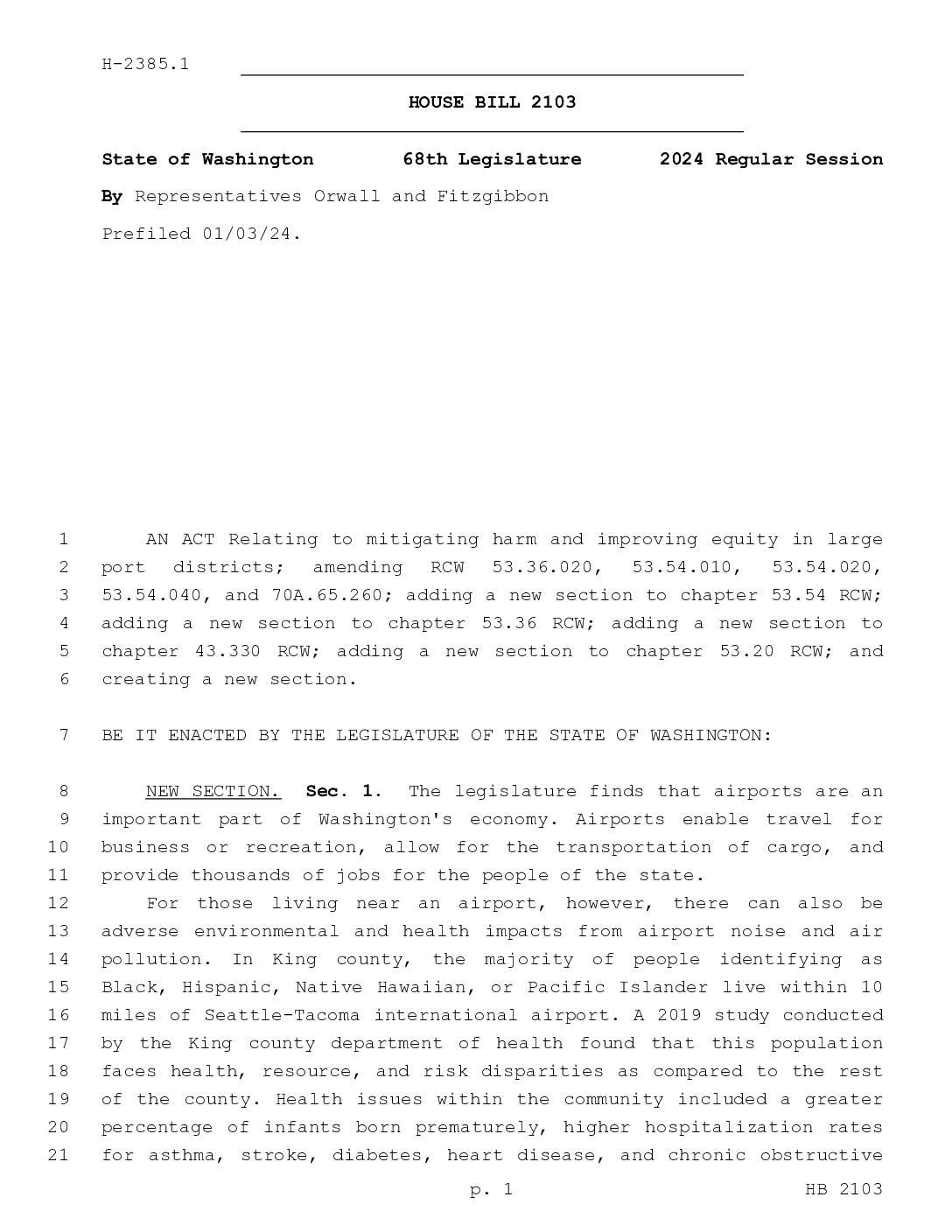
House Bill 2103: Mitigating Harm and Improving Equity in Large Port Districts
Washington House Bill 2103 (2024) requires large port districts operating major airports, such as Seattle-Tacoma International Airport, to dedicate a growing portion of their property tax levy revenue toward programs that reduce noise and air pollution impacts on nearby communities. The bill was prompted by health and equity concerns, as studies show that communities of color living close to Sea-Tac face higher rates of asthma, heart disease, premature births, and other health disparities. Mitigation programs funded under the bill may include repairing failed soundproofing equipment, providing air purifiers, creating urban green spaces, and supporting indoor community facilities in affected neighborhoods. -
 2024-01-01
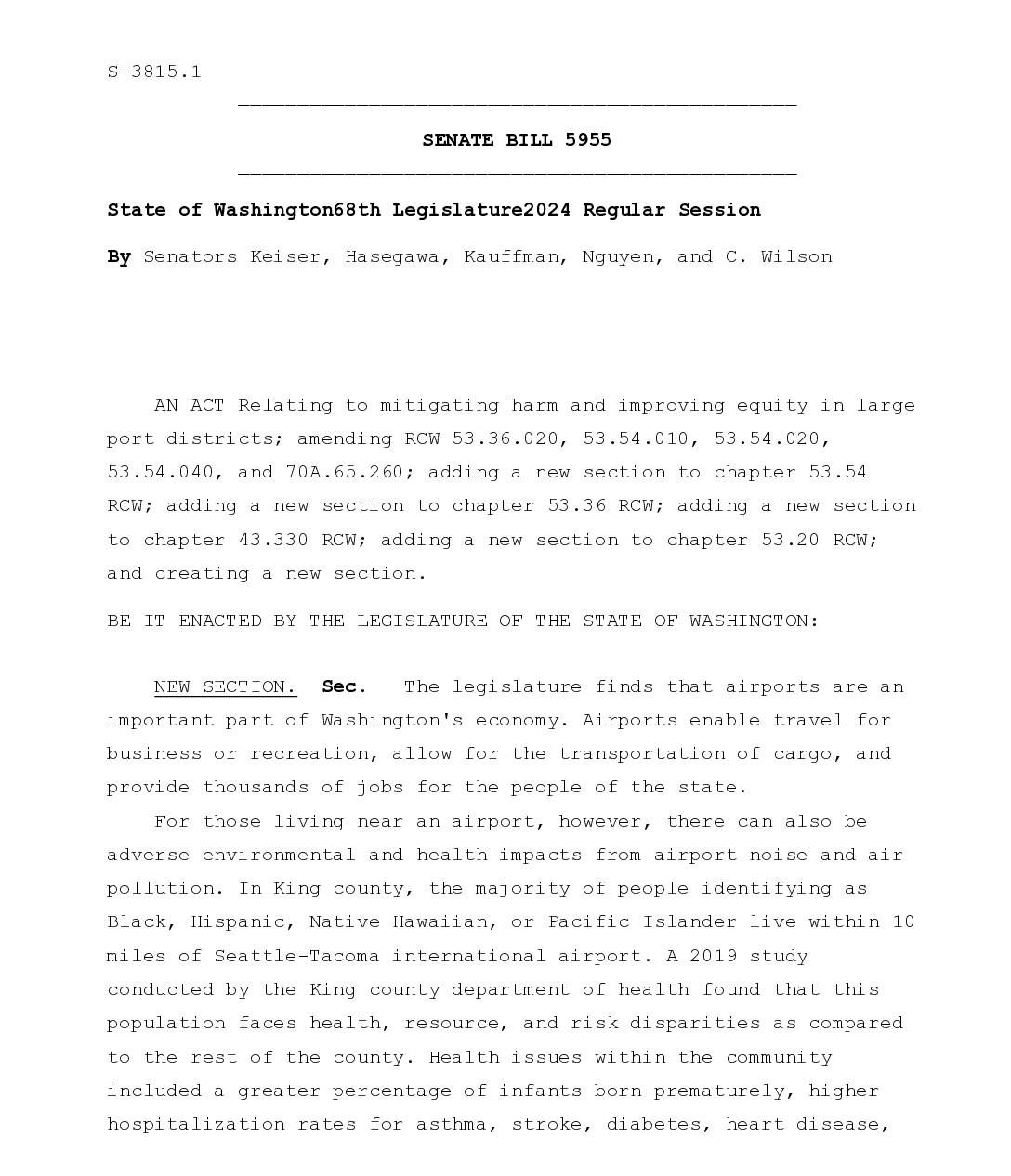
Senate Bill 5955: Mitigating Harm and Improving Equity in Large Port Districts
Washington Senate Bill 5955 (2024) requires large port districts operating airports, such as the Port of Seattle which runs Sea-Tac International Airport, to dedicate a growing share of their annual property tax levy revenue toward programs that reduce noise and air pollution impacts on nearby communities. Starting in 2024, at least half of any levy revenue increase must fund mitigation efforts, rising to a minimum of 1% of total levy revenue by 2025 and increasing by 1% each year up to a cap of 10%. The bill was introduced in response to documented health disparities—including higher rates of asthma, heart disease, and premature births—affecting Black, Hispanic, Native Hawaiian, and Pacific Islander residents who disproportionately live within 10 miles of Sea-Tac Airport. -
 2023-10-24
Property Tax Levy 2023 (and a few words about sex trafficking)
Commissioners, It’s with an increasingly heavy heart we take in your discussion of the Property Tax Levy every year now. Despite your claims to be the most progressive commission ever, the tax levy is evidence that your relationship with the cities under the flight path, especially fence line communities, is steadily becoming less equitable with -
 2022-10-01
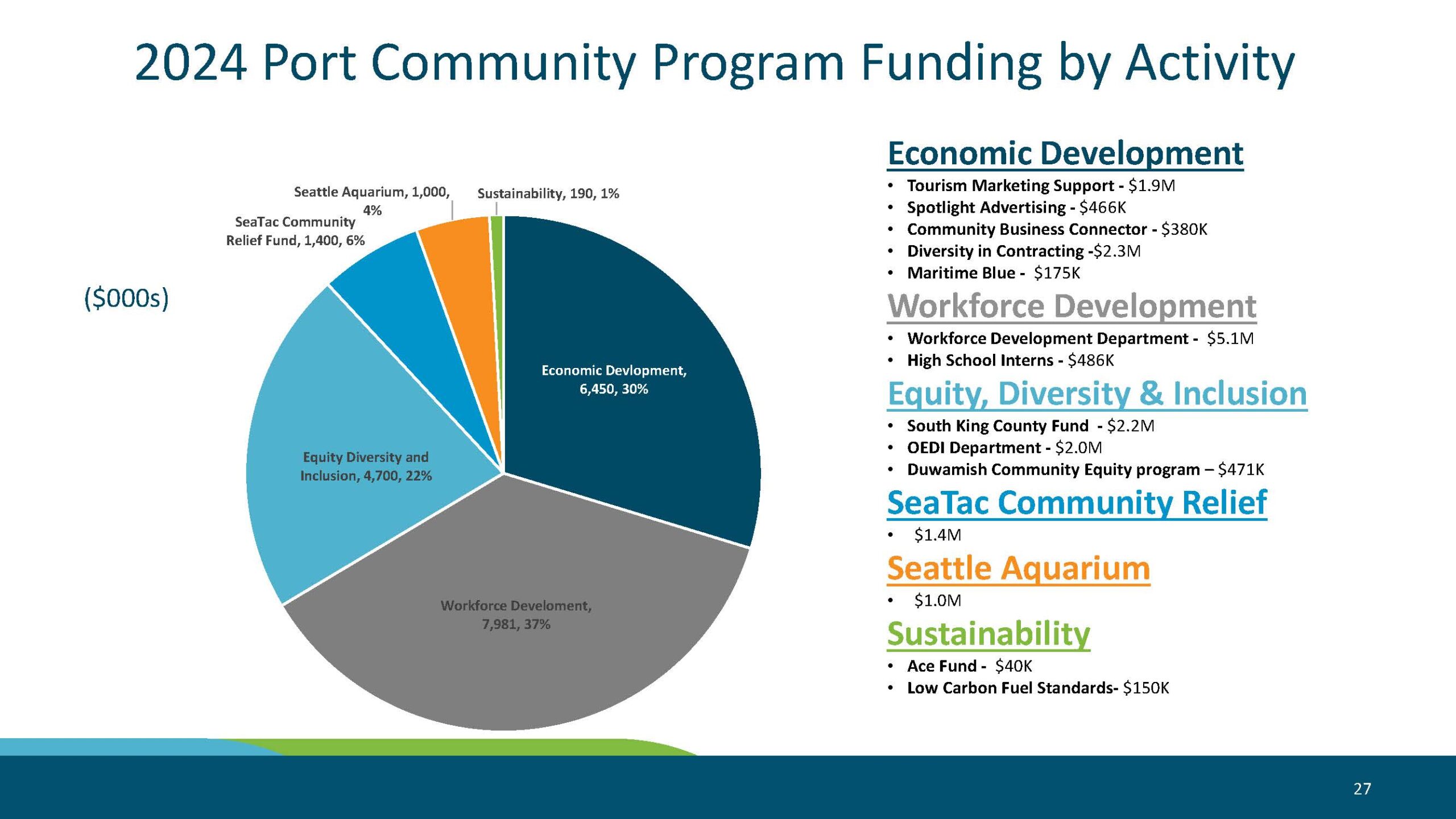
Port of Seattle 2023 budget information one-pager
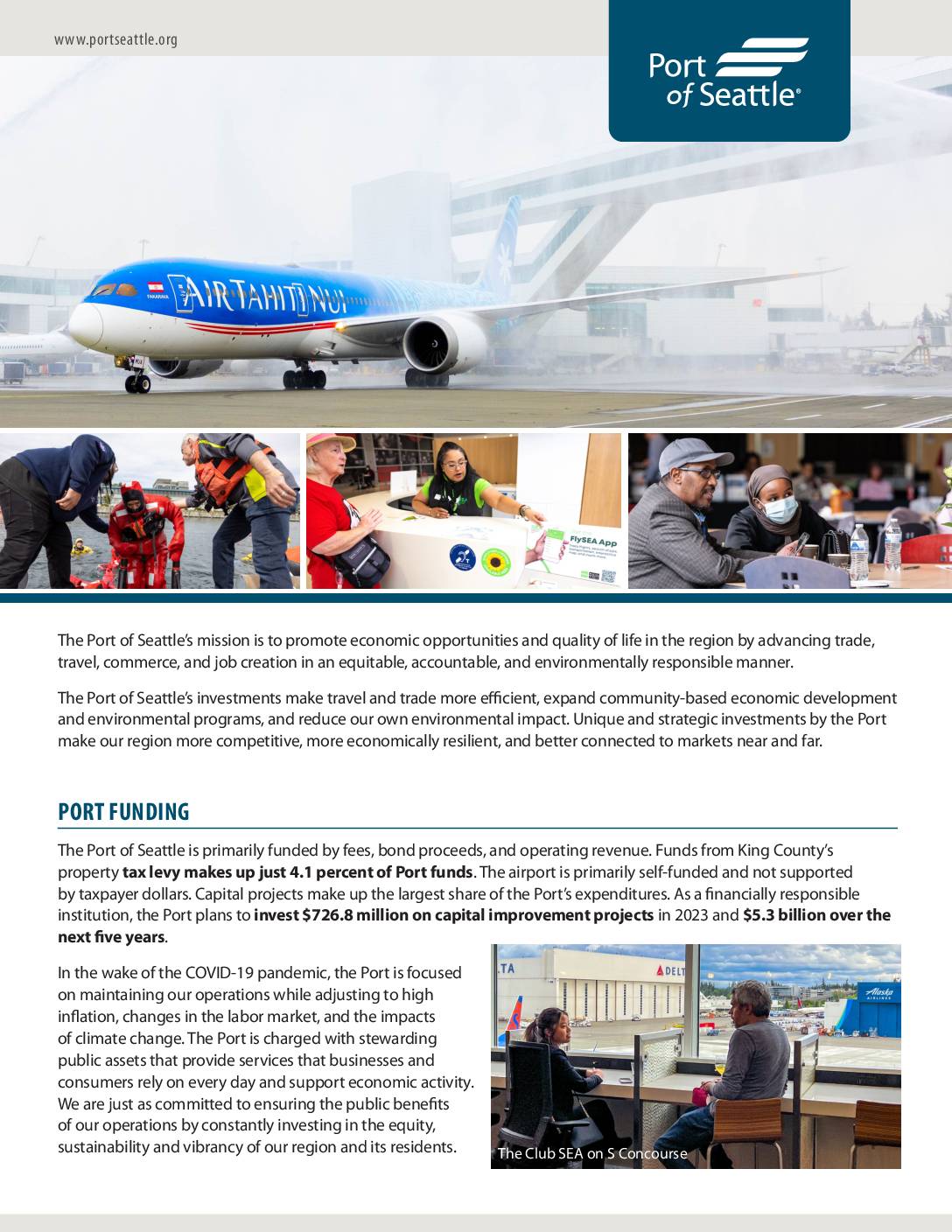
The Port of Seattle funds its operations primarily through fees, bond proceeds, and operating revenue, with King County property taxes accounting for just 1.2% of all property taxes collected and roughly $78 per year for the median homeowner. The Port's tax levy has historically been directed away from Seattle-Tacoma International Airport itself, instead funding noise mitigation improvements at Highline School District schools near the airport. In 2023, the Port planned to invest $726.8 million in capital projects and $19.1 million across 18 community programs, while managing operating expenses of $573.5 million. -
Draft Finance Plan 201-2023-2018_11_13_SM_7c_supp_Page_32
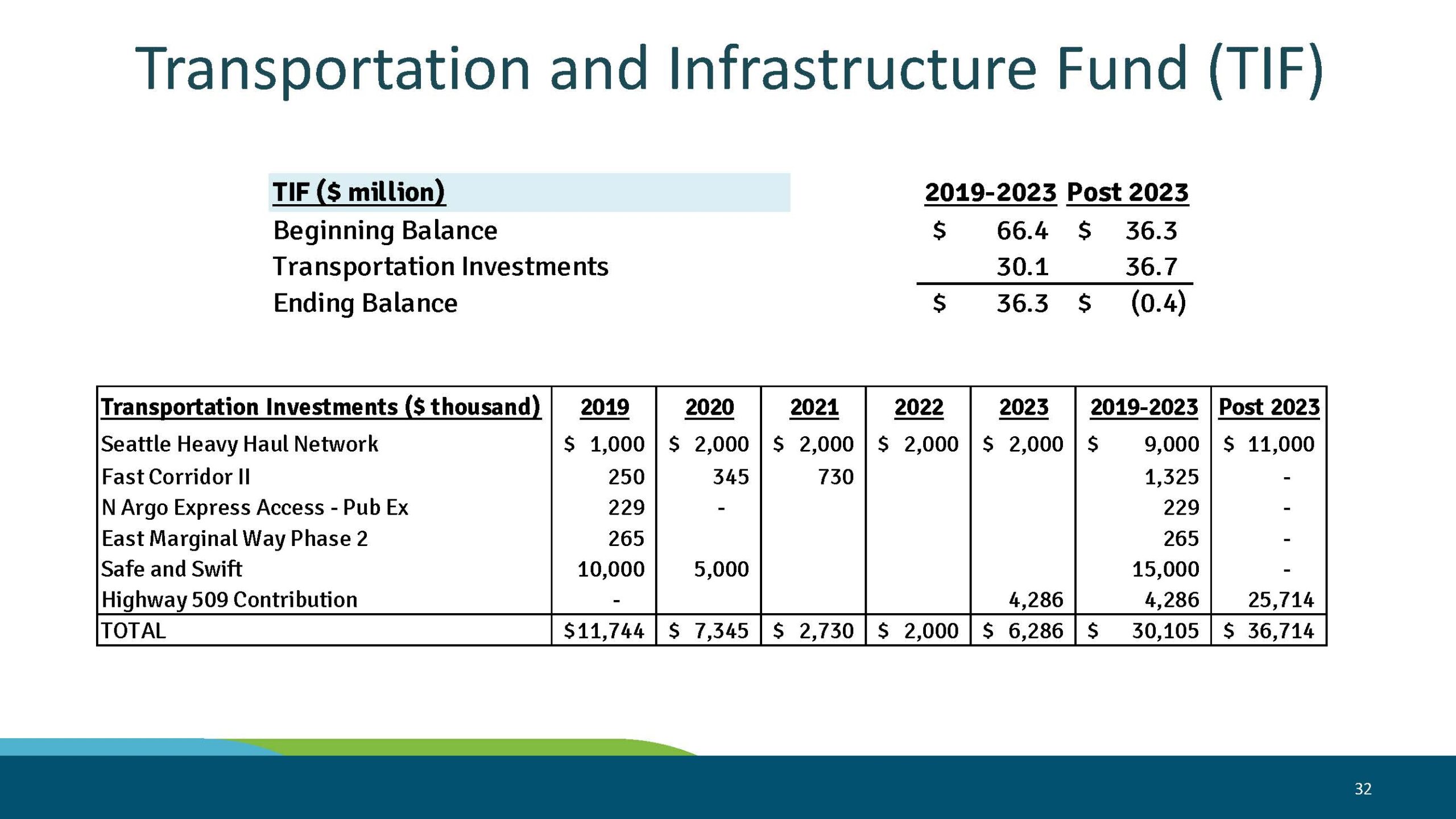
A budget presentation slide detailing the Port of Seattle's Transportation and Infrastructure Fund (TIF), showing a beginning balance of $66.4 million for 2019-2023 with $30.1 million in transportation investments and an ending balance of $36.3 million. The detailed breakdown includes investments in projects such as Seattle Heavy Haul Network, Safe and Swift, and Highway 509 Contribution, with post-2023 projections showing a negative ending balance of $(0.4) million. -
Draft Finance Plan 201-2023-2018_11_13_SM_7c_supp_Page_38
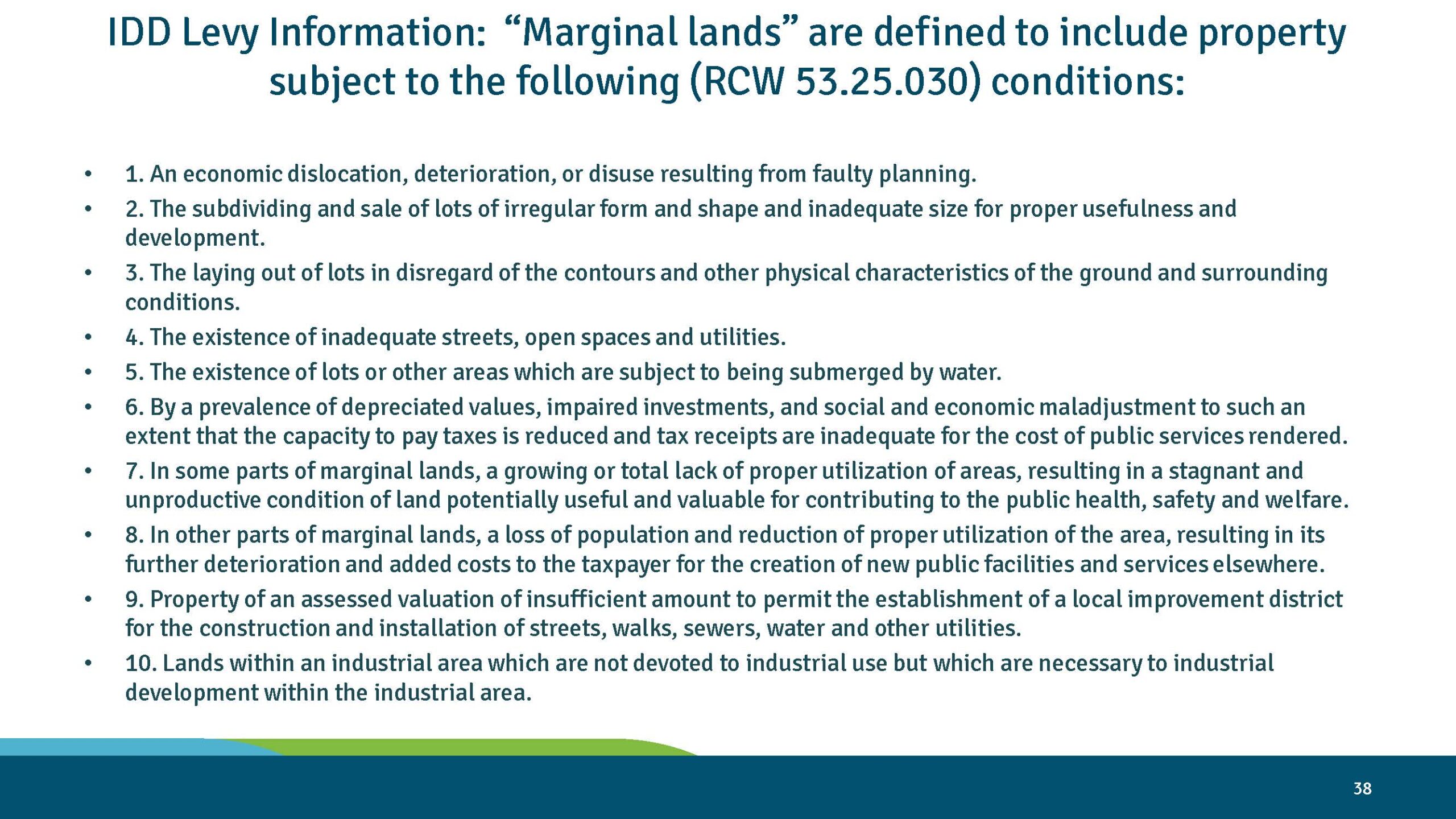
A slide titled 'IDD Levy Information: Marginal lands are defined to include property subject to the following (RCW 53.25.030) conditions,' listing ten statutory conditions under Washington State law that qualify property as marginal lands, including economic dislocation, inadequate utilities, flood-prone lots, depreciated values, and underutilized industrial areas. The slide is numbered page 38 of a larger presentation. -
Draft Finance Plan 201-2023-2018_11_13_SM_7c_supp_Page_22
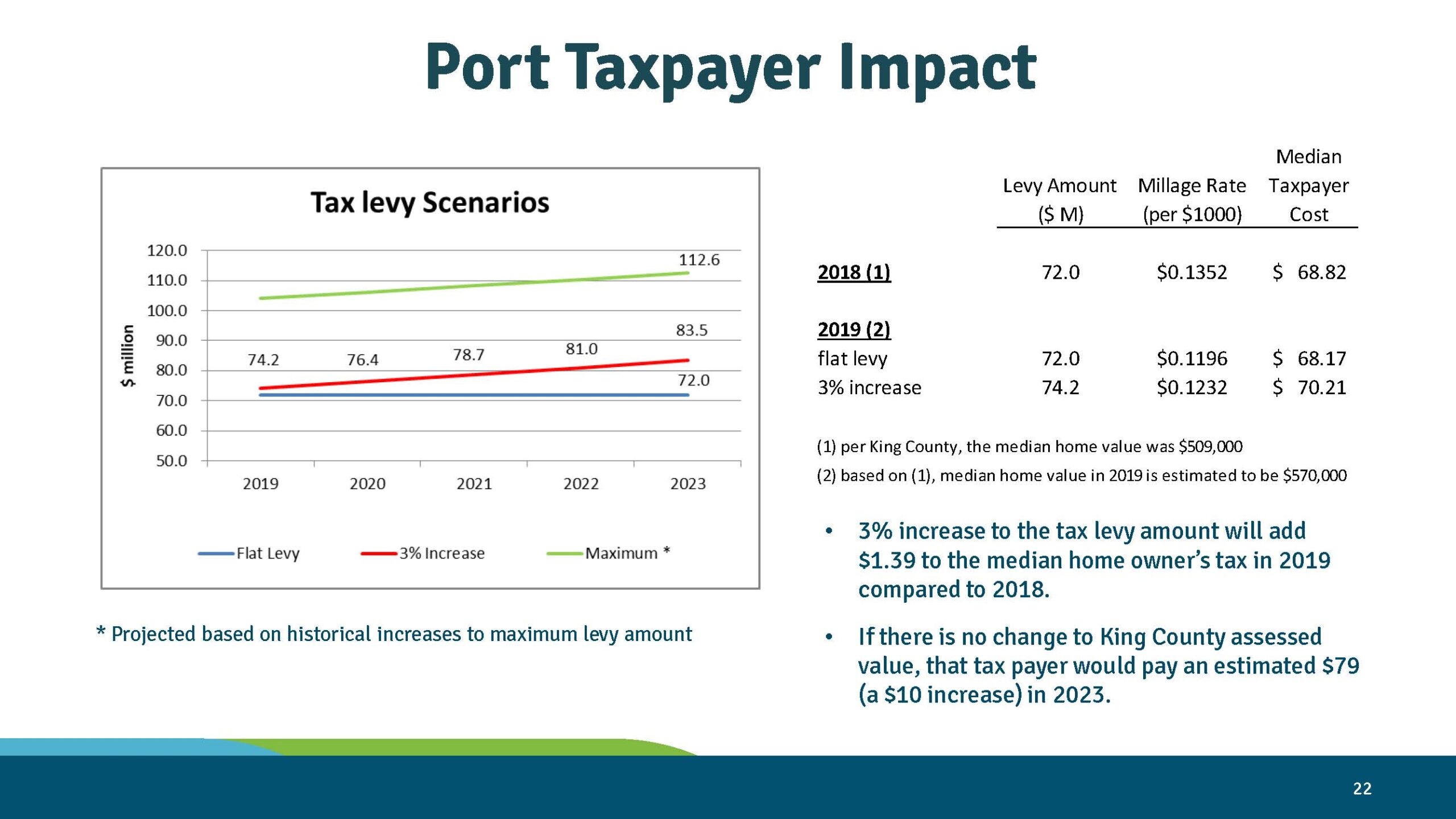
A presentation slide titled 'Port Taxpayer Impact' shows tax levy scenarios (Flat Levy, 3% Increase, and Maximum) projected from 2019 to 2023, with the Maximum scenario reaching $112.6 million by 2023. The accompanying table compares 2018 and 2019 levy amounts, millage rates, and median taxpayer costs based on King County median home values, noting that a 3% levy increase adds $1.39 to the median homeowner's tax in 2019 compared to 2018. -
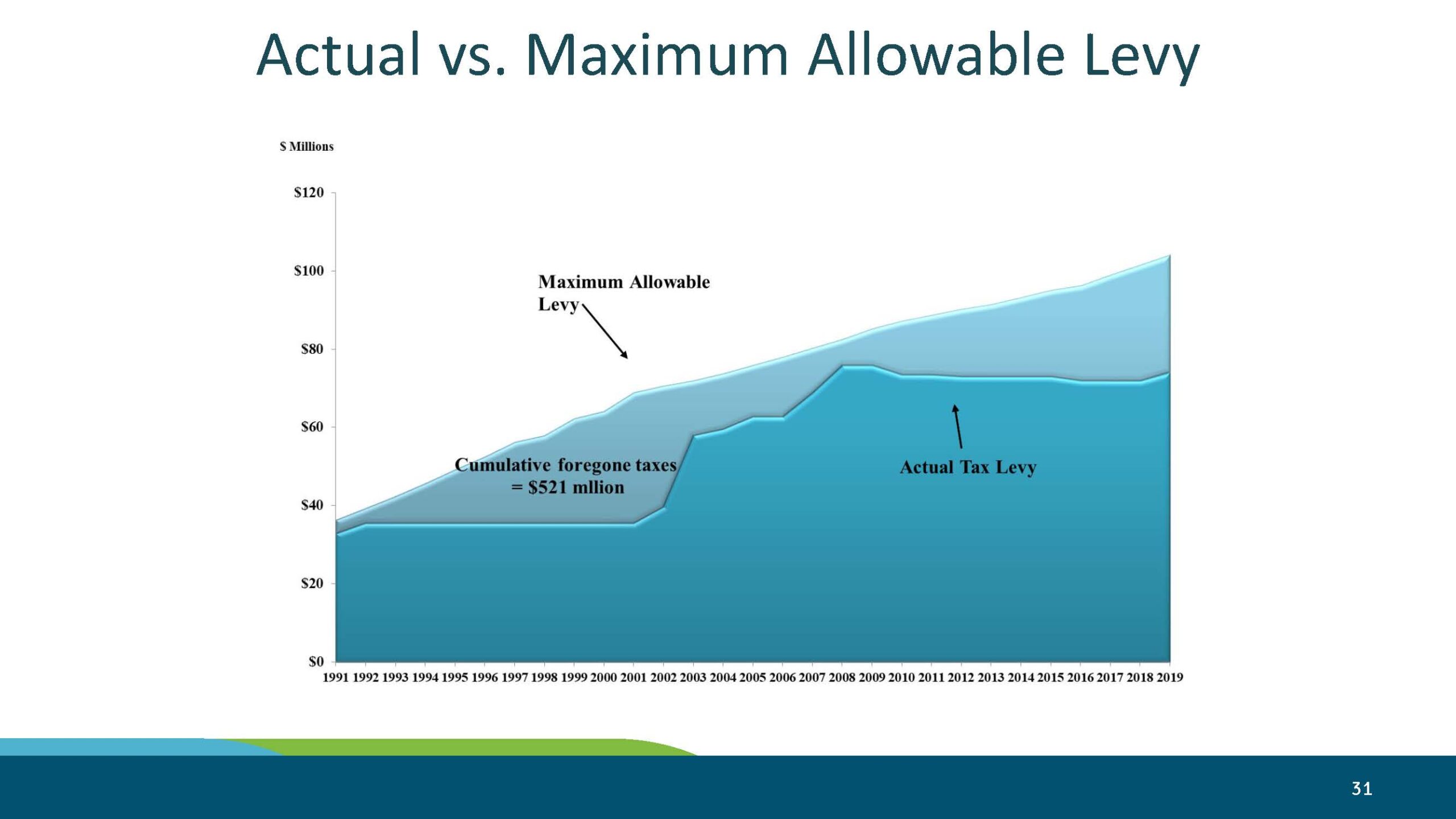
Draft Finance Plan 201-2023-2018_11_13_SM_7c_supp_Page_31
Area chart comparing the Maximum Allowable Levy to the Actual Tax Levy in millions of dollars from 1991 to 2019, with the gap between the two lines representing cumulative foregone taxes totaling $521 million. The actual levy remained consistently below the maximum allowable levy throughout the period shown.