TagProperty Tax Levy(83)
-
Draft Finance Plan 201-2023-2018_11_13_SM_7c_supp_Page_30
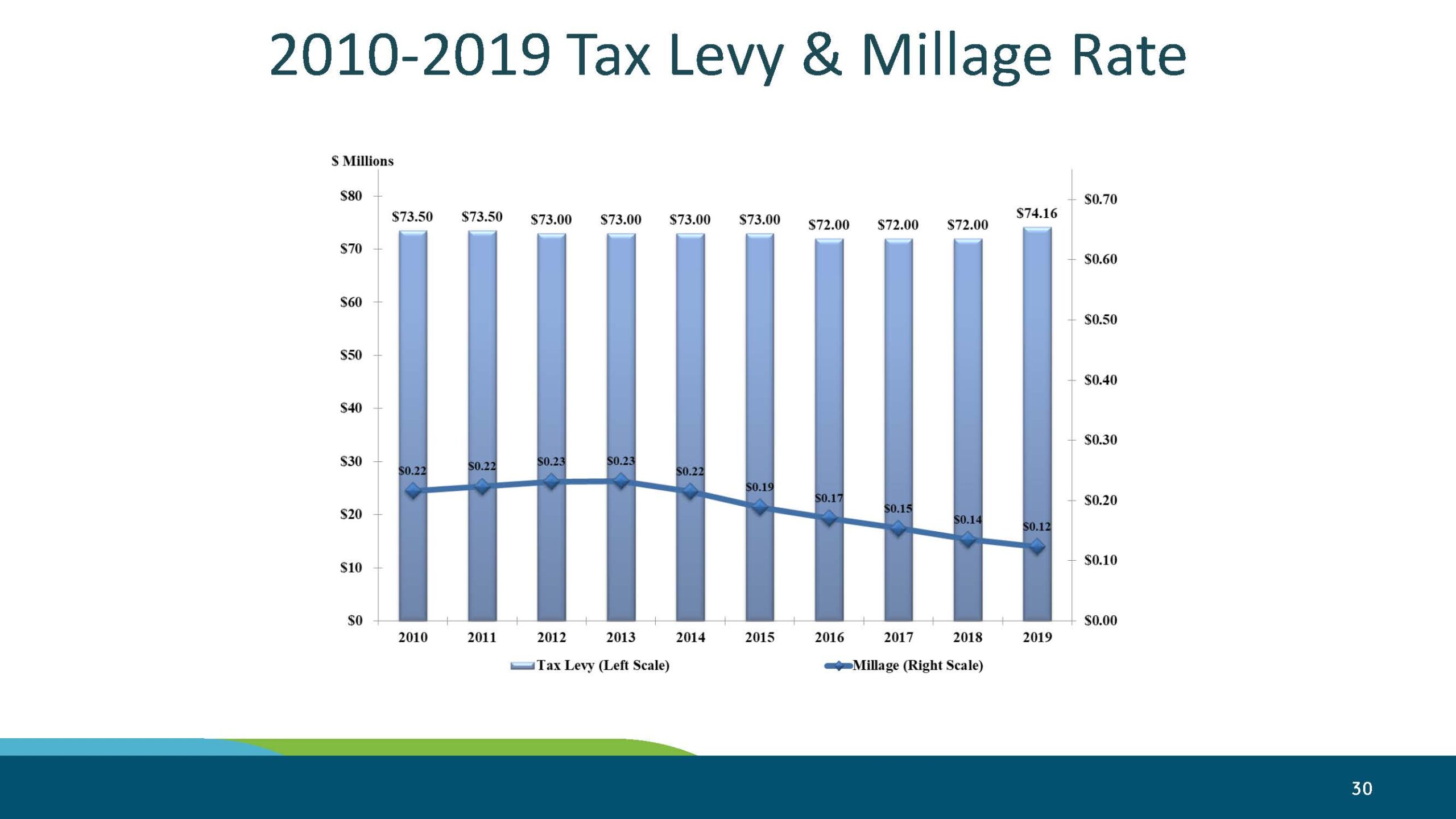
A dual-axis bar and line chart showing annual tax levy amounts (in millions of dollars, left scale) and millage rates (right scale) from 2010 to 2019. Tax levy values range from $72.00M to $74.16M, while the millage rate declined steadily from $0.22 in 2010 to $0.12 in 2019. No organizational logo or authorship is visible to identify the source agency. -
Draft Finance Plan 201-2023-2018_11_13_SM_7c_supp_Page_29
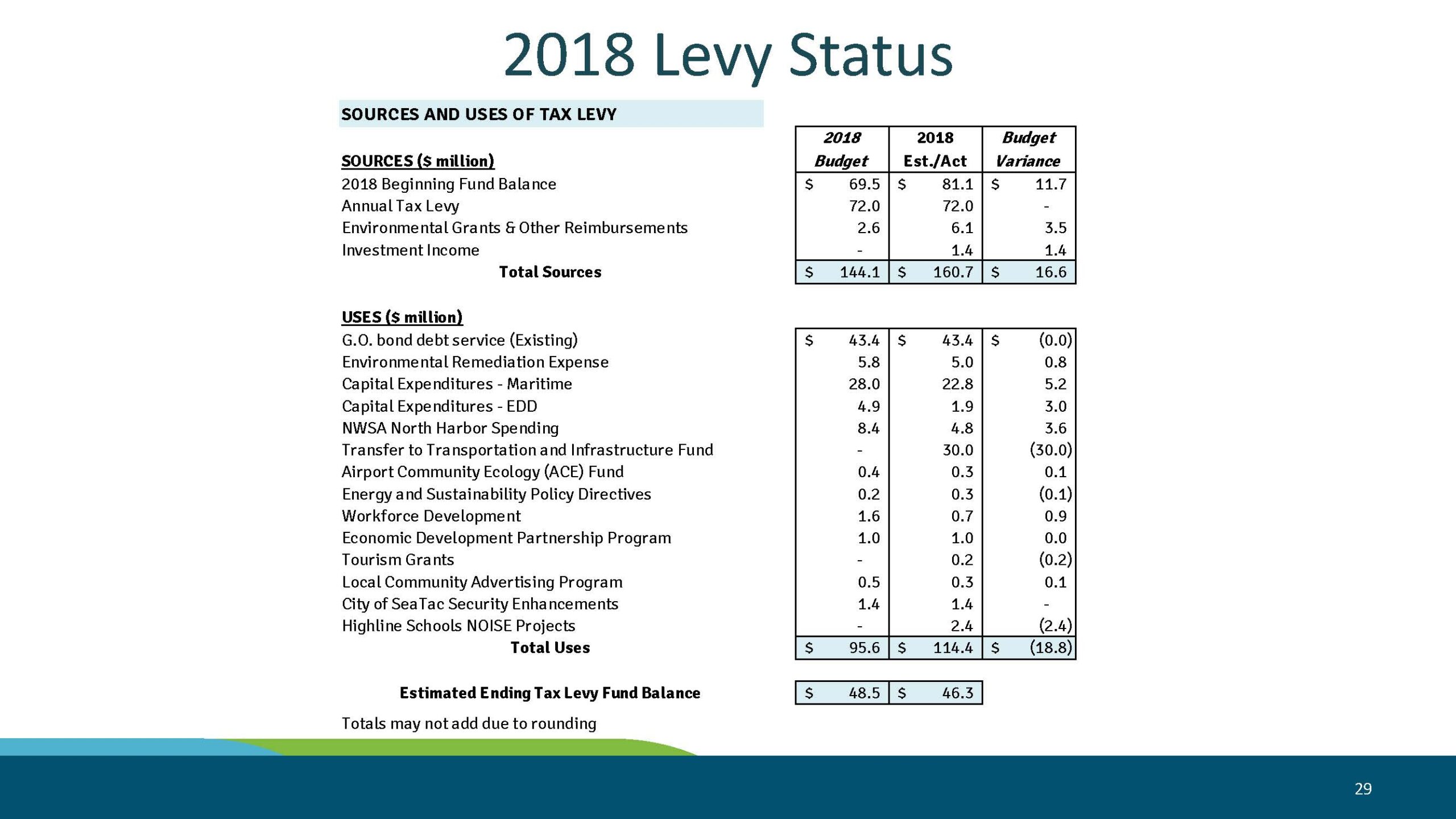
A financial summary slide titled '2018 Levy Status' showing Sources and Uses of the Port of Seattle Tax Levy Fund. Total Sources were budgeted at $144.1M but came in at $160.7M (a $16.6M favorable variance), while Total Uses were $114.4M against a $95.6M budget, resulting in an Estimated Ending Tax Levy Fund Balance of $46.3M. Notable uses include a $30M Transfer to Transportation and Infrastructure Fund and $2.4M for Highline Schools NOISE Projects, relevant to Sea-Tac Airport noise mitigation policy. -
Draft Finance Plan 201-2023-2018_11_13_SM_7c_supp_Page_28
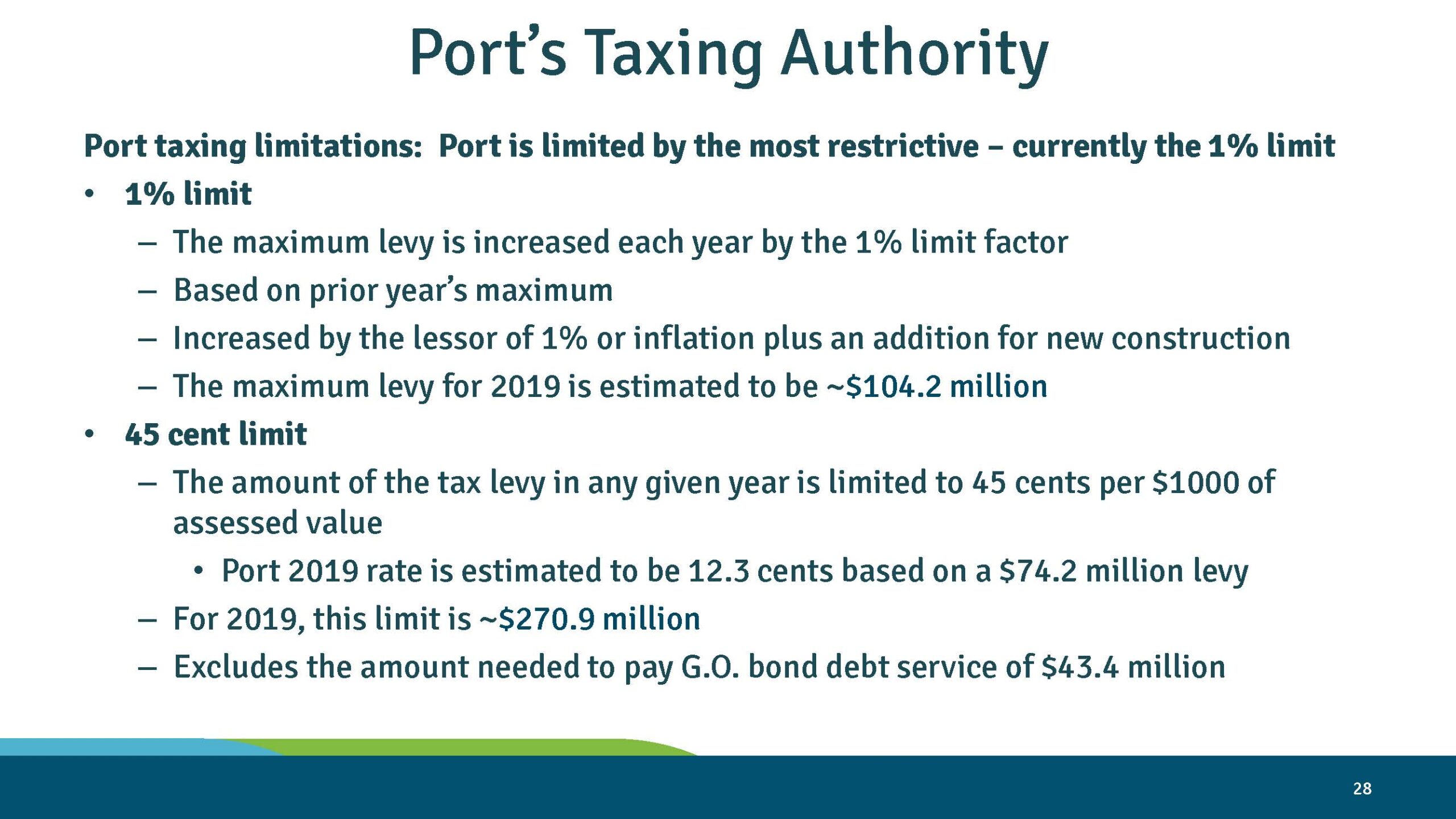
A presentation slide titled 'Port's Taxing Authority' outlines the Port of Seattle's tax levy limitations, including the 1% limit factor and 45-cent-per-$1000 assessed value cap. For 2019, the maximum levy under the 1% limit is estimated at ~$104.2 million, while the 45-cent limit allows up to ~$270.9 million, with the Port's actual 2019 rate estimated at 12.3 cents based on a $74.2 million levy. -
Draft Finance Plan 201-2023-2018_11_13_SM_7c_supp_Page_27
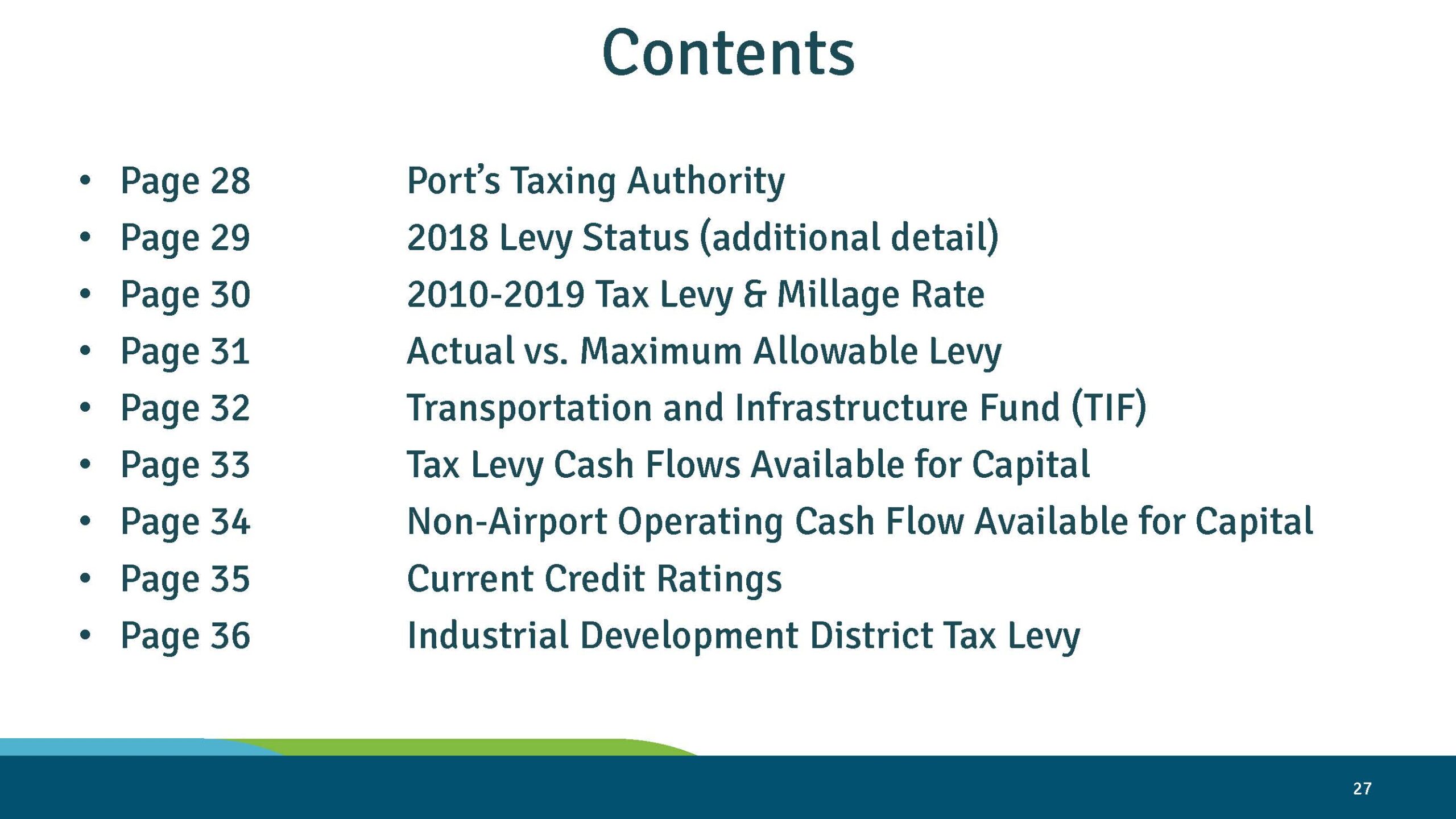
This slide is page 27 of a Port of Seattle financial presentation, listing contents for pages 28–36. Topics covered include Port's Taxing Authority, 2018 Levy Status, 2010–2019 Tax Levy & Millage Rate, Actual vs. Maximum Allowable Levy, Transportation and Infrastructure Fund (TIF), Tax Levy Cash Flows, Non-Airport Operating Cash Flow, Current Credit Ratings, and Industrial Development District Tax Levy. -
Draft Finance Plan 201-2023-2018_11_13_SM_7c_supp_Page_37
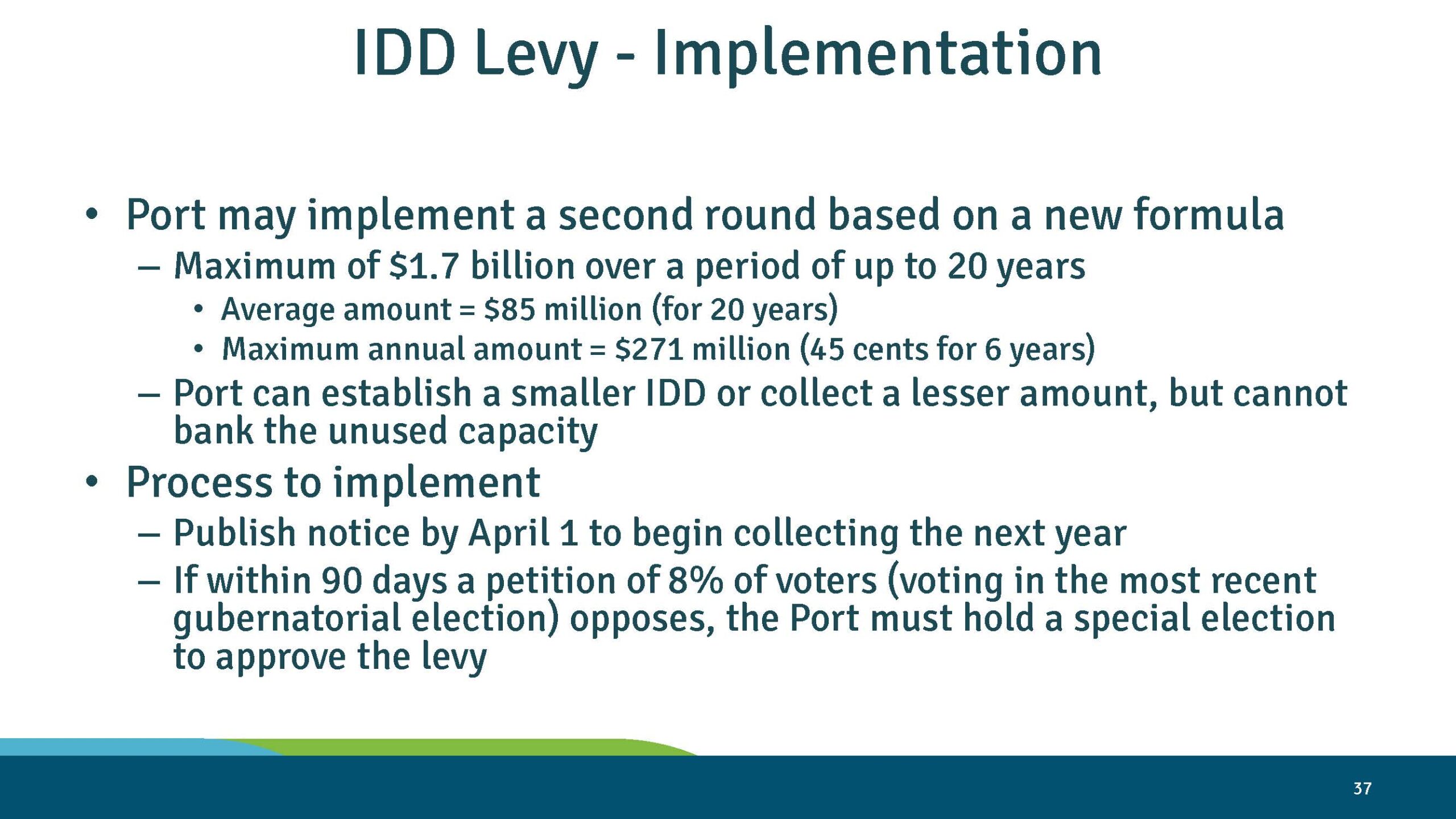
A presentation slide titled 'IDD Levy - Implementation' describing a second-round levy formula with a maximum of $1.7 billion over 20 years, an average annual amount of $85 million, and a maximum annual amount of $271 million. It also outlines the implementation process, including an April 1 notice deadline and a provision for a special election if 8% of voters petition within 90 days. -
Draft Finance Plan 201-2023-2018_11_13_SM_7c_supp_Page_36
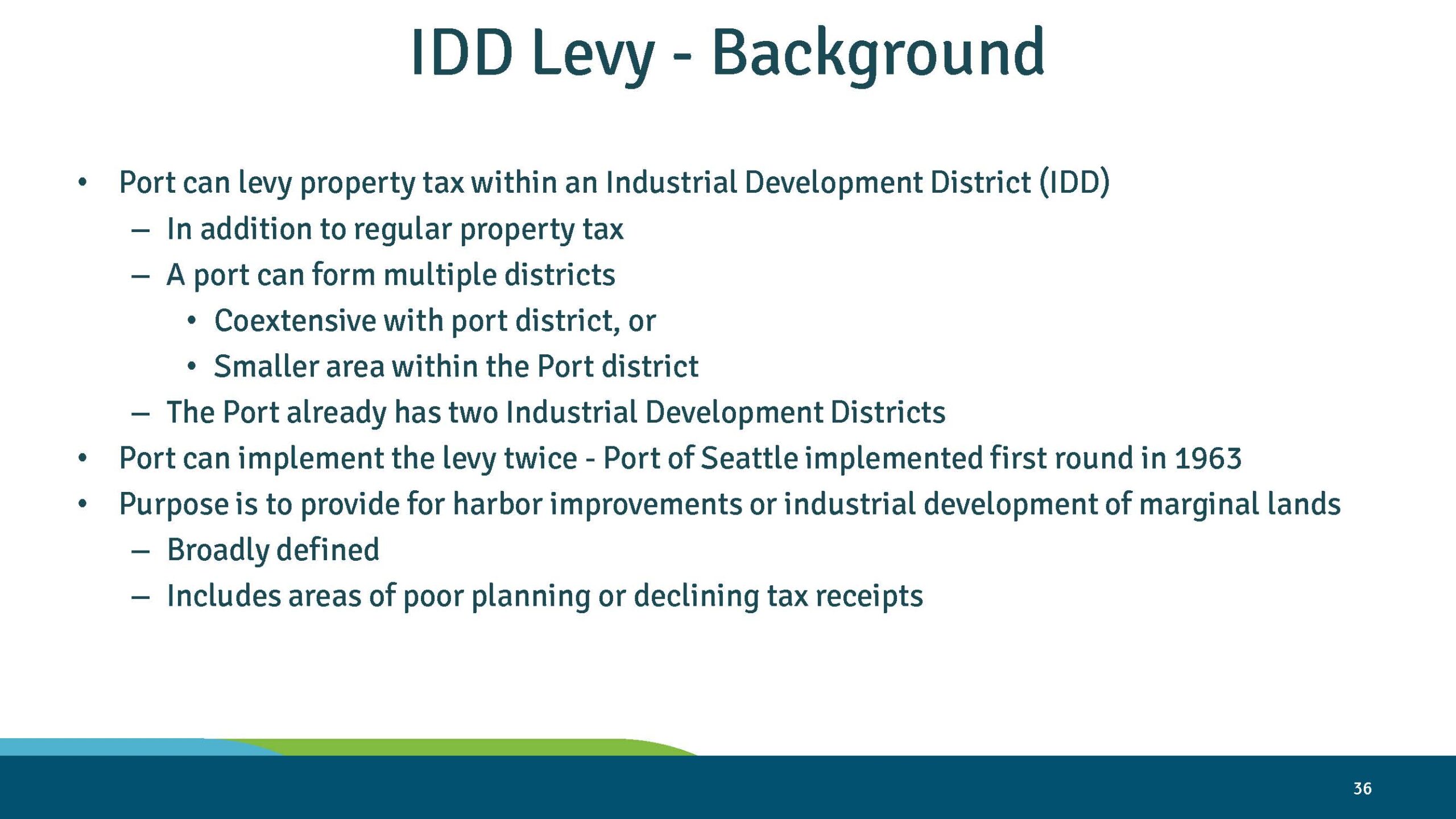
A presentation slide titled 'IDD Levy - Background' explaining that the Port of Seattle can levy property tax within an Industrial Development District (IDD) in addition to regular property tax. It notes the Port already has two IDDs, that it can implement the levy twice (with the first round implemented in 1963), and that the purpose is to provide for harbor improvements or industrial development of marginal lands. -
Draft Finance Plan 201-2023-2018_11_13_SM_7c_supp_Page_35
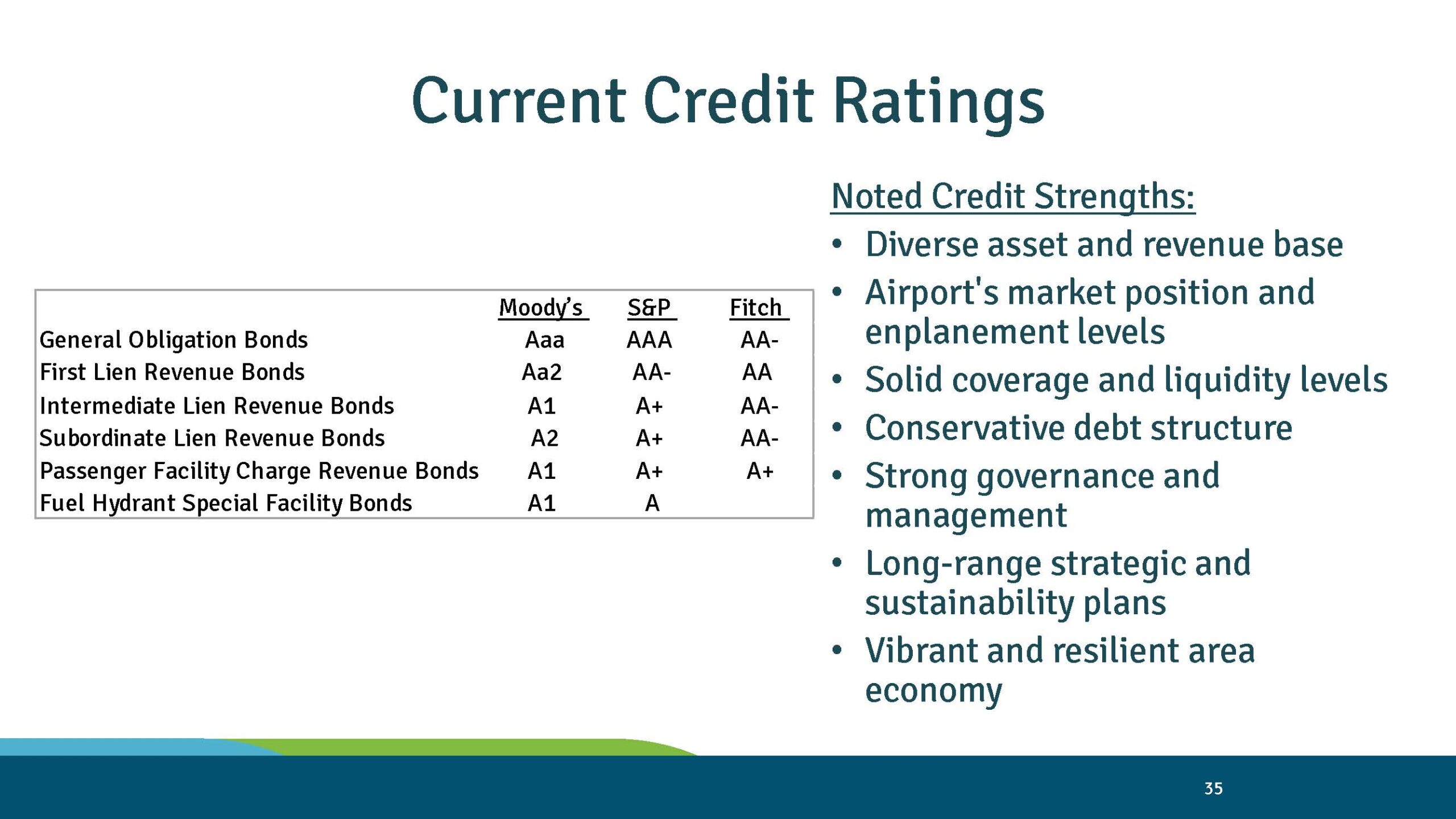
A presentation slide titled 'Current Credit Ratings' displaying bond ratings from Moody's, S&P, and Fitch for six bond types including General Obligation Bonds (Aaa/AAA/AA-) and First Lien Revenue Bonds (Aa2/AA-/AA). The slide also lists noted credit strengths including diverse asset and revenue base, solid coverage and liquidity levels, and conservative debt structure, consistent with an airport finance or investor relations presentation. -
Draft Finance Plan 201-2023-2018_11_13_SM_7c_supp_Page_34
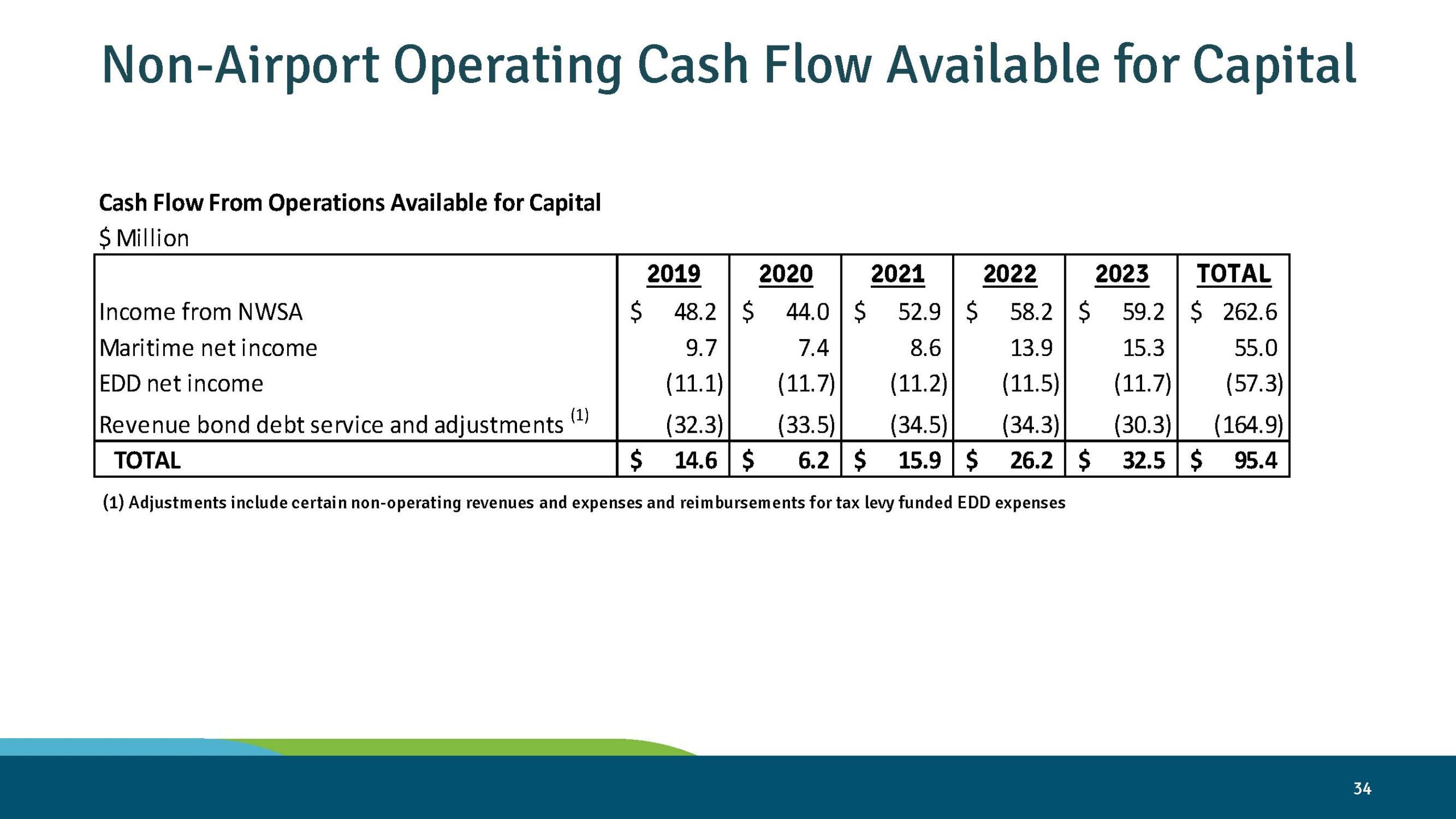
This financial table from a Port of Seattle presentation details Cash Flow From Operations Available for Capital across 2019–2023, broken down by Income from NWSA, Maritime net income, EDD net income, and Revenue bond debt service and adjustments. The five-year total cash flow available for capital is $95.4 million, with annual figures ranging from $6.2 million (2020) to $32.5 million (2023). -
Draft Finance Plan 201-2023-2018_11_13_SM_7c_supp_Page_33
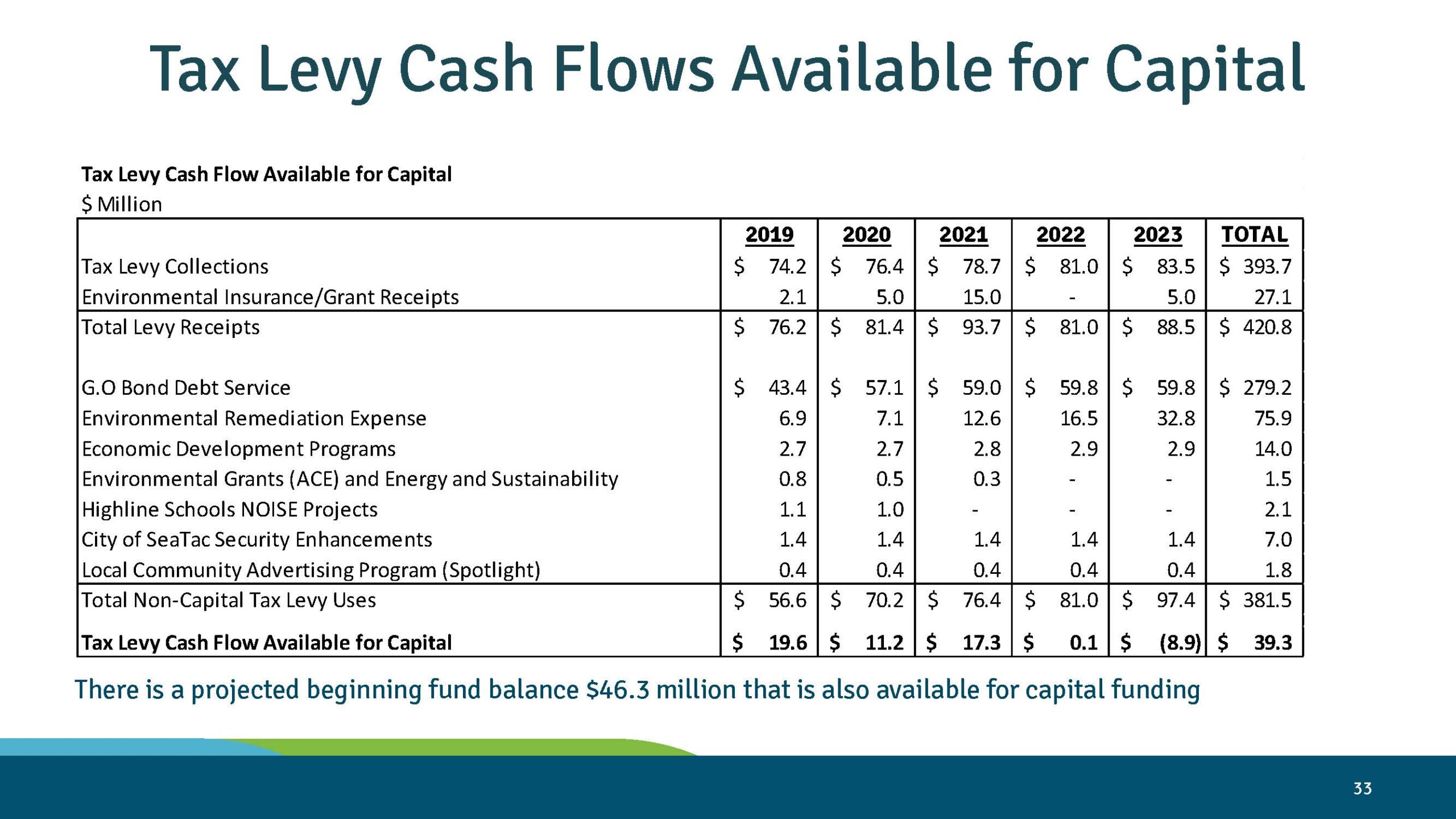
This slide presents a financial table showing Port of Seattle Tax Levy Cash Flow Available for Capital in millions of dollars across fiscal years 2019–2023, with a five-year total of $39.3 million after non-capital uses of $381.5 million. The document notes a projected beginning fund balance of $46.3 million also available for capital funding, relevant to Sea-Tac Airport noise policy and environmental remediation planning. -
Tax_Levy-Pages from 2018_11_13_SM_7c_supp
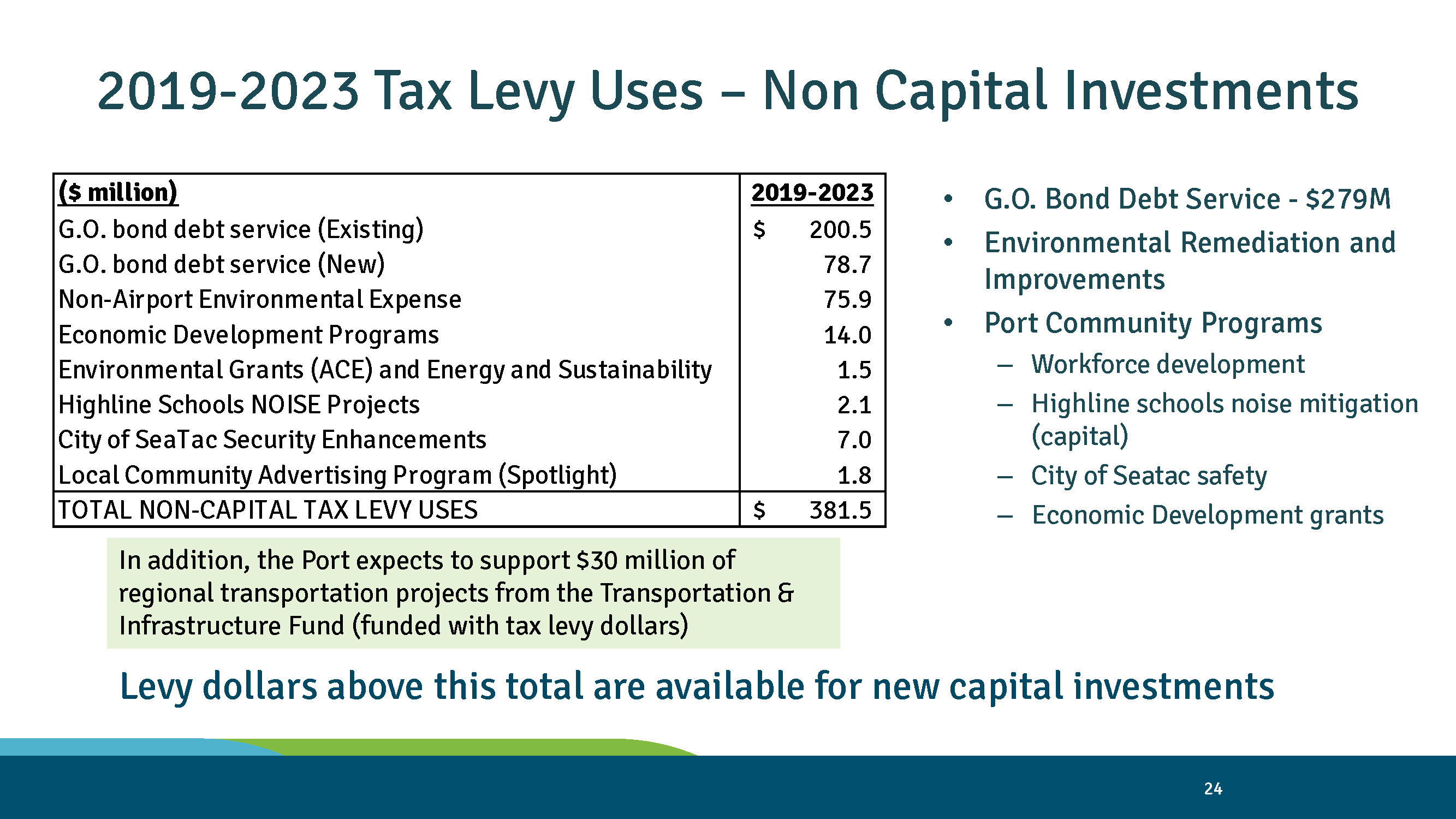
A Port of Seattle budget presentation slide detailing non-capital tax levy uses for 2019–2023, totaling $381.5 million. Major line items include G.O. bond debt service ($279M combined existing and new), Non-Airport Environmental Expense ($75.9M), and community programs such as Highline Schools NOISE Projects ($2.1M) and City of SeaTac Security Enhancements ($7.0M); an additional $30M is noted for regional transportation projects from the Transportation & Infrastructure Fund.