TagPort Of Seattle(2349)
-
Port of Seattle paid fraudsters more than $570,000 due to lax security, audit finds
The port fell for phishing schemes on two occasions in 2021, the Washington State Auditor’s Office found, due to weak controls including staff not following protocol. In October, 2021 the Port of Seattle Diversity, Equity & Inclusion department fell victim to what auditor’s office spokesperson called a “classic phishing scheme”: cyber-fraudsters posing as a legitimate -
 2023-04-06
Accountability audit report: Port Of Seattle
The Washington State Auditor's Office conducted an accountability audit of the Port of Seattle covering the period January 1 through December 31, 2021, with the report published on April 6, 2023. The audit examined the Port's compliance with applicable requirements and its safeguarding of public resources, with findings and responses documented in the report. This independent audit was intended to promote transparency and accountability in Port operations for the benefit of management, commissioners, and the public. -
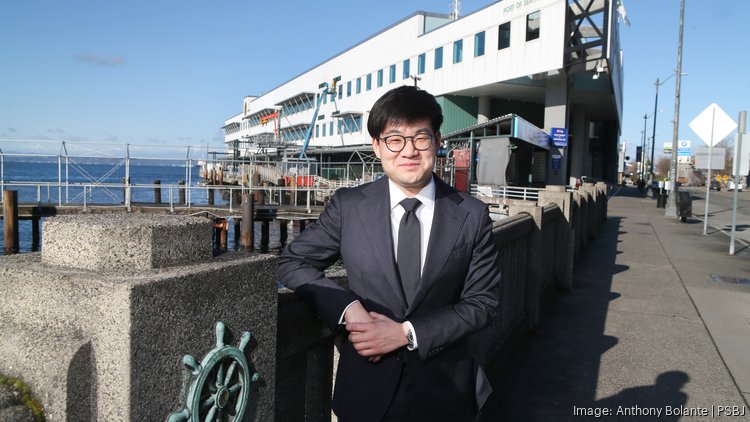
Sam Cho Port Commission President
A man in a dark suit and tie poses near the Port of Seattle waterfront. The image is credited to photographer Anthony Bolante for the Puget Sound Business Journal (PSBJ), visible in the lower-right watermark. -
 2023-04-04
Comments of the Port Of Seattle and Seattle-Tacoma International Airport on draft FAA policy regarding air carrier incentive program, Docket No. FAA-2002-1204
The Port of Seattle submitted comments to the FAA in April 2023 regarding proposed rules for airport air carrier incentive programs, arguing that airports should have broad flexibility to design their own incentive programs rather than follow a rigid list of prohibited practices. Seattle-Tacoma International Airport (SEA), which has run a New Air Service Incentive Program for over 15 years, raised concerns about a blanket ban on transferring funds to carriers, arguing that reimbursing carriers for pre-approved marketing activities should not be considered a prohibited subsidy. The Port also sought clarification on eligibility rules for competitive services and the 30-day public notice requirement for incentive agreements. -
Port Commission President Sam Cho aims to re-engage international trade partners
The 32-year-old sat down with the Business Journal to talk about the technological and market opportunities for the port and how it is preparing for a potential economic downturn. Port of Seattle Commission President Sam Cho ANTHONY BOLANTE | PSBJ About Sam: Job: Port of Seattle Commission President Board positions: Bellevue Chamber of Commerce, Greater Seattle Partners -
 2023-03-21
Burien Airport Committee agenda, March 21, 2023
The Burien Airport Committee held its March 21, 2023 meeting to review and vote on Resolution 495, which proposed amendments to the committee's governing guidelines, and to receive a general overview presentation about the Port of Seattle. The agenda also included a meet-and-greet with new committee applicants and a discussion of the 2023 workplan focused on outreach and education related to Sea-Tac Airport noise issues. Draft minutes from the February 21, 2023 meeting were also reviewed, reflecting prior discussions on committee structure and a U.S. Senate Commerce Committee request for policy priorities on aviation matters. -
 2023-03-15
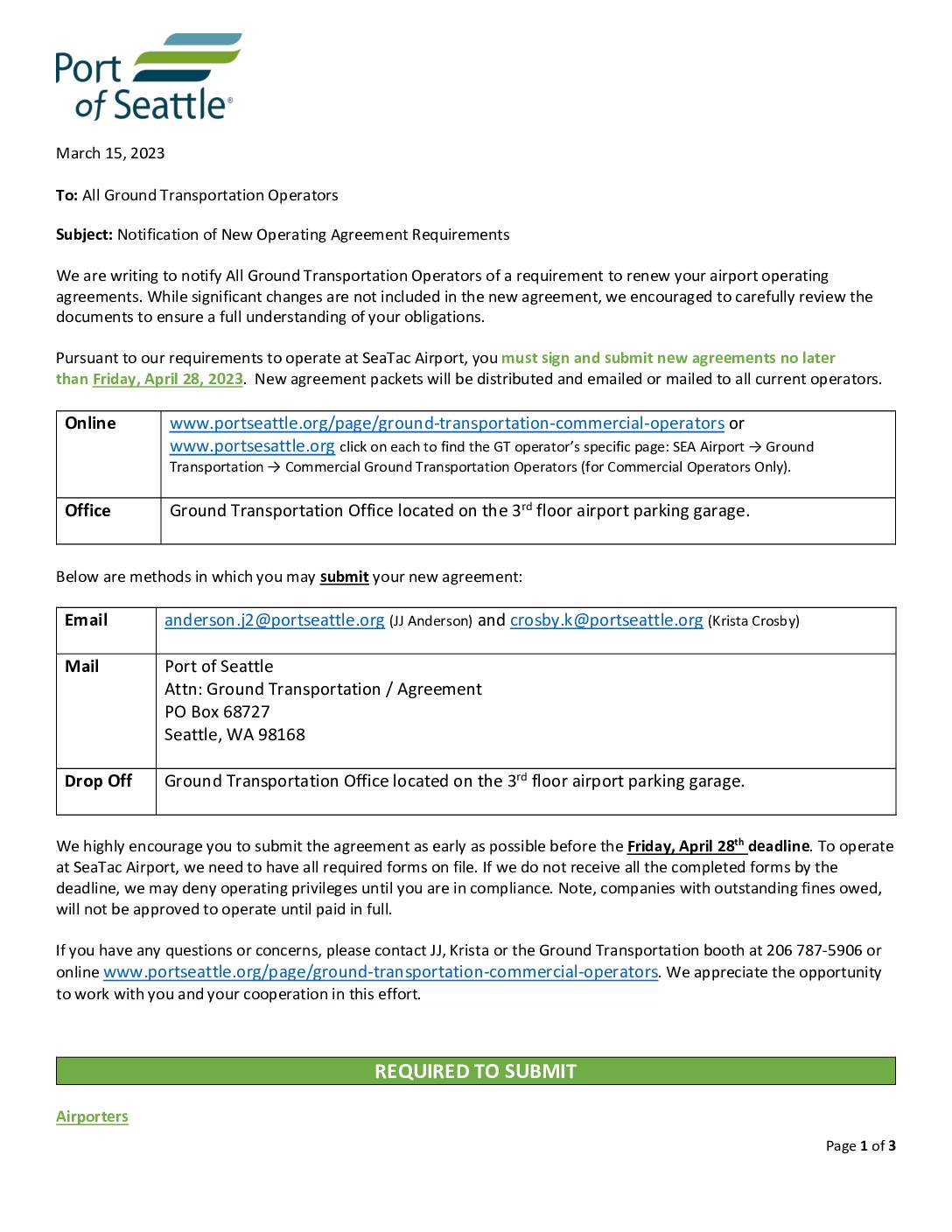
Notification of new operating agreement requirements
The Port of Seattle issued a March 2023 notice requiring all ground transportation operators at Seattle-Tacoma International Airport to sign and submit renewed operating agreements by April 28, 2023. Operators can submit agreements by email, mail, or in person at the Ground Transportation Office on the third floor of the airport parking garage. Required documents vary by operator type—such as airporters, charter buses, crew vans, and limousines—but generally include a signed agreement, proof of insurance, vehicle registrations, and a company information form. -
 2023-03-01
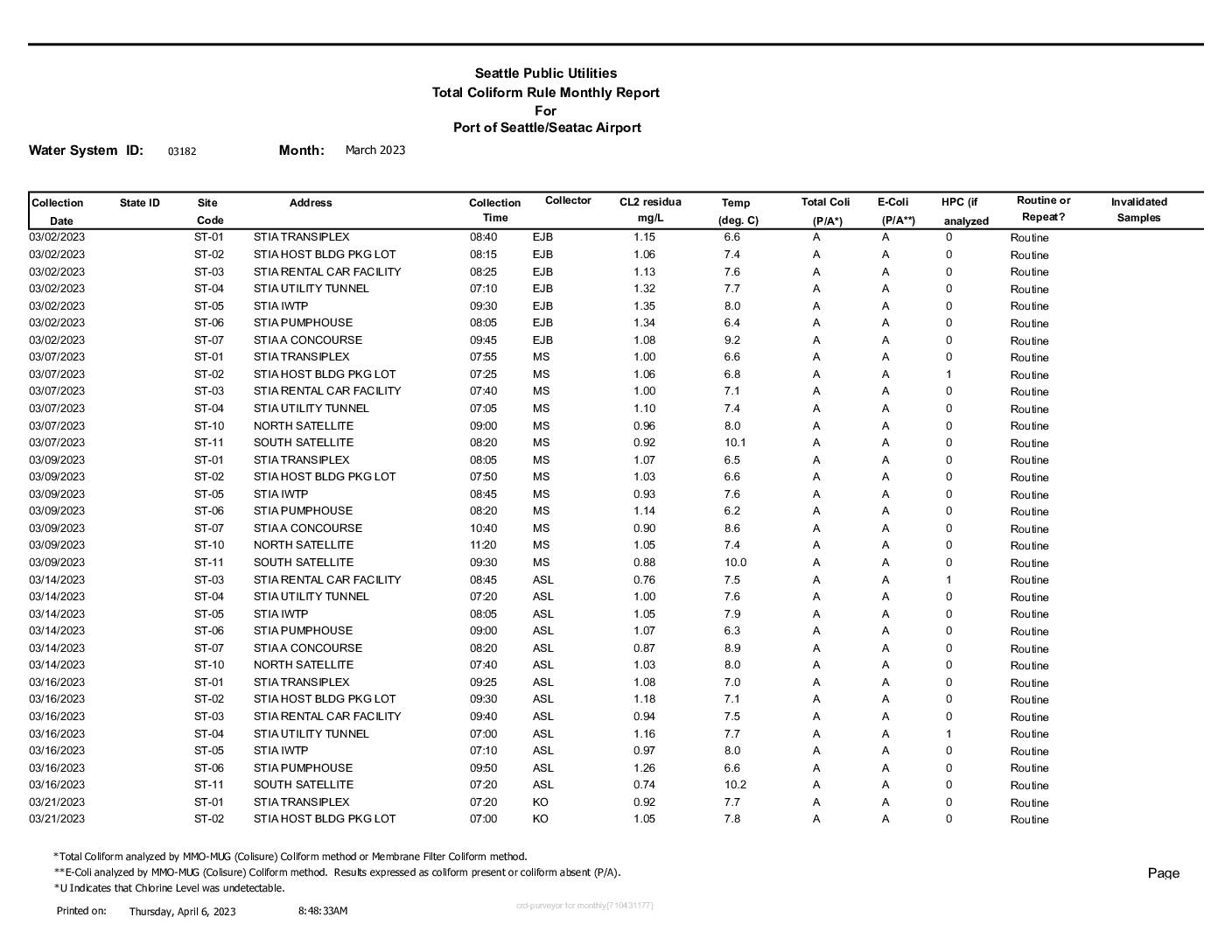
Seattle Public Utilities total coliform rule monthly report for Port Of Seattle/Seatac Airport – March 2023
This Seattle Public Utilities water quality report covers routine Total Coliform Rule monitoring at Seattle-Tacoma International Airport (Sea-Tac) for March 2023. A total of 52 water samples were collected from airport locations including the A Concourse, Rental Car Facility, Utility Tunnel, and satellite terminals, with all samples testing absent for total coliform and E. coli bacteria. The system met all regulatory standards, achieving 100% detectable chlorine levels and an average chlorine residual of 1.01 mg/L across the monitoring period. -
 2023-02-10
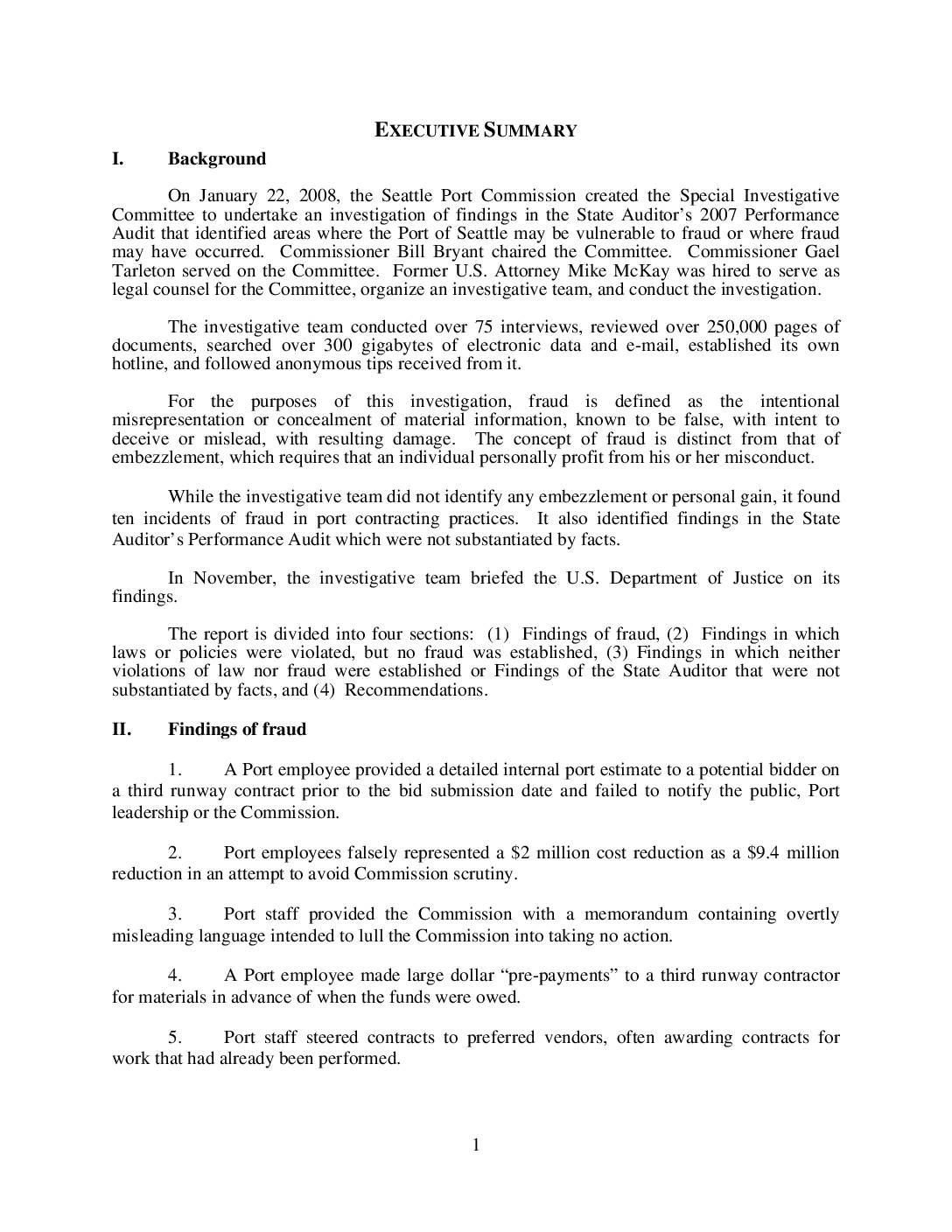
Executive Summary: Special Investigative Committee Report on Port Of Seattle Contracting Fraud
A 2008 investigation by the Seattle Port Commission found ten instances of fraud in Port of Seattle contracting practices, including bid manipulation, improper payments, and contract steering to preferred vendors, though no personal financial gain or embezzlement was identified. The inquiry, which reviewed over 250,000 pages of documents and conducted 75+ interviews, also found several instances where Port staff violated laws or policies without meeting the legal definition of fraud. Additionally, some findings from the State Auditor's 2007 Performance Audit were determined to be unsubstantiated by the underlying facts. -
 2023-01-26
Port Of Seattle 2023-2027 Capital Improvement Program presentation to SAME
The Port of Seattle presented its 2023–2027 Capital Improvement Program on January 26, 2023, outlining planned infrastructure investments across its Aviation, Maritime, Economic Development, and NW Seaport Alliance divisions. The presentation covered recently completed projects, projects currently underway, and upcoming projects with consulting opportunities. The Port oversees Seattle-Tacoma International Airport — the 9th busiest airport in the United States — along with cruise terminals, marinas, and cargo facilities.