TagPort Of Seattle Commission(302)
As the owner/operator of Sea-Tac Airport, following Commission meetings is a must. https://meetings.portseattle.org/
-
 2003-06-24
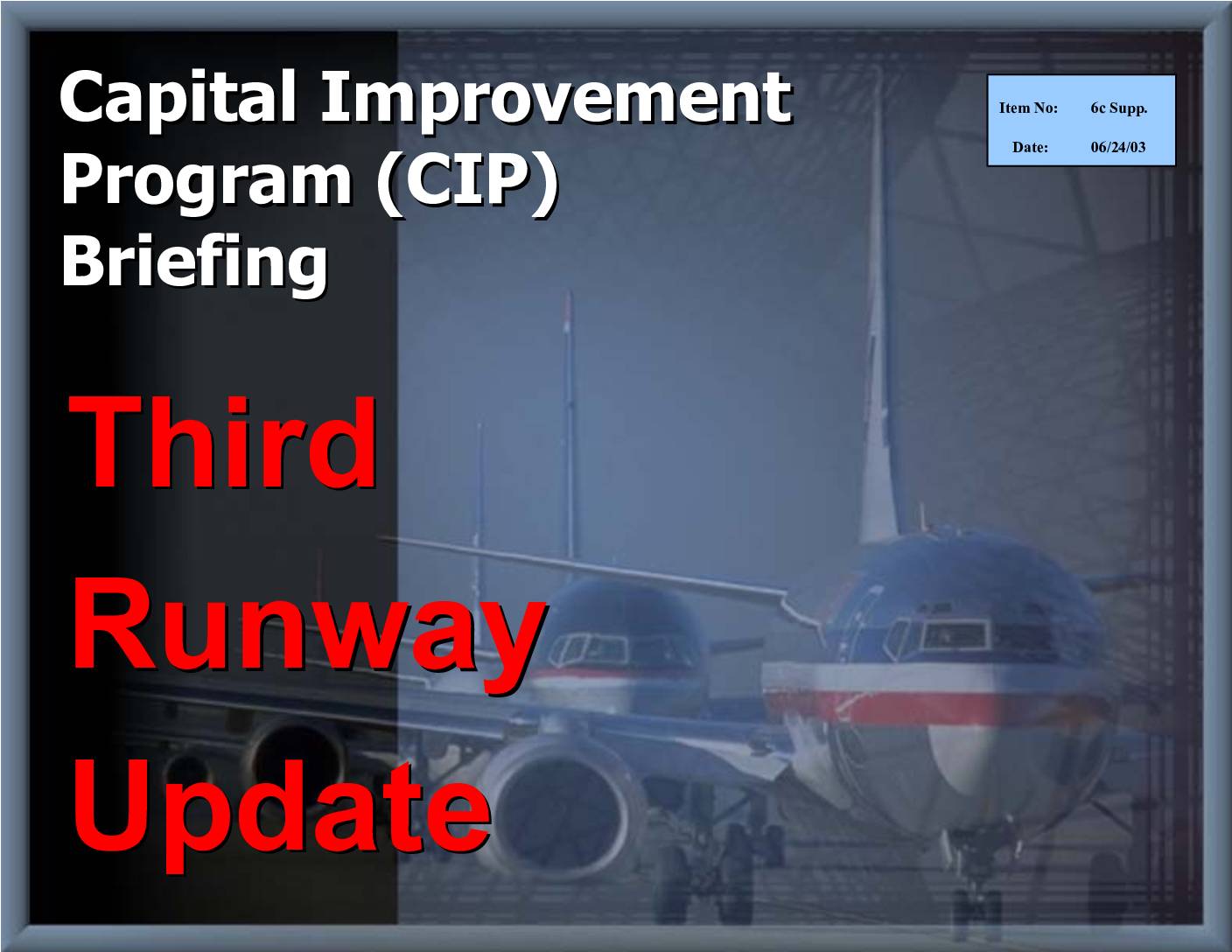
Third runway update: Capital Improvement Program (CIP) briefing
This June 2003 Capital Improvement Program briefing provides an update on the Third Runway project at Seattle-Tacoma International Airport. It outlines the revised 1999 project cost of $773 million, a target completion date of Fall 2006, and the assumption that an Army Corps of Engineers 404 Permit would be obtained by December 1999. A project schedule chart shows the planned phases—permitting, runway embankment, and runway pavement—spanning from 1999 through 2006, along with progress made to date. -
 2002-10-23
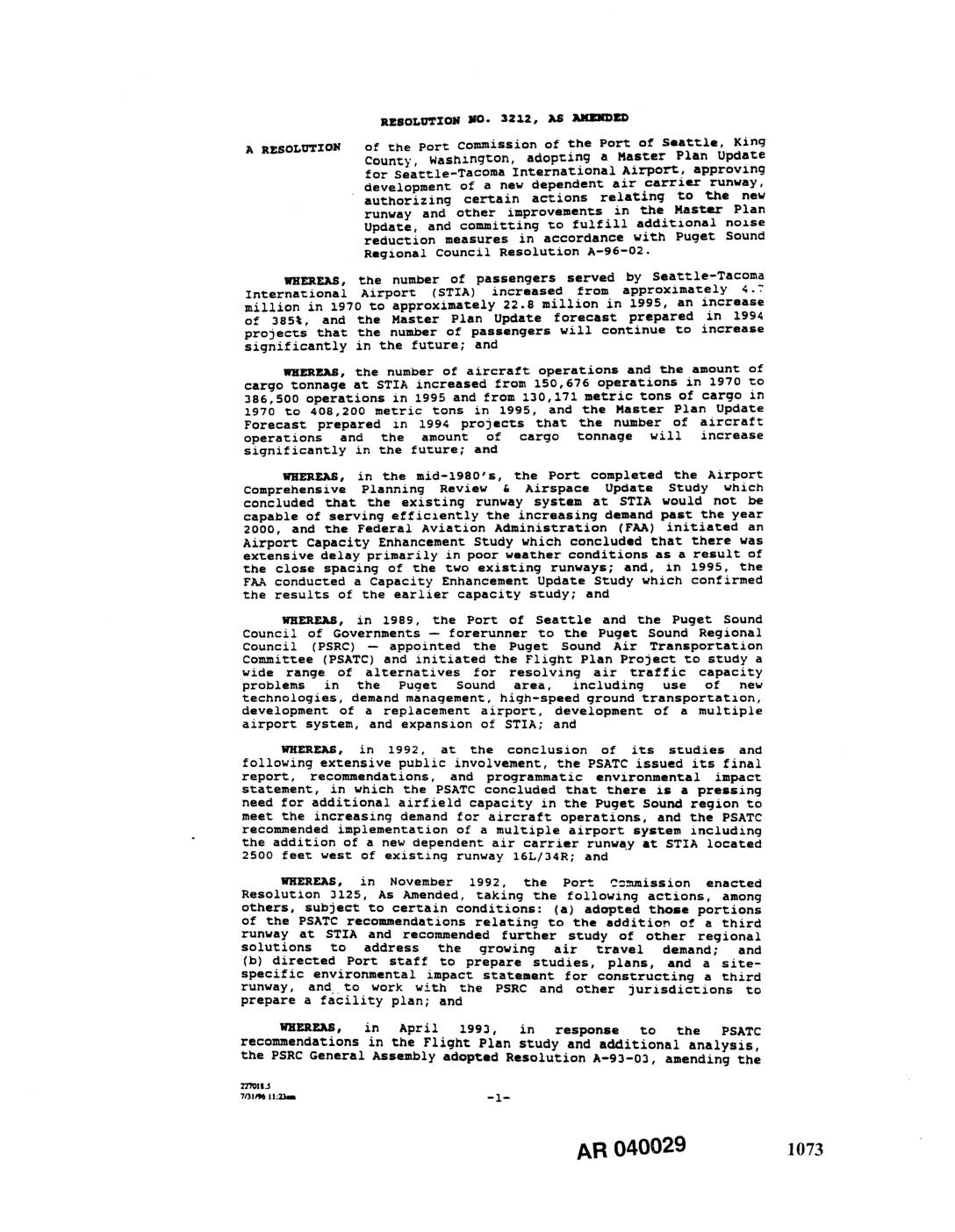
EXH AR040029: Resolution No. 3212, As Amended — Port Of Seattle Commission Master Plan Update for STIA, Third Runway Approval
Port Of Seattle Commission Resolution No. 3212, As Amended, adopting the Airport Master Plan Update for Seattle-Tacoma International Airport (STIA), approving development of a new 8500-foot dependent air carrier runway with centerline located no further than 2500 feet west of runway 16L/34R, and committing to additional noise reduction measures per Puget Sound Regional Council Resolution -
The port’s jet set
The port’s jet set High-flying Port bigwigs spent $126,000 on travel last year. By Rick Anderson • October 9, 2006 12:00 am Port Commissioner Clare Nordquist (front) and executive director Mic Dinsmore spent nearly $90,000 on travel last year. THE BOYS AT Fishermen’s Terminal like to imagine what they could do with the $126,000 that -
 2002-01-22
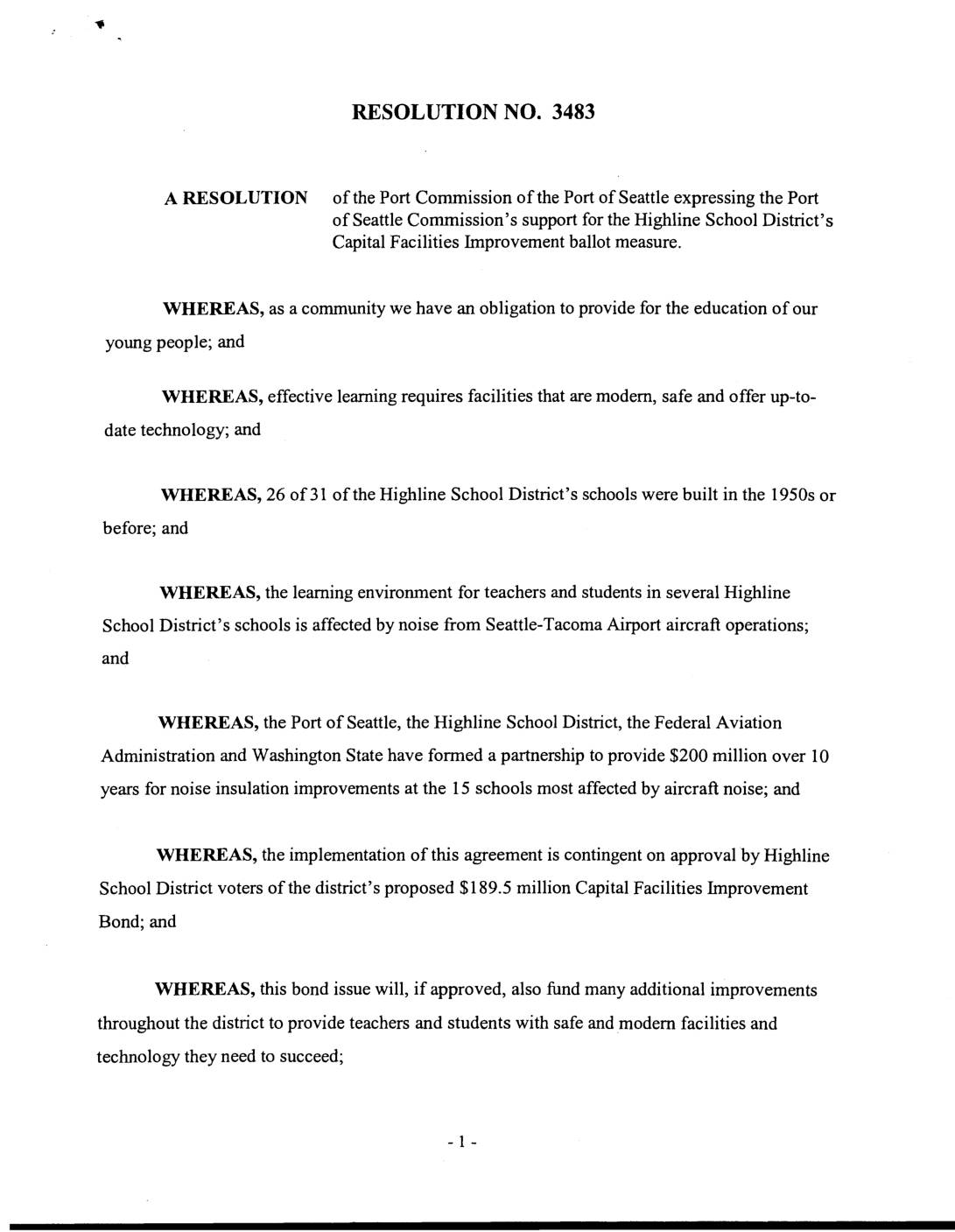
Resolution No. 3483: Port Of Seattle Commission Support for Highline School District Capital Facilities Improvement Ballot Measure
In January 2002, the Port of Seattle Commission passed Resolution No. 3483 to formally support the Highline School District's $189.5 million Capital Facilities Improvement Bond, which was on the March 12, 2002 ballot. The resolution reaffirmed the Port's commitment to contribute $50 million as part of a $200 million partnership with Washington State and the FAA for noise insulation and ventilation improvements at the 15 Highline schools most impacted by Seattle-Tacoma Airport aircraft noise. The funding partnership was contingent on Highline District voters approving the bond measure, which would also finance broader facility and technology upgrades across the district's aging school buildings. -
1999-02-02
See The World – Run For Port Commission (Editorial Board)
Feb 2, 1999 CANDIDATES, please. Two positions on the Port of Seattle commission are on the ballot this fall. If tradition holds, incumbents Gary Grant and Clare Nordquist will seek re-election and face minor opposition from unknowns who are driven more by a generalized beef with the Port than an informed set of ideas. The -
Incumbent Touts Advances By Port; Rival Seeks Shake-Up
Lisa Pemberton-Butler Seattle Times Business Reporter Up to a point, the political platforms of Port of Seattle Commissioner Jack Block and his challenger, David Ortman, are remarkably similar. Both strongly opposed the Seattle-Tacoma International Airport’s controversial third runway. Both believe the Port should be self-supporting – that its tax levy on King County homeowners should -
 1997-05-28
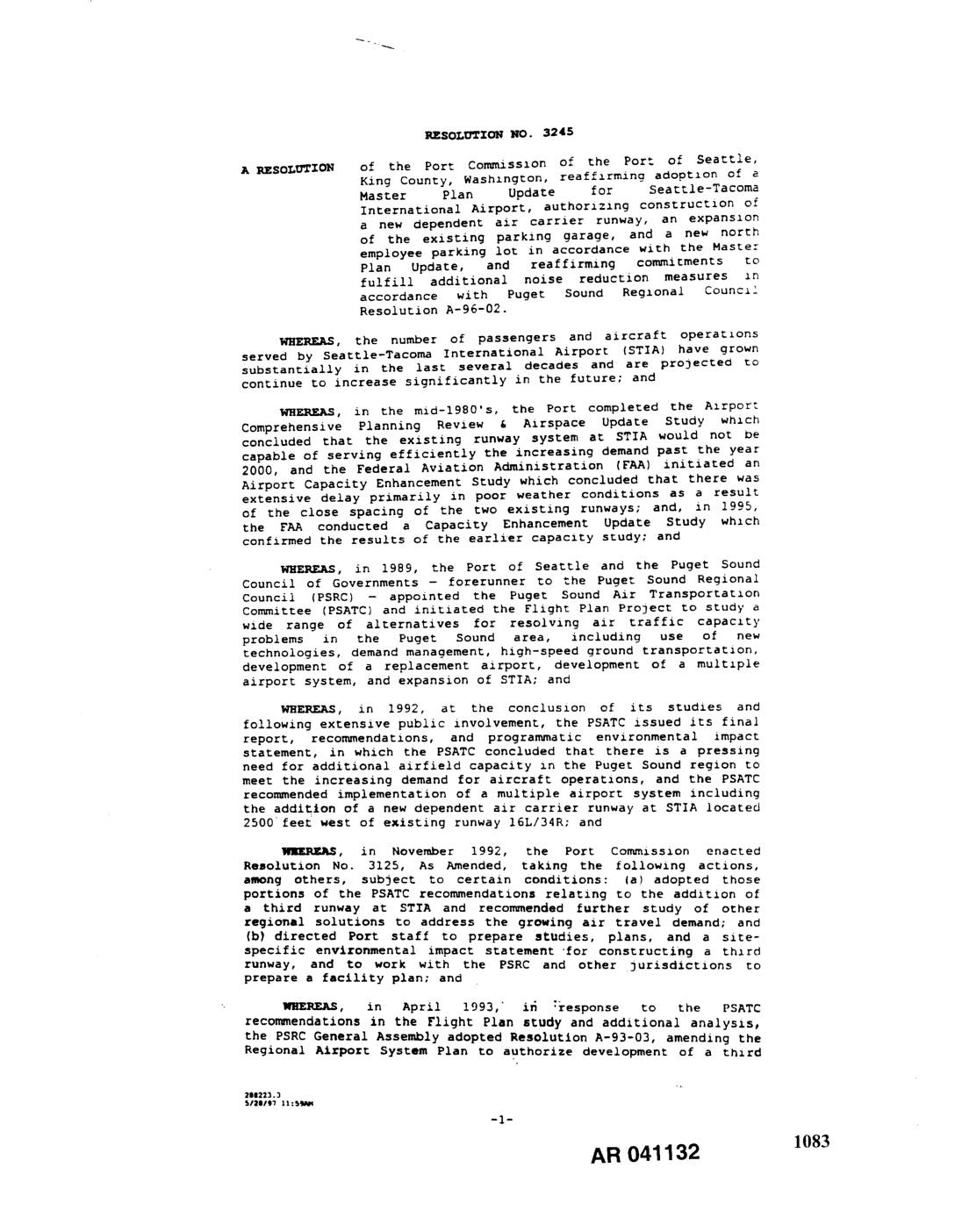
EXH AR041132: Port Of Seattle Commission Resolution No. 3245 — Reaffirming Master Plan Update and Authorizing Third Runway Construction at STIA
Port Of Seattle Commission Resolution No. 3245 reaffirms adoption of the Airport Master Plan Update for Seattle-Tacoma International Airport (STIA), authorizes construction of a new dependent air carrier runway (third runway) located 2500 feet west of existing runway 16L/34R, expansion of the existing parking garage, and a new north employee parking lot. References PSRC Resolution -
 1992-10-29
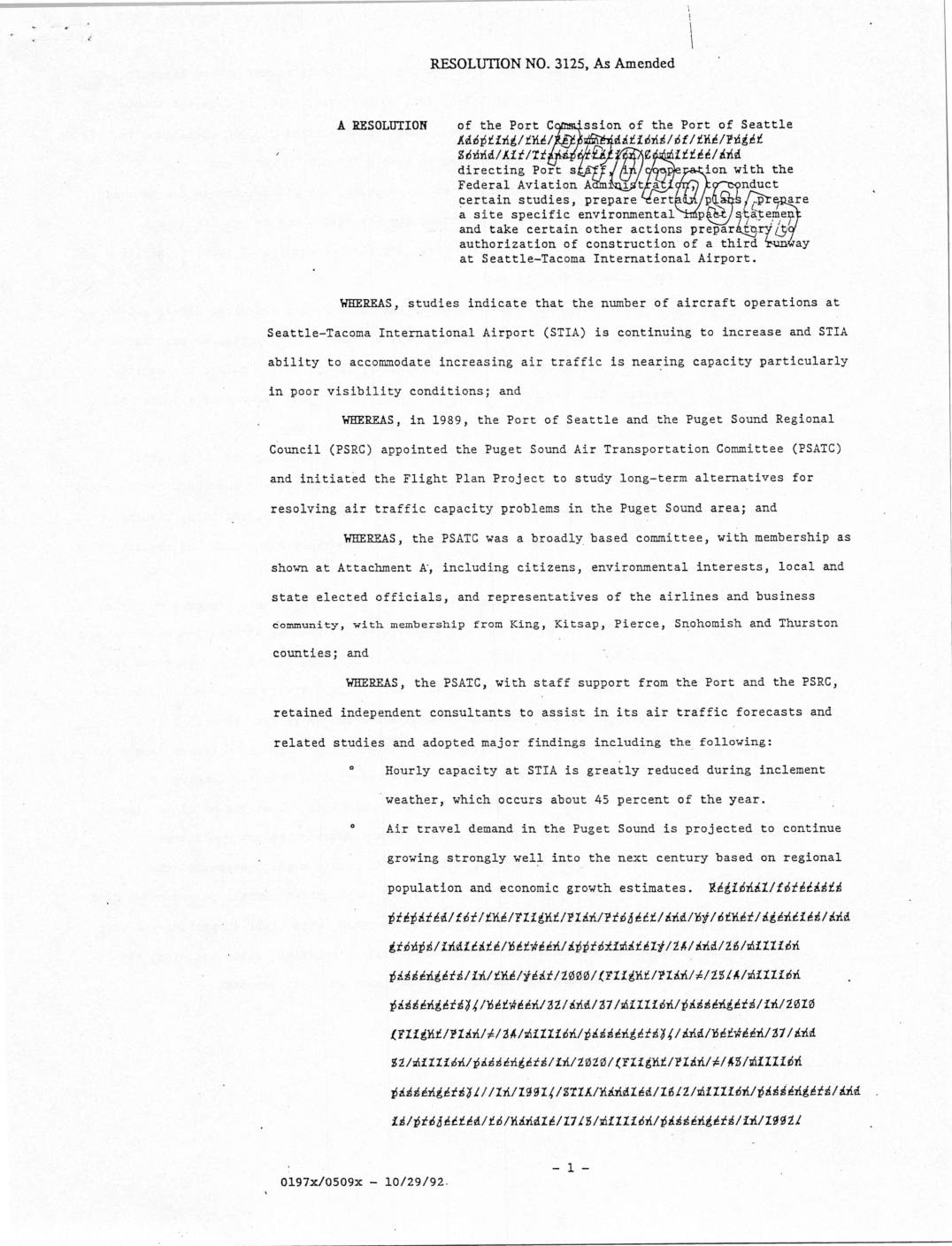
Resolution No. 3125, as amended
Resolution No. 3125, adopted by the Port of Seattle Commission in 1992, authorizes planning and environmental studies for the construction of a third runway at Seattle-Tacoma International Airport (Sea-Tac) to address growing air traffic demand and capacity limitations, particularly during poor weather conditions. The resolution follows a two-year study by the Puget Sound Air Transportation Committee (PSATC), which recommended a phased multiple-airport system, including a new dependent runway at Sea-Tac by 2000. The Port also called for broader regional solutions, including a fast rail link between Portland and Vancouver airports and diversion of cargo-only carriers to alternative airport sites. -
 1992-09-08
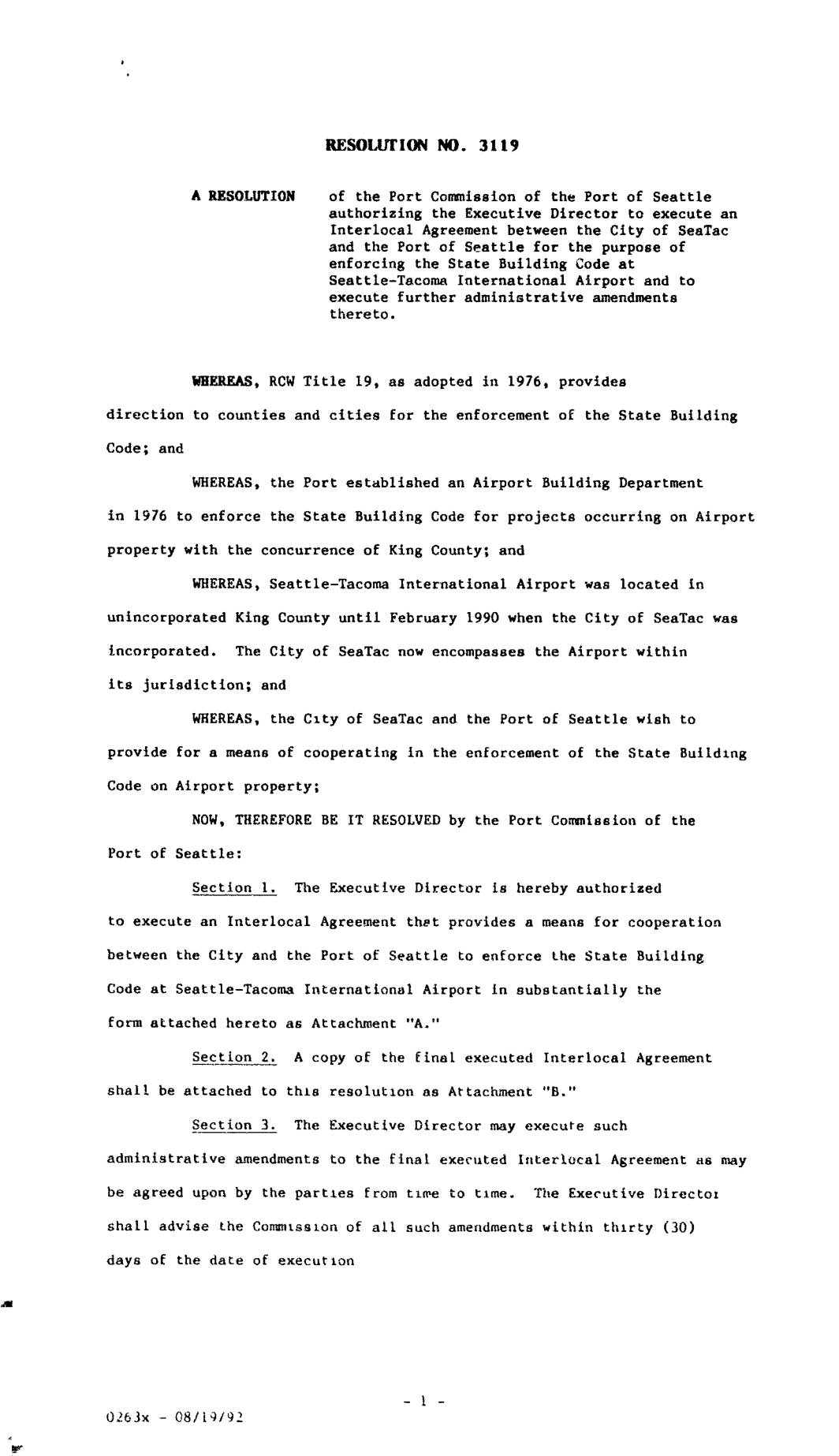
Resolution 3119: Port Of Seattle Commission Authorization for ILA with City of SeaTac for State Building Code Enforcement at Sea-Tac
Port Of Seattle Commission Resolution No. 3119, adopted September 8, 1992, authorizing the Executive Director to execute an Interlocal Agreement between the City of SeaTac and the Port of Seattle for enforcement of the State Building Code at Seattle-Tacoma International Airport. The resolution references RCW Title 19 (1976), the Airport Building Department established in 1976 -
1992-03-11
PORT OF SEATTLE ORDERS $75,000 AIR CARGO STUDY | Journal of Commerce
John Davies | Mar 11, 1992, 7:00 PM EST A $75,000 study of the needs of the air cargo industry at Seattle-Tacoma International Airport was ordered Tuesday. Port of Seattle commissioners authorized a review of existing facilities, growth forecasts and a projection of what the airport should do to be prepared for emerging demands.The action follows the