TagMiller Creek(252)
-
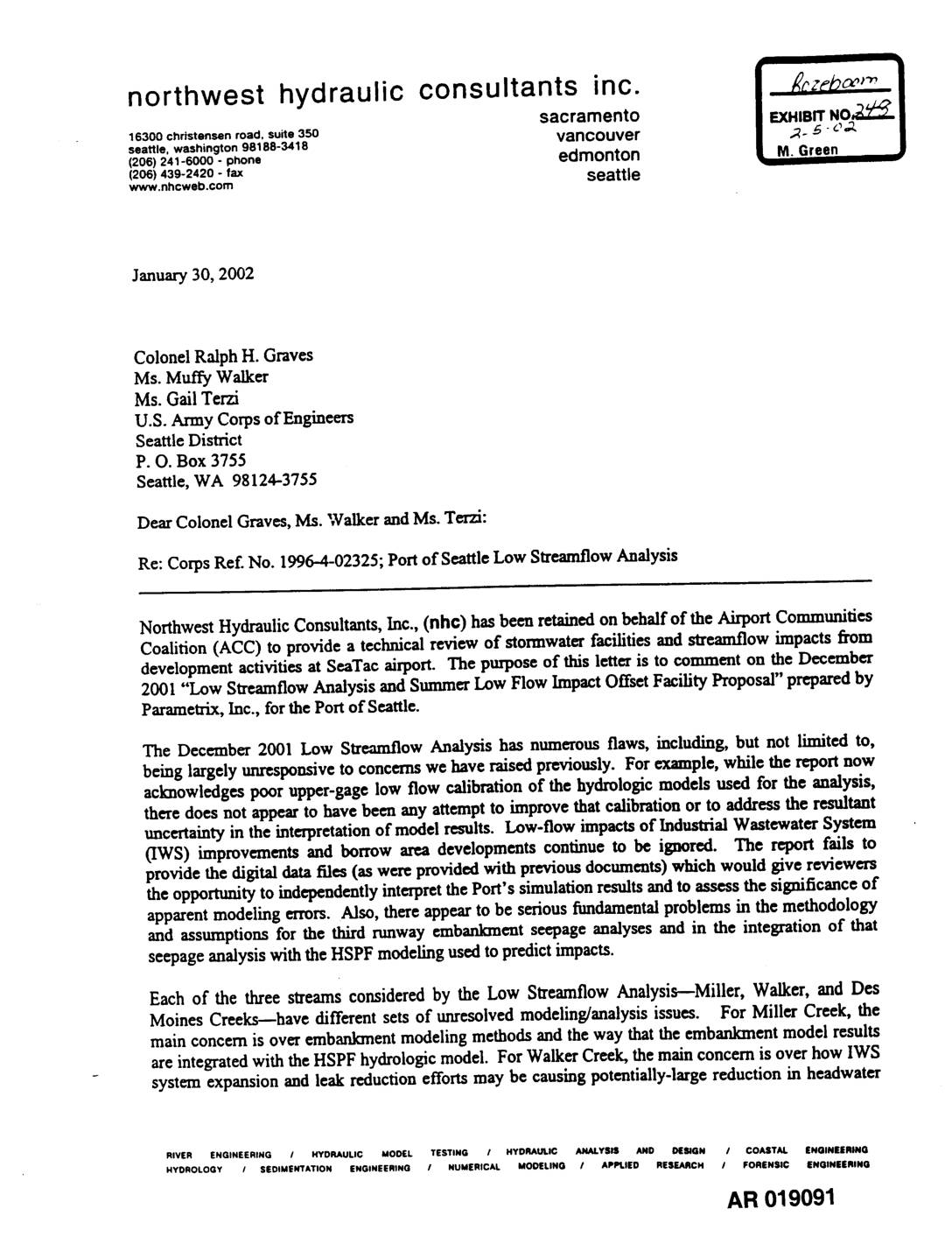 2002-01-30
EXH 248: NHC Letter to USACE — ACC Technical Review Low Streamflow Analysis, Miller, Walker & Des Moines Creeks
A January 2002 technical letter from Northwest Hydraulic Consultants challenges the Port of Seattle's December 2001 Low Streamflow Analysis for SeaTac Airport, identifying serious modeling errors that led to underestimated impacts on Miller, Walker, and Des Moines Creeks. Key flaws include double-counting of groundwater discharges in the Miller Creek model, inconsistent methodology for assessing embankment seepage, and failure to account for updated construction methods. The letter was submitted to the U.S. Army Corps of Engineers on behalf of the Airport Communities Coalition. -
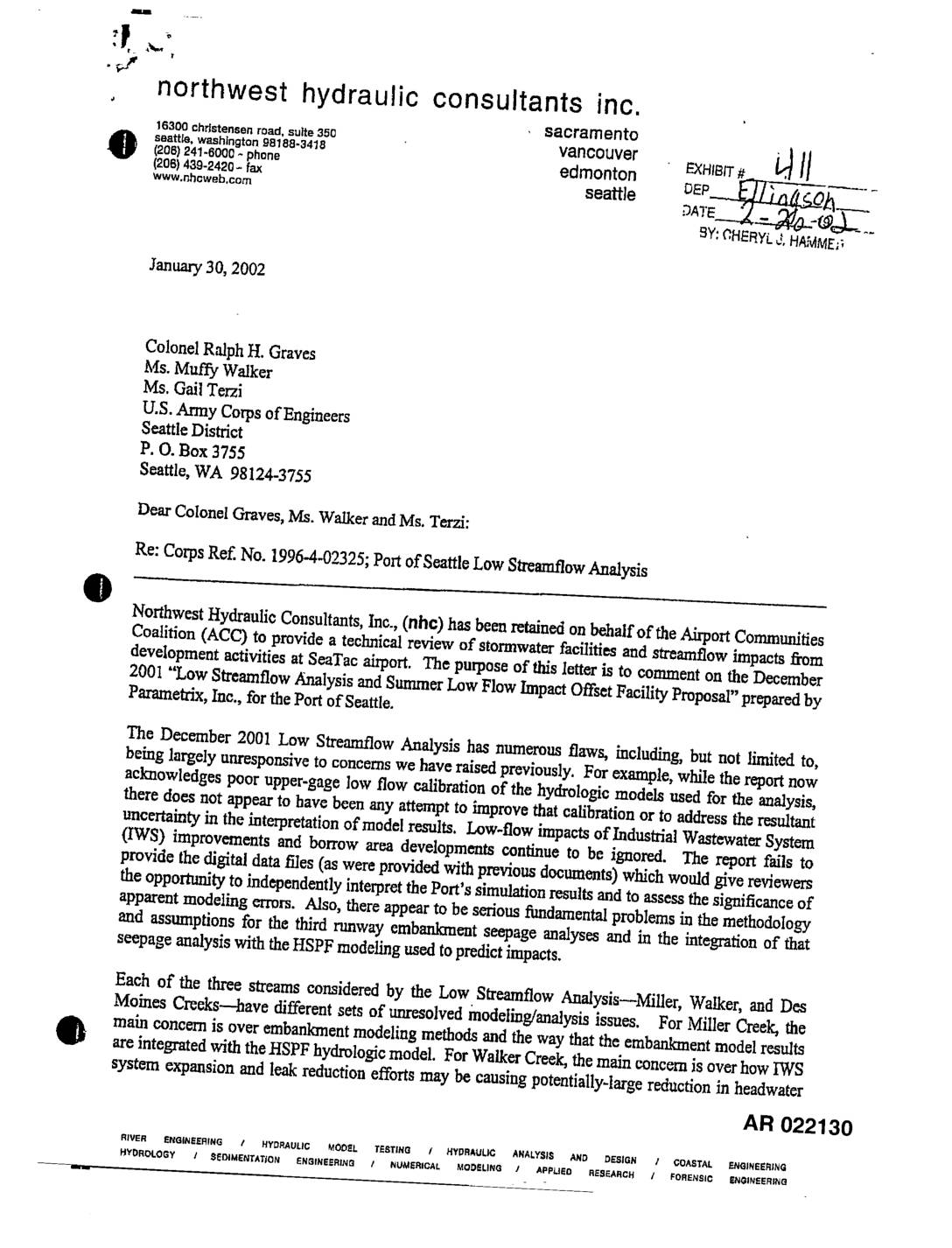 2002-01-30
EXH 411: NHC Letter to US Army Corps Engineers Low Streamflow Analysis Miller Creek Walker Creek Des Moines Creek
A January 2002 letter from Northwest Hydraulic Consultants to the U.S. Army Corps of Engineers challenges the Port of Seattle's December 2001 Low Streamflow Analysis related to Sea-Tac Airport's third runway development. The letter identifies critical flaws in hydrologic modeling of Miller, Walker, and Des Moines Creeks, including double-counting of groundwater discharges, flawed seepage modeling methodology, and failure to account for construction impacts on stream low flows. The consultants argue these errors cause the Port to substantially underestimate the project's negative impacts on local stream flows. -
 2002-01-21
EXH AR031548: Wetlands on STIA North End Properties — Supplemental Information Regarding Wetlands (Parametrix Technical Memorandum)
Parametrix, Inc. technical memorandum dated January 21, 2002, from Jim Kelley, Ph.D., to Muffy Walker, US Army Corps of Engineers Regulatory Branch, regarding Port Of Seattle permit 1996-4-02325 (Sea-Tac Airport Master Plan Update). Provides supplemental information on wetland impacts in upper watersheds of Miller Creek, Walker Creek, and Des Moines Creek, including percent loss of -
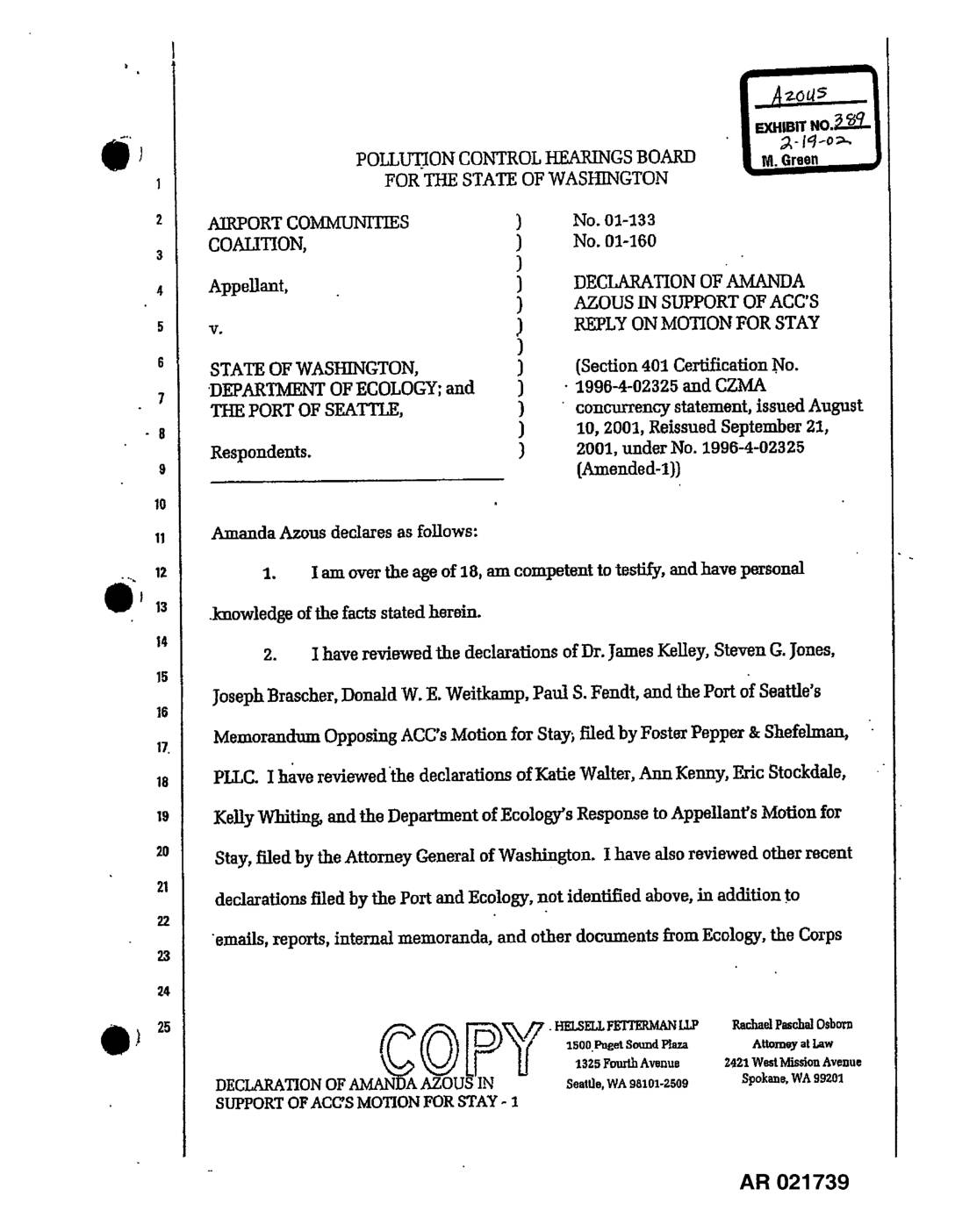 2002-01-19
EXH 389: Declaration Amanda Azous Supporting ACC Reply Motion for Stay
A wetlands scientist named Amanda Azous filed a legal declaration opposing the Port of Seattle's airport expansion project, arguing that filling approximately 2.8 acres of wetlands near Miller Creek would cause serious and irreversible environmental harm. She contends that the Port's mitigation plan—relying on stormwater management, embankment walls, and upland planting—cannot adequately replace the lost wetland functions, particularly the critical water and nutrient flows these wetlands provide to the broader Miller Creek watershed. The declaration was submitted in support of the Airport Communities Coalition's motion to halt the project before the Washington Pollution Control Hearings Board in 2001. -
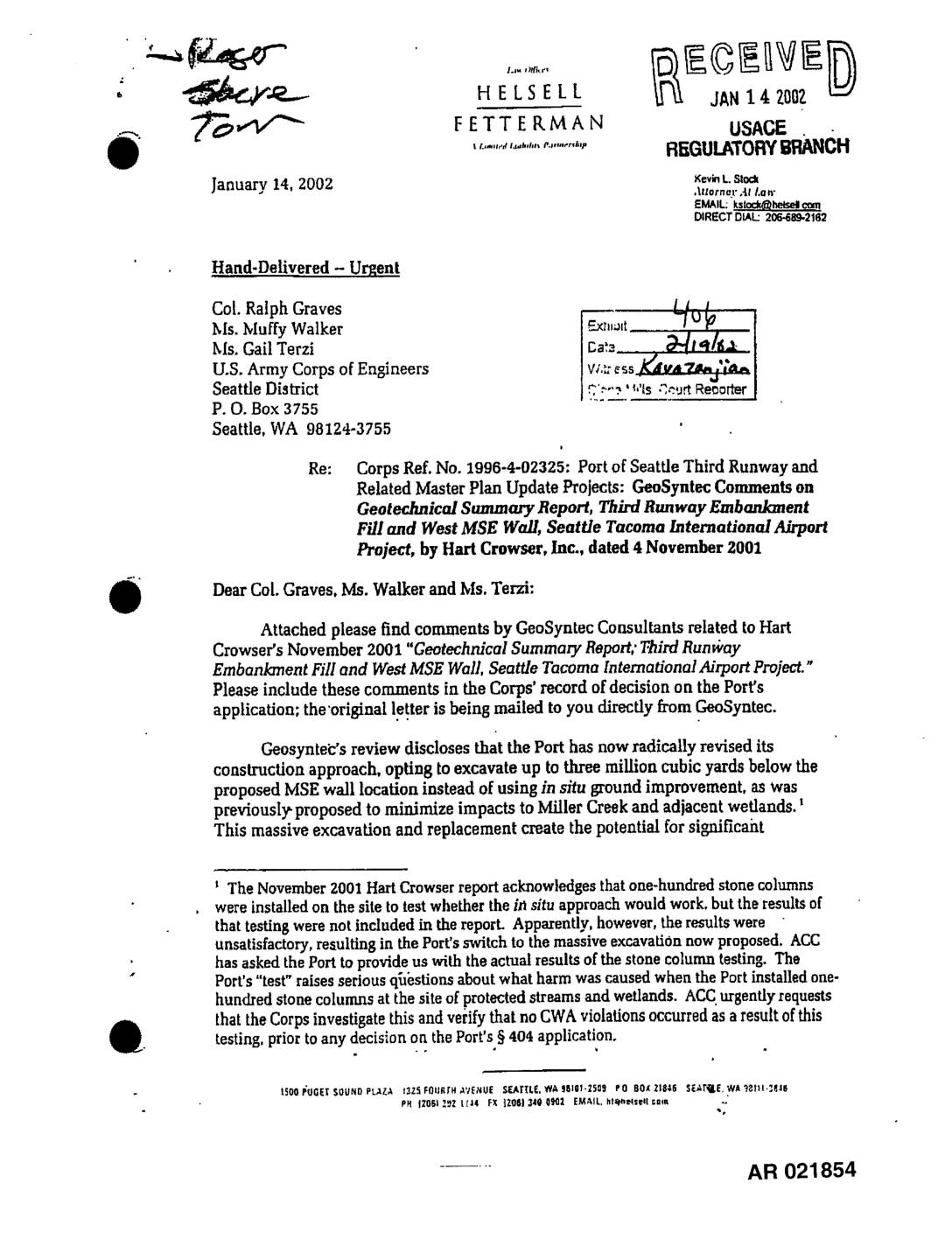 2002-01-14
EXH AR021854: Helsell Fetterman to Army Corps Transmitting GeoSyntec Comments on Hart Crowser Geotechnical Summary RP, Third Runway Embankment Fill and West MSE Wall, STIA
A January 2002 letter from law firm Helsell Fetterman, on behalf of the Airport Communities Coalition, raises concerns with the U.S. Army Corps of Engineers about the Port of Seattle's revised construction plans for the Sea-Tac Third Runway. The Port switched from an in-place ground improvement approach to excavating up to three million cubic yards of material beneath the proposed retaining wall, a major change that critics argue could significantly harm Miller Creek and adjacent wetlands. Attached technical comments from GeoSyntec Consultants also identify deficiencies in the Port's geotechnical report and argue the changes undermine the Port's Clean Water Act Section 404 permit application. -
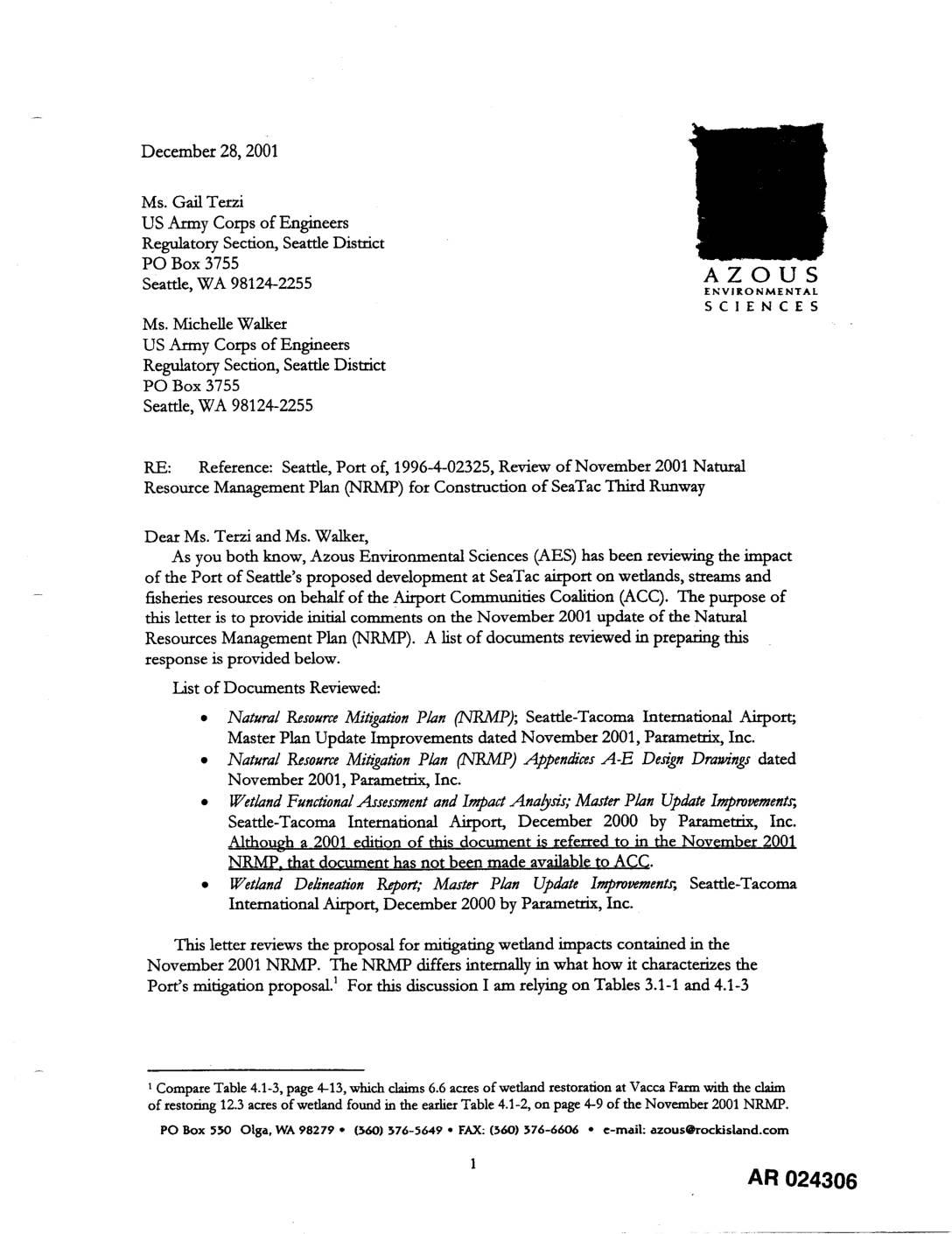 2001-12-28
EXH AR024306: ACC Review Letter — Nov 2001 NRMP Wetland Mitigation Inadequacies, STIA Third Runway
A December 2001 letter from Azous Environmental Sciences challenges the Port of Seattle's wetland mitigation plan for the SeaTac Third Runway construction project, arguing that the plan inadequately offsets environmental damage to wetlands and streams. The letter contends that the Port has misclassified wetland 'enhancement' work at Vacca Farm as 'restoration,' inflating mitigation credits, and that the overall plan fails to meet no-net-loss standards required under Army Corps of Engineers regulations. -
 2001-12-18
EXH AR017596: NHC Letter to U.S. Army Corps of Engineers re Port Of Seattle Document Inconsistencies in SMP for Sea-Tac Airport Master Plan Update
Northwest Hydraulic Consultants (NHC), retained by ACC (Airport Communities Coalition), wrote to Colonel Ralph H. Graves, Ms. Muffy Walker, and Ms. Gail Terzi of the U.S. Army Corps of Engineers Seattle District (Corps Ref. No. 1996-4-02325) identifying inconsistencies in Port Of Seattle proposals for site development and stormwater management at Sea-Tac Airport Master Plan Update -
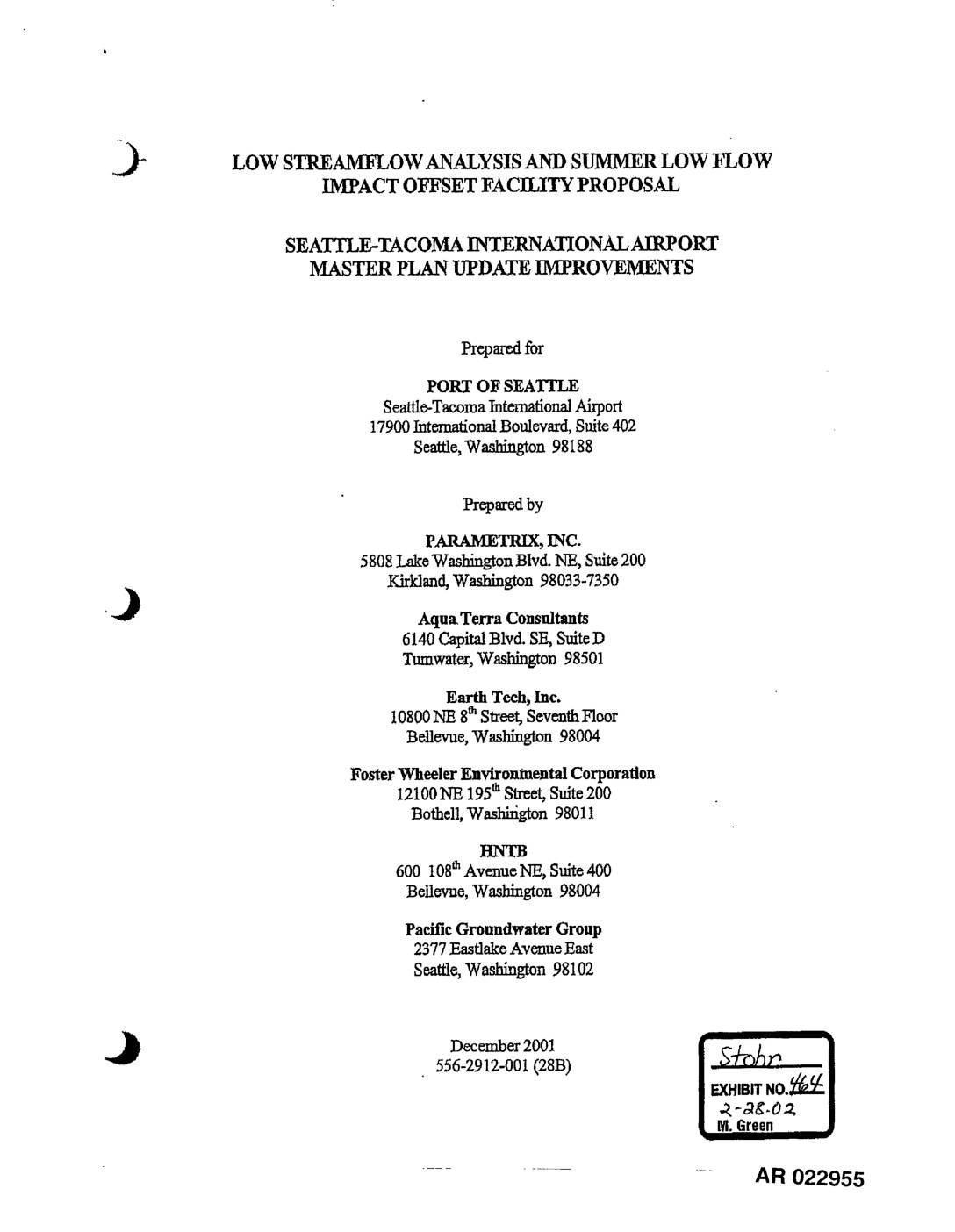 2001-12-01
EXH 464: Low Streamflow Analysis Summer Low Flow Impact Offset Facility Proposal STIA Master Plan Update
This December 2001 technical report analyzes low streamflow conditions in Miller, Walker, and Des Moines Creeks near Seattle-Tacoma International Airport, assessing the hydrologic impacts of the proposed third runway embankment as part of the airport's Master Plan Update. The study found that the runway construction would reduce summer stream flows, requiring mitigation of 0.11 cfs in Walker Creek and 0.08 cfs in Des Moines Creek during the annual low-flow period (late July through October). To offset these impacts, the Port of Seattle proposed collecting and storing excess winter stormwater in underground vaults—approximately 18.5 acre-feet for Walker Creek and 13.5 acre-feet for Des Moines Creek—for controlled release during dry-season low-flow periods. -
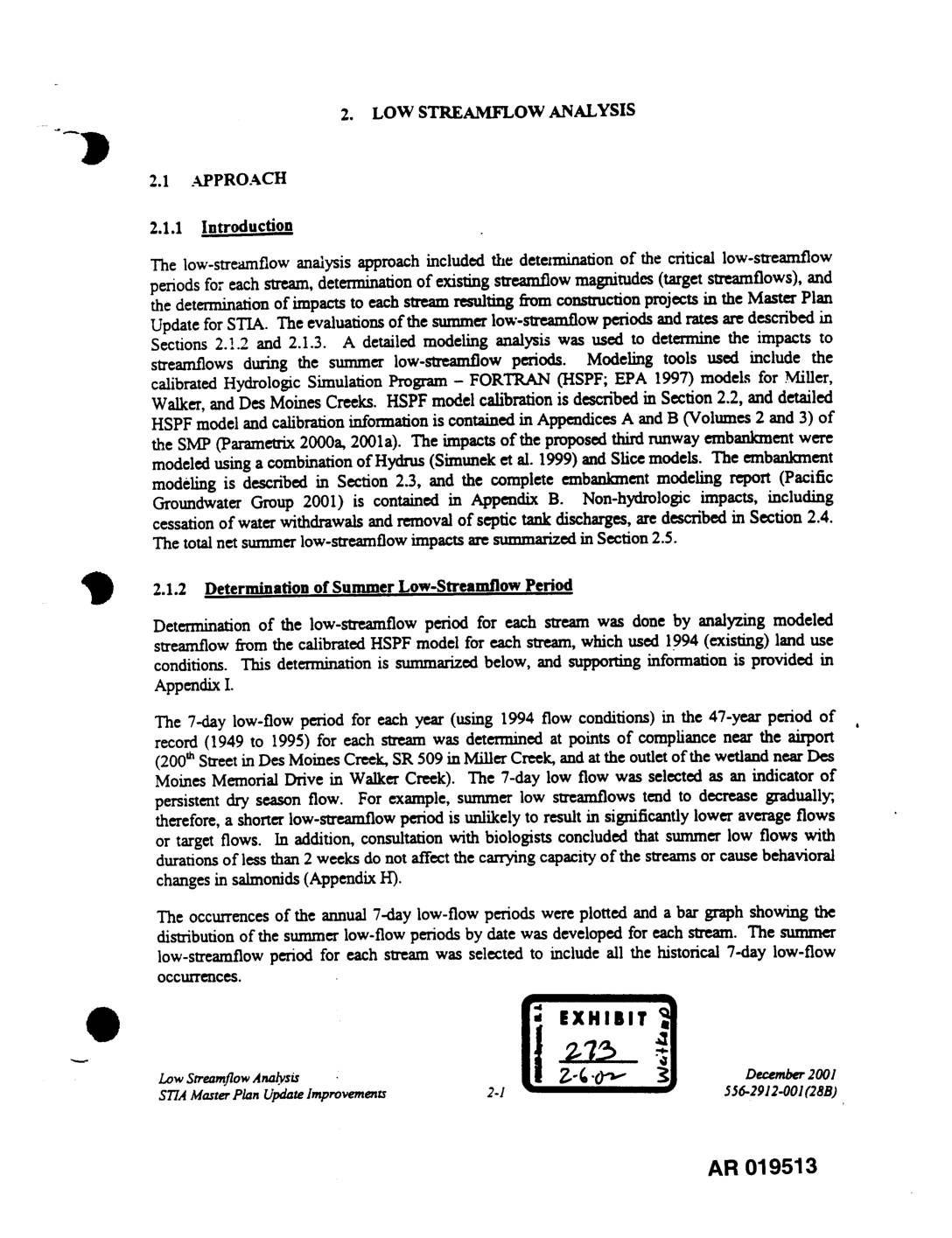 2001-12-01
EXH 273: Low Streamflow Analysis — STIA Master Plan Update Improvements
This technical report analyzes low streamflow conditions in three creeks near Seattle-Tacoma International Airport (Miller, Walker, and Des Moines Creeks) to assess the potential impacts of airport construction projects on summer water flows. Using a 47-year record of streamflow data and computer modeling tools, analysts determined target streamflow levels for each creek and evaluated how proposed runway and infrastructure improvements might affect seasonal low-flow periods critical to salmon habitat. The study found existing summer low streamflow targets of 0.33 cfs for Des Moines Creek, 0.77 cfs for Walker Creek, and 0.73 cfs for Miller Creek, which were used to guide mitigation planning. -
 2001-11-27
EXH AR052548: Sea-Tac Third Runway Embankment Fill Modeling in Support of Low Streamflow Analysis
Report by Pacific Groundwater Group (project JE0105) prepared for Port Of Seattle, dated November 27, 2001, analyzing embankment fill modeling in support of low streamflow analysis for the Sea-Tac Third Runway. Uses HYDRUS-SLICE modeling to assess vertical infiltration through embankment fill materials (General Fill and Type 1 Fill), saturated flow beneath the fill, and effective