TagKing County(422)
-
 2020-05-29
Sea-Tac Airport Communities Impact Study: Air Quality Analysis (Section 6, Appendix A)
This 2020 study examines how Seattle-Tacoma International Airport affects regional air quality, reviewing data from 1997 to 2018 collected across 13 monitoring stations within a 15-mile radius of the airport. It finds that King County consistently meets federal, state, and regional air quality standards for pollutants such as ozone, carbon monoxide, nitrogen dioxide, and particulate matter. In fact, pollution levels have generally decreased over time, leading authorities to shut down some monitoring stations near SeaTac due to consistently low readings. -
 2020-05-25
Community health impacts of airports
This presentation by Kim Serry, a University of Washington public health graduate student, reviews research on the community health impacts of airports, covering pollutants, health effects, and which populations are most affected. The session, produced in partnership with Public Health Seattle King County and the UW Center for Health Innovation and Policy Science, also examines local conditions relevant to the Sea-Tac area. The 30-35 minute recorded presentation concludes with an open question-and-answer period. -
 2020-01-01
King County Joint Aircraft Emissions Technical & Community Task Force Report
A King County task force report examines aircraft emissions from airports including Seattle-Tacoma International Airport (SEA) and King County International Airport (KCIA), finding that aviation accounts for 15 percent of King County's total emissions and disproportionately harms nearby frontline communities. The report identifies key challenges to reducing aviation pollution at the local level, including limited regulatory authority and immature clean-energy technologies. Near-term recommendations focus on improving air quality around airports and phasing out leaded aviation fuel, while acknowledging that significant emissions reductions are unlikely in the short to medium term. -
 2019-12-10
2020 Economic Development Partnership Program Authorization Request
The Port of Seattle is requesting $965,000 to fund its 2020 Economic Development Partnership Program, which provides grants to King County cities (excluding Seattle) to support local economic development projects such as business recruitment, tourism, and planning studies. Now in its fourth year, the program provides cities $1 per capita in funding and requires a 50% match from participating cities. In 2019, 23 of 38 eligible King County cities participated, with approximately $778,000 awarded for projects ranging from business assistance to regional marketing collaborations. -
Property Tax Appeal Cookbook
Sorry to be a tease but it’s not ready yet. This is the second most requested topic on the entire site so we decided it might be a good idea to put up a placeholder to describe what we’re doing. As of 1 September 2019, we’ve had nine homeowners successfully appeal their value assessments and -
 2018-12-14
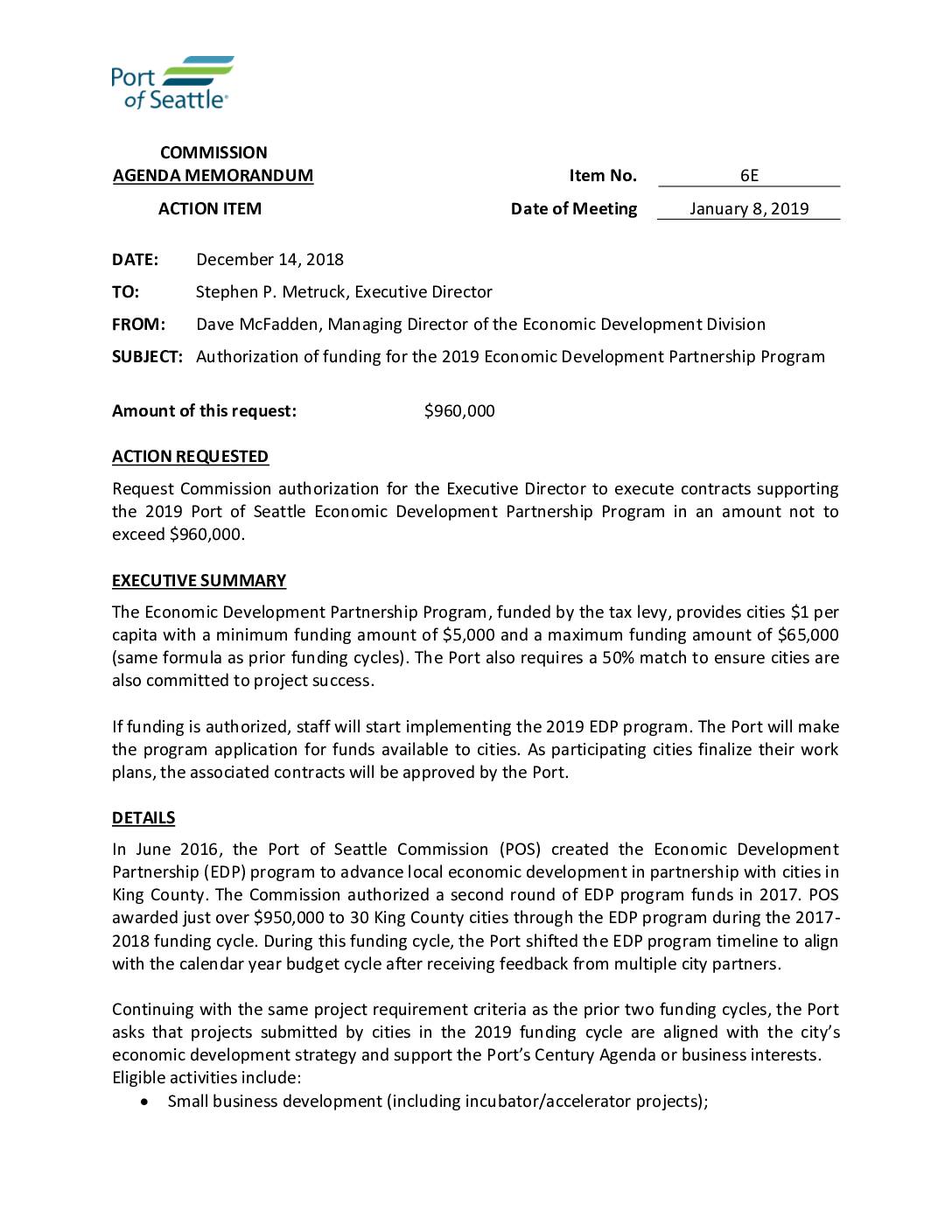
Authorization of funding for the 2019 Economic Development Partnership Program
The Port of Seattle Commission considered authorizing up to $960,000 for its 2019 Economic Development Partnership Program, which provides grant funding to King County cities based on a $1-per-capita formula (minimum $5,000, maximum $65,000) to support local economic development projects. Eligible activities include small business development, business recruitment, workforce development, tourism, and downtown revitalization, with cities required to provide a 50% funding match. The program, funded through the Port's property tax levy, has been running since 2016 and previously awarded about $950,000 to 30 King County cities during the 2017–2018 cycle. -
 2018-12-11
Tourism Marketing Grant Program 2019
The Port of Seattle's Tourism Marketing Grant Program, presented at the December 11, 2018 commission meeting, outlines the fourth year of a partnership initiative aimed at advancing statewide tourism and promoting use of Port facilities across Washington. The program has built partnerships with 26 organizations spanning King County, Eastern Washington, the Olympic Peninsula, and Western Washington, generating visitor interest and travel throughout the state. Smaller tourism organizations have been noted as particularly appreciative of the program's support. -
 2018-12-01
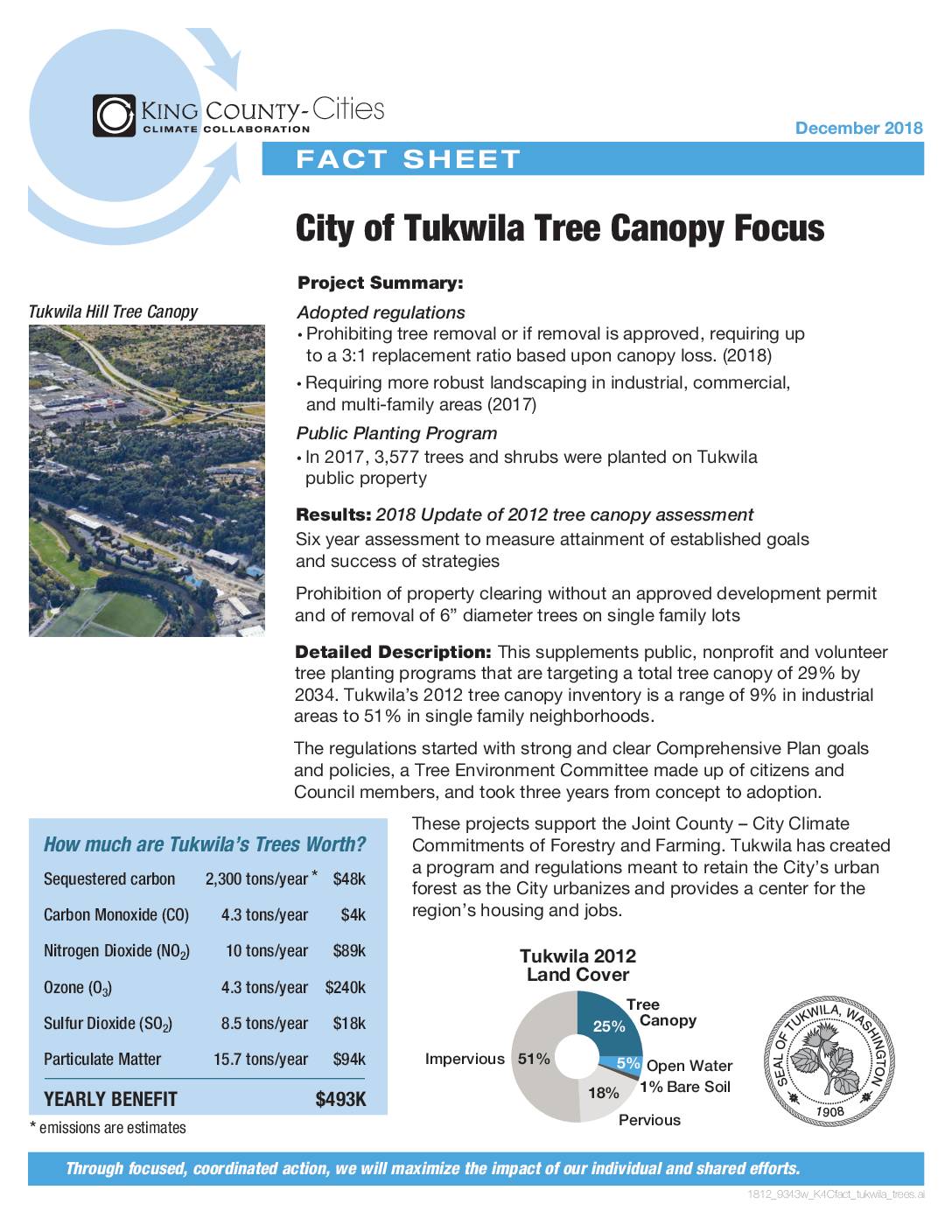
K4C City of Tukwila Tree Canopy Focus
Fact sheet summarizing Tukwila’s tree canopy management program, including regulations prohibiting tree removal, public planting initiatives, and environmental benefits. The city targets 29% tree canopy coverage by 2034 and provides $493K in yearly environmental benefits. -
 2018-12-01
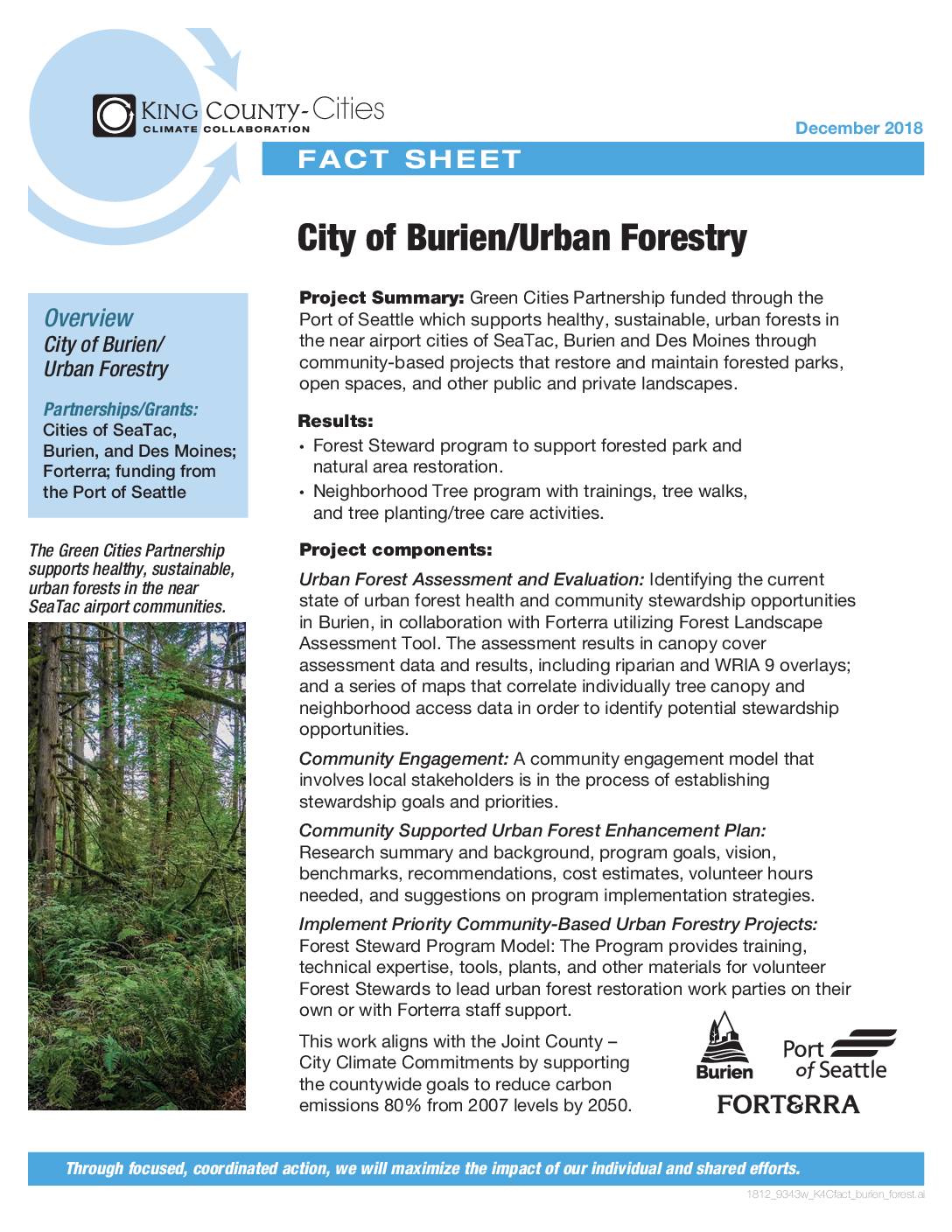
K4C Fact Sheet City of Burien/Urban Forestry
The Green Cities Partnership, funded by the Port of Seattle, supports healthy urban forests in the near-airport communities of SeaTac, Burien, and Des Moines through community-based restoration projects. Key initiatives include a Forest Steward Program, where trained volunteers lead park and natural area restoration efforts, and a Neighborhood Tree Program offering tree walks, plantings, and care activities. The project also includes an urban forest assessment and a community-supported enhancement plan aimed at reducing carbon emissions 80% from 2007 levels by 2050.