TagHealth(103)
-
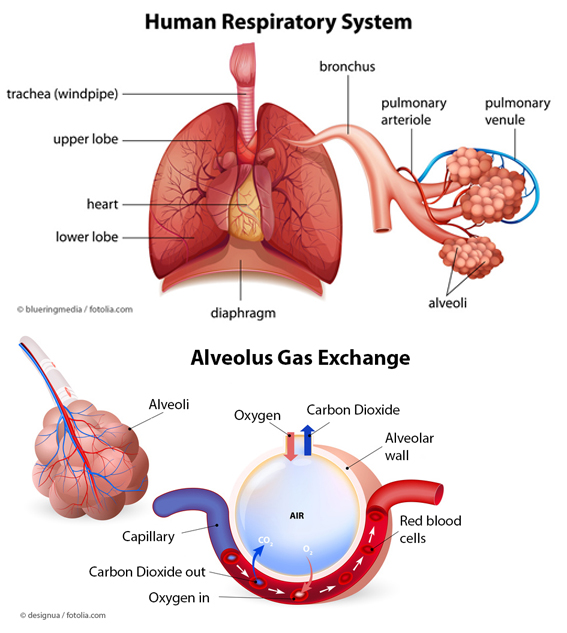
Human Respiratory System Gas Exchange
A labeled educational illustration depicting the human respiratory system (trachea, bronchus, lungs, heart, diaphragm, alveoli, pulmonary arteriole and venule) and a detailed diagram of alveolus gas exchange showing oxygen intake and carbon dioxide expulsion via capillaries and red blood cells. Watermarks indicate copyright by blueringmedia/fotolia.com and designua/fotolia.com. -
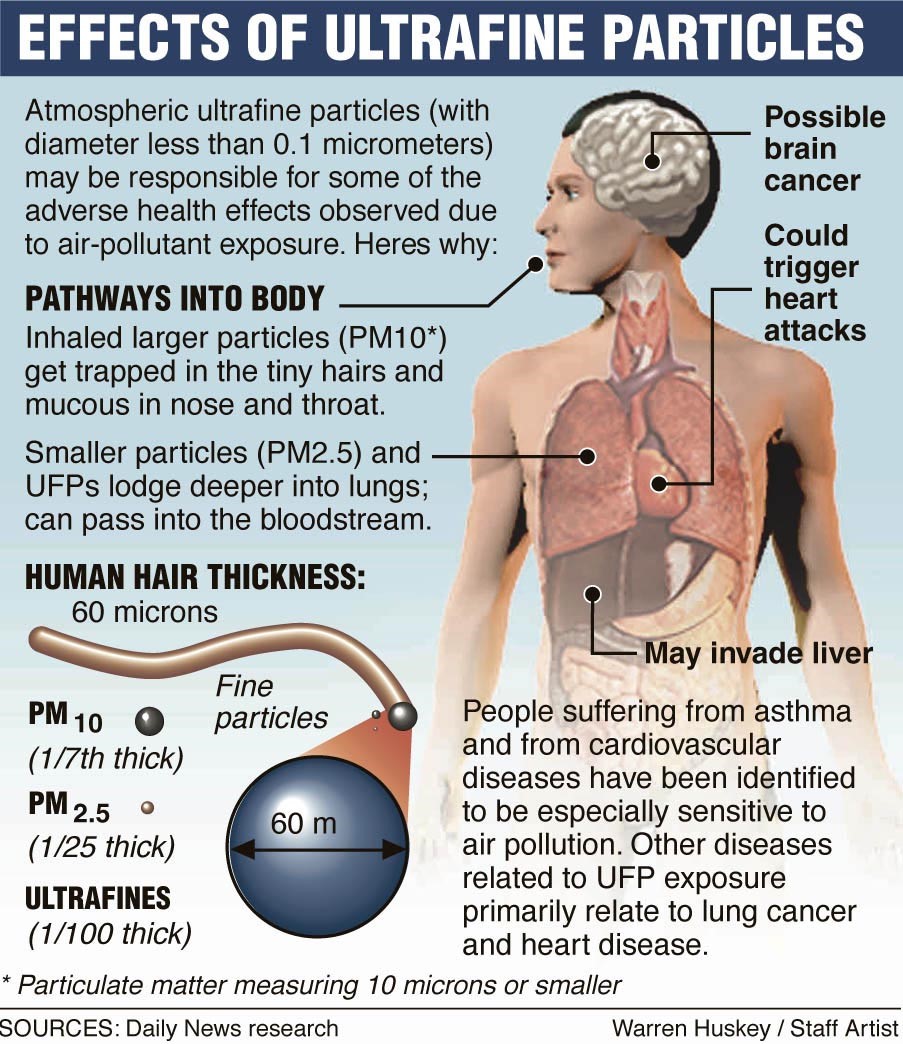
Effects of Ultrafine Particles
Infographic from Daily News, illustrated by staff artist Warren Huskey, explaining how atmospheric ultrafine particles (diameter less than 0.1 micrometers) enter the human body and cause adverse health effects including possible brain cancer, heart attacks, and liver invasion. It details particle size comparisons (PM10, PM2.5, and ultrafines) relative to human hair thickness of 60 microns. -
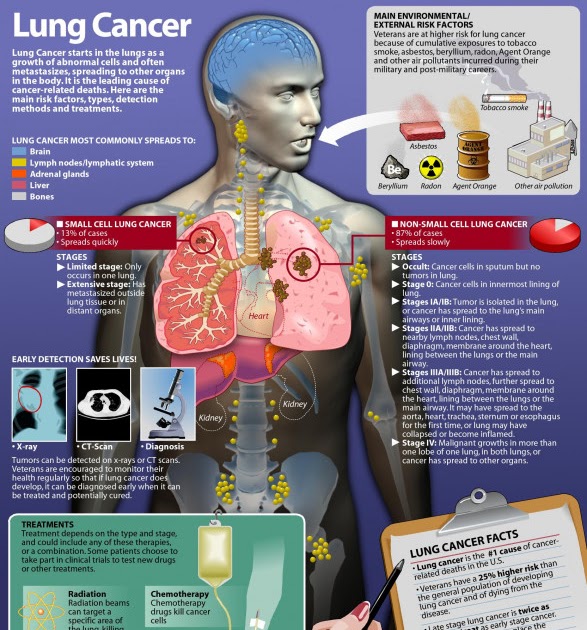
Lung Cancer
A detailed medical infographic titled 'Lung Cancer' covering risk factors, types (small cell and non-small cell), stages, early detection methods, and treatments. Includes sections on environmental/external risk factors such as asbestos, beryllium, radon, and Agent Orange, with particular relevance to veterans. -
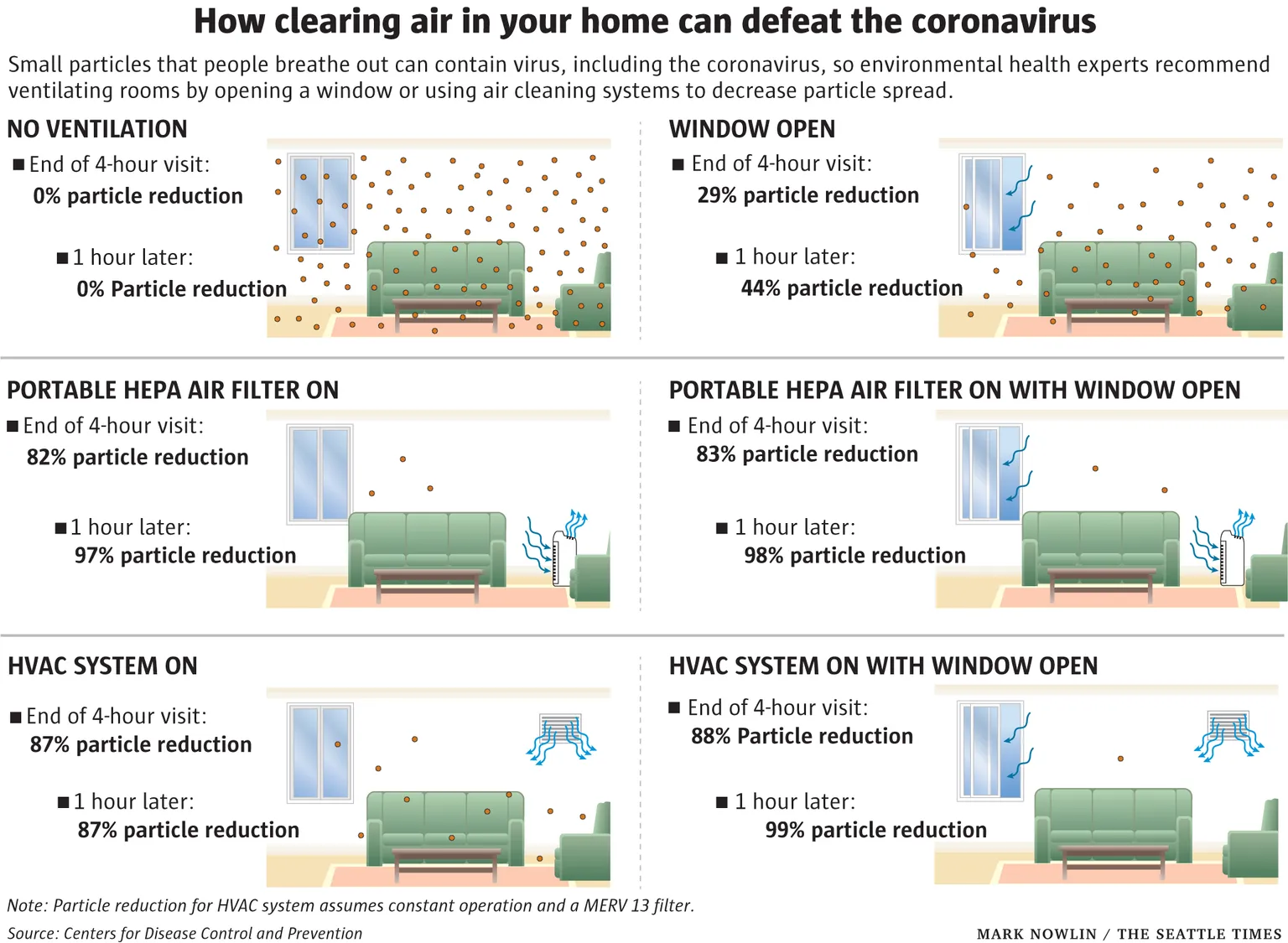
king county air ventilation
Infographic by Mark Nowlin for The Seattle Times, sourced from the Centers for Disease Control and Prevention, illustrating how various ventilation methods (no ventilation, open window, portable HEPA air filter, HVAC system) reduce airborne particles that may contain coronavirus. Data shows particle reduction percentages at end of a 4-hour visit and 1 hour later for six ventilation scenarios. -
 2022-02-14
Characterization of annual average traffic-related air pollution levels (particle number, black carbon, nitrogen dioxide, PM2.5, carbon dioxide) in the greater Seattle area from a year-long mobile monitoring campaign
Researchers conducted a year-long mobile air quality monitoring campaign across the greater Seattle area, measuring traffic-related pollutants including ultrafine particles, black carbon, nitrogen dioxide, fine particulate matter, and carbon dioxide at 309 locations. The study developed predictive models of annual average pollution levels to support health research on how traffic emissions affect Seattle residents, particularly the elderly. The findings showed strong spatial variation in pollution levels linked to traffic and land use patterns across the region. -
Compendium of WHO and other UN guidance on health and environment
Welcome to the global repository of interventions for creating healthier environments and improving health The Compendium is a comprehensive collection of available WHO and other United Nations (UN) guidance for improving health by creating healthier environments. It provides an overview and easy access of 500 actions, and a framework for thinking about health and environment -
 2022-01-01
Environmental noise: compendium of WHO and other UN guidance on health and environment, 2022 update
★ 32A 2022 World Health Organization report on environmental noise outlines the health risks posed by traffic, aircraft, and leisure noise, including increased risk of heart disease, sleep disturbance, and hearing impairment. The report recommends that aircraft noise levels stay below 45 dB for average exposure and below 40 dB at night to protect public health. It also defines mitigation strategies ranging from reducing noise at the source to behavior change and community education. -
 2022-01-01
Compendium of WHO and other UN guidance on health and environment: 2022 update
This 2022 WHO compendium brings together guidance from the World Health Organization and other United Nations agencies on the links between human health and environmental factors. It covers topics such as air quality, water, sanitation, and climate-related health risks, providing policymakers and practitioners with a consolidated reference for evidence-based standards. The document is produced in collaboration with UNDP, UN Environment, and UNICEF. -
 2021-08-03
Leaded aviation gasoline exposure risk at Reid-Hillview Airport in Santa Clara County, California
This 2021 report by Mountain Data Group, commissioned by Santa Clara County, examines the health risks posed to children living near Reid-Hillview Airport in California due to lead emissions from leaded aviation gasoline. It analyzes statistical associations between children's blood lead levels and factors such as residential distance from the airport, aircraft traffic, and fuel sales. Note that while this report focuses on lead exposure from aviation fuel at a California airport, it does not address noise policy or Sea-Tac Airport operations. -
Washington Tracking Network
Welcome to WTN, a Washington State Department of Health program focused on making public health data more accessible. WTN staff keep data in all tools up to date and develop additional data based on need and availability. Data are available for download and exploration using our four tools.