Skip to content
  • STNI
  • Statistics
    • Ops and Passengers
      • King County International Airport (Boeing Field) Annual Operations
    • Financials
    • Aviation fuel uplift in the State of Washington 2018 – 2025
      • Aviation Fuel Uplift at Sea-Tac Airport
    • Air Quality Monitoring
    • Flight Tracking
      • Flow and Flight Tracks
      • Five Year Comparison
      • Busiest Hours and Days
    • SEL Noise Reports & Graphs
      • About The Permanent Noise Monitors
      • Minutes of Quiet by Noise Monitor
      • Noise Events mapped
      • Noise Events (SEL)
    • Runways
    • Employees
    • Real Estate
      • Port Properties and Trees mapped
    • Parking
  • Events
  • Protest
    • Regular Events
    • Legislation 2026
    • Complain about a particular flight
    • Advocacy Organizations
    • Media Outlets
    • People
    • The Port of Seattle
      • Commission Meetings
      • Public Records Requests
      • StART
      • Highline Forum
    • Contact Your Electeds
  • Resources
    • FAQs
      • FAA Occurrences/Accidents/Indents
    • The unSustainable Airport Master Plan
      • SAMP Public Comment Template
        • Two versions of Appendix K: NEPA/SEPA 2018 vs 2023
      • SAMP NTP: 31 projects by the numbers
      • SEPA Draft EIS (2026)
      • SAMP Record of Decision/FONSI (2025)
      • SAMP Draft EA (October 2024)
      • 2018 Scoping
    • Port Packages
      • Port Package Property Costs
      • Port Packages mapped
      • The Port Package Explainer
      • So you want a (first-time) Port Package? Start here
      • Port Package Looker Upper
      • How do I determine if I have a Port Package or Avigation Easement?
      • Progress on Port Package Update legislation
      • Having a Port Package Problem?
      • Port Package Site Visit Follow-Up
    • Document Library
    • Explainers
      • The Airport Law Cheat Sheet
      • The Grant Explainer
    • External Articles
    • History
      • Timeline
      • The Sea-Tac Communities Plan
        • Sea-Tac Communities Plan – Planning Maps
      • PSRC Third Runway Decision Process
    • Studies
    • Videos
  • Stories
  • Mission
  • Subscribe
  • Contact
Scroll down to content

Get InformedStay Informedx

I understand that you will never share my information with anyone, you will only use it to keep me updated on relevant events and that I may unsubscribe at any time.

STNI

STNISea-Tac Noise.Info

  • Solve for Sea-Tac. Solve for every airport.
  • Since 2016, working to obtain justice for everyone living under the flight path.
  • Less Noise. Cleaner Air. Better Public Health. Compensation.
  • Everything you think you know about the airport is wrong.

TagGeneral Aviation(60)

Advanced Search Options

  • Dates
  • Media
    • External Articles
    • Images
    • PDFs
    • Video
    • Audio
  • Order By
  • 2009-07-01

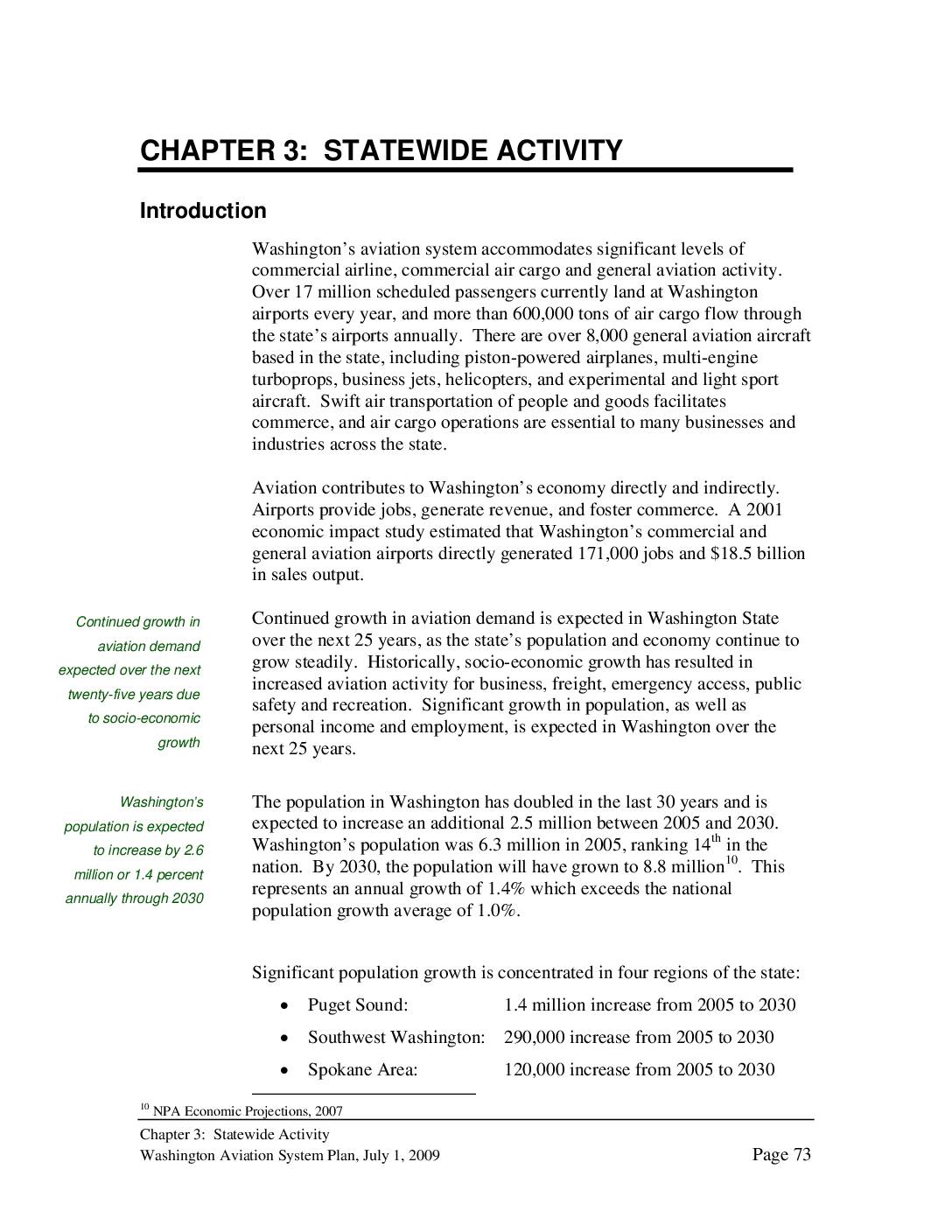
    Washington Aviation System Plan: Chapter 3 — Statewide Activity

    Washington State's aviation system serves over 17 million scheduled passengers and 600,000 tons of air cargo annually, with Seattle-Tacoma International Airport among the 20 commercial service airports statewide. The state's population and economy are projected to grow steadily through 2030, driving continued increases in aviation demand across commercial, cargo, and general aviation sectors. Economic growth in Washington is expected to outpace the national average, reinforcing the critical role airports play in jobs, commerce, and quality of life.
    TagsCommercial Aviation, General Aviation, State of Washington, Washington Aviation System Plan, WASP
  • 2009-07-01

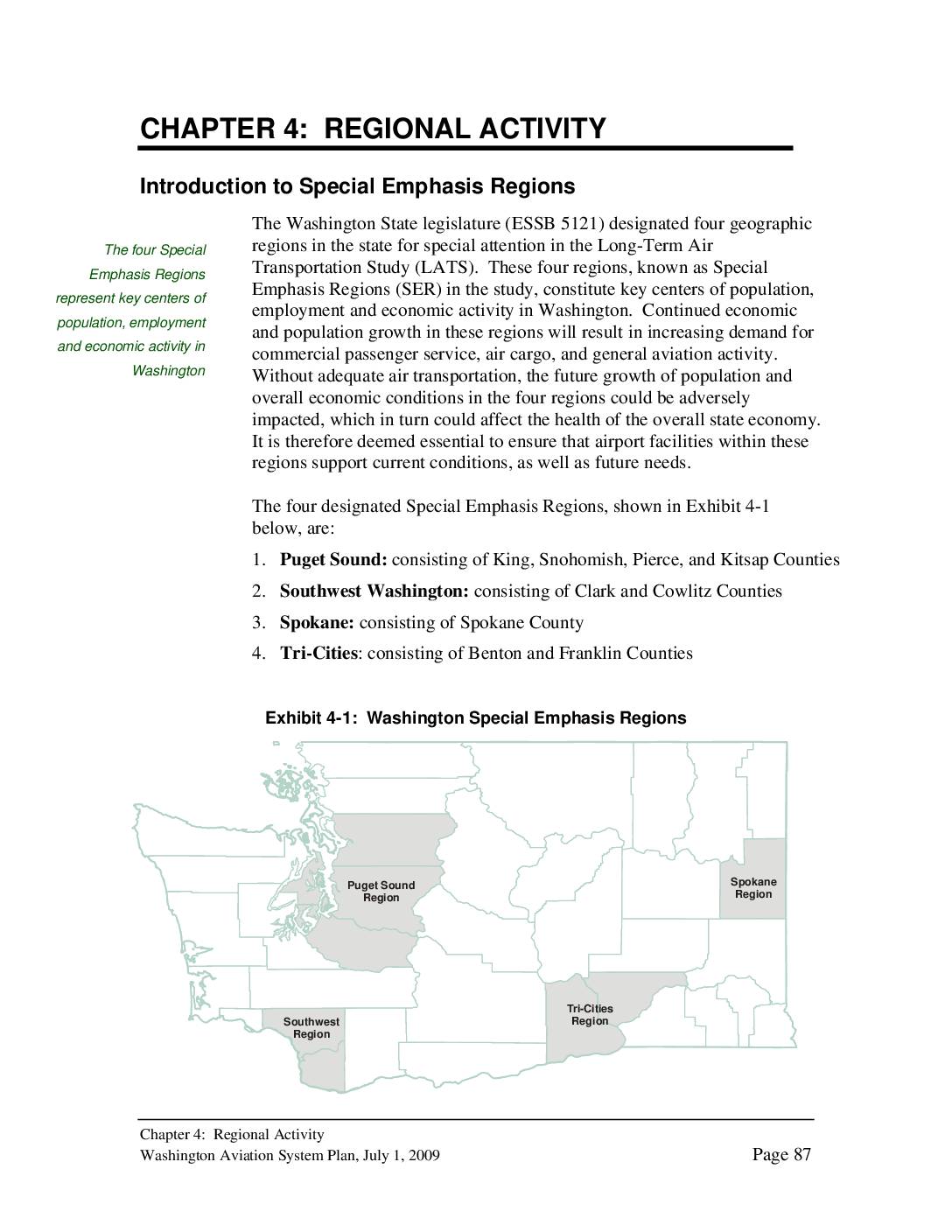
    Washington Aviation System Plan, Chapter 4: Regional Activity

    The Washington Aviation System Plan identifies four Special Emphasis Regions in the state, with the Puget Sound region — encompassing King, Snohomish, Pierce, and Kitsap Counties — standing out as the busiest aviation area. The region is home to Seattle-Tacoma International Airport, the state's primary commercial airport, along with 27 other public-use airports serving commercial, general aviation, and seaplane operations. As of 2005, the Puget Sound region housed approximately 55 percent of Washington's total population, driving significant demand for air service and making adequate airport capacity a key economic priority.
    TagsGeneral Aviation, NPIAS, Puget Sound, Washington Aviation System Plan, WASP
  • 2009-07-01

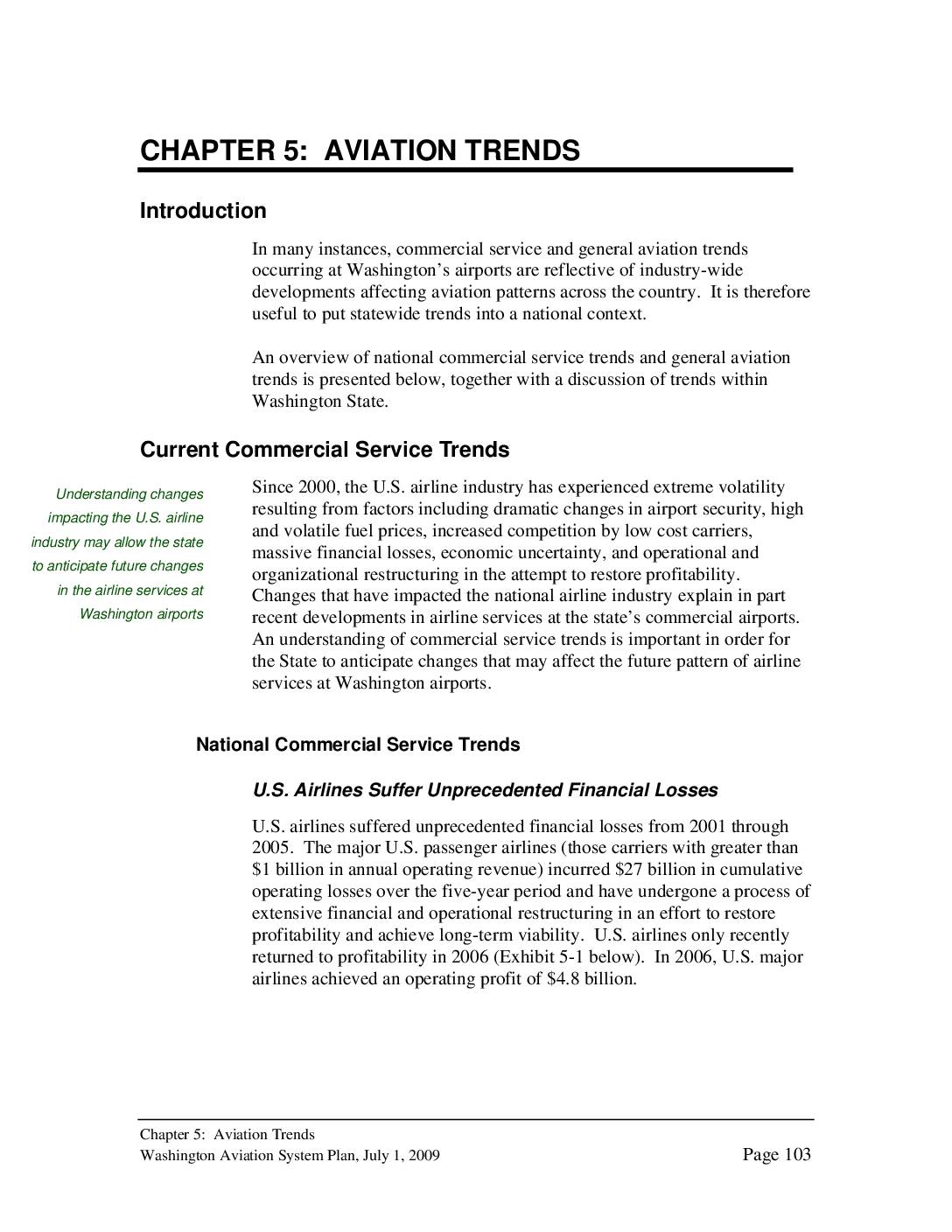
    Chapter 5: Aviation Trends — Washington Aviation System Plan

    This chapter from Washington State's 2009 Aviation System Plan examines commercial aviation trends affecting the state's airports, set against a turbulent national backdrop. U.S. major airlines suffered $27 billion in cumulative operating losses between 2001 and 2005 due to post-9/11 demand drops, soaring fuel costs, and intense competition from low-cost carriers, before returning to profitability in 2006. In response, legacy carriers restructured costs, reduced domestic capacity, and leaned more heavily on regional airline partners, contributing to rising passenger load factors across the industry.
    TagsAirline Industry, Commercial Aviation, General Aviation, State of Washington, Washington Aviation System Plan, WASP
  • 2009-07-01

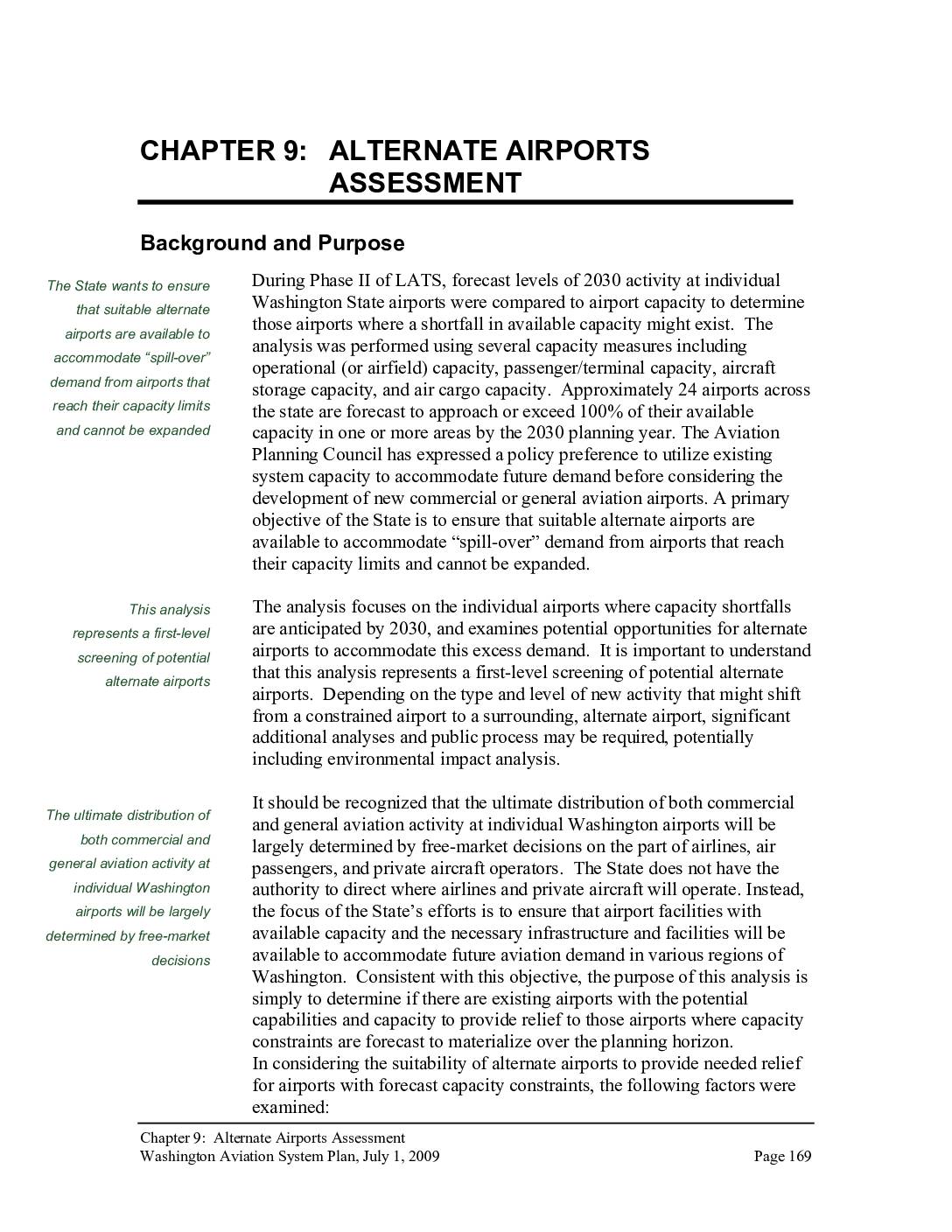
    Washington Aviation System Plan, Chapter 9: Alternate Airports Assessment

    A 2009 Washington State aviation planning study assessed which existing airports could absorb overflow demand from airports projected to hit capacity limits by 2030, with Sea-Tac International among those forecast to exceed both airfield operations and passenger terminal capacity. The analysis evaluated potential alternate airports within roughly 60 miles of Sea-Tac based on factors such as available capacity, runway length, and highway access, while noting that free-market decisions by airlines and passengers would ultimately determine how traffic is distributed. The study was intended as a first-level screening, with more detailed environmental and operational analyses expected before any formal relief airport designations could be made.
    TagsBoeing Field, General Aviation, Sea-Tac Airport, Washington Aviation System Plan, WASP
  • 2005-10-21

    ESSB 5121, Statewide air transportation capacity study summary brief

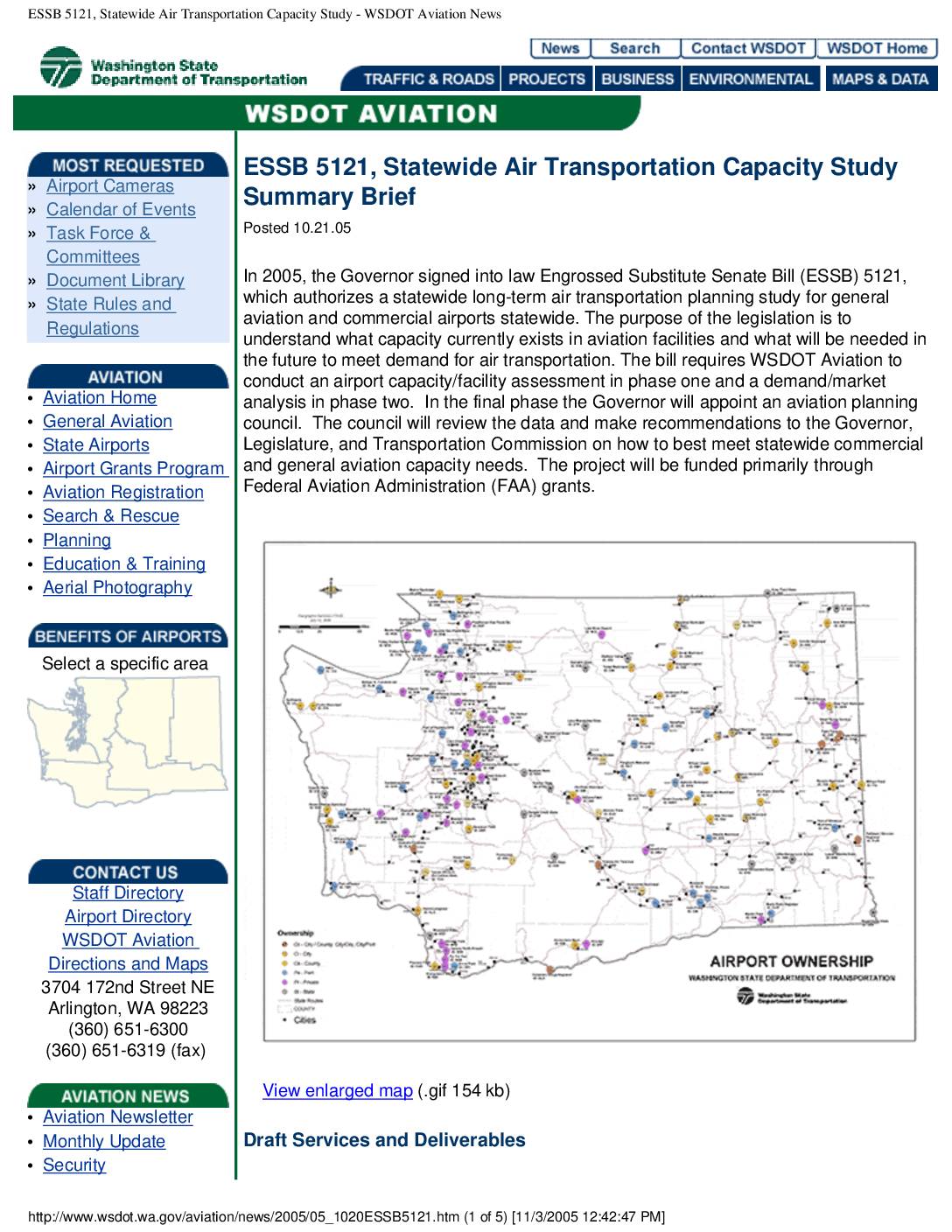
    In 2005, Washington State passed ESSB 5121, directing the Washington State Department of Transportation (WSDOT) to conduct a multi-phase statewide air transportation capacity study covering both commercial and general aviation airports. The study required an assessment of existing airport facilities and capacity (Phase 1, due July 2006), followed by a 25-year demand and market forecast analysis with focused attention on the Puget Sound region (Phase 2, due July 2007). A 10-member Governor-appointed aviation planning council would then review the findings and make recommendations on how to meet the state's long-term aviation capacity needs, including identifying sites for future airport facilities.
    TagsFAA, General Aviation, RCAA, Washington Aviation System Plan, Washington State Legislature, WSDOT
  • 1995-07-01

    EXH AR038694: STIA Capacity Enhancement Plan Update

    Seattle-Tacoma International Airport (STIA) Capacity Enhancement Plan Update, July 1995, AR 038694. Prepared jointly by the U.S. Department of Transportation, Federal Aviation Administration (FAA), Port Of Seattle, and airlines and general aviation community serving Sea-Tac Airport. Document covers airport capacity planning and enhancement initiatives.
    TagsACC, Capacity, FAA, General Aviation, Pollution Control Hearings Board, Port Of Seattle, Sea-Tac Airport
  • Rasp 198 2020 executive summary pdf
    1987-10-01

    Regional Airport System Plan 1988-2020: Air transportation element of the Regional Transportation Plan

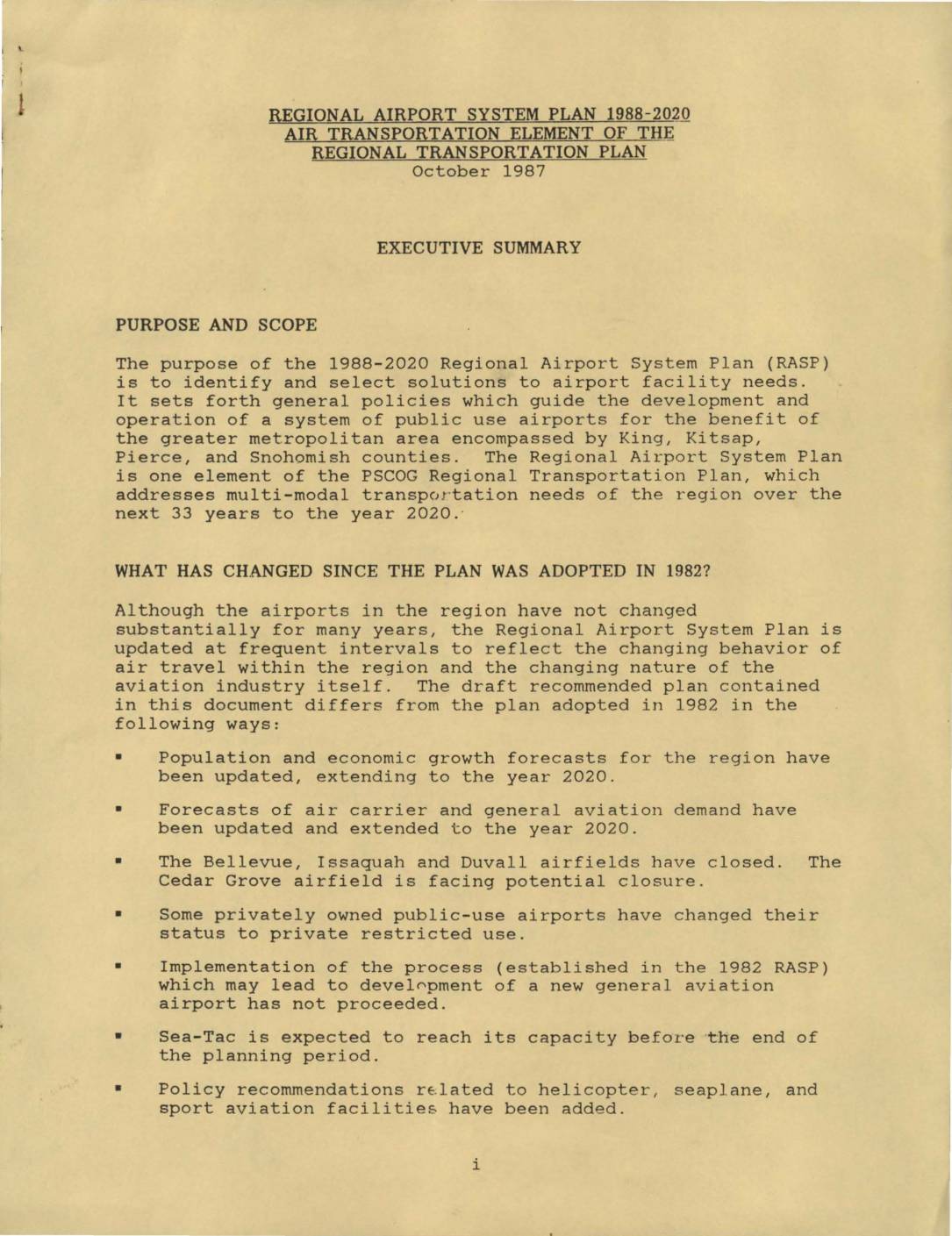
    The 1988-2020 Regional Airport System Plan, published in October 1987, outlines policies for managing and developing public-use airports across King, Kitsap, Pierce, and Snohomish counties through the year 2020. A central finding is that Sea-Tac Airport was projected to reach full capacity within 10 to 15 years, with intolerable aircraft delays expected unless alternative measures were taken. The plan also addresses noise and flight track mitigation programs, land use compatibility near airports, and the potential role of satellite airports such as Paine Field, Bremerton National, and Tacoma Narrows in relieving pressure on Sea-Tac.
    TagsGeneral Aviation, Puget Sound Regional Council, RASP, Regional Airport System Plan, Sea-Tac Airport
  • 1979-04-12

    Initial development of the Westside General/Corporate Aviation Facility, Sea-Tac International Airport: Final environmental impact statement

    This April 1979 Final Environmental Impact Statement, prepared by the Port of Seattle's Planning and Research Department, evaluates the proposed initial development of a general and corporate aviation facility on the west side of Sea-Tac International Airport. The document was issued in compliance with Washington State's Environmental Policy Act of 1971 and incorporates findings from an earlier 1977 EIS related to a Weyerhaeuser corporate aviation facility on the same site. It was distributed to government agencies, citizen groups, and interested individuals to assess the environmental effects of the proposed development.
    TagsEIS, Environmental Impact Statement, General Aviation
  • 1968-02-01

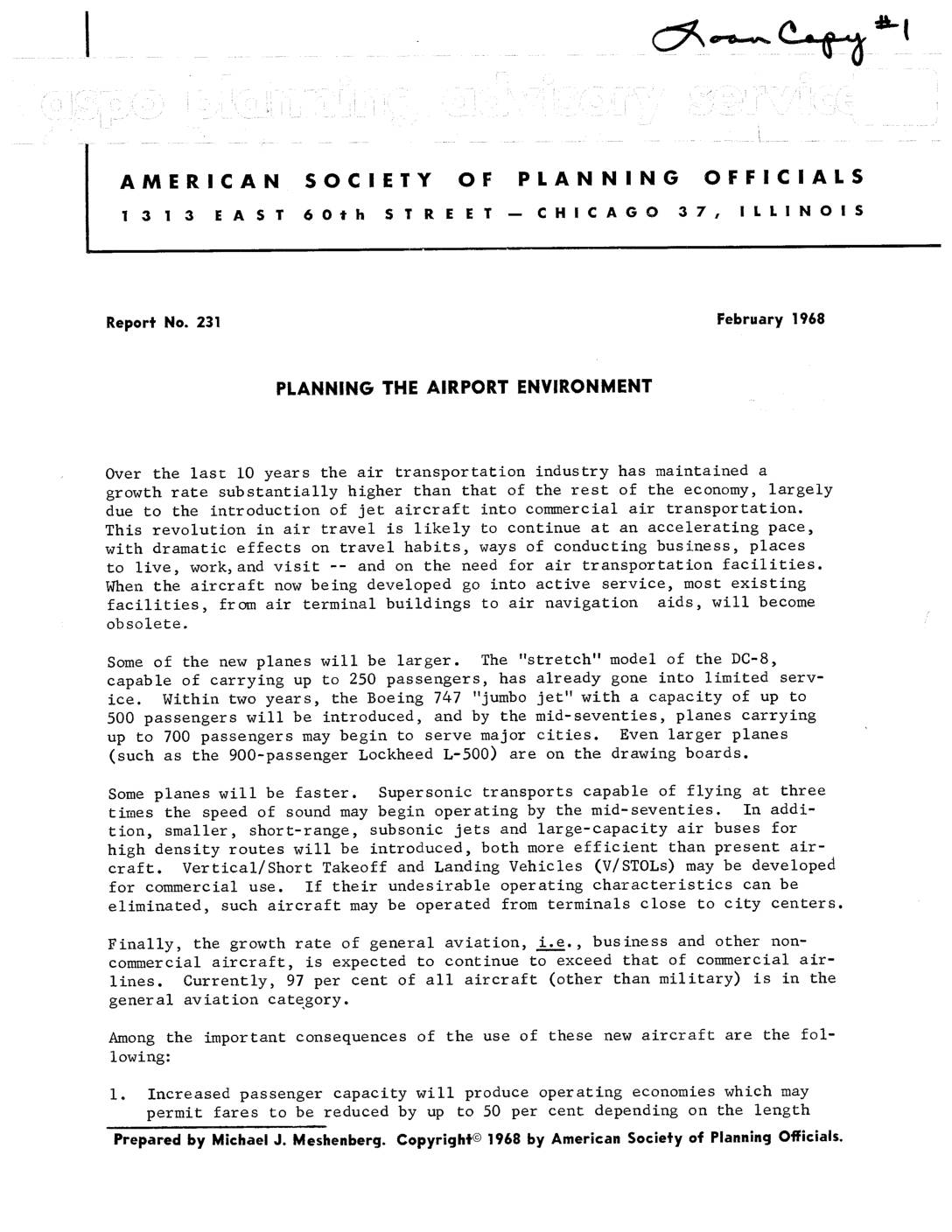
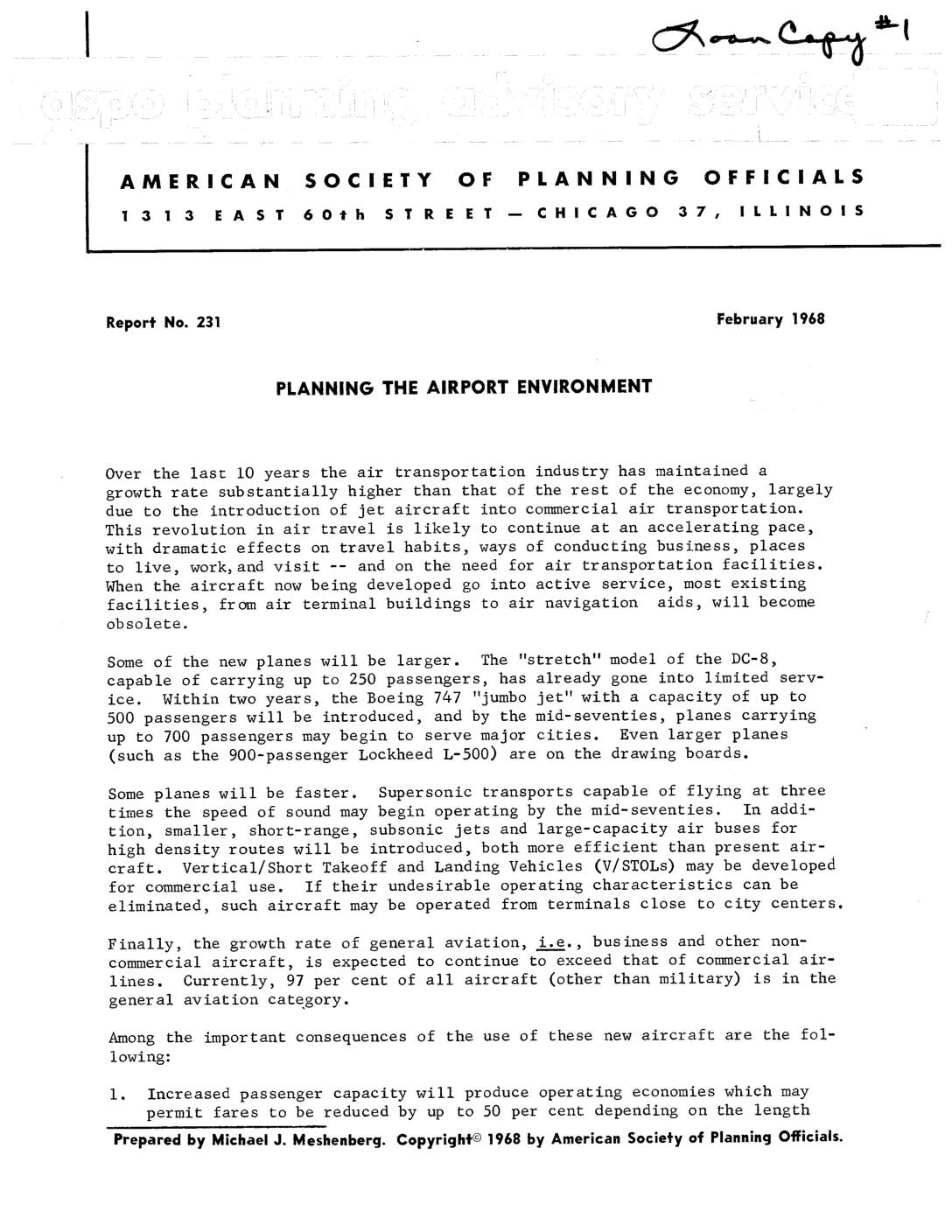
    APA – Planning The Airport Environment

    This 1968 report by the American Society of Planning Officials examines the major planning challenges posed by airports, particularly in light of rapid growth in air transportation and the introduction of new jet aircraft. It summarizes methods and tools planners can use to achieve environments compatible with airport operations, viewing airports as transportation facilities, nuisances,
    TagsAirports, American Planning Association, General Aviation, Land Use
  • Report231 pdf
    1968-02-01

    Planning the airport environment

    This 1968 report by the American Society of Planning Officials examines the major planning challenges posed by airports, particularly in light of rapid growth in air transportation and the introduction of new jet aircraft. It summarizes methods and tools planners can use to achieve environments compatible with airport operations, viewing airports as transportation facilities, nuisances,
    TagsAirport Improvement Program, Airports, FAA, General Aviation, Land Use

Posts pagination

Page 1 … Page 4 Page 5 Page 6
Sidebar On/Off

Upcoming Events

  • StART SEA Stakeholder Advisory Round Table
    Add to CalendarMWednesday Aug 26, 5:00pm - 7:00pm
    Zoom (Virtual Meeting)
    START meetingagenda 2026826 final 0 pdf

    Meeting Objectives Introduce the primary feedback themes identified by StART members regarding StART’s Operating Procedures and determine areas that may warrant future discussion. 5:00 PM – Welcome Meeting Management Welcome Lead: Andrés Mantilla, Facilitator, Uncommon Bridges; Wendy Reiter, Airport Managing Director, POS 5:15 PM – Dinner: All participants eat. 5:30 PM – StART Operating Procedures

    [...]
  • Commercial Aviation Work Group
    Add to CalendarMThursday Sep 3, 10:00am - 1:30pm
    Virtual Meeting (Zoom)
    Cawg agenda sep 3 26 virtual pdf

    Meeting Agenda 10:00 a.m. – 10:15 a.m. | Welcome – Evan Nordby, Chair a. Introductions and Agenda Reviewb. Status of appointments and non-voting member invitationsc. Other updates as necessary 10:15 a.m. – 11:00 a.m. | Is it practical and legal to operate the western Washington [Puget Sound] airports as a single airport system? – Consultant

    [...]

[See all...]


Help study childhood asthma. Get free HEPA filter!

read more...

Issues

Sea-Tac Airport is currently undergoing the largest and longest expansion in its history, collectively known as the Sustainable Airport Master Plan (SAMP). Some of it you can already hear, but you’re probably not aware of what it all means. Here’s what you need to know.
read more...

Read This!

As the source for federal transportation grants, the Puget Sound Regional Council was charged with developing a system to meet the growing need for commercial aviation. When the search for a second airport failed, they authorized the Port of Seattle to build the Third Runway, with a mandate to develop a noise abatement and mitigation program. In their effort to stop the Third Runway, the ACC argued over every detail of the Port's efforts--including property buyouts and sound insulation. The dispute was meant to be settled by a three member Expert Arbitration Panel. This is their final report. It finds 2-1, that the Port's program was insufficient in several respects. Despite that, funding for the Third Runway was approved by the PSRC, and the 'Port Package' program, proceeded largely unchanged. Expert Arbitration Panel's final decision finding that the Port of Seattle had not shown sufficient reduction in real on-the-ground noise impacts to satisfy noise reduction conditions required for approval of a third runway at Sea-Tac International Airport. The majority decision concluded the Port's noise abatement programs were insufficient despite being impressive in scope.
continue...

The Podcast!

Subscribe to the only podcast devoted to policies, politics, history, impacts for people living under the flight path everywhere. It’s definitely not just about noise!
  • Sea-Tac Noise.Info
  • Connect with STNI

    • Subscribe
    • Port Package Problem?
    • Donate
    • Podcast
    • Socials
      • Facebook
      • X (Twitter)
      • Bluesky
      • Instagram

    "Sea-Tac Communities Plan background and environmental findings" — , 2026

  • Learn

    • Frequently Asked Questions
    • Explainers
    • Youtube
    • Research Requests
    • Make a complaint
  • Goals

    Fulfill the promises of 1976:
    • Compensation
    • Reduced noise
    • Improved air quality
    • Environmental remediation
Login/Register
©2026•Data Privacy

Message

We use cookies to provide basic functionality. We also provide access to search engines in order to provide site analytics. We do not sell or share your data.
V V