Skip to content
  • STNI
  • Statistics
    • Ops and Passengers
      • King County International Airport (Boeing Field) Annual Operations
    • Financials
    • Aviation fuel uplift in the State of Washington 2018 – 2025
      • Aviation Fuel Tax Revenue in the State of Washington 1983-2025
      • Aviation Fuel Uplift at Sea-Tac Airport
    • Air Quality Monitoring
    • Flight Tracking
      • Flow and Flight Tracks
      • Five Year Comparison
      • Busiest Hours and Days
    • SEL Noise Reports & Graphs
      • About The Permanent Noise Monitors
      • Minutes of Quiet by Noise Monitor
      • Noise Events mapped
      • Noise Events (SEL)
    • Runways
    • Employees
    • Real Estate
      • Port Properties and Trees mapped
    • Parking
  • Events
  • Protest
    • Regular Events
    • Legislation 2026
    • Complain about a particular flight
    • Advocacy Organizations
    • Media Outlets
    • People
    • The Port of Seattle
      • Commission Meetings
      • Public Records Requests
      • StART
      • Highline Forum
    • Contact Your Electeds
  • Resources
    • FAQs
      • FAA Occurrences/Accidents/Indents
    • The SAMP
      • SAMP Public Comment Template
        • Two versions of Appendix K: NEPA/SEPA 2018 vs 2023
      • SAMP NTP: 31 projects by the numbers
      • SEPA Draft EIS (2026)
      • SAMP Record of Decision/FONSI (2025)
      • SAMP Draft EA (October 2024)
      • 2018 Scoping
    • Port Packages
      • Port Package Property Costs
      • Port Packages mapped
      • The Port Package Explainer
      • So you want a (first-time) Port Package? Start here
      • Port Package Looker Upper
      • How do I determine if I have a Port Package or Avigation Easement?
      • Progress on Port Package Update legislation
      • Having a Port Package Problem?
      • Port Package Site Visit Follow-Up
    • Document Library
    • Explainers
      • The Airport Law Cheat Sheet
      • The Grant Explainer
    • External Articles
    • History
      • Timeline
      • The Sea-Tac Communities Plan
        • Sea-Tac Communities Plan – Planning Maps
      • PSRC Third Runway Decision Process
    • Studies
    • Videos
  • Stories
  • Mission
  • Subscribe
  • Contact
Scroll down to content

Get InformedStay Informedx

I understand that you will never share my information with anyone, you will only use it to keep me updated on relevant events and that I may unsubscribe at any time.

STNI

STNISea-Tac Noise.Info

  • Solve for Sea-Tac. Solve for every airport.
  • Since 2016, working to obtain justice for everyone living under the flight path.
  • Less Noise. Cleaner Air. Better Public Health. Compensation.
  • Everything you think you know about the airport is wrong.

TagFour Post Plan(18)

Advanced Search Options

  • Dates
  • Media
    • External Articles
    • Images
    • PDFs
    • Video
    • Audio
  • Order By
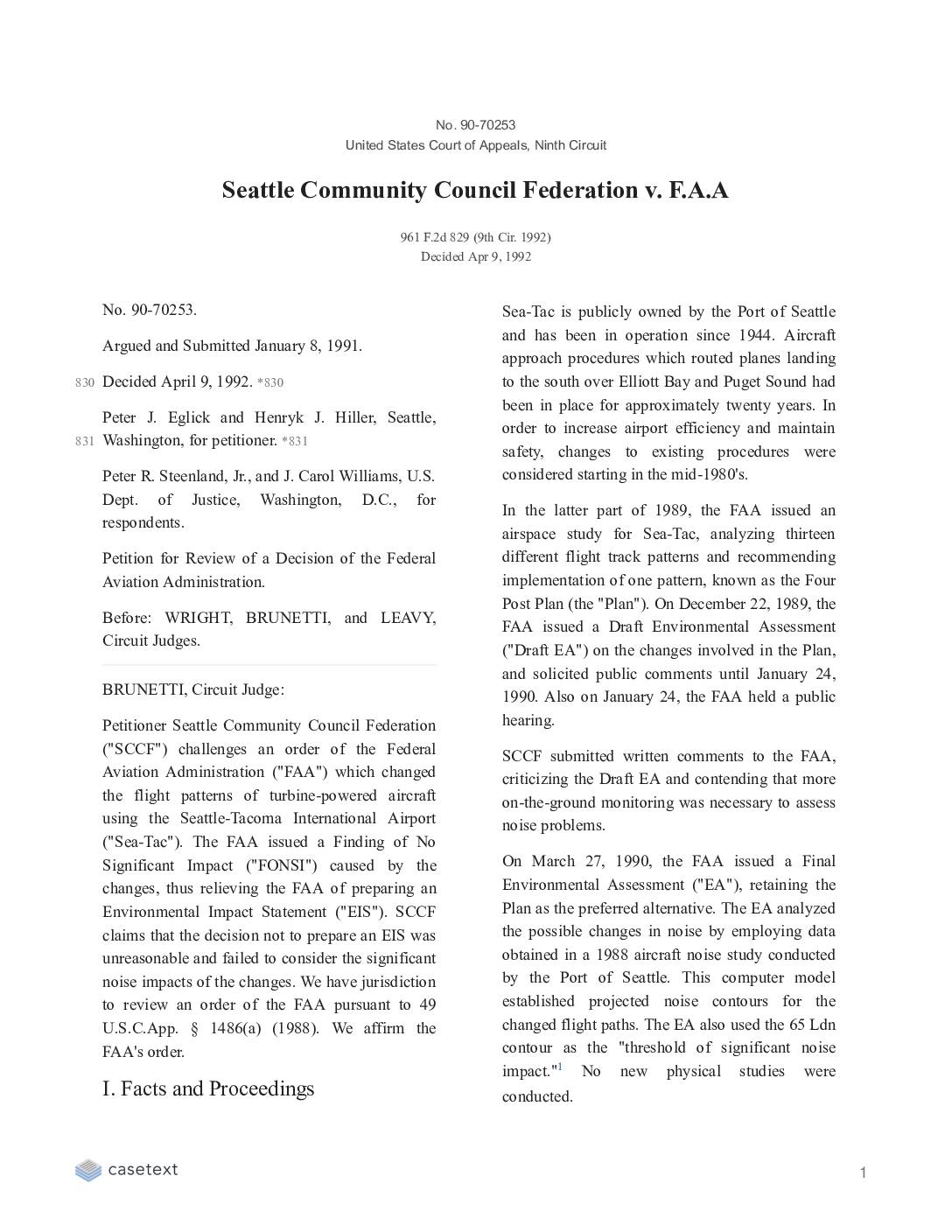
  • Seattle Community Council Federation v. FAA 961 F.2d 929

    961 F.2d 829 SEATTLE COMMUNITY COUNCIL FEDERATION, a Washington nonprofit corporation, Petitioner, v. FEDERAL AVIATION ADMINISTRATION; Samuel Skinner, Respondents. No. 90-70253. United States Court of Appeals, Ninth Circuit. Argued and Submitted Jan. 8, 1991. Decided April 9, 1992. Peter J. Eglick and Henryk J. Hiller, Seattle, Washington, for petitioner. Peter R. Steenland, Jr., and J.
    CategoriesLitigation TagsDNL65, FAA, Four Post Plan, SCCF, Seattle Community Council Federation
  • 1992-04-09

    Seattle Community Council Federation v. F.A.A., 961 F.2d 829 (9th Cir. 1992)

    In 1992, the Ninth Circuit Court of Appeals upheld the FAA's decision to change flight patterns for turbine-powered aircraft at Seattle-Tacoma International Airport without preparing a full Environmental Impact Statement. The FAA had issued a Finding of No Significant Impact based on a computer noise model using the 65 decibel day-night sound level as the threshold for significant noise impact, which the court found to be a reasonable approach. The Seattle Community Council Federation had challenged the decision, arguing that the FAA failed to adequately assess the noise effects on surrounding communities.
    TagsEnvironmental Impact Statement, FAA, Four Post Plan, NEPA, SCCF, Seattle Community Council FederationFolderFour Post Plan
  • 1991-03-31

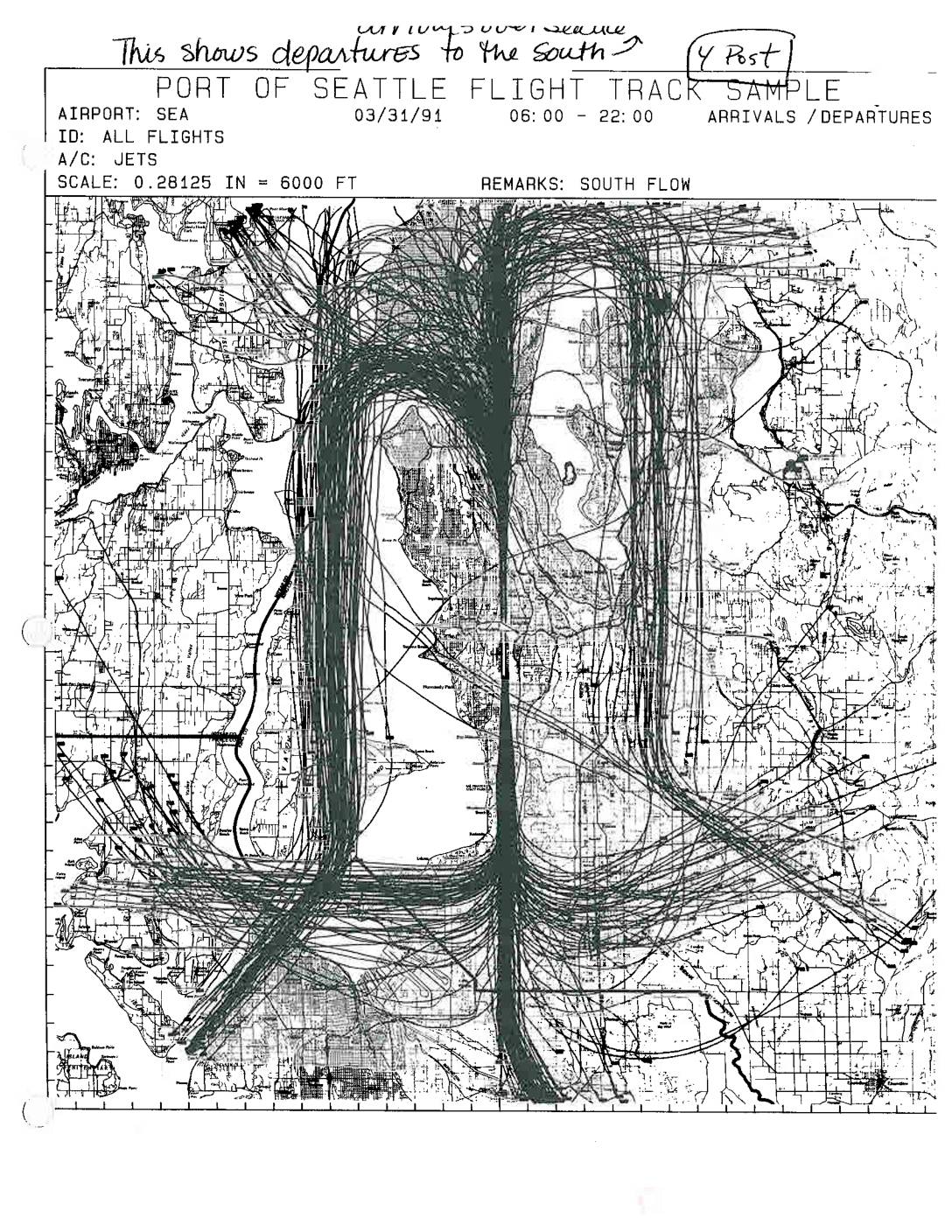
    Port Of Seattle Flight Track Sample: South Flow Arrivals/Departures — Pre- and Post-Four Post Plan Comparison Maps

    These two Port of Seattle Flight Track Sample maps compare jet aircraft arrival and departure patterns at Seattle-Tacoma International Airport (SEA) under south flow conditions, one from March 22, 1989 (pre-4 Post) and one from March 31, 1991 (4 Post). Both charts plot all jet flight tracks between approximately 4:30–24:00 and 6:00–22:00 respectively, showing how flight paths over the Seattle region shifted between the two periods. The maps are annotated to highlight southbound departures and arrivals over Seattle, serving as visual evidence for noise impact analysis related to airport runway and procedure policy changes.
    TagsFAA, Flight Tracks, Four Post Plan, Noise Abatement Procedures, Port Of Seattle, Sea-Tac AirportFolderFour Post Plan
  • 1990-04-02

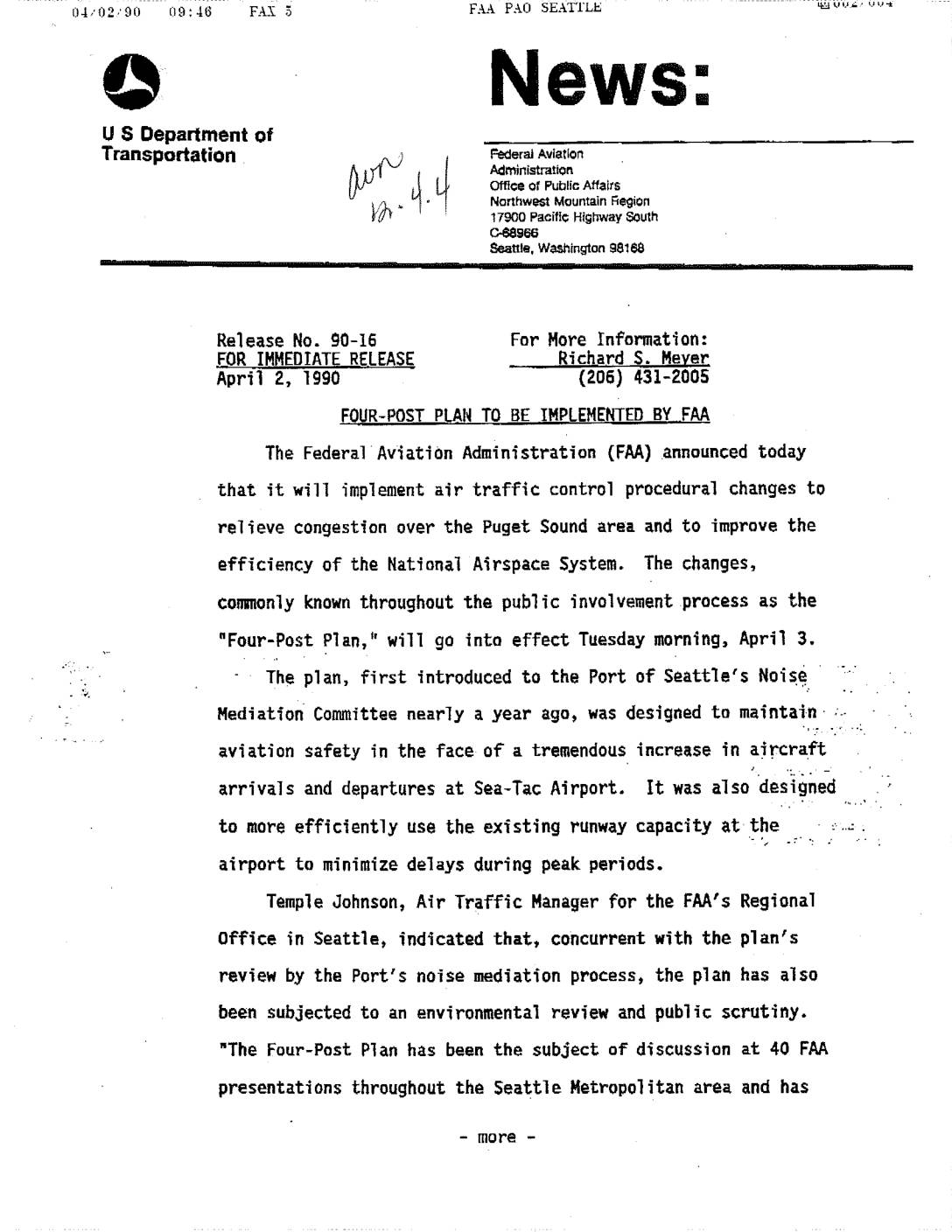
    Four-Post Plan to Be Implemented by FAA

    On April 2, 1990, the FAA announced it would implement the 'Four-Post Plan,' a set of air traffic control procedural changes at Seattle-Tacoma International Airport designed to reduce congestion, improve efficiency, and address worsening arrival delays. The plan, developed after nearly a year of public meetings, environmental review, and computer simulation of 13 alternatives, was determined to produce no significant noise impact on surrounding communities. The FAA cited a 30,000 increase in annual landings and takeoffs since 1988 and the failure of mediation talks to produce an agreed-upon flight path solution as key reasons for moving forward with the changes.
    TagsAir Traffic Control, FAA, Four Post Plan, Sea-Tac AirportFolderFour Post Plan
  • 1990-03-31

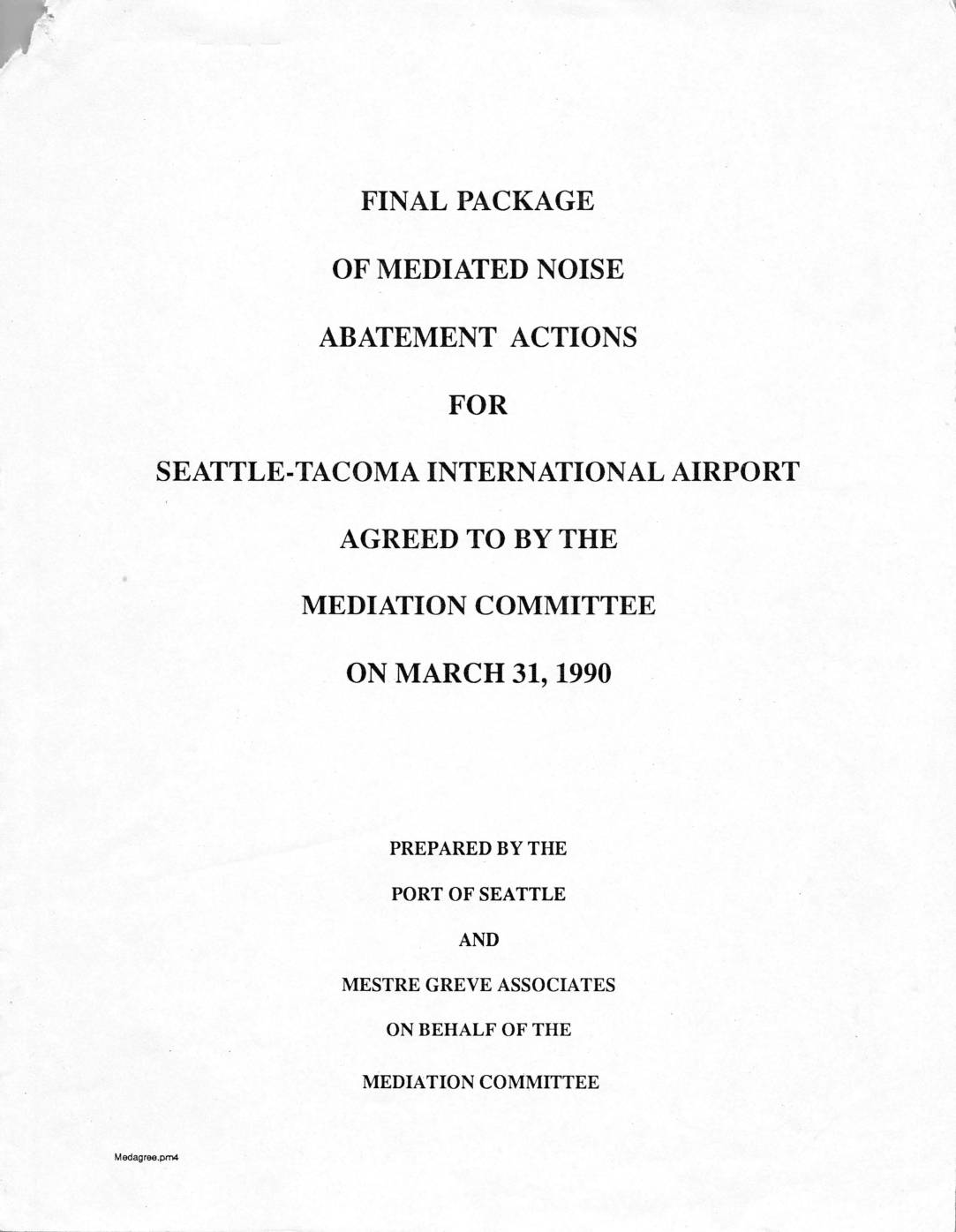
    Final Package of Mediated Noise Abatement Actions for Seattle-Tacoma International Airport, Agreed to by the Mediation Committee, March 31, 1990

    This 1990 document outlines a comprehensive package of noise abatement actions for Seattle-Tacoma International Airport, agreed upon by a Mediation Committee on March 31, 1990. It covers measures such as nighttime flight restrictions, soundproofing programs for nearby homes and public buildings, improved flight corridors, and a new noise management monitoring system. According to the technical consultant involved, full implementation of these agreements could reduce noise levels by approximately 50% for communities surrounding the airport.
    CategoriesHistory TagsFAA, Flight Tracks, Four Post Plan, Noise Abatement Procedures, Noise Remedy Program, Port Of Seattle, Sea-Tac Noise Abatement Committee, Vince MestreFolderFour Post Plan
  • 1990-01-22

    Rumblings Over Flight-Path Plan

    By DICK LILLY January 22, 1990 Publication: THE SEATTLE TIMES Page: B3 Word Count: 1469 Like a plague, they slipped into Barbara Maxwell’s neighborhood, rattling the windows. Pretty soon, they were making it hard to hear phone conversations. After a while, they were interrupting backyard barbecues More and more jet planes, on their way to Seattle-Tacoma International Airport,
    CategoriesFrom The Web, History TagsFAA, Four Post Plan, Seattle Times
  • 1990-01-22

    Planned Flight Paths Spur Arguments

    Planned Flight Paths Spur Arguments Jan 22, 1990 Linda W.Y. Parrish Hearing set– The Federal Aviation Administration has set an environmental assessment hearing on its proposed changes in Sea-Tac Airport flight patterns for 7 to 10 p.m. Wednesday at Cleveland High School, 5511 15th Ave. S. FEDERAL WAY When the wind blows from the north,
    CategoriesFrom The Web TagsFAA, Federal Way, Four Post Plan, Gary Locke, Greg Fisher, Seattle Times
  • 1980-10-07

    SEA TWR 7110.071C: Noise Abatement Procedures, Seattle-Tacoma Tower

    This 1980 Federal Aviation Administration order establishes noise abatement procedures for aircraft operating to and from Seattle-Tacoma International Airport and Boeing Field. It directs turbojet aircraft to fly over Puget Sound and Elliott Bay whenever possible, sets altitude and distance restrictions before aircraft can turn toward populated shoreline areas, and defines preferred takeoff and landing runways to minimize noise impact. The procedures apply to both VFR and IFR turbojet flights, with stricter nighttime rules between 2200 and 0600 local time.
    TagsAir Traffic Control, Boeing Field, FAA, Four Post Plan, Noise Abatement Procedures, Sea-Tac AirportFolderFour Post Plan

Posts pagination

Page 1 Page 2
Sidebar On/Off

Upcoming Events

  • Stay Grounded Event: Night trains, not night planes!
    Add to CalendarMSunday Sep 13: 12:00am
    Ntnnp social media3

    For the past two years, more than 220 initiatives from 15 countries have declared September 13th as the International day for the ban of night flights at airports. In parallel, activists across Europe have been gathering for pyjama parties for night trains – coordinated in 2024 and 2025 by Back on Track and Stay Grounded.

    [...]
  • Burien Airport Committee Meeting September 15, 2026
    Add to CalendarMTuesday Sep 15: 6:00pm
    400 SW 152nd St, Burien, WA 98166
    Burien airport committee 15 sep 2026 agenda pdf pdf

    a) Part 150 Noise Study (Emily Inlow-Hood) — 15 minutes
    b) SAMP Update and Next Steps (Brian Davis and Sarah Moore) — 15 minutes
    c) Legislative Updates — 10 minutes
       • SCA (Sarah Moore)
       • Work with Sen. Orwall (Brian Davis)
    d) StART Reorganization (Jeff Harbaugh and Karen Veloria) — 10 minutes

    [...]

[See all...]


Help study childhood asthma. Get free HEPA filter!

read more...

Issues

Sea-Tac Airport is currently undergoing the largest and longest expansion in its history, collectively known as the Sustainable Airport Master Plan (SAMP). Some of it you can already hear, but you’re probably not aware of what it all means. Here’s what you need to know.
read more...

Read This!

As the source for federal transportation grants, the Puget Sound Regional Council was charged with developing a system to meet the growing need for commercial aviation. When the search for a second airport failed, they authorized the Port of Seattle to build the Third Runway, with a mandate to develop a noise abatement and mitigation program. In their effort to stop the Third Runway, the ACC argued over every detail of the Port's efforts--including property buyouts and sound insulation. The dispute was meant to be settled by a three member Expert Arbitration Panel. This is their final report. It finds 2-1, that the Port's program was insufficient in several respects. Despite that, funding for the Third Runway was approved by the PSRC, and the 'Port Package' program, proceeded largely unchanged. Expert Arbitration Panel's final decision finding that the Port of Seattle had not shown sufficient reduction in real on-the-ground noise impacts to satisfy noise reduction conditions required for approval of a third runway at Sea-Tac International Airport. The majority decision concluded the Port's noise abatement programs were insufficient despite being impressive in scope.
continue...

The Podcast!

Subscribe to the only podcast devoted to policies, politics, history, impacts for people living under the flight path everywhere. It’s definitely not just about noise!
  • Sea-Tac Noise.Info
  • Connect with STNI

    • Subscribe
    • Port Package Problem?
    • Donate
    • Podcast
    • Socials
      • Facebook
      • X (Twitter)
      • Bluesky
      • Instagram

    "EXH 270: STIA Master Plan Update — Table A-3, Projects Requiring Stormwater Management" — , 2001

  • Learn

    • Frequently Asked Questions
    • Explainers
    • Youtube
    • Research Requests
    • Make a complaint
  • Goals

    Fulfill the promises of 1976:
    • Compensation
    • Reduced noise
    • Improved air quality
    • Environmental remediation
Login/Register
©2026•Data Privacy

Message

We use cookies to provide basic functionality. We also provide access to search engines in order to provide site analytics. We do not sell or share your data.
V V