TagFill Dirt(72)
-
 2002-02-15
EXH AR053402: STIA Third Runway Embankment Fill Water Quality and Transport Analysis
Final report prepared by S.S. Papadopulos & Associates, Inc. for Port Of Seattle, dated February 15, 2002, analyzing water quality and contaminant transport from embankment fill materials used in the Seattle-Tacoma International Airport Third Runway construction. AR 053402. Covers embankment fill soil criteria, water-quality criteria, chemical analysis of soils, adsorption capacity, Synthetic Precipitation Leaching Procedure -
 2002-02-14
EXH AR024303: Marten Brown Letter to Kevin Stock Transmitting Elizabeth Clark Fill Sources Notes
A February 2002 letter from Marten Brown Attorneys at Law transmits Excel spreadsheets containing Elizabeth Clark's notes on fill sources related to the case ACC v. Port of Seattle. The attached spreadsheets provide a cumulative fill summary for the Draft Third Runway project at Sea-Tac Airport, detailing fill sources, suppliers, volumes, and placement locations across three construction phases spanning 1997–2001. Sources include borrowed pit materials, city transfers, and various property acquisitions used to build runway embankments and stockpiles. -
 2002-01-28
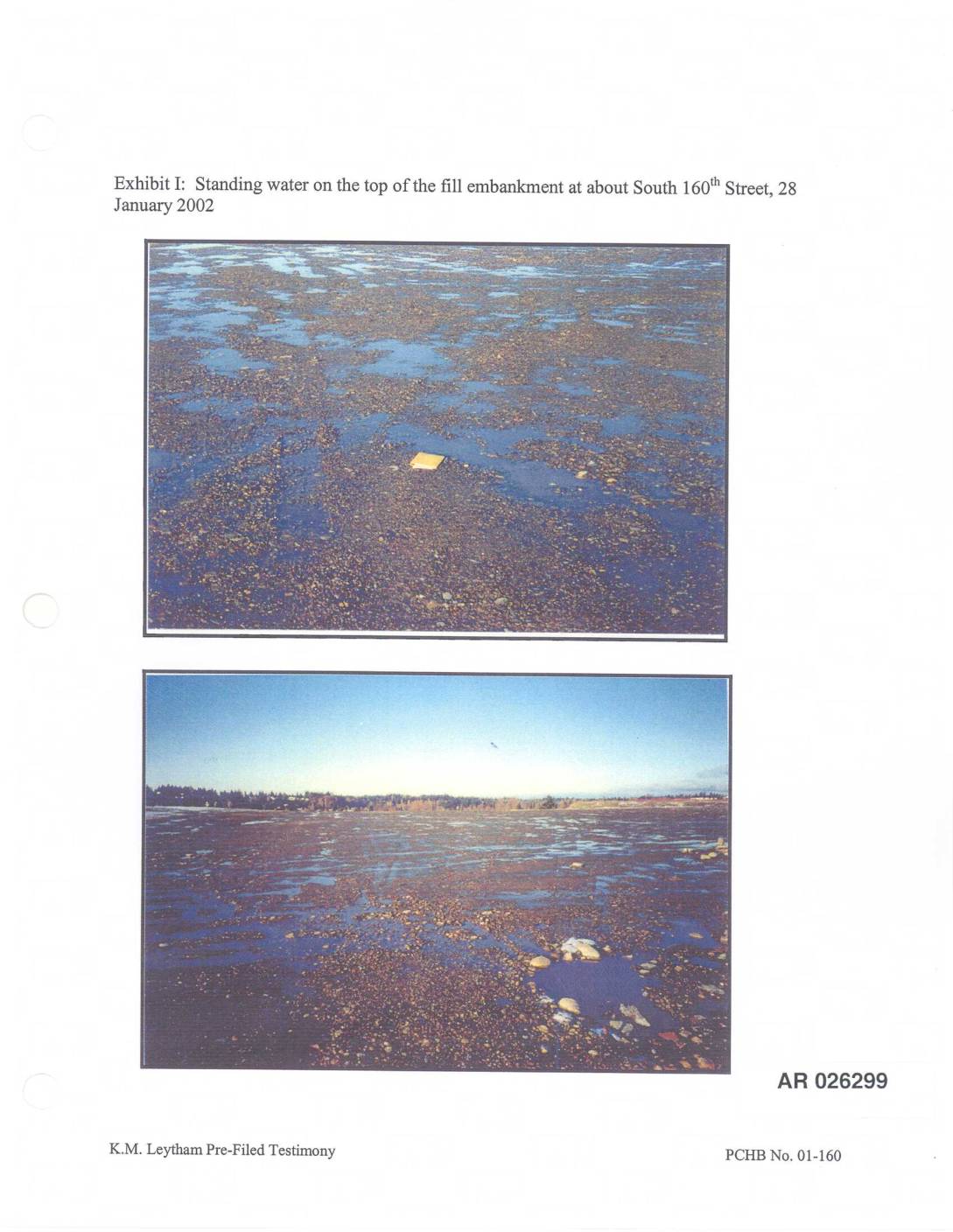
EXH I: Standing Water on Fill Embankment S 160th St 28 Jan 2002
This exhibit, part of K.M. Leytham's pre-filed testimony in PCHB No. 01-160, shows photographs taken on January 28, 2002, documenting standing water on top of a fill embankment near South 160th Street. The images provide visual evidence of water pooling conditions on the embankment surface, likely related to construction or environmental concerns associated with Sea-Tac Airport development. This material was submitted as part of a formal hearing record before the Pollution Control Hearings Board. -
 2002-01-28
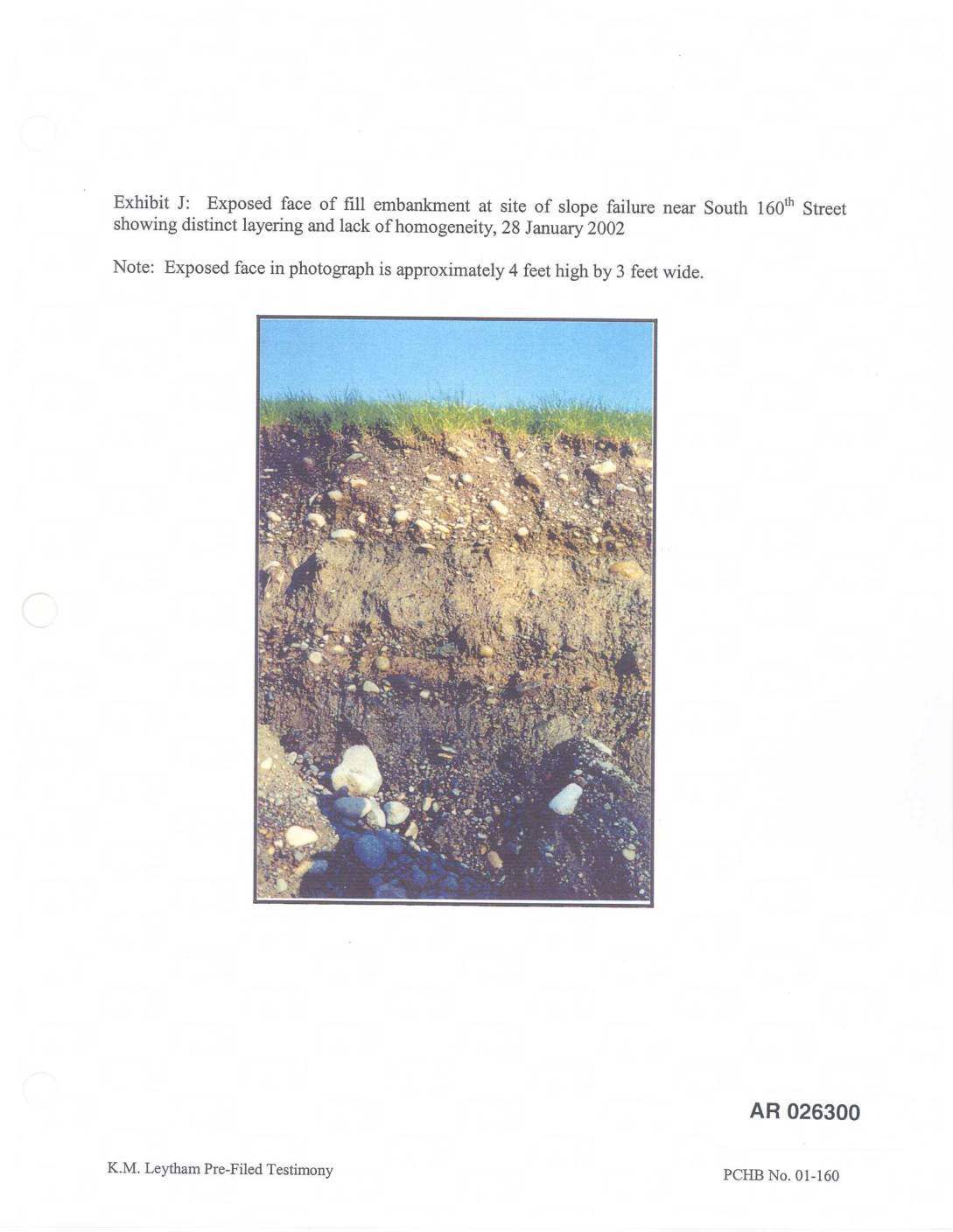
EXH AR026300: Exposed Fill Embankment S 160th St Slope Failure — Layering and Lack of Homogeneity, 28 Jan 2002
This exhibit, part of K.M. Leytham's pre-filed testimony (PCHB No. 01-160), shows a photograph taken on January 28, 2002, of an exposed fill embankment face near South 160th Street where a slope failure occurred. The image, approximately 4 feet high by 3 feet wide, reveals distinct layering and a lack of uniformity in the fill material. This evidence was submitted in connection with proceedings related to Sea-Tac Airport development and its surrounding infrastructure impacts. -
 2002-01-22
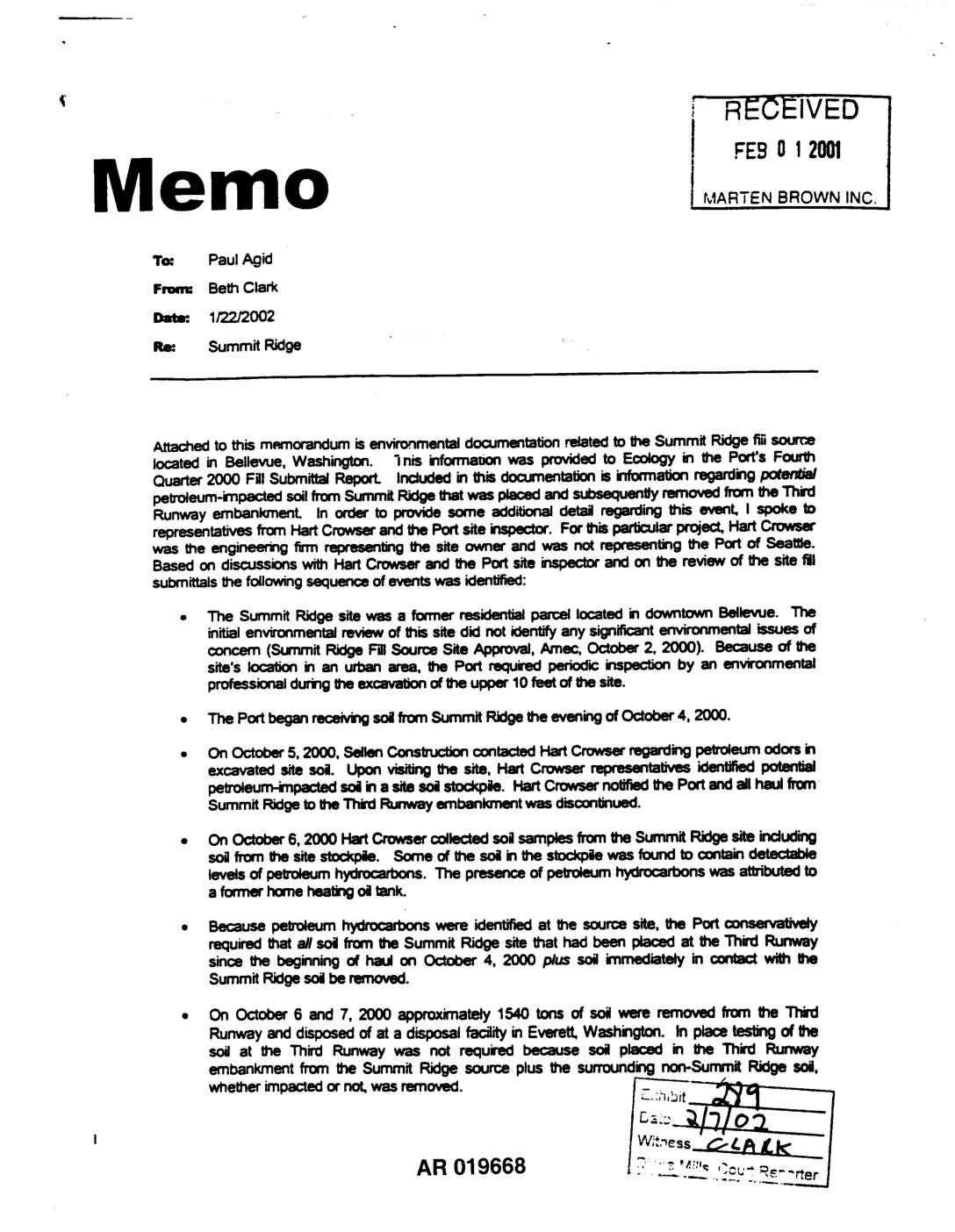
EXH AR019668: Memo Clark to Agid – Summit Ridge Fill Source & Petroleum-Impacted Soil, Third Runway Embankment
This January 2002 memo from the Port of Seattle describes an environmental incident in which soil from the Summit Ridge fill site in Bellevue, Washington—potentially contaminated with petroleum hydrocarbons from a former home heating oil tank—was temporarily placed in the Third Runway embankment during construction. Upon discovery of the contamination in October 2000, the Port halted all haul from the site and removed approximately 1,540 tons of soil, disposing of it at a facility in Everett. The Port subsequently implemented additional environmental safeguards, including full-time on-site supervision, to prevent further transport of impacted soil to the Third Runway. -
 2002-01-22
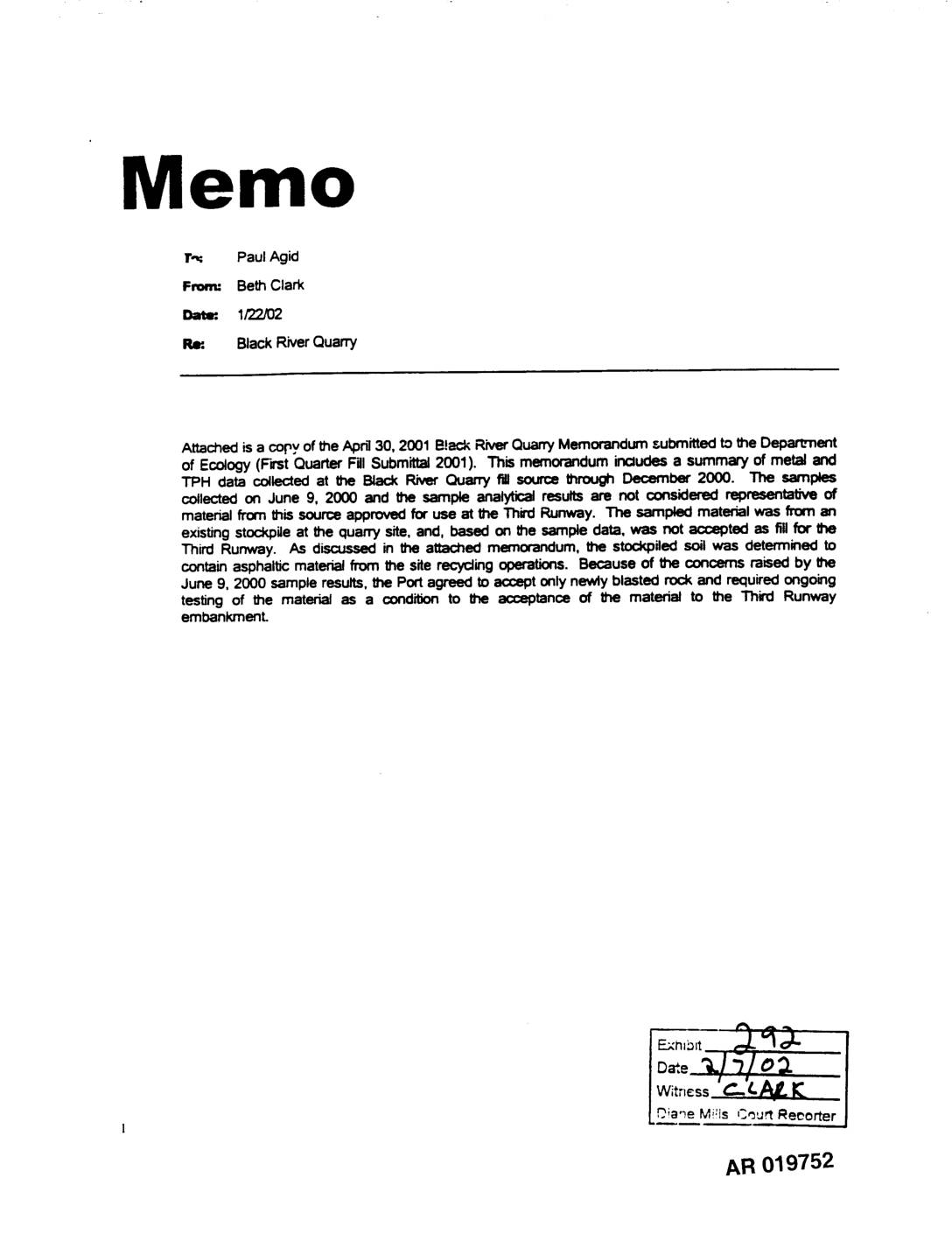
EXH 292: Memo — Black River Quarry Fill Material Testing TPH Metals Third Runway Embankment
This memo from Port of Seattle environmental staff describes chemical testing of rock aggregate imported from Black River Quarry for use in the Third Runway embankment at Sea-Tac Airport. Testing revealed petroleum hydrocarbons (TPH) and elevated copper levels in some samples, traced to contamination from on-site asphalt recycling operations. As a result, the Port restricted material acceptance to newly blasted rock only and halted imports from the quarry in mid-October 2000 pending operational changes and additional testing. -
 2002-01-10
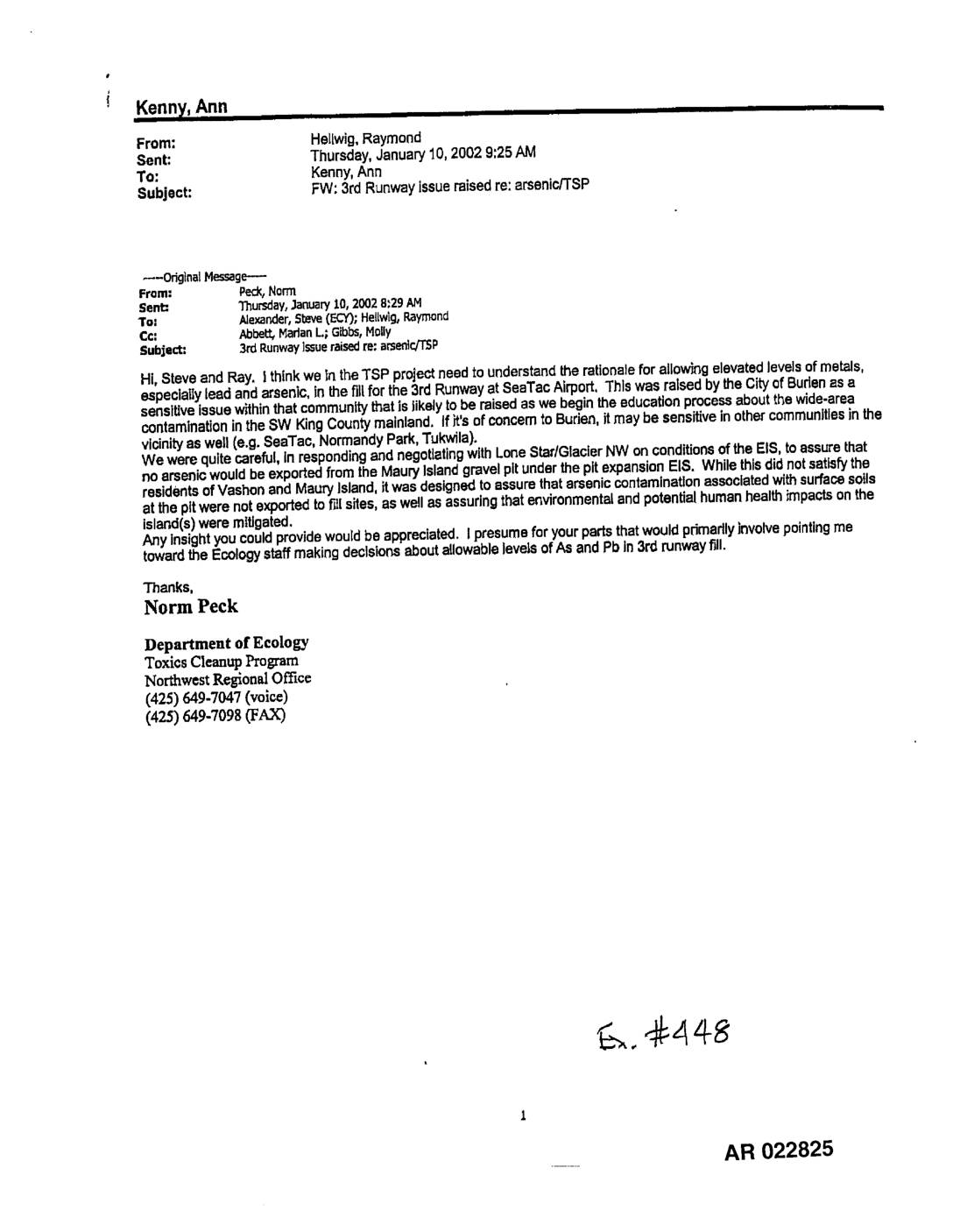
EXH 448: Email Thread — 3rd Runway Fill Arsenic Lead Levels TSP Project Concern (Jan 10, 2002)
A January 2002 internal email from Washington State Department of Ecology staff raises concerns about elevated levels of metals, particularly lead and arsenic, in fill material being used for the 3rd Runway construction at Sea-Tac Airport. The issue was flagged by the City of Burien as a community sensitivity, with worries that it could become a broader concern for neighboring communities including SeaTac, Normandy Park, and Tukwila. The email seeks clarification on the rationale behind allowable arsenic and lead levels in the runway fill, drawing a comparison to stricter restrictions previously placed on arsenic exports from the Maury Island gravel pit. -
 2001-12-13
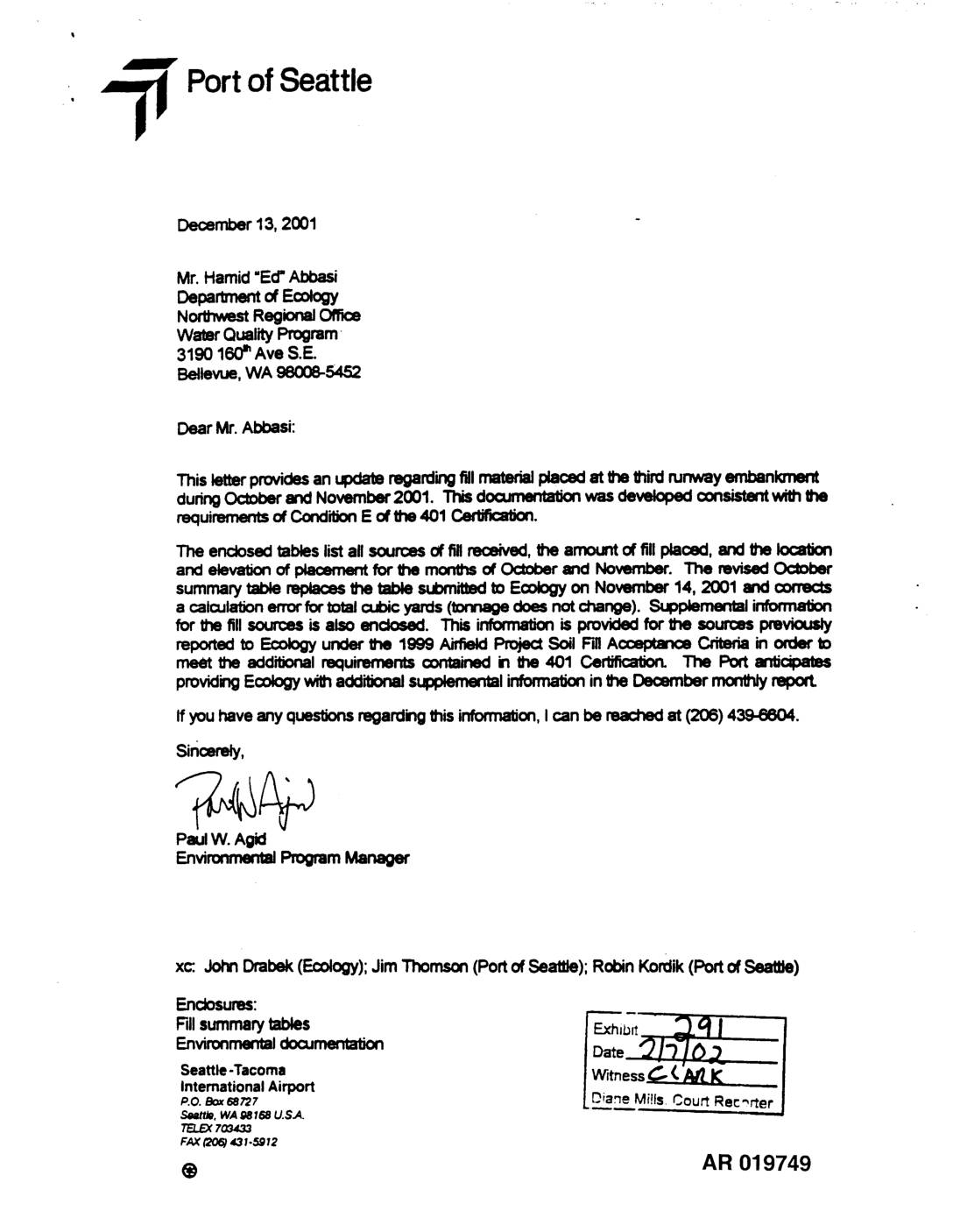
EXH 291: Letter to Ecology — Third Runway Embankment Fill Material Update Oct–Nov 2001
In December 2001, the Port of Seattle submitted a compliance update to the Washington State Department of Ecology documenting fill material placed at the Sea-Tac Airport third runway embankment during October and November 2001. The report lists all fill sources, quantities, and placement locations and elevations for that period, and corrects a calculation error in a previously submitted October summary table. The documentation was prepared to meet the requirements of Condition E of the 401 Water Quality Certification governing the third runway construction project. -
 2001-11-01
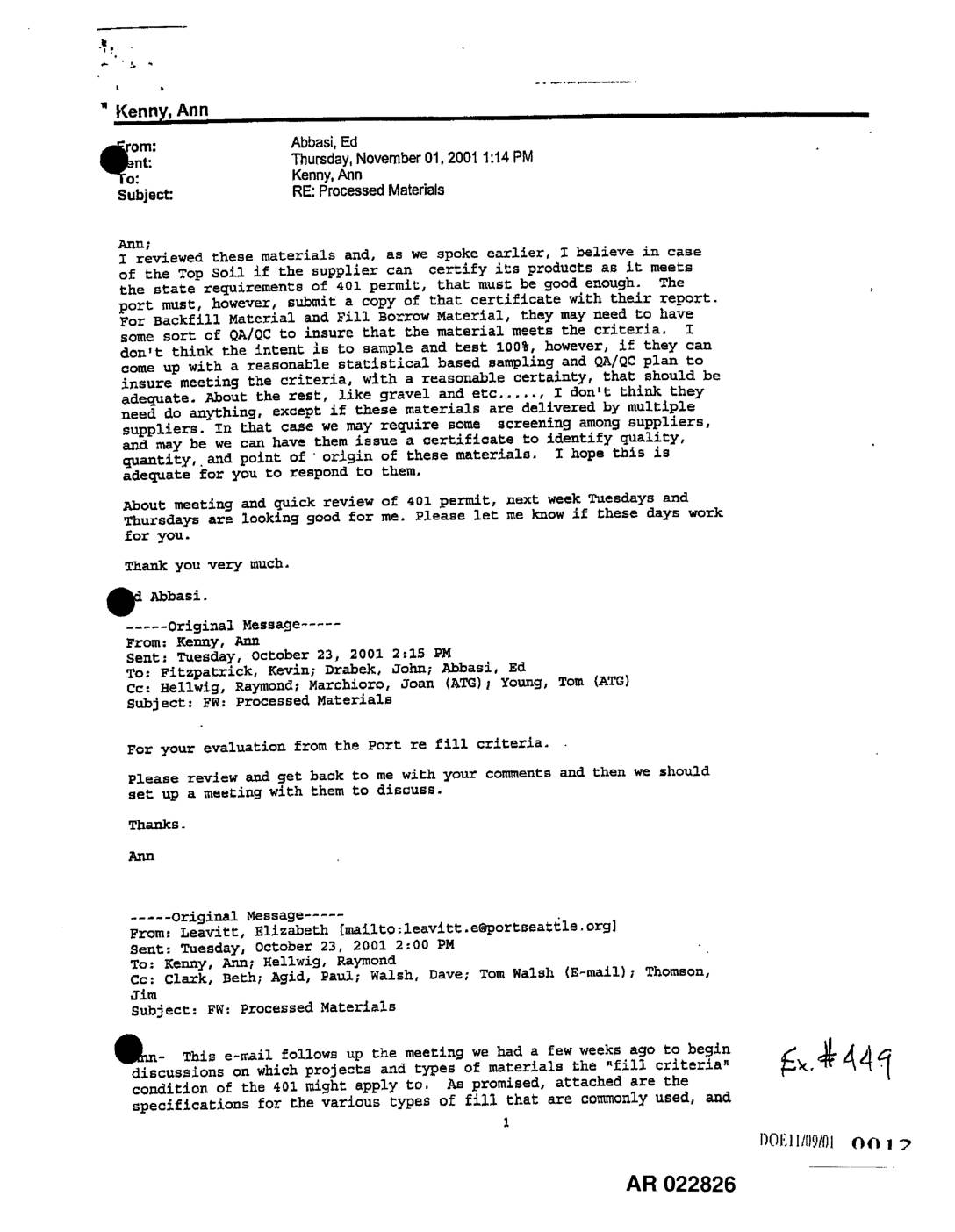
Exhibit 449: Email Chain Re: Processed Materials and Fill Criteria Under 401 Permit — Port Of Seattle Third Runway
This 2001 email chain discusses how fill materials used in the construction of Seattle-Tacoma Airport's Third Runway Embankment should meet environmental criteria under a 401 water quality permit. State regulators and Port of Seattle staff debated which materials — including topsoil, utility backfill, base course, and general embankment fill — required testing, supplier certification, or quality assurance plans to demonstrate compliance. Officials agreed that highly processed materials like topsoil could be covered by supplier certification, while bulk embankment fill would require a statistical sampling and QA/QC program. -
 2001-10-23
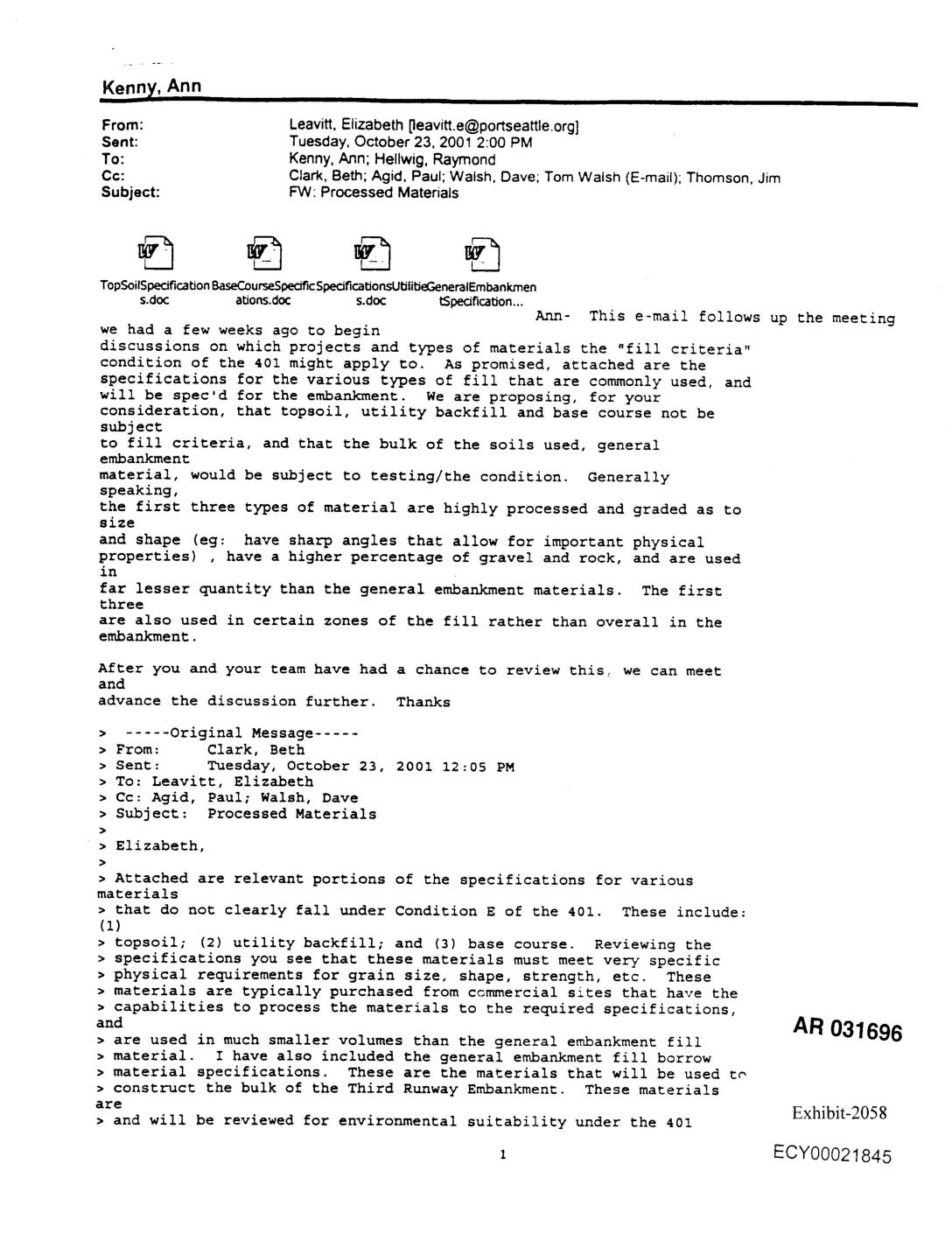
Exhibit 2058: Port Of Seattle Email on Processed Materials and 401 Fill Criteria for Third Runway Embankment
Email chain dated October 23, 2001 from Elizabeth Leavitt (Port Of Seattle) to Ann Kenny and Raymond Hellwig, forwarding a message from Beth Clark, discussing which fill materials are subject to Condition E of the 401 water quality certification for the Third Runway Embankment. Port Of Seattle proposes that topsoil, utility backfill, and base course