TagFederal Aviation Administration(23)
-
 2023-01-05
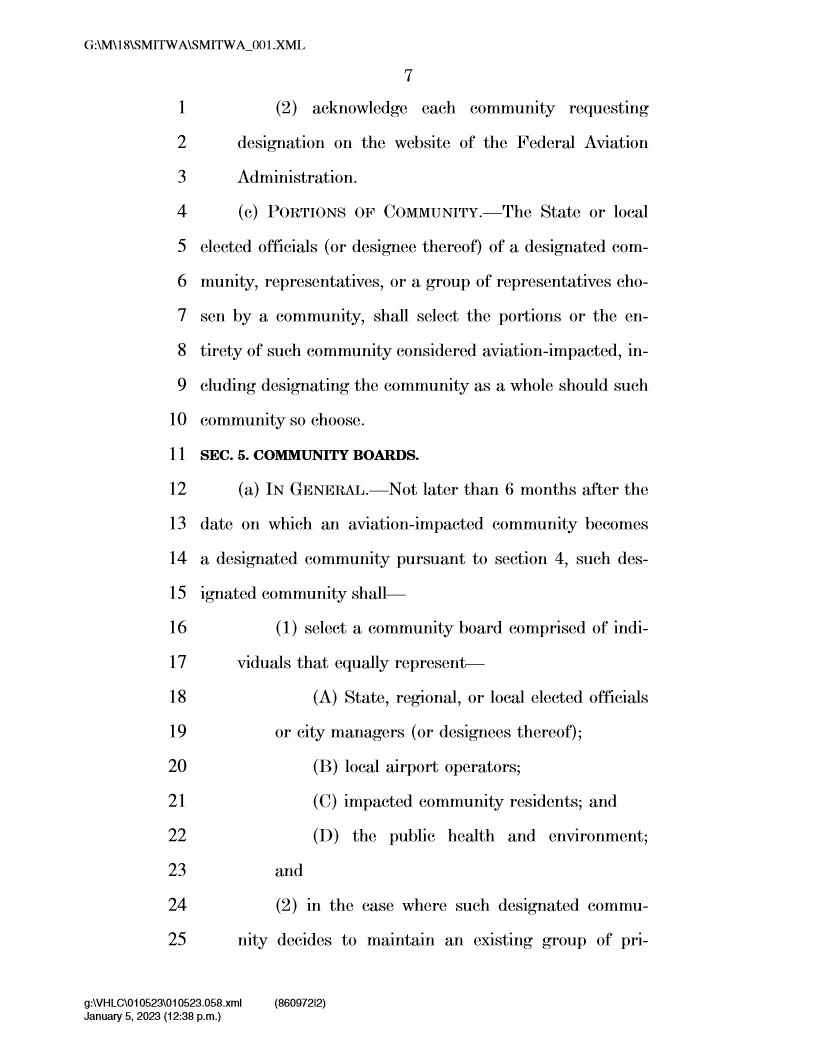
Aviation-Impacted Communities Act Draft — Community Board Structure (Page 7, January 2023)
Page 7 of a U.S. House legislative draft (file g:WHLC1052310523.058.xml, dated January 5, 2023) covering Sections 4–5 of what appears to be the Sen/Rep Smith aviation noise bill (SMITWA). The text establishes that designated aviation-impacted communities must, within 6 months, select a community board equally representing elected officials, local airport operators, impacted residents, and public health and environment interests. -
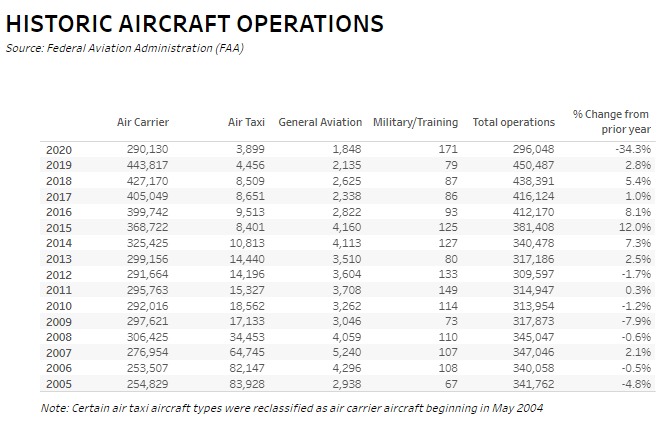
Tableau Historic Operations 2005-2020
A data table sourced from the Federal Aviation Administration (FAA) showing historic aircraft operations from 2005 to 2020, broken down by Air Carrier, Air Taxi, General Aviation, and Military/Training categories, along with total operations and percent change from prior year. The table shows a sharp -34.3% decline in total operations in 2020, dropping to 296,048, compared to 450,487 in 2019. -
 2020-12-01
Administrator’s Fact Book
The FAA Administrator's Fact Book (December 2020) is an official reference document compiled by the FAA Office of Communications outlining the agency's core mission and vision. The FAA's mission is to provide the safest and most efficient aerospace system in the world, while its vision emphasizes advancing safety, efficiency, environmental responsibility, and global leadership with accountability to the American public. This document serves as a foundational overview of FAA priorities, which directly inform federal aviation and noise policies affecting airports such as Seattle-Tacoma International Airport. -
 2020-09-30
National Plan of Integrated Airport Systems (NPIAS) 2021–2025
The National Plan of Integrated Airport Systems (NPIAS) 2021–2025 is a federal planning document published by the U.S. Department of Transportation's Federal Aviation Administration on September 30, 2020. It outlines the nation's airport infrastructure needs and investment priorities for a five-year period under Title 49 U.S. Code, Section 47103. While it covers the broader national airport system, it provides context for understanding federal aviation policy that can influence noise management decisions at airports like Sea-Tac. -
FAA Northwest Mountain Region offices open in Des Moines
GSA Northwest/Arctic Region @US_GSAR10 Today (June 14, 2018), GSA and FAA officially opened the new FAA offices in Des Moines, WA. The new center consolidated four separate buildings into one saving taxpayer dollars and creating a more efficient workspace. 3:11 PM · Jun 14, 2018 -
 2012-05-25
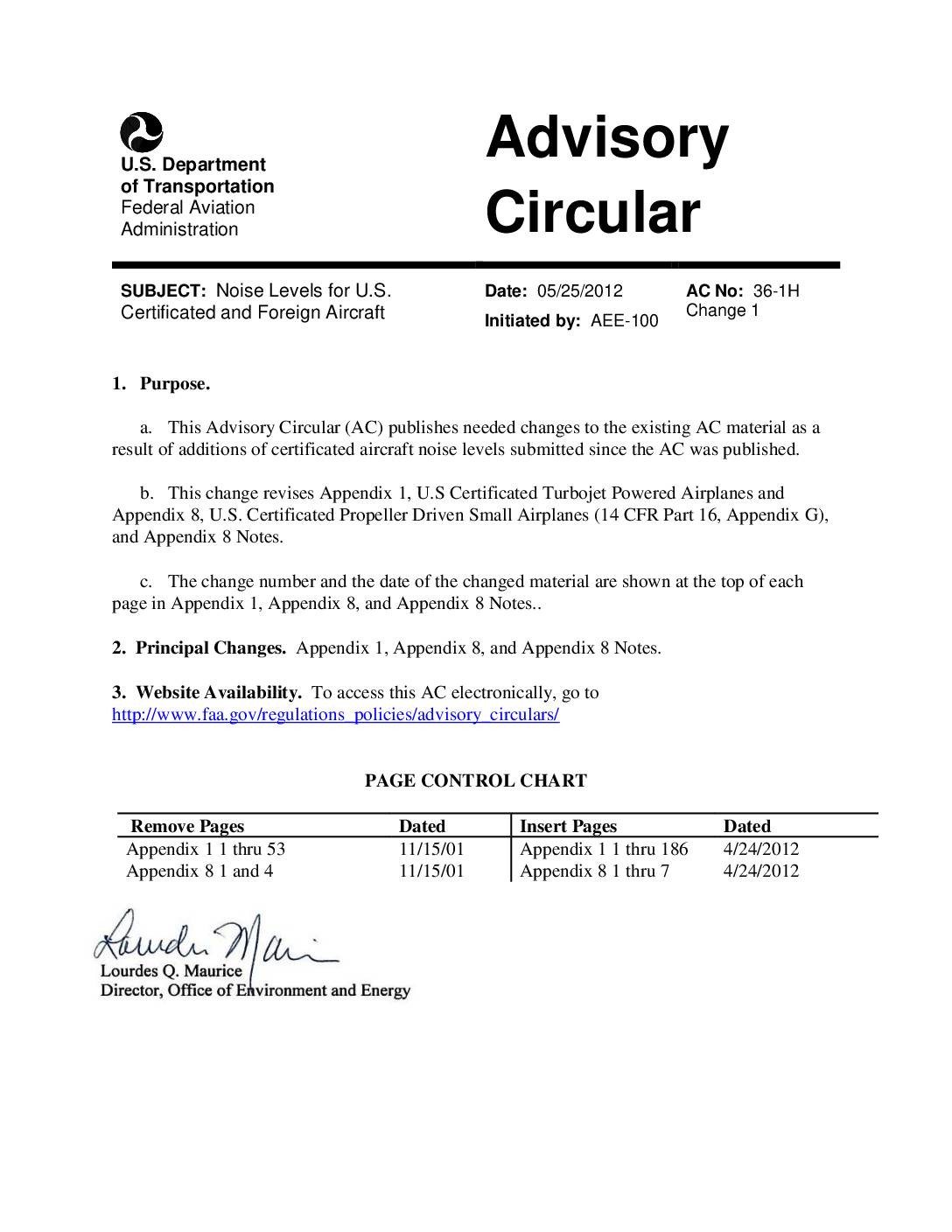
Noise levels for U.S. certificated and foreign aircraft
This FAA Advisory Circular (AC 36-1H) published in 2001 and updated in 2012 provides official noise level data for U.S.-certificated and foreign aircraft, including turbojet and propeller-driven planes tested under 14 CFR Part 36 and ICAO Annex 16 standards. Noise measurements, expressed in Effective Perceived Noise Levels (EPNdB), cover takeoff, sideline, and approach conditions and are organized across multiple appendices by aircraft type and compliance stage. The document serves as a reference for tracking progress in aircraft noise reduction and supports noise policy decisions at airports across the United States. -
 2008-01-01
Compilation of Airport Law Resources
A comprehensive legal research digest that compiles and indexes airport law resources for attorneys and administrators. It provides a bibliography of federal resources, statutory materials, regulations, case law, and secondary sources related to airport legal issues including topics like eminent domain, environmental concerns, leasing, contracting, security, and liability. -
 2001-01-01
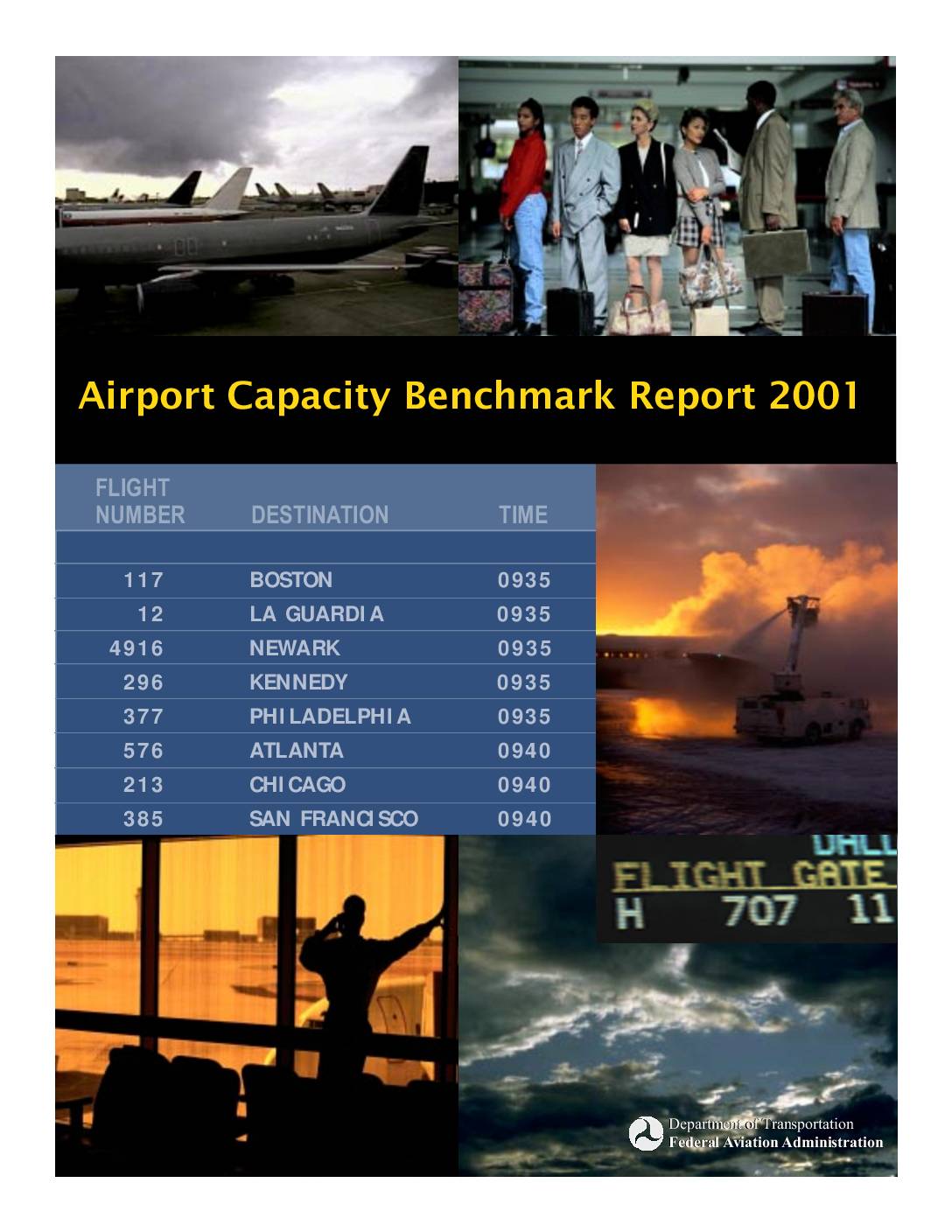
Airport Capacity Benchmark Report 2001
The FAA's Airport Capacity Benchmark Report 2001 measures the maximum number of flights 31 of the nation's busiest airports can handle per hour under both good and adverse weather conditions. The benchmarks were developed between October 2000 and April 2001 by the FAA and MITRE/CAASD to help understand the relationship between airline demand and runway capacity, and to inform long-term aviation policy decisions. While useful as a reference point, the report notes that these benchmarks are starting points for discussion rather than definitive guides for major investment or scheduling decisions. -
 1999-12-01
EXH AR026410: Wildlife Hazard Management Airports — Manual Airport Personnel
This 1999 manual, prepared jointly by the Federal Aviation Administration and the U.S. Department of Agriculture, provides airport personnel with guidance on managing the safety risks posed by wildlife at airports. It covers topics including the FAA National Wildlife Strike Database, the roles of various federal agencies, and strategies for reducing bird and animal strikes on aircraft. The manual draws on strike records from 1990–1998 to illustrate the frequency, types, and impacts of wildlife encounters with aircraft. -
 1994-08-01
Seattle-Tacoma International Airport data package no. 6: Airport Capacity Enhancement Plan update
This August 1994 report, prepared by the Federal Aviation Administration Technical Center in Atlantic City, New Jersey, presents technical data collected as part of the Seattle-Tacoma International Airport Capacity Enhancement Design Team Study. It is the sixth in a series of data packages examining airport capacity and delay simulation at Sea-Tac, with findings subject to revision as the design team's analysis continued. The document serves as an interim reference for planners and researchers studying runway and airspace capacity improvements at the airport.