TagEnvironmental Impact Statement(400)
-
 1995-04-01
ACC Comments on the Proper Scope of the Environmental Impact Statement for a Proposed Development of Seattle-Tacoma International Airport
The Airport Communities Coalition, representing the cities of Burien, Des Moines, Normandy Park, and Tukwila, Washington, submitted formal scoping comments to the FAA and Port of Seattle regarding the proper scope of an Environmental Impact Statement for a proposed expansion of Seattle-Tacoma International Airport. The comments address key issues including the purpose and need for the project, the role of Puget Sound Regional Council planning, and the requirement for the FAA to independently fulfill its obligations under the National Environmental Policy Act. The document also calls for the EIS to account for connected and cumulative impacts, including planned land-side facility improvements and the Part 150 Noise Mitigation Program. -
 1995-03-20
Sea-Tac International Airport Hotel draft environmental impact statement
This March 1995 Draft Environmental Impact Statement, prepared by Kato & Warren, Inc. for the Port of Seattle, evaluates the proposed construction of a 16-story, 384-room hotel on a 77,000-square-foot site at Sea-Tac International Airport, located between the 'D' Concourse and the airport entry drives. The hotel, which would include 10,000 square feet of meeting rooms plus a restaurant and lounge, was to be connected to the terminal and parking garage via pedestrian skybridges on land then occupied by a United Airlines office building. The document was issued for public comment under Washington State's Environmental Policy Act (SEPA), with responses due by April 20, 1995. -
 1994-03-01
Port Of Seattle South Aviation Support Area final environmental impact statement
This March 1994 Final Environmental Impact Statement, prepared jointly by the Federal Aviation Administration's Seattle Airports District Office and the Port of Seattle, evaluates the proposed South Aviation Support Area at Seattle-Tacoma International Airport. The document assesses the potential environmental effects of developing aviation support facilities in the southern portion of the airport, covering impacts such as noise, land use, and related concerns. It was produced as part of the federally required environmental review process before any major airport infrastructure decisions could be approved. -
 1994-02-11
Executive Order #12898 Federal Actions To Address Environmental Justice in Minority Populations and Low-Income Populations
Executive Order 12898, signed by President Clinton in February 1994, directs all federal agencies to identify and address disproportionately high and adverse environmental and health impacts on minority and low-income populations. It establishes an Interagency Working Group on Environmental Justice, led by the EPA, to coordinate agency strategies, data collection, and research. Each federal agency was required to develop and finalize an environmental justice strategy within 12 months, ensuring that federal programs do not discriminate based on race, color, or national origin. -
 1993-12-22
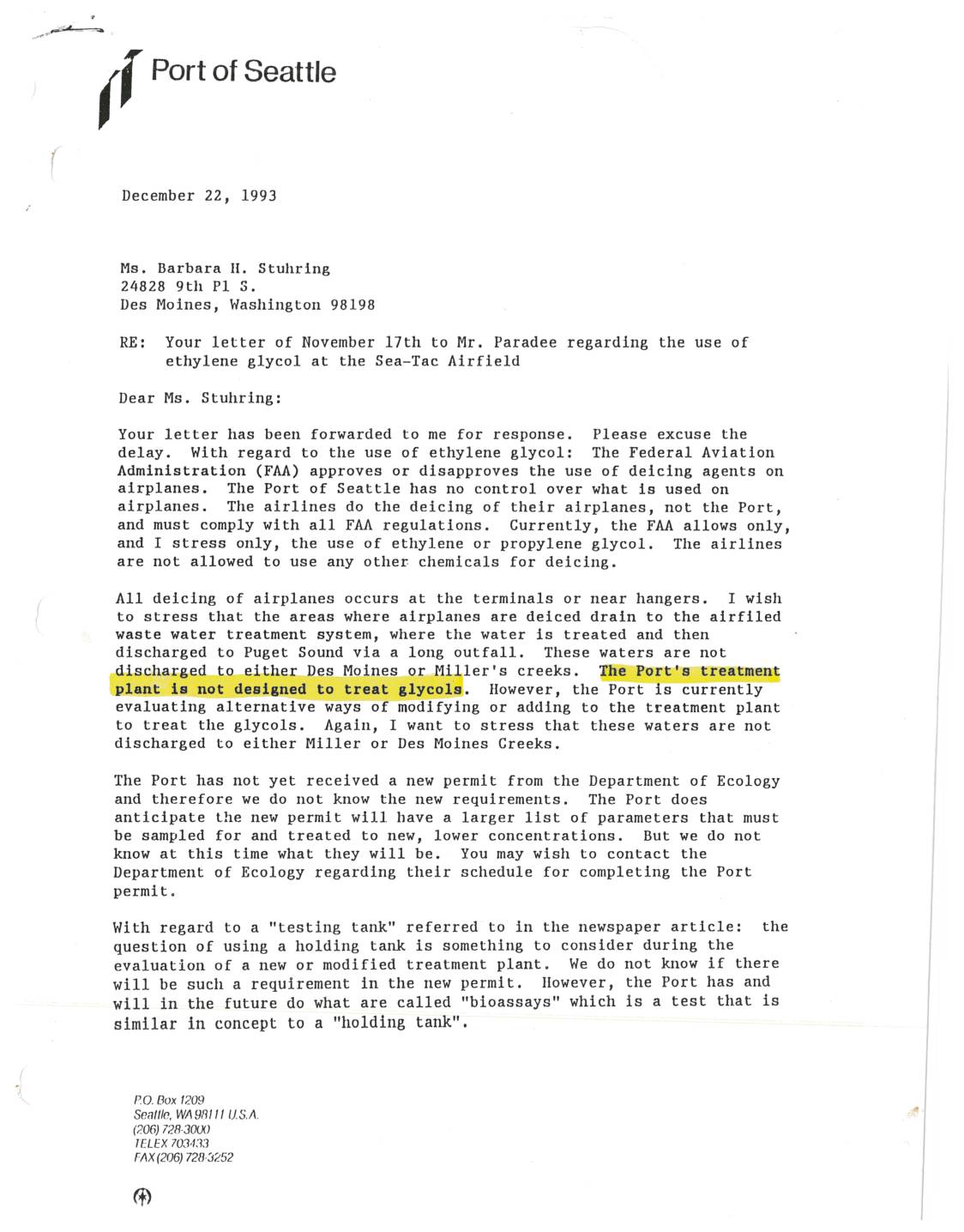
Port Of Seattle Letter to Barbara Stuhring: Ethylene Glycol Deicing at Sea-Tac Airport and Wastewater Treatment
December 22, 1993 letter from Port of Seattle to Barbara H. Stuhring of Des Moines, WA responding to her November 17 inquiry about ethylene glycol and propylene glycol deicing fluid use at Sea-Tac Airport. Letter states FAA requires only ethylene or propylene glycol for aircraft deicing, that deicing areas drain to the airfield wastewater treatment -
1993-12-22
Port Of Seattle Letter to Barbara Stuhring: Ethylene Glycol Deicing at Sea-Tac Airport and Wastewater Treatment
A 1993 letter from the Port of Seattle to a Des Moines resident explains that airline deicing at Sea-Tac Airport uses only FAA-approved ethylene or propylene glycol, and that wastewater from deicing drains to the airport's treatment system before being discharged to Puget Sound — not to Miller or Des Moines Creeks. The Port acknowledged its treatment plant was not designed to handle glycols and was evaluating upgrades. A follow-up 1996 letter challenges a contradictory statement in the airport's Final Environmental Impact Statement, which claimed most deicing fluids were contained and treated by the Port's Industrial Wastewater System. -
 1993-02-02
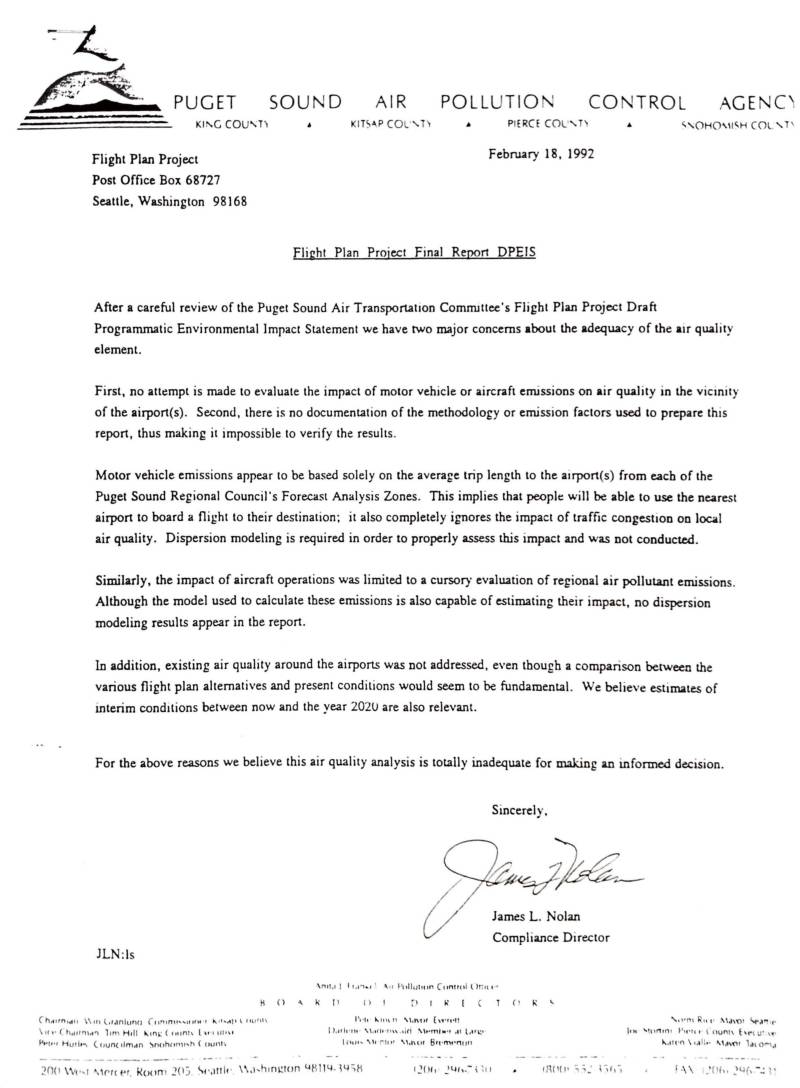
PSAPCA’s role regarding airport air quality
The Puget Sound Air Pollution Control Agency (PSAPCA) raised concerns in 1992 about inadequate air quality analysis in the Flight Plan Project's environmental impact statement, citing missing dispersion modeling for both vehicle and aircraft emissions near Sea-Tac Airport. A follow-up 1992 letter addressed the use of ethylene glycol as a de-icing agent at Sea-Tac, concluding it was unlikely to pose a significant air quality risk due to its low vapor pressure. A 1993 internal memo clarified PSAPCA's role in reviewing airport-related environmental impact statements and conducting annual inspections of registered equipment at airports within its jurisdiction. -
 1992-11-06
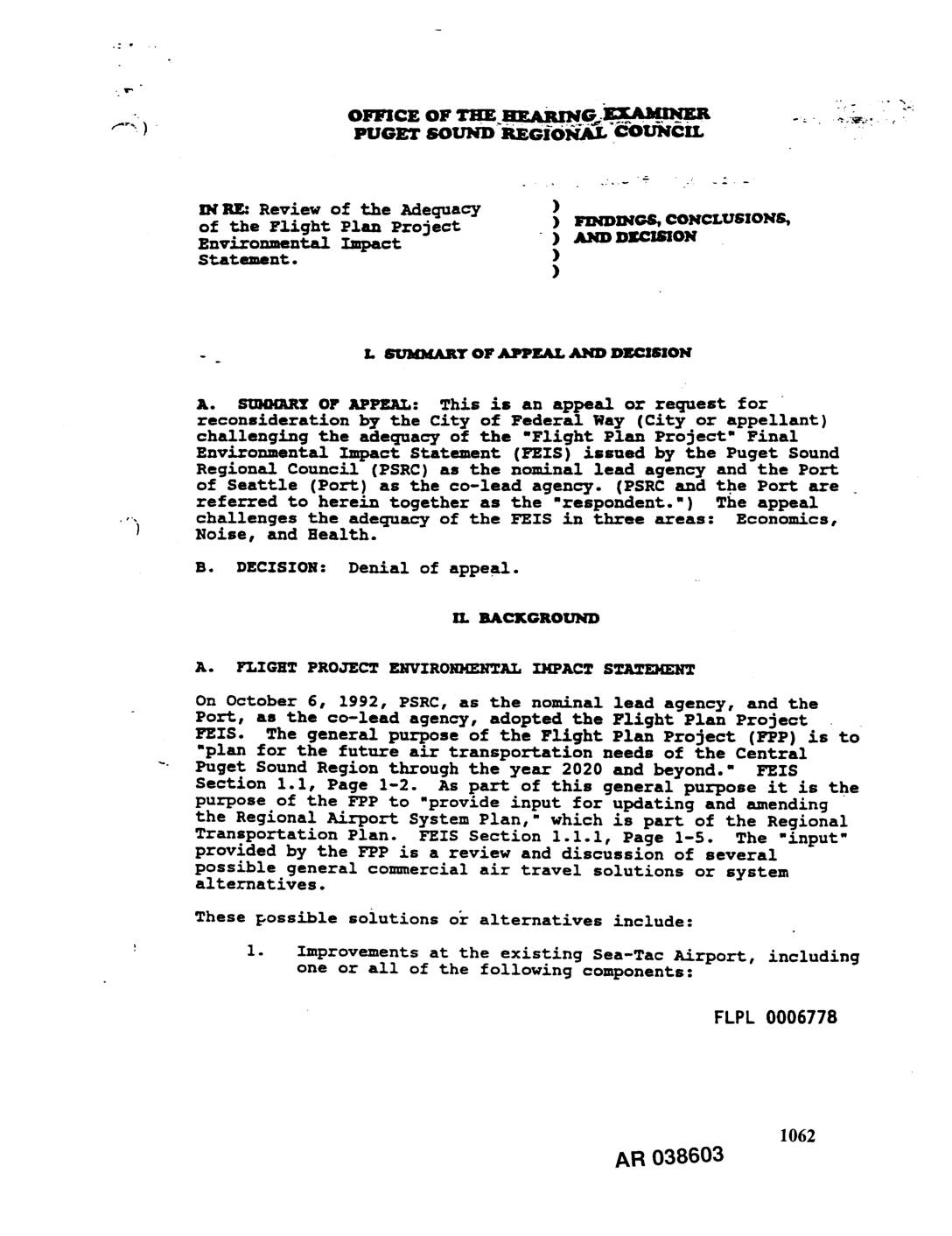
EXH AR038603: Findings, Conclusions, and Decision — City of Federal Way Appeal of Flight Plan Project EIS Adequacy
Office of the Hearing Examiner, Puget Sound Regional Council (PSRC) Findings, Conclusions, and Decision on City of Federal Way appeal (filed November 6, 1992) challenging adequacy of the Flight Plan Project Final Environmental Impact Statement (FEIS) issued by PSRC as nominal lead agency and Port of Seattle as co-lead agency. Appeal challenges FEIS adequacy in -
 1992-10-29
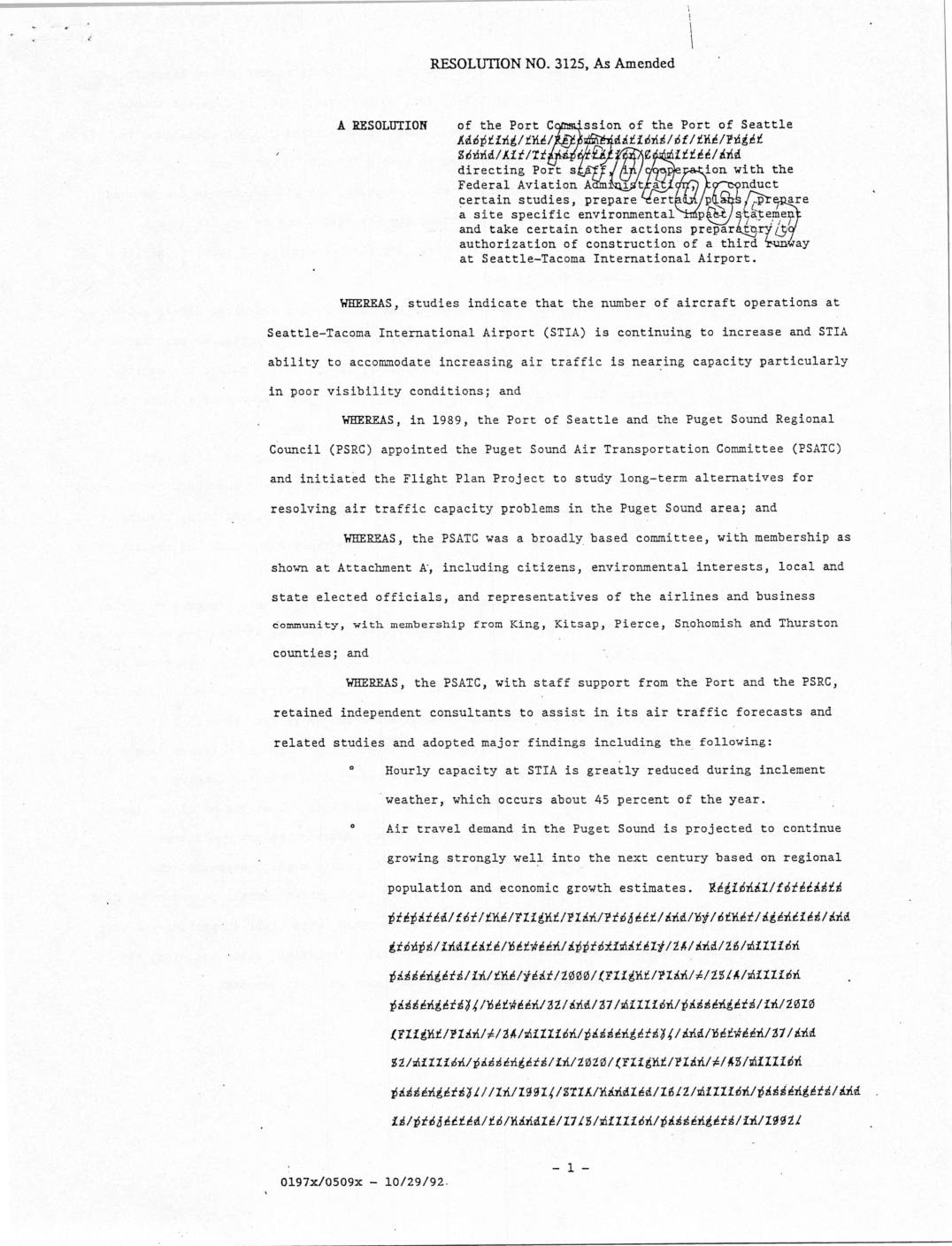
Resolution No. 3125, as amended
Resolution No. 3125, adopted by the Port of Seattle Commission in 1992, authorizes planning and environmental studies for the construction of a third runway at Seattle-Tacoma International Airport (Sea-Tac) to address growing air traffic demand and capacity limitations, particularly during poor weather conditions. The resolution follows a two-year study by the Puget Sound Air Transportation Committee (PSATC), which recommended a phased multiple-airport system, including a new dependent runway at Sea-Tac by 2000. The Port also called for broader regional solutions, including a fast rail link between Portland and Vancouver airports and diversion of cargo-only carriers to alternative airport sites. -
 1992-06-27
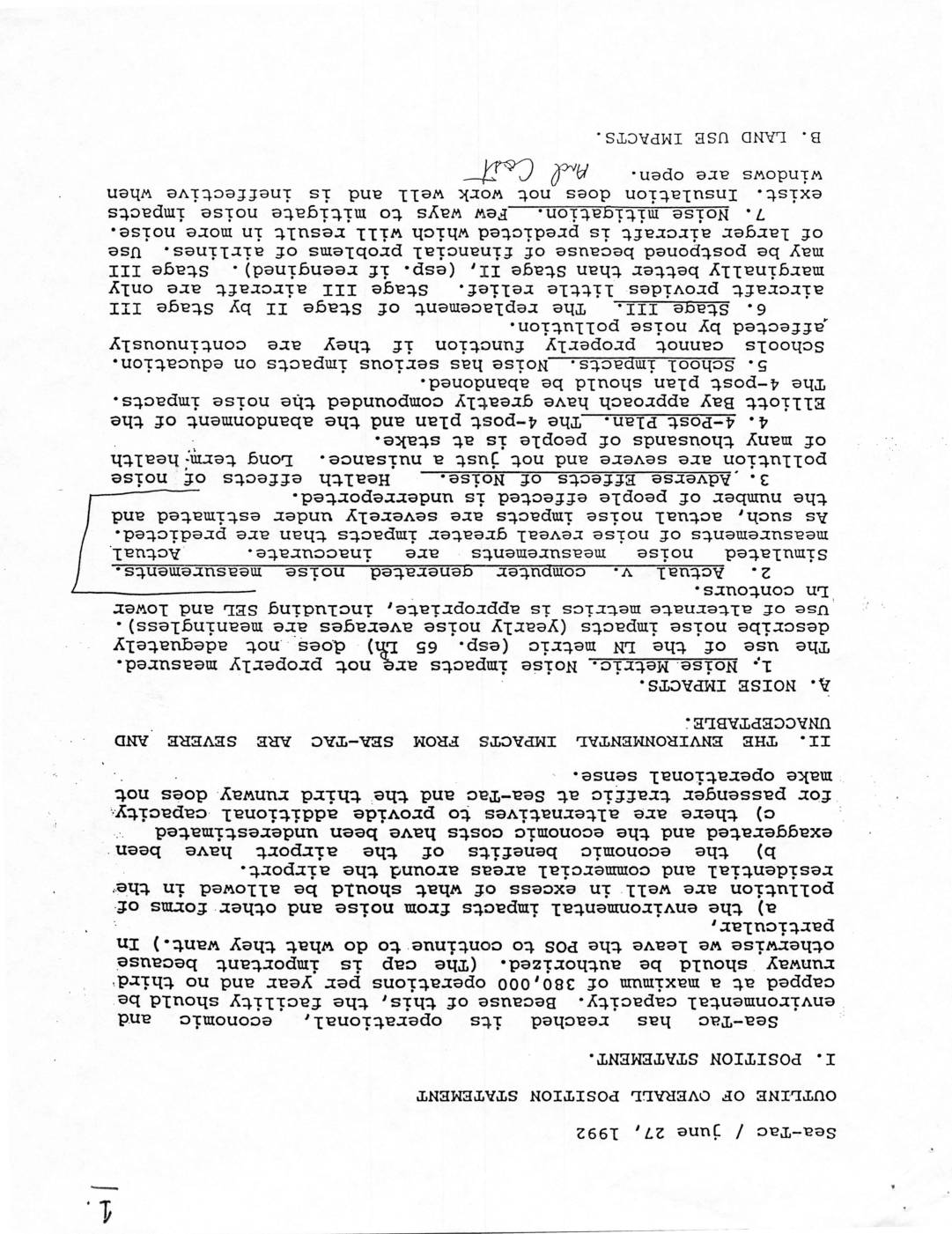
Outline of overall position statement: Sea-Tac, June 27, 1992
A 1992 position statement argues that Seattle-Tacoma International Airport (Sea-Tac) has reached its operational, economic, and environmental capacity and should be capped at a maximum of 380,000 operations per year with no third runway authorized. The document contends that noise impacts on surrounding communities are severely underestimated, that a third runway would make no operational or economic sense, and that alternatives such as demand management, use of existing regional airports, and improved transportation systems should be pursued instead.