TagEcology(797)
-
 1993-01-01
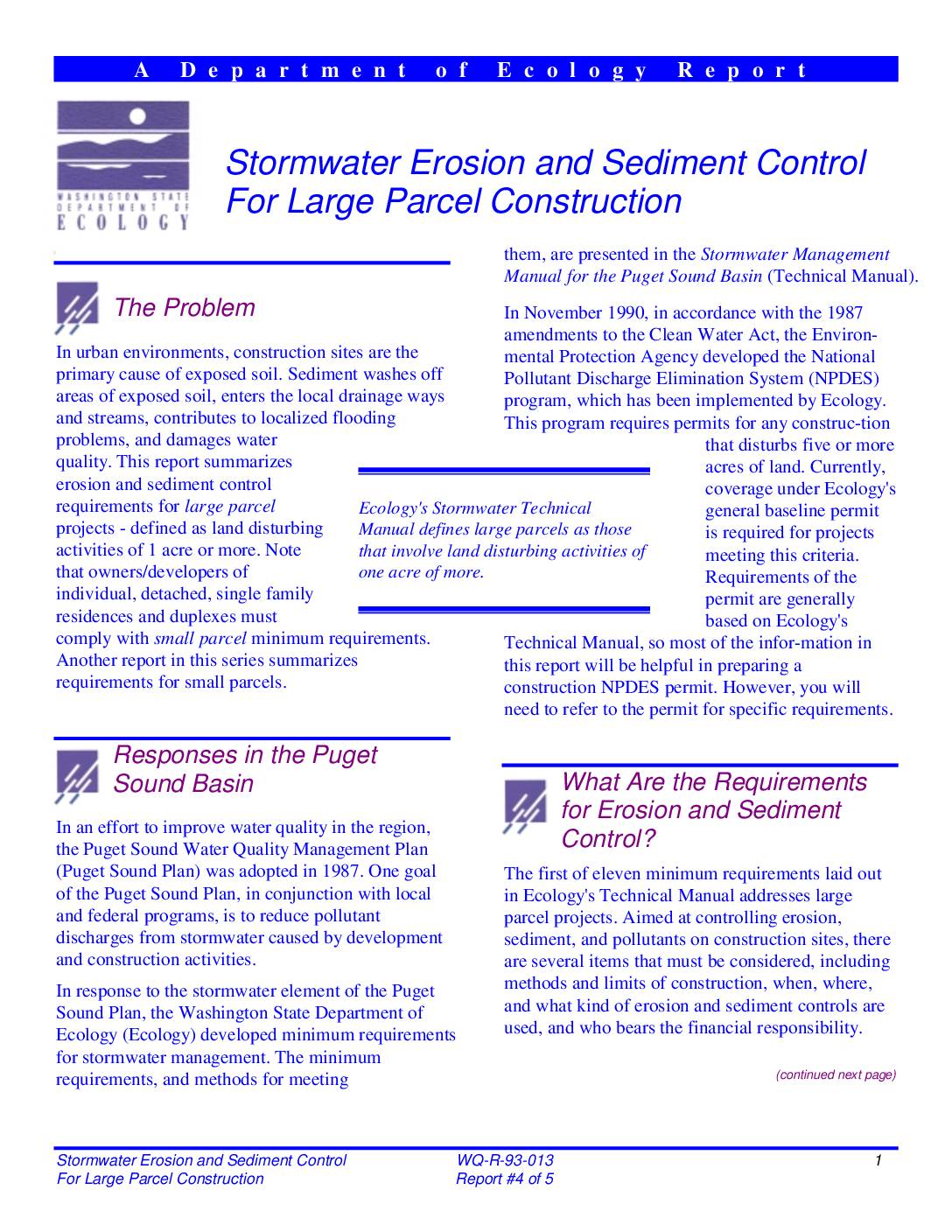
Stormwater erosion and sediment control for large parcel construction
This Washington State Department of Ecology report outlines stormwater erosion and sediment control requirements for large construction projects involving one or more acres of disturbed land in the Puget Sound Basin. It describes best management practices (BMPs) such as covering exposed soil, trapping sediment onsite, and protecting adjacent properties from runoff and sediment. Developers are required to create an erosion and sediment control plan and are financially responsible for its implementation. -
 1992-12-26
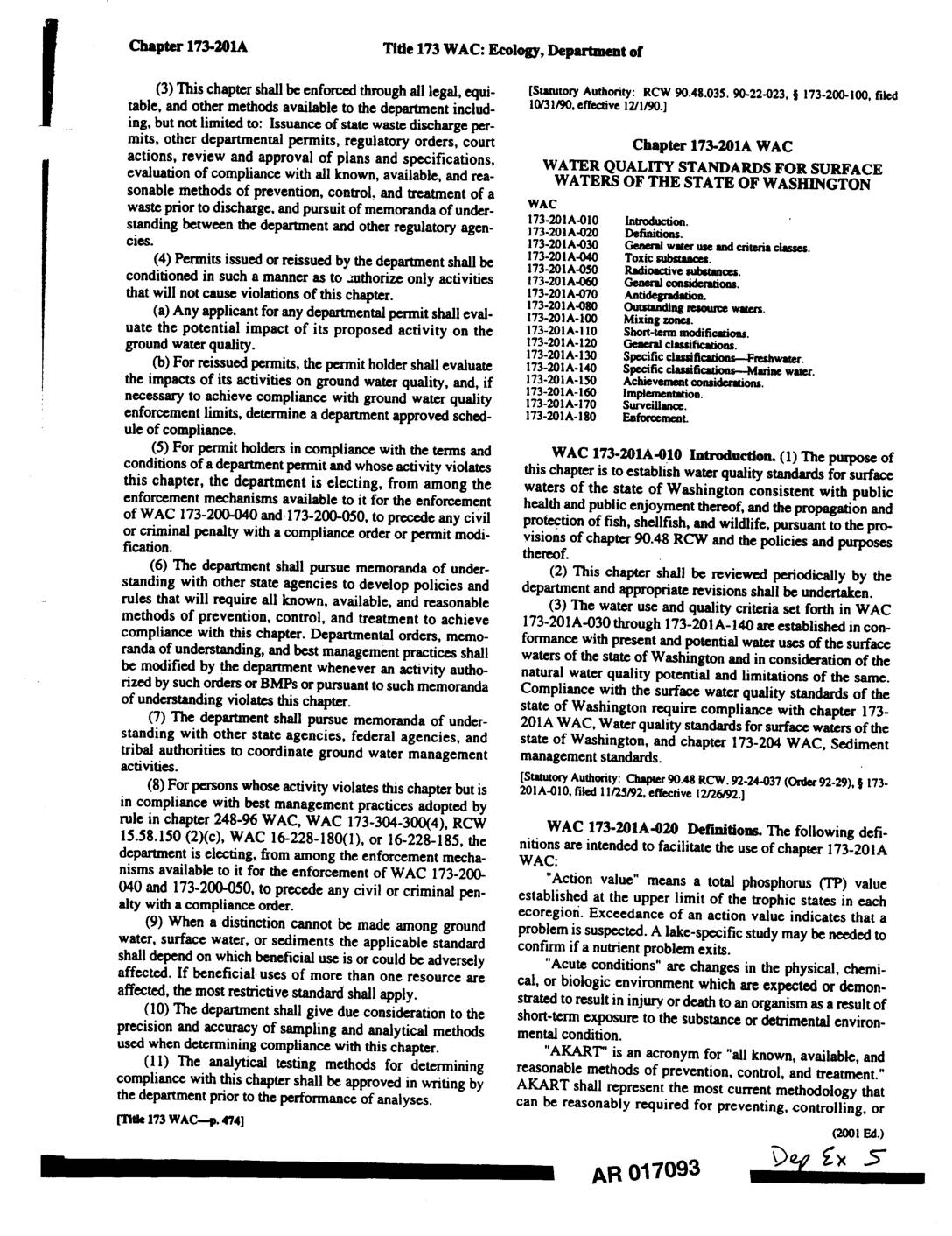
EXH AR017093: Water Quality Standards for Surface Waters of the State of Washington — WAC Chapter 173-201A
Washington Administrative Code (WAC) Chapter 173-201A, Water Quality Standards for Surface Waters of the State of Washington, issued by the Washington State Department of Ecology under RCW 90.48. Covers introduction (WAC 173-201A-010) and definitions (WAC 173-201A-020) including AKART, background conditions, best management practices, carcinogen, chronic/acute conditions, critical condition (7Q10 flow), ecoregions, fecal coliform, hardness, mixing -
 1992-02-01
EXH AR028244: Wetland Mitigation Replacement Ratios: An Annotated Bibliography
Annotated bibliography on wetland mitigation replacement ratios, published February 1992 as Publication #92-09 by the Washington State Department of Ecology (Ecology), Shorelands and Environmental Assistance Program, Olympia, Washington. Edited by Andrew J. Castelle, Catherine Conolly, and Michael Emers (Adolfson Associates, Inc., Edmonds, WA) and Eric D. Metz, Susan Meyer, and Michael Witter (W & H -
 1991-10-30
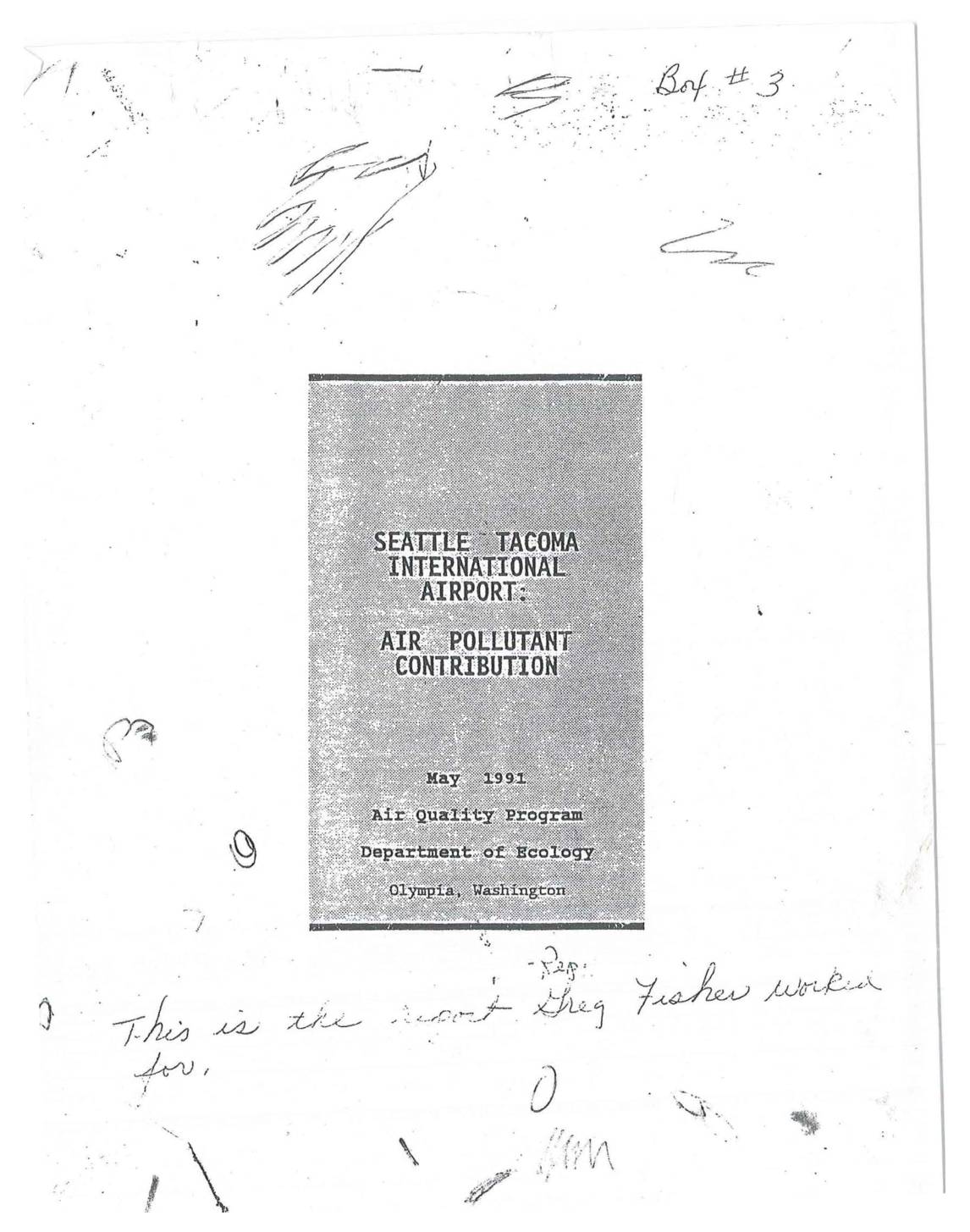
Sea-Tac Airport identified as a major polluter
A May 1991 Washington State Department of Ecology study, requested by state Representative Greg Fisher, identified Seattle-Tacoma International Airport as a major indirect source of air pollution, responsible for approximately 8% of carbon monoxide and 5% of nitrogen oxide emissions in King County. The report found that idling jets on the runway were the primary source of carbon monoxide, while aircraft climb and approach operations generated the most nitrogen oxide, with local pollution hotspots identified near South 154th Street, Seattle Christian School, and Tyee Golf Course. The study recommended minimizing runway queuing, reducing airport automobile traffic, exploring alternative fuels for ground support vehicles, and conducting further ground-level air quality testing around the airport. -
 1991-05-01
EXH AR019107: Field Assessment Mitigation Replacement Ratios Puget Sound
This 1991 report by Sheldon and Associates, prepared for the Washington Department of Ecology, assesses wetland mitigation replacement ratios in the Puget Sound region. It evaluates compensation sites where wetlands were restored or created to offset permitted wetland losses, examining how well those sites functioned as replacements. The report provides findings, conclusions, and recommendations on compensation plan design, monitoring, and appropriate replacement ratios for regulatory guidance. -
 1989-01-01
Puget Sound water quality: An annotated bibliography of agency materials
This 1989 annotated bibliography from the Puget Sound Water Quality Authority catalogs agency publications related to Puget Sound water quality, covering topics such as nonpoint source pollution, shellfish safety, oil spills, and stormwater management. It lists reports, newsletters, and pamphlets from federal, state, and local agencies—including the EPA, Washington Department of Ecology, and various county departments—along with contact information for obtaining each document. The bibliography serves as a resource guide for researchers, planners, and community members concerned with environmental water quality issues in the Puget Sound region. -
 1984-10-01
EXH AR037232: Guidelines for Deriving Numerical Aquatic Site-Specific Water Quality Criteria by Modifying National Criteria
EPA-600/3-84-099, published October 1984 by the U.S. EPA Environmental Research Laboratory, Duluth, Minnesota. Authored by Anthony R. Carlson, William A. Brungs, Gary A. Chapman, and David J. Hansen from EPA Environmental Research Laboratories in Duluth MN, Narragansett RI, Corvallis OR, and Gulf Breeze FL. Provides protocols for deriving numerical aquatic site-specific water quality criteria by