TagClean Air Act(22)
-
 2020-08-20
Comments on the FAA EA: SAMP Environmental Assessment
This document presents formal public comments opposing an FAA Environmental Assessment for expansion projects at Seattle-Tacoma International Airport, arguing that the stated justification for growth is misleading because FAA safety regulations would naturally cap operations without new gates. The comments raise concerns about disproportionate air pollution health impacts on nearby residents, flawed emissions modeling dating back to the 1990s, and inadequate environmental justice and cumulative impact analyses. The author contends that adding gates and terminals is the true driver of increased flight operations, not an unavoidable surge in demand that would occur regardless of expansion. -
2020-08-20
Comments on the FAA EA: SAMP Environmental Assessment
Public comments opposing the FAA Environmental Assessment (EA) for the Sea-Tac Airport Sustainable Airport Master Plan (SAMP), arguing the project should not be approved on seven grounds: false premise/purpose and need, disproportionate mortality and morbidity in affected communities, untrustworthy NAAQS air pollution calculations, inadequate cumulative impact analysis, missing environmental justice analysis, missing children’s health analysis, -
 2018-11-30
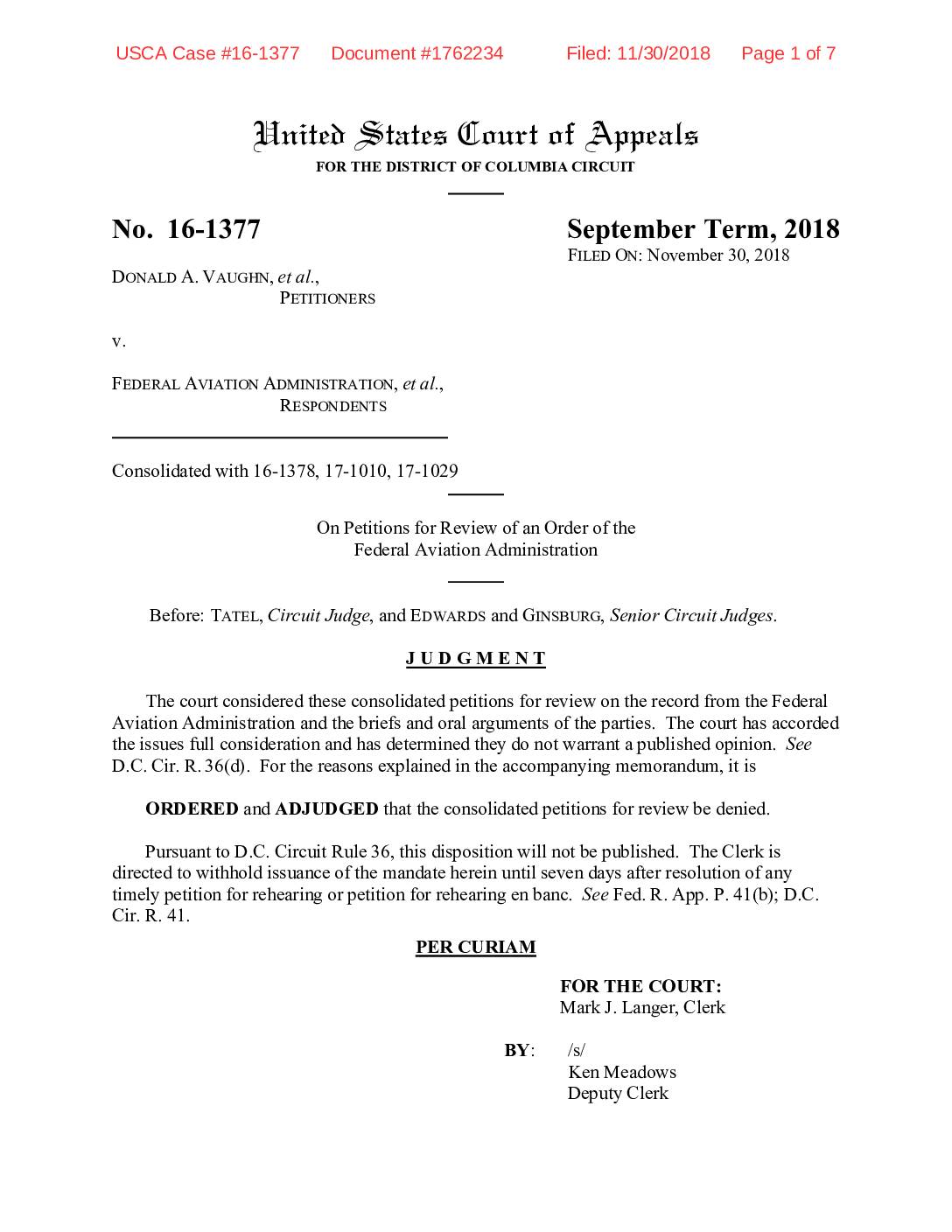
Vaughn v. Federal Aviation Administration: Judgment and Memorandum, D.C. Circuit Court of Appeals, No. 16-1377
A federal appeals court denied petitions challenging the FAA's 2016 SoCal Metroplex project, which redesigned flight paths at several Southern California airports to improve air-traffic efficiency. Residents and local groups argued the FAA failed to adequately study increased noise, air emissions, and cumulative environmental impacts under federal law, but the court found the FAA's environmental analysis was reasonable and legally sound. The court upheld the FAA's Finding of No Significant Impact, concluding the agency had taken the required 'hard look' at environmental consequences before implementing the new flight routes. -
 2007-04-02
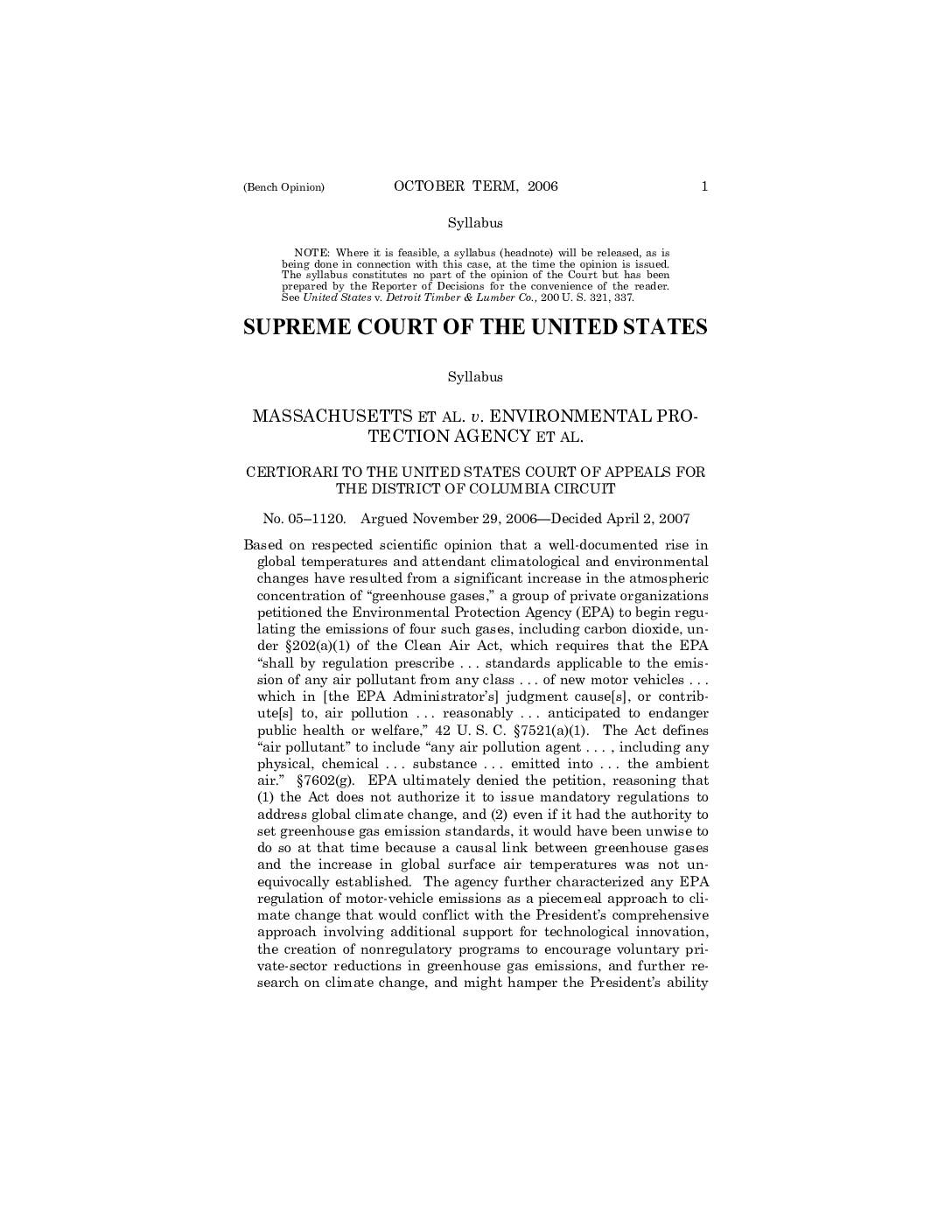
Massachusetts v. Environmental Protection Agency Supreme Court Decision
In this 2007 U.S. Supreme Court case, Massachusetts and other states sued the Environmental Protection Agency (EPA) for refusing to regulate greenhouse gas emissions from motor vehicles under the Clean Air Act. The Court ruled that the EPA had the authority and responsibility to regulate such emissions, and that states like Massachusetts had legal standing to challenge the EPA's inaction due to real harms caused by rising sea levels and climate change. This case established that carbon dioxide and other greenhouse gases can be regulated as air pollutants under federal law. -
 2004-04-01
Air quality: Focus on Puget Sound
This April 2004 report by the League of Women Voters examines air quality in the Puget Sound region, tracing the history of air pollution regulation from King Edward I's coal ban in 1305 through the creation of the U.S. Environmental Protection Agency in 1970. It focuses on the role of the Puget Sound Clean Air Agency in monitoring and reducing local air pollutants, with particular attention to small particles and diesel emissions. The report provides background on federal clean air legislation and outlines the League's related policy positions. -
 1998-11-24
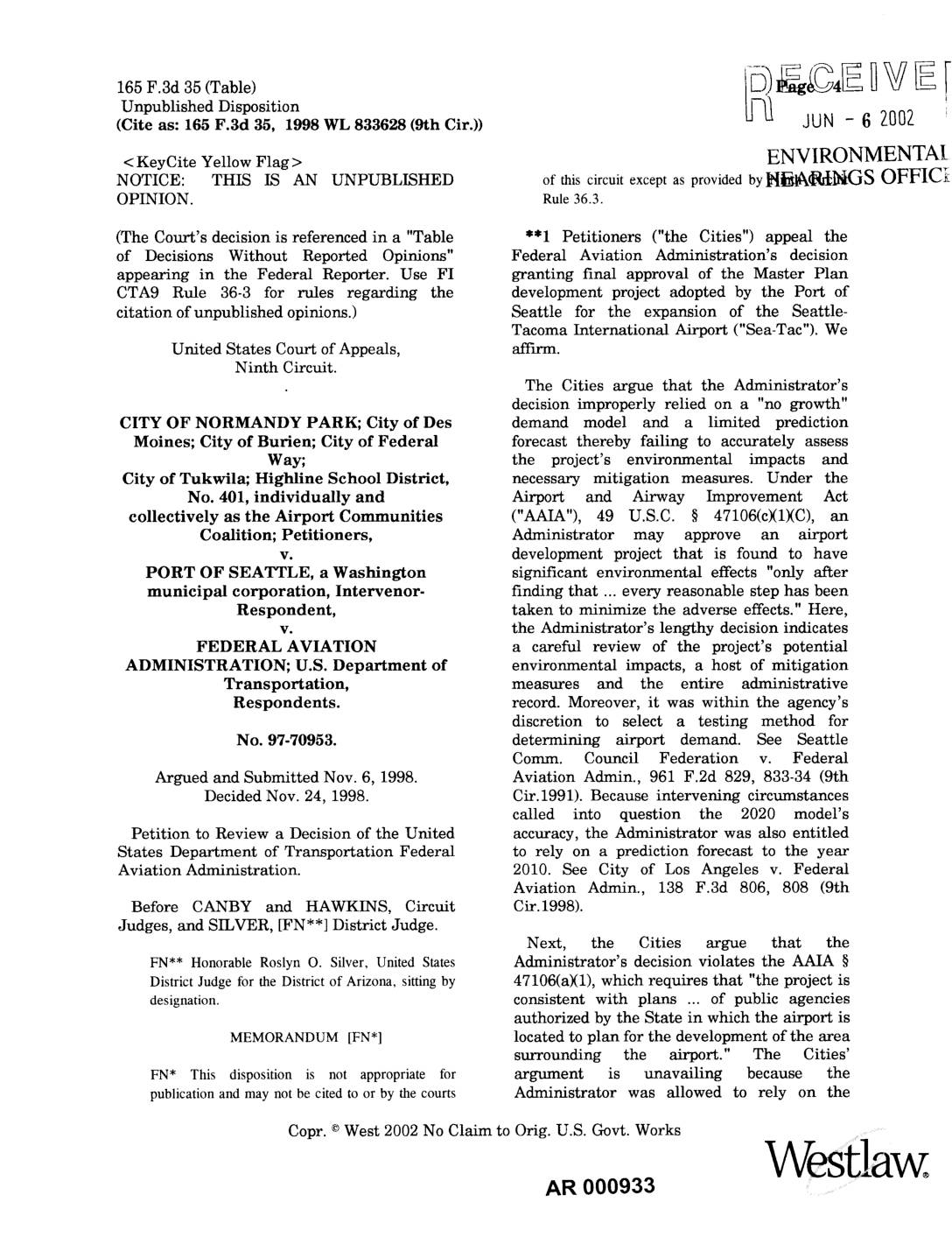
EXH AR000933: City of Normandy Park et al. v. Port Of Seattle and FAA — Ninth Circuit Unpublished Decision
Ninth Circuit Court of Appeals unpublished memorandum disposition (165 F.3d 35, 1998 WL 833628) affirming the FAA Administrator’s final approval of the Sea-Tac Airport Master Plan expansion project by Port Of Seattle. Petitioners — City of Normandy Park, City of Des Moines, City of Burien, City of Federal Way, City of Tukwila, Highline School District -
 1998-11-24
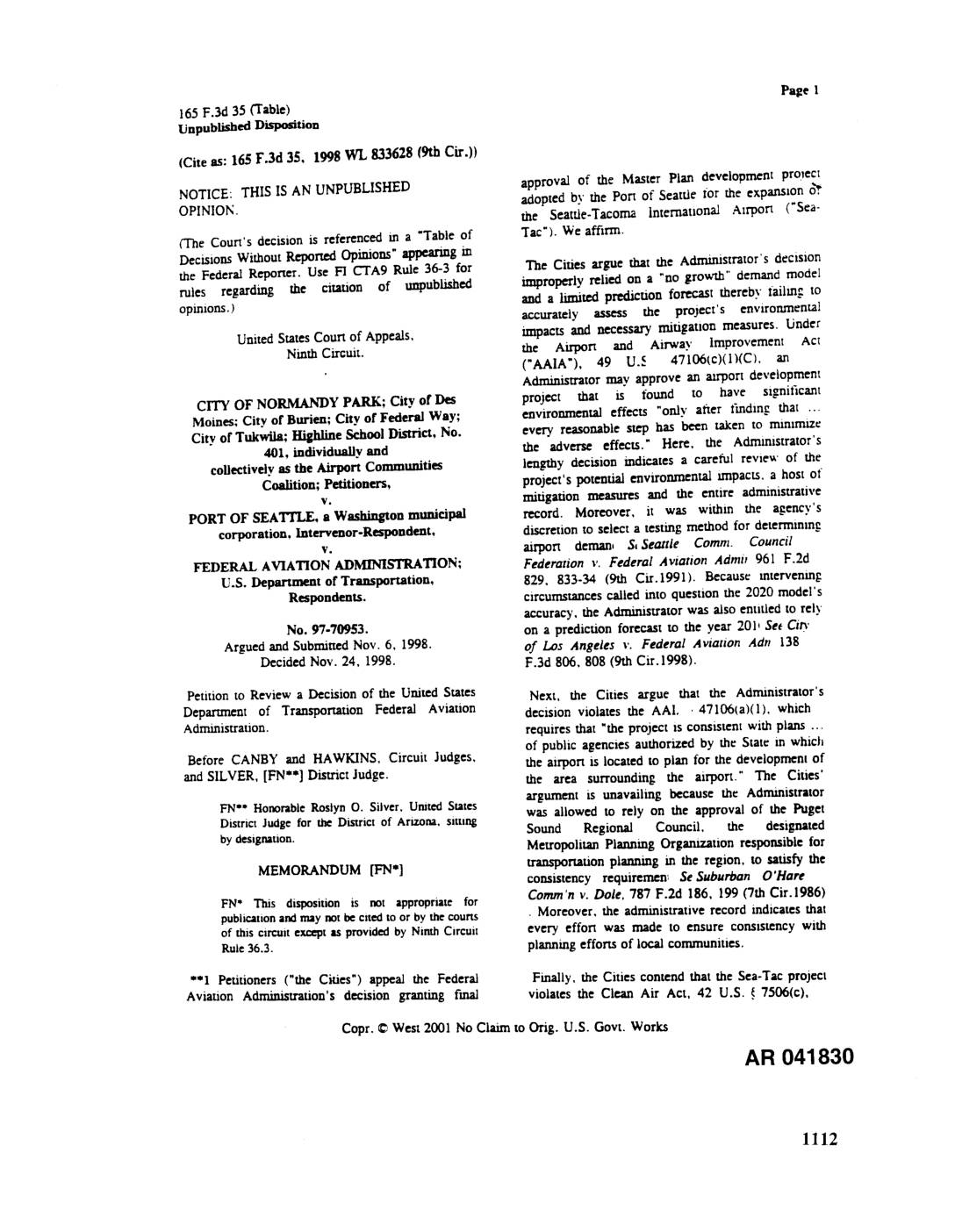
EXH AR041830: City of Normandy Park et al. v. Port Of Seattle and Federal Aviation Administration, 165 F.3d 35 (9th Cir. 1998)
Unpublished Ninth Circuit Court of Appeals memorandum opinion, 165 F.3d 35 (1998 WL 833628), affirming the FAA Administrator’s approval of the Master Plan development project for Sea-Tac Airport expansion. Petitioners — City of Normandy Park, City of Des Moines, City of Burien, City of Federal Way, City of Tukwila, and Highline School District No. 401 -
 1997-06-30
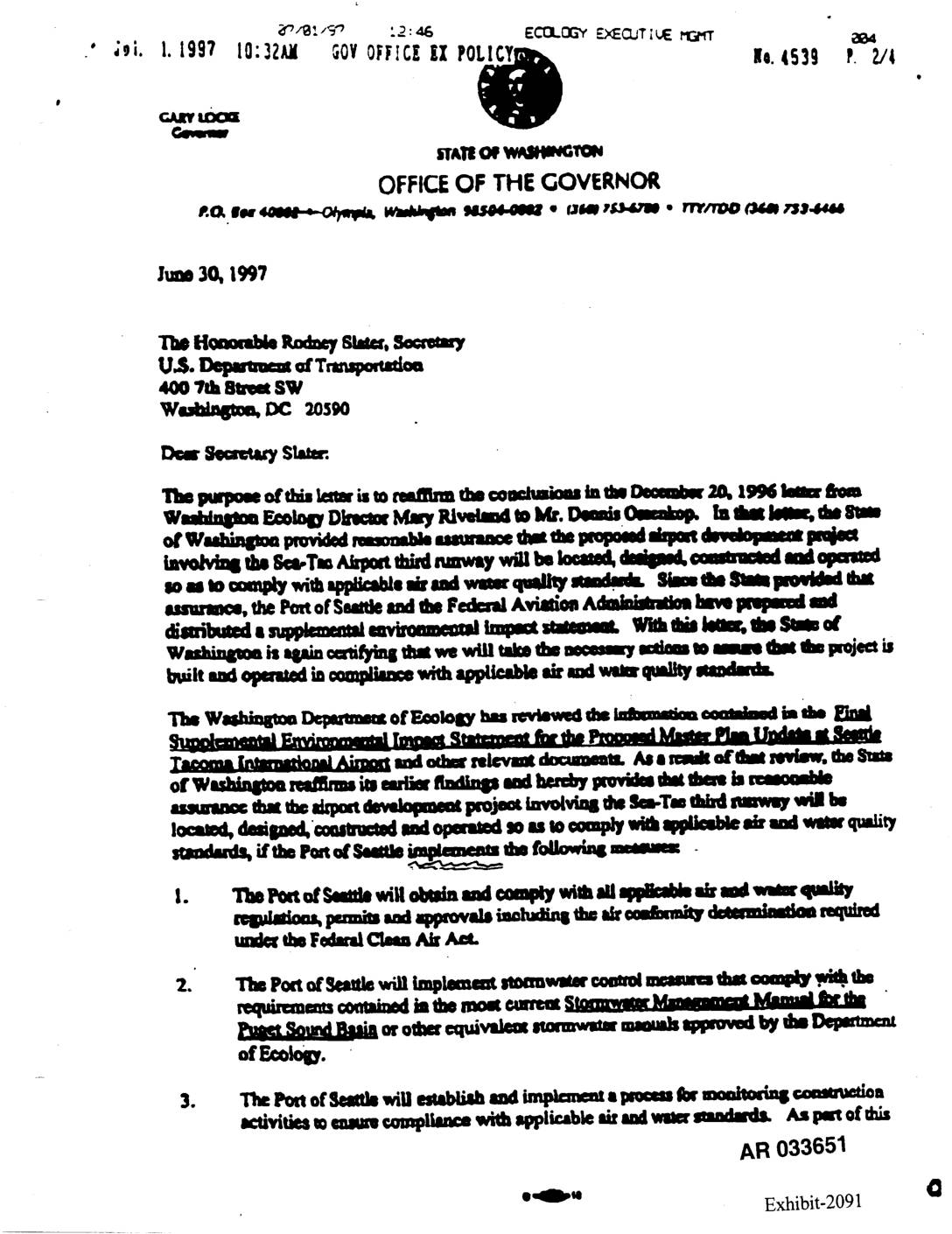
Exhibit 2091: Governor Gary Locke Letter to Secretary Rodney Slater Re: Sea-Tac Airport Third Runway Air and Water Quality Assurance
June 30, 1997 letter from Washington Governor Gary Locke to U.S. Department of Transportation Secretary Rodney Slater reaffirming state certification under 49 U.S.C. 47101 for the Sea-Tac Airport third runway development project. Supersedes December 20, 1996 letter from Ecology Director Mary Riveland to Dennis Ossenkop. Port of Seattle required to: obtain air and water quality -
 1996-06-06
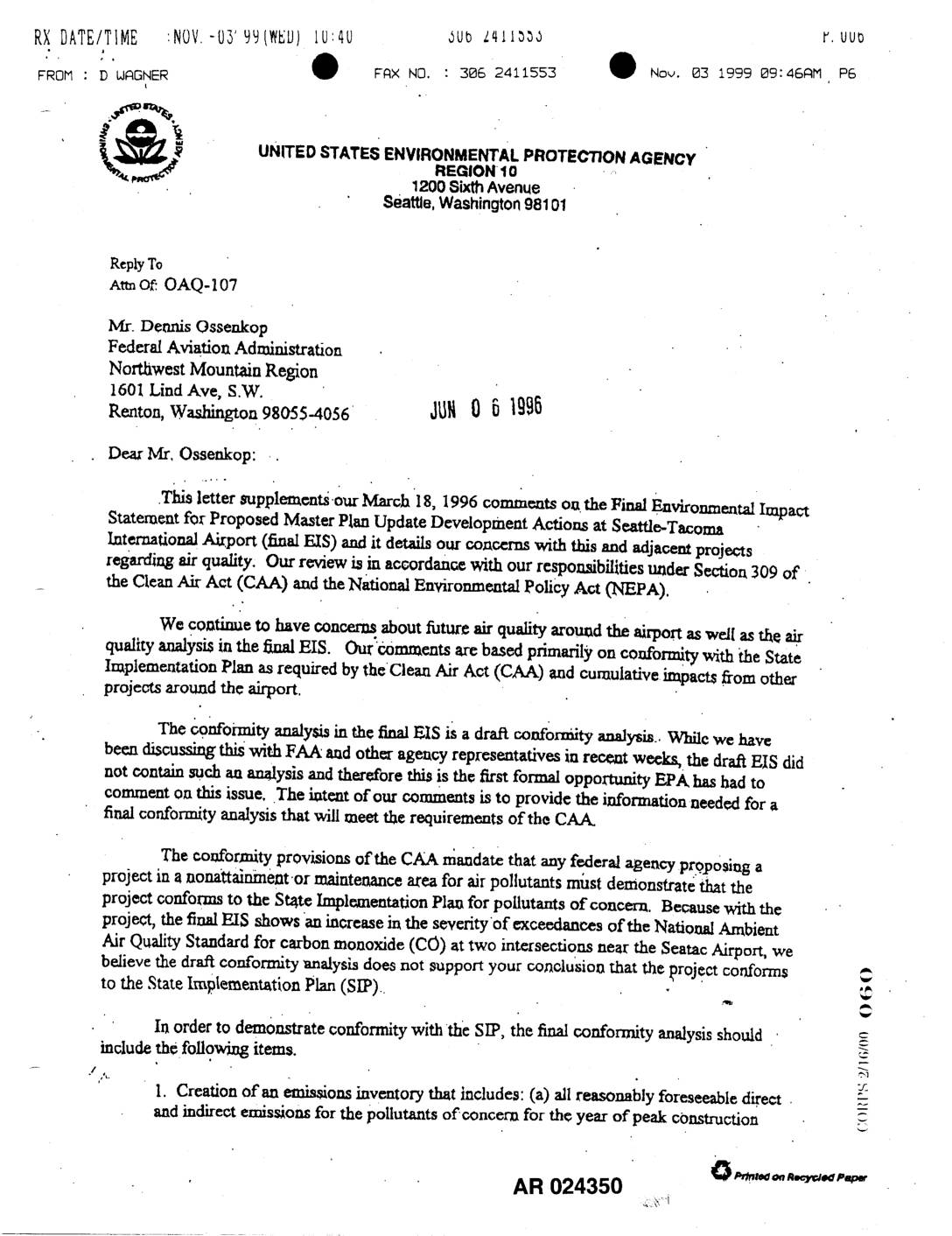
EXH AR024350: EPA Region 10 Letter to FAA Air Quality Conformity Analysis STIA Master Plan Update EIS
In a 1996 letter to the Federal Aviation Administration, the U.S. Environmental Protection Agency (EPA) Region 10 raised concerns about air quality impacts from the proposed Master Plan expansion at Seattle-Tacoma International Airport, noting that the project was projected to worsen carbon monoxide levels at nearby intersections in violation of federal air quality standards. The EPA called for a comprehensive emissions inventory, a comparison of air quality with and without the project, and enforceable mitigation measures, while also highlighting inconsistencies in air quality modeling across multiple related development projects in the airport area. The agency urged the FAA and Port of Seattle to coordinate data sharing with regional authorities and establish a long-term air quality monitoring program to address cumulative impacts from surrounding projects. -
 1996-06-05
Air Quality Conformity Review for Sea-Tac Master Plan Update
A 1996 air quality review commissioned by the Airport Communities Coalition challenges the FAA's finding that Sea-Tac Airport's Master Plan Update would not worsen air pollution. Envirometrics, Inc. found that if the proposed third runway increased airport operations—by up to 33% annually and 50% during peak hours—carbon monoxide (CO) and nitrogen dioxide (NO₂) levels would exceed federal air quality standards at multiple locations near the airport. The report concludes that these increased emissions from greater aircraft and vehicle traffic would delay attainment of ambient air quality standards in the surrounding communities.