TagCity Of SeaTac(241)
-
 2026-08-28
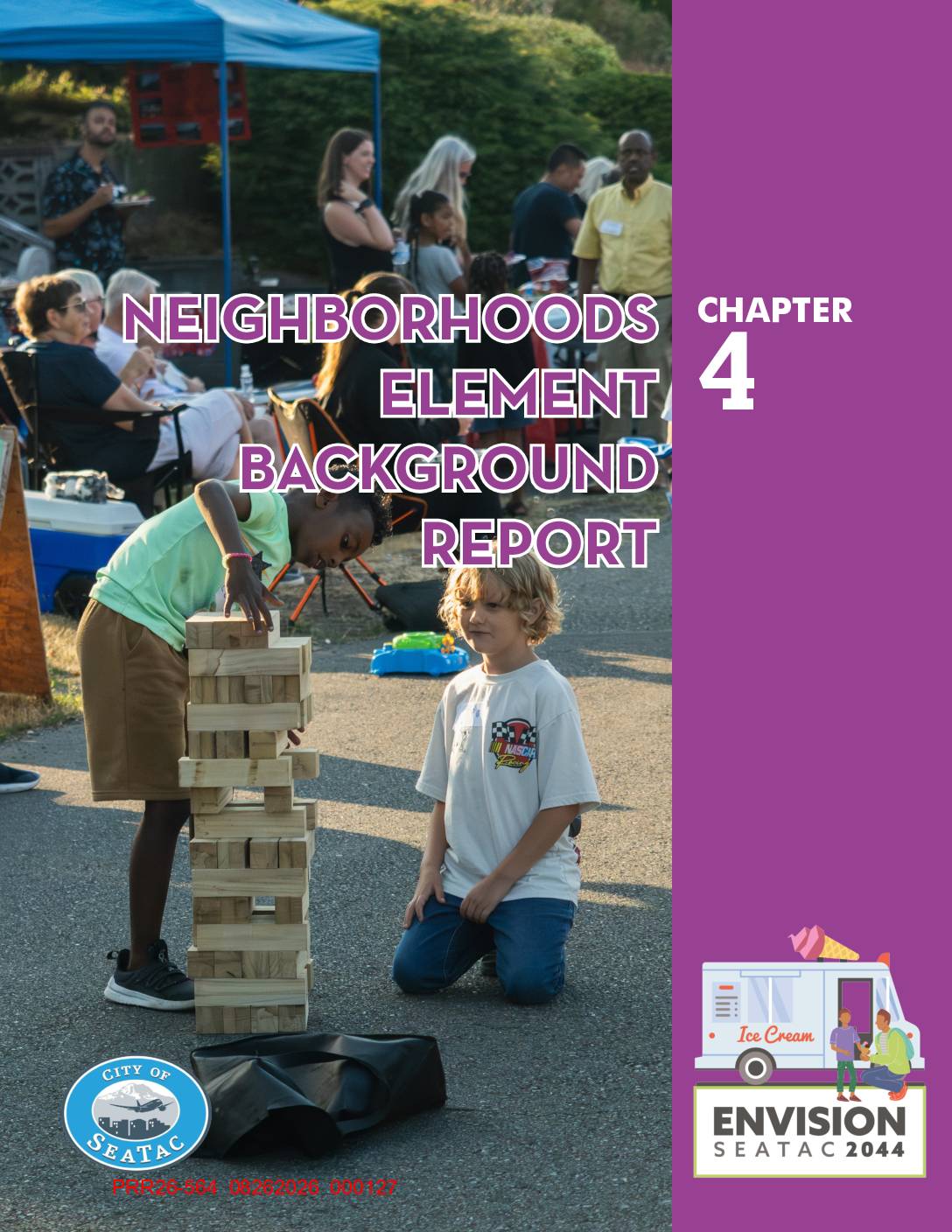
Chapter 4 Neighborhoods Element Background Report
This document is Chapter 4 of SeaTac's Envision SeaTac 2044 Comprehensive Plan, focusing on the Neighborhoods Element Background Report. It describes SeaTac's nine residential neighborhoods, noting challenges such as limited street connectivity, lack of sidewalks, and only one functional neighborhood business node (McMicken Heights). The report outlines the city's Citywide Growth Strategy, which prioritizes healthy, equitable, and complete neighborhoods with access to goods, services, transportation, and open spaces over the next twenty years. -
 2026-08-28
Neighborhoods Element Background Report
This document is Chapter 4 of SeaTac's Envision SeaTac 2044 Comprehensive Plan, focusing on the Neighborhoods Element Background Report. It describes SeaTac's nine residential neighborhoods, noting challenges such as limited street connectivity, lack of sidewalks, and only one functional neighborhood business node (McMicken Heights). The report outlines the city's Citywide Growth Strategy, which prioritizes healthy, equitable, and complete neighborhoods with access to goods, services, transportation, and open spaces over the next twenty years. -
 2026-08-28
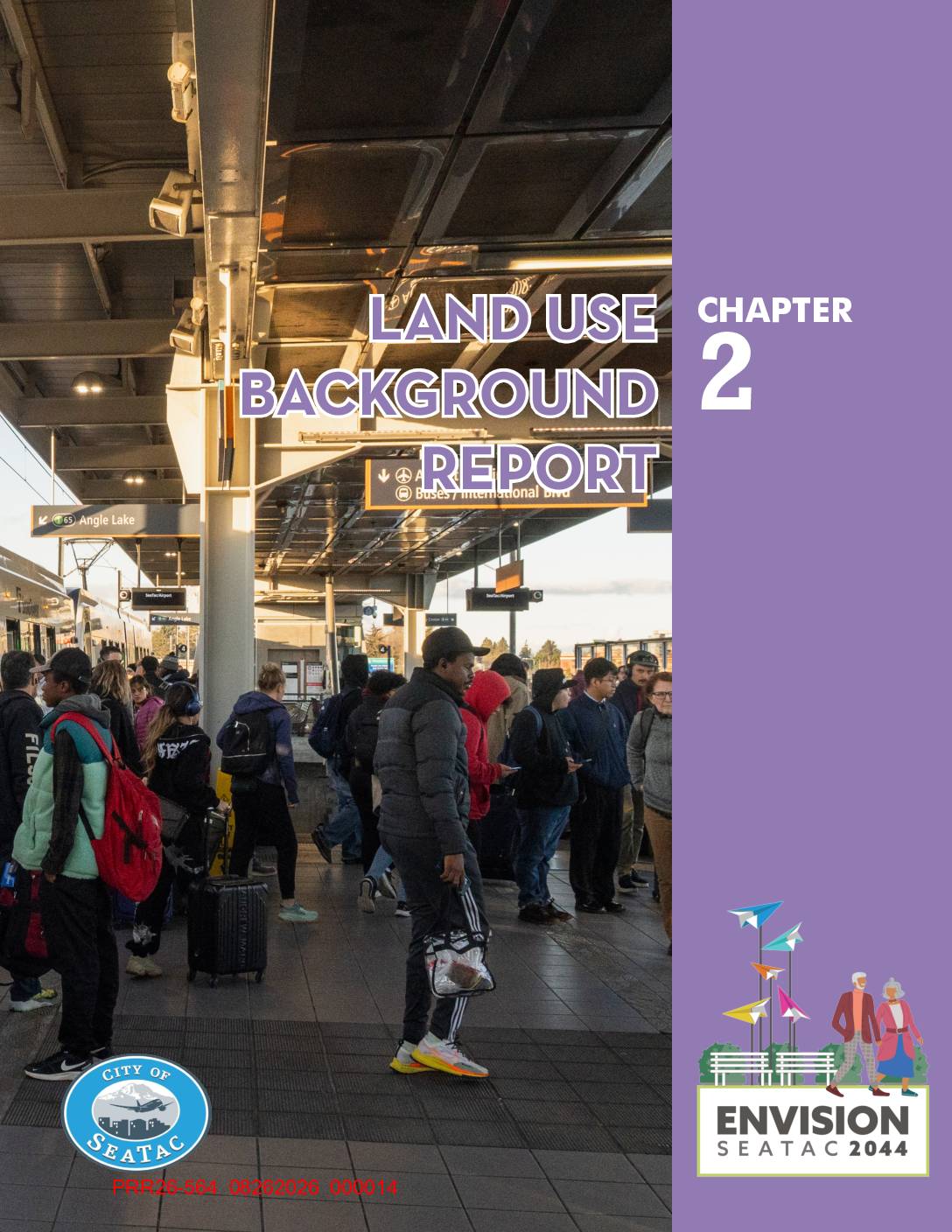
Chapter 2 Land Use Background Report
This document is Chapter 2 of the City of SeaTac's Envision SeaTac 2044 Comprehensive Plan, providing a background report on land use patterns, physical features, and growth targets within the city. It covers topics including existing residential, commercial, industrial, and airport-related land uses, as well as water resources, housing and employment targets through 2044, and essential public facilities. While focused broadly on land use planning, it includes data relevant to airport-related land use and the impact of Seattle-Tacoma International Airport on surrounding development. -
 2026-08-28
Chapter 2 Land Use Background Report
This document is Chapter 2 of the City of SeaTac's Envision SeaTac 2044 Comprehensive Plan, providing a background report on land use patterns, physical features, and growth targets within the city. It covers topics including existing residential, commercial, industrial, and airport-related land uses, as well as water resources, housing and employment targets through 2044, and essential public facilities. While focused broadly on land use planning, it includes data relevant to airport-related land use and the impact of Seattle-Tacoma International Airport on surrounding development. -
 2026-08-20
Comments from Sea-Tac, Burien, and Des Moines on the SEPA Draft EIS for Sea-Tac Airport SAMP NTP
Joint comment letter filed August 20, 2026 by the Cities of SeaTac, Burien, and Des Moines to Port Of Seattle Senior Environmental Program Manager Steve Rybolt on the Draft SEPA Environmental Impact Statement (DEIS) for the Sustainable Airport Master Plan Near-Term Projects (SAMP NTPs) at Seattle-Tacoma International Airport (SEA). The letter documents cross-cutting deficiencies in -
 2026-08-11
City of Sea-Tac Bridge Budget: 2027–2028 Biennial Budget Overview Presentation
City of SeaTac City Manager’s Office presentation to Council Study Session on August 11, 2026, introducing the 2027–2028 Biennial Budget titled ‘The Bridge Budget: Guiding Us Across the Gap.’ Documents a projected structural gap of $1.6 million in 2027 and $4.4 million in 2028, defined as the difference between expected revenues and the cost of -
City of SeaTac primary Interlocal Agreements with Port of Seattle (ILA)
The City of SeaTac has had a unique relationship with 1Sea-Tac Airport since its founding in 1990. (Fun fact: the originally proposed city boundaries did not include the property which now comprises 43% of its land area.) But as soon as the decision was made, how to benefit from the relationship with the Port of -
 2026-07-16
Joint letter from Burien, Des Moines, and SeaTac requesting extension of SAMP SEPA DEIS comment period
In July 2026, the city managers of Burien, Des Moines, and SeaTac jointly wrote to Port of Seattle Commissioners demanding that the public comment period for the Sustainable Airport Master Plan's Draft Environmental Impact Statement be extended from 60 to at least 120 days. The cities argued that the document's enormous size (over 6,000 pages), technical complexity, and missing underlying data made meaningful review within 60 days impossible, particularly for lower-resource community members most affected by airport impacts. The letter also called on the Port to honor its own equity commitments by ensuring historically overburdened communities surrounding the airport have a genuine opportunity to participate in the review process. -
 2026-06-18
(Draft) Joint letter from City of Burien, City of Des Moines, and City of SeaTac to Port Of Seattle Commissioners regarding SAMP environmental review
The mayors of Burien, Des Moines, and SeaTac jointly wrote to Port of Seattle Commissioners in 2026 to challenge the claim that airport expansion projects outlined in the Sustainable Airport Master Plan (SAMP) would have no significant impact on neighboring communities. The letter highlights concerns about aircraft noise, air pollution, traffic, and disproportionate burdens on historically disadvantaged residents living closest to the airport. The cities also demand that the public comment period for the Draft Environmental Impact Statement be extended from 60 to at least 120 days to allow for meaningful community review. -
 2026-05-18
Request for 90-day extension to SAMP SEPA draft EIS comment period
The cities of SeaTac, Burien, and Des Moines jointly wrote to the Port of Seattle on May 18, 2026, requesting a 90-day public comment period for the Sustainable Airport Master Plan (SAMP) Draft Environmental Impact Statement. The cities cited the document's technical complexity, overlapping regional demands including 2026 FIFA World Cup preparations, summer scheduling constraints, and unresolved concerns from the prior federal environmental review as reasons more time is needed. The letter was signed by the SEPA Responsible Officials from all three cities and emphasizes that airport-related impacts on noise, air quality, transportation, and public health directly affect their communities.