TagWASP(27)
-
 2011-01-01
WSDOT Airports and Compatible Land Use Guidebook M 3074.00
WSDOT Aviation’s Airport and Compatible Land Use Program Guidebook (M 3074.00, January 2011) addresses encroachment of incompatible land uses near Washington State’s 138 public-use airports listed in the Washington Aviation System Plan (WASP). Covers RCW 37.70.547 Growth Management Act requirements for towns, cities, and counties to adopt comprehensive plan policies and development regulations discouraging incompatible -
 2009-07-01
Washington Aviation System Plan, Chapter 9: Alternate Airports Assessment
A 2009 Washington State aviation planning study assessed which existing airports could absorb overflow demand from airports projected to hit capacity limits by 2030, with Sea-Tac International among those forecast to exceed both airfield operations and passenger terminal capacity. The analysis evaluated potential alternate airports within roughly 60 miles of Sea-Tac based on factors such as available capacity, runway length, and highway access, while noting that free-market decisions by airlines and passengers would ultimately determine how traffic is distributed. The study was intended as a first-level screening, with more detailed environmental and operational analyses expected before any formal relief airport designations could be made. -
 2009-07-01
Washington Aviation System Plan: Chapter 10 — Public Process
During Phase III of Washington's Long-Term Air Transportation Study (2008–2009), the public was invited to weigh in on statewide aviation policies through regional meetings, electronic town halls, and an online survey. Community members raised concerns about noise, air pollution, and health impacts on neighborhoods near airports, and called for greater consideration of environmental and community needs alongside aviation capacity planning. Public feedback strongly supported investing in advanced aviation technology, while opposing demand management techniques and redistributing air traffic to nearby airports. -
 2009-07-01
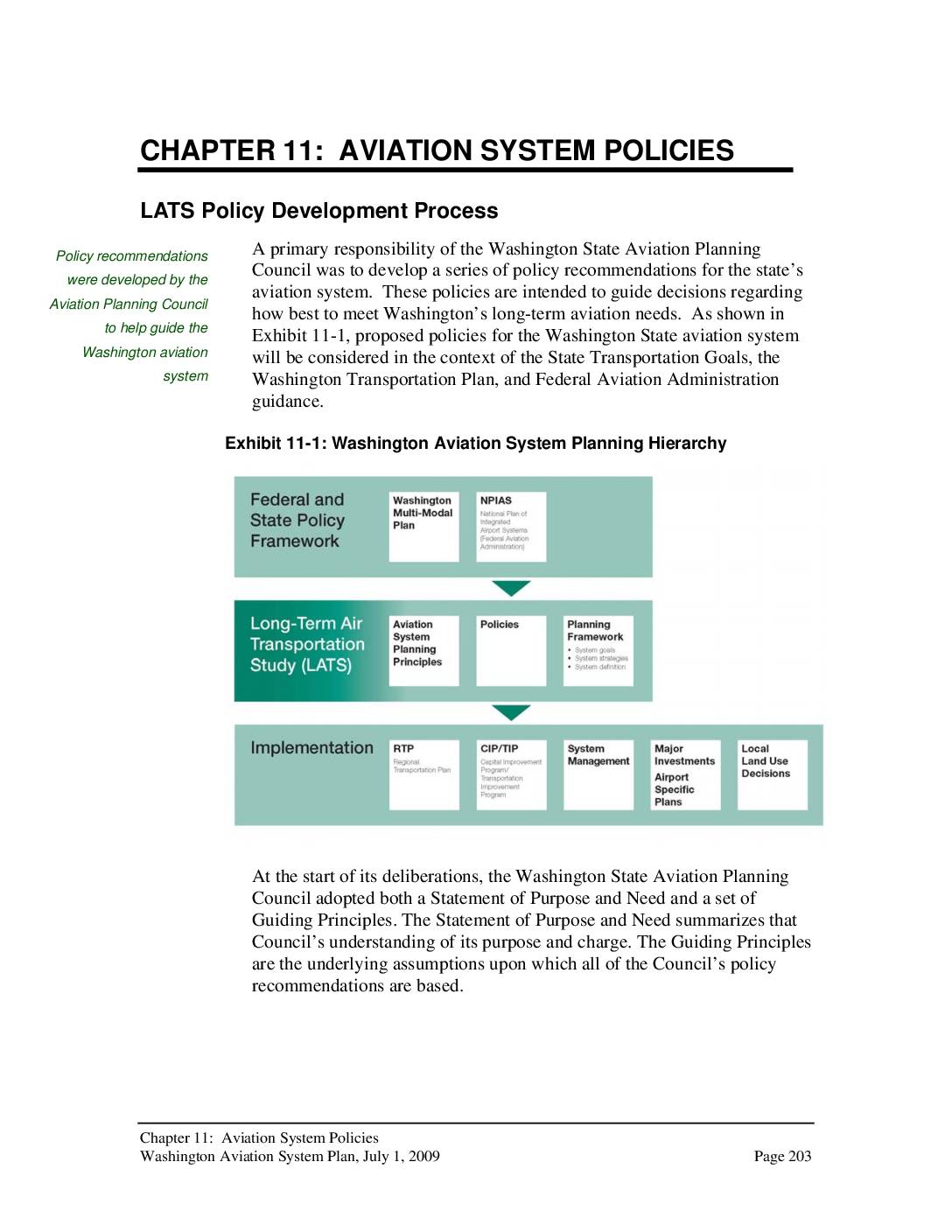
Washington Aviation System Plan, Chapter 11: Aviation System Policies
The Washington State Aviation Planning Council developed a series of policy recommendations to guide long-term decisions about the state's aviation system, covering everything from large commercial airports to small community airstrips. The policies are built on nine Guiding Principles addressing key challenges such as funding shortfalls, deferred maintenance, land use compatibility, and the need for strong partnerships among government, industry, and local communities. Decisions about airport expansion and siting are intended to be made through an open public process, balancing economic benefits with environmental and social impacts. -
 2009-07-01
Washington Aviation System Plan: Long-Term Air Transportation Study
The Washington Aviation System Plan is a Long-Term Air Transportation Study published in July 2009 by the Washington State Department of Transportation (WSDOT Aviation), partially funded by an FAA planning grant and Washington State grants. It was developed in collaboration with a consulting team including SH&E, WHPacific, URS Corp., PRR, and Cambridge Systematics, with input from airport sponsors and a Technical Advisory Committee. The plan examines Washington State's aviation system needs and future development, though its contents do not represent official FAA policy or commitments to specific development projects. -
 2009-07-01
Washington Aviation System Plan: Executive Summary
The Washington Aviation System Plan (2009) outlines the state's strategy for maintaining and improving its 138 public-use airports over the next 25 years, highlighting aviation's critical role in Washington's economy and transportation network. The plan was developed through the Long-Term Air Transportation Study (LATS), a three-phase process authorized in 2005, which assessed existing airport capacity and projected future needs amid challenges such as population growth, limited funding, and land use conflicts. A ten-member Aviation Planning Council was appointed to translate study findings into actionable recommendations for both commercial and general aviation across the state. -
 2009-07-01
Appendix A: Detailed table of the Washington State airports
This document is an appendix from Washington State's 2009 Aviation System Plan, listing detailed information about airports across the state. It catalogs each airport by site number, name, city, and service level classifications under both federal (NPIAS) and state systems, covering facilities ranging from major commercial airports like Seattle's Boeing Field to small rural seaplane bases. The table includes nearly 100 airports of varying types and service levels throughout Washington State. -
 2009-07-01
Washington Aviation System Plan: Chapter 1 — Study Overview
The Washington State Long-Term Air Transportation Study (LATS), authorized in 2005, is a comprehensive statewide aviation planning effort examining current airport capacity and future air transportation needs across Washington's 138 public-use airports, including Seattle-Tacoma International Airport. The study addresses key challenges such as population growth, limited funding, and land use conflicts over a 25-year planning horizon. Its findings are intended to guide long-term investment decisions and shape aviation policy at federal, state, and regional levels. -
 2009-07-01
Recommendations of the Washington State Aviation Planning Council: Long-Term Air Transportation Study
The Washington State Aviation Planning Council's 2009 Long-Term Air Transportation Study (LATS) presents recommendations to Governor Gregoire on the future of Washington's aviation system, which had shrunk from 141 to 138 public-use airports with at least two more at risk of closing. The study warns that over the next decade, 12 airports will approach or exceed capacity limits, while land use encroachment and limited resources threaten the system's viability. Public outreach showed strong support for investing in advanced technology and safety improvements, and greater efficiency in existing airports rather than building new ones. -
 2009-07-01
Washington Aviation System Plan: Chapter 2 — Washington Public Airports
Washington State operates 138 public-use airports, with Seattle-Tacoma International (Sea-Tac) serving as the primary commercial hub, handling approximately 15 million passengers in 2007 and ranking among the top 20 busiest airports in the nation. The state's aviation system supports over 17 million scheduled passengers and 3.7 million aircraft operations annually, contributing an estimated 171,000 jobs and $18.6 billion in sales output. General aviation is also highly active in Washington, making it the fourth busiest state in the nation for general aviation flight hours.